
A contract that reads 30 percent at signing, 30 percent at midpoint, and 40 percent at completion leaves out the one item Arizona law asks for by name. A.R.S. § 32-1158 requires a residential contract over $1,000 to state the dollar amount of each progress payment and the stage of construction at which the contractor becomes entitled to collect it. A calendar date is not a stage of construction.
That gap is what makes the 30/60/90 schedule worth arguing about before you sign rather than after. It moves money on a clock while the work moves on a jobsite, and the two drift apart quietly. By the time a homeowner notices, the contractor is holding 60 percent of the contract and the job is not demoed yet.
I’ve read a lot of these contracts across a kitchen table with the homeowner sitting next to me, and the payment page is important.
What Does Arizona Law Actually Require in a Remodeling Payment Schedule?
Arizona requires your contract to state both the dollar amount of each progress payment and the stage of construction that earns it. A.R.S. § 32-1158, the contract-requirements statute the Arizona Registrar of Contractors enforces, applies to any contract over $1,000 between a contractor and a property owner, and subsection A paragraph 8 names the progress-payment amount and its triggering construction stage as required written terms, alongside paragraph 7’s requirement to state any advance deposit in dollars. On a Chandler guest bath, a line reading 25 percent at vanity set and plumbing trim-out names a stage a homeowner can stand in the room and verify; a line reading 30 percent on October 15 names a date and answers paragraph 8 with nothing.
Two things about how that statute behaves are worth knowing before you go looking for a fight. Subsection C says these requirements are not prerequisites to forming or enforcing a contract, so a schedule built on dates is still a binding agreement and failing to comply is not by itself a defense for either party. What a missing stage takes away is your ability to point at the page and say the work owed for this draw hasn’t happened yet.
Paragraph 9 of the same subsection requires the contract to state your right to file a written complaint with the registrar, printed in at least ten-point bold type, with the ROC’s telephone number and website on the page. If that block isn’t in the document in front of you, you’re holding a contract that skipped a written requirement the state spells out in plain language.
A Deposit Is Not a Progress Payment, and Neither Should Be Treated Like the Other
The statute itself draws this line, and most contracts blur it. Paragraph 7 covers a deposit: it just has to be stated in dollars. Paragraph 8 covers a progress payment: it has to be stated in dollars and tied to a stage of construction you can verify. Those are different instruments doing different jobs, and a schedule that’s honest about which is which reads very differently from one that treats every draw as an interchangeable slice of the total.
A deposit collected at signing isn’t standing in for finished work, because no work exists yet to point to. What it funds is the first purchasing decision on the job: closing out selections and placing the order on whatever has the longest lead time, which on most kitchens is the cabinet line. That’s a real, immediate use of the money, but it’s a deposit, not a progress payment, and a contract should say so rather than dressing it up as 30 percent of “the work.”
Everything after that should be a progress payment in the statute’s actual sense: a dollar amount tied to a stage you can walk into the room and confirm. Demo and rough mechanical work finishing is one such stage. Field dimensions get confirmed there, which is what lets tile, stone, and plumbing fixtures get finalized and ordered, so a payment landing at that point is funding a real purchasing decision, not just marking the calendar. Countertops being templated and set is another: it’s usually the last major material cost hitting the job, and it’s a stage you can see. Final walkthrough is the last one, and it should hold back enough of the contract that finishing the punch list still matters to the person doing it.
Where a lot of contractors, including ones who mean well, fall short isn’t the size of any one payment. It’s that nothing on the page or in the process shows the homeowner that a payment actually turned into an order. The money goes out, the homeowner is told materials are being purchased, and that’s where it stops. On a healthy job that gap never matters, because the money did go where it was supposed to. On a job that’s already in trouble, that same gap is how one homeowner’s cabinet money ends up covering somebody else’s drywall bill three jobs over, and nobody notices until their own materials are late with no explanation. Naming the deposit as a deposit and tying every payment after it to a stage doesn’t close that gap by itself, but it’s the difference between a schedule you can question and one you can’t.
Arizona Lien Notices and the Draw Schedule
Somewhere in the first few weeks of a remodel, an envelope arrives from a supplier or a subcontractor you’ve never spoken to. It’s a Preliminary Twenty Day Notice, required under A.R.S. § 33-992.01 as a prerequisite to any later mechanic’s lien claim, and every supplier, subcontractor, and professional-services provider on your job has to serve one within twenty days of first furnishing labor or materials to the jobsite.

Those notices are routine paperwork, and the statute itself says on its face that the notice is not a lien. What they are is a running list of everyone who can record a lien against your home if your general contractor collects your draw and doesn’t pay them. Keep every one that arrives. That stack is the roster you check your payments against.
The statute also names the protection. A.R.S. § 33-1008 subsection D sets out conditional waivers, signed before you pay, and unconditional waivers, signed after payment clears. Tying each draw release to signed waivers from the trades covered by that draw is the single most useful clause a Phoenix homeowner can ask to add to a payment schedule, and it costs a contractor who is paying his subs nothing to agree to it.
How Much Should a Deposit Be on an Arizona Remodeling Contract?
Arizona sets no dollar cap on the deposit for a general residential remodeling contract, which makes the practical ceiling the $30,000 the state recovery fund will return to a single claimant. A.R.S. § 32-1132.01 subsection D caps an individual award from the Residential Contractors’ Recovery Fund at $30,000, and subsection C states that when a deposit is paid and no work is performed or materials delivered, actual damages equal the deposit plus 10 percent annual interest, still subject to that same $30,000 ceiling. On a $95,000 Gilbert kitchen, a 30 percent deposit is $28,500 and sits just under the line; on a $190,000 Arcadia whole-home contract, the same 30 percent is $57,000, and $27,000 of that sits past anything the fund can reach.
Run that math on your own contract before you write the check. What you’re measuring is whether the dollar figure on the deposit line is one the state has a mechanism to return.
A deposit that maps to something real, design work already delivered, a cabinet order actually placed with a manufacturer, a slab actually tagged at the yard, is a different instrument than a percentage pulled off the total. The first one has a receipt behind it. The second one is a number.
A Stage-Based Payment Schedule on a Real Phoenix Project
Our contracts run four payments, and each one is tied to something real rather than a date on the calendar. The first is a deposit at signing, thirty percent, which is what puts the cabinet order in with the manufacturer while lead times are still running in our favor instead of against the schedule. The second is thirty percent at demo complete, which is when field dimensions are locked and tile, stone, and plumbing fixtures get finalized and ordered. The third is thirty percent at roughly seventy-five percent complete, which on most kitchens lines up with countertops being templated and set, the last major material cost on the job. The fourth is the remaining ten percent at project complete, held until the final walkthrough.
Four payments, not seven, and we don’t pretend otherwise. What each one has in common is that it’s tied to a purchasing decision or a stage you can see, not a percentage that sounds fair in isolation. The deposit is a deposit under the statute’s own terms, not dressed up as a progress payment for work that hasn’t started. The three that follow are progress payments tied to stages a homeowner can walk into the room and confirm.
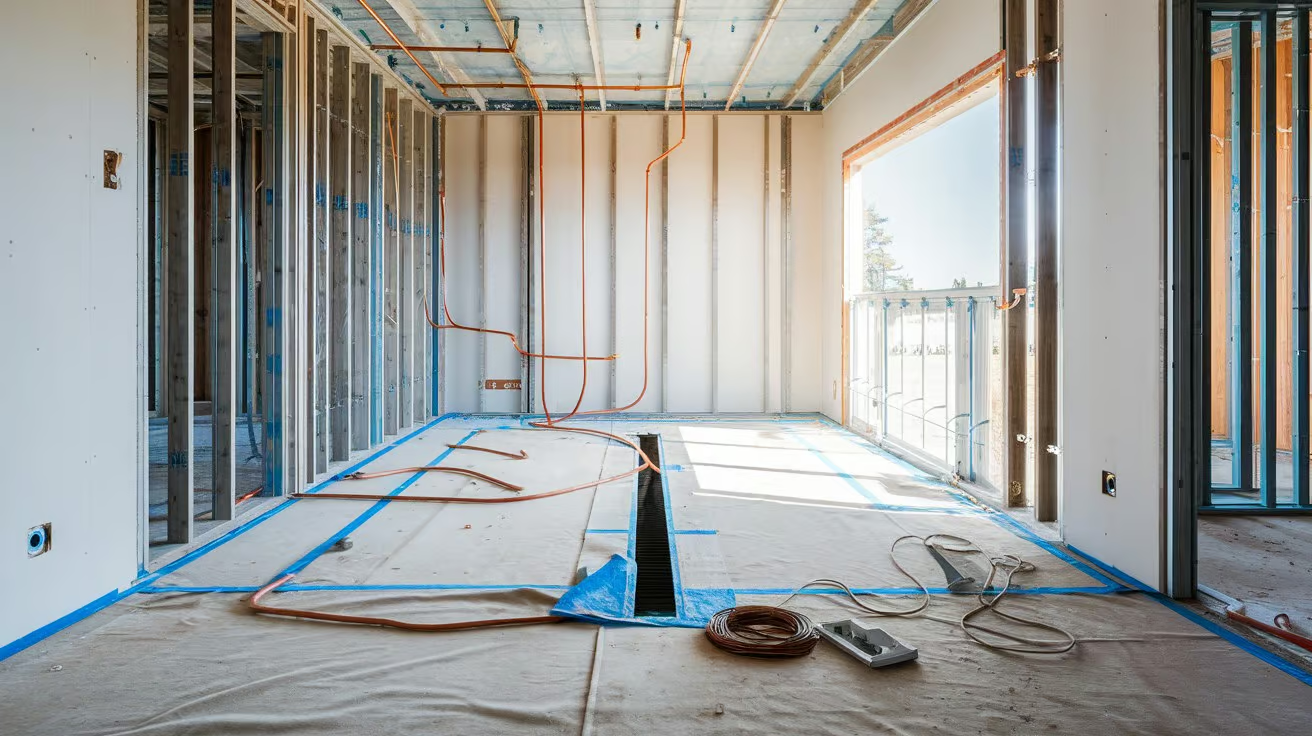
The stage that gets the most scrutiny, understandably, is demo. It’s dramatic. Walls are open, copper and PEX are visible, the room is unrecognizable, and it’s also one of the cheaper stages of the job by labor and material cost. That’s not a reason to distrust a payment landing there. It’s a reason the payment shouldn’t be priced as if it’s compensating for the demo work itself. It’s funding what demo makes possible: locking dimensions and placing the second wave of material orders. The stage and the dollar amount don’t have to be justified by the same math, and a homeowner is owed that distinction, not a schedule that hopes nobody asks.
The reason we can name real stages at all is that the design phase closes selections first. Cabinet line, door style, slab, tile, plumbing finishes, and lighting are specified and priced before a construction contract exists, which is what makes the draw schedule describable in stages instead of guesses. Fixed price before shovel meets stucco is a pricing promise, and it’s also what makes a draw schedule name real things instead of round numbers.
Does the Arizona Recovery Fund Cover a Deposit You Never Got Work For?
Yes, up to $30,000, provided you occupy the home as your primary residence and the contractor held a valid residential license at the right moment. A.R.S. § 32-1132 limits eligibility to owners who actually occupy or intend to occupy the damaged property as a primary residence, and subsection C requires the contractor to have been appropriately licensed on the date the contract was signed, the date the first payment was made, or the date the work first began. A Mesa homeowner who paid a deposit on a rental house they do not live in collects nothing from the fund, no matter how clean the contract looked on the day they signed it.
The clock matters as much as the eligibility. A.R.S. § 32-1162 subsection A requires a written complaint to the registrar within two years after completion of the specific project, or for new construction within two years after the earlier of close of escrow or actual occupancy. Homeowners who spend eighteen months trying to get a contractor to come back and finish are spending the window they’d need to file.
Checking a license takes about five minutes at azroc.gov, and the lookup shows license status, classification, bond information, and complaint history. Do it before the contract, not after the deposit.
Rewrite Your Payment Schedule This Week
Pull whatever contract or proposal is sitting on your counter and find the payment page. Then rewrite it yourself, on paper, before you talk to anyone.
Find the deposit and separate it from the rest. It doesn’t need a construction stage under Arizona law, just a dollar figure stated plainly, but it should be labeled a deposit, not folded into the schedule as if it were the first of several equal progress payments.
Replace every remaining calendar date with a construction stage you could walk into the room and verify. If you can’t describe what the room looks like when a draw comes due, the draw isn’t tied to anything.
Add up what percentage of the contract is collected before cabinets, stone, and finish materials arrive at your address. That number will usually be high on any properly sequenced job, since materials have to be ordered and delivered before they can be installed. What matters more than the number itself is whether each payment funding those purchases is named to a stage, not just larger with each draw.
Write your deposit figure next to $30,000 and see which side of the line it lands on.
Add one sentence requiring signed lien waivers from the trades covered by each draw, per A.R.S. § 33-1008 subsection D, as a condition of release.
Confirm the ten-point bold ROC complaint block required by A.R.S. § 32-1158 subsection A paragraph 9 is actually printed in the document.
Take that rewritten page to whoever you’re considering. A contractor who has done the design work and knows his own costs can usually restructure a schedule around stages in one sitting. A schedule that can only be expressed in dates is telling you the sequence hasn’t been planned in enough detail to name the stages yet.
For project-category ranges to check your contract total against, our cost guide covers Phoenix scope ranges by project type. The design phase page explains how selections get closed before a construction contract is written, the FAQ answers the contract questions homeowners ask us most, and our planning book walks through the full sequence from first conversation to final walkthrough. For kitchens specifically, the kitchen remodeling page lists the stages a complete schedule should account for.
The process a remodeler uses is vital to their success. PHR uses Automation and AI to give the best client experience possible. If you are interested, here’s how and why we use AI at PHR.