
Every August we get some version of the same call. A homeowner in Chandler or Gilbert has decided this is the year they’re finally doing the kitchen, and they’d like it done before family arrives for the holidays. They’re not being unreasonable. They’ve got four months. Four months sounds like plenty.
Here’s the part nobody tells them until they’ve already signed something: cabinets in this market run 6 to 16 weeks from the day the order is released. Not from the day you sign. From the day the order is released — which is a different date, and usually a much later one.
I’d rather give you the math now than watch you find out in November.
The math nobody runs until it’s too late
Work it backwards from the date that actually matters to you.
Say you want to cook Thanksgiving dinner in the new kitchen. That’s roughly 14 weeks from today. Cabinets are 6 to 16 weeks from release. Even if you released an order this afternoon — which you can’t, because nothing is designed or measured yet — you’d miss it by several weeks.
Now run Christmas. That’s about 18 weeks out. Technically inside the window, if and only if the order releases within the next two weeks. Which means design, layout decisions, appliance specs, every door style and finish and hardware choice locked, and a final field measure — all of it done in fourteen days. That’s aggressive but it’s not impossible. We’ve done it. It requires the homeowners to make decisions faster than most people are comfortable making them.
Run mid-January and everything relaxes. Design through October, release in early November, cabinets land in March at the outside, install and finish behind it. Nobody’s rushing, nobody’s paying expedite fees, and you get to actually think about the layout.
That’s the whole trade-off in three paragraphs. The date isn’t a scheduling detail — it’s the single decision that determines how much of the rest of this you get to control.
Where the 6 to 16 weeks actually goes
It helps to know why the number is what it is, because it explains which parts can be compressed and which can’t.
Semi-custom and custom cabinet lines are built to order. Nothing sits on a shelf. When an order releases, the manufacturer schedules it into a production slot, sources the door material, cuts and assembles boxes, finishes doors in a spray-and-cure cycle that can’t be rushed without hurting the finish, then crates and ships. Most of the lines serving the Valley ship from the Midwest or the Southeast, so add transit.
The part people underestimate is what happens before release. A cabinet order can’t go out on a rough layout. It needs final appliance model numbers, because a 36-inch range and a 35.75-inch range are different cabinets. It needs the sink picked, because the sink base is sized to it. It needs the hood decided, the door style, the drawer configuration, the finish, the hardware boring. Miss one and the order either sits or goes out wrong.

This is the honest case for design-build, and I’ll be specific about it rather than waving at it. On a design-build job, the same team that drew the plan is the team ordering the cabinets and installing them, so the appliance spec, the plumbing rough locations, and the cabinet order are reconciled in one place before anything releases. On a bid-then-build job, the designer hands off drawings and the installer finds the conflict at delivery. A door-swing conflict caught in the design phase costs an afternoon. Caught at delivery, it costs a replacement cabinet and eight weeks.
Design-build does not eliminate every unknown. It eliminates the expensive ones — and on a deadline job, a re-order is the expensive one.
What “in stock” really means
You’ll hear “in stock” as the answer to the lead-time problem. Sometimes it genuinely is. Usually it’s narrower than it sounds.
Stock cabinet programs carry a limited set of door styles and finishes in a limited set of standard box sizes. If your layout happens to land on those sizes, and you like one of those finishes, stock is a real option and it can cut ten weeks out of your schedule. That’s a legitimate trade, not a compromise you should feel bad about.
What it costs you is fit. Stock runs in 3-inch increments, so leftover space gets absorbed by filler strips — and on a Phoenix ranch kitchen with an out-of-square 1978 wall, you can end up with a 5-inch filler in a spot you’ll look at every morning. Stock also limits interior fittings, drawer depths, and how far you can push storage. If storage is the reason you’re remodeling, stock will undercut the reason you’re doing it.
The version of this I’d push back on hardest is a “stock is in stock” promise made without a field measure. In-stock means the SKU is available today. It does not mean the SKU is available in the quantity your job needs on the day your job needs it. Ask for the specific sizes and counts to be confirmed, in writing, against your actual measured layout.
Three ways to hit a holiday deadline
If the date is real — someone’s flying in, there’s a milestone, whatever it is — there are three honest paths and each one costs something different.
1. Move the finish date, keep the scope. Cheapest by a wide margin. You start design now, release in the fall, build through the winter, and you’re done in February with the layout you actually wanted. Costs you the holidays this year.
2. Keep the date, narrow the scope to stock or a quick-ship line. Adds nothing to the budget and may reduce it. Costs you fit, storage optimization, and finish range. This is the right answer more often than people expect, especially in a kitchen where the layout is already working and the problem is that everything is thirty years old.
3. Keep the date and the scope, and pay for it. Expedite fees on cabinet orders are real and vary by line — plan on a meaningful percentage, not a rounding error. Add overtime for the install crew and premium scheduling for trades. And understand you’re buying probability, not certainty: an expedited order still ships when it ships.
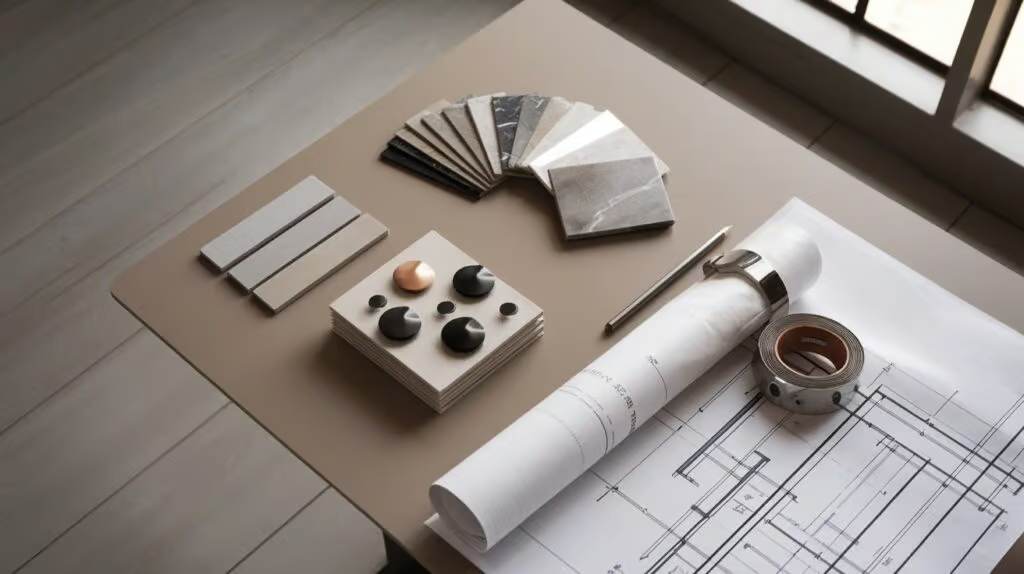
What I’d steer you away from is a fourth option that isn’t on the list: keeping the date and the scope by having somebody demo the kitchen in September and figure the rest out as it goes. That’s how you end up washing dishes in the laundry sink through January. A gutted kitchen with no cabinet delivery date is worse than an old kitchen with a February plan.
If the date is non-negotiable
Occasionally it really is fixed. Here’s how we’d run it.
Compress the front end, not the back end. The back end — manufacturing, curing, shipping — doesn’t compress. The front end does, if the homeowners are prepared. That means coming into the first design conversation with appliances already shortlisted, a rough budget you’re willing to say out loud, and agreement between both decision-makers about what the kitchen is for. Most delays in the design phase aren’t design problems. They’re two people who haven’t finished a conversation yet.
Then lock selections in one sitting instead of three. Our normal design and selection process runs multiple walk-throughs on purpose, because reversing a decision on paper is free and reversing it in the field isn’t. On a compressed job we still do the walk-throughs — we just do them close together, and we ask you to bring everything to the table on day one.
Last, get the fixed price before demo. On a deadline job the pressure to start swinging hammers before the number is final is enormous, and it’s exactly backwards. Fixed price before shovel meets stucco, then start. Our cost guide lays out what Valley kitchens actually run, and the FAQ covers how change orders get priced when something turns up behind a wall.
What to do this week
You don’t need us for any of this.
Pick your real date and write it on something. Not “before the holidays” — a specific day. Then count backward: ~10 weeks for cabinets, 3 weeks for design and selections before that, 4 to 6 weeks of construction after delivery. If that lands past your date, you now know it in August instead of November, and you get to choose which of the three paths you want instead of having one chosen for you.
Second, go shortlist appliances. Not buy — shortlist. Write down model numbers for the range, hood, refrigerator, dishwasher, and microwave. Nothing unblocks a kitchen project faster, and it’s a Saturday afternoon on a laptop.
Third, stand in your kitchen at the busiest time of your day and watch where people collide. Where does someone have to wait? Which drawer do you open eight times? That’s the list that should drive the layout — and it’s worth more than any inspiration photo you’ll save between now and October.
Every day in a home you’re not happy with is a day wasted. But a rushed kitchen is a house you’re unhappy with for the next fifteen years. If the calendar says February, take February.