
Kitchen design has steadily evolved from purely functional spaces into highly efficient and technology-driven environments. One of the most noticeable innovations shaping contemporary kitchens is the touchless faucet. These fixtures eliminate the need to physically touch the handle, allowing water to flow with a simple hand motion.
Modern touchless kitchen faucets use motion sensors to activate water flow automatically, improving hygiene, reducing water waste, and providing convenience while maintaining a sleek contemporary appearance in Phoenix kitchens.
3 Key Takeaways:
- Touchless kitchen faucets improve everyday convenience by letting homeowners activate water with a simple motion, which is especially useful during cooking, cleaning, and food prep.
- The best touchless faucet depends on sensor reliability, power source, finish, installation requirements, and how well it fits the surrounding sink, countertop, and cabinet layout.
- Proper installation and routine maintenance matter because sensors, valves, batteries, and finishes all affect long-term performance and usability.
Homeowners considering upgrades often discuss faucet technology with a trusted kitchen remodeling company, especially when renovating sinks, cabinetry, or countertops simultaneously. A faucet may appear to be a small fixture, but it dramatically influences convenience, sanitation, and kitchen workflow.
Touchless technology reflects a broader shift toward smarter, more responsive kitchens.

Understanding the Mechanics of Modern Touchless Kitchen Faucets
Touchless faucets operate through a carefully engineered combination of sensors, valves, and power sources. The technology behind these fixtures is designed to be responsive and efficient while remaining discreet within the faucet body.
Homes throughout Desert Villas and Valencia Acres increasingly incorporate touchless fixtures because they align with modern minimalist kitchen aesthetics while improving everyday functionality.
Understanding the mechanics behind these systems reveals why they have become so widely adopted.
The Sensor Magic
Touchless faucets rely on sensors that detect motion or the presence of an object beneath the spout. These sensors communicate with internal valves that control water flow.
Infrared technology remains the most widely used system. When a hand interrupts the invisible infrared beam, the faucet activates instantly. Kitchens near Hermosa Vista Flood and Thunder Mountain often rely on infrared sensor faucets because they respond quickly without requiring physical contact.
Ultrasonic sensing represents another method. Instead of light beams, ultrasonic faucets use sound waves to detect movement. This technology can sometimes offer greater sensitivity, particularly when washing large cookware.
Sensor systems ensure the faucet activates only when needed.
Powering the Touchless Experience
Touchless faucets require power to operate their sensors and valves. Manufacturers have developed several options to meet different installation environments.
Battery-powered models remain the most common option. These faucets operate using replaceable batteries typically lasting one to three years. Homes in Sossaman Estates often prefer battery-powered models because installation remains straightforward without requiring additional electrical work.
AC-powered faucets connect to household outlets and provide continuous operation. Kitchens around Emperor Estates sometimes install these models when outlets are already present beneath the sink cabinet.
Emerging technologies also include hydroelectric generators that produce power through water flow itself. These systems reduce the need for external power sources.
Reliable power ensures consistent performance.
Electronic Valves: The Core Mechanism
The heart of every touchless faucet lies in its electronic valve system. Once a sensor detects motion, it sends a signal that opens a solenoid valve, allowing water to flow.
When the sensor no longer detects motion, the valve closes automatically. This rapid response prevents unnecessary water usage.
Homes near Downtown Tempe and Hudson Manor frequently adopt touchless faucets partly because this automatic shut-off helps reduce water waste during daily cooking routines.
Electronic valve precision allows faucets to function both efficiently and reliably.
Design Aspects and Aesthetics
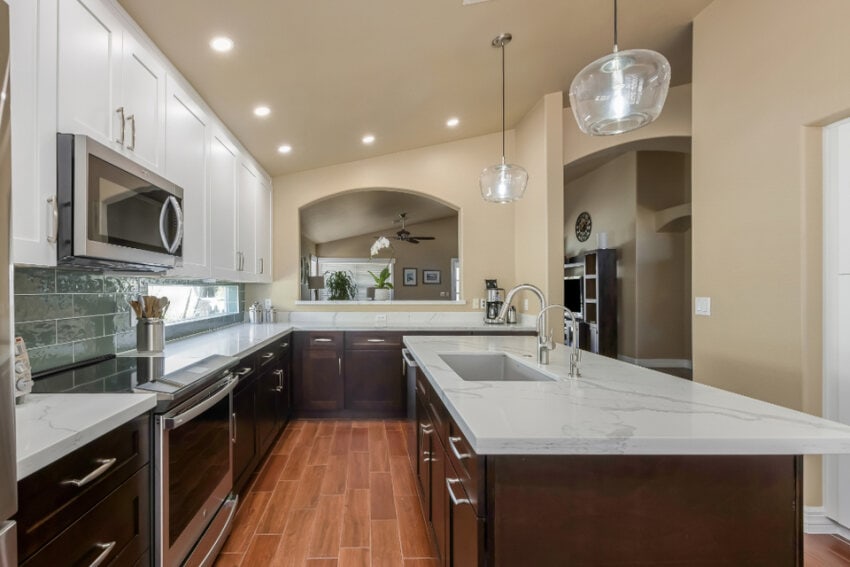
Modern touchless faucets are designed to complement a wide variety of kitchen styles. While early versions were often bulky or industrial in appearance, current models emphasize elegance and simplicity.
Kitchens throughout Sierra Tempe and Meyer Park often feature slim gooseneck touchless faucets that combine graceful curves with sensor technology. These fixtures provide both visual appeal and ergonomic functionality.
Finishes range from brushed stainless to matte black and champagne bronze. Each finish allows homeowners to coordinate the faucet with cabinet hardware and lighting fixtures.
Homeowners comparing fixture finishes should also consider whether kitchen faucets should match cabinet hardware so the faucet, cabinet pulls, lighting, and surrounding finishes feel cohesive.
A touchless faucet becomes both a functional appliance and a design statement.
The Future: What's Next in Touchless Technology?
Technology continues advancing rapidly in the kitchen environment. Touchless faucets represent only the beginning of a broader movement toward intelligent kitchen fixtures.
Voice-activated faucets are already emerging in some models. These systems integrate with smart home assistants to allow users to control water flow or temperature through voice commands.
Smart faucets also track water usage and alert homeowners to potential leaks. Properties around Queen Creek Ranchettes and Spyglass Estates sometimes incorporate these systems as part of larger smart home upgrades.
Future developments will likely integrate faucets with entire kitchen automation systems.
Innovation continues to shape how kitchens operate.

Benefits of Using Touchless Kitchen Faucets
The rapid growth of touchless faucet adoption stems from several clear advantages.
Enhanced Hygiene
Touchless faucets reduce the spread of bacteria because hands do not need to contact the fixture to turn it on. This feature becomes particularly valuable when preparing food.
Homes in Montelena and Neely Ranch often adopt touchless faucets for this hygiene benefit alone, especially in households with frequent cooking activity.
Reducing contact surfaces helps maintain cleaner kitchen environments.
Water Conservation
Automatic shut-off significantly reduces water waste. Traditional faucets may remain running accidentally, but touchless models deactivate automatically once motion stops.
Kitchens near Stratland Estates and Val Vista Meadows often highlight this feature as homeowners seek environmentally responsible solutions.
Efficient water usage benefits both households and municipal systems.

Convenience
Convenience remains one of the most appreciated benefits. Hands covered in dough, soap, or food residue no longer need to touch faucet handles.
Properties in Camelot Village and College Park frequently install touchless faucets because they simplify cleaning tasks during meal preparation.
Convenience transforms routine kitchen tasks into easier experiences.
Safety
Temperature control features built into some touchless faucets reduce the risk of scalding. Many models include pre-set maximum temperatures.
Families living near Arcadia Proper and Arizona Country Club often consider these features valuable when children or elderly household members frequently use the kitchen.
Safety enhancements add another layer of functionality.
Modern Aesthetic
Touchless faucets also introduce a modern visual element to kitchen design. Their sleek forms often complement contemporary cabinetry and countertops.
Homes around Royal Palms Estates and Lower Arcadia frequently integrate touchless faucets as part of larger kitchen remodeling projects where minimalist aesthetics dominate.
Design and technology combine seamlessly.

Reduced Maintenance and Cleanup
Without the need for hands-on operation, touchless faucets tend to stay cleaner for longer.
This means fewer smudges, fingerprints, or soap marks to clean up.
Since they're often used in conjunction with automated soap dispensers, the sink area remains tidier.
Longevity
With fewer manual parts to wear out from repeated use, touchless faucets can often have a longer lifespan than traditional taps.
The reduced physical wear and tear ensures they remain functional for years to come.
Cost Savings
While the initial investment might be higher than standard faucets, touchless models can lead to savings in the long run. By conserving water, they can significantly reduce monthly water bills.

Common Misconceptions about Touchless Kitchen Faucets
Touchless faucets have grown increasingly common in residential kitchens, yet several misconceptions still surround their functionality. Some homeowners assume the technology is overly complex or difficult to maintain. In reality, modern sensor faucets are designed with reliability and simplicity in mind.
Homes in communities like Downtown Tempe and Hudson Manor often integrate touchless fixtures during remodels because they streamline kitchen tasks rather than complicate them. The internal sensors detect motion with high accuracy, minimizing accidental activation.
Another misconception is that these faucets consume more water than traditional models. The opposite is usually true. Because the flow stops automatically when hands move away, water waste is reduced. Kitchens near Sierra Tempe and Meyer Park frequently adopt touchless faucets specifically for this conservation benefit.
Understanding these systems helps homeowners feel more confident about adopting them.
Durability and Lifespan
Touchless faucets are built to last many years when installed and maintained properly. The internal electronics are sealed to protect them from moisture, and the valve mechanisms are engineered for repeated use.
Homes throughout Queen Creek Ranchettes and Spyglass Estates often install these fixtures during complete kitchen renovations, expecting them to perform for well over a decade.
The durability of a touchless faucet depends largely on build quality. High-grade stainless steel bodies tend to resist corrosion and physical wear better than plated finishes. Internal solenoid valves also influence lifespan because they regulate water flow repeatedly throughout the day.
Homeowners comparing faucet finishes can also review chrome vs. stainless steel kitchen faucets to understand how each option performs in terms of durability, maintenance, and long-term appearance.
→ https://phxhomeremodeling.com/chrome-vs-stainless-steel-kitchen-faucets/
Routine maintenance such as replacing batteries or cleaning sensors ensures the faucet continues functioning smoothly.
Installation Considerations
Installing a touchless faucet involves similar plumbing steps as a standard faucet but includes an additional electronic component. Power sources must be planned carefully during installation.
When upgrading from a standard fixture, understanding how to change your kitchen faucet can help homeowners see why plumbing connections, power access, and sensor setup should be planned together.
Battery-powered models remain the most common option because they require no additional electrical wiring. Homes near Montelena and Neely Ranch often use battery-powered units because they simplify installation within existing cabinetry.
AC-powered faucets connect to electrical outlets under the sink. These installations sometimes occur in kitchens around Stratland Estates and Val Vista Meadows where outlets are already available beneath cabinets.
Installation also involves calibrating the sensor sensitivity. Proper positioning ensures the faucet activates only when intended.
Professional installation guarantees that both plumbing and electronics operate correctly.
Maintenance and Cleaning
Maintaining a touchless faucet is straightforward. Regular cleaning keeps both the finish and the sensors functioning properly.
Homes in Camelot Village and College Park often maintain touchless faucets with simple cleaning routines using mild soap and soft cloths. Abrasive cleaners should be avoided because they can damage finishes or cloud sensor lenses.
Occasional inspection of the sensor window prevents buildup of soap residue or water spots that could interfere with motion detection.
Battery replacement schedules vary depending on usage. Most households replace batteries once every year or two.

Consistent maintenance ensures the faucet performs reliably for many years.
Cost vs Long-Term Value
Initial costs for touchless faucets may exceed those of traditional models, but the long-term value often offsets the difference. Water savings, durability, and convenience contribute to the investment.
Properties around Arcadia Proper and Arizona Country Club frequently include touchless fixtures in modern kitchen upgrades because the technology aligns with high-end appliance packages and contemporary cabinetry.
Reduced water waste also lowers utility expenses over time. Families who cook frequently appreciate the convenience of hands-free operation during food preparation.
Evaluating cost alongside longevity often reveals the advantages of these systems.
Design Compatibility
Touchless faucets adapt well to multiple kitchen design styles. Their sleek form allows them to complement both minimalist and transitional spaces.
Homes in Royal Palms Estates and Lower Arcadia frequently integrate matte stainless finishes that pair seamlessly with modern appliances and quartz countertops.
The absence of manual handles also contributes to the streamlined appearance many homeowners seek in updated kitchens.
Choosing the right finish ensures the faucet harmonizes with the surrounding design. Beyond touchless technology, choosing the right kitchen faucet also means considering finish, spout height, handle style, sink configuration, and how the fixture supports daily kitchen routines.
Final Thoughts
Touchless kitchen faucets represent one of the most practical technological advancements in modern kitchen design. Their ability to combine convenience, hygiene, and water efficiency makes them an appealing upgrade for many households.
Homes across Desert Villas and Valencia Acres demonstrate how these fixtures enhance everyday kitchen tasks while maintaining a sleek aesthetic.
When evaluating faucet upgrades, working with Phoenix Home Remodeling ensures that installation, fixture selection, and overall kitchen design align seamlessly.
Touchless technology transforms an ordinary faucet into a smarter and more efficient centerpiece within the kitchen.
FAQs On Modern Touchless Kitchen Faucets
Are touchless kitchen faucets actually worth it for everyday use, or just a luxury feature?
Touchless faucets are worth it when they improve how you use your kitchen daily, not just because they add modern appeal.
At first glance, touchless faucets seem like a convenience upgrade, but their real value shows up in everyday routines. When your hands are messy from cooking, handling raw ingredients, or cleaning, being able to activate water without touching the faucet reduces effort and improves hygiene immediately. Over time, that convenience becomes something you rely on.
In many Phoenix homes, especially in open kitchens across areas like Desert Villas or Valencia Acres, the kitchen is used for more than just cooking. It becomes a social and functional hub. In those environments, touchless functionality reduces interruptions and keeps the space cleaner.
At Phoenix Home Remodeling, this decision is evaluated during the Feasibility, Planning, and Design phase.
The goal is to determine whether the feature aligns with your habits. When it does, it becomes a practical upgrade that improves efficiency, not just a design statement.
Do touchless faucets really help with hygiene in the kitchen?
Yes, touchless faucets significantly improve hygiene by reducing how often you need to touch shared surfaces.
In a traditional setup, every time you handle raw food or wash dishes, you touch the faucet handle. This transfers bacteria and residue back onto the fixture, which then requires constant cleaning. Touchless systems eliminate that contact point entirely.
This becomes especially valuable in high-use kitchens where food preparation is frequent. In many homes across the Phoenix metro area, particularly in busy households, maintaining a clean workspace is a daily priority.
In some areas like Sierra Tempe or Meyer Park, where kitchens often serve multiple roles throughout the day, this benefit becomes even more noticeable. Less contact means fewer surfaces to clean and a more sanitary environment overall.
At Phoenix Home Remodeling, hygiene considerations are part of the design discussion when selecting fixtures.
The goal is to create a kitchen that supports clean, efficient routines without adding extra maintenance tasks. Touchless technology directly contributes to that outcome.
Are touchless faucets reliable, or do they have more issues than traditional faucets?
Modern touchless faucets are generally reliable, but their performance depends on quality, installation, and proper setup.
Earlier versions of touchless technology sometimes had issues with inconsistent sensor response or accidental activation. Today’s systems are far more refined. Infrared and sensor-based mechanisms are designed to detect movement accurately and respond quickly without unnecessary activation.
The key factor is installation. If the sensor is not positioned correctly or the system is not calibrated properly, performance can be inconsistent. Power source also plays a role, whether battery or AC-powered.
In many Phoenix homes, especially in newer remodels across areas like Queen Creek or Sossaman Estates, touchless faucets perform reliably because they are installed as part of a coordinated kitchen system.
At Phoenix Home Remodeling, installation is handled during the design and planning phases to ensure proper alignment with cabinetry and sink placement.
This ensures the faucet works as intended from the start. Reliability is not just about the product. It is about how well it is integrated into the kitchen.
Do touchless faucets really save water, or is that overstated?
Touchless faucets do reduce water waste, but the savings depend on how the kitchen is used.
Because the water flow stops automatically when the sensor no longer detects movement, there is less chance of leaving the faucet running unintentionally. This can make a noticeable difference over time, especially in busy kitchens where water is used frequently.
In traditional setups, it is common to leave water running while multitasking. Touchless systems eliminate that habit by shutting off automatically.
In many Phoenix homes, particularly in areas like Downtown Tempe or Hudson Manor where kitchens are used heavily throughout the day, this feature contributes to both convenience and efficiency.
At Phoenix Home Remodeling, water usage is considered as part of the overall kitchen design.
While the primary benefit of touchless faucets is convenience and hygiene, water savings become an added advantage when the system is used consistently.
What are the biggest drawbacks of installing a touchless kitchen faucet?
The main drawbacks are higher upfront cost, reliance on a power source, and the need for proper calibration.
Touchless faucets typically cost more than traditional models due to the added technology. They also require either batteries or a power connection, which introduces another component that must be maintained.
Sensor sensitivity can also be an issue if not properly adjusted. If the sensor is too sensitive, it may activate unintentionally. If it is not sensitive enough, it may require repeated motion to activate.
In some Phoenix kitchens, especially in older homes where electrical access is limited, these factors can influence whether touchless technology is practical.
At Phoenix Home Remodeling, these considerations are addressed during the planning phase so expectations are clear before installation.
The goal is to ensure the faucet enhances the kitchen rather than creating frustration. When properly planned, these drawbacks are minimized.
How do touchless faucets impact overall kitchen design?
Touchless faucets contribute to a cleaner, more modern design by reducing visual clutter and simplifying the sink area.
Without the need for manual handles, many touchless designs feature streamlined shapes that align well with contemporary cabinetry and countertops. This creates a more cohesive look, especially in kitchens that emphasize minimalism.
In many Phoenix homes, particularly in areas like Arcadia Proper or Biltmore, touchless faucets are used as part of a larger design strategy to create a seamless, uncluttered space.
The finish also plays a role. Stainless steel and matte finishes are often chosen to match appliances and hardware, reinforcing a unified aesthetic.
At Phoenix Home Remodeling, faucet selection is integrated into the design phase to ensure it complements the overall kitchen.
The goal is not just to add technology, but to enhance the visual and functional flow of the space.
What is the biggest mistake homeowners make when choosing a touchless faucet?
The biggest mistake is choosing a touchless faucet without considering how it fits into the overall kitchen system.
Homeowners often focus on features like sensor type or finish without thinking about placement, power source, or how the faucet will be used daily. This can lead to issues with performance or integration.
Another common mistake is treating the faucet as a standalone upgrade rather than part of a coordinated design. When it does not align with the sink, cabinetry, or workflow, it can feel out of place.
At Phoenix Home Remodeling, this is avoided by incorporating faucet selection into the Feasibility, Planning, and Design phase.
This ensures the faucet works with the entire kitchen rather than being added at the end. The result is a system that feels cohesive and performs reliably.
What is the best first step before choosing a touchless kitchen faucet?
The best first step is to design the kitchen as a complete system before selecting any fixtures.
Choosing a faucet too early can limit your options because it may not align with the final layout or sink configuration. Without understanding how the kitchen will function, it is difficult to select the right features.
At Phoenix Home Remodeling, this process begins during the Feasibility, Planning, and Design phase.
The entire kitchen is planned first, including layout, sink placement, and cabinetry. This allows the faucet to be selected with full context.
Instead of guessing which model will work best, you are making a decision based on a complete plan. That approach ensures the faucet enhances both functionality and design from the beginning.
Video of Touchless Kitchen Faucets
PDF version:
Why Homeowners Trust Phoenix Home Remodeling
Phoenix homeowners investing in a kitchen remodel consistently identify two concerns above all others: costs that change mid-project and timelines that slip.
Phoenix Home Remodeling addresses both through a planning-first process that confirms cabinet layout, appliance selections, and fixed pricing before a single cabinet is removed.
Recognized as the Number 1 Kitchen Remodeling Company in Arizona by Contractor List HQ
Rated Best Phoenix Kitchen Remodeler by Trust Analytica
Rated Best Phoenix Home Remodeler by Trust Analytica
Rated 4.9 Stars Across 200+ Verified Public Reviews
Accredited by the Better Business Bureau with an A+ Rating
Member of the National Association of the Remodeling Industry (NARI)
Member of the National Kitchen and Bath Association (NKBA)
Named a Top Contractor in Arizona by Ranking Arizona (2024)
Voted a Nextdoor Neighborhood Favorite (2022, 2023, 2024, 2025)
Founder authored Remodel Without Regret, an Amazon bestselling homeowner remodeling guide
Each kitchen project begins with a comprehensive feasibility review, cabinet layout planning, and finalized material and appliance selections before construction is scheduled. Countertop choices, cabinetry configurations, and any electrical or plumbing modifications are resolved during the design phase so pricing is locked before demolition begins. A dedicated project manager coordinates cabinetry delivery, trade sequencing, and communication checkpoints throughout the build so the project stays on schedule.
Homeowners who resolve layout, appliance selections, and material choices before demolition typically experience fewer scope changes, more predictable timelines, and a finished kitchen that matches what was planned.
Do you live in Phoenix, Scottsdale, Chandler, Gilbert, Mesa, Tempe, Sun Lakes, Ahwatukee, Laveen, or Queen Creek?
Ready to talk about your remodeling needs?
Take the next step...