
Choosing the perfect cabinet size is one of the most important decisions you will make when designing or remodeling your bathroom. Cabinetry affects storage, layout flow, comfort, and even resale value. While finishes and fixtures get much of the attention, proportions and dimensions determine whether the space functions well every single day.
Understanding Standard Bathroom Cabinet Sizes is not just about knowing width and height numbers. It is about aligning those dimensions with the size of your bathroom, the number of users, plumbing placement, and your long-term goals for the space.
Standard bathroom cabinet sizes in Phoenix Arizona typically range from 24 to 72 inches wide, 17 to 21 inches deep, and 32 to 36 inches high, depending on whether the vanity is for a guest bath or master suite. Choosing the right size is critical for maintaining proper walkway clearance, plumbing alignment, and storage efficiency, especially in Phoenix homes where layouts vary between older neighborhoods like Arcadia and Biltmore and newer developments in Gilbert or Queen Creek.
3 Key Takeaways:
- Standard bathroom cabinet sizes usually include vanity widths from 24 to 72 inches, depths around 17 to 21 inches, and heights around 32 to 36 inches, but the right size depends on the bathroom layout and users.
- Cabinet height, depth, width, plumbing placement, door swing, drawer clearance, and traffic flow should be planned together so the bathroom feels comfortable instead of crowded.
- Standard cabinetry can simplify planning, while custom cabinetry may be helpful when walls, plumbing, storage needs, or architectural details require a more precise fit.
Homeowners across Phoenix frequently prioritize cabinetry upgrades as part of larger bathroom transformations.
In surrounding communities such as Scottsdale, Tempe, Gilbert, Mesa, Sun Lakes, and Queen Creek, cabinet sizing often determines whether a remodel feels spacious and refined or cramped and inefficient.
Working with professional bathroom remodel services helps ensure cabinetry dimensions align with plumbing, wall framing, and overall layout so that functionality matches aesthetics.What Are The Standard Bathroom Cabinet Sizes?
Standard bathroom cabinet sizes are based on ergonomic comfort and plumbing compatibility. Manufacturers produce cabinetry in consistent increments to accommodate common bathroom layouts.
The most common bathroom vanity heights range between:
32 inches (traditional height)
34 inches (transitional)
36 inches (comfort height)
Depth is typically:
17 to 21 inches for standard vanities
18 to 21 inches for wall-mounted cabinets
21 to 24 inches for deeper storage units
Width varies more dramatically and is often available in:
12-inch increments
18 inches
24 inches
30 inches
36 inches
48 inches
60 inches
72 inches
In master bathrooms located in Arizona Biltmore Estates and Arizona Biltmore Villas, double vanities measuring 60 to 72 inches wide are common.
In guest bathrooms within Hayden Square AZ and Downtown Tempe AZ, smaller 24- or 30-inch vanities are more typical.
These dimensions are not arbitrary. They reflect the balance between storage capacity and walkway clearance.

Premade Bathroom Cabinets
Premade bathroom cabinets are factory-built units available in standard dimensions. They offer convenience, faster installation, and lower upfront cost compared to fully custom options.
Premade cabinets are widely used in homes across Stratland Estates AZ and Val Vista Meadows AZ, where homeowners often prefer streamlined remodel timelines.
Advantages of premade cabinets include:
Predictable sizing
Lower material cost
Faster lead times
Pre-assembled or ready-to-install options
These cabinets typically follow standard bathroom cabinet sizes, which simplifies integration with plumbing and flooring layouts.

Benefits And Limitations Of Premade Cabinets
Premade cabinets provide clear advantages, but they also come with design constraints.
Benefits:
Cost-effective compared to custom builds
Quick installation
Available in popular finishes and colors
Widely compatible with standard sinks and countertops
Limitations:
Limited width increments
Fixed depth and height options
Reduced customization
May not maximize unusual layouts
In neighborhoods such as Royal Palms Estates and Arizona Country Club, homeowners with unique architectural layouts often outgrow standard sizing and require custom solutions.
Understanding both sides helps determine whether premade cabinetry supports your design goals.

Factors To Consider When Choosing Premade Cabinets
Selecting premade cabinets involves more than picking a width that fits the wall.
Important considerations include:
Material Selection
Water-resistant plywood, MDF with moisture-resistant coating, and solid wood are common choices. Arizona’s dry climate reduces humidity concerns but plumbing leaks remain a risk.
Durability
Higher-density materials and soft-close hardware extend lifespan. Understanding different bathroom cabinet hinges types can help homeowners choose hardware that supports smoother operation, better durability, and a more comfortable daily routine.
Installation Process
Premade cabinets simplify installation, but alignment with plumbing must still be precise.
Budget Constraints
Premade units generally lower total bathroom remodel cost.
Maintenance
Smooth finishes and sealed edges resist moisture and staining.
In Silverleaf and Estancia, even when using premade cabinets, homeowners often upgrade hardware and countertops for a refined finish.

Regular Bathroom Cabinets
Regular bathroom cabinets refer to standard base cabinets, wall cabinets, and linen towers designed to fit conventional bathroom layouts.
These cabinets typically align with:
34–36 inch finished counter heights
21 inch depth maximum
12–36 inch width increments
In homes located in Sun Lakes Country Club AZ and Cottonwood PaloVerde AZ, homeowners often choose standard sizes for accessibility and aging-in-place design.
Standard sizing simplifies plumbing alignment and countertop fabrication.

Customization Options Available With Regular Cabinets
Regular cabinets can be modified or upgraded even within standard size categories.
Customization may include:
Drawer organizers
Pull-out trays
Built-in electrical outlets
Floating vanity configurations
Extended toe-kicks
In communities such as Spyglass Estates AZ and Thunder Mountain AZ, homeowners often integrate floating vanities to create a more open visual effect without changing the footprint.
These modifications enhance function while keeping cabinet boxes within standard dimensions.

Cabinet Box Widths
Cabinet box widths are the structural framework that determines overall vanity proportions.
Common widths include:
12 inches
18 inches
24 inches
30 inches
36 inches
48 inches
60 inches
72 inches
In master bathrooms within Queen Creek Ranchettes, The Pecans, and Montelena, double-sink vanities often range between 60 and 72 inches wide.
Wider vanities require careful attention to walkway clearance and door swing spacing.

Benefits Of Customizable Cabinet Box Widths
Custom box widths allow homeowners to:
Maximize wall-to-wall space
Accommodate unique plumbing layouts
Balance symmetry with storage needs
Integrate linen towers seamlessly
Custom widths are especially helpful in older Phoenix homes where wall framing may not align perfectly with standard increments.

Factors To Consider When Selecting Cabinet Box Widths
When selecting cabinet box widths, consider:
Available wall length
Plumbing placement
Door swing clearance
Drawer extension depth
Traffic flow through the bathroom
In Arcadia Proper and Biltmore Terrace, many bathrooms feature architectural details that require precise cabinet measurements.
Accurate planning prevents installation delays and costly modifications.
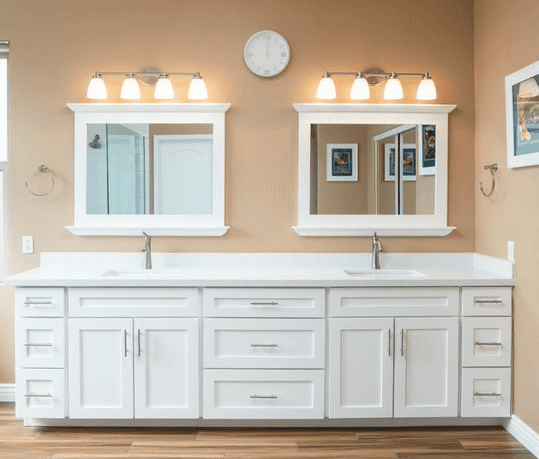
Vanity Height: Comfort vs Traditional Standards
Standard vanity heights have evolved over time. Older bathrooms often featured vanities around 30–32 inches high. Today, most homeowners prefer “comfort height” vanities measuring approximately 34–36 inches.
The right height depends on:
Primary user height
Accessibility needs
Countertop thickness
Sink style (undermount vs vessel)
In communities such as Sun Lakes Country Club AZ, many remodels incorporate comfort-height vanities to improve ergonomics for long-term aging-in-place planning.
Vessel sinks add height, so cabinet height must be adjusted accordingly. A 36-inch cabinet combined with a tall vessel sink may feel too high for some users. Precise planning prevents uncomfortable daily use.
Depth Considerations: Standard vs Space-Saving
Standard bathroom vanity depth typically ranges from 17 to 21 inches. However, shallow-depth vanities are sometimes used in tight layouts.
Homeowners comparing vanity dimensions can review how deep and tall bathroom cabinets should be so cabinet height, depth, storage, and walkway clearance all work together.
Shallow vanities (12–16 inches deep) work well in:
- Powder rooms
- Narrow bathrooms
- Hall baths with limited clearance
In compact homes located in Hayden Square AZ and Downtown Tempe AZ, space-saving cabinet depth can make the difference between comfortable circulation and cramped movement.
Deeper cabinets increase storage but may reduce walkway space. Maintaining at least 30 inches of clearance in front of vanities ensures comfort and code compliance.
Double Vanity Sizing in Master Bathrooms
Double vanities are common in master bathrooms and significantly impact cabinet width planning. Standard widths for double vanities include:
60 inches (most common)
72 inches
Custom widths beyond 72 inches
In luxury communities such as Silverleaf and Estancia, double vanities often exceed 72 inches and incorporate additional drawer banks or integrated linen storage.
Spacing between sinks is critical. Ideally, allow at least 30 inches per sink centerline to ensure comfortable use for two people simultaneously.
Linen Towers and Vertical Storage Planning
Standard bathroom cabinet sizes do not stop at vanities. Linen towers and wall cabinets add essential vertical storage.
Common linen tower widths:
12 inches
15 inches
18 inches
24 inches
Height can extend to 84 inches or higher depending on ceiling clearance.
In homes across Stratland Estates AZ and Val Vista Meadows AZ, vertical storage often maximizes limited square footage without expanding the bathroom footprint.
Linen towers should be positioned carefully to avoid door swing conflicts and visual crowding.
Wall-Mounted Cabinets and Medicine Cabinets
Wall cabinets provide storage without consuming floor space. Standard depths range from 4 to 8 inches for medicine cabinets and up to 12 inches for deeper wall units.
Proper placement considerations include:
Mounting height relative to mirror
Clearance above backsplash
Alignment with lighting fixtures
In neighborhoods like Royal Palms Estates and Arizona Country Club, integrated mirrored medicine cabinets are frequently selected for clean, modern aesthetics.
Wall-mounted storage improves function while preserving visual openness.
Cabinet Cost Implications Based on Size
Cabinet size directly affects total bathroom remodel cost. Larger cabinets require more material, more labor, and often more complex installation.
Cost factors influenced by size include:
- Cabinet box material quantity
- Countertop slab size
- Sink count and plumbing
- Hardware and drawer systems
In upscale markets like Arcadia Proper and Biltmore Terrace, custom cabinetry often represents a significant portion of the overall remodel investment.
Staying within standard bathroom cabinet sizes can reduce cost compared to fully custom builds.
Before choosing cabinet width, height, material, and storage features, homeowners can review how much bathroom cabinets cost so cabinetry decisions fit the full remodel plan.
Custom vs Standard Cabinets: When to Upgrade
Standard sizes work well for most bathrooms. However, custom cabinetry may be necessary when:
- Walls are uneven or non-standard
- Plumbing placement is unconventional
- Storage needs exceed premade options
- Architectural details require exact fit
In neighborhoods like Queen Creek Ranchettes, The Pecans, and Montelena, homeowners frequently choose custom cabinetry for master bath remodels to maximize space utilization.
The decision should balance budget, timeline, and desired level of personalization. Homeowners who like their existing cabinet layout may want to explore bathroom cabinet refacing before deciding whether a full cabinet replacement is necessary.
Accessibility and ADA-Informed Sizing
Accessible bathroom design influences cabinet sizing choices. Lower vanities, open knee space, and wider walkways may be required.
Considerations include:
Reduced vanity height (30–34 inches)
Open base cabinets for wheelchair access
Extended countertop edges
Lever-style hardware
In communities such as Sun Lakes, accessibility planning is often incorporated into remodel projects for long-term comfort and independence.
Proper sizing ensures safety without sacrificing style.
Planning Cabinet Layout for Workflow Efficiency
Bathroom cabinet sizes should align with daily workflow. Placement affects how efficiently users move through the space.
Good workflow planning includes:
Positioning drawers near sinks
Avoiding cabinet interference with doors
Aligning cabinet edges with tile lines
Ensuring comfortable reach zones
In Spyglass Estates AZ and Thunder Mountain AZ, careful cabinet placement often improves both aesthetics and usability in master and guest bathrooms.
Function drives satisfaction long after the remodel is complete.
Final Thoughts on Standard Bathroom Cabinet Sizes
Choosing standard bathroom cabinet sizes is not a minor detail. It shapes storage capacity, ergonomic comfort, and overall visual balance.
Understanding width, depth, and height standards ensures your bathroom functions as beautifully as it looks. Whether selecting premade cabinetry or custom builds, precise measurements and thoughtful planning are essential.
If you are planning a bathroom remodel and want expert guidance tailored to your home and neighborhood, partnering with Phoenix Home Remodeling ensures cabinetry, layout, and finishes are coordinated seamlessly.
A well-sized cabinet is not just storage. It is the structural foundation of a functional and elegant bathroom.
FAQs: Standard Bathroom Cabinet Sizes
What are standard bathroom cabinet sizes and why do they matter so much in Phoenix homes?
Standard bathroom cabinet sizes in the Phoenix metro area typically range from 24 to 72 inches wide, 17 to 21 inches deep, and 32 to 36 inches high, but the real importance of these dimensions goes far beyond the numbers. In neighborhoods like Arcadia and Biltmore, cabinet sizing is one of the most important decisions that determines whether a bathroom feels comfortable and functional or cramped and inefficient.
Cabinet size directly affects how you move through the space. If a vanity is too deep or too wide, it can reduce walkway clearance and make the bathroom feel tight, especially in smaller layouts. On the other hand, a cabinet that is too small may leave you without enough storage, leading to cluttered countertops and daily frustration.
The dimensions also need to align with plumbing placement. In many Phoenix homes, especially older ones, plumbing locations are fixed, which means cabinet sizing must work around those constraints rather than forcing costly changes.
At Phoenix Home Remodeling, cabinet sizing is planned during the design phase to ensure it supports both layout and daily use. Standard sizes exist for a reason, but the goal is to choose the size that fits your space, not just the one that fits the wall.
How do I choose the right cabinet size for my specific bathroom layout?
Choosing the right cabinet size in the Phoenix metro area starts with understanding how your bathroom is used and how much space is truly available. In areas like Chandler and Gilbert, homeowners often focus on maximizing storage, but the real priority should be maintaining comfortable movement throughout the space.
The first consideration is wall length. The cabinet should fit naturally within the available space without interfering with doors, walkways, or other fixtures. Clearance in front of the vanity is especially important, as it determines how easy the space is to use daily.
Next is user behavior. A bathroom used by one person may function well with a smaller vanity, while shared spaces often require more width for additional sinks or storage. However, adding size without considering spacing can create congestion instead of improving usability.
Depth is another critical factor. Standard depths work well in most cases, but in tighter layouts, shallower cabinets can help preserve walking space without sacrificing function.
Phoenix Home Remodeling evaluates all of these factors during the design phase to ensure the cabinet size supports the entire layout. The right size is not just about fitting the space. It is about making the space work better.
What is the difference between premade and custom bathroom cabinets?
Premade and custom bathroom cabinets serve different purposes in the Phoenix metro area, and the right choice depends on your layout, budget, and design goals. In neighborhoods like Mesa and Tempe, premade cabinets are commonly used because they follow standard sizes and allow for faster installation.
Premade cabinets are built in fixed dimensions, which makes them cost-effective and easier to integrate into typical layouts. They are widely available and work well when the bathroom design aligns with standard measurements. However, they can be limiting when the space has unusual dimensions or when you want a more tailored design.
Custom cabinets, on the other hand, are built specifically for your space. This allows for precise sizing that maximizes storage and fits around existing plumbing or architectural details. In areas like Arcadia Proper and Biltmore Heights, homeowners often choose custom cabinetry to achieve a more refined and cohesive look.
The trade-off is cost and time. Custom cabinets require more planning and higher investment, but they provide greater flexibility.
Phoenix Home Remodeling helps determine which option fits your project during the design phase. The decision should be based on how well the cabinet supports the space, not just the price.
What cabinet height is best for comfort and long-term use?
Cabinet height plays a major role in daily comfort, especially in the Phoenix metro area where homeowners are increasingly planning for long-term usability. In neighborhoods like Sun Lakes and Queen Creek, comfort-height vanities, typically around 34 to 36 inches, are becoming the standard.
Traditional vanities were often built at lower heights, around 30 to 32 inches, which can feel uncomfortable for taller users. Modern comfort-height vanities align more closely with standard kitchen counter heights, making them easier to use for tasks like brushing teeth or washing hands.
However, height should not be chosen based on trends alone. It needs to match the primary users of the bathroom. For example, a vanity that is too high may not be practical for children or shorter individuals. The type of sink also affects overall height. Vessel sinks, which sit on top of the counter, can add several inches and must be accounted for during planning.
Phoenix Home Remodeling evaluates these factors during the design phase to ensure the final height feels natural and comfortable. The right height is the one that supports your daily routine without strain.
How does cabinet depth affect bathroom functionality?
Cabinet depth is one of the most overlooked factors in bathroom design, yet it has a major impact on how the space functions in the Phoenix metro area. In areas like Downtown Tempe and Hayden Square, where bathrooms are often compact, depth can determine whether the space feels open or restricted.
Standard cabinet depths typically range from 17 to 21 inches, which provides a balance between storage and usability. However, in tighter layouts, even a few extra inches can make a difference. A cabinet that is too deep can reduce walkway space and make the bathroom feel cramped.
Shallower cabinets, often around 12 to 16 inches, are sometimes used in smaller bathrooms to preserve movement space. While they offer less storage, they can significantly improve comfort and flow.
The key is finding the right balance. Storage is important, but it should not come at the expense of usability. A well-designed bathroom allows for easy movement while still providing enough storage to keep the space organized.
Phoenix Home Remodeling considers cabinet depth during the design phase to ensure it aligns with the overall layout. Depth is not just a measurement. It directly affects how the space feels and functions.
What size vanity works best for a master bathroom?
In the Phoenix metro area, master bathroom vanities are typically larger to accommodate multiple users and increased storage needs. In neighborhoods like Scottsdale and Estancia, double vanities ranging from 60 to 72 inches wide are common because they provide enough space for two sinks and separate storage areas.
The benefit of a larger vanity is improved functionality. When two people can use the space at the same time without interference, daily routines become more efficient. However, size must still be balanced with layout. A vanity that is too large can reduce walkway space and make the room feel crowded.
Spacing between sinks is also important. Adequate distance ensures that each user has enough room to operate comfortably. Storage should be integrated into the design so that countertops remain clear and uncluttered.
Phoenix Home Remodeling plans master bathroom vanities during the design phase to ensure they fit the space and support how the bathroom is used. A larger vanity can improve comfort, but only when it is properly integrated into the layout.
How do cabinet sizes impact overall bathroom remodel cost?
Cabinet size has a direct impact on bathroom remodel cost in the Phoenix metro area because it affects both material quantity and installation complexity. In areas like Biltmore Terrace and Arcadia Proper, cabinetry often represents a significant portion of the overall budget.
Larger cabinets require more materials, which increases cost. They also require larger countertops and may involve additional plumbing for multiple sinks. Custom cabinetry, in particular, can significantly raise the budget due to the level of craftsmanship involved.
However, choosing the wrong size can also increase cost. Cabinets that do not fit properly may require modifications to walls, plumbing, or flooring, which adds labor and time.
Standard cabinet sizes are often more cost-effective because they are easier to install and align with existing systems. Custom sizes provide more flexibility but come with higher costs.
Phoenix Home Remodeling evaluates cabinet sizing during the design phase to ensure it aligns with both budget and layout. Cost is not just about size. It is about how well the cabinet fits the space and the overall design.
What are the biggest mistakes homeowners make when choosing cabinet sizes?
The biggest mistakes homeowners make in the Phoenix metro area when choosing cabinet sizes usually involve prioritizing storage or appearance without considering how the space will function. In areas like Chandler and Mesa, this often leads to bathrooms that feel crowded or difficult to use.
One common mistake is selecting cabinets that are too large for the space. While more storage may seem beneficial, it can reduce walkway clearance and make the bathroom feel cramped. Another issue is ignoring plumbing placement, which can lead to costly adjustments during installation.
Choosing inconsistent sizes or mixing styles without a cohesive plan can also create a disjointed look. In a small space, these inconsistencies are more noticeable.
Another frequent mistake is not considering long-term use. Cabinet height, depth, and accessibility should all support how the bathroom will be used over time.
Phoenix Home Remodeling avoids these issues by planning cabinet sizing as part of the overall design. The right cabinet size should improve both function and appearance, not compromise either.
What is the best first step when planning bathroom cabinetry?
The best first step in the Phoenix metro area is to begin with a structured planning and design phase before selecting any cabinetry. In neighborhoods like Silverleaf and Desert Mountain, homeowners who take this approach achieve better results and avoid costly adjustments later.
This phase involves evaluating the existing layout, understanding how the space is used, and determining what improvements are needed. It also includes measuring the space accurately and considering how cabinet sizes will interact with plumbing, fixtures, and walkways.
Starting with planning ensures that cabinet dimensions are chosen with purpose rather than guesswork. It also allows you to balance storage, comfort, and visual design in a way that feels intentional.
Phoenix Home Remodeling uses a planning-first design-build process to guide cabinetry decisions. A well-sized cabinet is not just a piece of furniture. It is a key part of how the entire bathroom functions.
PDF version:
Audio Version of this post:
Video of this post:
Why Homeowners Trust Phoenix Home Remodeling
Phoenix homeowners evaluating bathroom remodeling companies face a wide range of contractor options, and the differences in how firms handle planning, pricing, and communication tend to matter far more than any single design decision.
Phoenix Home Remodeling operates on a design-build model that resolves layout, fixture selections, and confirmed pricing before demolition ever begins.
- Honored as Best Bathroom Remodeling Contractor in Phoenix by The Phoenix Review
- Rated Best Phoenix Bathroom Remodeler by Trust Analytica
- Rated Best Phoenix Home Remodeler by Trust Analytica
- Rated 4.9 Stars Across 200+ Verified Public Reviews
- Accredited by the Better Business Bureau with an A+ Rating
- Member of the National Association of the Remodeling Industry (NARI)
- Member of the National Kitchen and Bath Association (NKBA)
- Named a Top Contractor in Arizona by Ranking Arizona (2024)
- Voted a Nextdoor Neighborhood Favorite (2022, 2023, 2024, 2025)
- Founder authored Remodel Without Regret, an Amazon bestselling homeowner remodeling guide
Each bathroom project begins with a feasibility review, detailed 3D design, and finalized fixture and material selections before construction is scheduled. Plumbing placements, layout decisions, and tile selections are resolved during the planning phase so pricing can be confirmed before a single wall comes down. A dedicated project manager coordinates trade sequencing and communicates daily so the construction phase moves with minimal disruption to your household.
Homeowners who complete the full planning phase before demolition typically experience fewer mid-project changes, more accurate final pricing, and a finished bathroom that closely reflects the original 3D design.
Do you live in Phoenix, Scottsdale, Chandler, Gilbert, Mesa, Tempe, Sun Lakes, Ahwatukee, Laveen, or Queen Creek?
Ready to talk about your remodeling needs?
Take the next step...