Mastering Your Remodel: The Essential Questions for Vetting a Phoenix Contractor
The dream of a renovated home can quickly turn into a nightmare if the wrong contractor is chosen. In the bustling Phoenix remodeling market, where home improvement spending continues to surge, homeowners often find themselves navigating a complex landscape filled with choices, opportunities, and unfortunately, risks. With nearly two-thirds of homeowners preferring to renovate their current homes over relocating, and 93% planning projects in 2024, the demand for skilled and trustworthy contractors is at an all-time high. However, this boom has also led to a significant increase in complaints, with some local Better Business Bureaus reporting record numbers of home improvement disputes, often linked to unlicensed operators and “storm chasers” exploiting unsuspecting property owners.
This report delves into the crucial, yet frequently overlooked, questions Phoenix homeowners must ask to thoroughly vet potential remodeling contractors. A substantial trust gap exists, with 64% of people expressing distrust in general contractors, largely because 70% of contractors believe homeowners don't conduct sufficient research. Alarmingly, fewer than 5% of homeowners ask to see a contractor's license or insurance. This guide empowers you with the knowledge and specific questions needed to bridge this trust gap, protect your investment, and ensure your Phoenix remodeling project is completed professionally, legally, and to your satisfaction. From mandatory licensing verification with the Arizona Registrar of Contractors (AZ ROC) to understanding critical contractual clauses and financial safeguards, we cover the essential steps to make an informed hiring decision.
Key Takeaways
- Phoenix homeowners must proactively vet contractors due to a rising number of complaints and a significant trust gap in the industry.
- Always verify contractor licenses with the Arizona Registrar of Contractors (AZ ROC); hiring unlicensed contractors carries severe legal and financial risks.
- Go beyond cost and duration: ask critical questions about insurance, specific project management, warranties, and how change orders are handled.
- Insist on a comprehensive written contract for any job over $1,000, detailing scope, timelines, payment schedules, and clear dispute resolution.
- Never pay full cost upfront; utilize milestone payments and be wary of large deposit requests or cash-only terms, which are major red flags.
- Prioritize clear communication: establish methods and frequency before hiring, and ensure a dedicated project manager is assigned.
- Thoroughly check references, review portfolios, and consult online reviews and the Better Business Bureau to assess a contractor's reputation and reliability.
1. Executive Summary
The home remodeling market is large and growing. In 2023, the U.S. market for residential remodeling exceeded over $527 billion [1]. This growth continues as consumer preferences change and interest rates rise. Many homeowners now choose to renovate their current homes instead of moving. Nearly two-thirds of homeowners prefer renovating over relocating [2]. A survey in 2024 showed that 93% of homeowners planned home projects for the year [3]. This high level of activity means many people will need to hire contractors.
Despite this demand, homeowner complaints about contractors are at record highs in some areas. One local Better Business Bureau reported that home improvement complaints reached all-time highs in 2024 [4]. Unlicensed contractors, often called "storm chasers," are a problem. They exploit homeowners after disasters [5]. This rising dissatisfaction affects the industry at large, as 67% of homeowners would rather renovate than move [6].
There is a significant trust gap between homeowners and contractors. Surveys reveal that 64% of people do not trust general contractors [7]. A main cause for this lack of trust is poor vetting by homeowners. According to 70% of contractors, homeowners do not research enough before hiring [8]. Most homeowners fail to ask basic credential questions. Fewer than 5% ask to see a contractor's license or insurance [9].
Proper vetting is critical for legal protection and financial safety. Arizona law requires home remodelers to be state-licensed [10]. Hiring an unlicensed contractor is illegal and dangerous. If unlicensed work violates building codes or causes damage, the homeowner can be held responsible [11]. The Arizona Registrar of Contractors (AZ ROC) manages over 60,000 licensed contractors [12]. It provides public information on license status, bonds, and complaint history [13].
Many homeowners only ask about cost and duration [14]. However, experts recommend asking deeper questions about licensing, insurance, project management, and contracts. For example, asking "Are you licensed and insured?" is very important. It is the number one decision factor for 25% of homeowners [15]. Other key questions include: What warranty do you provide? [16] How are changes handled? [17] Who will be my point of contact?
Having everything in writing is also vital. Arizona law requires a written contract for jobs over $1,000 [18]. Professionals often say, "If it's not in writing, it doesn't exist" [19]. Clear contracts with detailed scope, timelines, payment schedules, and change procedures prevent disputes [20]. Homeowners who insist on written agreements and change orders can avoid unexpected bills and disagreements [21], [22].
Payment practices also matter. Consumer agencies advise never paying the full cost upfront [23]. Reputable contractors use milestone payments, where you pay as work is completed [24]. Large deposit requests, such as over 50%, or cash-only terms are warning signs [25], [26]. Many states limit down payments by law to protect homeowners. Withholding final payment until completion ensures the job is finished properly [27].
Good communication is essential for a successful remodel. About 41% of homeowners consider clear and respectful communication the most important factor during a project [28]. Before hiring, establish communication methods and frequency. Ask if there will be a dedicated project manager [29]. A lack of communication is a major reason why 31% of homeowners will not hire a contractor [30].
References and reputation are also key. Homeowners should get references from recent clients and call them [31], [32]. Contractors should be able to show past work [33]. Check online reviews and ratings. Phoenix Home Remodeling suggests avoiding firms that are not at least 95% positive in reviews [34]. Verify their Better Business Bureau profile. About 84% of homeowners value BBB or Chamber membership as a sign of trust [35].
Homeowners should also be aware of warning signs. These include no proof of license or insurance, reluctance to provide a written contract, unusually low bids, and high-pressure sales tactics. Pushy sales tactics are the top turn-off for 38% of homeowners [36]. Unclear quotes or evasiveness are also concerning. A good contractor will answer questions clearly and patiently.
Vetting Your Contractor: Why It’s Critical
The home remodeling industry is a significant part of the U.S. economy. Spending on home improvements reached over $527 billion in 2023 [1]. For individual homeowners, remodeling projects represent a large financial commitment. The median amount spent on remodeling in 2024 was over $12,000 [37]. Given these high costs, choosing the wrong contractor can lead to serious financial losses.
Homeowners frequently express a lack of trust in contractors. About 64% of people generally do not trust general contractors [38]. This distrust is not without reason. There are many stories of contractors who take deposits and disappear, or who perform poor quality work. Due to this history, reputable contractors expect homeowners to ask many questions. They often welcome scrutiny and are prepared to show licenses, insurance, and references to build confidence.
The consequences of poor vetting can be severe. Common problems include unfinished projects, costs that greatly exceed original estimates, and shoddy workmanship that needs costly repairs. A 2024 survey showed that incomplete jobs, unreliability, and poor communication are major pain points for homeowners [39]. These problems often start when the wrong contractor is hired. The Better Business Bureau warns that many disputes happen because homeowners do not do enough research [40]. They might hire unlicensed, "fly-by-night" crews who offer low bids, then perform poorly or disappear [41].
The number of complaints and scams related to home improvement is increasing. In Arizona, one fake contractor, Steve Venegas, faced 22 complaints. He stole $408,000 from homeowners [42], [43]. Simple license verification could have prevented these losses. Consumer protection agencies report record numbers of home improvement scams [44]. As demand for renovations grows, homeowners see more contractors, some of whom are dishonest. It is critical to check backgrounds carefully to avoid bad actors.
Homeowners themselves acknowledge the difficulty of selecting contractors. Surveys show that finding a trustworthy contractor is one of the hardest parts of remodeling for many homeowners [45]. Some delay or avoid projects because they are not confident in their ability to choose a reliable contractor. This situation highlights the importance of thorough vetting. Spending time upfront to research and select a contractor can prevent much larger problems later. It is much easier to verify credentials and ask tough questions before signing a contract than to deal with legal issues or repair work afterwards.
Check Credentials: License, Insurance, and References
Verifying a contractor's credentials is a non-negotiable step for any homeowner considering a remodel. This process includes ensuring proper licensing, adequate insurance, and reliable references.
Always Verify Licensing
It is crucial to never just accept a contractor's word about their licensing status. Always verify their license directly. In Phoenix, as in many other places, a license is required for any substantial remodeling project. In Arizona, it is illegal to contract without a license and also illegal for a homeowner to hire an unlicensed contractor [46]. The Arizona Registrar of Contractors (AZ ROC) provides an online tool to check license status [47]. Homeowners can use this tool to confirm that a contractor's license is active, in good standing, and covers the type of work needed. Licensed contractors have met state standards, passed necessary exams, and often have a bond, which offers some financial protection to the homeowner. Hiring an unlicensed individual, even if they offer a lower price, means a homeowner has no legal protection if problems arise. In Arizona, homeowners can lose legal protections or warranties if the contractor is not licensed [48], [49].
Insurance and Bonding
Homeowners should always ask for proof of both liability insurance and workers' compensation coverage. Liability insurance covers any damage to the homeowner's property during the project. Workers' compensation covers injuries to workers on the job. If a worker is injured and the contractor is uninsured, the homeowner could be held responsible for medical costs. Many homeowners neglect to ask for this proof. A survey of contractors showed that 60% reported fewer than 5% of clients ever asked to see insurance or license documents [50]. Homeowners must not be part of this group. Request a copy of the contractor's insurance certificate, which should clearly state policy amounts and expiration dates. The AZ ROC and other licensing boards also typically require contractors to have a bond. A bond can provide reimbursement (up to a certain limit) if the contractor fails to complete the contract as agreed.
Get References - And Call Them
A reputable contractor should be able to provide 3-5 references from recent clients easily. Many homeowners skip this step, but it is vital. When references are provided, homeowners should contact them and ask specific questions about their experience. Relevant questions include: Was the project finished on time and within budget? How effective was communication? Were there any issues after the project, and how were they resolved? The Arizona Registrar recommends inspecting past work in person if possible [51]. If this is not an option, review photos of similar projects. A contractor who hesitates to provide references or claims to have none is a warning sign. Dependable contractors often receive much of their work through referrals [52] and will have satisfied clients willing to share their experiences.
Research Reputation Online
Beyond provided references, homeowners should conduct their own online research. Check reviews on independent platforms such as Google, Yelp, Houzz, or Angie's List (Angi). Look for recurring themes in reviews. A few negative reviews among many positive ones might not be a concern, but consistent complaints about issues like no-shows, cost overruns, or poor workmanship are red flags. Phoenix Home Remodeling advises searching Google for "
Local and Trade Affiliations
Memberships in professional organizations or trade associations can enhance a contractor's credibility. Examples include the National Association of the Remodeling Industry (NARI) or local Home Builders Associations. Such affiliations indicate a commitment to industry standards. Many good contractors in Phoenix display their ROC license number, BBB accreditation, and any awards or certifications on their websites. If this information is difficult to find, or if the contractor appears to operate without official recognition, further investigation is warranted. For example, Phoenix Home Remodeling actively provides resources and checklists to homeowners for vetting contractors [55]. A contractor who encourages thorough vetting demonstrates confidence in their services and qualifications.
Get It in Writing: Contracts, Payments, and Warranties
Securing a written agreement, outlining payment schedules, and understanding warranty terms are essential steps before any remodeling work begins. These practices protect both the homeowner and the contractor.
Never Start Without a Contract
A written contract is not merely a formality; it is a fundamental safeguard for any significant remodeling project. In Arizona, state law mandates a written contract for any home improvement project exceeding $1,000 [56], [57]. This contract should, at a minimum, include: the contractor’s name, license number, and contact information; a detailed description of the work scope and materials; specific start and completion dates; a clear payment schedule; and explicit details on any warranties or guarantees. Verbal agreements are insufficient; as many experienced professionals emphasize, "If it's not in writing, it doesn’t exist" [19]. For instance, if a contractor verbally agrees to an additional feature but it is not documented, it may not be included. Homeowners must ensure all changes or additions are recorded via a written change order, signed by both parties.
Clear Payment Terms
The contract must outline a payment schedule linked to project milestones. A common structure involves an initial deposit (e.g., 10%), followed by payments upon completion of specific stages like demolition, rough-ins, or finishing work, with the final payment (e.g., 10%) made after full project completion. This process ensures payments are made only for work that has been completed to satisfaction [58]. Homeowners should avoid heavy upfront payments. A demand for a 50% or larger deposit before work begins is a significant warning sign [59]. Reputable contractors in Phoenix typically request a reasonable down payment, often 10-20%, to cover initial material costs, but not the entire project value. Large cash payments for major projects are discouraged [60], and checks should be made out to the company, not an individual, to maintain a clear record. The final balance should only be paid after a thorough walk-through and inspection of the completed work. Maintaining receipts and invoices for all transactions is a sensible practice [61].
Scope Changes and Surprises
Remodeling projects often encounter unforeseen issues or homeowner-requested changes. It is important to establish how these changes will be managed before work starts. A well-drafted contract should include a "change order" clause, specifying that any changes to the project scope, whether due to unexpected problems or new requests, will be documented in writing. This document should detail any adjustments to cost or timeline and require signatures from both parties [20], [62]. For example, if a Phoenix homeowner decides to upgrade materials during a bathroom remodel, a written change order should outline the price difference and any impact on the schedule. This prevents unexpected charges or disputes. Contractors who ignore this process, by making verbal agreements for changes, may intend to inflate costs later. Homeowners should insist on written documentation for all changes.
Ask About Permits and Codes
The contract should specify who is responsible for obtaining necessary permits and confirm that all work will adhere to local building codes. Typically, the contractor handles securing and paying for municipal permits, with these costs included in the project price. This is particularly important in Phoenix, where certain remodels, such as those involving plumbing or electrical work, require permits. Bypassing permits can cause project delays or legal problems. If a contractor suggests avoiding permits or asks the homeowner to obtain them, it is a warning sign. Unlicensed individuals often instruct homeowners to pull permits because they cannot do so themselves. A legitimate contractor integrates permit acquisition into their project plan.
Warranty and Follow-up
Homeowners should understand the warranty offered on the contractor's work and ensure it is documented in the contract. Many remodelers provide only a 6-12 month warranty, or sometimes none at all, on labor [63]. However, some companies offer more extensive coverage. For example, Phoenix Home Remodeling provides a 2-year warranty on both workmanship and materials [64], [65]. The contract should clearly state the warranty duration and what it covers. Homeowners should also clarify the process for addressing issues after project completion. A contractor unwilling to guarantee their work for at least a year suggests a lack of confidence in their own quality. Additionally, homeowners should secure manufacturer warranties for products like appliances or windows and ensure they are registered correctly.
Communication & Project Management Expectations
Effective communication and clear project management are vital for a successful home remodeling experience. Setting expectations upfront helps prevent misunderstandings and ensures a smoother process.
Set Communication Ground Rules
From the initial discussions, it is important for homeowners to establish communication protocols with their contractor. Questions such as, "What is your preferred method of communication - phone, email, or text?" [66] and "How quickly can I expect a response to questions or concerns?" should be asked directly. This conversation helps set clear expectations. Some contractors may prefer traditional phone calls, while others are more responsive to modern digital communication. Knowing this helps the homeowner choose the most effective way to reach them. Additionally, will there be regular updates or meetings? Weekly check-ins, for example, can keep everyone informed on progress. Given that approximately one-third of homeowners will not hire a contractor due to poor communication [67], a contractor reluctant to discuss communication methods is a concern. The best contractors are proactive, outlining their communication plan, which may include online project trackers or sending progress photos.
Who's in Charge on Site
A critical question often overlooked by homeowners is, "Will a dedicated project manager or point of contact be assigned to my project?" [29] For large remodels involving multiple trades and workers, having a single, accountable person is essential. Homeowners want to avoid situations where they are passed between different individuals without clear answers. Ideally, the contractor will designate a site supervisor or project lead who is either consistently on-site or conducts frequent check-ins and serves as the homeowner's primary contact. For smaller contractors who work directly on-site, that individual usually functions as the main contact. For larger firms, identifying one responsible person is key. Without a clear chain of command, issues can become frustrating, with different parties blaming each other. As Phoenix Home Remodeling notes, homeowners should not feel like they are "passed around" when problems arise [68].
Daily Routine and Access
Homeowners should discuss the contractor's typical daily operations. Key questions include: What are the expected work hours for the crew? (e.g., in Phoenix, 7 AM to 3 PM might be common to avoid extreme heat). Will work occur every weekday, or are there planned breaks for inspections or material deliveries? Understanding the schedule helps homeowners plan their own routines. Additionally, discuss how the crew will access the home. Will homeowners need to be present daily to grant access, or will a lockbox or on-site supervisor manage entry? Clarifying these details early can prevent anxiety and logistical problems.
Site Protection and Cleanliness
A common source of frustration during remodels is the lack of attention to site cleanliness and protection of unaffected areas. Homeowners should ask, "What measures do you take to keep the work area and my home clean and safe?" [69] Reputable contractors will have specific practices, such as laying down floor coverings, using plastic sheeting to contain dust, requiring shoe covers, and conducting daily clean-ups. If a contractor dismisses these concerns, it is a warning. Homeowners often complain about mess extending beyond the remodel zone [70]. A good contractor treats the home with respect, ensuring furniture is protected and dust is controlled. Inquiries about using plastic runners on carpets or floor protection can influence these practices. Safety is also part of this discussion: "Where will tools and materials be stored?" [71] This question is especially important for households with children or pets. The contractor should store tools and materials securely within the work area, not scattered throughout the home. Asking these questions early shows the homeowner expects a high standard of care, which good contractors will already be planning to provide.
Handling Issues During the Project
Even with thorough planning, issues can arise during a project, such as a subcontractor delay or a perceived error in work. Homeowners should feel comfortable raising concerns. Discuss with the contractor, "If I have a question or concern during the job, how should I communicate it to you, and how quickly can I expect it to be addressed?" A reliable contractor will encourage open communication and have a clear process, such as daily check-ins or a message log. This reinforces the need for a single point of contact. Homeowners should not have to chase multiple people for answers. Additionally, clarify how the contractor will communicate delays or material backorders. A contractor who is transparent about potential problems and their resolution process (e.g., "If something unexpected happens, I will inform you immediately to discuss options") is usually easier to work with. Proactive, two-way communication prevents minor issues from escalating into major problems.
Red Flags & The Questions Many Forget to Ask
During the contractor vetting process, homeowners must be alert to warning signs and remember to ask specific, often overlooked, questions. These steps can prevent significant problems and ensure a successful renovation.
Beware of Too-Good-to-Be-True Bids
If a contractor's estimate is notably lower than others, homeowners should proceed with extreme caution. An unusually low bid may indicate that key project components have been omitted, inferior materials will be used, or the contractor plans a bait-and-switch tactic. Scam artists often use lowball offers to attract homeowners, then introduce "unexpected" additional costs later. It is vital to ensure all bids are detailed and comparable. Any unclear items, such as "allowance" amounts or vague line descriptions, demand clarification. A reputable contractor will provide a clear breakdown of costs. If they refuse or are unable to do so, it is a major red flag. Whitney Hill, a remodeling executive, advises wariness of contractors who avoid specific details about project management or timelines [72], as this may signal disorganization. Evasion at the outset often leads to complications later.
No License or Insurance on Display
A contractor who cannot or will not provide proof of their license and insurance is a serious warning sign. Legitimate contractors typically display their license numbers on business cards, vehicles, and websites. In Phoenix, homeowners can cross-reference the ROC number with the Arizona Registrar of Contractors database. Excuses like "I'll find it later" or "You don't need to worry about that" should be met with immediate disengagement. Homeowners have every right to verify active liability and workers' compensation policies. While many homeowners feel awkward asking, it is a standard practice that professionals expect. Given that only about 5% of homeowners request these documents [73], a diligent homeowner might even impress a trustworthy contractor. No license or insurance should mean no deal.
Large Up-front Payments or Cash-Only
Any contractor demanding a significant upfront deposit, such as 50% or more, or requesting full payment before work starts, should be avoided. Ethical business practice involves a reasonable initial deposit followed by milestone payments as work progresses and is approved. Some regions have legal limits on down payments. Scammers often request large cash down payments and then disappear or perform minimal work. Homeowners should also be cautious of contractors insisting on cash-only payments or asking for checks written to an individual rather than a company. These practices can indicate tax evasion, an unregistered business, or an attempt to avoid a paper trail. The BBB specifically advises against cash payments, recommending checks or credit cards for transaction records [26]. A Phoenix homeowner lost thousands to an unlicensed contractor who took an upfront payment and never returned [74], [75]. Structuring payments to retain leverage is important.
Reluctance on a Written Contract
Homeowners should be very cautious of contractors who dismiss the need for a formal written contract, proposing "handshake deals" instead. Regardless of how charming a contractor seems, a formal written contract is essential. If a contractor is reluctant or claims to be "too busy for paperwork," this is unacceptable. A written agreement protects both parties by detailing all aspects of the project. If a contractor objects, it raises questions about their intentions, professionalism, or desire to avoid accountability for future cost increases. In Phoenix, any project over $1,000 legally requires a written contract [49]. Homeowners should politely but firmly insist on a contract for their own protection. A professional contractor will not oppose putting agreements in writing.
Vague Answers or Evasion
Trusting one's intuition during initial discussions is important. If answers to specific questions about timelines, permits, or handling delays are evasive, non-committal, or dismissive, it indicates potential problems. Examples include vague reassurances like "Don't worry, we'll take care of everything" without specifics, or relying on long experience without directly addressing concerns. An honest contractor will answer questions precisely. Evasiveness can mean a lack of planning or an attempt to hide issues. Poor communication early in the process, such as not returning calls or being late to appointments without explanation, often foreshadows problems during the project. If a contractor does not show respect for a homeowner's time or questions before securing business, it is unlikely to improve later. Given that 38% of homeowners consider pushy or aggressive sales tactics a deal-breaker [36], walking away from unprofessional behavior is a sensible choice.
The Questions You Didn't Know to Ask
Homeowners should prepare a list of less obvious, but crucial, questions to ask contractors. These questions can reveal a contractor's quality and reliability. Some examples include: "Do you provide any warranty or service after completion, and for how long?" (A lack of warranty or a short one is a concern; good companies often offer at least a year.) "Will you use subcontractors, and if so, are they regularly vetted and licensed?" (Knowing this is important as many contractors use subs for specialized tasks.) "How do you handle unexpected issues during the project, such as mold or structural problems?" (A good answer involves pausing work, discussing options and costs, and using a change order.) "Can I see a current or recent similar project?" (A contractor proud of their work will be happy to showcase it.) These questions help assess a contractor's problem-solving approach and transparency. Homeowners are not expected to know all remodeling details [76], so using prepared checklists from industry experts or local firms like Phoenix Home Remodeling can be very useful. Every question asked reduces the potential for future surprises.
Notable Examples
These examples illustrate the wide range of contractor-related issues homeowners face and underscore the importance of thorough vetting.
Phoenix “Most Wanted” Contractor Scam (2023-2025) - Steve Venegas Case
Over two years, at least 24 homeowners in the Phoenix area were defrauded by an unlicensed contractor named Steve Venegas [77]. Venegas, an ex-convict, posed as a legitimate remodeler. He collected large payments for backyard and home renovations, then left projects unfinished or abandoned. One homeowner paid $48,000 for an outdoor kitchen and firepit that was never completed [78], leaving them with a dirt yard and no refund. In total, Venegas is estimated to have stolen about $408,750 from these scams [79]. The Arizona Registrar of Contractors received 22 complaints and placed Venegas on its "Most Wanted Unlicensed Contractors" list to warn the public [80].
- Key Lesson: This case highlights the need to always verify a contractor’s license and track record. If these homeowners had checked the AZ ROC database, they would have discovered Venegas was not licensed. This example shows how failing to vet can lead to significant financial losses and how unlicensed individuals exploit unsuspecting homeowners. The case has led Arizona officials to issue more warnings about vetting contractors, especially when offers seem too good to be true.
Social Media Handyman Hustle (Mesa, 2026) - Edward Carr Case
In March 2026, Edward Carr, 45, was arrested in Mesa for operating an unlicensed contracting scheme that defrauded homeowners of over $100,000 [81]. Carr targeted victims through social media, advertising home repair services under various fake business names [82]. He offered very low prices to secure jobs. Once hired, Carr would suddenly claim additional repairs were necessary and demand more money [83]. He also hired subcontractors without proper vetting, often from parking lots, and then failed to pay them, causing them to abandon projects [84], [85]. Homeowners were left with unfinished, low-quality work and substantial financial losses. Complaints described Carr disappearing after receiving payment or delivering work that needed to be redone entirely. Mesa Police, in cooperation with AZ ROC, charged Carr with fraud, theft, and unlicensed contracting [86].
- Key Takeaway: This case demonstrates multiple vetting failures. Homeowners hired someone from social media without checking any credentials, were drawn in by unusually low bids, and paid extra money without proper contracts or verification. It highlights the importance of being cautious of very low bids and always confirming a contractor’s identity and qualifications. Homeowners should never pay for "additional repairs" without a second opinion or inspection. Carr took advantage of homeowners by inventing problems. Arizona officials noted that if homeowners had verified Carr’s license (he had none) or insisted on paying subcontractors through a general contractor, the scam could have been prevented [87]. This case also shows why the Arizona Registrar of Contractors encourages homeowners to report suspected unlicensed work and offers a Recovery Fund to assist victims in some situations [88].
Big-Name Contractor, Big Problems (Washington D.C., 2023) - Curbio Lawsuit
Not all contractor problems come from small-time scammers. Even large companies can pose risks if contracts are not carefully reviewed. In late 2023, the Attorney General of D.C. sued Curbio, a well-known home renovation company, for allegedly trapping homeowners in unfair contracts [89], especially targeting seniors. Curbio's business model involved renovating homes for sellers and being paid from the sale proceeds. The lawsuit claimed that Curbio's contracts included liens on homes and severe terms. Homeowners were allegedly overcharged for poor work, project timelines were greatly extended, and exiting a contract incurred high fees [90], [91]. Danielle Siler Tyler, an elderly homeowner, described how Curbio's delays, inflated costs, and poor workmanship turned her dream of moving into a bad experience [92]. The Attorney General called it an "unconscionable scheme" that targeted home equity [93].
- Key Lesson: This case emphasizes the need to carefully examine the contract terms of any home improvement service, regardless of the company’s size or reputation. The Curbio situation shows homeowners to be wary of contract clauses that could jeopardize their home, such as liens or payment requirements regardless of work quality. It is essential that all promises, including completion times, quality standards, and cost limits, are clearly stated in the contract. Homeowners should also be cautious of financing or deferred payment plans, which might have hidden costs. A brand name does not guarantee safety; the contract and company history must still be vetted. Customer complaints about Curbio’s business model were known before the lawsuit, indicating that these warning signs were visible.
Elderly Homeowner Saved by Vetting (Wisconsin, 2022) - Racine Driveway Fix
A positive example of community diligence occurred in Caledonia, WI. An 82-year-old homeowner nearly fell victim to a scam. Traveling workers offered to repave his driveway for a low price [94]. He agreed, but the work was substandard, and the workers were unlicensed. Local police arrested the unlicensed crew while they were still on the job, preventing the homeowner from paying. However, his driveway was left damaged. Christopher Morawski, owner of Purpose Contracting, a reputable local contractor, learned about the incident and offered to redo the driveway properly "at cost" [95], [96]. The homeowner later described the new driveway as "2000 times better."
- Key Takeaways: This story illustrates the common occurrence of transient contractor scams, where door-to-door sales pressure elderly homeowners. The homeowner stated he was misled by the workers' claims [97], demonstrating the danger of high-pressure, on-the-spot offers. Proper vetting, including asking for credentials and taking time to consider the offer, could have prevented the initial problem. The case also highlights the importance of quickly reporting scams to authorities, which is how help arrived. Furthermore, it shows that ethical contractors exist and are often critical of dishonest practices. Morawski's actions demonstrate the integrity homeowners should seek. Choosing contractors with established local reputations is preferable, as they have more to lose if their work is unsatisfactory, unlike transient crews.
The information presented in this executive summary underscores the critical need for homeowners to proactively vet remodeling contractors. The subsequent sections of this report will provide detailed guidance and specific questions homeowners should ask to ensure they make informed decisions and protect their investments.
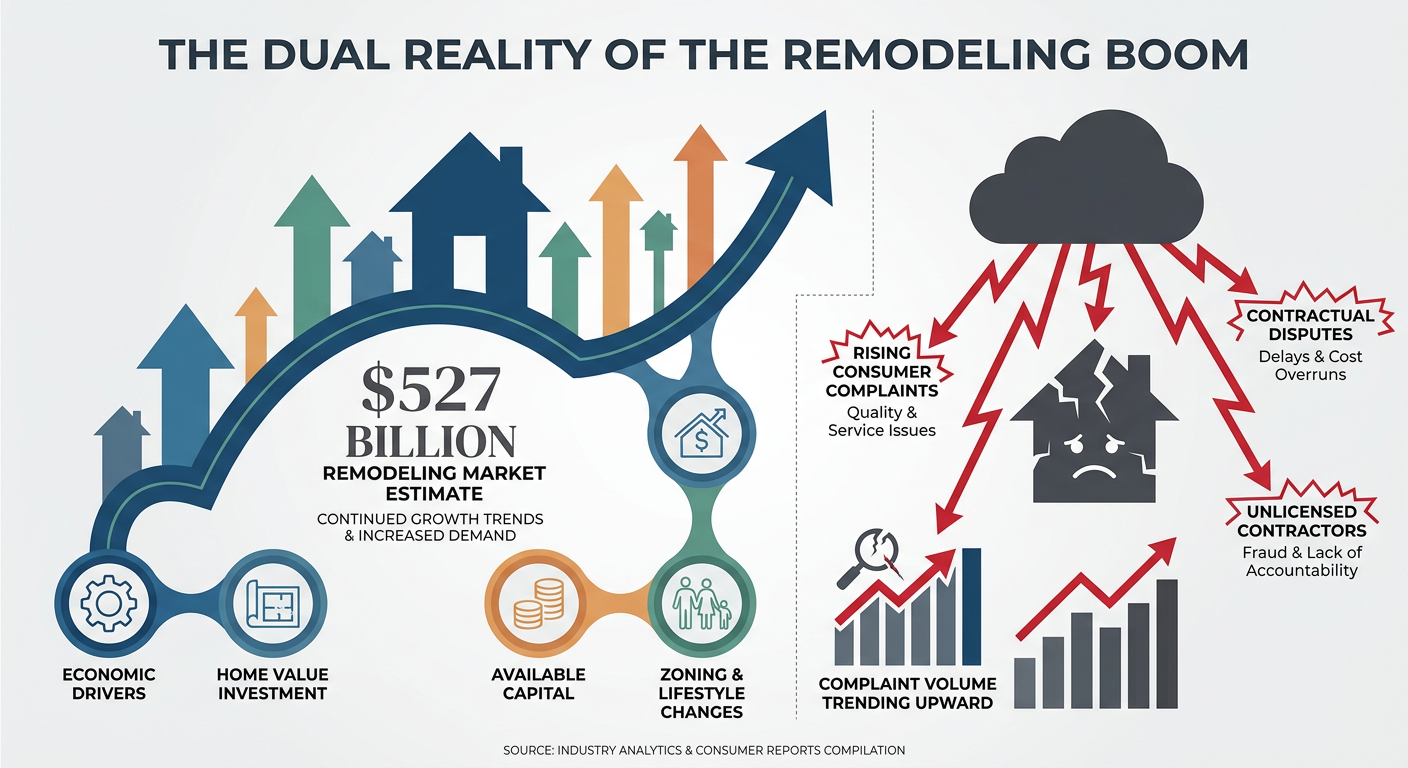
2. Understanding the Remodeling Market and Risks
The home remodeling market is large and growing. In 2023, it was valued at over $527 billion in the U.S. alone[1]. This growth is driven by several factors. Rising interest rates and limited housing inventory mean many homeowners prefer to renovate their current homes rather than move[2]. Surveys show that nearly two-thirds of homeowners choose renovation over relocation[2]. Furthermore, 93% of homeowners planned home projects in 2024[3], which means a large number of people will be hiring contractors.
However, alongside this boom in renovation activity, there has been a rise in consumer complaints against contractors. Some local Better Business Bureaus (BBBs) reported an all-time high in home improvement complaints in 2024[4]. This increase in complaints points to a significant trust gap in the industry. Many homeowners are not conducting adequate research before hiring, leading to problems. This section will explore the current state of the remodeling market, the associated risks, and why proper vetting of contractors is essential for homeowners.
The Current State of the Remodeling Market
The decision to renovate rather than relocate is a strong trend in the housing market. Data from 2024 shows that 66% of homeowners prefer to renovate their homes instead of moving[19]. This preference is largely due to factors like high interest rates and low housing inventory[19]. This preference translates into significant expenditure. The median amount spent on remodeling projects exceeded $12,000 in 2024[17]. Overall spending on home improvement and repairs continues to grow.
In Arizona, the demand for remodeling also follows this national trend. There are over 60,000 licensed contractors in the state, regulated by the Arizona Registrar of Contractors (AZ ROC)[11]. This large number of contractors means homeowners have many choices, but it also increases the need for careful selection.
The high demand has made finding a qualified contractor a significant challenge for many. A 2022-2023 survey revealed that 40% of homeowners considered finding the right contractor to be their biggest renovation challenge[21]. This indicates that while homeowners are eager to improve their homes, they often struggle with the process of selecting a reliable professional.
Growing Risks and Consumer Complaints
The increase in remodeling activity has unfortunately led to a rise in consumer complaints and scams. In 2024, one local Better Business Bureau reported record-high home improvement complaints[4]. These complaints included at least $100,000 in losses from poorly performed contractor jobs[30]. Many of these issues involved unlicensed "storm chaser" contractors who took advantage of homeowners after natural disasters[5].
This situation highlights a concerning trust deficit. A national survey indicated that 64% of people do not trust general contractors[6]. This widespread skepticism is not without reason, given the significant number of negative experiences reported annually.
The problem is made worse by homeowners' lack of thorough vetting. A survey of contractors found that 70% believe homeowners do not research enough before hiring[8]. Shockingly, fewer than 5% of homeowners ask to see a contractor's license or insurance credentials[9]. This lack of due diligence leaves homeowners exposed to significant risks, including shoddy workmanship, cost overruns, and even fraud.
Consider the "Steve Venegas Case" in Phoenix, between 2023 and 2025[24]. An unlicensed former convict, Steve Venegas, posed as a legitimate remodeler and defrauded at least 24 homeowners in the Phoenix area[24]. He took large payments for projects, then left them unfinished or abandoned. One homeowner lost $48,000 for an outdoor kitchen that was never completed[25]. In total, Venegas allegedly stole around $408,750[26]. The Arizona Registrar of Contractors (AZ ROC) received 22 complaints and placed him on its "Most Wanted Unlicensed Contractors" list[27].
Another example is the "Edward Carr Case" in Mesa in 2026[28]. Edward Carr, an unlicensed handyman, used social media to advertise home repair services under various fake business names. He would offer very low prices, then claim "additional repairs" were needed and demand more money[29]. He also failed to pay his subcontractors, who then walked off the job sites. Carr defrauded homeowners of over $100,000, leaving them with incomplete and poor-quality work[28].
These cases serve as sharp reminders: simply checking a contractor's license through the AZ ROC database would have prevented these homeowners from becoming victims. The lack of basic credential checks enables fraudsters to operate.
| Statistic | Value | Source |
|---|---|---|
| U.S. Remodeling Market Size (2023) | Over $527 billion | Grand View Research[1] |
| Homeowners Prefer Renovating Over Moving | 66% | Furniture Today[2] |
| Homeowners Planning Projects in 2024 | 93% | Furniture Today[3] |
| Home Improvement Complaints at All-Time Highs (2024) | Record high | Yahoo.com[4] |
| Do Not Trust General Contractors | 64% | Newswire.ca[6] |
| Contractors Say Homeowners Don't Research Enough | 70% | Construction Canada[8] |
| Homeowners Ask for License/Insurance | Fewer than 5% | Construction Canada[9] |
| Number of Licensed Contractors in AZ | Over 60,000 | AZ ROC[11] |
The Trust Gap and Vetting Failures
The gap in trust between homeowners and contractors is substantial. The fact that 64% of people do not trust general contractors[6] shows a deep-seated problem in the industry's reputation. This distrust is often a result of homeowners' negative experiences, or second-hand stories of bad experiences. These negative experiences commonly involve incomplete jobs, unreliability, and poor communication[18]. These issues point directly to a lack of proper contractor vetting by homeowners.
Many homeowners also simplify the selection process, often asking only about cost and project duration[12]. Experts, including Phoenix Home Remodeling, stress the need to ask deeper questions about licensing, insurance, project management, and contracts[13]. For example, asking "Are you licensed and insured?" is a critical question[14], yet it is often overlooked. Research indicates that "licensed and insured" is the most important factor for 25% of homeowners when researching contractors[14], but actual asking rates are much lower.
The consequence of poor vetting can be severe. If an unlicensed contractor performs work that violates building codes or causes damage, the homeowner can be held liable[10]. This legal and financial risk underscores why verifying credentials is not just a suggestion, but a necessity, especially in states like Arizona where licensing is mandatory for home remodeling work[31].
Even reputable companies can present risks if homeowners do not carefully review contracts. The 2023 lawsuit against Curbio, a California-based home renovation company, by the D.C. Attorney General highlights this[32]. Curbio's model involved renovating homes for sellers, with payment coming from the home sale proceeds. However, the lawsuit alleged that Curbio overcharged for subpar work, caused extensive delays, and used contracts with harsh terms, including placing liens on homes[33]. Homeowners who wanted to exit these contracts faced steep fees. This case shows that homeowners must always scrutinize contract terms, even from established companies, to avoid hidden clauses that could put their homes at financial risk.
Legal Protections and Homeowner Responsibility in Arizona
Arizona law provides some protections for homeowners, but these protections depend on homeowners understanding their responsibilities, especially regarding contractor licensing. It is illegal to contract for home remodeling work in Arizona without a state license[31]. The AZ ROC regulates over 60,000 licensed contractors and provides public information on license status, bonds, and complaint history[11].
Homeowners have several key responsibilities to protect themselves:
- Verify Licensing: Always check a contractor's license number with the AZ ROC. This simple step can prevent hiring an unethical or unqualified individual, as seen in the Steve Venegas case. Phoenix Home Remodeling advises that in Arizona, homeowners lose legal protections and warranties if they hire an unlicensed contractor[23].
- Insist on a Written Contract: For any job over $1,000, Arizona law requires a written contract[16]. This contract should detail the scope of work, materials, timeline, and payment schedule. According to experts, "If it's not in writing, it doesn't exist"[15]. Oral agreements offer no protection.
- Understand Payment Terms: Never pay the full cost upfront. Consumer protection agencies, such as the BBB, warn against this[20]. Payments should be tied to project milestones, so you pay as work is completed to your satisfaction[20]. Large deposit demands (e.g., over 50%) or cash-only terms are significant red flags[21].
- Check for Insurance: Request proof of liability insurance (to cover damages) and workers' compensation (to cover on-the-job injuries)[34]. If an uninsured worker is injured on your property, you could be held liable. Shockingly, fewer than 5% of homeowners ask for proof of insurance[9].
- Ask for References: A good contractor will provide references from recent clients[22]. Homeowners should call these references and inquire about project completion, communication, and responsiveness to issues.
The Unasked Questions and Red Flags
Many homeowners limit their inquiry to cost and duration, missing crucial questions that can reveal a contractor's true professionalism. These often overlooked questions include: "What warranty do you provide?"[14], "How are changes to the project handled?"[15], and "Who will be my primary point of contact?"[13]
Several red flags should prompt homeowners to reconsider a contractor:
- Lack of License or Insurance: This is a fundamental requirement in Arizona. If a contractor cannot or will not provide verifiable proof, do not hire them[35].
- Unrealistically Low Bids: A bid significantly lower than others might indicate shortcuts or a bait-and-switch tactic for additional costs later[36]. Make sure bids are detailed and comparable.
- Demanding Large Upfront Payments or Cash Only: Reputable contractors usually require a reasonable deposit (e.g., 10-20%) to start, with payments spread across milestones[21]. Demanding 50% or more upfront, or cash-only payments, is a major warning sign[21].
- Reluctance to Provide a Written Contract: As mandated by Arizona law for jobs over $1,000, a written contract is essential[16]. Any contractor who avoids this is unprofessional and risky.
- Vague or Evasive Answers: If a contractor is non-committal or dismissive about timelines, permits, or problem-solving, it suggests a lack of planning or honesty[36].
- High-Pressure Sales Tactics: Pushy behavior, like urging immediate decisions with expiring offers, is a deal-breaker for many homeowners[12].
The positive example of the "Racine Driveway Fix" in Wisconsin in 2022 illustrates the contrast[37]. An 82-year-old homeowner was approached by unlicensed workers offering a cheap driveway repair. The work was substandard, but fortunately, local police arrested the crew before the homeowner paid. A local reputable contractor, Christopher Morawski of Purpose Contracting, then stepped in and redid the driveway properly at cost[37]. This highlights the prevalence of transient scams and the value of ethical contractors who stand by their work and community.
The current remodeling market presents both opportunities for homeowners to improve their living spaces and significant risks from unqualified or dishonest contractors. The rise in consumer complaints and the widespread trust gap indicate that many homeowners are not adequately prepared to navigate this market. By understanding the common pitfalls and committing to thorough vetting processes, homeowners can protect their investments and ensure successful remodeling projects. The next section will detail specific questions homeowners should ask to vet contractors effectively.

3. The Importance of Contractor Vetting
Home remodeling represents a significant financial and personal investment for many homeowners. In 2023, the U.S. home remodeling market exceeded $527 billion, and nearly two-thirds of homeowners expressed a preference for renovating their current home over moving, especially with rising interest rates and limited housing options[11][12]. This trend is expected to continue, with 93% of homeowners planning home projects in 2024[13]. While this strong demand makes remodeling a popular choice, it also brings increased risks. A thorough vetting process for contractors is critical for protecting homeowners from financial loss, legal problems, and unsatisfactory project outcomes. Without proper due diligence, homeowners can face numerous problems, ranging from unfinished work to outright scams.
The Rising Incidence of Contractor Disputes and Scams
The demand for remodeling services has been accompanied by a concerning rise in consumer complaints and disputes against contractors. Local Better Business Bureaus (BBB) reported home improvement complaints reaching record highs in 2024, with some areas noting at least $100,000 in losses from poorly executed contractor jobs[15]. Many of these issues involved unlicensed "storm chaser" contractors who exploit homeowners after natural disasters, performing substandard work or disappearing after receiving payments[16]. Nationally, homeowner dissatisfaction is growing, highlighting a significant trust gap within the industry[17].
A staggering 64% of people do not trust general contractors[18], a sentiment often reinforced by poor vetting practices on the part of homeowners. Surveys indicate that 70% of contractors believe homeowners do not conduct enough research before hiring[19]. Alarmingly, fewer than 5% of homeowners ask to see a contractor’s license or insurance credentials, leaving them vulnerable to unlicensed or inadequately insured individuals[20]. Such a lack of vetting can lead to significant problems including incomplete jobs, increased costs, and subpar workmanship[34]. These problems often happen when homeowners hire individuals or companies without properly checking their background and credentials.
Case Study: The Steve Venegas Scandal in Phoenix
The importance of vetting is underscored by cautionary examples, such as the case of Steve Venegas in the Phoenix area. Over a two-year period, at least 24 homeowners were victimized by Venegas, an unlicensed individual posing as a legitimate remodeler. Venegas, an ex-convict, took large payments for backyard makeovers and home renovations, only to leave projects half-finished or completely abandoned[36]. One homeowner, for instance, paid $48,000 for an outdoor kitchen and firepit that was never completed, leaving them with an unfinished yard and no refund[37]. In total, Venegas reportedly defrauded homeowners of approximately $408,750[39]. The Arizona Registrar of Contractors (AZ ROC) received 22 complaints and placed Venegas on its "Most Wanted Unlicensed Contractors" list to alert the public[38].
This case illustrates a critical lesson: simple license verification could have prevented significant financial losses. The AZ ROC database is publicly accessible and would have shown that Venegas was not licensed. This type of incident highlights how critical it is to verify credentials, as unlicensed individuals exploit unsuspecting homeowners for profit.
Case Study: The Edward Carr Unlicensed Contracting Scheme in Mesa
Another example from the Phoenix region is the case of Edward Carr in Mesa. In March 2026, Carr was arrested for operating an unlicensed contracting scheme that defrauded homeowners of over $100,000[40]. Carr used social media to advertise home repair services under various fake business names, attracting victims with very low price quotes[41]. Once hired, he would claim that "additional repairs" were necessary, demanding more money mid-project[42]. Carr also hired subcontractors from local stores, failed to pay them, causing them to leave job sites and abandon projects[43]. Homeowners were left with unfinished, poor-quality work and significant financial losses. Mesa Police, working with AZ ROC, charged Carr with fraud, theft, and unlicensed contracting[44].
This situation highlights several vetting failures: homeowners hired someone from social media without checking credentials, were drawn in by unusually low bids, and paid extra money without proper documentation or verification. It reinforces the need for skepticism when encountering extremely low bids and the importance of confirming a contractor’s identity and qualifications. Consumers should be cautious of contractors who request additional payments for supposed "unexpected repairs" without clear reasons or a second opinion. AZ ROC encourages homeowners to report suspected unlicensed work and offers a Recovery Fund to assist victims in some circumstances[45].
Case Study: Curbio Lawsuit and Contractual Dangers
Even reputable-sounding companies can pose substantial risks if contracts are not carefully reviewed. In late 2023, the Attorney General of Washington D.C. sued Curbio, a venture-backed home renovation company, for allegedly trapping homeowners in unfair contracts, particularly targeting seniors[46]. Curbio's business model involved renovating homes for sellers and getting paid from the proceeds of the home sale. However, the lawsuit alleged that Curbio's contracts placed liens on properties and contained harsh terms, resulting in homeowners being overcharged for substandard work, extensive project delays, and steep fees if they tried to terminate the agreement[47]. One elderly homeowner, Danielle Siler Tyler, described how delays, inflated costs, and poor workmanship turned her renovation project into a distressing experience[48].
This case serves as a reminder that all contract terms must be carefully examined, regardless of the size or branding of the company. It highlights the potential for contract clauses to jeopardize home equity and the importance of ensuring that all promises, such as completion times, quality standards, and cost limits, are clearly outlined in writing. Homeowners should also be careful with financing or deferred payment arrangements, as they may include hidden costs. Customer complaints about Curbio’s practices prior to the lawsuit were a public indicator that these issues were present.
Legal and Financial Safety: The Role of Licensing
One of the most critical aspects of contractor vetting is verifying proper licensing. In Arizona, home remodelers are legally required to be state-licensed. Hiring an unlicensed contractor is illegal and carries significant risks[21]. If work performed by an unlicensed individual violates building codes or causes damage, the homeowner can be held directly liable[22]. This means that if an unlicensed worker is injured on the property, the homeowner could be responsible for medical costs and other damages, particularly if the contractor lacks workers' compensation insurance.
The Arizona Registrar of Contractors (AZ ROC) regulates over 60,000 licensed contractors statewide[23]. The AZ ROC provides a public database where homeowners can verify a contractor's license status, check their bonds, and review their complaint history[24]. Phoenix Home Remodeling advises that checking the AZ ROC database is a necessary step.
Licensed contractors have met minimum training standards, passed necessary examinations, and posted a bond. This bond offers a layer of protection to homeowners, allowing them to seek reimbursement (up to a certain limit) if the contractor fails to fulfill their contractual obligations. Without a licensed contractor, homeowners may have little to no legal recourse if problems arise, as Arizona law may void certain warranties or legal protections if the contractor is not licensed[31][32].
The Credibility Gap: Why Homeowners Fail to Vet
Despite the severe risks, a high percentage of homeowners fail to perform basic vetting. A survey of contractors revealed that only 0-5% of clients ask to see their license or insurance documents[20]. This lack of due diligence leaves many homeowners exposed to potential fraud, poor workmanship, and significant liability.
Several factors contribute to this credibility gap:
- Lack of Awareness: Many homeowners simply do not realize the legal and financial implications of hiring an unlicensed or uninsured contractor. They might not know that they can be held liable for injuries to workers or for damages resulting from unpermitted work.
- Focus on Price: Homeowners often prioritize the lowest bid, without considering that a price significantly below market value can be a major red flag. Unlicensed contractors can offer lower prices because they do not incur the costs associated with licensing, bonding, or insurance.
- Trust and Haste: In emergency situations, such as damage after a storm, homeowners may rush to hire the first available contractor, making them vulnerable to "storm chasers." Additionally, some homeowners may feel uncomfortable asking detailed questions or requesting documentation, assuming the contractor is trustworthy.
- Complexity of Remodeling: Finding the right contractor is a significant challenge for 40% of homeowners, according to a 2022-2023 survey[33]. The complexity of evaluating qualifications and comparing bids can deter homeowners from thorough research.
Key Elements of a Thorough Vetting Process
Effective contractor vetting involves more than just getting a quote. It requires asking pointed questions and verifying critical information. The Arizona Registrar of Contractors recommends a comprehensive approach to vetting.
1. Verify Credentials: License, Insurance, and Bonding
The first and most important step is to verify the contractor's credentials:
- License: Confirm that the contractor holds an active license with the AZ ROC. The AZ ROC website provides an online lookup tool for this purpose[24]. A licensed contractor has demonstrated competence and financial responsibility.
- Insurance: Request proof of liability insurance, which covers damage to your property, and workers' compensation insurance, which protects you from liability if a worker is injured on your property. Insist on seeing current certificates of insurance that list coverage amounts and expiration dates.
- Bonding: Licensed contractors in Arizona are generally required to be bonded. This bond can protect homeowners by providing compensation if the contractor fails to complete the project or adhere to contract terms.
For discerning homeowners, confirming these elements is the most important factor when choosing a contractor, even more so than price or referrals[27].
2. Check References and Reputation
A reputable contractor should be able to provide three to five references from recent clients[26]. Do not skip this step; contact each reference and ask specific questions about their experience:
- Was the project completed on time and within budget?
- How was communication throughout the project?
- Were there any issues, and how were they resolved?
- Would you hire this contractor again?
Beyond provided references, homeowners should conduct their own online research. Check reviews on platforms like Google, Yelp, Houzz, or Angie’s List (Angi). Look for consistent patterns in positive or negative feedback. Phoenix Home Remodeling advises searching for "
3. Insist on a Detailed Written Contract
For any remodeling job costing over $1,000, Arizona law requires a written contract[25][30]. A comprehensive contract is your primary protection and should clearly outline:
- Scope of Work: A detailed description of all work to be performed, including materials, finishes, and specific tasks.
- Timeline: Agreed-upon start and completion dates, with provisions for delays.
- Payment Schedule: A clear breakdown of payments tied to project milestones. Never pay the full amount upfront[25]. Reputable contractors typically require a reasonable deposit (e.g., 10-20%) and stage payments as work progresses, with final payment upon satisfactory completion[30].
- Change Orders: A process for handling unexpected changes or additional work, requiring written documentation and mutual agreement on costs and timeline impacts[25].
- Permits: Specification of who is responsible for obtaining and paying for all necessary permits, ensuring compliance with local building codes.
- Warranty: Details of the warranty provided on labor and materials, including term length and coverage. While many contractors only offer a 6-12 month warranty on labor, some, like Phoenix Home Remodeling, offer longer 1-2 year warranties on workmanship and materials[25].
As experts often state, "If it's not in writing, it doesn't exist"[25]. Verbal agreements are difficult to enforce and can lead to misunderstandings and disputes.
4. Establish Communication Protocols and Project Management
Clear communication is a leading factor in homeowner satisfaction, with 41% of homeowners citing it as most important[35]. Before starting a project, discuss:
- Preferred Communication Method: How will questions, updates, and concerns be shared (phone, email, text)?
- Point of Contact: Will there be a dedicated project manager or site supervisor as your primary contact? This prevents confusion and clarifies accountability. Phoenix Home Remodeling emphasizes the importance of a clear point of contact to avoid being "passed around."
- Project Schedule: Understand the typical working hours, frequency of workdays, and how the contractor plans to manage project flow.
- Site Management: Discuss how the contractor will protect your property, manage dust and debris, and ensure site cleanliness and safety, especially if children or pets are present.
Contractors who are transparent about their communication and project management approach are more likely to deliver a positive experience. Nearly a third of homeowners (31%) will not hire a contractor with poor communication habits[35].
5. Recognize Red Flags
Homeowners must be alert to warning signs that signal a potentially problematic contractor:
- Unrealistically Low Bids: A bid significantly lower than others may indicate omitted work, subpar materials, or a "bait-and-switch" tactic.
- Lack of Credentials: Any reluctance or inability to produce proof of license, insurance, or bonding is a major red flag.
- Large Upfront Payment Demands: Demanding a deposit of 50% or more, or insisting on cash-only payments, is highly suspicious. Reputable contractors accept reasonable initial payments and milestone-based installments.
- No Written Contract: Refusal to provide a detailed written contract for jobs over $1,000 is illegal in Arizona and indicates unprofessionalism.
- Vague or Evasive Answers: Contractors who provide unclear responses to questions about timelines, permits, or problem-solving approaches may lack organization or be hiding issues.
- High-Pressure Sales: Pushy sales tactics, such as demanding an immediate decision, are a deal-breaker for about 38% of homeowners[35].
Trust your instincts. If something feels off, it probably is. The time invested in a thorough vetting process is a small price to pay compared to the potential costs and stress of dealing with a problematic contractor.
Conclusion
The home remodeling market is growing, and with it, the potential for both rewarding projects and costly nightmares. The instances of contractor disputes, scams, and legal issues underscore the critical need for homeowners to be proactive and informed consumers. By carefully checking licenses, verifying insurance, contacting references, insisting on comprehensive contracts, clarifying communication protocols, and recognizing red flags, homeowners can significantly mitigate risks. The Arizona Registrar of Contractors and resources from reputable firms like Phoenix Home Remodeling offer valuable tools and guidance to support homeowners in making sound hiring decisions. Failing to vet a contractor can turn a dream renovation into a financial and emotional burden, emphasizing that due diligence is not optional, but essential.
The next section of this report will explore into the specific questions homeowners should ask to make an informed decision, building upon the foundational understanding of why thorough vetting is so important.

5. Essential Contract Elements and Payment Practices
Home remodeling projects represent a substantial financial and emotional investment for homeowners. With the U.S. residential remodeling market exceeding $527 billion in 2023, and demand for renovations continuing to rise, the risk of disputes and financial losses due to poor contractor practices is also increasing exponentially. Many homeowners choose to renovate their current homes instead of moving; in fact, nearly two-thirds of homeowners prefer renovating their current home over relocating, especially with higher interest rates and limited housing inventory2. This trend means more individuals will engage with contractors for significant projects. Ensuring a clear, comprehensive contract and secure payment practices is not merely a formality but a basic protection for homeowners.
Consumer complaints against home improvement contractors have reached record highs in some areas in 2024, with some Better Business Bureau (BBB) offices reporting all-time highs3. These complaints often stem from issues such as unfinished work, cost overruns, and shoddy craftsmanship. At least $100,000 in losses resulted from bad contractor jobs in one reported area alone19. A significant factor contributing to these problems is the lack of proper vetting by homeowners. Surveys indicate that up to 70% of contractors believe homeowners do not conduct adequate research before hiring5. Specifically, fewer than 5% of homeowners ask to see a contractor’s license or insurance documents, leaving them vulnerable to unscrupulous or unqualified individuals6.
Arizona law requires home remodelers to be state-licensed. Hiring an unlicensed contractor is illegal and increases homeowner risk substantially7. If unlicensed work results in building code violations or damage, the homeowner can be held directly responsible8. The Arizona Registrar of Contractors (AZ ROC) manages over 60,000 licensed contractors and offers public access to license status, bond information, and complaint histories9,10. This resource is critical for initial vetting, yet many homeowners overlook it.
Beyond verifying credentials, the contract itself is the primary tool for safeguarding a homeowner’s interests. Arizona law mandates a written contract for any home improvement project exceeding $1,000 in value11. This legal requirement exists to prevent misunderstandings and provide legal recourse if issues arise. As experts often state, “If it’s not in writing, it doesn’t exist”12. A clear, detailed contract that includes the scope of work, timeline, payment schedule, and procedures for changes is essential for preventing disputes. Additionally, smart payment practices, such as tying payments to project milestones rather than paying large sums upfront, are strongly recommended by consumer agencies like the BBB13.
This section will outline the essential elements every homeowner should expect in a remodeling contract. It will also cover wise payment strategies and explain the legal framework in Arizona that protects homeowners through proper contracting.
The Foundational Role of a Comprehensive Written Contract
A remodeling contract is more than a simple document; it is a legally binding agreement that defines the terms of the project. It protects both the homeowner and the contractor by setting clear expectations and responsibilities. Given the high financial stakes in home renovations, having everything in writing is not optional, especially in Arizona where it is a legal requirement for projects over $1,00011.
The contract should leave no room for ambiguity. Every detail, from the exact scope of work to the brand of materials used, should be spelled out. Without this level of detail, disagreements can easily arise over what was agreed upon. For instance, a contractor might claim a certain task was not included, or install cheaper materials than the homeowner expected, leading to dissatisfaction and potential cost disputes. The phrase, "If it's not in writing, it doesn't exist"12, accurately reflects the legal reality of home improvement agreements.
Here are the crucial elements that must be present in any comprehensive remodeling contract:
- Contractor and Homeowner Information: The contract must clearly identify all parties involved. This includes the full legal name, address, and contact information for both the homeowner(s) and the contractor. For contractors, their Arizona Registrar of Contractors (AZ ROC) license number should be prominently displayed. This allows homeowners to verify the license status and history of the contractor through the AZ ROC website (roc.az.gov)9.
- Detailed Scope of Work: This is arguably the most critical section. It should describe, in explicit detail, every task the contractor will perform. Generic phrases are not acceptable. For a bathroom remodel, this might include demolition of existing fixtures, installation of new tiling (specifying type, size, and pattern), plumbing work (new lines, repositioning fixtures), electrical work (new outlets, lighting), painting (color, number of coats), and final clean-up. The scope should also specify what is not included to avoid future misunderstandings.
- Materials and Product Specifications: The contract must list all materials, products, and appliances to be used. This includes specific brands, models, colors, and quantities where applicable. For example, instead of "new kitchen cabinets," it should state "Brand X, Model Y, Shaker style, in Arctic White finish, 10 linear feet of uppers and 12 linear feet of lowers." This eliminates any discretion the contractor might have to substitute lower-quality items.
- Project Timeline and Schedule: A clear timeline with projected start and completion dates is essential. It should also include a schedule for key milestones, such as demolition completion, rough-ins, inspections, and final touches. While delays can happen, the contract should outline how such delays will be communicated and managed.
- Total Project Cost and Payment Schedule: The total price of the project should be clearly stated. The payment schedule should be tied to specific, measurable milestones rather than arbitrary dates or large upfront payments. This practice will be discussed in detail in the next subsection.
- Change Order Procedure: Remodeling projects often encounter unforeseen issues or homeowner-requested changes. The contract must detail the process for handling these "change orders." This procedure should require that any changes to the scope of work, materials, timeline, or cost must be documented in writing and signed by both the homeowner and the contractor before the work proceeds15. This prevents "surprise" charges or additional work being done without explicit approval.
- Permits and Inspections: The contract should state who is responsible for obtaining all necessary permits (typically the contractor) and that all work will comply with local building codes. It should also outline the schedule for required inspections by city or county officials. A legitimate contractor will handle permits and will never suggest skipping them, as this can lead to severe legal and safety issues for the homeowner.
- Warranty Information: Details of any warranties on workmanship and installed products should be included. Many contractors offer a 6-12 month warranty on their labor16. Some, like Phoenix Home Remodeling, offer longer warranties, such as a 1-2 year warranty on workmanship and materials17,18. The contract should specify the duration and what the warranty covers, as well as the process for filing a warranty claim.
- Dispute Resolution Clause: This section outlines the agreed-upon method for resolving disagreements, such as mediation or arbitration, before resorting to litigation.
- Lien Waivers: Homeowners should request lien waivers from the contractor and any major subcontractors and suppliers. This protects the homeowner from having a lien placed on their property if the contractor fails to pay the subcontractors or suppliers. The contract should specify when these waivers will be provided (e.g., with each progress payment).
- Right to Cancel: Arizona law, like federal law, may grant homeowners a "right to cancel" a home improvement contract within a certain number of business days, particularly if the contract was signed in the home. The contract should clearly state this right and the procedure for exercising it.
By ensuring these elements are thoroughly addressed in the contract, homeowners can establish a clear framework for their project and significantly reduce the likelihood of costly and stressful disputes.
Smart Payment Schedules Linked to Project Milestones
How and when homeowners pay their contractor is as important as the contract itself. Improper payment practices can expose homeowners to significant financial risk, especially if a contractor absconds with funds or performs substandard work. Consumer agencies, such as the Better Business Bureau, strongly advise against paying the full project cost upfront13. In fact, large deposit demands (e.g., 50% or more of the total cost) are a commonly recognized red flag14.
The recommended approach is to establish a payment schedule that is directly linked to the completion of specific project milestones. This structure ensures that homeowners retain some leverage and are paying for work that has been demonstrably completed to their satisfaction. A typical milestone payment schedule might look like this:
- Initial Deposit: A reasonable initial deposit is standard to allow the contractor to cover initial costs, such as material procurement and scheduling14. This deposit is generally 10% to 20% of the total project cost. Some states even cap down payments by law, for example, limiting them to 10% or $1,000 for home improvement contracts. In Arizona, reputable contractors typically ask for a reasonable down payment but not the entire project cost. An example of a scam contractor demanding significant upfront cash was the case of Steve Venegas in Phoenix, who allegedly pocketed approximately $408,750 from unsuspecting homeowners after taking large payments and leaving projects unfinished55,56.
- Progress Payments: Subsequent payments should be made as major phases of the project are completed and inspected. For example:
- Payment 2: Upon completion of demolition and rough-ins (framing, plumbing, electrical).
- Payment 3: Upon completion of drywall installation and priming.
- Payment 4: Upon installation of cabinets and flooring.
- Payment 5: Upon completion of painting, trim work, and fixture installation.
- Final Payment: The final payment, usually 10% to 15% of the total cost, should be withheld until the entire project is completed to the homeowner's satisfaction, all final inspections (including city permits if applicable) have passed, and a final walk-through has confirmed all punch-list items are addressed. This final payment provides powerful leverage for the homeowner to ensure all details are resolved. Never pay the full balance until the work is finished and inspected39.
It is important to heed warnings from organizations like the BBB to never pay the full cost upfront13. The practice of tying payments to milestones minimizes risk. If a contractor stops work or walks away, the homeowner has only paid for the work completed, not the entire project. This also protects against "storm chaser" contractors who exploit homeowners after natural disasters, often demanding large upfront payments and then disappearing or performing poor quality work4.
Furthermore, homeowners should always make payments using trackable methods, such as checks or credit cards. Paying in cash should be avoided for large projects, as it leaves no verifiable record of the transaction39. The case of Edward Carr in Mesa, Arizona, illustrates the danger of untraceable payments. Carr, an unlicensed handyman, lured homeowners with low bids from social media, then fabricated additional costs mid-project. He also stopped paying subcontractors, leaving homeowners with unfinished work and significant financial losses. Many of his victims had paid in cash or through informal methods, making recourse more challenging58,59,60. By using checks or credit cards, homeowners create a paper trail that can be vital if disputes arise.
TABLE 1: Example Milestone Payment Schedule
| Milestone | Payment Percentage | Action Required by Homeowner |
|---|---|---|
| Contract Signing | 10-20% Initial Deposit | Verify contractor license, insurance, and signed contract. |
| Demolition & Rough-ins Complete | Next 25-30% | Inspect completed demolition, framing, plumbing, electrical rough-ins. Verify passed inspections. |
| Drywall & Major Installations Complete | Next 25-30% | Inspect finished drywall, cabinets, flooring, etc. |
| Substantial Completion | Next 10-15% | Project largely complete, minor punch-list items remain. Perform walk-through. |
| Final Completion | Final 10-15% | All work complete, final inspections passed, punch-list addressed. Obtain lien waivers. |
This structured approach to payments protects homeowners by ensuring that a contractor has "skin in the game" throughout the project, discouraging them from abandoning work before completion. It fosters trust by transparently linking financial compensation to verified progress.
Legal Requirements for Contracts Over $1,000 in Arizona
Arizona law provides specific protections for homeowners entering into remodeling contracts. For any home improvement or remodeling project where the total contract price exceeds $1,000, Arizona Revised Statutes §32-1158 mandates that the contract must be in writing74. This is a critical legal requirement designed to prevent verbal agreements that can lead to misinterpretations and disputes. If a contractor suggests proceeding without a written contract for a job over $1,000, it is a clear red flag and a violation of state law.
Beyond the written requirement, the law specifies several essential details that must be included in the contract to make it legally sound and protective of the homeowner's interests. Adherence to these requirements provides a legal foundation for resolving disputes. These requirements include:
- Identification of Parties: The printed name, business address, and license number of the contractor must be stated clearly. The homeowner's name and address must also be included.
- Detailed Project Description: A clear and detailed description of the work to be performed, including materials to be used, quality standards, and scope of construction.
- Total Price and Payment Schedule: The total price agreed upon for the work, as well as the payment schedule, including any down payments, progress payments, and the final payment due upon completion.
- Start and Completion Dates: Approximate dates for the start and completion of the work. If the project is expected to take a predetermined amount of time, this should be noted.
- Information on Subcontractors: A statement of whether the contractor intends to use any subcontractors.
- Change Order Procedures: A method for handling changes in the contract, ensuring that any modifications in scope, price, or schedule are documented in writing and agreed upon by both parties.
- Permitting Responsibilities: Clarification on which party is responsible for obtaining necessary permits.
- Warranty Information: Any express warranties offered by the contractor regarding materials or workmanship.
- Lien Rights: A notice regarding mechanic's lien laws, informing the homeowner about potential liens if the contractor fails to pay suppliers or subcontractors.
- Registrar of Contractors Information: The name, address, and telephone number of the Registrar of Contractors, along with a statement advising the homeowner to contact the Registrar for information about the contractor.
The purpose of these strict legal requirements is to empower homeowners by ensuring transparency and accountability. Without a legally compliant written contract, homeowners may lose significant protections and legal recourse if problems arise. For instance, if disputes occur, the AZ ROC may be limited in its ability to intervene if the contract does not meet statutory requirements. Furthermore, Phoenix Home Remodeling highlights that if a contractor is not licensed, any warranties or legal protections you typically have might be voided38.
The "Steve Venegas" case in Phoenix is a stark reminder of the risks of not adhering to legal requirements. Venegas, an unlicensed individual, defrauded dozens of homeowners out of hundreds of thousands of dollars by taking large payments for unfinished work55,56. Had these homeowners checked his license status with AZ ROC - a basic step facilitated by explicit requirements in a compliant contract - they would have discovered he was operating illegally. Similarly, the "Curbio Lawsuit" in Washington D.C., though not directly in Arizona, shows that even prominent companies can be accused of trapping homeowners in exploitative contracts with harsh terms, including liens and severe penalties for early termination62,63. These cases underscore the need for homeowners to also insist on a written contract but also to carefully review its terms and ensure it complies with all state laws.
In conclusion, a legally compliant, comprehensive contract, combined with a milestone-based payment schedule, forms the bedrock of a successful and secure home remodeling project. Homeowners in Arizona must be especially diligent in ensuring that their contractors adhere to state laws regarding written agreements for projects exceeding $1,000. By doing so, they protect their financial interests, ensure quality workmanship, and maintain clear expectations throughout the renovation process.
The next section will explore the importance of verifying a contractor's references and reputation, providing practical steps homeowners can take to assess a contractor's past performance and standing in the community.

6. Managing Project Communication and Expectations
Effective communication and clear expectation setting are crucial for a successful home remodeling project. Many homeowners overlook these aspects when vetting contractors, focusing instead on cost and timeline. However, the way a contractor manages communication and project flow directly impacts the homeowner's experience and the project's outcome. Research shows that
The rise in remodeling activity, with
Establishing Clear Communication Channels
Before a project starts, homeowners and contractors must agree on how they will communicate. This establishes a framework for exchanging information, addressing concerns, and reacting to changes. The initial consultation is the best time to discuss these communication preferences. Homeowners should ask,
Preferred Methods: Contractors vary in their communication habits. Some prefer formal email correspondence for documentation, while others might use text messages for quick updates. It is important for homeowners to align with the contractor's preferred method or reach acompromise that works for both parties. For example, important decisions or change orders should always be in writing, even if daily updates are via text. A lack of responsiveness early on, such as not answering an initial call promptly, can be a warning sign.64% of homeowners consider it important that a contractor answers the initial call or inquiry, and 35% say this is the single most important factor when booking [22]. This early indication of communication quality directly translates to project satisfaction.Response Times: Understanding expected response times helps manage expectations. If a contractor states they respond within 24 hours, homeowners know when to expect a reply. Delays in communication can lead to project slowdowns or misunderstandings. A contractor who is vague about response times may also be vague during the project.Regular Check-ins: For larger projects, regular check-ins can prevent small problems from growing. This could be a weekly meeting, a brief daily chat, or scheduled updates via an online portal. These discussions allow for reviewing progress, addressing any emerging issues, and planning for the next steps. Proactive communication from the contractor, such as sharing progress photos or using project management software, can significantly boost homeowner satisfaction.
The goal is to prevent miscommunication, which can cause delays and frustration. By setting these ground rules, homeowners create a clear process for information exchange. This clarity helps build trust and ensures both sides understand their roles in the communication flow.
Identifying a Dedicated Project Manager
One of the most important questions homeowners often do not ask is,
A dedicated project manager or site supervisor acts as the primary contact for the homeowner. This individual oversees the project daily, coordinates subcontractors, manages the schedule, and is responsible for communicating with the homeowner. Their presence ensures that someone is taking ownership of the project's progress and addressing any problems promptly. If a contractor states they will be the sole point of contact and are present on-site daily, that is clear. However, for larger firms with multiple crews, homeowners must know who their specific point person is.
The research emphasizes the importance of this role. Phoenix Home Remodeling highlights that homeowners should not be
This clear chain of command helps prevent common complaints such as unmet expectations, delays, and cost overruns. It gives the homeowner a reliable resource for all project-related inquiries, fostering a sense of control and transparency throughout the remodeling process.
Setting Daily Routine Expectations
Understanding the daily routine of a remodeling project helps homeowners plan their lives around the construction and minimize disruption. Before the project begins, homeowners should ask about the typical workday, access procedures, and material storage. This conversation establishes clear expectations and reduces surprises.
| Area of Concern | Specific Questions to Ask | Why This Matters | Potential Contractor Response |
|---|---|---|---|
| Work Hours | What hours will the crew be at my house each day? Will they work on weekends? | Helps homeowners plan their personal schedules and informs neighbors about potential noise. | "Our crew works from 7 AM to 3 PM, Monday to Friday. We might work Saturdays if needed, with prior notice." (In Phoenix, early start times are often used to avoid extreme heat.) |
| Work Schedule | Will work happen every weekday, or are there breaks for inspections or material delivery? | Alerts homeowners to potential periods of inactivity, preventing concerns about delays. | "We expect daily work, but there might be a few days waiting for the city inspection or specialty materials. We'll communicate those gaps in advance." |
| Home Access | How will your team access my home each day? Do I need to be present to let them in? | Ensures homeowners understand their role in granting access and can plan if they need to be away. | "We'll use a lockbox, so you don't need to be home daily. Or, we can coordinate entry with you each morning." |
| Material and Tool Storage | Where will tools and materials be stored during off-hours and overnight? | Addresses safety concerns, especially for homes with children or pets, and protects homeowner property. | "All tools and materials will be secured in the designated work area, or in a locked trailer on your driveway if space allows." |
Clarity on these points avoids a lot of daily anxiety. Homeowners will know if they need to adjust their routines, take time off work, or make arrangements for children and pets. This proactive discussion signals to the contractor that the homeowner expects organized and respectful work practices. It also helps manage neighbor relations, as clear schedules can be shared if needed, reducing complaints about noise or activity.
Ensuring Site Cleanliness and Safety
The impact of a remodeling project extends beyond the immediate work area. Homeowners are often concerned about how their living space will be affected by dust, debris, and safety hazards. Asking specific questions about site cleanliness and safety measures demonstrates homeowner expectations and helps prevent frustration. Homeowners should ask,
Dust and Debris Control: Remodeling generates significant dust. Reputable contractors should have specific measures to contain it. These include:- Laying down floor coverings and protection on unaffected areas.
- Using plastic sheeting or temporary walls to seal off the work zone.
- Employing air scrubbers or negative air pressure to minimize dust spread.
- Scheduling daily cleanup routines to remove debris.
Phoenix Home Remodeling notes that homeowners frequently complain about contractors who
“make a mess of also the rooms being remodeled but other rooms nearby” [29]. A contractor who outlines specific steps for dust control shows respect for the homeowner's property.Safety Protocols: A construction site, even a small residential one, has safety risks. Homeowners should inquire about:- How tools and equipment will be stored securely when not in use.
- Measures taken to protect children and pets from the work area.
- Protocols for handling hazardous materials.
- Emergency procedures in case of an accident.
Knowing
“Where will tools and materials be stored?” [30] is vital. The ideal answer involves secure storage in the work area or a designated, locked location.Subcontractor Management: Many general contractors use subcontractors for specialized tasks like plumbing or electrical work. Homeowners should ask,“Will you be using subcontractors, and if so, are they people you work with regularly and are they licensed?” This is important for ensuring that all individuals working on the property meet similar standards of professionalism and safety. The Mesa contractor scam example in 2026, where Edward Carrhired subcontractors off the street and then stopped paying them [39], illustrates the risks of unvetted subcontractors to both project quality and homeowner finances. Homeowners could end up with mechanics' liens if subcontractors are not paid.
By discussing these points, homeowners set a clear expectation for a tidy and safe work environment. A contractor who provides detailed answers and has solid practices in place demonstrates professionalism and a commitment to customer satisfaction.
Handling Issues During the Project
Even with careful planning, unexpected issues can arise during a remodel. These could include discovering structural problems behind a wall, a sudden delay in material delivery, or a disagreement about a design choice. How these issues are addressed can significantly impact project success and homeowner satisfaction. Homeowners should ask,
Process for Concerns: A good contractor will have a clear process for homeowners to raise concerns. This might involve contacting the dedicated project manager directly, using a specific communication log, or having a scheduled discussion during weekly check-ins. The goal is to ensure that small issues do not become larger problems due to lack of communication.Contractor Communication of Issues: Communication is a two-way street. Homeowners should also inquire how the contractor will inform them of any problems or changes from their side. If there is a delay due to a material shortage or an unforeseen complication, how will this be communicated? A contractor who is upfront and proactive about potential hiccups builds trust. For example, they might explain, “If something unexpected comes up, I will let you know immediately and discuss options and any cost implications through a formal change order.”Change Orders: Any modifications to the project scope, timeline, or cost-whether initiated by the homeowner or due to an unforeseen issue-should be documented through a formal change order. A good contract includes provisions for change orders, detailing how these will be recorded, priced, and approved. This avoids “surprise” bills at the end of the project or disputes about what was agreed upon. As Whitney Hill, a remodeling executive, advises,“Reputable contractors should be willing and able to discuss how they manage their job sites, including things that go wrong.” [32]
Effective communication about issues prevents misunderstandings and helps maintain a positive working relationship. A contractor who is transparent and solution-oriented will be easier to work with when problems inevitably arise.
Red Flags in Communication and Project Management
While asking the right questions helps identify good contractors, homeowners must also recognize red flags related to communication and project management. These warning signs can indicate future problems and should prompt homeowners to reconsider their choice.
Vague or Evasive Answers: If a contractor gives non-committal or dismissive answers to specific questions about a project's timeline, permit handling, or delay protocols, this is a red flag. Phrases like“Don’t worry about it, we’ll take care of everything” without providing details, or“I’ve been doing this 20 years, trust me” are not acceptable substitutes for clear, specific information. Evasiveness suggests a lack of planning or a reluctance to be transparent.Poor Responsiveness Before Hiring: If a contractor is slow to return calls, late for appointments, or generally difficult to reach before securing the job, their communication will likely not improve once they have your commitment. This initial behavior indicates a lack of professionalism and respect for the homeowner’s time.No Dedicated Point of Contact: For larger projects, if the contractor cannot clearly identify a single person responsible for managing the project and communicating with the homeowner, it can lead to confusion and lack of accountability later. Homeowners should avoid situations where they are left to navigate a network of subcontractors without a clear guide.Lack of Site Cleanliness and Safety Plan: A contractor who shrugs off questions about dust control, debris removal, or tool storage indicates a disregard for the homeowner’s property and safety. This can result in damage to other parts of the home, safety hazards for residents, and general frustration.Reluctance to Use Formal Change Orders: If a contractor prefers verbal agreements for project changes, rather than formal written change orders, this is a significant red flag. It opens the door to cost disputes and misunderstandings. All changes to the scope, timeline, or cost must be in writing.
By paying attention to these red flags, homeowners can avoid contractors who may cause significant stress and problems throughout the remodeling process. A professional contractor welcomes questions, provides clear answers, and operates with transparency.
The emphasis on clear communication and expectation management cannot be overstated in home remodeling. These factors directly influence the homeowner’s satisfaction and the overall success of the project. By actively vetting contractors on these points, asking specific questions, and recognizing warning signs, homeowners can set the stage for a smoother, more transparent, and ultimately more successful renovation experience.
The next section will discuss the importance of checking credentials, including licensing, insurance, and references, to further protect homeowners from potential issues.
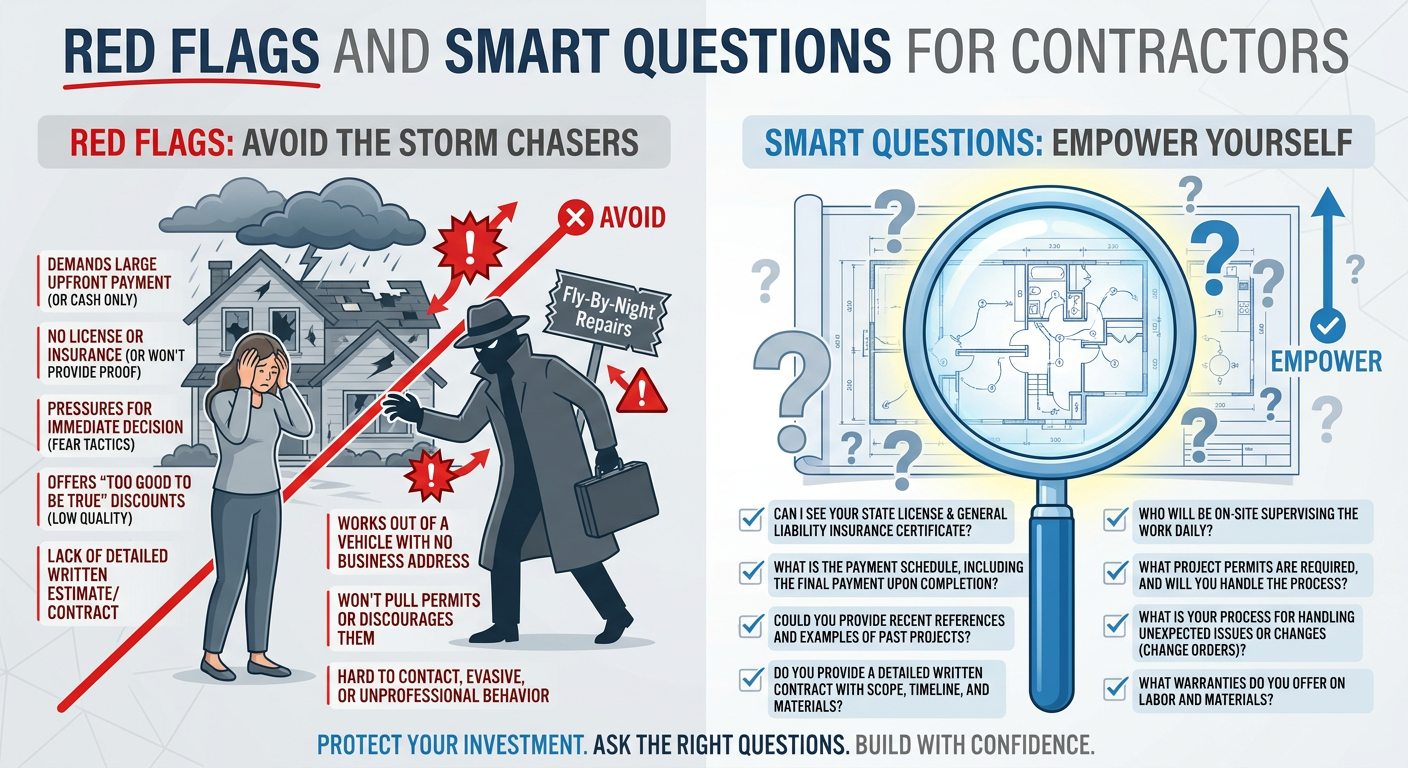
7. Key Questions and Red Flags to Avoid
Home remodeling projects represent a significant financial and emotional investment for homeowners. The U.S. home remodeling market was over $527 billion in 2023 alone[1], illustrating the scale of this activity. With nearly two-thirds of homeowners choosing to renovate rather than move, and 93% planning home projects in 2024[2], the demand for contractors continues to grow. However, this high demand also comes with increased risks. Home improvement complaints have reached record highs in some areas in 2024[3], with reports of unlicensed contractors, often called "storm chasers," exploiting homeowners after natural disasters[4]. A significant trust gap exists, as 64% of people do not trust general contractors[5]. A major reason for this distrust is poor vetting by homeowners; 70% of contractors believe homeowners do not research enough before hiring[6], and fewer than 5% ask to see a contractor’s license or insurance[7].
Given the high stakes, knowing which questions to ask and what warning signs to look for is crucial. Many homeowners only focus on basic questions like project cost and timeline[8]. However, experts stress the need to ask deeper questions about licensing, insurance, project management, and contract details. This section will outline essential, yet often overlooked, questions homeowners should ask and detail various red flags that should prompt caution or lead to walking away from a contractor. Proper vetting protects homeowners from financial loss, shoddy work, and legal liabilities. In Arizona, for example, it is illegal to contract for home remodeling without a state license[9], and hiring an unlicensed contractor can leave homeowners liable if accidents occur or codes are violated[10]. The Arizona Registrar of Contractors (AZ ROC) regulates over 60,000 licensed contractors and provides public information on their status and complaint history[11].
Deep Dive into Key Questions Homeowners Overlook
Beyond the cost and duration of a project, a homeowner's ability to ask specific, in-depth questions can make a substantial difference in the project's outcome and overall satisfaction. These questions aim to gauge the contractor's professionalism, competence, and reliability, covering aspects many homeowners do not consider in their initial interactions.
Warranty and After-Completion Service
One critical question often missed is about the warranty provided on the work. Homeowners should ask, "Do you provide any warranty or service after completion, and for how long?" Many remodeling contractors offer only a 6-12 month warranty, with some offering no warranty at all[12]. For example, Phoenix Home Remodeling states they offer a 1-2 year warranty on products and workmanship[13], which exceeds the industry standard. A longer, written warranty indicates a contractor’s confidence in their work quality. The contract should clearly state the warranty terms, including duration and what is covered. Homeowners should also clarify the process for addressing issues that arise post-completion. An evasive answer or a refusal to provide a warranty should be a concern. This question helps confirm the contractor's commitment to quality beyond project completion.
Subcontractor Management and Licensing
Many remodeling projects involve various specialized trades like plumbing, electrical work, or tiling. It is common for general contractors to use subcontractors. Homeowners should ask, "Will you be using subcontractors, and if so, are they people you work with regularly, and are they licensed and insured?" The answer sheds light on the contractor’s network and their vetting process for these essential project partners. Using unvetted or unlicensed subcontractors can introduce significant risks, including poor workmanship, project delays, and potential liability issues if accidents occur. A reputable contractor will have a trusted network of subcontractors they work with consistently and should be able to confirm their credentials. If a contractor plans to hire subcontractors they have not worked with before, or if they cannot confirm the subcontractors' licensing and insurance, it suggests a lack of proper project planning and quality control.
Handling Unforeseen Issues
Remodeling projects, especially in older homes, can uncover unexpected problems like mold, outdated wiring, or structural damage. How a contractor plans to handle such surprises is a crucial indicator of their problem-solving skills and ethical practices. Homeowners should ask, "How do you handle it if the project runs into an unexpected issue, such as mold or structural problems?" The ideal response would involve a clear process: the contractor should immediately inform the homeowner, stop work in the affected area, assess the issue, and present options for resolution, along with a written change order detailing any additional costs or time needed. Contractors who provide vague answers or suggest they will "just take care of it" without detailing the process might be setting the stage for unexpected charges or disputes. Transparency in handling unforeseen circumstances is paramount to maintaining trust and managing project expectations.
Project Visits and Portfolio Review
A contractor who takes pride in their work should be willing to showcase it. Homeowners should ask, "Can I see a current project or recent project similar to mine?" While photos can provide a visual overview, visiting a current or recently completed project offers a firsthand look at the contractor's workmanship, site management, and client interactions. This allows homeowners to verify the quality of work, cleanliness, and organization of the job site. If an in-person visit is not possible, asking for a detailed portfolio with high-quality images of past work, possibly with client testimonials linked directly to the projects, can be an alternative. A contractor's reluctance to provide such access or examples should be viewed as a potential red flag, as it might suggest they have something to hide regarding their quality standards.
Red Flags to Avoid at All Costs
During the vetting process, certain behaviors and situations should immediately signal caution for homeowners. These red flags often indicate a lack of professionalism, potential for scams, or future problems during the project. Recognizing these warning signs early can save homeowners significant time, money, and stress.
Extremely Low Bids
If one contractor's bid is significantly lower than others, it warrants careful scrutiny. Whitney Hill, a remodeling executive, advises wariness of contractors who avoid specific details about managing job sites or timelines[14]. An unusually low estimate can indicate several issues: the contractor may have overlooked critical aspects of the job, intends to use substandard materials, or may be employing a bait-and-switch tactic, where the initial low price is used to secure the job, followed by numerous "unexpected" add-ons. For example, the case of Edward Carr in Mesa showed how contractors lure homeowners with low prices only to demand more money mid-project for "additional repairs"[15]. All bids should be detailed and itemized to allow for an "apples-to-apples" comparison. If a contractor cannot or will not break down costs clearly, especially for vague "allowance" amounts, it is a significant red flag. Homeowners should understand that quality work comes at a fair price, and drastically undercutting competitors usually means corners are being cut.
Lack of Licensing or Insurance Proof
This is arguably the most critical red flag. A contractor who cannot or will not provide proof of an active license and adequate insurance should be rejected. In Arizona, it is illegal to contract without a license, and homeowners who hire unlicensed contractors risk losing legal protections[16]. The Arizona Registrar of Contractors database allows easy verification of license status. About 60% of contractors report that fewer than 5% of clients ask to see their license or insurance documents[17]. This oversight leaves homeowners vulnerable. Without liability insurance, any damage to property during the remodel might not be covered. Without workers' compensation, homeowners could be held liable if a worker is injured on their property. Excuses about documents being unavailable or suggesting that verification is unnecessary are unacceptable. Always confirm active licenses and insurance directly, rather than taking the contractor's word alone. The Steve Venegas case in Phoenix, where an unlicensed individual defrauded homeowners of over $408,000, starkly illustrates the dangers of skipping this crucial step[18].
Demands for Large Upfront Payments or Cash-Only Transactions
Be very cautious if a contractor demands a substantial upfront payment, such as 50% or more of the total project cost, before any work has begun. The Better Business Bureau and other consumer protection agencies advise against paying the full cost in advance, recommending staggered payments tied to project milestones instead[19]. Large initial deposits can indicate a contractor's financial instability or an intent to abscond with the money. Some states even have legal limits on the maximum upfront deposit, often around 10%. Similarly, an insistence on cash-only payments is a massive red flag[20]. Cash transactions leave no paper trail, making it difficult to prove payments or seek recourse if a dispute arises. Ethical contractors prefer traceable payment methods like checks or credit cards. The case of an unlicensed contractor in Phoenix taking thousands upfront and disappearing highlights the danger of large cash payments[21].
Reluctance to Provide a Written Contract
A contractor who avoids providing a detailed written contract, suggesting a "handshake agreement" is sufficient, should be avoided. In Arizona, any home improvement project over $1,000 legally requires a written contract[22]. Verbal agreements offer no legal protection. The saying "If it’s not in writing, it doesn’t exist"[23] holds true in remodeling. A comprehensive contract should outline project scope, materials, timeline, payment schedule, and warranty information. A reluctance to formalize the agreement in writing indicates a potential lack of professionalism, an intent to cut corners, or a desire to leave room for later disputes on project details or costs. Homeowners should insist on a clear, written contract and review it thoroughly before signing.
Vague Answers or Evasive Communication
Initial interactions with a contractor are telling. If a contractor provides non-committal, vague, or dismissive answers to specific questions about the timeline, permits, handling delays, or project management, this is a red flag. Phrases like "Don't worry, we'll take care of it" without specifics, or relying solely on personal assurance like "I've been doing this for 20 years, trust me," without directly addressing concerns, suggest a lack of a clear plan or something to hide. Trustworthy contractors are transparent and patient, willing to detail processes and answer questions thoroughly. Poor communication habits, such as not returning calls promptly or arriving late to appointments without explanation, are also predictive of future communication problems and are top deal-breakers for 31% of homeowners[24]. Homeowners should trust their instincts; if a contractor seems evasive or unprofessional, it is best to seek other options.
High-Pressure Sales Tactics
Any contractor who pressures a homeowner for an immediate decision, uses scare tactics, or offers "today-only" discounts should be viewed with extreme suspicion. Pushy sales tactics are a significant turn-off for homeowners, with 38% in a 2025 survey citing it as their top deal-breaker[25]. These tactics aim to prevent homeowners from doing their due diligence, comparing bids, or thoroughly reviewing contracts. Reputable contractors understand that choosing a remodeling partner is an important decision and will provide ample time for consideration. The elderly homeowner in Wisconsin who almost fell victim to traveling workers offering cheap driveway paving illustrates how high-pressure, on-the-spot offers can be dangerous[26]. Always take time to research, verify credentials, and review contracts before committing.
Common Pitfalls to Avoid
Homeowners often fall into traps due to lack of experience or insufficient preparation. Avoiding these common pitfalls through diligent vetting is as important as asking the right questions.
- Skipping Reference Checks: Many homeowners receive references but do not call them. Reach out to at least three recent clients and ask specific questions about project timeliness, budget adherence, communication, and how the contractor handled issues.
- Neglecting Online Research: Beyond provided references, check independent review sites such as Google, Yelp, Houzz, and the Better Business Bureau. Phoenix Home Remodeling suggests searching "
issues" or "complaints" to uncover hidden problems[27]. The BBB is a trusted source, with 84% of homeowners valuing membership as a trust signal[28], and allows checking complaint history. - Not Understanding the Contract: Every part of the contract should be understood. This includes scope of work details, material specifications, payment schedules, and clauses for change orders. If anything is unclear, ask for clarification before signing.
- Forgetting About Permits: Assuming the contractor will handle all permits or agreeing to pull permits as the homeowner is a mistake. The contractor should obtain all necessary permits, ensuring the work complies with local building codes. A contractor asking the homeowner to pull permits often signals they are unlicensed.
- Ignoring Communication Style: Prioritize contractors who demonstrate clear, respectful, and responsive communication from the outset. Discuss preferred communication methods and expected response times. Poor communication is a leading cause of project dissatisfaction.
- Not Defining a Point of Contact: On larger projects, clarify who the primary point of contact will be. This could be the contractor themselves or a dedicated project manager. This prevents confusion and ensures accountability throughout the project[29].
- Overlooking Site Management Details: Discuss how the contractor plans to keep the job site clean, safe, and minimize disruption to the home. This includes routines for daily cleanup, dust control, property protection, and storage of tools and materials[30].
By actively asking these questions and staying alert for red flags, homeowners can significantly improve their chances of a successful and positive remodeling experience. Proactive vetting is the best defense against common contractor problems and fraudulent operators.
The next section will discuss the importance of transparent communication throughout the remodeling process and how to establish clear communication channels with your chosen contractor.
8. Online Research and Reputation Management
Hiring a home remodeling contractor can be a challenging process for many homeowners. Deciding who to trust with a significant investment in one's home requires careful consideration beyond just price and timeline. The volume of remodeling activity in the United States, which reached over $527 billion in 2023, means many homeowners are seeking renovation services and will need contractors [1]. As interest rates rise, nearly two-thirds of homeowners prefer renovating their current homes rather than moving [2]. In 2024, 93% of homeowners planned home projects [3]. This high demand for remodeling services highlights the need for effective contractor vetting.
Despite this need, a significant trust gap exists. A survey found that 64% of people do not trust general contractors [8]. This distrust is not without cause. Home improvement complaints reached record highs in some areas in 2024 [4]. Some of these complaints involved unlicensed "storm chaser" contractors exploiting homeowners after disasters [5]. Nationally, dissatisfaction is growing as more people renovate, with 67% preferring to renovate over moving [6].
Part of the problem stems from insufficient homeowner vetting. Seventy percent of contractors report that homeowners do not research enough before hiring [9]. Most homeowners fail to ask basic credential questions; fewer than 5% ask to see a contractor’s license or insurance [10]. This gap between the need for vetting and the actual practices of homeowners can lead to problems a proper contractor search could prevent.
In Arizona, home remodelers must be state-licensed [11]. Hiring an unlicensed contractor is against the law and carries significant risks. If unlicensed work violates building codes or causes damage, the homeowner can be held responsible [12]. The Arizona Registrar of Contractors (AZ ROC) regulates over 60,000 licensed contractors [13] and provides public information on license status, bonds, and complaint history [14].
Many homeowners mainly inquire about cost and timeframes [15]. However, experts stress the importance of deeper questions covering licensing, insurance, project management, and contracts. For example, asking "Are you licensed and insured?" is essential, as it is the top concern for 25% of homeowners [16]. Other important questions include "What warranty do you provide?" (most offer 6-12 months, but some offer more) [17], "How are changes handled?" (using change orders avoids unexpected charges) [18], and "Who will be my point of contact?" (this ensures accountability).
A written contract is crucial for protection. Arizona law mandates a written contract for jobs over $1,000 [19]. Professionals advise, "If it's not in writing, it doesn’t exist" [20]. Clear contracts with detailed scope, timelines, payment schedules, and change procedures help prevent disputes [21], [22].
Payment practices also require careful attention. Consumer agencies like the Better Business Bureau (BBB) warn against paying the full cost upfront [23]. Reputable contractors use milestone payments, where homeowners pay as work is completed [24]. Large deposit demands (over 50%) or cash-only terms are red flags [25], [26].
Good communication is vital. Forty-one percent of homeowners cite clear, respectful communication as the most important factor in a project [29]. Before hiring, establish communication methods and frequency. Ask if a dedicated project manager will be assigned [30]. Lack of communication is a common deal-breaker; about 31% of homeowners will not hire a contractor with poor communication or who does not listen [31].
Online research and reputation management are essential parts of contractor vetting. This section will focus on using online reviews, BBB profiles, and professional affiliations to assess a contractor's reputation and track record.
The Importance of Online Reviews and References
Online reviews and references have become central to consumer decision-making, including hiring remodeling contractors. Homeowners often start their search for services online, and the digital footprint of a contractor can provide initial insights into their reliability and quality of work. Nearly 7 in 10 homeowners research contractors online and check reviews or references before making a decision [37].
Reputable contractors should have a visible and positive online presence. If a company lacks reviews, or if its reviews show consistent complaints, homeowners should be cautious [33]. For example, Phoenix Home Remodeling advises against selecting any firm that does not maintain approximately 95% positive reviews [33]. This high standard reflects the importance of online sentiment as an indicator of a contractor's commitment to customer satisfaction.
When evaluating online reviews, homeowners should look for patterns rather than focusing on a single review. One or two negative reviews among many positive ones might not be a deal-breaker. However, if multiple reviews cite common problems, such as missed deadlines, unexpected costs, poor communication, or unsatisfactory workmanship, these are significant warning signs. It is useful to search for the contractor's name followed by terms like "issues" or "complaints" to uncover potential problems not immediately visible on primary review platforms [32]. This expanded search can reveal news articles, forum discussions, or reports from consumer protection agencies about the contractor.
Beyond online platforms, obtaining and contacting references directly from previous clients is a crucial step that many homeowners overlook. A trustworthy contractor should readily supply 3-5 references from recent clients [34], [35]. When speaking with references, specific questions can help gauge the contractor's performance:
- Was the project completed on time and within budget?
- How was the communication throughout the project?
- Were there any issues or problems that arose, and how effectively were they resolved?
- Would you hire this contractor again or recommend them to others?
In addition to contacting references, it can be valuable to view a contractor's portfolio of past work or, if possible, visit an ongoing project. Many reputable contractors are proud of their work and will be willing to showcase it [36]. If a contractor hesitates to provide references or a portfolio, it should raise concerns.
The reliance on online information and personal recommendations underscores a paradox. While word-of-mouth referrals remain highly trusted, with 61% of homeowners preferring recommendations from people they know, homeowners still typically conduct online checks even for referred contractors [38]. Conversely, only 14% of homeowners explicitly trust third-party contractor referral platforms [39]. Alarmingly, almost 30% of homeowners have reported negative experiences with contractors found through online platforms [40]. This highlights that while online platforms can be a starting point, thorough individual due diligence remains irreplaceable.
Better Business Bureau Profiles and Accreditations
The Better Business Bureau (BBB) serves as a significant resource for homeowners vetting contractors. An overwhelming 84% of homeowners consider a contractor's membership in a professional organization, such as the BBB or local builders' guild, an important sign of trust [33]. This shows the value homeowners place on external validation and accountability.
Checking a contractor's BBB profile can provide critical information:
- Accreditation Status: BBB accreditation signals a commitment to ethical business practices and resolving customer complaints. While not a guarantee, it indicates that the business has met specific standards and is willing to engage with consumer feedback.
- Rating: The BBB assigns ratings from A+ to F based on a variety of factors, including complaint history, transparency, and business practices. A high rating, such as an A-rating, especially with zero unresolved complaints, offers considerable peace of mind [33].
- Complaint History: The BBB profile details any complaints filed against the contractor and, importantly, how those complaints were addressed or resolved. A pattern of unresolved complaints is a major red flag. Conversely, a contractor who actively works to resolve issues demonstrated professionalism and customer focus.
The BBB is a frequently used resource, ranking third among sources homeowners use to find contractors, after personal referrals and Google [32]. This suggests that homeowners trust the BBB's role in vetting businesses and documenting complaint records. Local BBB offices have also been instrumental in highlighting emerging issues, such as the record number of home repair complaints in 2024, which often include issues caused by unlicensed "storm chaser" contractors [5].
However, membership in the BBB is not a substitute for checking state licensing. For instance, in Arizona, an unlicensed contractor like Steve Venegas managed to defraud 24 homeowners of over $408,000 [7]. A rapid check of his status with the Arizona Registrar of Contractors (AZ ROC) would have revealed he was unlicensed. This illustrates that while BBB accreditation is valuable, it must be combined with mandatory government checks, such as license verification with the appropriate state board (e.g., AZ ROC).
Professional Affiliations and Industry Recognition
Beyond BBB accreditation, other professional affiliations and industry recognitions can provide further insights into a contractor's reliability and commitment to their trade. These affiliations often require adherence to certain standards, continuous education, and ethical conduct.
Examples of such affiliations include:
- National Association of the Remodeling Industry (NARI): Membership in NARI shows a commitment to industry best practices, professional development, and integrity.
- Local Home Builders Associations (HBA): Local HBAs often have codes of conduct for members and provide resources that promote high standards in home construction and remodeling.
- Specialized Certifications: Depending on the type of remodeling project, certifications from specific trade organizations (e.g., for roofing, plumbing, or electrical work) indicate specialized expertise and adherence to safety and quality standards.
Many reliable Phoenix contractors will prominently display their AZ ROC license number, BBB accreditation, and any awards or certifications on their websites and marketing materials. If such information is absent or hard to locate, it warrants further investigation by the homeowner.
Some contractors actively assist homeowners in the vetting process, demonstrating transparency and confidence in their own qualifications. For example, Phoenix Home Remodeling provides resources, such as a checklist of vetting questions, to help homeowners choose a contractor [32]. A contractor who encourages careful vetting of all options, including their own, is likely secure in their operational standards and customer service.
Active participation in the local business community, such as Chamber of Commerce membership, can also be a positive indicator. This suggests the contractor is invested in their community and aims to maintain a positive local reputation. Such engagement often differentiates fly-by-night operators from established, responsible businesses [33].
Red Flags in Online Research and Reputation
While online research offers many benefits, homeowners must also be aware of potential red flags that may indicate a contractor is not legitimate or reliable.
- Lack of an Online Presence: In today's digital age, a complete absence of an online presence (website, social media, review profiles) for a contractor should be a significant concern. While some smaller, word-of-mouth businesses exist, most reputable contractors will have at least a basic online footprint.
- Aggressive or Unprofessional Responses to Negative Reviews: While contractors may respond to negative reviews to clarify misunderstandings, overly aggressive, defensive, or unprofessional responses can signal poor customer service and difficulty handling criticism.
- Generic or Suspiciously Perfect Reviews: A long list of reviews that are all overly positive, short, and lack specific details (e.g. "Great job! Five stars!") might be suspicious. Similarly, reviews that appear to be copied or use similar language can indicate false reviews.
- Sudden Spikes in Reviews: A sudden influx of many positive reviews in a short period, especially after a period of few reviews or negative feedback, could indicate an attempt to manipulate ratings.
- Disconnected Information: Inconsistencies between information found on different platforms (e.g., different business names, phone numbers, or addresses) may suggest a lack of transparency or a contractor trying to evade a problematic history.
- Offered "Deals" or "Bargains" on Social Media: As seen in the example of Edward Carr in Mesa, who defrauded homeowners of over $100,000 by advertising services on social media [51], offers that seem too good to be true, especially from unknown sources, should be approached with extreme caution. These often lead to unexpected mid-project cost increases or unfinished work [52].
The case of Edward Carr further highlights how low bids can attract homeowners who fail to verify credentials [53]. Carr would demand "additional repairs" mid-project and then fail to pay subcontractors, leaving homeowners with unfinished work [54]. Had homeowners checked his licensing or insisted on paying subs through a legitimate general contractor, the scam might have been avoided [55]. This demonstrates the pitfalls of trusting social media advertisements without proper vetting. Mesa Police, working with the AZ ROC, charged Carr with fraud, theft, and unlicensed contracting [56].
Homeowners must be vigilant and critical when evaluating online information. The internet offers a wealth of data, but it also contains misinformation and opportunities for fraud. By combining online checks with direct verification of licenses, insurance, and references, homeowners can build a more complete and reliable picture of a contractor's reputation.
Table 1: Key Online Research and Reputation Checklist
| Category | Action Item | Why This Matters |
|---|---|---|
| Online Reviews | Check Google, Yelp, Houzz, Angi, etc. | Look for patterns of positive or negative feedback. Avoid contractors with consistent complaints about cost, timeliness, or quality. Phoenix Home Remodeling suggests aiming for 95% positive reviews [33]. |
| Expanded Search | Search Google for "Company Name issues" or "complaints" [32]. | Uncover legal issues, news reports, or less visible complaints. |
| Better Business Bureau (BBB) | Verify BBB profile, rating, and complaint history. | A-ratings and membership signal credibility. Check if complaints are resolved or if a pattern of issues exists [33]. |
| Professional Affiliations | Look for memberships (NARI, local HBAs) and certifications. | Indicates commitment to industry standards and professional development. |
| Portfolio/References | Request 3-5 recent client references and contact them. Ask to see a portfolio of similar projects. | Personal testimonials and visual evidence affirm quality and reliability from real experiences [34], [36]. |
| Social Media Presence | Observe contractor's activity, responsiveness, and content on social platforms. | Can reveal insights into their professionalism and communication style, but be wary of deals from unverified sources [51]. |
The importance of online research cannot be overstated in today's environment, where consumer complaints against contractors have reached record highs [4], and instances of fraud, like the Steve Venegas case involving $408,000 stolen from homeowners in Arizona [7], continue to emerge. Homeowners who thoroughly vet contractors using online tools and direct checks reduce their risk of financial loss and project dissatisfaction. This proactive approach helps bridge the trust gap in the remodeling industry, ensuring a smoother and more satisfactory renovation experience.
The next section will discuss important considerations for contracts, payments, and warranties, building on the groundwork of strong online research and reputation management.
9. Frequently Asked Questions
Selecting a remodeling contractor can feel like a complex process for many homeowners. With significant financial and personal investment in a home renovation, it is common to have many questions. This section addresses some of the most common questions homeowners ask, or should ask, when vetting a remodeling contractor in Phoenix. It covers essential topics from licensing and insurance to contracts, payment, communication, and red flags. The goal is to give homeowners clarity and confidence as they make important decisions about their home projects.
What are the first things I should ask a potential remodeling contractor in Phoenix?
When you first speak with a potential remodeling contractor in Phoenix, focus inquiries on their basic credentials and experience:
- Are you licensed and insured? Obtaining an active license is required for contractors in Arizona. Asking this question is crucial. Arizona law requires home remodelers to be state-licensed [10]. Hiring an unlicensed contractor is illegal and risky [10]. Fewer than 5% of homeowners ask to see a contractor’s license or insurance [13]. However, 25% of homeowners say "licensed and insured" is the most important factor when choosing a contractor [14].
- What is your Arizona Registrar of Contractors (AZ ROC) license number? This allows you to verify their license status directly with the state. The AZ ROC regulates over 60,000 licensed contractors [11]. It provides public information on license status, bonds, and complaint history [12].
- Do you carry liability insurance and workers' compensation? Ask for proof of both. Liability insurance protects you if the contractor damages your property. Workers' compensation protects you from claims if a worker is hurt on your property [13]. If the contractor lacks proper insurance, the homeowner can be held liable for injuries [17].
- How long have you been in business, and what is your experience with projects like mine? This helps assess their stability and relevance. This also helps you understand if they have done similar projects in the past.
- Can you provide references from recent clients? A reputable contractor will have a list ready [15]. You should call these references.
These initial questions establish the contractor's legal standing and basic reliability. If a contractor hesitates or cannot provide clear answers, it is a significant red flag.
Why is it so important for a contractor to be licensed in Arizona?
For several reasons, a contractor must be licensed in Arizona:
- Legal Requirement: Arizona law requires home remodelers to be state-licensed [10]. Any home improvement contract over $1,000 must be in writing [18].
- Consumer Protection: A licensed contractor has met state standards, passed exams, and often carries a bond. This bond can offer some financial recourse if the contractor fails to complete the work or if problems arise [10]. Unlicensed contractors do not provide this protection. If unlicensed work violates building codes or causes damage, the homeowner can be held liable [11].
- Workmanship and Safety: Licensed contractors are generally more familiar with building codes, safety regulations, and proper construction techniques. This reduces the risk of shoddy work, costly errors, or unsafe conditions [10].
- Recourse for Disputes: If a dispute arises with a licensed contractor, you have access to the Arizona Registrar of Contractors (AZ ROC) complaint resolution process. The AZ ROC can help mediate issues and enforce regulations [12]. With an unlicensed individual, your options for recourse are much more limited and can be costly in court [16]. For example, the AZ ROC received 22 complaints against one fake contractor who stole $408,000 from homeowners [7].
- Insurance Requirements: To obtain and maintain a license, contractors must carry specific types and amounts of insurance, including liability and workers' compensation. This protects both the homeowner and the workers on site [17].
Phoenix Home Remodeling emphasizes that hiring an unlicensed contractor can void legal protections and warranties provided by state law [16]. Always verify a contractor's license through the AZ ROC database before hiring [12].
What kind of information should be in a written contract?
A written contract is a legal document that protects both the homeowner and the contractor. Arizona law mandates a written contract for any home improvement project costing over $1,000 [19]. A comprehensive contract should include:
- Contractor and Homeowner Details: Full legal names, addresses, contact information, and the contractor's AZ ROC license number.
- Project Scope: A detailed description of the work to be performed, including all tasks, materials, and specifications. This should leave no room for ambiguity. For example, it should specify brands, colors, and types of finishes.
- Project Timeline: Clear start and estimated completion dates, including milestones.
- Total Cost and Payment Schedule: The agreed-upon total price, a detailed breakdown of costs, and a clear payment schedule tied to project milestones. The Better Business Bureau (BBB) recommends staggering payments [20]. Avoid contractors who demand large upfront payments, like 50% or more [21].
- Change Order Procedure: A defined process for how changes to the scope of work, materials, or timeline will be agreed upon. All changes should be in writing and signed by both parties [22].
- Warranty Information: Details of any warranties on workmanship and materials, including duration and what is covered [23]. Many contractors offer a 6 to 12-month warranty [23]. Phoenix Home Remodeling, for example, offers a 1 to 2-year warranty on projects [27].
- Permits and Inspections: Who is responsible for obtaining necessary permits and scheduling inspections. Usually, it is the contractor's responsibility.
- Cleanup and Site Management: Expectations for daily job site cleanup, debris removal, and protection of the homeowner's property [30].
- Dispute Resolution: A clause outlining how disagreements will be handled.
- Cancellation Clause: Terms and conditions for terminating the contract.
The saying "If it’s not in writing, it doesn’t exist" holds true for remodeling contracts [19]. Always read the contract carefully before signing. Make sure it contains every detail discussed and agreed upon.
How should I handle payments to a contractor? What are the red flags?
Smart payment practices are important for protecting your investment:
- Avoid Large Upfront Payments: Never pay the full cost upfront [20]. The BBB and Phoenix Home Remodeling advise against paying the entire project amount upfront [20]. Large deposit demands (over ~50%) are red flags [21]. Reputable contractors typically ask for a reasonable deposit, often 10-20%, to cover initial materials and planning [21].
- Milestone Payments: Structure payments to be tied to the completion of specific project milestones [20]. This ensures you only pay for work that has been completed to your satisfaction. For example, payments could be made upon completion of demolition, rough-ins, finish work, and final project completion.
- Withhold Final Payment: Always withhold the final payment until the entire project is completed to your satisfaction, all inspections are passed, and you’ve conducted a final walk-through [22].
- Use Traceable Payment Methods: Pay by check or credit card. This creates a paper trail [22]. Never pay in cash for a large project, as cash payments are difficult to track and offer no protection [22].
Red flags related to payment include:
- Demanding unusually large upfront payments (50% or more) [21].
- Insisting on cash-only payments [22].
- Asking you to make checks out to an individual person instead of the company.
- Pressuring for quick payment or not providing detailed invoices.
These practices often signal a contractor who may be operating without proper licenses, trying to avoid taxes, or planning to abandon the job after receiving payment. For example, Steve Venegas, an unlicensed contractor in Phoenix, stole $408,750 from homeowners by taking large payments and then abandoning projects [7].
How can I verify a contractor's reputation and track record?
Confirming a contractor's reputation is a multi-step process:
- Check AZ ROC: Use the Arizona Registrar of Contractors website to verify their license, ensure it is active, and check for any past complaints or disciplinary actions [12].
- Call References: Ask for and actually call 3-5 references from recent clients [15]. Ask specific questions about project completion, communication, and problem resolution [15].
- Online Reviews: Check reviews on platforms like Google, Yelp, Houzz, and social media. Look for patterns in feedback. Consistently negative reviews are a major warning sign [15]. Phoenix Home Remodeling suggests being wary of any firm that isn't at least 95% positive in reviews.
- Better Business Bureau (BBB): Check the contractor's profile on the BBB website. Look for accreditation, their rating, and any customer complaints. You can see how complaints were handled and if they remain unresolved [15]. 84% of homeowners value BBB membership as a trust signal [15].
- Portfolio and Site Visits: Ask to see a portfolio of their past work, especially projects similar to yours. If possible, ask to visit a current or recently completed project [15]. Good contractors should be proud to display their work.
- Social Media Presence: A professional social media presence can show ongoing projects and customer interactions. However, be cautious, as some scammers use social media to find victims, as seen in the Edward Carr case in Mesa, where he defrauded homeowners out of over $100,000 via social media advertising [8].
Combining these methods provides a comprehensive view of a contractor's true reputation.
What are common red flags that should make me walk away from a contractor?
Be aware of these warning signs:
- No License or Insurance: Refusal or inability to show proof of a valid AZ ROC license and appropriate insurance coverage [17]. This is a primary red flag.
- Too-Good-To-Be-True Bids: A quote significantly lower than other bids often indicates shortcuts, poor-quality materials, or hidden costs [44]. Edward Carr used very low quotes to get hired before springing "additional repairs" on homeowners [8].
- Large Upfront Payment Demands: Asking for 50% or more of the project cost upfront [21].
- Cash-Only Requests: Insisting on cash payments [22].
- No Written Contract: Reluctance to provide a detailed written contract for jobs over $1,000, or pressuring you to start work without one [19].
- Pushy Sales Tactics: High-pressure sales, such as "sign today or the price doubles" [6]. Almost 38% of homeowners are put off by pushy sales tactics [9].
- Vague or Evasive Answers: Non-committal responses to specific questions about the project, schedules, materials, or problem-solving.
- Lack of References or Poor Reviews: No references, or a pattern of consistent negative reviews online.
- Asking You to Pull Permits: If a contractor asks the homeowner to obtain the permits, it might mean they are unlicensed and cannot legally pull permits themselves [29].
- Lack of Communication: Unresponsive communication during the initial vetting phase is a strong indicator of poor communication during the project. 31% of homeowners will not hire a contractor with poor communication habits [28].
Trust your instincts. If something feels off, it likely is. It is always better to walk away from a potential problem contractor than to regret your choice later.
What questions should I ask about communication and project management during the remodel?
Clear communication is a key factor in satisfaction during a remodel, with 41% of homeowners citing it as most important [26]. Ask the following questions:
- Who will be my primary point of contact, and how often will they communicate? You need to know exactly who to speak to about any concerns [27]. Will there be a dedicated project manager or site supervisor?
- What is your preferred method of communication (phone, email, text) and your typical response time? [27] This sets expectations for responsiveness.
- How will project progress be reported? Will you have regular meetings, get email updates, or receive progress photos?
- How will changes to the project (e.g., unexpected issues, design changes) be discussed and documented? This ties into the change order process mentioned in the contract [22].
- What are the expected working hours for the crew, and will they be on-site every day? Knowing the schedule helps you plan your daily life around the remodel [30].
- How will you protect my property and keep the work area clean? Ask about dust containment, floor protection, and daily cleanup routines. Many homeowners complain about messiness [30].
- Where will tools and materials be stored? This is important for safety, especially if you have children or pets [30].
A contractor who provides clear, consistent answers to these questions demonstrates good organizational skills and a respect for your concerns. Phoenix Home Remodeling helps homeowners by providing a checklist of vetting questions, which can be useful to ensure all aspects of the project are discussed [16].
What about warranties? What should I expect?
Warranties are important for peace of mind:
- Ask for a Warranty: Inquire about the warranty provided on their workmanship and materials. Get the details in writing within the contract [23].
- Typical Duration: Many remodeling contractors offer a 6-12 month warranty on labor [23]. Some, like Phoenix Home Remodeling, offer longer warranties (e.g., 1-2 years on both workmanship and materials) [27].
- Manufacturer Warranties: Ensure you receive all manufacturer warranties for products and appliances installed during the remodel.
- What's Covered: The warranty should specify what defects or issues it covers and for what period. It should also outline the process for making a claim.
A contractor who provides a clear and reasonable warranty demonstrates confidence in their work and materials. A lack of a warranty or a very short one might suggest they are less confident about the longevity of their work.
Should I get multiple bids, and how many are too many?
It is generally advised to get multiple bids:
- At Least Three Bids: Getting at least three estimates is recommended to compare pricing, project approaches, and contractor communication styles [22]. About 42% of homeowners get two bids, 28% get three, and only about 16% solicit four or more [25].
- Compare "Apples-to-Apples": When comparing bids, ensure they cover the same scope of work, use similar quality materials, and include all necessary elements (permits, cleanup, etc.). A very low bid might exclude important details [44].
- Quality Over Quantity: While comparing bids is important, don't get lost in too many options. Once you have a few detailed proposals from well-vetted contractors, focusing on comparing their value and fit for your project is more useful than getting endless quotes.
The goal of multiple bids is not just to find the cheapest option, but to understand the fair market value for your project and to find a contractor who inspires trust and confidence. The time spent vetting a contractor upfront is an investment that can prevent significant problems and costs later.
The next section will cover the various types of remodeling services commonly offered by contractors in the Phoenix area, highlighting what homeowners can expect from each.
References
- U.S. Residential Remodeling Market Size Report, 2030
- Homeowners embrace renovation over relocation - Furniture Today
- Homeowners embrace renovation over relocation - Furniture Today
- Record Number of Home Repair Complaints Made to Better Business Bureau: What’s Going On?
- Record Number of Home Repair Complaints Made to Better Business Bureau: What’s Going On?
- Record Number of Home Repair Complaints Made to Better Business Bureau: What’s Going On?
- National Ipsos Survey on Renovation - 7 in 10 Canadians Have Difficulty Finding a Contractor They Can Trust
- Homeowners should ask more questions: report - Construction Canada
- Homeowners should ask more questions: report - Construction Canada
- Arizona Registrar Of Contractors Offers Free Brochure | ACHR News
- Record Number of Home Repair Complaints Filed With Better Business Bureau
- General Information | Arizona Registrar of Contractors
- Arizona Registrar Of Contractors Offers Free Brochure | ACHR News
- Questions to ask a home remodeling company
- Survey | What Matters to Homeowners When Choosing a Contractor
- 9 Questions Every Homeowner Should Ask Their Contractor
- 9 Questions Every Homeowner Should Ask Their Contractor
- 9 Questions Every Homeowner Should Ask Their Contractor
- Record Number of Home Repair Complaints Filed With Better Business Bureau
- Record Number of Home Repair Complaints Filed With Better Business Bureau
- 9 Questions Every Homeowner Should Ask Their Contractor
- 9 Questions Every Homeowner Should Ask Their Contractor
- Record Number of Home Repair Complaints Filed With Better Business Bureau
- 9 Questions Every Homeowner Should Ask Their Contractor
- 10 Tips for Hiring a Contractor - Badger Roofing
- 10 Tips for Hiring a Contractor - Badger Roofing
- Survey | What Matters to Homeowners When Choosing a Contractor
- 9 Questions Every Homeowner Should Ask Their Contractor
- Modernize Homeowner Insights 2025: Contractor Selection Trends |
- 10 Tips for Hiring a Contractor - Badger Roofing
- Record Number of Home Repair Complaints Filed With Better Business Bureau
- Record Number of Home Repair Complaints Filed With Better Business Bureau
- Questions to ask a home remodeling company
- Survey | What Matters to Homeowners When Choosing a Contractor
- Modernize Homeowner Insights 2025: Contractor Selection Trends |
- Arizona Registrar Of Contractors Offers Free Brochure | ACHR News
- General Information | Arizona Registrar of Contractors
- Arizona Registrar Of Contractors Offers Free Brochure | ACHR News
- Homeowners embrace renovation over relocation - Furniture Today
- Homeowners embrace renovation over relocation - Furniture Today
- Record Number of Home Repair Complaints Made to Better Business Bureau: What’s Going On?
- Record Number of Home Repair Complaints Made to Better Business Bureau: What’s Going On?
- Record Number of Home Repair Complaints Made to Better Business Bureau: What’s Going On?
- What Do Homeowners Look For in a Renovation Professional? | Houzz Pro
- Homeowners should ask more questions: report - Construction Canada
- Homeowners should ask more questions: report - Construction Canada
- Survey | What Matters to Homeowners When Choosing a Contractor
- Survey | What Matters to Homeowners When Choosing a Contractor
- Modernize Homeowner Insights 2024: Contractor Selection Trends |
- 9 Questions Every Homeowner Should Ask Their Contractor
- Record Number of Home Repair Complaints Filed With Better Business Bureau
- 9 Questions Every Homeowner Should Ask Their Contractor
- 9 Questions Every Homeowner Should Ask Their Contractor
- Record Number of Home Repair Complaints Filed With Better Business Bureau
- 10 Tips for Hiring a Contractor - Badger Roofing
- 9 Questions Every Homeowner Should Ask Their Contractor
- 9 Questions Every Homeowner Should Ask Their Contractor
- 9 Questions Every Homeowner Should Ask Their Contractor
- Survey | What Matters to Homeowners When Choosing a Contractor
- Modernize Homeowner Insights 2025: Contractor Selection Trends |
- Modernize Homeowner Insights 2025: Contractor Selection Trends |
- Leaf Home Survey Reveals Trust Gap in Home Improvement Industry - NARI – North East Wisconsin Chapter
- Leaf Home Survey Reveals Trust Gap in Home Improvement Industry - NARI – North East Wisconsin Chapter
- Leaf Home Survey Reveals Trust Gap in Home Improvement Industry - NARI – North East Wisconsin Chapter
- Modernize Homeowner Insights 2024: Contractor Selection Trends |
- Modernize Homeowner Insights 2025: Contractor Selection Trends |
- Modernize Homeowner Insights 2024: Contractor Selection Trends |
- Modernize Homeowner Insights 2024: Contractor Selection Trends |
- Modernize Homeowner Insights 2024: Contractor Selection Trends |
- U.S. Residential Remodeling Market Size Report, 2030
- Homeowners embrace renovation over relocation - Furniture Today
- National Ipsos Survey on Renovation - 7 in 10 Canadians Have Difficulty Finding a Contractor They Can Trust
- Leaf Home Survey Reveals Trust Gap in Home Improvement Industry - NARI – North East Wisconsin Chapter
- Record Number of Home Repair Complaints Filed With Better Business Bureau
- Record Number of Home Repair Complaints Filed With Better Business Bureau
- Fake contractor placed on Arizona’s contracting board’s ‘most wanted’ list
- Fake contractor placed on Arizona’s contracting board’s ‘most wanted’ list
- Record Number of Home Repair Complaints Made to Better Business Bureau: What’s Going On?
- What Do Homeowners Look For in a Renovation Professional? | Houzz Pro
- Arizona Registrar Of Contractors Offers Free Brochure | ACHR News
- Arizona Registrar Of Contractors Offers Free Brochure | ACHR News
- 9 Questions Every Homeowner Should Ask Their Contractor
- 9 Questions Every Homeowner Should Ask Their Contractor
- Homeowners should ask more questions: report - Construction Canada
- 10 Tips for Hiring a Contractor - Badger Roofing
- Record Number of Home Repair Complaints Filed With Better Business Bureau
- Questions to ask a home remodeling company
- Survey | What Matters to Homeowners When Choosing a Contractor
- Questions to ask a home remodeling company
- 9 Questions Every Homeowner Should Ask Their Contractor
- 9 Questions Every Homeowner Should Ask Their Contractor
- Record Number of Home Repair Complaints Filed With Better Business Bureau
- Record Number of Home Repair Complaints Filed With Better Business Bureau
- 9 Questions Every Homeowner Should Ask Their Contractor
- 10 Tips for Hiring a Contractor - Badger Roofing
- 10 Tips for Hiring a Contractor - Badger Roofing
- Record Number of Home Repair Complaints Filed With Better Business Bureau
- 9 Questions Every Homeowner Should Ask Their Contractor
- 9 Questions Every Homeowner Should Ask Their Contractor
- 9 Questions Every Homeowner Should Ask Their Contractor
- 9 Questions Every Homeowner Should Ask Their Contractor
- 9 Questions Every Homeowner Should Ask Their Contractor
- Modernize Homeowner Insights 2025: Contractor Selection Trends |
- 9 Questions Every Homeowner Should Ask Their Contractor
- 9 Questions Every Homeowner Should Ask Their Contractor
- 9 Questions Every Homeowner Should Ask Their Contractor
- 9 Questions Every Homeowner Should Ask Their Contractor
- 9 Questions Every Homeowner Should Ask Their Contractor
- Record Number of Home Repair Complaints Filed With Better Business Bureau
- Homeowners should ask more questions: report - Construction Canada
- 10 Tips for Hiring a Contractor - Badger Roofing
- Navy veteran, others claim scammed by contractor
- Fake contractor placed on Arizona’s contracting board’s ‘most wanted’ list
- 9 Questions Every Homeowner Should Ask Their Contractor
- Modernize Homeowner Insights 2025: Contractor Selection Trends |
- Questions to ask a home remodeling company
- Fake contractor placed on Arizona’s contracting board’s ‘most wanted’ list
- Fake contractor placed on Arizona’s contracting board’s ‘most wanted’ list
- Fake contractor placed on Arizona’s contracting board’s ‘most wanted’ list
- Fake contractor placed on Arizona’s contracting board’s ‘most wanted’ list
- Mesa Man Arrested In Alleged $100K Contractor Scam
- Mesa Man Arrested In Alleged $100K Contractor Scam
- Mesa Man Arrested In Alleged $100K Contractor Scam
- Mesa Man Arrested In Alleged $100K Contractor Scam
- Mesa Man Arrested In Alleged $100K Contractor Scam
- Mesa Man Arrested In Alleged $100K Contractor Scam
- Mesa Man Arrested In Alleged $100K Contractor Scam
- Mesa Man Arrested In Alleged $100K Contractor Scam
- D.C. sues home renovation company Curbio, says it traps seniors in unfair contracts - CBS News
- D.C. sues home renovation company Curbio, says it traps seniors in unfair contracts - CBS News
- D.C. sues home renovation company Curbio, says it traps seniors in unfair contracts - CBS News
- D.C. sues home renovation company Curbio, says it traps seniors in unfair contracts - CBS News
- D.C. sues home renovation company Curbio, says it traps seniors in unfair contracts - CBS News
- D.C. sues home renovation company Curbio, says it traps seniors in unfair contracts - CBS News
- Racine contractor fixes damage after unlicensed workers mislead homeowner
- Racine contractor fixes damage after unlicensed workers mislead homeowner
- Racine contractor fixes damage after unlicensed workers mislead homeowner
- Racine contractor fixes damage after unlicensed workers mislead homeowner
- Record Number of Home Repair Complaints Filed With Better Business Bureau
- Record Number of Home Repair Complaints Filed With Better Business Bureau
- Homeowners embrace renovation over relocation - Furniture Today
- Homeowners embrace renovation over relocation - Furniture Today
- Modernize Homeowner Insights 2024: Contractor Selection Trends |
- Modernize Homeowner Insights 2024: Contractor Selection Trends |
- Survey | What Matters to Homeowners When Choosing a Contractor
- Survey | What Matters to Homeowners When Choosing a Contractor
- Homeowners should ask more questions: report - Construction Canada
- Homeowners should ask more questions: report - Construction Canada
- 9 Questions Every Homeowner Should Ask Their Contractor
- 9 Questions Every Homeowner Should Ask Their Contractor
- Fake contractor placed on Arizona’s contracting board’s ‘most wanted’ list
- Fake contractor placed on Arizona’s contracting board’s ‘most wanted’ list
- Mesa Man Arrested In Alleged $100K Contractor Scam
- Mesa Man Arrested In Alleged $100K Contractor Scam
- D.C. sues home renovation company Curbio, says it traps seniors in unfair contracts - CBS News
- D.C. sues home renovation company Curbio, says it traps seniors in unfair contracts - CBS News
- Racine contractor fixes damage after unlicensed workers mislead homeowner
- Racine contractor fixes damage after unlicensed workers mislead homeowner
- General Information | Arizona Registrar of Contractors
- 10 Tips for Hiring a Contractor - Badger Roofing
- 10 Tips for Hiring a Contractor - Badger Roofing
- Leaf Home Survey Reveals Trust Gap in Home Improvement Industry - NARI – North East Wisconsin Chapter
- What Do Homeowners Look For in a Renovation Professional? | Houzz Pro
- What Do Homeowners Look For in a Renovation Professional? | Houzz Pro
- 32-1158 - Contract requirements; provision of documents and receipt at contract signing