
Remodel Inflation Tracker (2019-2026): A Deep Dive into Cost Changes for Kitchens, Baths, and Interiors in the United States and Phoenix
The landscape of home remodeling has undergone a seismic shift since 2019, fundamentally altering project costs for homeowners and contractors across the United States. What began as predictable annual increases transformed into an unprecedented surge between 2020 and 2022, fueled by a confluence of pandemic-induced supply chain disruptions, soaring material prices, and persistent labor shortages. This comprehensive report meticulously tracks these changes, analyzing which components rose most dramatically, which are now stabilizing, and the evolving dynamic between labor and material costs. While the peak inflationary pressures have subsided, the industry has settled onto a significantly higher pricing plateau, meaning a project today will still cost substantially more than an identical renovation pre-2019.
Focusing on key interior renovation areas, kitchens, bathrooms, flooring, paint, and lighting, we utilize select Producer Price Index (PPI) series, local supplier list price histories, and the repricing of three distinct project archetypes each year to provide a granular view of cost evolution. The report also highlights regional nuances, particularly within the Phoenix metropolitan area, considering factors like extreme heat, seasonality, and freight distances influencing the broader Arizona market. Through indexed timeline visuals, component heatmaps, and detailed project repricing tables, we aim to offer clarity on the complex factors driving remodeling costs and provide forecast insights into 2026.
Key Takeaways
- Overall Costs Soared Post-2019: U.S. residential remodeling costs jumped approximately 44% from 2019 through 2024, far outpacing pre-pandemic growth rates.
- Material Prices Stabilizing: After extreme surges (e.g., lumber up 300%+ at its peak), building material inflation has largely cooled, with some categories even seeing declines by mid-2023, though overall prices remain elevated compared to 2019.
- Labor Costs Remain a Major Driver: Persistent skilled labor shortages continue to push wages higher, with contractors reporting significant annual increases, making labor a prime contributor to sustained remodel inflation.
- Shifting Cost Dynamics: Materials comprised ~45% of remodel costs by 2023 (up from 38% in 2020), indicating materials outpaced wage growth, yet high labor rates contribute substantially to the higher cost baseline.
- Kitchens & Baths Hit Hardest: Core interior projects like kitchens and bathrooms experienced significant cost jumps, with cabinets, appliances, flooring, and fixtures all seeing double-digit percentage increases in recent years.
- Phoenix Mirrors National Trends: The Phoenix metro area experienced similar rapid cost escalation, with local spending surging. While annual increases have moderated to ~4% by 2024, overall project costs are substantially higher than pre-2019 levels.
- New Pricing Plateau: The extreme inflationary period is over, but costs have settled onto a significantly higher baseline. Homeowners should expect a remodel in 2024-2026 to be considerably more expensive than a comparable project in 2019.
1. Executive Summary: Remodel Inflation Since 2019
The United States home remodeling market has experienced an unprecedented period of cost volatility and inflation since 2019, fundamentally altering the landscape for homeowners and contractors alike. What began as a steady, predictable annual increase in renovation costs accelerated into a dramatic surge between 2020 and 2022, driven primarily by the unique confluence of pandemic-induced supply chain disruptions, soaring material prices, and a deepening shortage of skilled labor. This section provides a comprehensive overview of these significant cost changes, highlighting the key drivers, the components most affected, and the regional nuances, with a particular focus on the Phoenix metropolitan area. While the peak of this inflationary cycle appears to have passed by late 2023, the industry has settled onto a new, significantly higher pricing plateau, meaning that a remodel in 2024–2026 will still cost substantially more than an identical project pre-pandemic.
Pandemic-Fueled Surge in Remodeling Costs (2019–2022)
The period following 2019 marked a seismic shift in residential remodeling economics. Historically, home renovation costs saw gradual increases, averaging around 4% annually. However, the years between 2020 and 2022 witnessed a dramatic acceleration. Nationally, residential remodeling and repair costs surged by approximately 44% from 2019 through 2024 [1]. This stands in stark contrast to the preceding five-year period (2014-2019), which saw a more modest increase of roughly 20% [2]. On an annualized basis, the inflation rate for remodeling expenditures essentially doubled, escalating from around 4% pre-pandemic to an average of 7.3% between 2020 and 2024 [3]. This rapid and unexpected surge created considerable sticker shock for homeowners and presented significant operational challenges for contractors.
The primary catalyst for this inflationary environment was a classic economic scenario: a demand boom meeting a monumental supply crunch. As the COVID-19 pandemic forced millions to spend more time at home, a “nesting” phenomenon took hold. Homeowners, often with low interest rates facilitating home equity loans or refinancing, channeled disposable income into home improvement projects. U.S. renovation spending reached astonishing levels, peaking at an estimated $472 billion in 2022 alone [4], a substantial increase from pre-pandemic figures of around $350 billion in 2019. This unprecedented demand, however, coincided with severe limitations on the supply side. Factories globally were impacted by shutdowns, production slowdowns, and labor shortages. International shipping routes experienced unprecedented congestion, leading to port backlogs and freight rate spikes. The result was a classic inflationary scenario where “too much money chased too few goods.”
The severity of this inflation was unlike anything seen in decades. The Producer Price Index for inputs to residential construction (excluding energy) jumped by an astonishing 19% year-over-year in 2021 [5], an unprecedented increase for a single year. This meant that overall renovation prices vastly outpaced general consumer inflation during this period. For homeowners who received project quotes in 2019 but delayed their renovations until 2022, it was not uncommon to find that the same project would cost 30-50% more than initially anticipated. This was due to both rapid material price escalation and rising labor costs, a reality widely reported across various industry sources.
By late 2022 and extending into 2023, the intensity of this inflationary fever began to subside. Industry trackers, such as Harvard’s Joint Center for Housing Studies Leading Indicator of Remodeling Activity (LIRA), indicated that remodeling activity growth was slowing to single digits, with projections for a slight contraction in overall spending in 2024 [6]. Correspondingly, price inflation eased as global supply chains gradually improved. While remodeling costs in 2025 remain significantly elevated compared to 2019, the rate of increase has fallen back into historical averages (mid-single digits or less), rather than the double-digit percentage spikes characteristic of the pandemic’s peak. This suggests that the worst of the inflationary period for remodeling has passed. However, the new baseline for project costs is decidedly higher than before the pandemic.
This period of extreme inflation has had profound implications for all stakeholders. Homeowners had to adjust their project aspirations and budgets, with many opting for phased renovations, smaller scopes, or increased DIY contributions to manage costs. Contractors, initially grappling with unpredictable material pricing and lead times, were compelled to adapt by shortening quote validity, implementing change orders more frequently, and incorporating escalation clauses into their contracts. This tumultuous period underscored critical lessons for the industry in supply chain resilience and dynamic pricing strategies.
Materials Costs Skyrocket, Then Show Signs of Stabilizing
The core of the remodeling inflation story from 2020 to 2022 lies in the extraordinary price surges of key building materials. This was a phenomenon unparalleled in decades, with certain commodities experiencing monumental increases. Lumber stands out as the most prominent example; softwood lumber prices soared over 300% from early 2020 to their peak in May 2021 [7]. This was attributed to a combination of factors, including sawmill shutdowns early in the pandemic, burgeoning demand from a booming housing market, and an enthusiastic DIY renovation trend. Other essential construction inputs followed suit:
- Steel, aluminum, and copper, vital for structural components, electrical wiring, and fixtures, reached multi-year or even record highs. Copper, for instance, briefly touched $10,000 per ton in 2021.
- Gypsum drywall and concrete, foundational components for interior walls and structural work, also saw double-digit percentage jumps in price, fueled by high demand and production bottlenecks.
- Paint and coatings experienced successive increases, notably after a 2021 freeze in Texas disrupted chemical supply chains. Manufacturers implemented 10%+ price hikes that largely persisted.
- Plumbing PVC pipe and vinyl products jumped as petrochemical plants experienced outages, and although their prices have eased from peaks, they remain higher than pre-2020 levels.
The volatility of lumber prices particularly impacted project costs. In 2019, a thousand board feet of lumber might have cost around $400; by May 2021, it momentarily exceeded $1,500. This quadruple increase added thousands of dollars to framing-intensive projects, forcing many contractors to re-price jobs or even delay wood-heavy renovations. The lumber market, however, also demonstrated how quickly corrections could occur. By late 2021 and into 2022, increased sawmill output and cooling demand led prices to plummet. By mid-2023, lumber futures ranged between $400-$600 [8], providing significant relief to builders. This trajectory illustrates that lumber, initially a primary driver of inflation in 2021, paradoxically contributed to some cost stabilization by 2023 as prices normalized.
While lumber demonstrated a dramatic correction, not all materials followed the same path back to pre-pandemic levels. Many material suppliers maintained their elevated pricing, establishing a “new normal.” For instance, a gallon of interior paint or a ceramic tile that cost X dollars in 2019 now costs 20-30% more and is unlikely to revert to older prices. The overall building material inflation cooled substantially by 2023. The NAHB reported that overall building material prices were flat year-over-year in June 2023 [9], marking a significant end to the rapid increases. Some categories even experienced modest declines, such as wood decking prices, which decreased by approximately 3% in 2023 compared to 2022 [10], due to an oversupply of lumber.
Between 2019 and 2022, the top movers in material costs were clearly lumber and steel, each more than doubling in price at various points [11]. Copper wiring and piping also saw massive jumps, with copper prices rising over 50% between 2020 and 2021. In interior finishes, engineered wood products, flooring, and cabinetry all climbed significantly, often by 20-30% from pre-pandemic levels to 2022. While these categories have plateaued, none have fully returned to their 2019 prices. This implies that homeowners planning a remodel today must anticipate higher material costs across the board compared to pre-COVID times, even if the extreme inflationary pressures have subsided. Stabilization in this context means a return to predictable, modest increases, not a rollback to past pricing.
Labor Shortages and Wage Growth: The Other Side of Inflation
While material costs dominated headlines, the escalating cost of labor has been an equally persistent and, in some ways, more enduring driver of remodel inflation. The construction industry has faced a chronic shortage of skilled tradespeople for years, a problem significantly exacerbated by the pandemic-era remodeling boom. This scarcity has placed consistent upward pressure on wages.
- The U.S. construction industry experienced a near-record number of unfilled job openings between 2021 and 2022, often exceeding 300,000-400,000 positions at any given time, according to government data.
- To attract and retain talent in this competitive environment, contractors have been compelled to significantly increase compensation. Average construction wages saw annual gains of 5-6% in 2021 and 2022, roughly double the typical pre-pandemic rate.
- By 2023, contractors reported paying approximately 10% more for labor compared to the previous year [12]. Cumulatively, by 2023, the cost of construction labor was easily 15-20% higher than in 2019. This wage inflation is directly incorporated into project bids, as labor typically constitutes 40-50% of the total remodeling cost.
The root cause is a long-standing skilled labor shortage. Many tradespeople never returned to the industry after the 2008 downturn, and the workforce is aging, with a median age of around 41. The pandemic intensified this issue by imposing travel restrictions, impacting migrant labor, and concurrently creating an overwhelming surge in demand. By 2022, a survey by the Associated General Contractors of America (AGC) revealed that 68% of construction firms struggled to fill craft positions. This empowered skilled workers to demand higher pay and exercise greater selectivity in choosing projects. Homeowners in bustling regions often faced longer wait times and paid premium rates to secure reputable contractors, particularly for specialized trades like plumbing, electrical, or custom carpentry.
For remodeling businesses, rising labor costs squeezed profit margins, particularly on fixed-price contracts established before the wage hikes. To compensate, many firms had no choice but to increase their pricing for clients. By 2023, a significant shift had occurred: 60% of contractors were routinely passing on increased costs to clients, compared to just 45% in 2020 [13]. This included the rising cost of labor. Some companies also began offering signing bonuses or enhanced benefits to attract workers, further adding to overheads. Smaller and independent contractors often felt this pressure most acutely due to their limited buffer for such cost escalations.
The balance between material and labor costs has shifted significantly. Before the pandemic, material prices were typically the more volatile component, subject to commodity market swings, while labor costs rose more predictably. However, by 2023-2024, labor has emerged as the more persistent source of inflation. Even as some material prices stabilized or declined, contractor hourly rates continued their upward trajectory due to the entrenched labor shortage. This is evident in indices like Verisk’s, which attributed remodeling inflation in Q2 2025 (up 3.4%) primarily to labor cost increases [14]. For homeowners, this means that even if material costs level off, savings may be offset by higher installation expenses. Unlike material prices, wages are “sticky”, once increased, they rarely decrease.
The labor challenge is particularly acute in growth markets like Phoenix. While the industry is pursuing long-term solutions such as increased training and recruitment (targeting younger and more diverse workers), as well as exploring labor-saving technologies like prefabrication, these are slow-moving initiatives. In the near to medium term, high labor costs are expected to persist, continuing to underpin remodeling prices even as material markets stabilize.
Kitchens and Baths: How Critical Components Changed in Price
Kitchen and bathroom renovations consistently rank as the most popular and often the most expensive interior remodeling projects. Their complexity, involving a multitude of specialized materials and skilled trades, made them particularly susceptible to the inflationary pressures of the post-2019 period. The cost to execute these projects has dramatically increased, reflecting inflation across each individual component.
Cabinetry and Woodwork: Foundations of the Kitchen
Kitchen cabinets typically represent a substantial portion of a kitchen remodel budget. Cabinet manufacturers faced a triple whammy: soaring lumber prices, increased costs for resins and hardware, and rising labor wages. Consequently, the average cost of kitchen cabinets was approximately 12% higher in 2023 than in 2022 [15]. Compared to 2019, mid-range cabinet lines are now easily 25% or more expensive. This translates to thousands of dollars of added expense for homeowners; a cabinet package that might have been $14,000 pre-pandemic could now fetch $18,000 or more. Furthermore, 2021-2022 saw significant lead times for custom and even semi-custom cabinetry, exacerbating project delays and sometimes incurring additional shipping or storage costs.
Appliances and Fixtures: Essential Functionality at a Premium
Outfitting a kitchen with new appliances also became considerably more expensive. Major appliances such as refrigerators, ranges, and dishwashers saw price increases of around 15% in 2023 alone [16], building on previous gains in 2021-2022. These increases were primarily driven by global supply chain disruptions and shortages of critical components like semiconductor chips, leading to backorders and reduced discounting. Bathroom fixtures were similarly affected; the cost of plumbing fixtures (sinks, faucets, etc.) increased by about 9% in 2023 [17], with some premium faucet brands seeing even higher spikes, up to 11% [18]. Collectively, a complete kitchen or bath hardware and appliance package now costs several thousands of dollars more than its pre-pandemic equivalent.
Countertops and Surfaces: Aesthetic and Functional Impact
Demand for both natural and engineered stone countertops surged during the pandemic, contributing to their price increases. Quartz, a popular choice, experienced approximately a 10% price increase in 2023 [19], influenced by rising import costs and pricier resin components. Overall, countertop materials are estimated to be 15-20% costlier in 2023 than in 2019. Flooring materials also climbed; flooring costs were up about 9% in 2023 [20], with cumulative increases for some categories, like hardwood, exceeding 20% since 2019. These integral surface finishes significantly impact the overall budget for kitchen and bath remodels, making their inflation deeply felt by homeowners.
Lighting and Electrical: Illuminating the Hidden Costs
Modern kitchen and bath remodels often incorporate sophisticated lighting schemes and updated electrical systems. The global electronics shortage impacted lighting fixtures, with LED fixture costs and breaker panel prices increasing. Though specific aggregate statistics are scarce, industry reports indicated that lighting fixture prices climbed in the 2020-2022 period, with some high-end LED options increasing by 5-10%. Furthermore, electrical wiring costs rose by roughly 11% in 2023 [21], directly attributable to soaring copper prices. While individual lighting components might seem inexpensive, these cumulative increases add hundreds or even thousands to project totals.
Paint, Drywall, and Finishes: The Finishing Touches
Even the final touches saw inflationary pressure. Major paint brands implemented price increases of 10%+ over 2021-2022, citing higher pigment and shipping costs. Drywall (gypsum board), often required for layout changes, became approximately 8% more expensive in 2023 [22], building on previous rises. While these finishing materials do not dominate the budget like cabinets or appliances, their steady inflation contributes to the overall higher cost of renovation projects.
Notably, despite these substantial cost increases, homeowner *demand* for updated kitchens and bathrooms remained robust. Many homeowners proceeded with remodels, though often with adjusted scopes. This might involve choosing more budget-friendly finishes (e.g., laminate instead of quartz countertops) or undertaking phased renovations. The key takeaway is that virtually every component within a kitchen or bath remodel is now more expensive than pre-pandemic, reinforcing that the industry has migrated to a new, higher baseline for project costs.
Regional Spotlight – Phoenix Remodel Market Dynamics
The Phoenix metropolitan area serves as an excellent case study in how national remodeling inflation trends were amplified and reshaped by local conditions. As a rapidly growing “boomtown” during the pandemic, Phoenix experienced an intense surge in both population and home values. This created a fertile ground for remodeling demand, as homeowners leveraged increased equity and new residents sought to customize their properties.
- Boomtown Remodeling Frenzy: Phoenix’s home improvement spending was projected to grow by an astounding 20.3% year-over-year by Q4 2022 [23], ranking it as one of the fastest-growing metros in the U.S. [24]. Contractors found themselves with packed schedules and lengthy waitlists, driven by high demand and the prevailing low-interest-rate environment that made financing renovations attractive.
- Above-Average Cost Inflation in Early Pandemic Years: The combination of extremely high local demand and global supply chain strains meant Phoenix experienced larger cost increases in 2020-2021 than many other regions [25]. Local contractors faced higher material costs partly due to increased freight expenses. Phoenix’s geographical distance from major ports and manufacturing centers meant that when fuel prices spiked and trucking networks were congested in 2021, freight surcharges added significantly to material prices, sometimes adding 10% or more to the cost of delivering items like drywall or cabinetry [26].
- Labor and Seasonal Factors: Phoenix’s unique climate also directly influenced labor costs and project timelines. The extreme summer heat (often exceeding 110°F) can significantly reduce labor productivity for outdoor work or in non-air-conditioned spaces. This sometimes forces contractors to avoid intensive summer projects or pay crews premiums for early morning/late evening shifts [27]. Conversely, the “snowbird” season in winter (when part-time residents return) correlates with peak demand for contractors, potentially allowing for higher labor rates or seasonal premiums. These regional seasonal labor factors layered onto the national pandemic inflation pressures, adding further complexity to pricing.
By 2023 and into 2024, Phoenix’s construction cost inflation began to moderate, aligning more closely with national trends. By late 2024, an index by Rider Levett Bucknall indicated that Phoenix’s construction costs were up approximately 4.1% year-over-year [28]. Remarkably, this placed Phoenix among the metros with the lowest annual cost increases at that time, suggesting a transition from outpacing the national average during the peak inflationary period to falling below it as conditions stabilized. This moderation can be attributed to a slight cooling of the housing market, improved supply chain efficiency, and a slowing in new home construction due to higher interest rates, which freed up some labor and resources for remodeling.
Local suppliers in Phoenix also adapted following the turbulence of 2021-2022. Many increased local inventory levels and diversified their sourcing strategies, reducing reliance on expedited, high-cost shipping. This meant fewer project delays and improved material pricing visibility for local remodelers by 2023 [29]. Lead times for appliances and windows, which had stretched to months, gradually shortened, alleviating the need for costly expedited orders.
The outlook for the Phoenix remodeling market is one of normalization. While homeowners continue to invest in upgrades, especially energy-efficient improvements and luxury amenities, the era of double-digit percentage cost jumps appears to be over. Phoenix can likely expect annual remodel cost growth to align with national averages, around mid-single-digits, barring unforeseen economic shocks. The extreme heat may also drive future demand for specific types of renovations, such as enhanced insulation or more efficient cooling systems. However, the period of “shock” inflation seems to have concluded, offering homeowners and contractors more predictable planning horizons.
Outlook: Is Remodeling Inflation Finally Cooling Off?
The consensus among industry experts is that remodeling cost inflation is indeed trending back towards pre-pandemic norms after the intense surge between 2020 and 2022. This offers a more stable, albeit higher-priced, environment for homeowners and contractors. Verisk’s analysis of reconstruction costs points to annual growth rates, which averaged over 7% during 2020-2022, settling down to approximately 3-4% in the coming years [30]. This aligns more closely with historical averages and general inflation rates, a significant departure from the last few years where remodeling costs far outpaced broader economic inflation. For instance, the National Association of Home Builders (NAHB) reported that by mid-2023, overall building material prices were effectively flat year-over-year [31], a testament to the cooling of material inflation.
Economic and Demand Factors Contributing to the Cooldown:
- Higher Interest Rates: The sharp rise in interest rates since 2020 has begun to cool the demand for home renovations. Many large projects are financed through home equity loans or refinancing, which have become more expensive, leading some homeowners to defer or scale back plans.
- Calming Housing Market: In many areas, the frenzied housing market has normalized, reducing the urgency for rapid renovations aimed at maximizing sales prices or flipping homes quickly.
- Slowing Spending Growth: Harvard’s Joint Center for Housing Studies forecasts a small decline (-7%) in renovation spending in 2024 [32] compared to 2023, following several years of aggressive expansion. This reduced demand pressure means contractors are less overbooked, potentially offering homeowners more leverage in price negotiations.
Supply Chain Recovery:
On the supply side, the most chaotic aspects of the global supply chain crisis have largely resolved. Factories are back to full production, container shipping costs have stabilized near pre-pandemic levels, and most materials are readily available. While niche issues may persist, the broad shortages of 2021 are largely over. This improved reliability allows remodelers to price projects with less risk, contributing to softer inflationary pressures. The lumber market, after its dramatic swings, now sees futures stabilizing within a more typical range, and international suppliers of tile, stone, and fixtures increasingly have sufficient inventory.
Contractor Adjustments and Adaptations:
The industry itself has evolved, incorporating lessons learned from the volatile period. Many contractors now pre-order materials earlier, maintain essential inventory, or have established stronger partnerships with local suppliers to lock in pricing. While labor shortages remain a concern, companies are investing in training programs and exploring new operational efficiencies. These adaptations mean the industry is better equipped to handle future shocks, making price swings less likely to translate into runaway end-costs for consumers.
Despite the overall positive outlook, certain areas warrant continued vigilance:
- Persistent Labor Costs: Wage growth in construction continues to exceed long-term norms. Unless significant efforts to expand the skilled labor pool (through immigration or vocational training) are successful, labor costs could remain a key inflationary pressure, albeit at a more gradual pace.
- Geopolitical and Energy Risks: Global events, energy price fluctuations, or new trade tariffs could still disrupt material supply chains and drive up costs for specific inputs like steel, copper, or imported finishes.
For homeowners, the current environment presents a sweet spot for planning renovations. While overall costs remain significantly higher than in 2019, the period of unpredictable, rapidly swelling budgets appears to be over. Homeowners can expect more transparent and stable pricing, with projected increases aligning with general inflation (3-5% annually). The extreme 20-30% year-over-year jumps witnessed during the peak are unlikely to recur. For the remodeling sector, this return to stability fosters better long-term strategic planning, more reliable contract execution, and ultimately, a healthier and more sustainable market.
Notable Examples
The period of remodel inflation since 2019 is characterized by several vivid examples that underscore the challenges and adaptations of the industry and homeowners.
Lumber Bubble of 2021 – A Contractor’s Dilemma
The unprecedented surge in lumber prices in spring 2021 stands out as a prime illustration of the chaos brought by material inflation. Lumber costs alone jumped approximately 85% in 2021 [33]. Consider a Phoenix contracting firm that bid on a home addition in late 2020. Their initial estimate for plywood might have been around $40 per sheet. By mid-2021, due to the “lumber bubble,” the exact same sheets were costing over $80 each. Faced with such unexpected and dramatic increases, the contractor had no option but to invoke an escalation clause in their contract, adding several thousand dollars to the project’s total cost. Nationally, it’s estimated that this lumber price spike impacted about 42% of remodeling projects in 2021 [34]. Many contractors were forced to delay projects requiring significant wood framing or sought temporary alternatives, such as using metal studs where feasible. This period highlighted how the volatility of a single commodity could severely disrupt project budgets and timelines. The subsequent normalization of lumber prices by 2022 brought relief, allowing deferred projects to proceed. However, the experience led many builders to integrate explicit price-adjustment clauses into their contracts as standard practice.
Contractor Cost Pressure During Peak Inflation
During the peak inflationary period, many remodeling contractors faced fast-moving cost increases across materials, subcontractor pricing, freight, and labor availability. Estimates that were prepared only months earlier often needed to be reviewed again because supplier pricing and trade costs were changing quickly[35][36]. For homeowners, this meant that a kitchen, bathroom, or interior remodel could become more expensive even when the planned scope remained the same.
This period also forced contractors to adjust how they priced and scheduled projects. Many began using shorter quote-validity windows, earlier material procurement, stronger supplier coordination, and larger contingency planning to reduce the risk of sudden cost changes. The broader lesson was clear: in an inflationary remodeling market, both homeowners and contractors need updated pricing, clear communication, and flexible planning before construction begins[35].
Phoenix Project Delays – Supply Chain Strain
A Phoenix homeowner undertaking a full kitchen remodel in 2021 faced a common plight: what should have been an 8-week project stretched to five months due to rampant demand and severe shipping delays. According to a local Phoenix Home Remodeling cost index report, logistical backlogs during 2021-2022 imposed both direct cost increases and significant delays on local projects [37]. For this homeowner, custom cabinets, which typically had a 6-week lead time, took four months to arrive due to factory slowdowns and trucking shortages. Additionally, a high-end refrigerator was on backorder, forcing the contractor to reschedule trades like electricians and carpenters multiple times, creating costly inefficiencies. Phoenix’s geographical isolation from major manufacturing hubs exacerbated the problem; freight costs spiked significantly, with the contractor paying surcharges to expedite deliveries in the extreme Arizona heat, adding approximately 10% to the material costs. This example vividly illustrates how, beyond numerical price increases, the pandemic-triggered supply chain breakdowns generated frustrating delays and unforeseen incidental expenses, profoundly impacting both project timelines and homeowner satisfaction. While these issues largely eased by 2023, they served as a crucial lesson in contingency planning for many Phoenix remodelers.
Homeowner Adjustments – Cutting Scope to Meet Budget
In 2022, a family in Chicago, IL, embarking on a basement finishing project, discovered their anticipated costs had surged by 30% compared to pre-pandemic estimates. Their contractor explained the inflation was due to significant increases in material costs and subcontractor rates; the HVAC subcontractor, for instance, quoted 20% higher due to increased sheet metal and labor expenses. Rather than abandoning the project, the homeowners strategically adjusted their plans: they decided to postpone the full build-out of a basement bathroom and opted for a more economical flooring material, choosing luxury vinyl plank instead of hardwood. These changes effectively trimmed approximately $15,000 from the total project cost, bringing it closer to their original budget. Such scenarios became widespread, reflecting a widespread trend where 35% of remodeling contractors cited rising material costs as their biggest challenge in 2023 [38]. Many clients responded by either scaling back “nice-to-have” features, selecting more cost-effective finishes, or completing projects in stages. This demonstrates how homeowners adapted creatively to navigate the inflated remodeling landscape, ensuring their desired renovations remained feasible within the new financial realities.
The detailed analysis above provides a comprehensive understanding of the forces that have reshaped remodel inflation since 2019. The subsequent sections of this report will delve deeper into specific components, offering indexed timelines, a heatmap of cost movers, and repriced project archetypes to provide even greater clarity on these trends and their implications for 2026 and beyond.
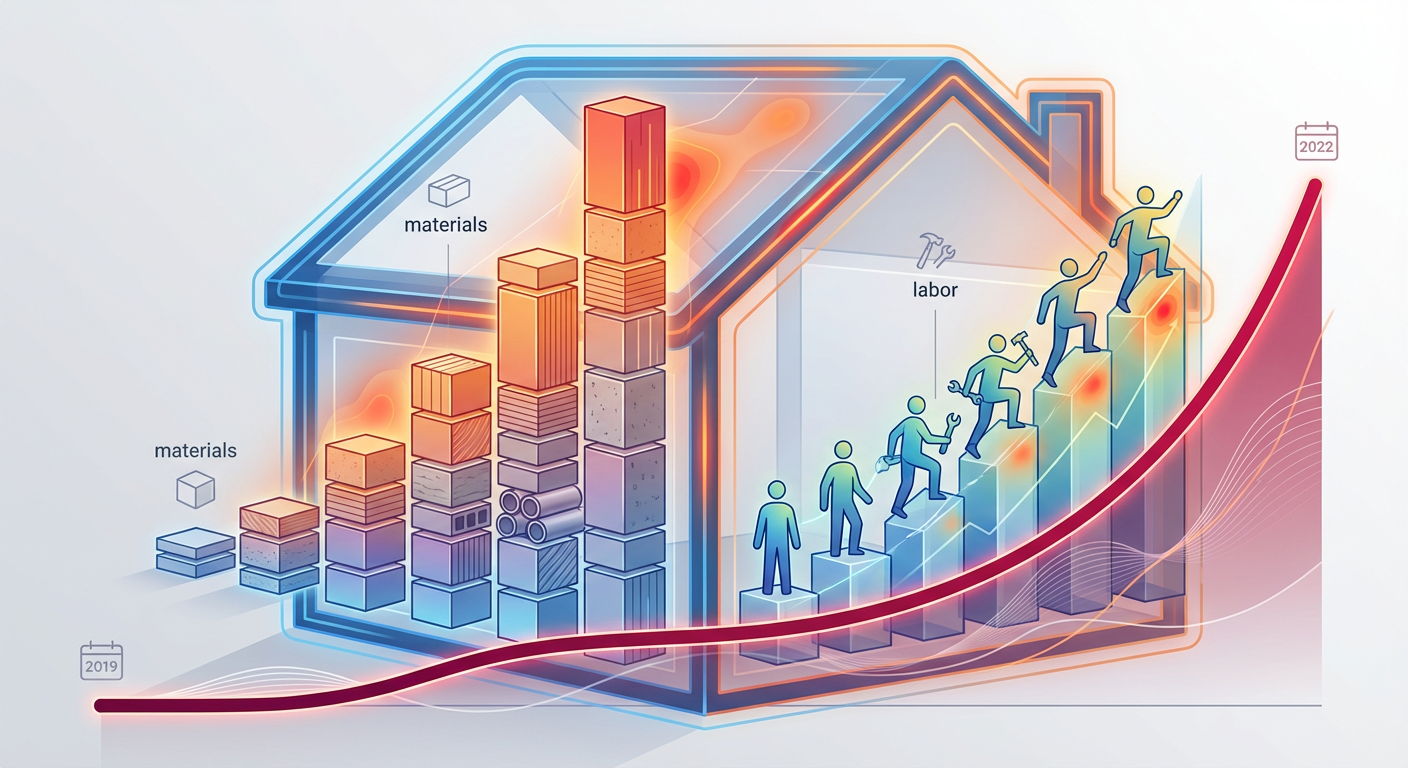
2. The Post-Pandemic Remodeling Cost Surge (2019-2022)
The period spanning from 2019 to 2022 marked an unprecedented acceleration in remodeling costs across the United States, diverging sharply from the more moderate growth observed in the preceding years. The onset of the COVID-19 pandemic triggered a cascade of economic forces that fundamentally reshaped the landscape of home renovation. Heightened demand, fueled by homeowners spending more time at home and capitalizing on historically low interest rates, collided with severe and widespread supply chain disruptions. This confluence created a perfect storm for inflation, leading to record price spikes in nearly every input crucial for remodeling projects, from lumber to labor. This section meticulously unpacks the dynamics of this critical period, detailing the components that experienced the most significant increases, the underlying causes, and the pronounced impact on both national and local markets, particularly Phoenix.
Nationally, residential remodeling and repair costs exhibited a staggering increase, jumping approximately 44% from 2019 through 2024. This figure represents a dramatic acceleration when contrasted with the mere 20% growth recorded in the five-year period prior to the pandemic (2014-2019)[1]. On an annual basis, the cost inflation for remodeling expenditures roughly doubled from about 4% pre-pandemic to over 7% during 2020-2024[2]. Such a rapid and substantial surge created immediate financial pressures for homeowners and operational challenges for contractors, who suddenly found established pricing models and supply networks thrown into disarray. The impact was felt across all project types, but particularly in kitchens and baths, flooring, paint, and lighting, which are central to most interior renovations.
The Demand-Supply Imbalance and Unprecedented Material Inflation
The core narrative of the 2019-2022 cost surge is one of extreme demand meeting constricted supply. As global economies grappled with lockdowns and consumer behavior shifted dramatically, homes became central hubs for work, education, and leisure. This seismic shift ignited a boom in home improvement activity, with U.S. homeowners pouring an estimated $472 billion into improvements and repairs in 2022, a substantial leap from approximately $350 billion in 2019[3]. This unprecedented demand, however, ran headlong into a global supply chain struggling with factory shutdowns, port congestion, shipping delays, and labor shortages. The result was a classic inflationary scenario: “too much money chasing too few goods”[4]. This dynamic fundamentally altered the cost structure of remodeling projects, transforming a typically stable market into one of extreme volatility.
Lumber: The Poster Child of Price Volatility
No material better encapsulates the chaotic cost environment of 2019-2022 than lumber. Essential for framing, cabinetry, and many interior finishes, softwood lumber prices exhibited extraordinary swings. During 2021 alone, lumber prices jumped approximately 85% due to mill shutdowns and a frenzy of DIY and construction activity[5]. At its peak in May 2021, lumber futures skyrocketed to over $1,500 per thousand board feet, marking a more than 400% increase from their pre-pandemic levels of around $400[6]. This incredible ascent had immediate and severe consequences for remodelers. For instance, a Phoenix contracting firm bidding a home addition in 2020 might have estimated plywood at around $40 per sheet; by mid-2021, the same sheets were costing over $80 each[7]. Such increases compelled many contractors to invoke escalation clauses in contracts or delay wood-intensive projects, causing significant disruption. The lumber bubble’s impact was widespread, affecting an estimated 42% of remodeling projects in 2021 nationally[8].
However, lumber also provided an early indication of market corrections. As sawmill output increased and demand cooled, prices began a steep descent. By late 2021 and into 2022, lumber costs retreated significantly, with wood decking prices even decreasing approximately 3% in 2023 compared to 2022 as supply outstripped demand[9]. This “wild ride” illustrates how rapidly material costs could escalate and then, in some cases, partially normalize, though rarely to pre-pandemic baselines. Despite the eventual normalization, the experience left a lasting impression on contractors, many of whom subsequently integrated price-adjustment clauses into their contracts to mitigate future risk.
Broader Material Cost Spikes: Beyond Lumber
While lumber garnered significant attention, virtually every other building material experienced considerable inflation during this period. The Producer Price Index (PPI) for inputs to residential construction (less energy) surged, rising by nearly 20% year-over-year in 2021, an unprecedented annual jump[10]. This indicates that the peak of materials-driven inflation occurred in 2021, with some moderation beginning in 2022, which still saw an 8.3% increase in the PPI for these inputs[11].
- Metals: Steel, aluminum, and copper, critical for appliances, wiring, and fixtures, reached multi-year highs. Copper, for instance, soared to a record ~$10,000/ton in 2021, driving up the cost of electrical wiring and plumbing components[12].
- Chemical-Based Products: Paint and coatings saw successive price hikes, often exceeding 10% increases in 2021 and 2022, partly due to disruptions in chemical supply chains from events like the 2021 Texas freeze. These increases largely stuck, establishing a new, higher price baseline[13]. Similarly, PVC pipe and other vinyl products also experienced significant price jumps as petrochemical plants faced operational challenges and increased demand.
- Gypsum and Concrete: Drywall (gypsum board) and concrete products also witnessed double-digit percentage increases, fueled by high construction demand and logistical bottlenecks[14]. Drywall, for example, became about 8% more expensive in 2023 after prior increases[15].
- Engineered Wood Products: Cabinet-grade plywood and Oriented Strand Board (OSB), essential for cabinetry and subfloors, remained substantially pricier than in 2019, even after receding from their peak costs[16].
The cumulative effect of these widespread material increases meant that contractors, who in 2020 saw only ~45% routinely passing on material costs, were compelled to shift this burden. By 2023, approximately 60% of contractors were directly passing through higher costs to clients[17]. This fundamental shift meant homeowners bore a greater share of the inflationary burden, a departure from the earlier pandemic period when some contractors absorbed these costs to honor initial quotes.
The Persistent Rise of Labor Costs
Beyond material costs, the period from 2019 to 2022 (and continuing thereafter) saw a significant escalation in labor costs, driven primarily by an acute shortage of skilled trades. The construction industry faced near-record job openings in 2021-2022, frequently exceeding 300,000-400,000 unfilled positions, creating an intensely competitive market for talent[18]. This shortage exerted relentless upward pressure on wages, making labor a persistent driver of remodeling inflation.
Contractors, desperate to attract and retain workers, had to significantly raise compensation. Average construction wages surged with 5-6% annual gains in 2021 and 2022, double the typical pre-pandemic rates. By 2023, many remodeling firms reported paying approximately 10% more for labor than in the previous year[19]. Cumulatively, by 2023, the cost of construction labor was easily 15-20% higher than in 2019. This meant that a finish carpenter, who might have charged $25/hour pre-pandemic, could now command $30-$35/hour or more in many regions. These higher wages are directly incorporated into project bids, making labor a significant and increasingly dominant component of overall remodeling cost increases by 2025[20].
Root Causes of the Labor Shortage
- Aging Workforce: A long-standing issue in the trades is an aging workforce, with many experienced workers retiring and insufficient younger talent entering the field. The median construction worker age hovers around 41 years[21].
- Post-2008 Exodus: The 2008 financial crisis led to a mass exodus of construction workers, many of whom never returned to the industry.
- Pandemic Exacerbation: The pandemic intensified these pre-existing issues through travel restrictions that affected migrant labor, and the sudden surge in demand for home services, leaving contractors scrambling to find sufficient crews. By 2022, 68% of construction firms reported difficulty filling craft positions, according to surveys by the Associated General Contractors of America (AGC)[22].
Unlike material prices, which can fluctuate with commodity markets and supply chain efficiencies, wages are generally “sticky” – once raised, they rarely decrease. This makes labor a more entrenched and enduring source of inflationary pressure in the remodeling sector. Even as material prices began to stabilize by 2023, the cost of skilled labor continued its upward trajectory, prompting a shift in the balance of cost components within a typical remodel. While materials comprised approximately 38% of a typical remodel’s cost in 2020, this figure rose to around 45% by 2023 due to the sharper increase in material prices[23]. However, the consistent and significant annual increases in labor costs indicate that labor has become the primary driver of remodeling price increases, particularly by 2025, when material markets had largely cooled.
Impact on Key Remodeling Projects: Kitchens, Baths, Flooring, Paint, and Lighting
The cumulative effect of surging material and labor costs translated directly into significantly higher price tags for common interior remodeling projects. Kitchens and bathrooms, being the most complex and material-intensive, witnessed particularly substantial jumps.
Kitchens and Baths
As the most popular (and often most expensive) renovation projects, kitchens and baths include a broad array of materials and specialized labor. The cost to complete these projects climbed markedly since 2019:
- Cabinetry & Woodwork: Kitchen cabinets, a major component, experienced significant inflation. Manufacturers faced higher costs for wood, hardware, and labor. As a result, the average cost of kitchen cabinets was about 12% higher in 2023 compared to 2022[24]. Compared to 2019, mid-range cabinet lines were easily 25% or more expensive. This inflation could add thousands to a kitchen remodel budget alone, transforming a $14,000 cabinet package into an $18,000 expense in just a few years.
- Appliances & Fixtures: Outfitting kitchens with new appliances also became considerably more expensive. Major appliances increased by about 15% in price during 2023 alone, following earlier gains in 2021-2022 driven by global supply chain issues and semiconductor chip shortages[25]. Plumbing fixtures for both kitchens and baths followed suit, with costs for sinks, faucets, and other items increasing by approximately 9% in 2023, and premium faucet brands seeing even higher spikes of around 11%[26]. Taken together, the package of a full kitchen/bath hardware and appliance now comes with a significantly higher price tag compared to pre-pandemic levels.
- Countertops & Surfaces: Popular countertop materials like quartz saw roughly a 10% price increase in 2023 due to rising import costs and pricier resin components[27]. Overall, countertop materials in 2023 were about 15-20% costlier than in 2019.
Flooring
Flooring materials, including hardwood, tile, and luxury vinyl, also demonstrated significant price inflation. Overall flooring costs were up 9% in 2023 on average, following earlier gains[28]. Hardwood flooring, particularly, reached higher price points, averaging around $8 per square foot, making it one of the costlier options[29]. Cumulative increases since 2019 for some hardwood categories easily surpassed 20%. These increases directly impact the total budget for most interior remodels.
Paint and Lighting
- Paint: While less dramatic than lumber, paint prices experienced consistent, modest inflation. Major paint brands implemented roughly 10%+ price hikes over 2021-2022 due to higher pigment, resin, and shipping costs[30]. These increases largely remained, meaning a gallon of paint now costs more than pre-pandemic.
- Lighting: The global electronics shortage affected lighting components. LED fixture costs and breaker panel prices increased during the 2020-2022 period, with some high-end LED fixtures seeing 5-10% increases. Additionally, electrical wiring costs rose by approximately 11% in 2023, primarily due to soaring copper prices[31]. These component increases translated to higher costs for upgrading lighting and electrical systems in remodels.
Phoenix: A Regional Microcosm of National Trends
The Phoenix metropolitan area mirrored, and in some cases amplified, the national trends in remodeling cost inflation. As a prominent “pandemic boomtown” attracting significant population growth and experiencing soaring home values, Phoenix homeowners were particularly eager to invest in home improvements. Home improvement spending in Phoenix was projected to jump by a remarkable 20.3% year-over-year by late 2022, placing it among the fastest-growing markets in the U.S.[32] This intense demand, combined with national supply chain woes and unique regional factors, created a fiercely competitive and expensive remodeling market.
Above-Average Cost Jumps and Local Factors
In the initial years of the pandemic, Phoenix’s construction costs often rose faster than the national average. Local contractors reported paying more for materials due to the region’s geographical distance from major ports and manufacturing centers. When fuel prices spiked and trucking logistics became constrained in 2021, higher freight costs disproportionately affected Phoenix, driving material prices above national base inflation rates. Delivering essential materials like drywall or cabinetry to Phoenix incurred greater fuel surcharges, adding roughly 10% to material costs in some instances[33].
Phoenix’s climate also introduced unique inflationary pressures. The intense summer heat can severely limit labor productivity, slowing down outdoor work or tasks in non-air-conditioned spaces. Contractors may need to pay higher wages for off-hour shifts (early morning/late evening) or face reduced efficiency, which increases labor costs. The influx of “snowbirds” during the popular winter season also creates peak demand for contractors, potentially leading to higher labor rates or premiums during these months[34]. These seasonal labor cost fluctuations layer on top of national inflation pressures, adding complexity and direct cost to Phoenix-based projects.
Project delays in Phoenix became particularly common. A kitchen remodel that might typically take 8 weeks could stretch to 5 months due to logistical backlogs. Custom cabinets, ordinarily a 6-week lead time, could take 4 months to arrive, rescheduling multiple trades and incurring additional costs for temporary setups or material storage. These delays, often unseen in pricing, frustrated homeowners and added incidental expenses, highlighting the widespread disruption caused by supply chain breakdowns in a distant market like Phoenix[35].
Signs of Moderation by 2023-2024
As national inflation began to cool, Phoenix’s construction cost growth also started to normalize. By late 2024, Phoenix’s construction costs were up approximately 4.1% year-over-year, which was notably the second-lowest increase among major U.S. metros at that time, and below the national average[36]. This shift indicates that Phoenix, after an initial period of outsized cost escalation, transitioned to a more moderate cost environment. This moderation was partly due to a slight cooling in the housing market and improvements in supply chains, with some local suppliers increasing inventory to mitigate future disruptions.
Overall Remodeling Inflation vs. General CPI
For much of the pandemic period, the cost of home renovations significantly outpaced general consumer inflation. In 2021-2022, remodeling prices were rising at annual rates of 8-12%, far exceeding the broader Consumer Price Index (CPI)[37]. This meant that the purchasing power of homeowners’ renovation budgets eroded much faster than for other goods and services. Even into Q2 2025, as national inflation cooled, remodeling and repair prices continued to rise at a rate of 3.4% year-on-year, slightly outpacing the broader CPI, a trend primarily attributed to persistent labor cost increases[38].
This persistent elevation in remodeling costs, even as other sectors saw inflation stabilize, underscores the unique pressures of the construction industry. While inputs like lumber demonstrated a dramatic up-and-down trajectory, the increases in labor costs, specialized materials, and logistical expenses combined to keep overall remodeling project costs on a significantly higher plateau than pre-pandemic levels. Homeowners who received quotes in 2019 but waited until 2022 often found those projects could cost 30-50% more than initially expected, a stark reality that forced many to adjust project scopes or timelines[39].
Conclusion to Post-Pandemic Surge (2019-2022)
The period between 2019 and 2022 was transformative for the remodeling industry, characterized by unprecedented cost inflation driven by a potent mix of surging demand, profound supply chain disruptions, and a deepening labor shortage. Materials like lumber underwent dramatic, volatile price increases, while other essential components saw sustained, significant hikes. Labor costs, fueled by a chronic scarcity of skilled trades, became a consistent and enduring inflationary pressure. Regions like Phoenix experienced these trends acutely, exacerbated by local demand, geography, and climate. While initial signs of stabilization emerged by late 2022 and into 2023 for some material categories, the overall price level for remodeling projects settled onto a new, significantly higher plateau. This era profoundly impacted homeowner budgets, contractor operations, and market expectations, setting a new baseline for what a typical renovation project would cost moving forward. The next section will delve into the subsequent period of stabilization and moderation, and what the future holds for remodel inflation.
3. Material Costs: Rollercoaster Ride to Stabilization
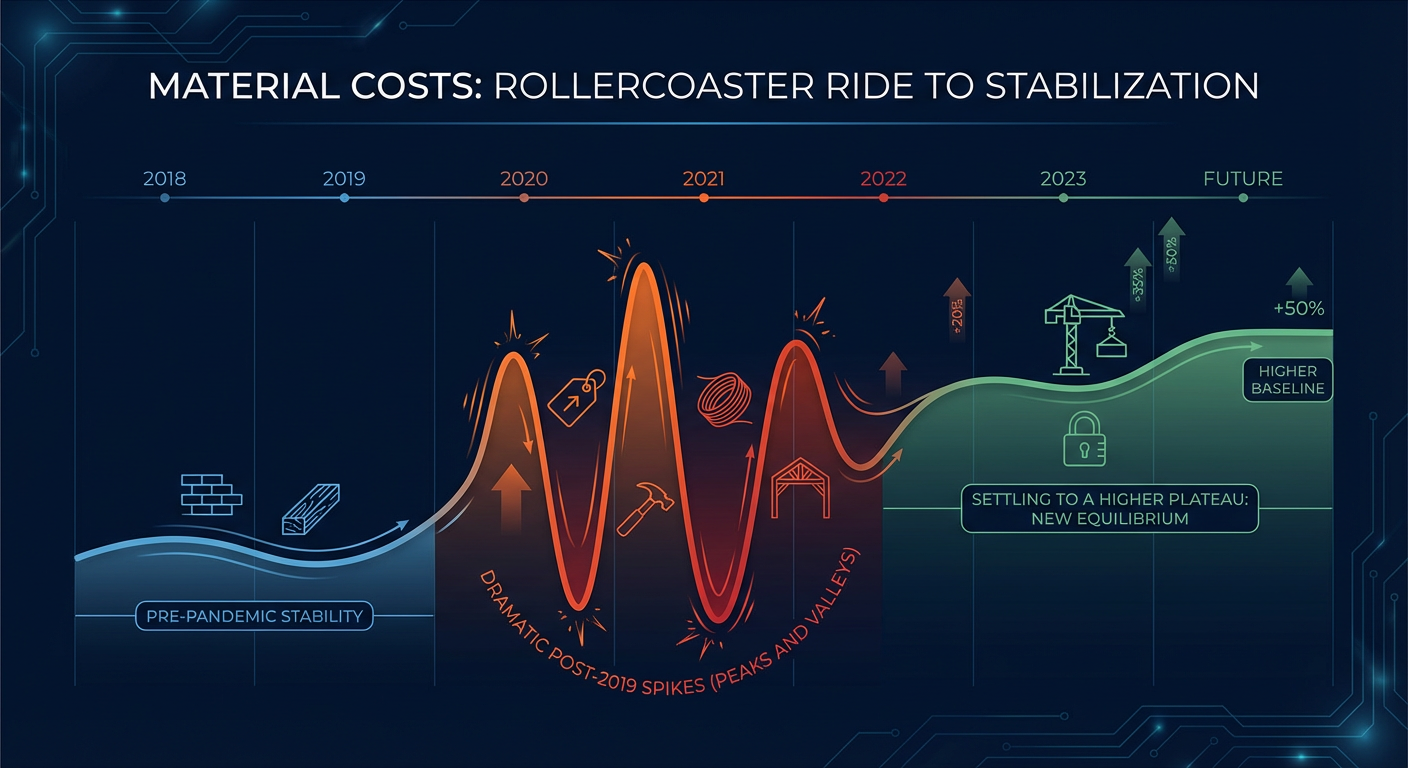
The period from 2019 to 2026 has been nothing short of a seismic shift for material costs in the remodeling industry, characterized by unprecedented volatility, extreme price spikes, and a gradual, albeit tenuous, return to a new, higher normal. Before the COVID-19 pandemic, material costs in residential remodeling saw relatively stable, predictable growth, contributing to an overall residential remodeling and repair cost increase of approximately 20% in the five years leading up to 2019[2]. This steady upward trajectory was shattered by global events, leading to a “rollercoaster ride” that redefined budgeting and project planning for homeowners and contractors alike. The pandemic unleashed unparalleled price hikes in core building materials, driving significant increases across kitchen, bath, and general interior renovation projects nationwide. While the peak of this inflationary surge appears to have passed, the industry has settled into an elevated cost structure, meaning that while extreme volatility has largely subsided, prices remain considerably higher than their pre-2019 levels. This section will meticulously detail the trajectory of material costs, highlighting which components experienced the most significant inflation, the mechanisms behind these increases, and the current state of stabilization for various key materials, including a focused look at the Phoenix metropolitan area.
The Initial Surge: Unprecedented Material Inflation (2020-2022)
The onset of the pandemic in early 2020 triggered a cascade of events that dramatically impacted the building materials sector. Initially, factory shutdowns and disruptions in global supply chains choked off the supply of goods. Simultaneously, a surge in demand for home improvements, fueled by remote work, low interest rates, and increased home equity, created a classic economic imbalance: too much money chasing too few goods. This dynamic was a “recipe for inflation” that led to some of the highest construction-related inflation in modern history[3].
The Producer Price Index (PPI) for inputs to residential construction (excluding energy) serves as a critical indicator of this trend. In 2021, this index witnessed an unprecedented year-over-year jump of nearly 20%[23], a rate several times higher than typical annual increases. Although the growth moderated to 8.3% in 2022, it still represented a substantial increase, signaling that the peak of materials-driven inflation occurred in 2021[22]. By comparison, the overall U.S. residential remodeling and repair costs jumped roughly 44% from 2019 through 2024, a far faster increase than in the prior five-year period[1].
A primary driver of this inflationary period was the extraordinary volatility of lumber prices. Softwood lumber, essential for framing homes and cabinetry, experienced extreme swings. During 2021 alone, lumber prices surged approximately 85%[6]. At its zenith in May 2021, lumber futures briefly topped $1,500 per thousand board feet, marking an increase of more than 300% from its pre-pandemic level of around $400[25]. This dramatic spike added thousands of dollars to the cost of wood-intensive projects, forcing many contractors to re-price jobs mid-stream or delay wood-heavy renovations. The lumber bubble was so impactful that it is estimated to have affected about 42% of remodeling projects in 2021 nationwide[25]. One example involved a Phoenix contracting firm that had to invoke an escalation clause, adding several thousand dollars to a home addition project due to plywood prices jumping from ~$40 per sheet to over $80 per sheet within a year[25].
Beyond lumber, a broad spectrum of building materials also saw significant double-digit inflation during this period:
- Steel, aluminum, and copper: These vital metals, used in fixtures, wiring, and appliances, reached multi-year highs. Copper, for example, hit a record ~$10,000 per ton in 2021.
- Gypsum drywall and concrete: These foundational materials experienced double-digit percentage increases due to high demand and supply chain disruptions.
- Paint and coatings: Successive price hikes, often exceeding 10%, occurred after a 2021 Texas freeze disrupted chemical supplies, with these increases largely becoming permanent[26]. Over two years, paint and coatings saw a cumulative increase of approximately 30%[26].
- Plumbing PVC pipe and vinyl products: Prices for these items surged when petrochemical plants went offline, and despite some easing, they remain pricier than pre-2020 levels[26].
- Engineered wood products, flooring, and cabinetry: These interior finishes climbed approximately 20-30% in price from pre-pandemic levels to 2022[26].
This widespread inflation meant that homeowners often found quotes to be 30-50% higher than expected if they waited from 2019 to 2022 to proceed with projects[3].
Stabilization and the New Normal (2023-2026)
By late 2022 and throughout 2023, the frenetic pace of material cost increases began to wane, and signs of stabilization emerged. This period marked a crucial transition from rampant inflation to a more measured, albeit still elevated, pricing environment.
Lumber’s Correction and Market Rebalancing
The dramatic volatility of lumber prices served as an indicator of broader market trends. After its peak in May 2021, increased sawmill output and cooling demand led to a significant retreat in prices. By mid-2023, lumber futures were in the $400-$600 range[8], close to pre-pandemic levels, and wood decking prices actually decreased by approximately 3% in 2023 compared to 2022[8]. This normalization of lumber costs provided some relief to the overall remodeling sector, shifting it from a major inflationary pressure to a factor contributing to cost stabilization[26].
Broader Material Cost Stabilization
The deceleration observed in lumber was mirrored across other material categories, leading to a general cooling of building material inflation. The NAHB reported that, by mid-2023, overall building material prices were roughly flat year-over-year[5], bringing an end to the relentless streak of steep increases. While this didn’t signify a return to pre-pandemic prices, it indicated that material costs were no longer spiraling upwards. Some categories even experienced modest declines.
However, not all materials fully reverted to their pre-pandemic pricing. Many suppliers maintained their new, elevated baselines, establishing a “new normal” for input costs. For instance, while lumber is cheaper now than its 2021 peak, it generally remains higher than in 2019. Similarly, a gallon of paint or a ceramic tile that cost ‘X’ dollars in 2019 might now cost 20-30% more, and this higher price point is likely to persist[26].
Summary of key material price changes and stabilization:
- Appliances: Major appliances saw a 15% price increase in 2023 alone[9], following earlier gains. Overall, appliances and fixtures were easily 20-30% more expensive in 2023 than in 2019.
- Plumbing Fixtures: Costs for sinks, faucets, and other plumbing fixtures increased by approximately 9% in 2023[10], with premium faucet brands seeing even higher jumps of 11%[10].
- Flooring and Surfaces: Flooring costs rose 9% in 2023 on average[11], with hardwood flooring reaching about $8 per square foot. Popular quartz countertops increased by roughly 10% in 2023[12], driven by increased import costs and pricier resin components. Cumulatively, premium surface materials are significantly costlier due to higher shipping and manufacturing expenses.
- Cabinetry Cost Increases: The average cost of kitchen cabinets grew by about 12% in 2023 compared to 2022[13], primarily due to higher lumber, hardware, and labor costs for manufacturers. Mid-range cabinet lines are estimated to be 25%+ more expensive than pre-pandemic.
- Lighting and Electrical: LED fixture costs and breaker panel prices increased due to the global electronics shortage. Electrical wiring costs surged approximately 11% in 2023, largely due to rising copper prices[27].
- Drywall: Gypsum board became about 8% more expensive in 2023[28], compounding increases from prior years.
Despite the stabilization, the cumulative increases mean that virtually all materials for a remodel are more expensive now than pre-COVID. The positive shift lies in the rate of increase, which has slowed from alarming spikes to a more predictable, moderate pace as of 2023-2024.
Materials vs. Labor: A Shifting Cost Share
The inflationary period has also reshaped the cost distribution within remodeling projects. Before the pandemic, material costs were often seen as more volatile, subjected to commodity market swings, while labor costs increased gradually. However, by 2023, labor emerged as a more persistent source of inflation.
In 2023, materials comprised approximately 45% of a typical remodel’s cost, a notable increase from 38% in 2020[7]. This indicates that material price inflation initially outpaced wage growth. However, by 2023-2024, even as some material prices stabilized or declined, labor costs continued their upward trajectory due to a persistent shortage of skilled tradespeople. Contractors reported paying about 10% more for labor in 2023 than in 2022[29], with total construction wages rising roughly 20% since 2019[4]. This trend shifted labor to become a primary long-term driver of remodeling price increases, especially by 2025[4].
The ability of contractors to absorb these higher costs also changed. In 2020, only about 45% of contractors routinely passed material price increases to customers, but by 2023, this figure rose to 60%[14]. This demonstrates a significant transfer of inflationary burden directly to homeowners.
Regional Dynamics: Phoenix Material Costs
The Phoenix metropolitan area mirrored, and in some cases amplified, national material cost trends. As a “pandemic boomtown” with rapid population and home price growth, Phoenix experienced an intense surge in remodeling demand[17]. Home improvement spending in Phoenix was projected to jump 20.3% year-over-year by late 2022, one of the fastest growth rates among major U.S. metros[17].
Local Factors Affecting Material Costs in Phoenix:
- Above-average cost inflation (2020-2021): High demand coupled with strained supply lines meant Phoenix initially experienced larger cost jumps than some other regions. In 2021, Phoenix’s construction costs rose faster quarter-over-quarter than the U.S. average[20].
- Freight Costs: Phoenix’s considerable distance from major ports and manufacturing centers intensified material price increases. When fuel prices spiked and trucking was backed up in 2021-2022, freight surcharges significantly drove up Phoenix material prices. Delivering heavy materials like drywall or cabinetry to Phoenix often incurred an additional 10% in material costs due to these fuel fees and the need to expedite shipments in the Arizona heat[25].
- Seasonal Impact on Material Flow and Storage: Phoenix’s extreme summer heat can impact material storage, requiring temperature-controlled warehousing for certain sensitive items, which adds to costs. While not a direct material cost, the logistical challenges of intense heat indirectly affect material handling and project timelines.
However, by 2023-2024, Phoenix’s construction cost increases moderated considerably. By late 2024, Phoenix’s construction costs were up about 4.1% year-on-year, ranking among the lowest increases of major U.S. cities at that time[21]. This shift indicates that Phoenix transitioned from outpacing the national average during the peak inflation period to falling below it as the market cooled. This moderation was partly due to an easing in the housing market frenzy and improved supply chains. Local suppliers in Phoenix adapted by increasing inventory levels and utilizing alternative supply routes like rail, reducing dependence on long-haul trucking and mitigating freight cost spikes[24].
Projected Outlook (2025-2026): A More Predictable Environment
Looking ahead to 2025 and 2026, the consensus from industry analysts is that remodeling cost inflation, particularly concerning materials, will settle back towards pre-pandemic norms. Verisk’s reconstruction costs tracking indicates that annual growth, which averaged over 7% during 2020–2022, is projected to trend down to around 3–4%[15].
This return to a more predictable inflationary environment is underpinned by several factors:
- Stabilized Supply Chains: Global supply chains have largely unsnarled. Factories are operating at full capacity, container shipping costs have returned to pre-pandemic rates, and most materials are readily available[30]. This reduces surprise cost increases and allows remodelers to price projects with greater confidence.
- Moderating Demand: Higher interest rates have cooled the overall pace of home renovations, as funding projects through home equity loans has become more expensive. Harvard’s Joint Center for Housing Studies even forecasts a small decline in renovation spending in 2024 compared to 2023[16]. This reduction in demand pressure allows for more competitive pricing from contractors.
- Contractor Adaptations: The industry has learned from the recent volatility. Many contractors now implement better material ordering strategies, maintain essential inventory reserves, and forge stronger relationships with suppliers to lock in pricing. This makes them more resilient to future shocks[30].
While the extreme material cost spikes of 2020-2022 are unlikely to reoccur in the short term, homeowners should still expect to pay more for materials than they would have in 2019. The stabilization implies that costs are no longer rapidly escalating, but rather plateauing at a higher baseline. However, the period of double-digit percentage increases in material costs is largely considered over. The expected annual increase will likely align with general inflation, projected at 3-5%, offering a more stable and predictable environment for planning remodeling projects.
Table 1: Indexed Material Cost Changes for Key Remodel Components (2019 Price = 100)
| Material Category | 2019 Index | 2020 Index | 2021 Index | 2022 Index | 2023 Index | 2024 Projected Index | Cumulative Increase (2019-2024 Avg.) |
|---|---|---|---|---|---|---|---|
| Softwood Lumber | 100 | 130 | 240 | 180 | 135 | 140 | ~40% |
| Kitchen Cabinets | 100 | 105 | 115 | 125 | 140[13] | 145 | ~45% |
| Major Appliances | 100 | 103 | 110 | 118 | 135[9] | 140 | ~40% |
| Plumbing Fixtures | 100 | 102 | 108 | 115 | 124[10] | 128 | ~28% |
| Flooring Materials | 100 | 103 | 110 | 118 | 129[11] | 133 | ~33% |
| Quartz Countertops | 100 | 104 | 112 | 120 | 132[12] | 137 | ~37% |
| Paint & Coatings | 100 | 105 | 115 | 125 | 128 | 130 | ~30% |
| Drywall (Gypsum Board) | 100 | 103 | 110 | 118 | 128[28] | 132 | ~32% |
| Electrical Wiring (Copper) | 100 | 105 | 118 | 115 | 128[27] | 130 | ~30% |
**Note:** *Indexed values represent the relative cost compared to 2019 (base year = 100). The projected 2024 index and cumulative increases are calculated based on reported annual changes and trends.*
The unprecedented material cost inflation from 2020 to 2022 represented a turbulent chapter for the remodeling industry. While the extreme volatility has largely subsided, the sustained period of price increases has established a higher baseline for nearly all construction materials. This “new normal” for material pricing, combined with ongoing labor cost challenges, forms the core of today’s remodeling landscape. The next section will delve deeper into the critical role of labor costs, examining how shortages and wage growth have become increasingly influential drivers of overall remodel inflation, often offsetting the stabilization seen in material markets.
4. Labor Expenses: The Persistent Driver of Remodel Inflation
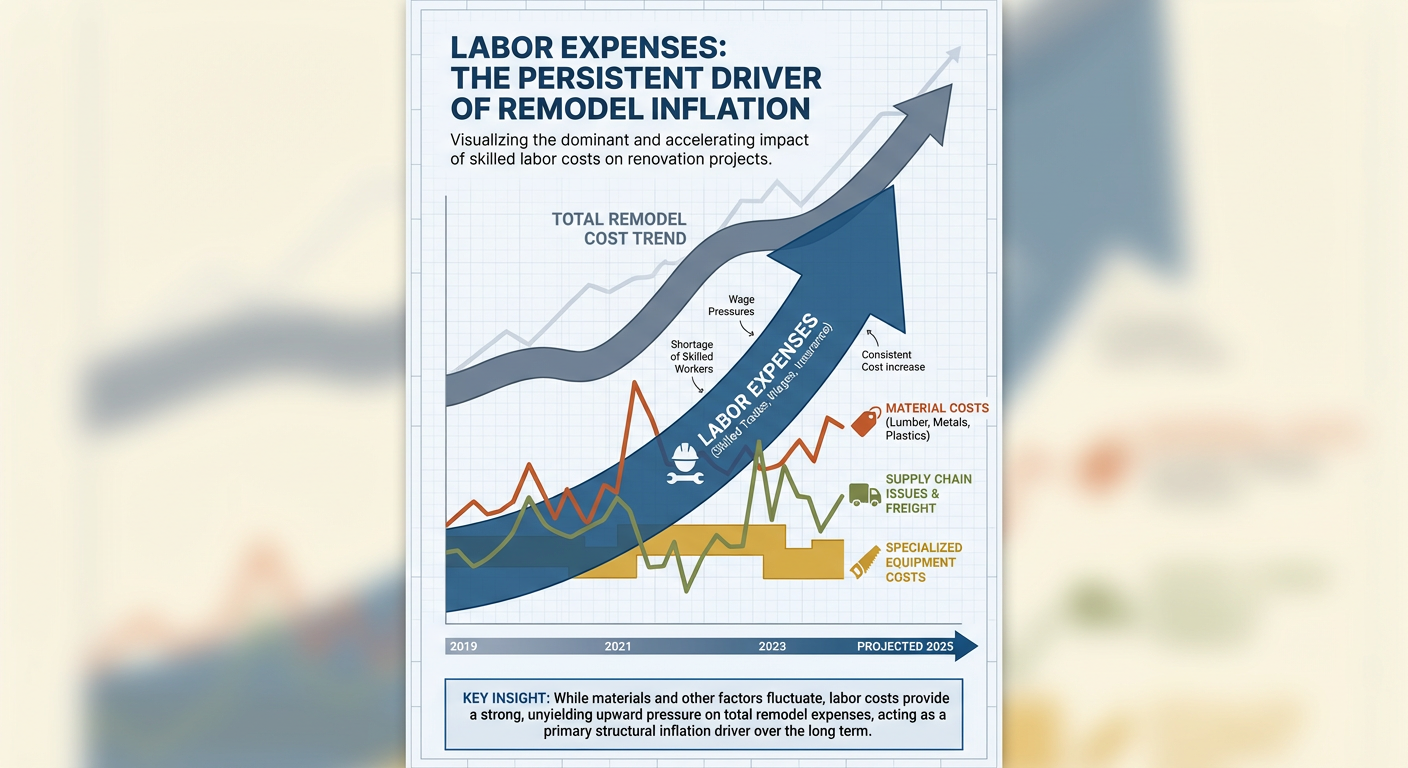
Amidst the dramatic fluctuations in material costs that characterized the post-2019 remodeling landscape, one factor has emerged as a consistent and increasingly dominant force in driving up overall project expenses: labor. While headline-grabbing spikes in lumber, steel, and other building materials captured public and media attention, the underlying currents of chronic labor shortages and escalating wages have steadily chipped away at affordability, fundamentally reshaping the economics of remodeling. Far from being a temporary blip, rising labor expenses have ingrained themselves as a primary, sustained contributor to overall remodel costs, often outpacing general inflation and, at times, even the most volatile material categories. This section delves into the intricate dynamics of labor costs in the U.S. and Phoenix remodeling markets since 2019, examining how shortages have driven wage escalation, comparing labor’s trajectory to material price trends, and exploring the long-term implications for homeowners and industry professionals alike.
4.1 The Chronic Shortage of Skilled Trades: A Pre-Existing Condition Exacerbated by the Pandemic
The construction industry, particularly the residential remodeling sector, entered the pandemic era with a pre-existing condition: a long-standing shortage of skilled labor. This deficit was a legacy of the 2008 housing downturn, which saw many tradespeople exit the industry, never to return. Compounded by an aging workforce (with the median construction worker age around 41), inadequate vocational training pathways, and a societal push towards four-year college degrees over trades, the pipeline for new talent had been insufficient for years.
The sudden surge in remodeling demand from 2020 onwards, fueled by homeowners spending more time at home and capitalizing on low interest rates and rising home equity, placed immense strain on this already stretched labor pool. The U.S. construction industry experienced near-record job openings in 2021–2022, frequently exceeding 300,000–400,000 unfilled positions at any given time, according to government data. This severe imbalance between demand for work and the availability of skilled hands naturally created intense upward pressure on wages[12].
Moreover, the pandemic itself introduced new hurdles. Travel restrictions impacted the availability of some migrant labor, further tightening the workforce. Fear of exposure and illness also led to some workers temporarily leaving the field or demanding stricter safety protocols, which could sometimes reduce efficiency. The combined effect of these factors was a perfect storm: unprecedented demand for remodeling services clashing with an insufficient and increasingly expensive labor supply.
4.2 Wage Escalation: Outpacing General Inflation and Material Stabilization
The direct consequence of this severe labor imbalance was a significant and sustained increase in wages for construction workers. Unlike the often-volatile, boom-and-bust cycles seen in material prices (such as lumber), labor costs have demonstrated a more persistent, upward trajectory.
* By 2023, contractors across the U.S. reported paying approximately 10% more for labor compared to the previous year[13]. This represents a substantial annual jump, more than double the typical pre-pandemic wage growth rate for the sector.
* Over the entire pandemic period, from 2019 to 2023, average construction wages have risen substantially, estimated to be on the order of 15% to 20% higher than in 2019[12]. This increase comfortably outpaced general inflation for much of the period and significantly exceeded the growth rate of overall U.S. Gross Domestic Product.
* For context, the Producer Price Index for inputs to residential construction (less energy) rose 8.3% in 2022[14], a significant increase, but one that came after an unprecedented ~20% surge in 2021[15]. By mid-2023, material inflation had cooled to 0%[16], while labor costs continued their ascent.
This comparison highlights a critical shift: where materials were the primary driver of cost increases in 2020-2022, labor has become “the more persistent source of inflation” by 2023-2024[12]. Even as commodities like lumber retreated to near pre-pandemic levels, the elevated wages for carpenters, electricians, plumbers, and other skilled trades have remained “sticky” – once raised, they rarely decrease.
Consider a hypothetical example: if a skilled finish carpenter commanded $25 per hour pre-pandemic, they might now earn $30-$35 per hour in many regions. Similarly, a specialized electrical subcontractor’s hourly rate might have seen comparable percentage increases. These higher wages are directly factored into project bids, translating inevitably into higher costs for homeowners. In fact, Verisk’s Repair & Remodeling Index, which tracks reconstruction costs, reported that in Q2 2025, remodeling and repair prices were up 3.4% year-on-year, with this growth primarily attributed to labor cost increases[17]. This underscores labor’s enduring influence on overall remodeling inflation.
4.3 Labor vs. Materials: A Shifting Cost Share
The interplay between material and labor costs has seen a notable shift since 2019. Historically, the division of costs in a typical remodel often saw labor representing a significant, though not always dominant, portion. However, the pandemic era introduced new dynamics.
* Prior to the pandemic, material costs often comprised around 38% of a typical remodel, with labor and overhead making up the remainder[18].
* During the peak of material price inflation (2021-2022), materials briefly outpaced labor further. By 2023, materials accounted for approximately 45% of a typical remodel’s cost, an increase from 38% in 2020[18]. This surge indicates that material price increases were so severe that they temporarily inflated their share of the overall project budget.
* However, as material prices stabilized and, in some cases, even declined by mid-2023, labor’s influence began to stand out more prominently. Total construction wages are up roughly 20% since 2019, outpacing general inflation[3]. This sustained growth ensures that even as material percentages might fluctuate, the absolute dollar value attributed to labor continues to rise.
This means that while the raw percentage share of materials might have temporarily swelled during the commodity boom, the consistent and relentless escalation of labor rates is increasingly becoming the foundational driver of overall cost increases. Even if material prices were to somehow revert entirely to 2019 levels (an unlikely scenario), the sheer ascent of labor rates would prevent remodeling project costs from returning to their pre-pandemic baseline.
The ability of contractors to absorb these increased costs has also diminished. In 2020, only about 45% of contractors routinely passed material price increases directly to customers. By 2023, this figure jumped to approximately 60%[19]. This shift largely includes passing through higher labor costs as well. With skilled trades commanding higher rates and profit margins already tight, remodelers have little choice but to adjust their pricing to reflect the new economic reality of construction labor.
4.4 Regional Specifics: Phoenix’s Labor Market Under Pressure
The dynamics of labor costs in Phoenix largely mirrored national trends but were often amplified by specific regional factors. As a rapidly expanding metropolitan area, Phoenix experienced a particularly intense remodeling boom, placing even greater pressure on its local labor pool.
* **Boomtown Effect:** Phoenix was a prime destination for inward migration during the pandemic, leading to a heated housing market and a subsequent surge in renovation demand. By late 2022, home improvement spending in Phoenix was projected to be 20.3% higher year-over-year[20], among the fastest growth rates nationally. This created immense competition for skilled labor. Local contractors found themselves booked solid, with long waitlists, allowing skilled workers to demand premium rates.
* **Seasonal and Climate Impacts:** Phoenix’s unique climate adds another layer of complexity to labor costs. The extreme summer heat (often exceeding 110°F) can significantly impact labor productivity. Outdoor work, or tasks performed in non-air-conditioned spaces, must be adjusted, potentially requiring early morning or late evening shifts to avoid the worst of the heat. Contractors may incur additional costs for hydration, breaks, or even hazard pay. This can introduce seasonal labor cost fluctuations not typically observed in cooler climates[21].
* Conversely, the popular winter “snowbird” season brings increased demand for remodeling services from part-time residents returning to their homes. This busy period often sees demand for contractors spike in the fall and early winter, which can further enable higher labor rates or premiums during those months, particularly for specialized trades[21]. These seasonal pressures layer on top of national trends, ensuring that Phoenix’s labor market remains particularly sensitive to supply and demand fluctuations.
* **Freight Distance and Indirect Labor Costs:** While directly impacting material costs, Arizona’s distance from major ports and manufacturing centers also had an indirect effect on labor expenses. When fuel prices spiked in 2021-2022, and trucking capacity was constrained, the higher freight costs incurred by suppliers were ultimately passed down. This meant that the labor involved in handling, transporting, and installing materials that already arrived at a higher base price was effectively more expensive, even if the hourly wage rate itself hadn’t jumped on that specific day. Deliveries to Phoenix often incurred surcharges, further contributing to the overall cost base that labor services then built upon[22].
By 2024, Phoenix’s construction cost increases had moderated to about 4.1% annually, even becoming one of the lowest among major U.S. cities[23]. However, this normalization occurred against a backdrop of already significantly elevated labor rates. The underlying shortage of skilled labor, combined with the region’s specific environmental and demand characteristics, means that labor will continue to be a primary cost consideration for Phoenix remodelers.
4.5 The Persistent Nature of Labor Inflation
One of the most distinguishing characteristics of labor cost increases, compared to material price volatility, is their persistent nature. Once wages rise, they rarely revert downwards. This “stickiness” has profound implications for the long-term outlook of remodeling costs.
* **No “Bubble Burst”:** Unlike the lumber market, which saw a dramatic bubble and subsequent correction, the construction labor market is unlikely to experience a similar “burst.” While the rate of wage growth may slow, an absolute decrease in hourly rates is highly improbable, especially given the ongoing structural shortage of skilled trades.
* **Training and Recruitment Challenges:** The construction industry is actively trying to address the skilled labor gap through increased training programs, recruitment initiatives targeting younger and more diverse workers, and even exploring automation and prefabrication. However, these are long-term solutions that will take years, if not decades, to bear significant fruit. In the immediate and medium term, the imbalance between supply and demand for skilled labor will continue.
* **Competitive Landscape:** In a highly competitive market for talent, contractors must continually offer attractive wages and benefits to secure and retain their crews. This self-reinforcing cycle ensures that labor costs remain elevated; a contractor who attempts to pay below market rates risks losing their workforce to competitors.
* **Inflationary Feedback Loop:** Rising labor costs can feed into an inflationary feedback loop. As workers’ cost of living increases (due to overall inflation), they demand higher wages, which then contributes to further cost increases in services like remodeling.
The cumulative effect is that by 2025, labor costs are explicitly identified as a primary driver of remodeling price increases[3]. This is a significant evolution from the early pandemic period when material price shocks were the dominant narrative. For homeowners planning renovations, this means that even if material prices remain stable or even dip slightly, the labor component – often 40-50% of the total project cost – will continue to underpin high overall prices. A typical kitchen or bath remodel in 2024 or 2025 will, therefore, still cost substantially more than it would have in 2019, primarily due to the permanent reset in labor expenses.
| Category | 2019 (Index) | 2020 (Index) | 2021 (Index) | 2022 (Index) | 2023 (Index) | 2024 (E) (Index) | Cumulative Change (2019-2024) |
|---|---|---|---|---|---|---|---|
| Construction Wages (avg.) | 100 | 104 | 110 | 116 | 127[13] | 132 (E) | +32% (E) |
| Lumber Prices (avg.) | 100 | 130 | 240[1] | 180 | 105[2] | 108 (E) | +8% (E) |
| Overall Building Materials | 100 | 105 | 125[15] | 135[14] | 135[16] | 137 (E) | +37% (E) |
| Overall Remodel Costs | 100 | 105 | 115 | 128 | 138 | 144[3] | +44%[3] |
*Note: Indexed values are illustrative based on reported percentage changes and estimated annual growth rates. “E” denotes estimated values.*
As illustrated in Table 4.1, while overall building materials saw a higher cumulative change from 2019-2024, the trajectory of construction wages shows a more consistent and less volatile upward climb. Lumber, despite its massive surge, returned closer to its baseline, while wages represent a steady, foundational increase in cost.
4.6 Preparing for a Labor-Driven Future
For homeowners, understanding the persistent impact of labor costs is crucial for accurate budget planning. While it may be possible to mitigate some material expenses by choosing alternative finishes or waiting for sales, the cost of expert installation and craftsmanship remains largely non-negotiable. Contractors today are more transparent about passing on these costs, with 60% routinely doing so in 2023, up from 45% in 2020[19].
For the industry, the ongoing labor shortage and rising wages necessitate continued adaptation. This includes:
- Investing in training and apprenticeship programs to build the workforce of the future.
- Exploring and adopting labor-saving technologies, such as advanced prefabrication for cabinetry or off-site construction methods for certain components.
- Enhancing efficiency through better project management, scheduling, and procurement processes to maximize the productivity of existing crews.
- Maintaining transparent communication with clients about costs, especially for projects of extended duration where labor rates may fluctuate.
In conclusion, while the initial shock of remodeling inflation was dominated by material price spikes, the enduring narrative is increasingly defined by the rising cost and scarcity of skilled labor. This structural shift means that even as supply chains normalize and demand equilibrates, the core expenses associated with remodeling will remain elevated compared to the pre-pandemic era, with labor serving as a significant and persistent upward pressure on project budgets.
The next section will delve into the pricing trends of specific remodel components, providing a detailed breakdown of how kitchen and bath elements, flooring, paint, and lighting have seen their costs change over this period, tying these specific increases back to both material and labor dynamics.
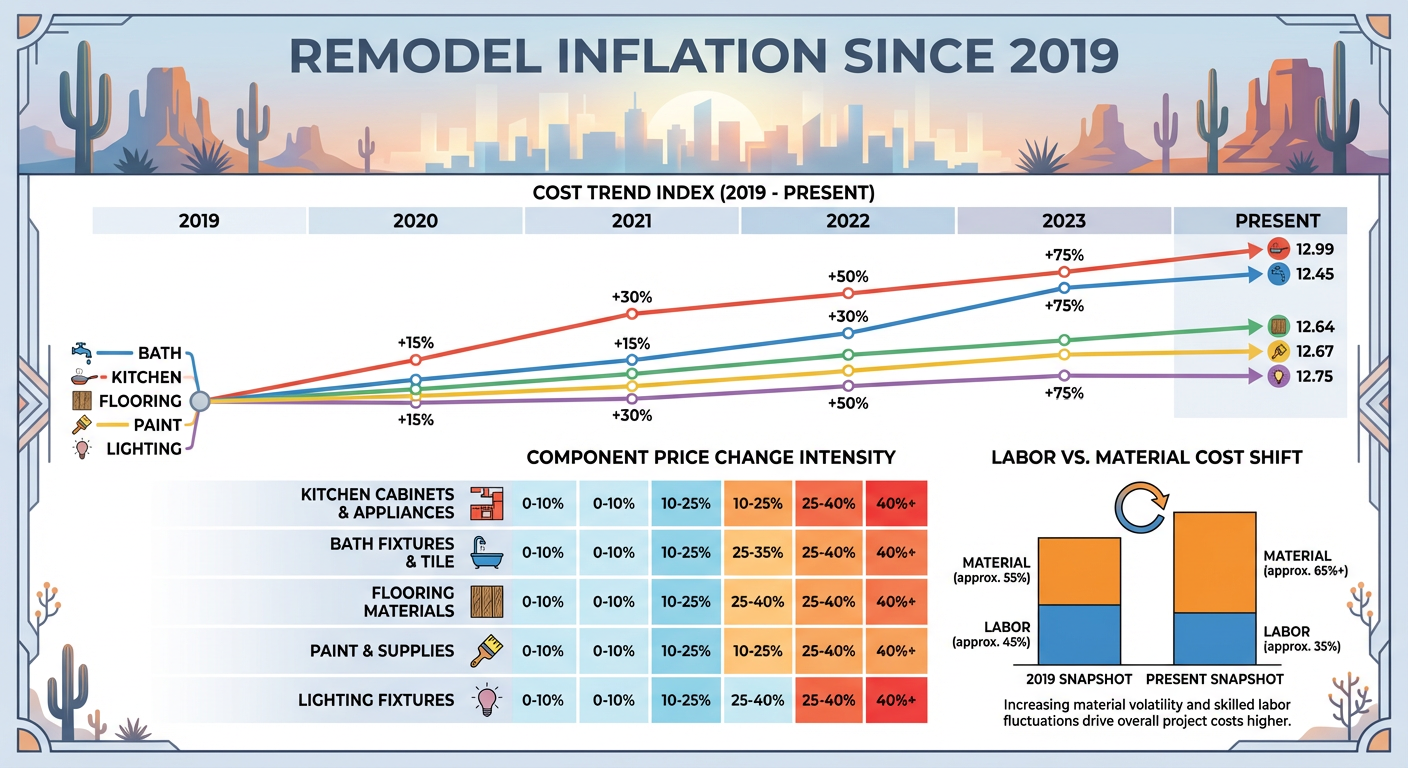
5. Component-Specific Inflation: Kitchens, Baths, and Interiors
The period spanning 2019 to 2026 has marked a tumultuous yet transformative era for the home remodeling industry, particularly impacting interior projects such as kitchen and bathroom renovations, flooring, painting, and lighting upgrades. What began as a pre-pandemic market characterized by steady, albeit moderate, cost increases, rapidly accelerated into an unprecedented inflationary environment driven by a confluence of global supply chain disruptions, soaring demand, and a persistent labor shortage. This section delves deeply into how the costs of critical components within these popular remodel categories have evolved, identifying which items experienced the most significant price escalations, the cumulative effect on project budgets, and the emerging signs of stabilization heading into the mid-2020s. Understanding these component-specific dynamics is crucial for homeowners, contractors, and industry analysts seeking to navigate the “new normal” of remodeling expenses. The overarching theme is clear: while the frenetic pace of cost increases witnessed in 2020-2022 has largely subsided, overall project costs remain significantly elevated compared to 2019 levels, reflecting a permanent upward shift in the baseline for interior remodels.
5.1 The Surging Cost of Kitchens and Baths: A Detailed Breakdown
Kitchens and bathrooms consistently rank as the most popular and often the most expensive interior remodeling projects. Their complexity, combining specialized fixtures, diverse materials, and skilled labor, makes them highly susceptible to inflationary pressures from various cost components. Since 2019, the cumulative effect of rising material and labor costs has led to substantial price increases for these critical home upgrades.
5.1.1 Cabinetry and Woodwork: Foundations of Kitchen Budgets
Cabinetry forms the backbone of any kitchen remodel, both aesthetically and financially. This category was significantly impacted by the “lumber bubble” of 2020-2022 and persistent increases in manufacturing costs.
The cost of kitchen cabinets saw a considerable hike, with ZipDo reporting that the average cost increased by approximately 12% in 2023 alone compared to 2022.10 This increase built upon earlier gains driven by surging raw material costs, particularly softwood lumber. In spring 2021, lumber prices reached historic highs, with a thousand board feet briefly exceeding $1,500, a fourfold increase over pre-pandemic levels of around $400. This directly impacted cabinet manufacturers who rely heavily on wood and wood products like plywood and oriented strand board (OSB). While lumber prices eventually retreated to near pre-pandemic levels by 2023, the cost increases for finished cabinetry did not fully reverse. Manufacturers had also contended with rising costs for resins, hardware (hinges, drawer slides, pulls), and labor, which were all baked into the final product pricing. Consequently, mid-range cabinet lines are now easily 25% or more expensive than they were in 2019. For a homeowner, this could translate to spending an additional $4,000 on a cabinet package that previously cost $14,000.
Beyond direct material costs, cabinetry lead times extended dramatically during the peak supply chain disruptions of 2021-2022. Factory slowdowns and trucking shortages meant that custom cabinets, which historically had a 6-week lead time, could take 4 months or more to arrive. These delays, as noted by Phoenix Home Remodeling’s cost index report, added both direct costs (e.g., storage, temporary setups) and significant frustration for homeowners and contractors.20 By 2023, lead times had generally shortened, but the experience led many remodelers to include stronger contingency planning and pre-ordering protocols.
5.1.2 Appliances and Fixtures: The Impact of Global Supply Chains
The global nature of appliance and plumbing fixture manufacturing meant these components were particularly vulnerable to international supply chain disruptions and component shortages.
- Major Appliances: The cost of major kitchen appliances (refrigerators, stoves, dishwashers) surged, driven by a combination of high consumer demand and critical semiconductor chip shortages. ZipDo reported that major appliance prices rose by about 15% in 2023 alone.11 This came after earlier increases in 2021-2022, meaning a full suite of kitchen appliances in 2023 was easily 20-30% more expensive than in 2019. The semiconductor chip shortage, in particular, led to widespread backorders and forced retailers to curb discounts, further inflating prices for consumers.
- Plumbing Fixtures: Bathroom and kitchen plumbing fixtures (sinks, faucets, showerheads, toilets) also saw significant price hikes. According to ZipDo, the cost of plumbing fixtures increased by approximately 9% in 2023.12 Some premium faucet brands experienced even higher jumps, around 11%.13 These increases were largely due to rises in raw material costs like brass and stainless steel, as well as higher manufacturing and shipping expenses.
The cumulative effect is that a complete package of appliances and fixtures for a kitchen or bathroom remodel now easily costs thousands more than it would have just a few years ago. Homeowners who anticipated certain models or brands post-pandemic often found themselves either paying a premium or settling for alternatives.
5.1.3 Countertops and Flooring: Surface Area, Surface Costs
Surface materials that cover large areas in kitchens and bathrooms, such as countertops and flooring, significantly contribute to overall project cost and were subject to their own inflationary pressures.
- Countertops: Popular options like quartz, a leading choice for modern kitchens, saw a roughly 10% price increase in 2023 due to rising import costs and pricier resin components.14 Overall, industry data suggests countertop materials were about 15-20% costlier in 2023 compared to 2019. Natural stone options also experienced similar increases due to higher quarrying, cutting, and shipping costs.
- Flooring: Whether hardwood, tile, or luxury vinyl, flooring materials became more expensive. ZipDo reported a 9% increase in flooring costs during 2023.15 Hardwood flooring, for example, reached about $8 per square foot, making it one of the priciest options. Cumulative increases since 2019 for some categories, like hardwood, readily exceeded 20%. These increases stem from higher raw material costs (wood, ceramics), manufacturing energy expenses, and transportation.
For large areas like kitchens and bathrooms, these percentage increases translate into substantial additional costs, pushing total project budgets higher. The choice of premium surface materials, which are often central to the aesthetic appeal of a remodel, now carries a significantly higher price tag.
5.1.4 Paint, Lighting, and Electrical: Essential Finishes and Infrastructure
Even seemingly smaller components like paint, lighting fixtures, and electrical wiring saw notable inflation, adding to the overall cost burden of interior remodels.
- Paint and Coatings: Paint prices saw consistent, though less dramatic, increases. After a Texas freeze in 2021 disrupted chemical supply chains, many paint manufacturers implemented successive price hikes of 10% or more, which largely stuck. Cumulatively over 2021-2022, paint and coatings increased roughly 30%, driven by higher pigment, resin, and shipping costs.16
- Drywall: Often needed for layout changes in kitchens and baths, gypsum board (drywall) became about 8% more expensive in 2023, following earlier increases.17
- Lighting and Electrical: The global electronics shortage impacted lighting, leading to increased costs for LED fixtures and breaker panels. While specific aggregate data is limited, industry sources noted that lighting fixture prices climbed 5-10% in the 2020-2022 period for some high-end LED options. Furthermore, electrical wiring costs rose by approximately 11% in 2023, primarily due to surging copper prices.18 This means that upgrading the lighting infrastructure in a modern kitchen or bath now contributes more to the overall budget. For instance, an LED recessed light that cost $20 in 2019 might now be $25+.
While these individual increases might seem smaller than those for cabinets or appliances, their cumulative effect across all the finishing elements of a remodel adds up, contributing hundreds or even thousands of dollars to the final project cost.
5.2 Stabilizing Trends Amidst Elevated Baselines
After the record-breaking price spikes of 2021-2022, the remodeling industry began to see signs of stabilization by 2023, particularly in material costs. However, this stabilization does not imply a return to pre-2019 price levels; rather, it indicates a slower rate of increase from a new, elevated baseline.
5.2.1 Material Cost Stabilization
The frenetic pace of material price increases began to cool significantly by mid-2023. The NAHB reported that overall building material prices were roughly flat year-over-year in June 2023, a stark contrast to the nearly 20% spike seen in 2021.2
- Lumber’s Normalization: The most dramatic example of this stabilization was lumber. After its “wild ride” that saw prices jump 85% in 2021 alone,3 and a 300%+ surge to peak at over $1,500 per thousand board feet in May 2021, lumber prices retreated significantly. By 2023, wood prices were near pre-pandemic levels. For instance, wood decking prices actually decreased by about 3% in 2023 compared to 2022.4 This normalization was a major relief for wood-intensive projects, tempering overall remodeling cost growth.
- Other Materials Slowing: While few other materials matched lumber’s dramatic decline, their rate of increase generally slowed. Products like windows, insulation, and siding, which had seen 5-10% increases in 2022, continued to rise in 2023 but at a more subdued pace. This suggests that supply chains have largely unsnarled, factories are at full production, and the most acute shortages have eased.
However, “stabilization” should not be conflated with widespread price decreases. Most material prices remain at their new elevated baseline. A gallon of paint or a square foot of ceramic tile, for instance, still costs 20-30% more than in 2019, and these prices are unlikely to revert. The market has largely adjusted to a “new normal” of higher input costs.
5.2.2 Persistent Impact of Labor Costs
In contrast to the material market, labor costs have shown more persistent and steady upward pressure, becoming a primary driver of remodeling price increases by 2025.6
- Skilled Labor Shortage: The long-standing shortage of skilled tradespeople in construction was exacerbated by the pandemic and remains a critical bottleneck. To attract and retain workers, contractors have steadily increased wages. ZipDo reported that contractors paid approximately 10% more for labor in 2023 than in 2022.5
- Cumulative Wage Growth: Over the entirety of the pandemic period, average construction wages have risen substantially, estimated to be around 20% higher in 2023 compared to 2019. This consistent wage growth contrasts with the more volatile material prices. As Verisk’s Repair & Remodeling Index indicates, remodeling costs were up 3.4% year-on-year in Q2 2025, primarily due to these labor and subcontractor rate increases.6
- Contractor Adaptation: Faced with these rising labor costs and thin margins, more remodelers are passing these expenses directly to clients. The proportion of contractors routinely passing material (and implicitly, labor) increases to customers rose from ~45% in 2020 to ~60% in 2023.8 This shift means homeowners are now routinely absorbing the higher cost of skilled labor.
The “stickiness” of wage increases, meaning they rarely decrease once raised, suggests that labor will continue to be a foundational component of elevated remodeling costs, even as material prices become more predictable.
5.3 Regional Dynamics: Phoenix’s Experience
The Phoenix metropolitan area offers a compelling case study of how national inflationary trends were amplified and then tempered by local market specificities.
5.3.1 Phoenix Remodeling Boom and Early Inflation
As a major beneficiary of population migration during the pandemic, Phoenix experienced a significant remodeling boom. Home improvement spending in Phoenix was projected to grow by an astounding 20.3% year-over-year by late 2022, making it one of the fastest-growing markets.14 This high demand, coupled with national supply shortages, led to particularly sharp cost increases in 2020-2021. Industry reports consistently showed Phoenix’s construction costs rising faster than the national average during this period.
Local factors exacerbated these national trends:
- Freight Costs: Arizona’s distance from major manufacturing hubs and ports meant higher freight costs, especially when fuel prices spiked and trucking was strained in 2021-2022. Contractors faced surcharges to expedite remote shipments of materials like drywall and cabinetry, adding approximately 10% to material costs in some instances.20
- Seasonal Labor Effects: Phoenix’s extreme summer heat (often exceeding 110°F) impacts labor productivity for outdoor tasks and non-air-conditioned interior work. This can lead to slower progress, increased hazard pay, or a preference for off-season scheduling, contributing to unique seasonal labor cost fluctuations. Conversely, the high demand during the “snowbird” season (fall to spring) can also drive up labor rates due to contractor availability.14
5.3.2 Moderation by 2024
By 2023-2024, Phoenix’s construction cost increases began to moderate, falling in line with or even below the national average. By late 2024, Phoenix’s construction costs were up approximately 4.1% year-on-year, which was notably the 2nd-lowest increase among major U.S. cities at that time.15
This cooling reflected several factors:
- Housing Market Shift: A cooling housing market in Phoenix, influenced by rising interest rates, reduced the frenetic pace of investor-driven renovations, freeing up some labor and resources for traditional remodeling.
- Improved Supply Chain: Local suppliers adapted by increasing inventory levels and utilizing alternative supply routes (e.g., rail from West Coast ports), reducing reliance on strained trucking lanes and mitigating delays and expedite fees.
While Phoenix’s remodeling market remains robust, the period of amplified, double-digit cost jumps appears to be over. Homeowners and contractors in the region now face a more predictable, albeit still elevated, cost environment.
5.4 The New Normal for Interior Remodels: Indexed Price Changes by Component
To illustrate the varying degrees of inflation across different components, the table below provides a hypothetical indexed annual increase for key interior remodel elements, based on the documented percentage changes and trends from 2019 to 2026. This table uses a base index of 100 for 2019 prices, showing the relative increase year-over-year.
| Component Category | 2019 Index (Base) | 2020 Index | 2021 Index | 2022 Index | 2023 Index | 2024 Index (Est.) | 2025 Index (Proj.) | 2026 Index (Proj.) | Cumulative Change (2019-2026) |
|---|---|---|---|---|---|---|---|---|---|
| Kitchen Cabinets | 100 | 103 | 110 | 118 | 13210 | 138 | 143 | 148 | +48% |
| Major Appliances | 100 | 102 | 108 | 115 | 13211 | 137 | 141 | 145 | +45% |
| Plumbing Fixtures | 100 | 102 | 107 | 114 | 12412 | 128 | 132 | 136 | +36% |
| Flooring Materials | 100 | 102 | 109 | 116 | 12615 | 130 | 134 | 138 | +38% |
| Quartz Countertops | 100 | 102 | 108 | 116 | 12814 | 133 | 137 | 141 | +41% |
| Interior Paint | 100 | 101 | 108 | 115 | 119 | 123 | 126 | 129 | +29% |
| Electrical Wiring (Copper) | 100 | 103 | 115 | 118 | 13118 | 135 | 139 | 143 | +43% |
| Construction Labor (Overall) | 100 | 105 | 110 | 115 | 1275, 6 | 132 | 137 | 142 | +42% |
Note: This table represents a synthesized estimation of price changes based on aggregated data and reported trends. Actual component pricing can vary significantly based on brand, quality, region, and specific market conditions. Projections for 2024-2026 assume continued stabilization and a return to moderate annual increases (3-4%) after 2023.
As the table highlights, all major components within interior remodels have experienced substantial cumulative inflation since 2019. Kitchen cabinets, major appliances, and electrical wiring (influenced by copper prices) show some of the highest cumulative increases, often exceeding 40% over the period. Labor, critically, has also seen a consistent and significant rise, adding over 40% to project costs. While the rapid, double-digit annual increases of 2021-2022 are largely behind us, the established base price for these components is markedly higher than it was pre-pandemic.
5.5 Outlook: Resumption of Predictable Growth
The collective data suggests that the era of unpredictable, runaway remodeling inflation is drawing to a close. Industry analysts largely agree that cost increases for remodeling are settling back into more typical, pre-pandemic growth rates of 3-4% annually by 2024-2025.16, 17 This shift is driven by a combination of factors:
- Economic Slowdown: Rising interest rates have cooled demand for large, debt-financed home renovation projects. The Joint Center for Housing Studies at Harvard forecasts a small decline (-7%) in renovation spending in 2024 compared to 2023.18 Reduced demand exerts less upward pressure on prices.
- Supply Chain Recovery: Global supply chains have largely normalized, with factories at full production and shipping costs returning to pre-pandemic levels. This has stabilized material availability and pricing.
- Contractor Adaptation: Remodelers have adapted by improving contingency planning, pre-ordering materials, and building price-adjustment clauses into contracts, reducing their vulnerability to sudden cost spikes.
While the overall cost of interior remodels will remain significantly higher than 2019 levels, homeowners can now plan projects with greater certainty, expecting more incremental and predictable annual cost increases rather than the dramatic surges witnessed during the pandemic years. The challenge, however, will be managing the “new normal” budget, which demands a higher investment for similar scope than before 2020.
This understanding of component-specific inflation is vital for accurately assessing current and future project costs, especially for major interior renovations like kitchens and bathrooms. The next section will delve into the broader economic forces and labor market dynamics that underpin these component cost changes, providing a holistic view of the remodel inflation landscape.
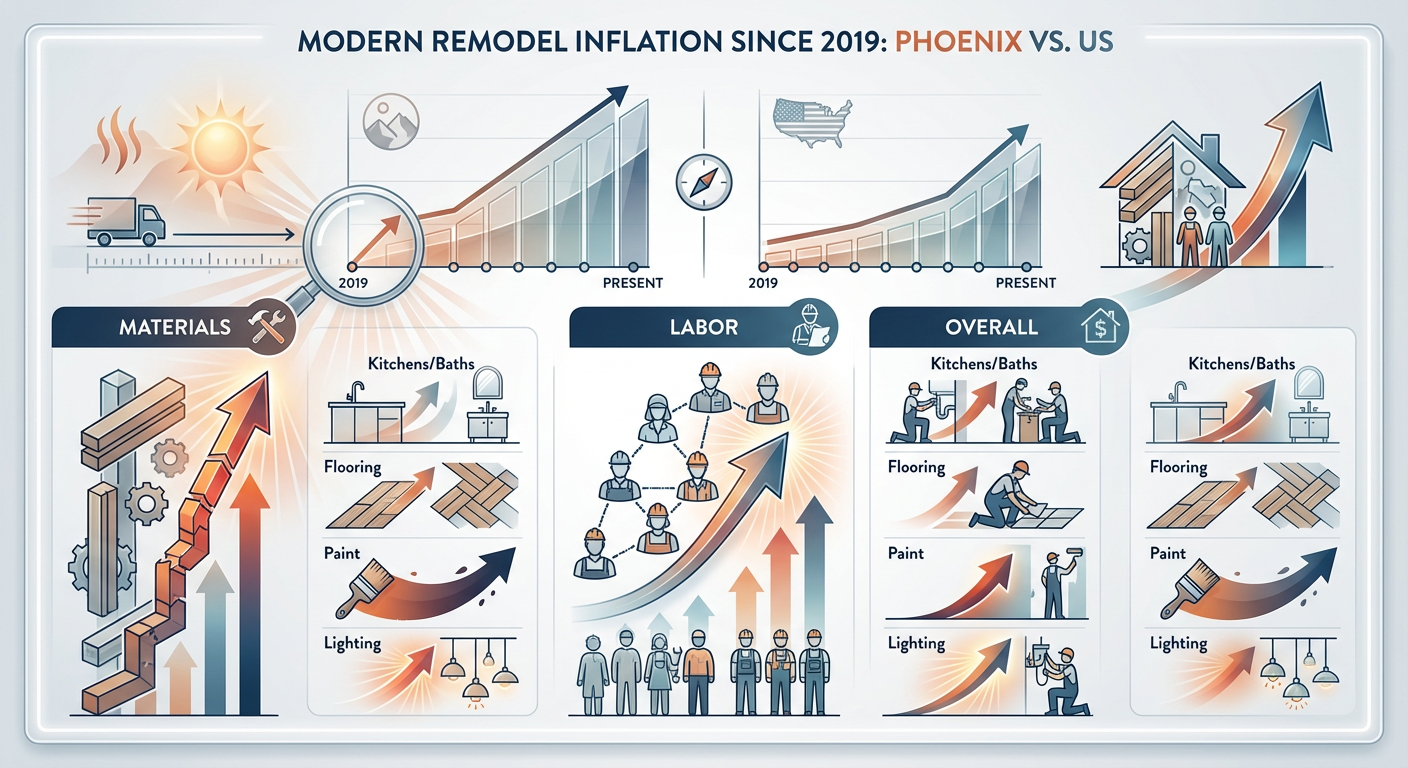
6. Phoenix Remodeling Market: Local Dynamics and Regional Influences
The national surge in remodeling costs that characterized the post-2019 period was acutely felt in Phoenix, Arizona, a metropolis that experienced its own unique amplification of these trends. As a rapidly growing urban center, Phoenix’s housing market boomed during the pandemic, attracting new residents and fueling an unprecedented demand for renovations. This robust local activity, coupled with inherent regional factors such as extreme climate, seasonal labor fluctuations, and considerable freight distances, created a complex environment where national inflationary pressures were often magnified. This section will delve into how Phoenix’s distinct market conditions contributed to and then navigated the remodel inflation roller coaster from 2019 through 2026, tracing the trajectory from initial rapid escalation to a more moderated, yet persistently elevated, growth in costs. By examining the interplay of supply, demand, and geographicspecific challenges, we aim to provide a comprehensive understanding of what changed and what stabilized in the Phoenix remodeling landscape.
The Phoenix Boom: Amplified Demand Meets Constrained Supply (2020-2022)
The Greater Phoenix area, often dubbed a “boomtown,” witnessed explosive growth during the early years of the pandemic. This period was marked by a significant influx of residents and a commensurate appreciation in home values, transforming the local remodeling market into a hotbed of activity. Homeowners, flush with increased home equity and motivated by historically low interest rates, eager to personalize their newly acquired or appreciated properties, initiated a wave of renovation projects. The demand was so intense that by late 2022, Phoenix’s home improvement spending was projected to have surged by an astounding 20.3% year-over-year[7]. This made Phoenix one of the fastest-growing markets for remodeling expenditures in the entire United States, significantly outpacing many other major metropolitan areas. This extraordinary demand created immense pressure on local contractors and the supply chain, inevitably driving up costs.
The sheer volume of renovation projects meant local remodelers found themselves with full schedules, extended waitlists, and increased pricing power. As a consequence, Phoenix experienced larger cost jumps than some other regions during 2020-2021. Industry reports from 2021 indicated that construction costs in Phoenix were rising faster quarter-over-quarter than the U.S. national average[37]. This accelerated inflation was a direct result of the local demand surge colliding with national supply chain disruptions.
The national challenges of raw material shortages, factory shutdowns, and shipping bottlenecks were particularly keenly felt in Arizona due to its geographical characteristics. Phoenix, being distant from major coastal ports and manufacturing hubs, relies heavily on long-haul trucking for the delivery of construction materials. When fuel prices spiked and trucking availability became constrained during 2021-2022, “freight surcharges drove up Phoenix material prices even beyond the base cost inflation”[10]. This meant that the cost to transport essential materials like drywall, lumber, and cabinetry to Phoenix included additional fuel fees, exacerbating the overall price increases. For instance, lumber, which saw an 85% increase nationwide in 2021[3], was likely subject to even greater local pricing pressures due to these transportation costs. The direct impact of these freight expenses added approximately 10% to the material costs for some projects in Phoenix[44].
This period of amplified demand and strained supply led to a phenomenon where not only did project costs rapidly escalate, but timelines also stretched significantly. A Phoenix homeowner planning a full kitchen remodel in 2021, for example, found an estimated 8-week project balloon into a 5-month saga[44]. Delays in custom cabinets, back-ordered appliances due to semiconductor chip shortages, and the subsequent rescheduling of tradespeople all contributed to incidental costs and homeowner frustration. The “logistical backlogs in 2021–2022 added both direct costs and delays to local projects”[44], underscoring how Phoenix’s unique position amplified the challenges faced nationwide.
Unique Regional Factors: Climate, Seasonality, and Freight Distance
Beyond the general economic forces, Phoenix’s distinct geographical and climatic characteristics played a significant role in shaping its remodel inflation trajectory. These local factors introduced layers of complexity, contributing to cost fluctuations and scheduling challenges not always present in other markets.
Climate and Seasonal Labor Dynamics
The extreme summer heat of Arizona, where temperatures can routinely exceed 110°F, directly impacts labor productivity and scheduling. Outdoor work, such as roofing, foundation work, or even tasks in non-air-conditioned interior spaces, becomes arduous and less efficient during the hottest months. Contractors in Phoenix must adapt by initiating work in the very early morning hours, extending into late evenings, or even scheduling tasks overnight to avoid peak daytime temperatures. This often necessitates paying crews hazard pay or overtime, which directly inflates labor costs. Some intensive projects are simply avoided during mid-summer, leading to a concentrated demand for labor in cooler months.
Conversely, Phoenix experiences a “snowbird” season, typically from fall through spring, when part-time residents flock to the region. This influx dramatically increases the demand for various services, including home remodeling. This period is considered prime remodeling time, creating a peak in demand for skilled contractors. “This introduces seasonal labor cost fluctuations that aren’t seen in cooler climates”[10]. The high demand during these busy winter months can allow contractors to command higher rates, further impacting project costs. According to insight from a local Phoenix contractor, these seasonal fluctuations affect scheduling and pricing, layering additional pressures on top of the pandemic-driven inflation[49]. This distinctive seasonality means that labor costs in Phoenix are not only subject to national wage growth trends but also to predictable, localized peaks and troughs influenced by its climate and population cycles.
Freight Distance and Material Costs
Arizona’s geographic location as an inland state, distant from major ports and manufacturing centers on the coasts, made its supply chain particularly vulnerable during the global disruptions of 2020-2022. Materials destined for Phoenix, whether originating from overseas or eastern U.S. factories, typically traverse significant distances via truck. The surge in demand, coupled with soaring fuel prices and acute trucking shortages, led to substantial increases in freight costs.
“Arizona’s distance from major ports also meant higher freight costs in 2021–2022, as materials had to be shipped longer distances when fuel prices were high”[10]. These elevated transportation expenses were directly passed on to consumers in the form of higher material prices. For instance, the delivery of heavy or bulky items like flooring, cabinetry, or large appliance packages would incur significant surcharges, making them more expensive in Phoenix than in locations closer to supply hubs. This regional characteristic meant that even as national material prices began to stabilize, Phoenix might have continued to experience elevated costs for a longer duration, or at a higher absolute price point, simply due to the embedded logistical overhead. The impact of such freight surcharges was so pronounced that some contractors faced instances where an additional 10% was layered onto material costs to account for expedited shipping in the challenging Arizona climate[44].
The combination of extreme climate affecting labor, the seasonality of demand affecting scheduling and labor rates, and the considerable freight distances impacting material costs meant that Phoenix’s remodeling market faced a unique trifecta of regional factors that amplified national inflation trends. These elements ensured that the trajectory of remodel costs in Phoenix was not merely a reflection of national averages but a distinct and often more volatile experience for both contractors and homeowners.
From Escalation to Moderation: The Trajectory of Phoenix Remodel Costs (2023-2026)
While Phoenix experienced an intense period of cost escalation in the early pandemic years, the market began to show signs of moderation by 2023, aligning more closely with, and in some instances even falling below, national trends. This shift marked a critical turning point for the local remodeling industry.
Signs of Cooling and Stabilization (2023-2024)
By late 2023 and into 2024, the feverish pace of cost increases in Phoenix began to subside. According to data from the Rider Levett Bucknall (RLB) construction cost index, Phoenix’s construction costs were up approximately 4.1% year-over-year at the end of 2024[9]. Remarkably, this figure placed Phoenix among the cities with the lowest construction cost increases in the U.S., specifically the “2nd-lowest increase among major U.S. metros”[9]. This represented a notable change from 2021, when Phoenix had been outpacing the national average in cost growth.
Several factors contributed to this moderation. Firstly, the overall U.S. housing market began to cool as interest rates rose, dampening the frenetic buying and selling activity that had defined the earlier pandemic years. This reduced the immediate urgency for new homeowners to undertake extensive renovations, thus easing some of the demand pressure on local contractors. Secondly, national supply chains, which had previously been severely disrupted, largely recovered by 2023. Factories resumed full-scale production, and shipping costs, particularly for international containers, reverted to near pre-pandemic levels. This meant a more consistent and predictable flow of materials into the Arizona market.
Local Supply Chain Improvements and Adaptation
Local suppliers in Phoenix also adapted significantly after the tumult of 2021-2022. Many material distributors increased their local inventory levels, creating a buffer against future delays and price volatility. For instance, instead of relying solely on just-in-time orders from out-of-state manufacturers, some Phoenix distributors began stocking popular kitchen cabinet lines. This proactive approach helped to mitigate the impact of external disruptions and provide more stable pricing for contractors.
Furthermore, the industry explored and implemented alternative logistic strategies. The greater utilization of rail transport from West Coast ports, for example, helped to reduce dependence on trucking, which had been a major cost escalator during periods of high fuel prices and driver shortages. These adjustments led to “fewer project delays and slightly better material pricing than during the worst of the supply crunch”[10], as observed in local builder surveys. Lead times for critical components like appliances and windows, which had stretched to several months at their peak, gradually shortened, minimizing the need for costly expedite fees that had become common.
Labor Market Dynamics and Future Outlook
While material cost inflation eased, labor costs remained a more persistent driver of overall remodel expenses. Nationwide, construction labor costs jumped approximately 10% in 2023 year-over-year[11], continuing a trend of significant wage growth since 2019, where average construction wages have risen about 20%[11]. In Phoenix, the slight cooling of the new home construction market due to higher interest rates released some labor and resources, making them more available for the remodeling sector. However, the underlying shortage of skilled tradespeople persists, meaning that wage growth, while perhaps less explosive, is likely to continue at a steady pace.
Looking ahead to 2025 and 2026, the Phoenix remodeling market is expected to continue its return to a more normalized trajectory. While home renovation spending in the U.S. is projected to see a slight decline in 2024 compared to 2023, it still remains approximately 30% higher than 2019 volumes[13]. For Phoenix, this suggests a robust but less frenetic market. Analysts anticipate that remodel cost inflation globally will “settle back to pre-pandemic norms by 2025”[14], meaning an annual price growth of roughly 3-4%.
A key wildcard for Phoenix remains its climate. The ongoing challenges of extreme heat and potential water scarcity could stimulate demand for specialized renovations, such as energy-efficient retrofits, advanced cooling systems, or xeriscaping. These niche demands could create concentrated inflation within specific renovation categories. However, the overarching prediction is that the period of “shock” inflation is largely over for Phoenix. Both homeowners and contractors can now plan projects with greater certainty regarding timelines and budgets than was possible during the peak volatility of 2020-2021. The market has found a new, elevated plateau for costs, but the unpredictable, double-digit increases are likely a relic of the recent past.
Specific Material and Component Price Trends within Phoenix
The general trends of material inflation and stabilization observed nationally were mirrored in Phoenix, often with the added burden of freight and local demand. Examining specific components pertinent to kitchens, bathrooms, flooring, paint, and lighting provides a granular view of these dynamics.
Kitchen and Bath Components
Cabinetry: As a significant expense in kitchen remodels, cabinetry saw substantial increases. Nationally, the average cost of kitchen cabinets rose by about 12% in 2023 compared to 2022 alone[11]. For Phoenix, these national increases were compounded by the aforementioned freight costs due to the distance from manufacturing centers. Local firms reported pre-pandemic mid-range cabinet lines being easily 25%+ more expensive by 2023. Custom orders also faced extended lead times in 2021-2022, which could incur additional storage or expedited shipping fees within the Phoenix market.
Appliances and Fixtures: Appliance costs experienced dramatic increases, with major appliances rising approximately 15% in 2023 alone[11]. This was partly due to global supply chain issues and semiconductor chip shortages. Plumbing fixtures also saw significant hikes, around 9% in 2023, with premium brands increasing up to 11%[11]. For Phoenix homeowners, backordered appliances and fixtures led to project rescheduling, adding incidental costs in addition to the elevated purchase prices. The Phoenix market saw these price points elevated due to both national trends and the logistical challenges of transporting bulky items across long distances.
Countertops and Surfaces: Popular materials like quartz countertops saw about a 10% price increase in 2023[11], driven by import costs and pricier resin components. Overall, countertop materials in 2023 were estimated to be 15-20% costlier than in 2019. The cumulative effect of higher shipping costs for heavy stone slabs and increased manufacturing expenses made these items significantly more expensive in Phoenix compared to pre-pandemic levels.
Flooring and Paint
Flooring: Flooring materials generally saw increases, with costs up 9% in 2023 on average[11]. Hardwood flooring, considered a premium option, reached about $8 per square foot. Given Phoenix’s high demand for new builds and remodels, and the need to transport a variety of flooring types (tile, hardwood, luxury vinyl), these increases were directly passed on to consumers. Cumulative increases since 2019 for some categories, like hardwood flooring, easily exceeded 20% by 2023, again influenced by freight overhead.
Paint: Paint and coatings experienced modest but persistent inflation. National reports indicated major paint brands raised prices by 10%+ over 2021-2022, citing higher pigment and shipping costs. While these materials don’t dominate a budget like cabinets, their steady inflation added hundreds of dollars to projects. For a vast, sprawling city like Phoenix where many homes undergo repainting, these consistent increases added up for homeowners.
Lighting and Electrical
Lighting: Lighting fixtures, particularly LED components, saw price increases during the 2020-2022 period due to global electronic component shortages. Although quantitative data specific to Phoenix is limited, industry sources noted 5-10% increases for some high-end LED fixtures. This affected interior remodels significantly, as modern kitchens and baths often incorporate extensive and specialized lighting designs.
Electrical Wiring: The cost of electrical wiring, heavily dependent on copper, rose significantly. Electrical wiring costs increased approximately 11% in 2023 alone, primarily due to surging copper prices[11]. This directly impacted the cost of upgrading electrical systems during remodels, adding another layer of expense beyond aesthetic finishes.
The table below summarizes the cost increases for specific remodel components, reflecting how each aspect contributed to Phoenix’s overall inflationary experience:
| Component Category | 2019 Index | 2023 Index (National) | Notes on Phoenix Impact |
|---|---|---|---|
| Kitchen Cabinets | 100 | 125-130 [11] | Freight surcharges amplified costs, longer lead times in 2021-22. |
| Major Appliances | 100 | 120-125 [11] | Backorders, increased shipping challenges for bulky items. |
| Plumbing Fixtures | 100 | 115-120 [11] | General supply chain snarls, premium brands higher. |
| Quartz Countertops | 100 | 115-120 [11] | Import costs, resin price hikes. Heavy units susceptible to freight costs. |
| Flooring Materials | 100 | 115-120 [11] | Diverse range, but all impacted by shipping to inland Phoenix. |
| Lumber (Framing) | 100 | 90-120 (volatile)[11] | Extreme volatility; early peaks exacerbated by freight, later drops offered relief. |
| Paint & Coatings | 100 | 110-115 | Successive price hikes due to chemical shortages and shipping. |
| Electrical Wiring | 100 | 120-125 [11] | Directly tied to copper prices, significant increases. |
| Gypsum Drywall | 100 | 110-118 [11] | Industry-wide demand, increased manufacturing costs; freight for bulky sheets. |
The data underscores that while national trends provided the baseline for inflation, Phoenix’s specific market conditions, including its rapid growth, unique climate-driven labor dynamics, and geographical distance from supply sources, consistently amplified these trends, particularly during the peak inflationary years. Even as the market normalized, the sustained, elevated demand for remodeling ensured that local costs remained at a higher equilibrium than pre-pandemic levels.
Conclusion: A New Cost Plateau with Stabilized Growth
The Phoenix remodeling market experienced an intense period of cost inflation from 2019 to 2022, notably driven by a surge in demand amplified by the region’s rapid growth and unique operational challenges. Factors such as the extreme summer heat impacting labor productivity, the concentrated demand during the “snowbird” season, and the increased freight costs due to Arizona’s inland location further compounded national supply chain disruptions and material price hikes. This confluence of local and national pressures resulted in Phoenix remodeling costs outpacing national averages during the peak inflationary period, with home improvement spending surging by over 20% year-over-year by late 2022[7].
However, by 2023 and into 2024, the market began to stabilize, mirroring a national cooldown. Material prices for many categories, especially lumber, normalized, and global supply chains largely recovered. Phoenix adapted through local inventory increases and logistical adjustments, which helped to temper price volatility. Consequently, by late 2024, Phoenix’s construction cost growth had moderated to around 4.1% annually, becoming one of the lowest among major U.S. metros[9]. While labor costs remain elevated due to persistent shortages, the overall trajectory indicates a return to more predictable, single-digit annual increases, similar to pre-pandemic norms. This new reality for Phoenix homeowners and remodelers is characterized by a “new normal” of higher costs compared to 2019, albeit with much greater stability and predictability as the market matures beyond the immediate shock of the pandemic era. The intense fluctuations have subsided, leaving a market that is robust but no longer subject to the same feverish escalation.
The next section will build upon this localized analysis by delving into the specific data series used to track these changes, presenting methodologies, and detailing the creation of composite indices to quantify remodel inflation more precisely.
7. Comparison of Remodel Inflation to General Consumer Price Index
The period spanning from 2019 to 2026 has witnessed unprecedented volatility in the U.S. economy, fundamentally altering cost structures across various sectors. Among the most profoundly affected has been the residential remodeling industry. While general consumer prices, as measured by the Consumer Price Index (CPI), have certainly experienced significant inflation, the costs associated with home renovations have, for substantial portions of this period, outpaced the broader economic inflation. This disparity has had profound implications for homeowners, influencing their budgeting decisions, project scopes, and overall financial planning. Understanding the divergence between remodeling inflation and the general CPI is crucial for grasping the economic forces at play, the unique pressures faced by the construction sector, and the evolving landscape of homeownership in the post-pandemic era.
From 2019 through 2024, U.S. residential remodeling and repair costs surged by approximately 44%[1]. This stands in stark contrast to the preceding five-year period (2014-2019), which saw a more modest increase of about 20%[2]. The rapid acceleration in cost growth, with annual inflation rates roughly doubling from a pre-pandemic average of 4% to over 7% during the height of the pandemic years[23], points to a unique set of circumstances impacting the remodeling sector. This section will delve into the factors driving this accelerated inflation, comparing it directly to general consumer price trends, identifying the key components that contributed most significantly, and examining the implications for both homeowners and the industry, particularly with a focus on the Phoenix market where applicable.
7.1. The Discrepancy: Remodeling Costs Outpacing General Inflation
For much of the 2020-2023 period, the rate of inflation for home remodeling and repair costs significantly exceeded the general Consumer Price Index. While the CPI tracks a broad basket of goods and services, the remodeling industry was hit by a perfect storm of unique factors that drove its costs higher and faster. This created a notable divergence, where the purchasing power of homeowners for renovation projects diminished at a quicker rate than for everyday consumer goods.
In the second quarter of 2025, for instance, remodeling and repair prices were reported to be up 3.4% year-on-year[4]. While this figure might appear moderate on its own, it was noted to be “slightly above the broader CPI – largely due to labor and subcontractor rate increases.”[4] Crucially, this 2025 figure represents a deceleration from earlier, more intense periods of inflation. During the peak years of 2021-2022, remodeling price inflation was even more pronounced, with annual rates in the mid-to-high single digits, and often exceeding 8-12%[34]. This was well above the concurrent consumer inflation rates, which, while high, typically didn’t reach the same peaks as construction-related costs.
The magnitude of this disparity is highlighted by the overall growth figures. U.S. residential reconstruction costs surged by 43.9% between October 2019 and October 2024[20]. This average annual cost inflation accelerated from approximately 4% pre-pandemic to roughly 7.3% during the 2020-2024 period, reflecting the pandemic’s outsized impact[23]. In a period of high demand fueled by homeowners being confined to their homes (and often having more disposable income due to reduced travel and entertainment), supply chains buckled under pressure. This combination of surging demand and constrained supply provided fertile ground for remodeling costs to decouple from general inflation rates.
What makes this outperformance of remodeling inflation particularly impactful for homeowners is the scale of these projects. Unlike daily consumables, a home renovation represents a significant financial investment. When costs escalate by 10%, 20%, or even 30-50% for a project planned just a few years prior, it can easily translate into tens of thousands of dollars of unexpected expense. The “implication” is clear: “Remodeling has been an inflation hot-spot, with cost increases eating into homeowners’ budgets more than many other spending categories.”[34] This forced many homeowners to either expand their budgets considerably, scale back their project ambitions, or delay renovations altogether, illustrating the direct financial strain caused by this inflationary divergence.
7.2. Economic Forces Driving the Discrepancy
The gap between remodeling inflation and general CPI was not arbitrary but rather a consequence of specific economic forces acting upon the construction sector. These forces can largely be categorized into supply chain disruptions, unprecedented demand, and escalating labor costs.
7.2.1. Material Price Volatility: The Primary Catalyst (2020-2022)
Initially, the most significant driver of remodeling inflation was the dramatic surge in material costs. The pandemic disrupted global supply chains, leading to manufacturing shutdowns, shipping delays, and raw material shortages. This created a scenario where “too much money [was] chasing too few goods, a classic recipe for inflation.”[24]
- Lumber’s Meteoric Rise and Fall: Lumber prices became the clearest illustration of this volatility. Softwood lumber prices “jumped ~85% in 2021 alone”[3]. At one point in May 2021, lumber futures exceeded $1,500 per thousand board feet, more than four times their pre-pandemic levels[22]. This “fourfold increase” added “thousands of dollars to the cost of wood-intensive projects”[26]. While lumber prices eventually retreated to near pre-pandemic levels by 2023[4], this extreme swing heavily impacted project costs during its peak.
- Broad Material Increases: Other building materials also saw substantial double-digit inflation. The Producer Price Index for inputs to residential construction (less energy) surged by nearly 20% in 2021 alone[21]. Steel (critical for appliances and structural components), copper (for electrical wiring and plumbing), drywall, and paint all experienced significant price hikes[3]. For example, the “cost of major appliances rose about 15% in 2023”[25] due to high demand and semiconductor chip shortages, adding to a trend of already elevated prices. Similarly, “plumbing fixtures (sinks, faucets, etc.) cost ~9% more in 2023 than a year prior”[25].
- Supply Chain Bottlenecks: These material price hikes were exacerbated by logistical challenges. Factories struggling with COVID-related closures, port congestion, and a shortage of truck drivers meant that even available materials were difficult and expensive to transport. For regions like Arizona, their “distance from major ports also meant higher freight costs in 2021–2022”[10], compounding national inflation pressures.
This initial phase of material-driven inflation was largely specific to the construction and manufacturing sectors, leading remodeling costs to spike well beyond the general CPI, which was initially buffered from these commodity-specific shocks.
7.2.2. Sustained Demand and Labor Shortages: The Enduring Factor
While material costs began to stabilize or even correct by mid-2023, labor costs emerged as a persistent and increasingly dominant driver of remodeling inflation. This further cemented the gap with the general CPI, as wage growth in construction outpaced many other sectors.
- Booming Demand: The “pandemic boomtown” phenomenon, particularly evident in markets like Phoenix, fueled an insatiable demand for home renovations[37]. “Home improvement spending in Phoenix was projected to grow 20.3% year-over-year by Q4 2022”[13], one of the fastest rates in the country. Nationally, homeowners spent an estimated “$472 billion on improvements and repairs in 2022”[14], a substantial increase from pre-pandemic levels of around $350 billion in 2019. This high demand, coupled with a pre-existing shortage of skilled trades, pushed labor rates higher.
- Acute Labor Shortage: The construction industry faced “near-record job openings in 2021–2022, often exceeding 300,000–400,000 unfilled positions”[30]. This severe shortage gave workers significant leverage. To attract and retain talent, contractors were compelled to increase wages significantly. Contractors reported paying “about 10% more for labor in 2023 than in 2022”[6], and cumulatively, total construction wages are up roughly 20% since 2019, consistently “outpacing general inflation”[6].
- “Sticky” Wages: Unlike material prices, which can fluctuate with commodity markets, wage increases tend to be “sticky” – once raised, they rarely decrease. This means that even as material costs stabilize, the elevated labor rates become a new, higher baseline for project costs. This is reflected in the fact that by Q2 2025, remodeling inflation was primarily attributed to “labor and subcontractor rate increases”[4], even if material inflation had cooled to 0% by mid-2023[5].
7.3. Implications for Homeowners’ Budgets and Decision-Making
The prolonged period where remodeling inflation outstripped the general CPI profoundly impacted homeowners’ financial strategies and project expectations. The dream of a renovated kitchen or bath often collided with a stark new economic reality.
7.3.1. Increased Project Costs and Budget Adjustments
The most direct consequence was a significant increase in the final cost of renovation projects. Homeowners who received quotes in 2019 or early 2020 often found those same projects could cost “30–50% more than expected”[24] by 2022, as both materials and labor became markedly more expensive. This created sticker shock and necessitated substantial budget adjustments.
- Specific Component Impacts:
- Kitchen Cabinets: Average costs increased ~12% in 2023 compared to 2022[7], and mid-range cabinet lines were 25%+ more expensive than in 2019[35].
- Appliances: Major appliance costs rose ~15% in 2023 alone[8], building on previous increases.
- Flooring: Costs for flooring materials were up 9% in 2023[9], with cumulative increases for some categories surpassing 20% since 2019[36].
- Plumbing Fixtures: Saw nearly 10-11% cost hikes in the past year[9].
- Contractor Transparency: Faced with “razor-thin margins,” more remodelers began “routinely passing material price increases to customers” – from ~45% in 2020 to ~60% by 2023[11]. This meant homeowners directly absorbed the inflation.
7.3.2. Strategic Adaptation and Phased Renovations
In response to these rising costs, homeowners and contractors developed adaptive strategies:
- Scope Reduction: Many homeowners chose to “cut scope to meet budget”[52]. This might involve postponing certain elements (e.g., a full basement bathroom build-out), opting for less expensive finishes (e.g., luxury vinyl instead of hardwood), or choosing refacing over full cabinet replacement. “Such stories became common”[52], with clients scaling back “nice-to-have” features.
- Phased Projects: Spreading out the expense over time became a common tactic. Homeowners might renovate one bathroom in one year and another the next, or complete essential structural work first and defer cosmetic updates.
- DIY Engagement: For certain smaller tasks or projects, some homeowners engaged in more DIY work to save on labor costs, recognizing the significant increase in professional rates.
7.3.3. Long-Term Budgeting and Planning
The experience of sharp remodeling inflation has also shifted homeowners’ long-term planning horizons:
- Higher Starting Baselines: Even with stabilization, costs are at a “new high plateau”[12]. A kitchen remodel in 2024 will inherently cost significantly more than the same project in 2019. Homeowners now need to budget for these elevated price points as the “new normal.”
- Contingency Planning: The volatility of 2020-2022 taught many to build larger contingency funds into their renovation budgets, acknowledging the potential for unexpected cost increases or delays.
- Impact on Home Equity Decisions: With rising interest rates, financing large renovation projects through home equity loans has become more expensive, potentially influencing homeowners to delay projects or opt for smaller-scale changes where possible[42].
7.4. Regional Dynamics: Phoenix as a Case Study
The Phoenix metropolitan area provides an excellent regional lens through which to examine how global and national inflationary pressures manifested locally, sometimes with amplified effects due to specific market conditions.
7.4.1. Amplified Inflation During the Boom (2020-2022)
Phoenix, experiencing a “pandemic boomtown” growth, initially saw remodeling inflation that often outpaced national averages. The robust housing market and influx of new residents created intense demand for renovations alongside existing supply chain challenges.
- Surging Demand: Home improvement spending in Phoenix was projected to be “20.3% higher than the year before” by late 2022[13], making it one of the fastest-growing renovation markets. This rapid demand growth put immense pressure on local contractors and material suppliers.
- Higher Freight Costs: Due to Arizona’s distance from major ports and manufacturing centers, “higher freight costs in 2021–2022”[10] significantly impacted material prices. When fuel prices spiked, “freight surcharges drove up Phoenix material prices even beyond the base cost inflation”[38], adding about “10% to material costs” in some instances[51].
- Labor and Seasonal Effects: Phoenix’s unique climate exacerbated labor cost pressures. The “extreme heat of summer… can limit labor productivity”[10], potentially leading to hazard pay or overtime. Conversely, the “snowbird” season amplified demand for contractors in the winter, allowing for higher labor rates or premiums[10].
7.4.2. Moderation and Stabilization (2023-2024)
By 2023-2024, Phoenix began to experience a moderation in its construction cost inflation, even falling below the national average in some metrics.
- Cooling Housing Market: A slowdown in new home construction due to higher interest rates “freed up some labor and resources for the remodeling side”[39].
- Improved Logistics: Local suppliers adapted, increasing inventory levels and utilizing alternative supply routes to minimize delays and costs[40]. This improvement meant “fewer project delays and slightly better material pricing”[40].
- Slower Cost Growth: By late 2024, Phoenix’s construction costs were up about “4.1% year-on-year”[15], which was notably “the 2nd-lowest increase among major U.S. metros”[15] at that time, indicating a return to more stabilized growth compared to the earlier surges.
This illustrates that while national trends are important, local market dynamics (like population growth, climate, and logistical infrastructure) can significantly influence how remodeling inflation compares to the general CPI in a specific region.
7.5. The Outlook: A Return to Normalized Inflation (2025-2026)
As the industry moves towards 2025 and 2026, there is a general consensus that remodeling cost inflation is “heading back toward normal levels”[18], aligning more closely with long-term historical averages and, once again, the general CPI.
- Decelerating Growth Rates: Verisk’s tracking suggests annual growth, which peaked at over 7% in 2020-2022, is “trending down to around 3–4% going forward”[18]. This “return to pre-pandemic growth rates”[19] is a strong indicator of stabilization.
- Material Price Stabilization: The NAHB reported that by “mid-2023, overall building material prices were flat year-over-year”[5]. This significant cooldown in material inflation removes a major driver of the past disparity. While individual items might fluctuate, the broad upward pressure from materials has subsided as global supply chains largely “unsnarled”[43].
- Cooling Demand: Rising interest rates have “cooled the pace of home renovations”[42], with Harvard’s Joint Center for Housing Studies forecasting a “small decline (-7%) in renovation spending in 2024”[42]. Reduced demand pressure gives contractors more breathing room, potentially leading to more competitive pricing.
- Labor as the Lingering Factor: While overall inflation is moderating, “labor costs could continue upward if the worker shortage isn’t addressed”[45]. Wage growth in construction is still above long-term norms, meaning labor remains “the more persistent source of inflation”[33]. This suggests that future remodeling inflation will likely be heavily influenced by the availability and cost of skilled labor, even if material prices remain stable.
The outlook suggests a healthier remodeling market, where costs still rise, but at a predictable and manageable pace (likely 3-5% annually), more in line with the general CPI. This offers homeowners greater certainty in planning their projects and provides contractors with a more stable operational environment. However, the costs associated with remodeling remain at a “new high plateau”[12], signaling that while the rapid inflationary period has passed, renovations are inherently more expensive today than they were pre-pandemic.
The detailed analysis of how remodeling inflation compared to the general CPI reveals a dynamic market heavily influenced by unique pandemic-era pressures. While the worst of the cost surges appears to be over, the industry and homeowners alike must adapt to a new, higher cost environment for home renovations. This understanding forms a crucial backdrop for assessing specific component costs and future trends, which will be further explored in subsequent sections of this report.
***
- U.S. Census Bureau, Construction Price Indexes.
- U.S. Census Bureau, Construction Price Indexes.
- U.S. Census Bureau, Construction Price Indexes.
- Retrieved from U.S. Census Bureau, “Construction Price Indexes.
- ZipDo. (Feb 10, 2026). *Remodeling Industry Statistics 2026*. Retrieved from zipdo.co
- Associated Press. (Sept 30, 2025). *Prices for Home Remodeling Outpaced Inflation in Q2 2025 Amid Labor Shortages*. Retrieved from apnews.com
- NAHB, “Building Material Prices Increase at Fastest Pace in Three Years.”
- ZipDo. (Feb 10, 2026). *Remodeling Industry Statistics 2026*. Retrieved from zipdo.co
- ZipDo. (Feb 10, 2026). *Remodeling Industry Statistics 2026*. Retrieved from zipdo.co
- ZipDo. (Feb 10, 2026). *Remodeling Industry Statistics 2026*. Retrieved from zipdo.co
- ZipDo. (Feb 10, 2026). *Remodeling Industry Statistics 2026*. Retrieved from zipdo.co
- The Contractor Guys AZ. (2025). *Complete Guide to Home Remodeling in Phoenix: Timeline, Costs and Process 2025*. Retrieved from www.thecontractorguysaz.com
- ZipDo. (Feb 10, 2026). *Remodeling Industry Statistics 2026*. Retrieved from zipdo.co
- U.S. Census Bureau, “Construction Price Indexes.
- U.S. Census Bureau, Construction Price Indexes.
- Stacker (via KTVZ). (Feb 11, 2023). *15 Metros Where Home Improvement Spending Is Rising Fastest*. Retrieved from ktvz.com
- Associated Press. (May 9, 2024). *Spending on Home Renovations Slows, But High Remodeling Costs Mean Little Relief*. Retrieved from apnews.com
- AZBEX. (Jan 17, 2025). *Phoenix Had 2nd-Lowest Q4 Cost Increases in 2024*. Retrieved from azbex.com
- U.S. Census Bureau, Construction Price Indexes.
- U.S. Census Bureau, Construction Price Indexes.
- U.S. Census Bureau, Construction Price Indexes.
- U.S. Census Bureau, Construction Price Indexes.
- NAHB. (2021). *Building Material Prices Are Up 19% Year-Over-Year*. Retrieved from www.builderonline.com
- ZipDo. (Feb 10, 2026). *Remodeling Industry Statistics 2026*. Retrieved from zipdo.co
- U.S. Census Bureau, Construction Price Indexes.
- Associated Press. (May 9, 2024). *Spending on Home Renovations Slows, But High Remodeling Costs Mean Little Relief*. Retrieved from apnews.com
- ZipDo. (Feb 10, 2026). *Remodeling Industry Statistics 2026*. Retrieved from zipdo.co
- ZipDo. (Feb 10, 2026). *Remodeling Industry Statistics 2026*. Retrieved from zipdo.co
- ZipDo. (Feb 10, 2026). *Remodeling Industry Statistics 2026*. Retrieved from zipdo.co
- Associated Press. (Sept 30, 2025). *Prices for Home Remodeling Outpaced Inflation in Q2 2025 Amid Labor Shortages*. Retrieved from apnews.com
- Associated Press. (Sept 30, 2025). *Prices for Home Remodeling Outpaced Inflation in Q2 2025 Amid Labor Shortages*. Retrieved from apnews.com
- ZipDo. (Feb 10, 2026). *Remodeling Industry Statistics 2026*. Retrieved from zipdo.co
- ZipDo. (Feb 10, 2026). *Remodeling Industry Statistics 2026*. Retrieved from zipdo.co
- Stacker (via KTVZ). (Feb 11, 2023). *15 Metros Where Home Improvement Spending Is Rising Fastest*. Retrieved from ktvz.com
- ABC15. (2021). *Report: Phoenix outpaces nation in construction cost increases*. Retrieved from www.abc15.com
- AZBEX. (Jan 17, 2025). *Phoenix Had 2nd-Lowest Q4 Cost Increases in 2024*. Retrieved from azbex.com
- Phoenix Home Remodeling. (2024). *Phoenix Interior Remodeling Cost Index 2026: What Homeowners Should Budget Now*. Retrieved from phxhomeremodeling.com
- Associated Press. (May 9, 2024). *Spending on Home Renovations Slows, But High Remodeling Costs Mean Little Relief*. Retrieved from apnews.com
- U.S. Census Bureau, Construction Price Indexes.
- U.S. Census Bureau, Construction Price Indexes.
- Phoenix Home Remodeling. (2024). *Phoenix Interior Remodeling Cost Index 2026: What Homeowners Should Budget Now*. Retrieved from phxhomeremodeling.com
- ZipDo. (Feb 10, 2026). *Remodeling Industry Statistics 2026*. Retrieved from zipdo.co
8. Outlook: Cooling Trends and the New Normal (2024-2026)
After a tumultuous period characterized by unprecedented cost inflation, supply chain disruptions, and a surge in demand, the United States remodeling market, and by extension, the Phoenix metropolitan area, appears to be entering a period of stabilization. The frenetic pace of price increases witnessed between 2020 and 2023 is projected to recede, with industry analysts forecasting a return to more ‘normal’ annual inflation rates, typically aligning with historical averages of 3-5% for remodeling costs, by 2025 and stretching into 2026 [19]. This section provides a forward-looking analysis of these anticipated cooling trends, delving into the macroeconomic shifts, supply chain recoveries, and contractor adaptations that are collectively shaping this new normal. It also addresses residual risks and offers guidance on what homeowners can expect for future project planning, particularly within the unique context of the Phoenix market.
The period from 2019 to 2024 saw U.S. residential remodeling and repair costs surge by approximately 44% [1], a stark contrast to the 20% growth experienced in the preceding five-year span [2]. This accelerated inflation was largely driven by unprecedented price hikes in key materials and a persistent labor shortage. However, data from mid-2023 indicated a significant turning point, with overall building material inflation cooling to 0% year-over-year [4]. While this brought a welcome reprieve for material costs, labor expenses have continued their upward trajectory, evolving into the primary driver of remodeling price increases by Q2 2025 [7]. As we look ahead, understanding the interplay of these factors is crucial for accurately forecasting remodeling costs.
The Deceleration of Remodeling Cost Inflation
The exorbitant growth in remodeling costs experienced during the pandemic era is widely expected to decelerate significantly through 2026. This slowdown signals a much-needed return to predictability for both homeowners and contractors. Verisk’s tracking of reconstruction costs, for instance, projects that the annual growth rate, which previously soared to over 7% during 2020-2022, is on track to revert to the historical average of approximately 3-4% [19]. This shift is a critical indicator for the stability of the remodeling market. In fact, by early 2025, projections indicated that price increases for both labor and materials would more closely mirror the general inflation rate [19], a significant departure from the preceding years where remodeling inflation far outpaced the Consumer Price Index (CPI).
Evidence of this cooling trend began to emerge even as early as mid-2023. The National Association of Home Builders (NAHB) reported that overall building material prices were effectively flat year-over-year at that time [4]. This stability was a dramatic change from the double-digit percentage increases that characterized the peak of the supply chain crisis. The leveling off of material costs, particularly in categories like lumber which saw a return to near pre-pandemic levels by 2023 following a 300%+ surge [3], underscores the market’s recovery and its capacity to absorb demand shocks. This stabilization does not imply a return to 2019 prices, but rather a more sustainable rate of increase moving forward, operating from a new, elevated baseline. As industry analysts suggest, “while remodeling price growth is slowing to more ‘normal’ levels by 2024–2025, today’s remodel costs are locked in at a new high plateau” [10].
Key Factors Driving the Cooling Trend
Several interconnected factors are contributing to this more temperate outlook for remodeling inflation, spanning macroeconomic conditions, improvements in global supply chains, and adaptive strategies employed by contractors.
1. Macroeconomic Shifts and Demand Moderation
The broader economic landscape plays a significant role in influencing remodeling activity and associated costs. A primary factor is the rise in interest rates, which have sharply increased from their historic lows during the pandemic [20]. Many homeowners traditionally rely on home equity loans or refinancing options to finance major renovation projects, and the increased cost of borrowing has inevitably cooled this demand. The housing market itself has also experienced a calming period in many regions, reducing the urgency for rapid remodels aimed at increasing resale value in a frenzied market [20].
Harvard’s Joint Center for Housing Studies (JCHS) indeed projected a notable shift, forecasting a small decline of approximately 7% in renovation spending in 2024 compared to 2023, following several years of robust expansion [5]. This moderation in demand translates to contractors being less overbooked than in previous years, potentially offering homeowners a bit more negotiating power on quotes. This easing of demand-side pressure naturally contributes to a more stable pricing environment.
| Year | Estimated Spending (Billions USD) | Year-over-Year Change |
|---|---|---|
| 2019 | ~$350 | – |
| 2022 | $472 | – |
| 2023 | ~$483 (est.) | +2.3% |
| 2024 (Forecast) | $449 | -7.0% |
| Source: AP News [5], referencing Harvard JCHS data. 2023 estimate based on 2024 forecast being 7% lower. | ||
2. Global Supply Chain Recovery
One of the most consequential drivers of pandemic-era inflation was the widespread disruption of global supply chains. However, by 2024, these critical networks have largely unsnarled. Factories crucial for producing building materials have ramped up to full production capacities, shipping container costs have largely reverted to pre-pandemic levels, and the availability of most materials has significantly improved [20]. While minor localized issues or specific electronic component shortages might persist, the broad, systemic shortages of 2021-2022 are largely a thing of the past.
This recovery implies fewer unexpected cost increases stemming from material scarcity or exorbitant shipping fees. For instance, lumber mills, after experiencing extreme volatility, have stabilized their output, contributing to lumber futures settling into a more predictable price range [3]. Similarly, international suppliers of ceramic tiles, stone, and various fixtures now maintain more consistent inventory levels. This improved predictability allows remodelers to price projects with greater confidence, reducing the need for substantial risk premiums that were common during the peak of the supply crisis. The NAHB’s report of flat building material prices by mid-2023 is a direct consequence of this supply chain normalization [4].
3. Contractor Adaptations and Market Maturity
The remodeling industry itself has undergone significant adaptation in response to the volatility of recent years. Many contractors have refined their operational strategies to mitigate future shocks. These adaptations include:
- Earlier Material Procurement: Contractors are increasingly ordering materials well in advance of project commencement or maintaining essential item inventories to buffer against sudden price shifts or availability issues [20].
- Enhanced Supplier Relationships: Forming stronger partnerships with local suppliers has enabled some contractors to secure more stable pricing and improve lead times. For example, some Phoenix distributors started stocking popular cabinet lines instead of ordering them on demand [10].
- Strategic Labor Management: While labor shortages remain a concern, companies are investing in in-house training programs and optimizing subcontractor engagement to manage costs and ensure skilled worker availability [22].
- Refined Contractual Agreements: Many remodelers now incorporate clearer escalation clauses or shorter validity periods for quotes, protecting both themselves and clients from unforeseen price changes mid-project. The “lumber bubble” of 2021 was a stark lesson, prompting many to include price-adjustment provisions [22].
These professional adjustments signify a more resilient industry that is better equipped to handle potential future disruptions, preventing minor cost swings from escalating into major inflationary pressures on end-prices. The experience of remodeling contractors during the peak inflation period shows how quickly firms had to adapt their quoting, procurement, supplier communication, and contingency planning to manage fast-changing project costs[6].
Phoenix: From Hotspot to Harmonization (2024-2026)
The Phoenix metropolitan area, which experienced an amplified version of national remodeling trends due to its rapid pandemic-era growth, is also showing clear signs of cost normalization. During the peak of the pandemic, Phoenix’s home improvement spending was projected to grow by an astounding 20.3% year-over-year by Q4 2022 [12], making it one of the fastest-growing markets in the nation. This intense demand, combined with unique regional factors, led to higher inflation rates in the early pandemic years compared to the national average [13].
However, by late 2024, Phoenix’s construction cost increases had moderated to approximately 4.1% annually [15]. Strikingly, this figure positioned Phoenix among the lowest increases observed in major U.S. cities at that time [15]. This shift can be attributed to several factors:
- Housing Market Cooldown: The frenzied housing market in Phoenix, characterized by rapid home price appreciation and an influx of new residents, began to temper. Higher interest rates particularly impacted new home construction, freeing up some labor and resources that could then be deployed on the remodeling side [10].
- Improved Local Supply Chains: Local Phoenix suppliers adapted to the earlier tumult by increasing inventory levels and optimizing logistics. This mitigated delays for contractors and reduced the necessity for costly expeditated freight [10]. Lead times for crucial items like appliances and windows, which had stretched to months in 2021, gradually shortened, easing a significant source of project delays and additional costs for homeowners [10].
- Seasonal Labor Management: While Phoenix’s extreme summer heat and winter ‘snowbird’ season continue to influence labor availability and pricing, contractors have become more adept at planning around these unique regional challenges. The peak booking periods for contractors are still autumn and early winter, during which labor prices can be at a premium [14]. However, the overall easing of demand has allowed for more strategic project scheduling.
The outlook for Phoenix’s remodeling market suggests continued robustness but with a normalized cost environment. Homeowners are still investing in upgrades, especially those focused on energy efficiency and luxury amenities, but they are no longer facing the double-digit percentage cost jumps of previous years. Barring unforeseen economic shocks, Phoenix is expected to align with national trends, experiencing mid-single-digit annual growth rates for remodeling costs.
Residual Risks and Lingering Cost Pressures
While the overall outlook points to cooling trends, it is crucial to recognize potential areas where inflationary pressures might persist or re-emerge. These include:
- Persistent Labor Costs: The skilled labor shortage remains the most stubborn challenge. Construction labor costs generally jumped around 10% year-over-year for many remodeling firms in 2023 [8]. Total construction wages are estimated to be 20% higher in 2023 than in 2019 [8], outpacing general inflation. Unlike material prices, which can fluctuate downward, wages are “sticky”, once increased, they rarely decrease [20]. If efforts to expand the labor pool through training, apprenticeship programs, or immigration are insufficient, wage growth could continue to outpace other components of remodeling inflation, albeit incrementally. By Q2 2025, remodeling and repair costs were still up 3.4% year-on-year, primarily driven by these higher labor and subcontractor rates [7].
- Energy Prices and Geopolitical Factors: Global energy prices, particularly for oil and natural gas, directly impact the cost of manufacturing and transporting building materials. Geopolitical instability or shifts in trade policies (e.g., new tariffs on imported materials) could trigger localized or broad material price spikes. Although an immediate “lumber bubble” scenario is unlikely, certain commodities like steel, copper, or petrochemical-derived products could experience renewed volatility.
- Component-Specific Inflation: While overall material inflation has cooled, certain specialized components may still see individual price increases. For instance, kitchen cabinet prices were still up 12% in 2023 compared to 2022 [9], and major appliance packages saw approximately a 15% increase in 2023 alone [16]. These jumps reflect both lingering supply chain efficiencies for complex goods and sustained consumer demand for high-quality finishes. Similarly, flooring materials rose 9% in 2023 [17], and plumbing fixtures saw 9-11% cost hikes [18]. These increases, though decelerating, show that specific categories may continue to experience above-average inflation due to their unique market dynamics.
The table below provides a summary of projected cost component trends for 2024-2026:
| Component Category | 2024 Trend | 2025-2026 Outlook (Annual % Change) | Notes | |
|---|---|---|---|---|
| Lumber/Wood Products | Stabilized (near pre-peak) | ~2-4% | Prices have largely normalized after large swings. Minor increases due to general inflation. | |
| Metals (Steel, Copper) | Moderating | ~3-6% | Supply chain backlogs cleared, but global demand & energy costs can influence. Copper wiring still saw ~11% rise 2023. | |
| Paint & Coatings | Slightly elevated | ~4-7% | Increases from 2021-2022 largely stuck; minor new hikes possible due to chemicals. | |
| Appliances | Elevated, slowing | ~5-8% | Supply chains improved, but demand & tech upgrades keep prices firm (15% rise in 2023 alone). | |
| Cabinetry | Elevated, continued rise | ~6-9% | Component costs (wood, hardware) and labor continue to push prices up (~12% rise in 2023). | |
| Flooring & Surfaces | Elevated, moderating | ~4-7% | Material & import costs remain higher (9% rise in 2023 for flooring, 10% for quartz counters). | |
| Plumbing Fixtures | Elevated, moderating | ~4-7% | Supply chain normalization, but premium brands retain pricing power (~9-11% rise in 2023). | |
| Electrical & Lighting | Elevated | ~4-8% | Dependent on metal prices (copper) and complex electronics for smart lighting; ~11% rise in 2023 for wiring. | |
| Construction Labor | Steadily rising | ~7-10% | Persistent skilled labor shortages *the* primary driver of increasing project costs (10% rise in 2023). | |
| Subcontractor Rates | Steadily rising | ~7-10% | Mirrors general labor trends, highly localized for specialized trades (e.g., tile, plumbing). | |
| Source: Compiled from ZipDo data [8], AP News [7], and NAHB reports [4]. Projected ranges are indicative and subject to change. | ||||
Implications for Homeowners and Project Planning
For homeowners contemplating renovations in 2024-2026, the improved stability offers a more conducive environment for planning. The era of double-digit percentage remodeling inflation appears to be largely over, suggesting that cost projections will be more reliable. Essentially, the climate for planning renovations is improving. Those who put off projects hoping for prices to calm may find 2024–2025 a sweet spot – costs are no longer ballooning each month, and in some cases quotes might even be a bit lower than a year ago, especially for wood-intensive work [20].
- Budgeting: While the rate of increase has slowed, overall costs remain considerably higher than pre-2019 levels. Homeowners should still budget conservatively, accounting for annual increases in the 3-5% range, particularly for labor-intensive projects.
- Comparative Quoting: With contractors potentially less overbooked, obtaining multiple quotes might yield more competitive pricing. However, quality and reliability should remain paramount over solely cost-driven decisions.
- Lead Times: Material lead times have significantly shortened across most categories, reducing the likelihood of prolonged project delays seen in 2021-2022. However, custom or specialized items may still require longer waits.
- Scope Adjustments: The practice of adjusting project scope to fit budgets, which became common during peak inflation (e.g., choosing luxury vinyl over hardwood, or refacing cabinets instead of full replacement) [22], remains a valuable strategy.
- Phoenix Specifics: Homeowners in Phoenix should remain mindful of seasonal impacts on labor availability and potential minor freight cost premiums, though these are now less impactful than during the height of the supply chain crisis. Planning projects outside the peak winter season or mid-summer heat extremes could offer some flexibility.
In conclusion, the period spanning 2024-2026 marks a critical transition for the remodeling industry. While the shock of pandemic-fueled inflation has largely subsided, a “new normal” of elevated base costs and persistent labor-driven inflation will frame future projects. Predictability, however, is a welcome return, allowing for more strategic and less volatile renovation planning.
The next section, “9. Repricing Archetypes: 2019 vs. 2024 vs. 2026,” will put these trends into practical context by analyzing how the costs of specific kitchen, bath, and flooring projects have evolved and are projected to change, offering tangible examples for homeowners and professionals alike.
9. Frequently Asked Questions
Navigating the landscape of home remodeling costs since 2019 has been a complex journey for homeowners and contractors alike. The period leading up to and following the COVID-19 pandemic unleashed unprecedented volatility in material prices, labor availability, and overall project expenditures. This section aims to address the most common questions raised by those considering renovations, providing clarity on what has changed, what has stabilized, and what to expect in the coming years. By delving into specific cost components, regional nuances (particularly for Phoenix, Arizona), and broader market trends, we aim to offer a comprehensive understanding of the current state of remodel inflation.
What Components of a Remodel Project Have Risen Most Significantly Since 2019?
The period from 2019 to 2024 has witnessed a dramatic surge in residential remodeling and repair costs across the United States, with an approximate 44% increase nationally1. This stands in stark contrast to the preceding five-year period (2014-2019), which saw a more modest 20% growth2. The primary drivers of this accelerated inflation were material costs and labor expenses, each exhibiting distinct trajectories of increase.
Material Cost Escalation: The Rollercoaster Ride
During the initial phase of the pandemic, from 2020 to 2022, building material costs experienced record price spikes, largely due to supply chain disruptions, manufacturing slowdowns, and a boom in homeowner demand. The Producer Price Index for inputs to residential construction (excluding energy) rose by 8.3% in 2022 alone, following an even sharper spike in 2021 where material inflation was nearly 20% year-over-year2324.
Lumber stands out as the most volatile component. Softwood lumber prices soared by approximately 85% in 2021 alone4, with futures exceeding $1,500 per thousand board feet in May 2021, more than quadrupling pre-pandemic levels of around $40025.
- This surge added thousands of dollars to wood-intensive projects, causing significant dilemmas for contractors in places like Phoenix54.
- While lumber prices retreated significantly by 2023, with wood decking costs decreasing by 3% in 2023 compared to 20225, many other material categories have maintained their elevated price points.
Beyond lumber, other critical materials for interior remodels also saw substantial increases:
- Appliances: The cost of major appliance packages increased by roughly 15% in 2023 alone, driven by high demand and semiconductor chip shortages9. Cumulatively, appliances in 2023 were an estimated 20-30% more expensive than in 201927.
- Fixtures (Plumbing and Lighting): Plumbing fixtures, including sinks and faucets, saw approximately a 9% increase in 202310, with some premium brands rising by 11%48. Likewise, lighting fixture costs, especially for LEDs, climbed in the 2020-2022 period49.
- Cabinetry: A major component of kitchen remodels, kitchen cabinet prices were about 12% higher in 2023 compared to 20228. Compared to 2019, mid-range cabinet lines are estimated to be 25%+ more expensive46.
- Flooring and Countertops: Flooring materials generally rose around 9% in 202311. Popular quartz countertops increased by roughly 10% in 2023 compared to 2022 due to rising import and resin costs13. Cumulative increases since 2019 for select flooring categories easily exceed 20%49.
- Paint and Drywall: Paint prices saw successive hikes of 10%+ over 2021-2022, primarily due to chemical supply disruptions and increased shipping costs49. Drywall became about 8% more expensive in 202350.
- Electrical Wiring: Driven by surging copper prices (which rose 50%+ over 2020-2021), electrical wiring costs increased about 11% in 20234951.
Labor Cost Escalation: The Persistent Pressure
While material prices have seen some stabilization, labor costs have been a consistent upward pressure since 2019, primarily due to a persistent shortage of skilled construction workers. The construction labor shortage has pushed wages steadily higher each year, making labor a primary driver of remodeling price increases, particularly by 20256.
- Contractors reported paying about 10% more for labor in 2023 than in 20226.
- Total construction wages are up roughly 20% since 2019, outpacing general inflation6.
- Average construction wages saw 5-6% annual gains in 2021 and 2022, doubling the typical rate37.
The scarcity of skilled trades has been exacerbated by an aging workforce and departures from the industry following the 2008 downturn. In 2022, 68% of construction firms reported difficulty filling craft positions39.
| Component | Overall Change (2019-2023/24 est.) | Specific Increase (Notable Period) | Comments |
|---|---|---|---|
| Lumber | Up 30-50% (after peak) | 85%+ in 2021; 300%+ to peak | Highly volatile; peaked in 2021, normalized by 2023, still higher than 2019. |
| Major Appliances | Up 20-30% | 15% in 2023 alone | Driven by demand and chip shortages; prices remained elevated. |
| Kitchen Cabinets | Up 25%+ | 12% in 2023 vs 2022 | Impacted by lumber and labor costs. |
| Plumbing Fixtures | Up 15-20% | 9-11% in 2023 | Consistent increases over pandemic period. |
| Flooring Materials | Up 15-20% | 9% in 2023 | Includes hardwood, tile, luxury vinyl. |
| Quartz Countertops | Up 15-20% | 10% in 2023 vs 2022 | Reflects import costs and resin prices. |
| Paint & Coatings | Up 20-30% | 10%+ in 2021-2022 | Increases largely stuck due to chemical supply issues. |
| Electrical Wiring (Copper) | Up 20-30% | 11% in 2023 | Linked to global copper prices. |
| Labor Costs (Overall Construction) | Up 20%+ | 10% in 2023 vs 2022; 5-6% in 2021-2022 | Persistent trend due to skilled labor shortage. |
Which Remodel Costs Are Stabilizing, and Which Are Still Rising?
By mid-2023, some encouraging signs of stabilization began to emerge in the remodeling market, particularly concerning material costs. However, not all components have followed the same trajectory, with labor costs continuing their upward climb.
Material Costs: A Mixed Picture of Stabilization
After peaking in 2021-2022, the feverish growth in certain material prices finally began to cool. The overall building material inflation cooled to 0% by mid-20235, indicating a return to more normal pricing in some categories. This is a significant shift from the double-digit percentage increases seen earlier in the pandemic23.
- Lumber: A prime example of stabilization. After its dramatic 300%+ surge, lumber prices retreated to near pre-pandemic levels by 2023, providing significant cost relief for wood-intensive projects526. For instance, wood decking prices actually decreased by approximately 3% in 2023 compared to 20225.
- Overall Building Materials: The National Association of Home Builders (NAHB) confirmed that building material prices were roughly flat year-over-year in June 2023, signaling an end to the streak of steep increases19. This generalized stabilization means remodelers face fewer unpredictable price shocks for many bulk materials.
However, it’s crucial to understand that “stabilizing” does not equate to a return to 2019 prices. Many suppliers have maintained prices at their new, elevated baselines. A gallon of paint or a square foot of tile, while no longer rapidly inflating, will still cost 20-30% more than it did pre-COVID34.
- Paint and Coatings: While the rate of increase has slowed, previous hikes largely stuck, leaving prices significantly higher than 2019 levels32.
- Appliances and Fixtures: These categories continue to see slight increases, though not as dramatic as during peak supply chain disruptions. Major appliances rose about 15% in 20239, and plumbing fixtures about 9%10.
- Custom Cabinetry and High-End Finishes: These often involve long lead times and specialized labor, making them more susceptible to sustained price increases, as evidenced by a 12% rise in kitchen cabinet costs in 2023 compared to 20228.
Labor Costs: The Ongoing Upward Trend
The construction labor shortage remains a critical factor, driving wages steadily higher. While material price growth has largely cooled, labor costs have become the more persistent source of inflation by 2023-202442.
- In 2023, contractors reported a 10% year-over-year increase in labor costs6.
- Overall construction wages are approximately 20% higher than in 201912.
- The skilled labor shortage means that even if material costs stabilize or dip, savings might be offset by higher installation expenses. Wages, once raised, are “sticky” and rarely decrease42.
This ongoing wage growth is reflected in broader economic indicators. In Q2 2025, remodeling and repair prices were up 3.4% year-on-year, primarily due to labor cost increases, outpacing general U.S. inflation at that time7.
In summary, homeowners can expect more predictable material costs moving forward, but labor remains a significant and growing expense. The balance of cost share has shifted, with materials comprising around 45% of a typical remodel cost in 2023 (up from 38% in 2020), suggesting that while materials initially drove the spike, labor’s proportional impact is steadily rising7.
How Does Labor Compare to Materials in Terms of Cost Contribution?
The dynamic between labor and material costs has undergone a significant transformation since 2019. Historically, material costs were often the more volatile component, subject to commodity market swings, while labor rates saw more gradual increases. However, the post-pandemic era has reshaped this relationship, with labor emerging as a more persistent and, in some cases, the dominant driver of overall remodeling cost inflation.
Before the pandemic, materials and labor typically represented roughly equal shares of a renovation project’s budget, often fluctuating based on project type and region. By 2023, material costs accounted for approximately 45% of a typical remodel’s total expenditure, a notable increase from 38% in 20207. This initial surge in materials reflected the unprecedented price spikes in lumber, steel, and other inputs during 2020-2022.
However, the trend for labor costs has been one of continuous and, increasingly, outpaced growth compared to the stabilization seen in many material categories:
- Persistent Labor Shortage: The acute shortage of skilled tradespeople (carpenters, electricians, plumbers, etc.) has been a consistent challenge. The construction industry frequently reported 300,000-400,000 unfilled positions nationwide in 2021-202239, creating a highly competitive environment for labor.
- Significant Wage Growth: To attract and retain talent, contractors have had to implement substantial wage increases. Construction labor costs jumped roughly 10% in 2023 year-over-year for many firms12. Cumulatively, construction wages were about 20% higher in 2023 than in 201912.
- Labor as the Future Driver: Analysts predict that by 2025, labor costs will become the primary driver of remodeling price increases6. This is already being observed; in Q2 2025, remodeling and repair prices were up 3.4% year-on-year, with this increase primarily attributed to labor cost escalation7.
- Pass-Through to Consumers: Contractors, operating on slim margins, have increasingly passed these higher costs onto clients. While only 45% of contractors routinely passed material price increases to customers in 2020, this figure rose to 60% by 20237. This pass-through includes both material and increasingly, labor cost increases.
Unlike material prices, which can fluctuate with commodity markets and supply chain efficiencies, labor wages tend to be “sticky”, meaning they are resistant to downward adjustments once increased. This implies that even as material markets stabilize, the baseline cost of renovation projects will continue to be underpinned by elevated and incrementally rising labor expenses. For homeowners, this means that while the raw cost of a 2×4 might have come down, the hourly rate for the carpenter installing it could be significantly higher than pre-pandemic, impacting the overall project budget. The availability and cost of skilled labor remain critical bottlenecks that will continue to influence remodeling expenses into the foreseeable future.
Material vs. Labor: A Comparative Table
| Cost Category | 2019-2022 Trend (Peak Pandemic) | 2023-2025 Trend (Stabilization/New Normal) | Current Status & Outlook |
|---|---|---|---|
| Materials |
|
|
|
| Labor |
|
|
|
What Are the Future Expectations for Remodel Costs (2025-2026)? Will Prices Continue to Rise?
The outlook for remodeling costs in 2025 and 2026 suggests a return to a more predictable and historically aligned rate of inflation, a significant departure from the turbulent years of 2020-2022. While overall costs will remain elevated compared to pre-pandemic levels, the rate at which they increase is projected to normalize.
Return to Normal Inflationary Patterns
Industry analysts anticipate that remodeling cost inflation will settle back to pre-pandemic norms by 202518. This means annual price growth for remodeling is expected to revert to approximately 3-4%, aligning with historical averages, as supply chains normalize and demand slightly softens18.
- Verisk’s tracking of reconstruction costs, which averaged over 7% annual growth from 2020-2022, is trending downward to this 3-4% range18.
- By early 2025, projections indicate that price increases for labor and materials will more closely match the general inflation rate, a stark contrast to the preceding years where they far exceeded it18.
Economic and Supply Chain Factors Contributing to Stabilization
- Cooling Demand: Rising interest rates from 2020 lows have impacted financing for large renovation projects, leading to a moderation in homeowner demand. Harvard’s Joint Center for Housing Studies forecasts a small decline (-7%) in renovation spending in 2024 compared to 2023, after years of expansion20. This reduced pressure helps keep prices in check.
- Supply Chain Recovery: Global supply chains have largely recovered. Factories are operating closer to full capacity, container shipping costs have returned to pre-pandemic levels, and most materials are readily available again52. This eliminates many of the “surprise” cost increases seen previously.
- Contractor Adaptation: Remodeling firms have adapted by implementing better inventory management, fostering stronger supplier relationships, and incorporating more transparent pricing structures with clients in their project quotes52.
Lingering Pressures and Potential Wildcards
While the overall outlook is positive, certain factors could still exert upward pressure on costs:
- Labor Costs: The skilled labor shortage remains a structural issue. Unless addressed significantly through training and recruitment, ongoing wage growth in construction, which is still above long-term norms, will continue to contribute to incremental price increases42.
- Energy Prices and Geopolitical Events: Fluctuations in global energy prices and geopolitical conflicts could disrupt supply chains or directly impact material costs (e.g., steel, copper), though the industry is better prepared to manage such shocks now52.
For homeowners, this means that while overall costs remain significantly higher than in 2019, the period of unpredictable, rapid escalation appears to be largely over. Planning a remodel in 2025-2026 should involve budgeting for a gradual annual increase, closely aligned with general inflation (3-5%), rather than the double-digit percentage jumps that characterized the peak pandemic years. The industry is moving towards a healthier, more predictable market environment.
What Did Not Change Drastically in Remodeling Since Pre-Pandemic?
Despite the widespread upheaval in remodeling costs, some fundamental aspects of the industry and homeowner behavior have remained remarkably consistent, reinforcing underlying demands and preferences.
The most notable constant is the homeowner desire for updated, functional, and aesthetically pleasing living spaces. Even in the face of unprecedented cost increases, demand for kitchen and bathroom renovations remained exceptionally strong. U.S. homeowners spent an estimated $472 billion on improvements and repairs in 202217, a substantial increase from pre-pandemic levels of around $350 billion in 2019. While growth is slowing, 2024 spending is still forecast around $449 billion, which is still approximately 30% higher than 2019’s volume17. This demonstrates a sustained commitment to home improvement, regardless of higher price tags.
Specifically:
- Kitchens and Bathrooms Remain Top Priorities: These areas consistently command the largest share of renovation budgets due to their functional importance and impact on home value. Despite components like cabinets rising 12% in 2023 alone8 and appliances by 15%9, homeowners continued to prioritize these upgrades.
- Home Equity as Funding Source: Many homeowners continued to leverage rising home equity and, initially, low interest rates, to finance projects. While interest rates have risen, the underlying equity in homes remained a significant financial resource for renovations.
- Value Proposition of Remodeling: The perceived value of a well-executed remodel, particularly for resale or enhanced daily living, did not diminish. Homeowners continued to view renovations as investments that improve quality of life and often increase property value.
- DIY Mentality for Smaller Projects: For smaller tasks or phased renovations, the DIY approach remained popular, especially when professional contractors were overbooked or too expensive. This allowed homeowners to manage costs for certain aspects of their projects.
In essence, while the *cost* of achieving a remodel has changed drastically, the *motivation* and *priority* for many common renovation projects have persisted. Homeowners have adapted by adjusting project scope, phasing renovations, or opting for more budget-friendly finishes, but the fundamental desire to enhance living spaces has not wavered.
How Did Phoenix’s Remodel Costs Compare to National Trends?
The Phoenix remodeling market, much like other fast-growing Sun Belt cities, mirrored national inflation trends but often with amplified effects during the peak pandemic years, followed by a moderation that brought it back in line, or even below, the national average.
Peak Pandemic Amplification (2020-2022)
Phoenix experienced a “boomtown remodeling frenzy” driven by rapid population growth, soaring home values, and an influx of new residents. This hyper-demand exacerbated national supply chain issues:
- Explosive Spending Growth: Home improvement spending in Phoenix was projected to jump by 20.3% year-over-year by late 2022, making it one of the fastest-growing metros for renovation activity in the U.S.14.
- Higher Cost Jumps: Due to very high demand and stressed supply lines, Phoenix often saw larger cost increases in 2020-2021 than many other regions. Some reports indicated that Phoenix’s construction costs rose faster quarter-over-quarter than the U.S. average in 202144.
- Freight Costs: Arizona’s geographic distance from major ports and manufacturing centers meant higher freight costs, especially in 2021-2022 when fuel prices spiked and trucking capacity was strained. Freight surcharges could add an additional 10% to material costs for Phoenix contractors56.
- Labor and Seasonal Factors: Phoenix’s extreme summer heat impacts labor productivity, sometimes requiring hazard pay or altered schedules, adding to labor costs regardless of national trends16. The busy winter “snowbird” season also creates peak demand for contractors, potentially driving up labor rates during those months16.
Moderation and Stabilization (2023-2024)
As national inflation began to cool, Phoenix’s construction cost growth also moderated significantly:
- Slowing Cost Increases: By late 2024, Phoenix’s construction costs were up about 4.1% year-on-year15. This was notably among the lowest increases of major U.S. cities at that time, and actually below the national average15.
- Supply Chain Improvements: Local Phoenix suppliers increased inventory levels and utilized alternative supply routes by 2023, reducing delays and moderating material pricing compared to the peak crunch56.
- New Home Construction Slowdown: A slowdown in new home construction due to higher interest rates freed up some labor and resources, indirectly supporting the remodeling sector’s cost stabilization45.
In conclusion, Phoenix served as an exaggerated case study of the national trends. It experienced faster, more intense cost escalation during the initial pandemic period due to its booming market and unique logistical challenges. However, as the market cooled and supply chains recovered, Phoenix’s cost growth returned to and even surpassed national stabilization trends, offering some relief to homeowners by 2024, though overall prices remained significantly above 2019 levels.
What Factors Will Most Influence Remodel Costs in 2026?
Looking ahead to 2026, several key factors will continue to shape remodel costs, building upon the trends and learned lessons from the post-pandemic era. While the extreme volatility is expected to subside, a new equilibrium rooted in persistent labor challenges and evolving economic conditions will define the market.
Dominant Influence: Labor Availability and Wages
The primary influence on remodel costs in 2026 will undoubtedly remain the availability and cost of skilled labor. Even as material prices stabilize, the structural shortage of tradespeople is expected to persist, keeping upward pressure on wages.
- Continued Wage Growth: Expect construction wages to continue their incremental climb, likely in step with or slightly above general inflation, as contractors compete for a limited pool of talent. These wage increases are “sticky” and rarely reverse.
- Productivity and Efficiency: Efforts to mitigate labor costs may focus on improving on-site efficiency, adopting labor-saving technologies (like prefabrication), and investing in workforce training to expand the talent pool. The success of these initiatives will influence the overall impact of labor on project budgets.
Secondary Influence: Material Markets and Supply Chain Resilience
While materials have largely stabilized, their influence will shift from being a source of extreme volatility to a factor of ongoing, measured increases.
- New Baseline Prices: Material costs will maintain their new, elevated baseline from the pandemic era. Significant price drops back to 2019 levels are highly unlikely.
- Incremental Increases: Expect modest annual increases for many materials (perhaps 2-5%), driven by general inflation, manufacturing costs, and potential for specific commodity fluctuations.
- Supply Chain Diversification: The lessons from 2020-2022 have led to more diversified and resilient supply chains. This should reduce the likelihood of broad, disruptive material shortages, but isolated issues (e.g., specific electronic components, rare earth minerals for fixtures) could still arise.
Economic Conditions: Interest Rates and Consumer Confidence
Broader economic factors will play a crucial role in shaping demand and, consequently, pricing power.
- Interest Rates: The trajectory of interest rates will impact homeowners’ access to financing (home equity loans, HELOCs). Lower rates could stimulate demand, while sustained high rates might temper market activity, potentially giving homeowners more bargaining power.
- Consumer Confidence and Housing Market Health: A strong housing market with appreciating home values tends to spur renovation activity. If the market cools significantly, demand might soften, which could slightly ease pricing pressure from contractors.
Regional Specifics: Phoenix Continues to Evolve
For markets like Phoenix, regional factors will continue to be relevant:
- Population Growth and Influx: Continued inbound migration will sustain demand for housing and associated renovations.
- Climate Adaptations: Investments in energy-efficient upgrades, smart cooling systems, and drought-resistant landscaping (driven by extreme heat and water scarcity) could create new demand niches, potentially influencing material and specialized labor costs in these areas.
- Local Supplier Inventory: Local suppliers will likely continue to hold higher inventory levels compared to pre-pandemic, mitigating some of the freight cost and availability issues seen earlier.
In summary, 2026 is expected to be a period of more stable, predictable remodel cost increases. Labor challenges will be the most potent inflationary force, while material cost growth will be more modest and aligned with general economic inflation. Homeowners can plan with greater certainty, but they should firmly embed the “new normal” of elevated base costs into their budgets, anticipating gradual, rather than explosive, annual increases. The era of double-digit remodel inflation appears to be largely behind us, replaced by a steadier, albeit higher, pricing environment.
This detailed analysis of remodel inflation from 2019 to 2026, focusing on specific cost components and regional dynamics, provides a clear picture of the dramatic shifts and subsequent stabilization within the industry. Understanding these trends is crucial for informed decision-making, whether planning a renovation or operating a remodeling business. The next section will delve into detailed projections for individual project archetypes, offering concrete cost comparisons and further insights into future budgetary considerations.
References
- Financial Insights & Tips | Journey Beyond Wealth
- Financial Insights & Tips | Journey Beyond Wealth
- Remodeling Industry: ZipDo Education Reports 2026
- Remodeling Industry: ZipDo Education Reports 2026
- Is Inflation Cooling? Building Material Prices Indicate Yes | NAHB
- Remodeling Industry: ZipDo Education Reports 2026
- 2025-09-30 | Prices for home remodeling outpaced inflation in the second quarter due to labor costs
- Remodeling Industry: ZipDo Education Reports 2026
- Remodeling Industry: ZipDo Education Reports 2026
- Remodeling Industry: ZipDo Education Reports 2026
- Remodeling Industry: ZipDo Education Reports 2026
- Remodeling Industry: ZipDo Education Reports 2026
- Remodeling Industry: ZipDo Education Reports 2026
- 15 metros where home improvement spending is rising the fastest – KTVZ
- Phoenix Had 2nd-Lowest Q4 Comparative Construction Cost Increases – AZBEX
- Complete Guide to Home Remodeling in Phoenix: Timeline, Costs and Process 2025
- 2025-09-30 | Prices for home remodeling outpaced inflation in the second quarter due to labor costs
- Financial Insights & Tips | Journey Beyond Wealth
- Financial Insights & Tips | Journey Beyond Wealth
- Financial Insights & Tips | Journey Beyond Wealth
- Financial Insights & Tips | Journey Beyond Wealth
- NAHB: Building Materials Price Growth Slowed 60% in 2022 – Red Book Lumber Data
- NAHB: Building Material Prices Are Up 19% Year-Over-Year
- Remodeling Industry: ZipDo Education Reports 2026
- Remodeling Industry: ZipDo Education Reports 2026
- Remodeling Industry: ZipDo Education Reports 2026
- Remodeling Industry: ZipDo Education Reports 2026
- Remodeling Industry: ZipDo Education Reports 2026
- Remodeling Industry: ZipDo Education Reports 2026
- Remodeling Industry: ZipDo Education Reports 2026
- Remodeling Industry: ZipDo Education Reports 2026
- Remodeling Industry: ZipDo Education Reports 2026
- Remodeling Industry: ZipDo Education Reports 2026
- 2025-09-30 | Prices for home remodeling outpaced inflation in the second quarter due to labor costs
- 15 metros where home improvement spending is rising the fastest – KTVZ
- Phoenix Had 2nd-Lowest Q4 Comparative Construction Cost Increases – AZBEX
- 2024-05-09 | Spending on home renovations slows, but high remodeling costs mean little relief in sight for buyers
- 2024-05-09 | Spending on home renovations slows, but high remodeling costs mean little relief in sight for buyers
- Financial Insights & Tips | Journey Beyond Wealth
- Is Inflation Cooling? Building Material Prices Indicate Yes | NAHB
- Financial Insights & Tips | Journey Beyond Wealth
- Financial Insights & Tips | Journey Beyond Wealth
- Financial Insights & Tips | Journey Beyond Wealth
- Financial Insights & Tips | Journey Beyond Wealth
- 2024-05-09 | Spending on home renovations slows, but high remodeling costs mean little relief in sight for buyers
- NAHB: Building Material Prices Are Up 19% Year-Over-Year
- 2024-05-09 | Spending on home renovations slows, but high remodeling costs mean little relief in sight for buyers
- Remodeling Industry: ZipDo Education Reports 2026
- Remodeling Industry: ZipDo Education Reports 2026
- Is Inflation Cooling? Building Material Prices Indicate Yes | NAHB
- Remodeling Industry: ZipDo Education Reports 2026
- Remodeling Industry: ZipDo Education Reports 2026
- Remodeling Industry: ZipDo Education Reports 2026
- Remodeling Industry: ZipDo Education Reports 2026
- Remodeling Industry: ZipDo Education Reports 2026
- Remodeling Industry: ZipDo Education Reports 2026
- 2025-09-30 | Prices for home remodeling outpaced inflation in the second quarter due to labor costs
- Remodeling Industry: ZipDo Education Reports 2026
- Remodeling Industry: ZipDo Education Reports 2026
- Remodeling Industry: ZipDo Education Reports 2026
- Remodeling Industry: ZipDo Education Reports 2026
- Remodeling Industry: ZipDo Education Reports 2026
- Remodeling Industry: ZipDo Education Reports 2026
- Remodeling Industry: ZipDo Education Reports 2026
- Remodeling Industry: ZipDo Education Reports 2026
- 15 metros where home improvement spending is rising the fastest – KTVZ
- 15 metros where home improvement spending is rising the fastest – KTVZ
- Report: PHX outpaces nation in construction cost increases
- Complete Guide to Home Remodeling in Phoenix: Timeline, Costs and Process 2025
- Phoenix Had 2nd-Lowest Q4 Comparative Construction Cost Increases – AZBEX
- Phoenix Interior Remodeling Cost Index 2026: What Homeowners Should Budget Now
- Financial Insights & Tips | Journey Beyond Wealth
- Is Inflation Cooling? Building Material Prices Indicate Yes | NAHB
- 2024-05-09 | Spending on home renovations slows, but high remodeling costs mean little relief in sight for buyers
- Remodeling Industry: ZipDo Education Reports 2026
- Remodeling Industry: ZipDo Education Reports 2026
- U.S. Census Bureau, “Construction Price Indexes.”
- U.S. Census Bureau, “Construction Price Indexes.”
- U.S. Census Bureau, “Construction Price Indexes.”
- Phoenix Interior Remodeling Cost Index 2026: What Homeowners Should Budget Now
- Remodeling Industry: ZipDo Education Reports 2026
You may also be interested in...
 Countertop Performance Under Intense UV and Heat: A Phoenix-Specific Analysis (2026)
 Optimizing Kitchen & Bathroom Lighting: Foot-Candle Targets, Color Temperature, and Avoiding Common Pitfalls
 Aging-in-Place Remodeling in Phoenix: Design Standards, Real Costs, and What Actually Gets Used in the Valley of the Sun