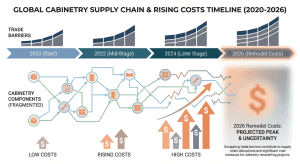
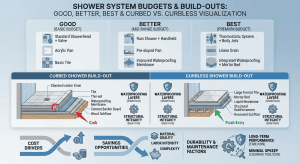
Stop Using Cost Per Square Foot for Remodels: The Case for Accurate, Scope-Based Budgeting
The allure of a simple, easily digestible budget figure, specifically, the “cost per square foot”, has long been a cornerstone for homeowners and, regrettably, some contractors in the initial planning stages of home renovation projects. This seemingly straightforward metric promises a quick approximation of project expenses by merely multiplying the property’s size by a presumed average unit cost. However, in the complex, highly individualized landscape of home remodeling, this approach is not merely simplistic; it is profoundly flawed. Our comprehensive analysis, drawing upon diverse industry data and real-world project outcomes, decisively demonstrates that relying on cost-per-square-foot (PSF) budgeting for remodeling projects consistently leads to significant inaccuracies, frequent budget overruns, and considerable financial strain for homeowners.
This report delves into the pervasive inaccuracies of PSF budgeting, using anonymized project data from the Phoenix market and broader industry statistics to illustrate its critical shortcomings. We highlight which project scopes, such as kitchens and bathrooms, most severely ‘break’ the PSF model and explore regional peculiarities that further undermine its utility. Ultimately, we present a compelling argument for abandoning this outdated practice in favor of more robust, transparent, and accurate scope-based budgeting strategies, offering practical insights for better estimating and improved project outcomes.
Key Takeaways
-
- Cost per square foot (PSF) budgeting for remodels is highly inaccurate, with 78% of projects projected to go over budget in 2025.
-
- Remodel costs vary dramatically (e.g., $100-$450/sq.ft. in the U.S.), making a single ‘average’ PSF figure misleading.
-
- Kitchens and bathrooms disproportionately inflate costs; a small bathroom can cost $115-$300/sq.ft., far exceeding whole-home averages.
-
- Local market conditions, like Phoenix’s preference for extensive tile, create unique cost multipliers that generic PSF estimates fail to capture.
-
- PSF budgets often result in 20-30% error margins, leading to significant financial strain and an average 31% cost overrun for projects with flawed early estimates.
-
- Two-thirds of homeowners rely on loans or credit to cover unexpected over-budget renovation costs due to poor initial budgeting.
-
- Moving to scope-based budgeting offers a superior, more accurate, and transparent approach that protects both homeowners and contractors.
- Moving to scope-based budgeting offers a superior, more accurate, and transparent approach that protects both homeowners and contractors.
1. Executive Summary: The Flaws of Cost Per Square Foot in Remodeling
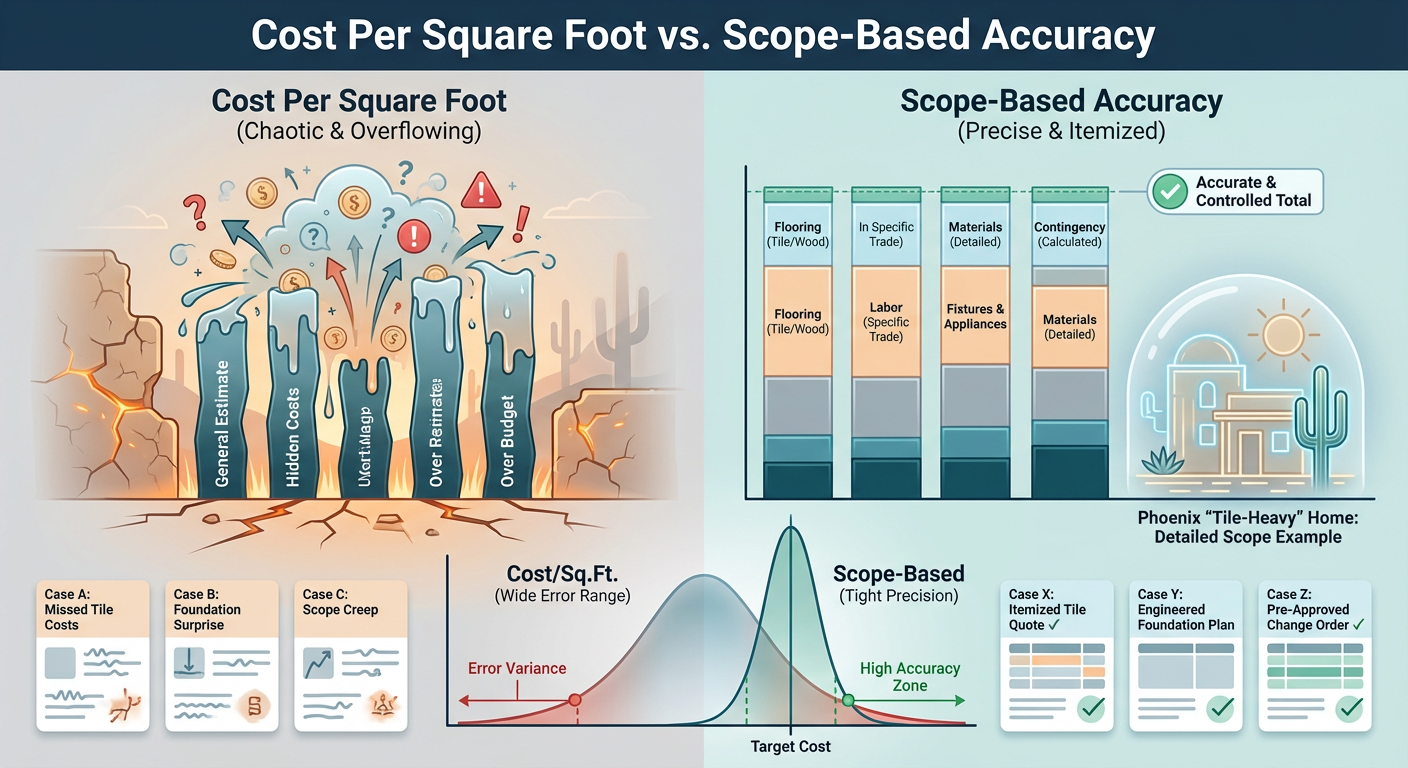
The allure of a simple, easily digestible budget figure, specifically, the “cost per square foot”, has long been a cornerstone for homeowners and, regrettably, some contractors in the initial planning stages of home renovation projects. This seemingly straightforward metric promises a quick approximation of project expenses by merely multiplying the property’s size by a presumed average unit cost. However, in the complex, highly individualized landscape of home remodeling, this approach is not merely simplistic; it is profoundly flawed. Our comprehensive analysis, drawing upon diverse industry data and real-world project outcomes, decisively demonstrates that relying on cost-per-square-foot (PSF) budgeting for remodeling projects consistently leads to significant inaccuracies, frequent budget overruns, and considerable financial strain for homeowners. In fact, current statistics indicate that a staggering 78% of home projects are expected to go over budget as of 2025, largely due to an over-reliance on such an unreliable estimation methodology [2]. This executive summary outlines the critical shortcomings of PSF budgeting in remodeling, highlights the common pitfalls it presents, and introduces the foundational argument for a more accurate, scope-based approach. It synthesizes key findings from our research, providing a high-level overview of the pervasive financial discrepancies and presenting a compelling case for abandoning this outdated practice in favor of more robust and transparent budgeting strategies.
The Pervasive Inaccuracy of Cost Per Square Foot
The fundamental problem with applying a cost-per-square-foot metric to remodeling is its inherent oversimplification of a highly nuanced process. Unlike new construction, where costs can be more uniformly distributed across a footprint, renovation projects involve an intricate web of existing conditions, varied work scopes, and personalized selections that defy a simple area-based average. The “typical price per square foot” for home renovations in the U.S. demonstrates an incredibly broad range, from about $100 up to $450 per square foot, with midrange projects often clustering between $200–$300/sq.ft. [8]. This approximately four-fold variance immediately underscores the misleading nature of any singular “average” figure. Such a wide range means that a single “average” PSF number provides virtually no actionable intelligence for a specific project. The consequences of this inaccuracy are far-reaching. A recent 2025 survey reveals that approximately 78% of home renovation projects will exceed their initial budgets [2]. This figure has seen a sharp increase from 2019 data, where 31% of projects ended over budget, and only 36% of homeowners managed to stay within their original financial plan [3]. The dramatic escalation in budget overruns, from roughly one-third to nearly four-fifths of projects, points directly to the inadequacies of traditional budgeting methods in a volatile market characterized by supply chain disruptions, labor shortages, and material price fluctuations post-2020 [4]. One primary driver of these overruns is the prevalence of incomplete or rushed initial estimates. Analysis from 2025 indicates that in 42% of construction projects, flawed early estimations led to an average cost overrun of 31% [5]. These findings paint a clear picture: square-foot “ballparks” are not just slightly off; they frequently lead to gross underestimations that result in tens of thousands of dollars in unexpected costs, often forcing homeowners to incur debt. Indeed, by late 2025, about two-thirds of homeowners found themselves taking on loans or credit to cover these additional expenses [2]. This financial burden is a direct consequence of an unreliable budgeting process that fails to capture the true complexity and cost drivers of remodeling.
Rooms That “Break” the PSF Model: Kitchens and Baths
Certain areas within a home disproportionately contribute to the breakdown of the cost-per-square-foot model. Kitchens and bathrooms, characterized by their high density of expensive fixtures, specialized finishes, and complex systems (plumbing, electrical, ventilation), are notorious for driving per-square-foot costs significantly higher than whole-home averages. They are frequently cited as the rooms most likely to go over budget [10]. For instance, a small bathroom remodel, even one as compact as 50 square feet, can range from $115 to $300 per square foot in 2025 [7]. This translates to a total cost of $3,000 to over $15,000 for a space barely larger than a walk-in closet, far exceeding what a generalized per-square-foot average for an entire home would suggest. Similarly, kitchens involve expensive components like custom cabinetry, high-end appliances, and intricate countertop installations, engaging multiple trades and leading to substantial costs that dwarf per-square-foot estimates based on a bedroom or living area. As noted by one contractor, “Kitchens are one of the most complex in a home due to the high number of trades, fixtures, and finishes involved,” making them prime candidates for budget overruns [10]. The issue is that PSF budgeting treats all square feet equally, ignoring the immense disparity in cost density between a purely aesthetic refresh of a living room and a complete gut renovation of a kitchen. A 150 sq. ft. kitchen could cost over $300/sq.ft. ($45,000 total), while a 150 sq. ft. bedroom might only cost $33/sq.ft. ($5,000 total) for cosmetic updates. Such variance fundamentally invalidates the utility of a single PSF rate. Small differences in room dimensions in high-cost areas like bathrooms do not translate to proportional cost reductions because the fixed costs of fixtures and labor remain largely the same, as exemplified by a contractor’s experience with a 90 sq. ft. bathroom costing nearly the same as a 100 sq. ft. one [6].
Regional Peculiarities: The Phoenix Experience
The Phoenix, Arizona, remodeling market offers a compelling case study on how local conditions, preferences, and economic shifts can drastically skew generic cost-per-square-foot estimates. Remodeling costs in Phoenix have surged by an estimated 40–50% since 2019, with a full interior renovation now reaching approximately $100/sq.ft. in 2026 [4]. This outpaces general U.S. inflation and creates a significantly higher baseline for local projects, rendering national averages inadequate. Local design trends, such as a strong preference for extensive tile flooring and oversized kitchen islands in open-concept layouts, introduce specific cost drivers. While basic ceramic tile might cost $2–$5/sq.ft. for materials, the popular premium porcelain or stone tiles in Phoenix can run $20–$40/sq.ft. [4]. Coupled with skilled installation labor costing an additional $6–$15/sq.ft. [4], flooring alone can become a $30,000–$40,000 expense in a 2,000 sq.ft. home. These “tile-heavy” preferences, particularly in a market known for its custom finishes, highlight how a PSF estimate that assumes standard flooring could dramatically under-budget a project. Furthermore, the desire for open-plan kitchens necessitates removing walls and potentially adding structural supports, a scope item that can increase project costs by 15–25%, without adding a single square foot to the total area being renovated [4]. These climate-driven needs and aesthetic preferences in Phoenix demonstrate that a “one-size-fits-all” PSF figure fails to capture the unique, localized cost multipliers that define specific markets.
The Impact on Stakeholders: Homeowners and Contractors
For homeowners, the reliance on imprecise square-foot estimates fosters unrealistic expectations and leads to financial distress. Being informed that a remodel costs “$150/sq.ft. on average” can lead to significant under-budgeting, with actual costs potentially two or three times higher depending on the specific scope [6]. This expectation gap is a major reason why projects go over budget [1]. The consequence is often unforeseen debt, with two-thirds of homeowners taking on loans or credit to complete their over-budget renovations [2]. Contractors also suffer from the pitfalls of PSF budgeting. Offering quick, generalized PSF quotes to win bids often leads to underpricing jobs, which then necessitates uncomfortable change orders, erodes profit margins, or compromises quality. Evidence suggests that 20–30% of construction projects exceed estimates due to inaccurate bidding practices [11]. This practice creates a vicious cycle: contractors underbid to compete, then struggle to meet costs, leading to client dissatisfaction and damaged reputations. In contrast, contractors who employ detailed, scope-based estimating methods secure 47% more profitable projects compared to those using generic PSF formulas [5]. This clearly indicates that accurate, upfront estimates protect both the contractor’s bottom line and their client relationships.
Transition to a Superior Alternative: Scope-Based Budgeting
The widespread issues stemming from cost-per-square-foot budgeting demand a shift towards more rigorous and precise methods. Our research unequivocally points to scope-based budgeting as the superior alternative, offering enhanced accuracy, transparency, and predictability. This approach involves breaking down a project into its constituent components, assigning specific costs to each item, and accounting for all variables from materials and labor to permits and contingencies. This method avoids the generalizations of PSF and instead builds an estimate from the ground up, reflecting the true unique nature of each remodeling project. The move towards detailed, line-item estimates is not just a theoretical improvement; it yields tangible financial benefits. Companies that adopt advanced, component-level budgeting practices report 18% higher profit margins on projects [11]. This demonstrates that investing in comprehensive scope definition and granular cost analysis is not merely a formality but a strategic imperative for financial success and client satisfaction in the remodeling industry. Best practices emerging in the industry underscore the importance of comprehensive scope definition, allocating 10–20% of the budget for contingencies [7], and providing transparent breakdowns of labor and material costs [9]. The following sections of this report will delve deeper into each of these points, providing specific examples, analytical data, and actionable recommendations for both homeowners and contractors to transition from the flawed cost-per-square-foot approach to more reliable and transparent scope-based budgeting. The goal is to demystify renovation costs and empower all stakeholders with the knowledge and tools to ensure projects are executed within realistic financial parameters.
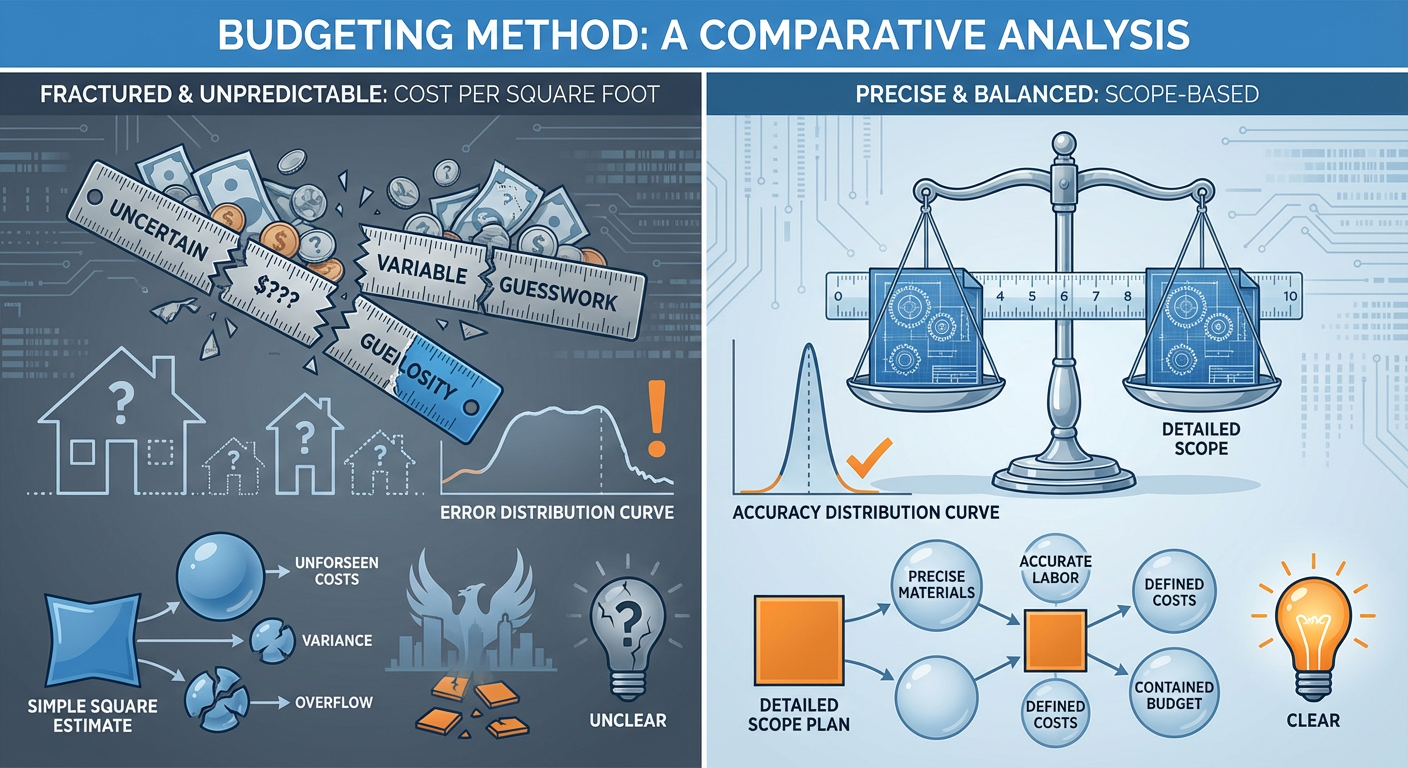
2. The Peril of Simplistic Cost-Per-Square-Foot Estimates
In the dynamic world of home renovation, the desire for a quick, straightforward cost estimate is understandable. For many homeowners, the concept of “cost per square foot” provides a seemingly easy benchmark to gauge project expenses. However, this seemingly convenient metric, while perhaps suitable for new construction where uniformity and predictable materials dominate, becomes a dangerously flawed and misleading tool when applied to the complexities of home remodels. A significant body of evidence, including recent market data and expert opinions, consistently highlights how relying on a one-size-fits-all cost-per-square-foot (PSF) approach for renovations invariably leads to significant budget overruns, homeowner dissatisfaction, and even contractor financial strain. This section will thoroughly dismantle the utility of PSF estimates for remodels, illustrating why their inherent oversimplification fails to capture the intricate variables that define genuine renovation costs, particularly in diverse markets like Phoenix.
The fundamental issue lies in the dramatic variability of home renovation projects. Nationally, typical home renovation costs can range from as low as $100 to over $450 per square foot in the U.S., with midrange projects often settling between $200 and $300 per square foot [8]. This extensive four-fold variance immediately signals the unreliability of any single average PSF figure. Such a broad spectrum underscores that a 150-square-foot room could cost anywhere from $15,000 to $67,500, depending entirely on the scope and quality of work. Furthermore, this range is markedly higher than new construction averages, which hover around $150 per square foot, emphasizing that renovation is a distinct and more complex beast [8].
The consequences of this oversimplification are stark. As of late 2025, approximately 78% of home renovation projects go over budget [2]. This represents a significant increase from 2019 data, which showed about 31% of homeowners going over budget, with only 36% managing to stay within their initial financial plan and 3% coming in under [1]. The surge in overruns suggests a growing disconnect between initial estimates and final costs, a chasm often created by an over-reliance on simplistic budgeting methods. Consequently, around two-thirds of homeowners are forced to incur debt to complete their over-budget renovations, leading to financial strain and dissatisfaction [2].
The Peril of Simplistic Cost-Per-Square-Foot Estimates
The Flaws of a “One-Size-Fits-All” Approach
The primary objection to using PSF for remodels is its inability to account for the unique characteristics of each project. Unlike new builds where construction begins with a blank slate, remodels inherit existing structures, each with its own history, condition, and idiosyncrasies. As a construction consultant, Bryan Kaplan, aptly states, “You can’t apply a one-size-fits-all square foot number to a custom remodel” [5]. This fundamental truth is often overlooked by those seeking a quick budget figure.
-
- No “Average” Remodel: Remodeling projects are inherently custom. A 100-square-foot bathroom, for instance, might cost $20,000, equating to $200 per square foot [6]. However, a slightly smaller 90-square-foot bathroom will not proportionally decrease in cost to $18,000 [6]. The core components – a toilet, a sink, a shower, and connection to plumbing lines – remain the same, representing fixed costs that do not scale linearly with square footage. This phenomenon is particularly challenging for rooms with high fixture density [6].
-
- Oversimplification Hides Real Costs: PSF estimates offer a “false sense of precision” [17]. They often mask crucial exclusions such as design fees, permit costs, or even specific material selections. One contractor’s “$300/square foot” might include high-end appliances and complex structural changes, while another’s might only cover basic finishes, making direct comparisons meaningless [19]. This lack of standardized definition means homeowners are often blindsided when these “hidden” costs are eventually tallied [17].
-
- Ignoring Existing Conditions: The age and condition of a home profoundly impact remodel costs, an aspect completely ignored by PSF metrics. A 1960s home needing updated electrical wiring, plumbing, or structural repairs, such as termite damage, will incur significantly higher costs than a cleaner 2000s build, even if both are the same square footage [20]. These unforeseen conditions, ranging from mold remediation to hazardous material abatement, can balloon budgets by tens of thousands of dollars, demonstrating how PSF pricing utterly fails to adjust for such critical variables [20].
-
- Historical Data vs. Current Market Realities: The construction industry is highly susceptible to market fluctuations. A PSF rate that was accurate just a few years ago can quickly become obsolete. Post-2020, “market shifts, supply chain issues, labor shortages, [and] material inflation” have rendered many older PSF benchmarks invalid [4]. In Phoenix, for instance, remodeling costs have surged by 40-50% since 2019 [4]. A whole-home refresh costing $70 per square foot in 2019 could realistically cost $100 per square foot or more by 2023, a significant 40% increase that a simple, outdated PSF formula would entirely miss [4].
Scope Matters: When PSF Estimates Break Down
Certain remodeling projects and specific rooms consistently challenge the PSF model due to their inherent complexity and high material/labor density. These “budget-busting” scopes are where the simplistic PSF approach is most likely to fail.
-
- Kitchens: Small Footprint, Enormous Cost: Kitchens are notorious for blowing budgets, often because they concentrate expensive design elements and specialized trades into a relatively small area. They involve a confluence of significant components:
- High-cost items like custom cabinetry, stone countertops, and high-end appliances.
- Multiple trade involvements including plumbing, electrical, tiling, and carpentry.
- Specific infrastructure requirements like venting and gas lines.
Indeed, contractors consistently report kitchens as the number one room to go over budget [10]. A 150-square-foot kitchen can easily cost $50,000 (over $300/square foot), while an equivalent-sized bedroom might only cost $5,000 for paint and carpet ($33/square foot). This disparity exemplifies why PSF figures for general living spaces cannot be applied to highly functional and artifact-dense rooms like kitchens [10].
- Kitchens: Small Footprint, Enormous Cost: Kitchens are notorious for blowing budgets, often because they concentrate expensive design elements and specialized trades into a relatively small area. They involve a confluence of significant components:
-
- Bathrooms: High-Density Expense: Similar to kitchens, bathrooms pack a disproportionate amount of expense into a compact area. Every fixture and finish contributes significantly to the overall cost, from the bathtub/shower enclosure and vanity to tile work and waterproofing.
- A small bathroom (e.g., 5’x10′, or 50 square feet) can range from $115 to $300 per square foot, totaling $3,000 to $15,000 or more depending on finishes [7].
- The difference between basic ceramic tiles and premium stone, for example, can be a 10-fold increase in material cost alone, for the same square footage [9].
The critical insight here is that the specific choices for fixtures and finishes, not merely the dimensions of the room, dictate the actual price. An average PSF for bathrooms is thus highly misleading.
- Bathrooms: High-Density Expense: Similar to kitchens, bathrooms pack a disproportionate amount of expense into a compact area. Every fixture and finish contributes significantly to the overall cost, from the bathtub/shower enclosure and vanity to tile work and waterproofing.
-
- Whole-Home “Refresh” vs. “Gut Renovations”: The depth of renovation fundamentally alters the cost per square foot. A cosmetic “refresh” involving paint, minor repairs, and new fixtures will naturally result in a much lower PSF, potentially as low as $20 per square foot for spaces like basements that don’t involve major mechanical changes [24]. Conversely, a comprehensive “gut renovation” that strips a home to its studs and rebuilds it with high-end finishes can easily reach or exceed $200-$300 per square foot [8]. If a homeowner misinterprets an average PSF, applying a “refresh” rate to a desired “gut” scope, they face a massive discrepancy.
-
- Hidden Structural Costs and Layout Changes: Major structural modifications, such as removing load-bearing walls for an open-concept design, introduce non-linear cost increases. These changes involve engineering assessments, new support beams, and extensive rework of electrical and HVAC systems, all of which do not directly correlate with square footage [25]. In Phoenix, creating open-concept kitchens with large islands can add 15-25% to a project’s cost compared to retaining the original layout [25]. Similar non-linear expenses are incurred when adding new plumbing lines for a bathroom or rerouting complex infrastructure, significantly skewing any PSF calculation derived from simple area multipliers.
-
- Premium Materials and Finishes: Material selection is a massive differentiator in PSF. Consider flooring: upgrading a 200-square-foot room from basic laminate ($2/sf) to imported marble tile ($20/sf) multiplies the material cost by ten for the same area. In Phoenix, the preference for high-end porcelain or stone tile, costing $20-$40 per square foot for materials alone, adds substantial expense to a remodel [9]. Installation labor further increases this cost, making it common for flooring alone to account for tens of thousands of dollars in a Phoenix renovation [28]. These choices are entirely scope-driven, not area-driven, and highlight how PSF estimates fail to capture the true cost implications of material selections.
- Premium Materials and Finishes: Material selection is a massive differentiator in PSF. Consider flooring: upgrading a 200-square-foot room from basic laminate ($2/sf) to imported marble tile ($20/sf) multiplies the material cost by ten for the same area. In Phoenix, the preference for high-end porcelain or stone tile, costing $20-$40 per square foot for materials alone, adds substantial expense to a remodel [9]. Installation labor further increases this cost, making it common for flooring alone to account for tens of thousands of dollars in a Phoenix renovation [28]. These choices are entirely scope-driven, not area-driven, and highlight how PSF estimates fail to capture the true cost implications of material selections.
The Hidden Error Margin in PSF Estimates
The reliance on PSF budgeting introduces substantial error margins, leading to widespread overruns and financial distress for homeowners. The data consistently demonstrates this trend:
-
- Frequent and Large Overruns: As noted, nearly 4 out of 5 home projects exceeded their budget in a 2025 survey [2]. Even in less volatile times, over a third of remodelers finished over budget [1]. An analysis of construction projects revealed that “incomplete or rushed initial estimates” led to an average 31% cost overrun in 42% of projects [3]. This magnitude of error, often tens of thousands of dollars on a single job, underscores the inadequacy of quick-ballpark PSF figures. The typical error range on a simplistic estimate can easily reach 20-30% [11].
-
- Reasons for the Gaps: These large error margins stem from several factors:
- Non-Analogous Comparisons: PSF rates are often borrowed from dissimilar projects. Using a high-end urban remodel’s PSF for a basic suburban renovation (or vice-versa) guarantees inaccuracy.
- Unknown Unknowns: Remodels are prone to surprises hidden behind walls or beneath floors (e.g., rotten subflooring, outdated plumbing, or unpermitted installations). These “contingency items” are rarely accounted for in a generic PSF estimate.
- Material & Selection Changes: Homeowner selections, which frequently evolve, instantly invalidate a static PSF budget. Upgrading finishes or adding features not initially planned will drive costs up rapidly.
- Market Volatility: Recent fluctuations in material costs (e.g., lumber, steel) and labor availability make static PSF benchmarks highly unstable. Initial estimates based on old data quickly become insufficient [11].
Essentially, PSF methods omit the granular line items and unpredictable elements that truly dictate a project’s cost, resulting in budgets built on incomplete information.
- Reasons for the Gaps: These large error margins stem from several factors:
-
- Inaccurate Bidding Risks for Contractors: For contractors, using PSF pricing often leads to systematically underbidding to secure projects, only to face “cost overruns, uncomfortable change orders, or eroding profit margins” later [5]. As many as 20-30% of construction projects exceed estimates due to inaccurate bidding practices [11]. A contractor giving a quick PSF quote to a client risks underpricing a job, leading to financial losses if they honor the estimate, or client dissatisfaction if they must issue numerous change orders [6].
-
- Homeowner Expectations vs. Reality: The pervasive narrative of “average remodel costs per square foot” (promoted by media and online sources) sets unrealistic expectations. A homeowner might see $150/square foot and budget $300,000 for a 2,000-square-foot remodel, only to discover the true, detailed estimate is $500,000 or more. This expectation gap is a leading cause of budget overruns [1], forcing many to take on debt, as nearly two-thirds of renovators did by 2025, to complete projects [2].
-
- Geographic and Temporal Variance: PSF reliability is further compromised by geographic and temporal differences. A $200/sf renovation in a lower cost-of-living area offers a very different scope than the same PSF in a high-cost urban center. Similarly, market conditions evolve rapidly. Phoenix’s 40% cost increase since 2019 means a 2019 PSF figure is vastly inadequate today [4]. The assumption that a single PSF metric is universally applicable is profoundly flawed in the dynamic construction environment.
- Geographic and Temporal Variance: PSF reliability is further compromised by geographic and temporal differences. A $200/sf renovation in a lower cost-of-living area offers a very different scope than the same PSF in a high-cost urban center. Similarly, market conditions evolve rapidly. Phoenix’s 40% cost increase since 2019 means a 2019 PSF figure is vastly inadequate today [4]. The assumption that a single PSF metric is universally applicable is profoundly flawed in the dynamic construction environment.
Phoenix Spotlight: How Local Factors Skew Cost/SF Estimates
The Phoenix metropolitan area offers a prime example of how local market dynamics significantly disrupt the validity of generalized cost-per-square-foot estimates. The city’s unique preferences, climate-driven requirements, and recent economic growth create a distinct cost landscape that defies generic national averages.
-
- Booming Demand and Cost Inflation: Phoenix has experienced rapid growth and a corresponding boom in remodeling demand. Since 2019, interior remodeling costs in Phoenix have surged by an astonishing 40-50% [4]. This means that a whole-home refresh that cost approximately $70 per square foot in 2019 now commands about $100 per square foot in 2026, representing a new, higher pricing baseline [4]. Homeowners and contractors using outdated national averages or pre-2020 local benchmarks would severely under-budget, potentially by over a third, underscoring the critical need for current, localized data [4].
-
- Tile-Heavy Designs and Their Impact: A defining characteristic of Phoenix interiors is the widespread use of extensive tile flooring, often in premium materials like wood-look porcelain or natural stone. This preference is driven by the desert climate, tile keeps homes cooler and is easier to maintain, but it comes with a substantial cost premium. While basic ceramic tile materials might cost $2-$5 per square foot, the popular premium options in Phoenix typically range from $20-$40 per square foot for materials alone [9]. The skilled labor required for tile installation further adds to this, costing an additional $6-$15 per square foot [9]. Consequentially, a typical 2,000-square-foot Phoenix home with upscale tile flooring can easily incur expenses of $30,000-$40,000 just for flooring [28]. A generic PSF estimate that doesn’t account for such a significant, region-specific material preference will inevitably be inaccurate.
-
- Grand Kitchen Islands & Altered Layouts: Phoenix remodels frequently feature open-plan layouts centered around oversized kitchen islands. These islands, often 8-10 feet long or more, necessitate significant investment in:
- Substantial custom cabinetry.
- Large, potentially multiple-slab countertops.
- Additional electrical outlets and plumbing for secondary sinks or appliances [34].
Achieving these open layouts often requires structural modifications, including the removal of walls, which adds engineering and construction costs disproportionate to the actual square footage being altered [25]. Phoenix contractors observe that incorporating these popular open concepts can escalate project costs by 15-25% compared to projects that maintain existing layouts [25]. This illustrates how stylistic preferences, if they involve infrastructure or structural changes, can “bust” the PSF model.
- Grand Kitchen Islands & Altered Layouts: Phoenix remodels frequently feature open-plan layouts centered around oversized kitchen islands. These islands, often 8-10 feet long or more, necessitate significant investment in:
-
- Climate-Specific Considerations: The desert environment imposes additional, often hidden costs. Phoenix’s hard water, for example, frequently leads homeowners to invest in water softening or filtration systems during remodels. The intense heat necessitates high-efficiency HVAC systems, upgraded insulation, and UV-resistant windows, especially in luxury renovations. These climate-driven enhancements, such as a new high-efficiency AC unit, represent significant line items that a generic PSF estimate derived from cooler climates would not include [37]. Additionally, outdoor living spaces, patios, misting systems, built-in BBQs, are integral to the Arizona lifestyle and contribute heavily to total project costs without impacting interior square footage, further highlighting the limitations of PSF.
-
- Comparisons to National Averages: While some mid-range project costs in Phoenix might align with national averages, the city often diverges significantly at the higher end [38]. The prevalence of premium materials, custom elements, and structural alterations in high-end Phoenix remodels means these projects can easily exceed generic national “high-end” budgets. For instance, a top-tier whole-home renovation for a 3,000-square-foot property in Phoenix can exceed $300,000, aligning with or surpassing costs found in traditionally pricier U.S. markets [39]. This demonstrates that Phoenix is not a “cheap” remodeling market and that national PSF averages should be viewed with extreme skepticism. The Phoenix market serves as a potent illustration of how localized factors fundamentally challenge the one-size-fits-all nature of PSF budgeting.
Beyond PSF: Achieving Accurate Remodel Budgeting
The clear and compelling evidence against simplistic cost-per-square-foot estimates for remodels underscores the need for a more rigorous, detailed, and transparent approach. Shifting away from generalized approximations towards granular, scope-based budgeting is not merely a best practice; it is a necessity for successful renovation projects.
-
- Detailed Scope Definition: The cornerstone of accurate budgeting is a meticulously defined scope of work. Professional remodelers “build the job on paper, piece by piece” [6]. This involves:
- Identifying every work area.
- Specifying precise improvements (e.g., “install 20 linear feet of custom cabinets,” “upgrade electrical panel to 200 amps,” “replace all interior doors with solid core”).
- Documenting material specifications (e.g., “Carrara marble countertops, level 3”).
- Clarifying site-specific logistics and requirements.
By breaking down the project into discrete components, realistic costs can be assigned to each based on current market rates for labor, materials, and specialized services. This comprehensive detailing eliminates the “missing pieces” problem inherent in PSF estimates, ensuring both homeowner and contractor share a clear understanding of what is included [9].
- Detailed Scope Definition: The cornerstone of accurate budgeting is a meticulously defined scope of work. Professional remodelers “build the job on paper, piece by piece” [6]. This involves:
-
- Leveraging Unit Costs and Historical Data: Instead of relying on a single PSF figure, accurate budgeting utilizes unit costs. This involves pricing work components at a granular level, such as:
- Cost per linear foot for cabinetry.
- Cost per square foot for installed flooring (including subfloor prep).
- Cost per fixture for plumbing or electrical.
- Cost per hour or day for specific trades.
Contractors increasingly use sophisticated software and internal historical data to track and apply these unit costs, allowing for precise, bottom-up estimates. This approach is far more reliable and allows for easier adjustments as project details solidify. Companies that adopt data-driven, component-level budgeting have reported 18% higher profit margins, demonstrating a clear business advantage [11].
- Leveraging Unit Costs and Historical Data: Instead of relying on a single PSF figure, accurate budgeting utilizes unit costs. This involves pricing work components at a granular level, such as:
-
- Accounting for Variables and Complexity: Effective estimators proactively integrate the unique complexities of each renovation:
- Hidden Conditions: Budgeting for potential issues in older homes, such as unforeseen structural damage, outdated systems needing code compliance upgrades (e.g., electrical panels, plumbing), or environmental hazards (e.g., asbestos, lead paint). A contingency fund, even for investigation and remediation, is crucial here.
- Site Logistics: Assessing access limitations, material staging areas, and waste removal, which can impact labor time and overall cost.
- Finish Selections: Integrating the specific pricing of desired finishes and materials, from standard-grade to luxury options.
Experienced project managers understand common budget killers and build these considerations into the detailed estimate, preventing mid-project financial crises that a generic PSF quote would miss.
- Accounting for Variables and Complexity: Effective estimators proactively integrate the unique complexities of each renovation:
-
- Implementing a Healthy Contingency: A critical element of responsible budgeting is the allocation of a contingency fund. Industry best practice recommends setting aside 10-20% of the total project budget for unforeseen expenses [7]. This buffer is not an optional extra but a realistic acknowledgment that unknowns will inevitably arise in older structures. This ensures that when unexpected issues like dry rot, unforeseen code upgrades, or a significant change in material pricing occur, the project has a planned financial cushion rather than facing an immediate budget crisis or requiring debt acquisition, safeguarding homeowner finances and project momentum.
-
- Transparency and Client Involvement: Detailed, scope-based estimates foster a transparent and collaborative relationship between homeowner and contractor. By breaking down costs into understandable categories (demolition, framing, plumbing, electrical, finishes, etc.), homeowners gain a clear view of where their investment is going. This transparency empowers clients to make informed trade-off decisions if the budget needs adjustment, rather than facing opaque figures. Professional firms prioritize precise breakdowns as a means to differentiate themselves, build trust, and ensure client satisfaction, thereby reducing disputes and enhancing referral rates [9].
-
- Iterative Estimation and Technology Tools: Budgeting for remodels should be an iterative process, evolving with the design and selections. The estimate should be refined at key project milestones, allowing for immediate cost adjustments if the scope changes. Modern estimation software and digital takeoff tools significantly enhance this process, ensuring all components are captured and allowing for rapid updates as project details solidify. These technological aids support a rigorous, detailed planning process, moving far beyond the primitive approach of PSF calculations. The investment in such detailed upfront work leads to significantly more accurate budgeting, fewer surprises, and ultimately, more successful and satisfying remodel projects [9].
The pervasive myth of reliable cost-per-square-foot estimating for remodels is demonstrably false. The research overwhelmingly shows that the dramatic variability in project scope, hidden conditions, material choices, and regional economic factors render this simplified metric incapable of providing accurate, predictable budgets. As we transition to understanding the specific error ranges, it becomes clear that adopting a detailed, scope-based budgeting methodology is not just advantageous, but essential for both homeowners and contractors seeking financial predictability and project success in the dynamic remodeling industry.
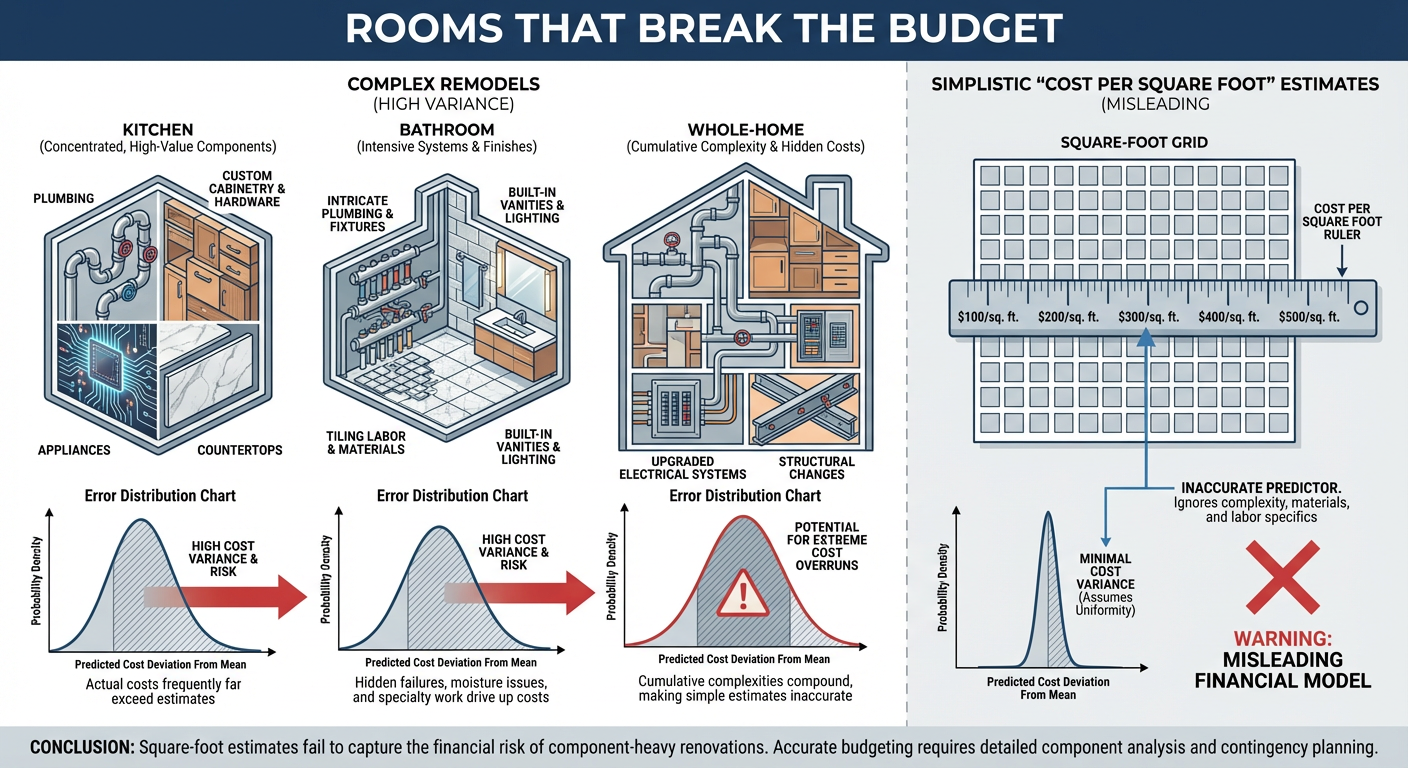
3. Rooms That Break the Budget: Kitchens, Baths, and Whole-Home Projects
In the realm of home remodeling, the concept of cost per square foot often promises a deceptively simple path to budgeting. However, as this research extensively demonstrates, this metric often proves to be an unreliable and misleading indicator, particularly when applied to specific, high-complexity areas of a home. Nowhere is this inaccuracy more pronounced than in kitchen and bathroom renovations, or comprehensive whole-home projects that oscillate between cosmetic refreshes and full gut renovations. These spaces and scopes inherently defy a linear, area-based cost model due to their concentrated value, intricate systems, and susceptibility to a multitude of design and material choices. Consequently, relying on a generalized cost per square foot for these critical areas frequently leads to significant budget overruns, homeowner dissatisfaction, and even diminished profitability for contractors. This section will delve into a detailed analysis of why kitchens, bathrooms, and whole-home remodels disrupt the per-square-foot cost paradigm, highlighting the specific elements that disproportionately inflate expenses and render simplistic budgeting methods ineffective.
Kitchens: Small Space, Enormous Expenses
Kitchens are consistently identified as one of the most budget-busting rooms in any home renovation project [10]. Despite often occupying a moderate to small portion of a home’s overall square footage, their functional complexity and the high-value components packed within them make a per-square-foot cost estimate highly inaccurate. The cost density in a kitchen is fundamentally different from that of a living room or bedroom. For instance, a 150 square foot kitchen remodel might easily cost upwards of $50,000, translating to over $330 per square foot. In stark contrast, a 150 square foot bedroom might only incur costs of around $5,000 for paint and new carpet, placing its cost at approximately $33 per square foot. This tenfold difference clearly illustrates the failure of a general per-square-foot metric to capture the true cost of a kitchen renovation. The primary drivers of this exorbitant cost density in kitchens stem from several key areas:
-
- High-Value Components: Kitchens are essentially workshops disguised as living spaces. They require an array of expensive, specialized items. Custom or semi-custom cabinetry, for instance, can represent a substantial portion of the budget. High-end countertops made from natural stone (like granite, marble, or quartz) or engineered materials not only involve significant material costs but also specialized fabrication and installation. Appliances, from refrigerators and ranges to dishwashers and microwaves, come with a vast price range, and selecting professional-grade models can add tens of thousands without altering the room’s dimensions. Many kitchen remodels also include specialty lighting, sinks, faucets, and other fixtures, each adding a premium.
-
- Multiple Trades Involved: A kitchen renovation is a symphony of skilled labor. It typically involves demolition crews, framers (if layout changes occur), plumbers for sinks and dishwashers, electricians for new outlets and lighting, HVAC technicians for range hoods, cabinet installers, countertop fabricators, tile setters, and painters. Coordinating these multiple trades, each with specialized knowledge and hourly rates, adds to the complexity and cost. Each trade’s work must often be meticulously scheduled in sequence, leading to labor costs that are far from uniform or easily distributed across square footage.
-
- Intricate Systems and Infrastructure: Beyond the visible elements, kitchens contain extensive unseen infrastructure. Plumbing lines for water supply and drainage, gas lines for ranges, and dedicated electrical circuits for high-amperage appliances are all concentrated within a small footprint. Upgrading outdated systems to meet modern codes and demands is often necessary, especially in older homes, adding unforeseen expenses for elements like new wiring, increased electrical panel capacity, or rerouting pipes. A builder noted that “Kitchens are one of the biggest rooms that go over budget because of all the different trades that end up being in that one room alone” [10].
-
- Phoenix-Specific Considerations: In markets like Phoenix, specific preferences further amplify kitchen costs. The trend towards oversized kitchen islands and open-plan layouts significantly inflates budgets [4]. These large islands often necessitate more cabinetry, larger single-slab countertops (which can require multiple costly slabs), and additional electrical outlets or plumbing connections. The desire for open-concept kitchens often involves removing load-bearing walls, adding significant structural engineering and framing costs (posing an increase of 15–25% to the project cost) along with the associated rerouting of electrical and HVAC systems [4]. These structural modifications are direct drivers of cost that have no direct correlation to the initial square footage, rendering per-square-foot metrics almost useless.
Bathrooms: High Cost Density in Compact Spaces
Much like kitchens, bathrooms are notorious for their high cost per square foot, often rivaling or even exceeding kitchen renovation rates despite their typically much smaller size. The reason is similar: bathrooms are packed with expensive fixtures, specialized finishes, and complex plumbing and electrical systems in a very confined area.
-
- Dense Concentration of Fixtures: Even a small bathroom, such as a 5’x10’ space (50 square feet), mandates a toilet, a sink, a vanity, and either a shower or a bathtub. Adding a custom shower enclosure, multiple showerheads, or a freestanding tub further increases cost. For reference, a small bathroom remodel can range from approximately $115 to $300 per square foot, resulting in a total cost anywhere from $3,000 to $15,000 or more, depending on the chosen finishes [7]. This drastic range within the same square footage underscores the variability.
-
- Specialized Finishes and Waterproofing: Bathrooms require extensive tile work – for floors, shower walls, and sometimes even tub surrounds. The cost of tile itself varies widely (from a few dollars per square foot for basic ceramic to $20–$40 for premium porcelain or stone) [4]. Beyond material, skilled tile installation is labor-intensive and costly, adding another $6–$15 per square foot [4]. Critical waterproofing measures behind shower walls and under floor tiles are essential but add another layer of expense and specialized labor.
-
- Plumbing and Electrical Work: The plumbing for multiple fixtures (toilet, sink, shower/tub) and their hot and cold lines, drains, and vents are all concentrated in a small area. Electrical work includes lighting, exhaust fans, and GFI outlets, all necessary for code compliance and functionality. Upgrading or relocating these systems can be complex and expensive due to tight spaces and the need to integrate with existing home infrastructure.
-
- Fixed Costs are Disproportionate: The basic fixed costs of bringing tradespeople (plumbers, electricians, tile setters) to the site and performing initial setup do not scale down proportionally with the room’s size. A plumber’s visit to install a toilet and sink in a 50 sq ft bathroom might cost almost as much as for a 70 sq ft bathroom, as the core tasks are similar. This creates an inverse relationship between space and perceived cost per square foot: smaller bathrooms often exhibit a higher per-square-foot cost simply because their fixed component costs are distributed over fewer square feet. As explained by one remodeler, a 100 sq ft bathroom renovation might cost $20,000 ($200/sq ft), but a 90 sq ft bathroom would not proportionally drop to $18,000 because the essential fixtures and associated labor costs remain nearly identical [6].
Whole-Home Projects: Cosmetic Refresh vs. Gut Renovation
The term “whole-home project” encompasses a vast spectrum of undertakings, each with wildly different cost implications. The distinction between a “cosmetic refresh” and a “full gut renovation” is paramount, and applying a single cost-per-square-foot average across these different scopes is a recipe for catastrophic budgeting errors.
-
- Cosmetic Refresh: Lower Per-Square-Foot Cost: A whole-home cosmetic refresh typically involves surface-level updates like painting, new flooring (carpet or laminate), replacing light fixtures, and minor repairs. In these scenarios, structural elements, plumbing, and electrical systems largely remain untouched. As a result, the cost per square foot can be relatively low. For example, a builder noted finishing a 2,000 sq ft basement for approximately $20 per square foot because it was primarily open space without major mechanical changes [23]. The cost savings here are directly tied to avoiding expensive structural work, significant system upgrades, and high-labor-density areas.
-
- Full Gut Renovation: Skyrocketing Per-Square-Foot Cost: Conversely, a full gut renovation involves stripping a home down to its studs, often reconfiguring layouts entirely, and replacing all major systems (plumbing, electrical, HVAC). This intensive scope translates to a much higher cost density. High-end gut remodels can easily reach $200–$300 per square foot or even more [8]. The core reason for this disparity is that every square foot now involves demolition, framing, new insulation, new drywall, new subfloors, and comprehensive upgrades to all underlying utilities. Hidden conditions, such as outdated wiring or structural issues, frequently emerge during gut renovations, adding unexpected costs that a simple per-square-foot estimate could not foresee.
-
- Structural Changes and Layout Alterations: Major layout changes, such as removing load-bearing walls to create an open-concept living space, disproportionately escalate costs. These changes require engineering assessments, permits, and the installation of new beams or supports, all of which cost thousands of dollars without adding any “new” square footage. In Phoenix, for instance, incorporating an open plan with a large kitchen island can add between 15% to 25% to the total project cost compared to retaining the original layout [4]. These are scope-driven expenses that are completely detached from a per-square-foot calculation. Similarly, relocating a bathroom or adding a new one involves significant plumbing rerouting and connection to main lines, incurring substantial costs that do not scale linearly with the home’s overall size.
-
- Premium Materials and Finishes: The choice of materials directly impacts the project’s overall cost, significantly skewing per-square-foot averages. For example, upgrading a 200 sq ft room from basic laminate flooring (approx. $2/sq ft) to imported marble tiles (approx. $20/sq ft) increases material costs ten-fold for the same area. In Phoenix, the preference for high-end porcelain or natural stone tile for flooring (costing $20–$40 per square foot for materials alone) means that homeowners can spend tens of thousands of dollars on flooring even if the home’s total square footage is not exceptionally large [4]. These material selections are driven by design choices and preferences, not by the size of the space, making per-square-foot estimates based on generic averages deeply flawed.
The Hidden Error Margin in Per-Square-Foot Estimates
The inherent flaws of using per-square-foot estimates for these complex areas contribute significantly to widespread budget overruns. Real-world data unequivocally shows that simplistic budgeting methods lead to frequent and sizable misses.
-
- Rampant Overruns: A staggering 78% of home renovation projects exceed their initial budgets as of late 2025 [2]. Even in 2019, when market conditions were more stable, almost one-third of homeowners undertaking renovations found themselves over budget [1]. These statistics underscore a systemic problem in how renovation costs are initially projected. An analysis further revealed that initial estimates are frequently off by a substantial margin, often 20-30%, with *42% of projects that started with incomplete early estimates averaging a 31% cost overrun* [5]. This degree of variance can easily translate to tens of thousands of dollars on a single project, highlighting the financial risk of relying on a generalized cost per square foot.
-
- The “Unknown Unknowns”: Remodeling, especially in older properties, is fraught with hidden conditions. A per-square-foot estimate cannot account for unexpected discoveries like unseen water damage, mold, pest infestations, rotten subfloors, or outdated electrical/plumbing systems that require mandatory upgrades to meet current codes. These “unknown unknowns” can quickly balloon costs, turning a simple renovation into a far more complex and expensive undertaking. Without a detailed scope-based budget that anticipates and allocates for such contingencies, these surprises inevitably lead to budget busts.
-
- Market Volatility and Regional Differences: Construction costs are not static. Post-2020 market shifts, driven by supply chain disruptions, labor shortages, and material inflation, have rendered many historical per-square-foot benchmarks obsolete [4]. For example, Phoenix experienced a 40-50% surge in interior remodeling costs since 2019 [4]. A whole-home refresh that cost $65–$70 per square foot in 2019 now runs about $100 per square foot in 2026 [4]. Relying on outdated or generalized national averages ignores critical regional cost drivers and current market conditions. The unique blend of local labor rates, material availability, permitting requirements, and stylistic preferences (like the prevalence of extensive tile flooring in Phoenix [4]) means that a per-square-foot cost in one region may be drastically different in another.
-
- Client Expectations vs. Reality: The pervasive nature of per-square-foot cost discussions in popular media often sets homeowners up for disappointment. If a homeowner reads that “remodeling averages $150/sq ft,” they might multiply this by their home’s total area and assume this is their budget. However, if their desired scope includes an expensive kitchen or bathroom renovation or significant structural changes, their actual costs could easily be two or three times higher. This gap between expectation and reality is a primary reason projects go over budget [1]. The financial consequences are significant, with approximately two-thirds of homeowners having to incur debt to complete over-budget renovations [2].
Phoenix Spotlight: How Local Factors Skew Cost/SF Estimates
Phoenix, Arizona, serves as an exemplary case study illustrating how unique local market characteristics and homeowner preferences can dramatically skew per-square-foot cost estimates, rendering them almost useless.
-
- High Cost Inflation: The Phoenix remodeling market has experienced an extraordinary surge in costs, jumping 40% to 50% since 2019 [4]. This rapid increase means that any historical per-square-foot data, even from a few years prior, will severely underestimate current project costs. A whole-home refresh that was $65–$70/square foot in 2019 is now an estimated $100/square foot in 2026 [4]. Homeowners and contractors using outdated benchmarks would face massive shortfalls.
-
- Tile-Heavy Designs and Costs: A distinct feature of Phoenix homes is the widespread preference for extensive tile flooring, often wood-look porcelain or natural stone. This preference is driven by both aesthetics and the practical need for cooler, durable surfaces in a desert climate [4]. While basic ceramic tile materials might cost $2–$5 per square foot, the popular premium porcelain or stone options used throughout Phoenix homes can run $20–$40 per square foot for materials alone, a nearly tenfold increase [4]. Additionally, skilled labor for installing these materials adds $6–$15 per square foot [4]. Consequently, a significant portion of a Phoenix remodel budget can be consumed by flooring, an expense that a generic national per-square-foot average might fail to capture accurately if it assumes less expensive flooring types. Re-tiling a 2,000 sq ft home with upscale materials can cost $30,000–$40,000 just for flooring [4].
-
- Open Layouts and Oversized Kitchen Islands: Modern Phoenix home designs frequently feature open-plan living spaces and grand kitchen islands. Achieving these designs often involves costly structural modifications, such as removing load-bearing walls, which requires engineering, beam installation, and rerouting of utilities [4]. These structural changes alone can add 15–25% to the total project cost [4]. Oversized islands demand extensive custom cabinetry, larger countertop slabs (potentially requiring more costly fabrication or multiple slabs), and additional electrical and plumbing elements, all of which drive up cost without increasing the overall square footage in a way a simplistic estimate would recognize.
-
- Climate-Specific Additions: The desert environment introduces additional costs not typically found in national averages. For example, Phoenix’s hard water often leads homeowners to install water softening or filtration systems during renovations. The intense heat necessitates high-efficiency HVAC systems, upgraded insulation, and UV-resistant windows, all of which are significant investments that boost project costs beyond general per-square-foot benchmarks. Furthermore, outdoor living is a cornerstone of the Arizona lifestyle, meaning many “whole-home” projects extend to elaborate patios, misting systems, and built-in barbeque areas, adding substantial scope and cost that an interior square footage calculation would entirely miss.
Beyond $/SF: How to Budget Remodels More Accurately
Given the significant pitfalls of per-square-foot budgeting in areas like kitchens, baths, and comprehensive home projects, a more rigorous, scope-based approach is essential for accurate estimation and successful project delivery.
-
- Detailed Scope Definition: The cornerstone of accurate budgeting is a meticulously detailed scope of work. Instead of relying on a generalized multiplier, professional remodelers adopt a “build the job on paper, piece by piece” mentality [6]. This involves a granular enumeration of every task, material, and component. For example, outlining “replace 10 windows with specific model X,” “install 20 linear feet of custom cabinetry,” and “rewire kitchen circuits to current code” provides a clear roadmap. This itemization safeguards against overlooked elements, which are common with vague per-square-foot estimates. It ensures both client and contractor have a shared understanding of what is included, mitigating disputes and unexpected costs later. The benefit of such explicit detailing is that any element not listed is understood to be outside the initial budget, providing clarity and preventing scope creep.
-
- Unit Costs and Historical Data: Moving away from a single, overarching cost per square foot, accurate budgeting involves breaking down projects into functional units. This means pricing costs per linear foot for cabinetry, per fixture for plumbing hookups, or per square foot for specific types of flooring *installation*. Remodelers leverage detailed cost databases and their own historical project data to assign realistic costs to these individual units. For instance, if past projects indicate that installing a standard interior door, inclusive of labor and materials, costs $350, then a project requiring ten such doors can be precisely estimated for that component (10 x $350 = $3,500). This “bottom-up” approach, where each element of the scope has a defined price, creates a far more reliable budget than a top-down guess. Modern estimating software and takeoff tools facilitate this process, allowing for systematic and efficient component-level pricing. Companies that embrace such advanced budgeting methodologies have reported an 18% increase in profit margins compared to those adhering to outdated lump-sum methods [11].
-
- Accounting for Variables and Complexity: Expert estimators recognize and adjust for the unique complexities of each project, a nuance entirely absent in generic per-square-foot figures. This includes factoring in the age of the home (e.g., allocating funds for potential electrical upgrades in an older structure), specific material selections (e.g., budgeting for seven quartz countertops at a precise cost per slab including fabrication and installation), and site-specific conditions. Accessibility challenges, like renovating a third-floor condo with difficult material transport, or the lack of on-site material staging space can necessitate additional labor time and costs. Seasoned project managers anticipate common budget pitfalls, such as asbestos removal, lead paint remediation, or the need to upgrade a main electrical panel to accommodate a new kitchen, proactively integrating these into the budget. This front-loaded analysis, which is absent in simple per-square-foot quotes, reduces mid-project “surprises.”
-
- Healthy Contingency Planning: A crucial element of reliable remodeling budgets is the inclusion of a significant contingency fund, typically 10–20% of the project’s total cost [7]. This allocation is not profit padding but a realistic acknowledgment that unforeseen issues will invariably arise once demolition begins and existing structures are exposed (e.g., hidden moisture damage, unexpected structural deficiencies, or unforeseen building code updates). This contingency acts as a financial buffer, preventing project derailment when such discoveries occur. By explicitly budgeting, for example, $10,000 for “unknowns” on a $50,000 project, homeowners protect themselves from financial panic and stressful last-minute decisions. If the contingency remains unused, the project effectively comes in under budget. This proactive risk management aligns with scope-based budgeting by anticipating potential challenges rather than ignoring them through over-simplified metrics.
-
- Transparency and Client Involvement: A significant advantage of detailed, scope-based estimates is the enhancement of communication and trust between contractors and clients. Categorizing costs (e.g., demolition, framing, plumbing, electrical, finishes) provides homeowners with a clear understanding of where their investment is being allocated. This transparency empowers clients to make informed decisions and trade-offs. For instance, if the budget exceeds expectations, the client can pinpoint specific areas, such as “$25,000 is allocated to premium tile work,” and then explore alternatives like a more economical tile or reduced tiled areas, rather than making arbitrary cuts. Professional contractors differentiate themselves by offering such precise breakdowns, fostering trust and repeat business [9]. This collaborative approach transforms budgeting from a vague black box into a transparent process, minimizing misunderstandings and disputes. A clear, itemized estimate serves as a robust contractual document, unequivocally defining the agreed-upon scope and costs.
-
- Iterative Estimation and Technological Tools: Effective scope-based budgeting is an iterative process, evolving alongside design and planning. Estimates should be updated at key project milestones – after schematic design, once final blueprints are approved, and after all material selections are finalized. This iterative approach allows for the immediate assessment of cost implications stemming from any design changes or additions (e.g., “what if we add a guest bathroom now?”). This prevents “scope creep” from silently eroding the budget. Many professionals utilize sophisticated estimation software that integrates with CAD drawings or employs detailed templates to ensure no component is overlooked. Newer technologies, such as 3D scanning, can even provide highly accurate material take-offs. While demanding more upfront effort, this rigorous and detailed planning process leads to significantly more accurate budgets, fewer change orders, and ultimately, more successful and satisfying remodeling projects for all parties involved.
In summary, residential remodeling, particularly for high-value areas like kitchens and bathrooms, and for extensive whole-home renovations, defies the simplistic logic of cost-per-square-foot estimations. The dense concentration of high-value components, intricate systems, specialized labor requirements, site-specific challenges, and regional market dynamics converge to create cost structures that are inherently non-linear and not proportional to area. By adopting a detailed, scope-based budgeting methodology, one that meticulously itemizes every task and material, leverages unit costs, includes robust contingencies, and maintains transparent communication, homeowners and contractors can move beyond the inherent inaccuracies of square-foot pricing and achieve far more predictable and successful project outcomes.
References
-
- [3] Quantifyna. (2025). *2025 Building Estimation: What Actually Drives Construction Costs in 2025?*. Retrieved from https://quantifyna.com/building-estimation/
-
- [4] Phoenix Home Remodeling. (2025). *Phoenix Interior Remodeling Cost Index 2026: What Homeowners Should Budget Now*. Retrieved from https://phxhomeremodeling.com/phoenix-interior-remodeling-cost-index-2026-what-homeowners-should-budget-now/
-
- [5] Buildwise. (2023, July 1). *Stop Using Square Foot Estimating in Residential Construction*. Retrieved from https://www.buildwiseapp.com/construction-finance-blog/stop-using-square-foot-estimating-construction
-
- [6] Journal of Light Construction. (2015, September 23). *Five Mistakes Remodelers Commonly Make When They Write Estimates*. Retrieved from https://www.jlconline.com/remodeling/five-mistakes-remodelers-commonly-make-when-they-write-estimates_o
-
- [7] Koalaty Remodel. (2025, February 25). *2025 Bathroom Remodel Cost Breakdown: Ultimate Guide*. Retrieved from https://koalatyremodel.com/bathroom/bathroom-remodel-cost/
-
- [8] LatestCost. (2025, December 17). *Average Home Renovation Cost Per Square Foot 2026*. Retrieved from https://latestcost.com/average-home-renovation-cost-per-square-foot/
-
- [9] Buildertrend. (2025, May 30). *How to Estimate Remodeling Jobs (Accurately)*. Retrieved from https://buildertrend.com/blog/estimate-remodeling-jobs/
-
- [10] RenoFi. (2025, June 23). *The 2 Rooms Most Likely to Go Over Budget During a Renovation*. Retrieved from https://www.renofi.com/home-renovations/rooms-most-likely-to-go-over-budget/
-
- [11] K38 Consulting. (2025). *How Smart Construction Budgeting Saved Our Project $2M (Case Study)*. Retrieved from https://k38consulting.com/smart-construction-budgeting-case-study/
-
- [12] HouseDigest. (2022). *The Untold Truth of the Sydney Opera House*. Retrieved from https://www.housedigest.com/905040/the-untold-truth-of-the-sydney-opera-house/
-
- [13] NerdWallet. (2022, November 16). *2022 Home Improvement Report*. Retrieved from https://www.nerdwallet.com/home-ownership/studies/2022-home-improvement
4. Quantifying the Error: The Hidden Margin of Cost-Per-Square-Foot Budgets
The allure of simplicity often leads to significant pitfalls, and nowhere is this more evident than in the realm of home remodeling budgeting. The ubiquitous “cost per square foot” metric, while seemingly straightforward, masks a profound inaccuracy that routinely destabilizes renovation projects. This section delves into the statistical reality of budget overruns, dissecting the typical error ranges associated with square-foot estimating and revealing how common projects exceed initial financial projections by substantial margins. We will explore the critical implications for both homeowners, who frequently accrue debt to cover unexpected costs, and contractors, who risk unprofitability due to flawed bidding practices. The evidence overwhelmingly demonstrates that quick, generalized estimates based on square footage are not merely imprecise; they are actively misleading, setting the stage for financial stress and project dissatisfaction.
The Pervasive Problem of Budget Overruns in Home Remodeling
Home renovation projects are notoriously prone to exceeding their initial financial estimates. This phenomenon is not an isolated occurrence but a widespread challenge, deeply embedded in the current budgeting landscape. According to a 2025 survey, a staggering 78% of home renovation projects ultimately go over budget[2]. This figure represents a dramatic increase from earlier data, highlighting a worsening trend in budget adherence. For context, in 2019, while a significant portion of renovations still missed the mark, only 31% of projects ended up over budget based on a Houzz survey, with just 36% managing to stay within their original financial plan[3]. The shift from 31% in 2019 to nearly 78% in 2025 underscores a growing disconnect between initial estimates and final project costs, likely exacerbated by post-pandemic market volatility, inflation, and supply chain disruptions. The consequences of these overruns are tangible and often severe. A significant majority of homeowners are forced to find additional funds to complete their projects. As of late 2025, approximately two-thirds (67%) of homeowners had to incur debt, such as taking out loans or using credit, to cover these extra costs[4]. This debt accrual directly impacts household financial stability and is a direct result of relying on unreliable upfront budgets. The primary culprit behind these frequent and substantial overruns is often traced back to the inadequacy of initial estimates. A 2025 analysis revealed that incomplete or rushed early estimates were a leading cause of budget overruns in 42% of construction projects. Critically, those projects experienced an average cost overrun of 31% beyond their original budget[5]. This implies that nearly half of all projects may commence with a foundational budget that is effectively understated by almost a third, preordaining financial strain. The reliance on simplistic cost-per-square-foot rules is a key factor contributing to this widespread inaccuracy, fostering a false sense of security that quickly crumbles under the weight of detailed project requirements.
| Budget Accuracy Statistics (General U.S. Remodeling) | Statistic | Year/Source |
|---|---|---|
| Percentage of projects over budget | 78% | 2025 (Nasdaq)[2] |
| Percentage of homeowners incurring debt to cover overruns | 67% | 2025 (Nasdaq)[4] |
| Projects with overruns due to incomplete initial estimates (% of all projects) | 42% | 2025 (Quantifyna)[5] |
| Average cost overrun for projects with incomplete initial estimates | +31% | 2025 (Quantifyna)[5] |
| Projects exceeding estimates due to inaccurate bidding practices | 20-30% | 2025 (K38 Consulting)[11] |
| Homeowners staying on budget | 36% | 2019 (Houzz)[3] |
This table vividly illustrates the high probability of exceeding a remodel budget, especially when initial estimates are insufficient. The commonality of projects running 20-30% or even 31% over initial estimates due to flawed bidding or rule-of-thumb budgeting reveals the hidden margin of error inherent in non-detailed approaches.
Why Cost Per Square Foot Is a Flawed Metric for Remodels
The fundamental issue with applying a cost-per-square-foot metric to remodeling projects stems from its inherent oversimplification of a highly complex and individualized process. Unlike new construction, where standardized building practices can allow for more predictable per-square-foot costs, renovation is defined by unique existing conditions and scope.
-
- No “Average” Remodel: Every renovation is distinct. A simple dollars-per-square-foot benchmark assumes that each square foot costs the same, which is a fallacy in remodeling[6]. Factors like the age of the house, its current layout, and the desired finish level can cause one 200 sq.ft. room to cost vastly more or less than another. For instance, a 100 sq.ft. bathroom might cost $20,000, translating to $200/sq.ft. However, a slightly smaller 90 sq.ft. bathroom will not necessarily see a proportional drop in cost, as the expensive fixtures and labor associated with plumbing, electrical, and tiling remain largely constant regardless of the minor dimension change[6]. Cost-per-square-foot formulas fail to account for these significant fixed costs.
-
- Oversimplification Hides Real Costs: Cost-per-foot quotes offer a deceptive sense of precision early in the planning process[17]. They often lack crucial details, leaving ambiguity as to whether the “cost” includes design fees, permits, or only raw construction[18]. Different contractors may interpret “cost per square foot” differently, with some factoring in appliances and permits while others do not[19]. This lack of standardization makes comparisons between bids difficult and can blindside homeowners when the full scope of costs is later revealed.
-
- Ignores Existing Conditions: Remodeling always involves existing structures, which often harbor surprises. A square-foot rate based on a past project cannot predict hidden issues behind the walls of another home[5]. For example, renovating a 1960s house with outdated electrical systems or termite damage will invariably cost more than a similar-sized home built in the 2000s in good condition. Square-foot pricing fails to adjust for these hidden complexities, such as mold remediation or code compliance upgrades, which can significantly inflate project costs.
-
- Historical Data vs. Current Reality: Construction costs are dynamic. A per-square-foot unit price that was relevant a few years ago can quickly become obsolete. Post-2020 market shifts, including supply chain disruptions, labor shortages, and material inflation, have invalidated many traditional per-square-foot benchmarks[4], [5], [6]. For example, a whole-home renovation averaging $70/sq.ft. in 2019 could easily cost $100/sq.ft. or more by 2023, representing a 40% jump in some markets[20]. Relying solely on outdated metrics leads to significant underestimation.
-
- Every Project Is Apples-to-Oranges: As construction consultant Bryan Kaplan emphasizes, “You can’t apply a one-size-fits-all square foot number to a custom remodel”[21], [22]. Remodel projects vary immensely; one might entail a complete gut-to-studs renovation, while another involves only surface-level updates. Site access, working conditions, and specific design choices all influence cost. Seasoned builders agree that each project requires a bottom-up estimate, considering labor, materials, and difficulty, rather than a generic square footage formula[6].
Scope Matters: Which Remodeling Projects Break the $/SF Model
Certain types of remodeling projects are particularly notorious for demonstrating the severe limitations of cost-per-square-foot budgeting. These projects, often characterized by high material density, extensive integration of trades, and complex functional requirements, consistently defy simple area-based cost projections.
-
- Kitchens: Small Space, Big Budget: Kitchens are frequently cited as the number one room to blow a budget, demonstrating a dramatic increase in cost per square foot compared to other areas[10]. They concentrate expensive components, custom cabinetry, stone countertops, high-end appliances, specialized lighting, intricate plumbing, and electrical work, into a relatively small footprint. A 150 sq.ft. kitchen, for instance, might cost $50,000 (over $300/sq.ft.), while a 150 sq.ft. bedroom refresh (paint and carpet) might only be $5,000 (around $33/sq.ft.). The complexity and sheer volume of specialized trades involved in a kitchen remodel render any “per square foot” rule of thumb utterly misleading.
-
- Bathrooms: High Cost Density: Similar to kitchens, bathrooms pack a punch in terms of cost per square foot despite their modest size. The significant investment in fixtures (bathtub/shower, vanity, toilet), extensive tile work, waterproofing, and plumbing integration means even a small bathroom can incur substantial costs. Industry data shows that a small bathroom (e.g., 5’x10′, or 50 sq.ft.) can range from $115 to $300 per square foot[7]. This means the same 50 sq.ft. space could cost anywhere from $6,000 to over $15,000 depending on fixture choices. Such wide variances highlight how the specifics of selection, not just the area, drive the actual price, making average per-square-foot figures useless.
-
- Whole-Home “Refresh” vs. “Gut”: The depth and nature of a whole-home renovation profoundly impact per-foot costs. A cosmetic refresh, involving paint and minor updates, leaves the underlying structure and systems largely untouched, resulting in a relatively low cost per square foot. For example, finishing a 2,000 sq.ft. basement with minimal structural changes might only cost $20 per sq.ft.[23]. Conversely, a full gut renovation, which strips a house to the studs and rebuilds, will have a far higher cost density, often reaching $200-$450/sq.ft. or more for high-end projects[8]. If homeowners blindly apply a low “average” per-square-foot figure to an intensive remodel, they face severe budgetary shortfalls.
-
- Hidden Structural Costs: Projects involving significant structural modifications introduce non-linear cost increases not accounted for by square footage. Removing a load-bearing wall for an open-concept design requires engineering, new beams, and extensive rework that can add thousands of dollars to a project. Phoenix builders, for example, report that creating an open-concept kitchen with a large island can add 15-25% to the project cost compared to maintaining the existing layout[10]. These costs are driven by scope, structural reinforcement, rerouting utilities, rather than an increase in area. Similarly, adding a bathroom necessitates significant plumbing and sewer infrastructure expenses that do not scale linearly with the home’s overall size.
-
- Premium Materials & Finishes: The choice of materials drastically alters per-foot costs. For example, upgrading a 200 sq.ft. room from basic laminate flooring (e.g., $2/sq.ft.) to imported marble ($20/sq.ft.) multiplies material costs tenfold for the same area. In Phoenix, where extensive high-end tile flooring is popular, material costs alone for porcelain or stone average $20-$40 per sq.ft., significantly higher than basic ceramic at $2-$5/sq.ft.[10]. With professional installation adding another $6-$15 per sq.ft.[10], a tile-heavy home can accrue tens of thousands of dollars in flooring costs alone, regardless of its overall square footage[10]. These client choices, whether for premium flooring, custom cabinetry, or high-end appliances, are fundamental cost drivers that generic per-foot averages entirely miss.
The Hidden Error Margin in $/SF Estimates
The statistical data unequivocally demonstrates that early, simplistic budgeting using square-foot metrics routinely results in significant financial discrepancies. This “hidden error margin” leads to frequent and often substantial budget overruns.
-
- Frequent and Large Overruns: Real-world project data confirms that rough square-foot budgeting is inherently inaccurate. As noted, nearly 4 out of 5 projects exceeded their budgets in a 2025 survey[2]. Even in 2019, when market conditions were more stable, almost a third of remodelers finished over budget[3]. The typical error range on a simplistic estimate can be 20-30% or even higher. A stark example comes from an analysis of contractors, which found that 42% of projects with poor initial estimates averaged 31% over budget[5]. This level of variance, potentially translating to tens of thousands of dollars on a single job, underscores the unreliability of per-square-foot estimates.
-
- Why the Gaps Happen: The large error margins are attributable to several factors. Often, the per-square-foot rate used is derived from non-analogous past projects. Remodels are also plagued by “unknown unknowns”, discovering rotten subflooring, outdated plumbing, or unpermitted work mid-project, all necessitating unexpected costs that a generic formula cannot anticipate. Material selections also often evolve; if a homeowner upgrades finishes, the initial per-square-foot budget instantly becomes obsolete. One case study highlighted how initial high-level estimates failed to account for market volatility in materials, leading to bids significantly higher than budgeted[11]. Square-foot methods omit the detailed line items that drive final prices, leading to budgets built on incomplete information.
-
- Inaccurate Bidding Risks: For contractors, relying on square-foot pricing can lead to systematically underbidding jobs just to secure work. Data suggests that 20-30% of projects exceed estimates due to faulty bidding practices[11]. A contractor might provide a competitive per-square-foot quote early on, only to find it inadequate when detailed plans reveal the true scope, forcing unpleasant change orders or eroding profit margins. As one expert warns, minor differences in measured square footage can produce significant cost variations that per-square-foot formulas will not capture[6]. Failing to account for such nuances upfront means the initial bid is fundamentally flawed.
-
- Homeowner Expectations vs. Reality: The widespread exposure to simplified cost-per-square-foot figures (e.g., from TV shows or online articles) often creates unrealistic homeowner expectations. If a homeowner assumes a “remodel costs $150/sq.ft. on average,” they might budget $300,000 for a 2,000 sq.ft. home, only to later discover the actual cost is closer to $500,000+. These expectation gaps are a primary reason projects go over budget, with many homeowners setting budgets too low because the generalized figures they used did not align with their specific project scope[1]. This often leads to scaling back plans or incurring significant debt, as exemplified by the two-thirds of renovators taking on debt by 2025 to complete over-budget projects[4].
-
- Variance Across Regions and Times: A significant portion of the error margin stems from geographic and temporal variations. A $200/sq.ft. remodel in a low-cost-of-living area might yield luxury results, while the same budget in a high-cost urban center might provide only mid-range finishes. National averages fail to capture these crucial local differences. Furthermore, costs fluctuate with market conditions; the material and labor cost volatility witnessed between 2020 and 2022 rendered many static per-square-foot figures obsolete. Phoenix, for example, experienced a ~40% increase in remodeling costs in just a few years[5]. Any contractor or homeowner relying on outdated figures would face severe overruns in such a dynamic market. The inherent assumption that a single per-square-foot metric is universally applicable is deeply flawed, as construction economics are highly sensitive to both location and time. The error margin is not just a statistical anomaly but an intrinsic defect of over-generalization.
Phoenix Spotlight: How Local Factors Skew Cost/SF Estimates
The Phoenix, Arizona, remodeling market offers a potent illustration of how local economic conditions, regional preferences, and environmental factors can profoundly distort generalized cost-per-square-foot estimates.
-
- Unique Market Characteristics: Phoenix has experienced significant growth and a corresponding surge in remodeling demand, leading to a substantial escalation in costs. Interior remodeling costs in the city have surged by 40-50% since 2019[4]. This means that a homeowner in Phoenix relying on national average cost-per-square-foot benchmarks would likely under-budget, as Phoenix’s baseline costs are notably higher. For instance, a whole-home refresh that cost approximately $70/sq.ft. in 2019 now commands around $100/sq.ft. by 2026[5]. This swift inflation demonstrates how rapidly generic square-foot figures can become irrelevant in dynamic local markets.
-
- Tile-Heavy Designs: A distinctive feature of Phoenix interior design is the widespread use of extensive tile flooring, often wood-look porcelain or natural stone. This preference is driven partly by the practical benefits of tile in the desert climate (cooler, easier to maintain) but carries significant cost implications. Phoenix remodelers note that while basic ceramic tile materials might cost $2-$5/sq.ft., the popular premium porcelain or stone options range from $20-$40/sq.ft. for materials alone[10]. Adding skilled installation labor, which can be another $6-$15/sq.ft.[10], means flooring can consume a substantial portion of the budget. A generic per-square-foot estimate, failing to account for this regional aesthetic preference for expensive tile, would dramatically underestimate overall project costs. Re-tiling an average 2,000 sq.ft. Phoenix home with upscale tile can easily run $30,000-$40,000 just for flooring[10].
-
- Grand Kitchen Islands & Altered Layouts: Modern Phoenix homes, particularly in higher-end remodels, frequently feature open-plan layouts with oversized kitchen islands as central design elements[10]. These large islands require significant cabinetry, extensive countertop material (often needing large, potentially seamed slabs), additional electrical outlets, and specialized plumbing. Phoenix contractors estimate that incorporating popular open-concept designs, which often involve removing walls, can add 15-25% to a project’s cost compared to retaining the original layout[10]. These are scope-driven costs, for structural engineering, beam installation, and rerouting utilities, that do not scale linearly with square footage.
-
- Climate and Infrastructure Factors: The harsh desert climate in Phoenix introduces specific cost drivers not typically found in national averages. The exceptionally hard water often necessitates water softening or filtration systems, adding plumbing expenses. The intense heat makes high-efficiency HVAC systems and upgraded insulation/windows critical, particularly for luxury remodels. These climate-dictated additions can push budgets higher, but a generic per-square-foot figure from a cooler climate would not account for them. Furthermore, outdoor living spaces are paramount in Arizona. Projects often extend to lavish patios, misting systems, and built-in BBQs, significantly adding to the total project cost without increasing interior square footage.
-
- Comparisons to National Averages: Phoenix homeowners must approach national remodeling cost benchmarks with caution. While some mid-range project costs might align with national averages, Phoenix diverges significantly in “Better” and “Best” tier upgrades due to the prevalence of premium materials and structural alterations. A top-tier, luxury whole-home renovation in Phoenix for a 3,000 sq.ft. home can exceed $300,000 by 2026[5], aligning with or surpassing costs in traditionally pricier markets. Phoenix stands as a testament to how regional cost drivers, style preferences, environmental needs, and local labor rates, create substantial variance, rendering broad national averages an unreliable budgeting tool.
Beyond $/SF: How to Budget Remodels More Accurately
Moving beyond the deceptive simplicity of cost-per-square-foot estimates requires a commitment to detail, transparency, and a comprehensive understanding of a project’s full scope. Adopting these best practices leads to significantly more accurate budgets, reduces overruns, and enhances client satisfaction.
-
- Detailed Scope Definition: The cornerstone of accurate budgeting is a meticulously defined scope of work. Instead of using a broad per-foot multiplier, professional remodelers emphasize “building the job on paper, piece by piece”[6]. This involves itemizing every task, material, and required improvement, e.g., “replace 10 windows,” “install 20 linear feet of custom cabinets,” “rewire kitchen circuits to current code.” This detailed approach prevents the omission of critical components common in square-foot estimates and ensures both contractor and homeowner are aligned on what is included. A clear written scope provides explicit clarity, minimizing misunderstandings and disputes.
-
- Use Unit Costs & Historical Data: Rather than a single cost per square foot, effective budgeting breaks a project into quantifiable units. This means pricing per linear foot of cabinetry, per door installed, per square foot of tile installation, or per plumbing fixture hookup. Contractors increasingly leverage internal databases and historical project data to assign realistic unit costs. For example, if past projects indicate that installing a standard pre-hung interior door costs an average of $350 (labor and materials), then 10 such doors can be accurately estimated at $3,500. This bottom-up approach, built on real cost data, is far more reliable than top-down estimations. Companies that adopt data-driven, component-level budgeting have reported 18% higher profit margins than those relying on lump-sum methods[11].
-
- Account for Variables and Complexity: Accurate estimators integrate the unique characteristics of each job into their projections. This includes hidden conditions in older homes (e.g., potential electrical upgrades or subfloor leveling), specific selections (e.g., 7 quartz countertops at $X each), and site-specific challenges (e.g., difficult access for material delivery). Experience is crucial here; seasoned professionals anticipate common budget-busters like mold remediation or main electrical panel upgrades. By consciously factoring in these variables, a detailed estimate incorporates nuanced costs that a simplistic per-square-foot quote would entirely overlook, thereby preventing mid-project surprises.
-
- Include a Healthy Contingency: Professional remodelers universally recommend allocating 10-20% of the total budget for contingencies[7]. This is not budget padding but a pragmatic recognition that unpredictable issues often arise once walls are opened or existing systems are exposed. By explicitly reserving a sum (e.g., $10,000 on a $50,000 project) for “unknowns,” the project is protected from being derailed by unexpected termite damage, code compliance requirements, or unforeseen structural issues. This planned buffer transforms potential crises into manageable challenges, preserving the budget and project timeline.
-
- Transparency and Client Involvement: Detailed, scope-based estimates foster superior communication and trust with clients. By breaking down costs into categories (demolition, framing, plumbing, finishes, etc.), homeowners gain a clear understanding of where their money is being allocated, enabling informed decisions. If a budget needs adjustment, clients can see the precise impact of choosing less expensive tile or reducing scope in a particular area. As noted by industry experts, providing a precise breakdown differentiates professional contractors and enhances client confidence and repeat business[9]. This collaborative approach transforms budgeting from a black box into a clear, shared roadmap.
-
- Iterative Estimation & Tech Tools: Budgeting should be an iterative process that evolves with the project design. Good practice involves updating the estimate at key milestones, such as after schematic design, after final design approval, and after major material selections. This continuous refinement allows for immediate cost implications to be calculated and communicated if the homeowner decides to add or alter scope. Modern estimation software, often integrated with design tools or offering systematic templates, further aids in this process by preventing omissions and streamlining take-offs. Investing in accurate estimating tools and processes yields better project outcomes, fewer change orders, and ultimately, greater client satisfaction.
The contrast between the rudimentary cost-per-square-foot approach and a detailed, scope-based budget is stark. While the former often leads to financial overruns for homeowners and reduced profitability for contractors, the latter promotes predictability, transparency, and successful project completion. The evidence underscores a clear imperative: for any remodeling project, particularly those involving kitchens, bathrooms, or significant structural changes, a deep dive into line-item costs, supported by current market data and proper contingencies, is not merely advantageous, it is essential. This detailed exploration of the deficiencies in cost-per-square-foot budgeting naturally leads to the critical question of how to apply a more effective, scope-based methodology in practice. The next section will synthesize these findings into actionable recommendations, providing concrete strategies for estimating remodels with greater precision and reliability, particularly within the dynamic Phoenix market.
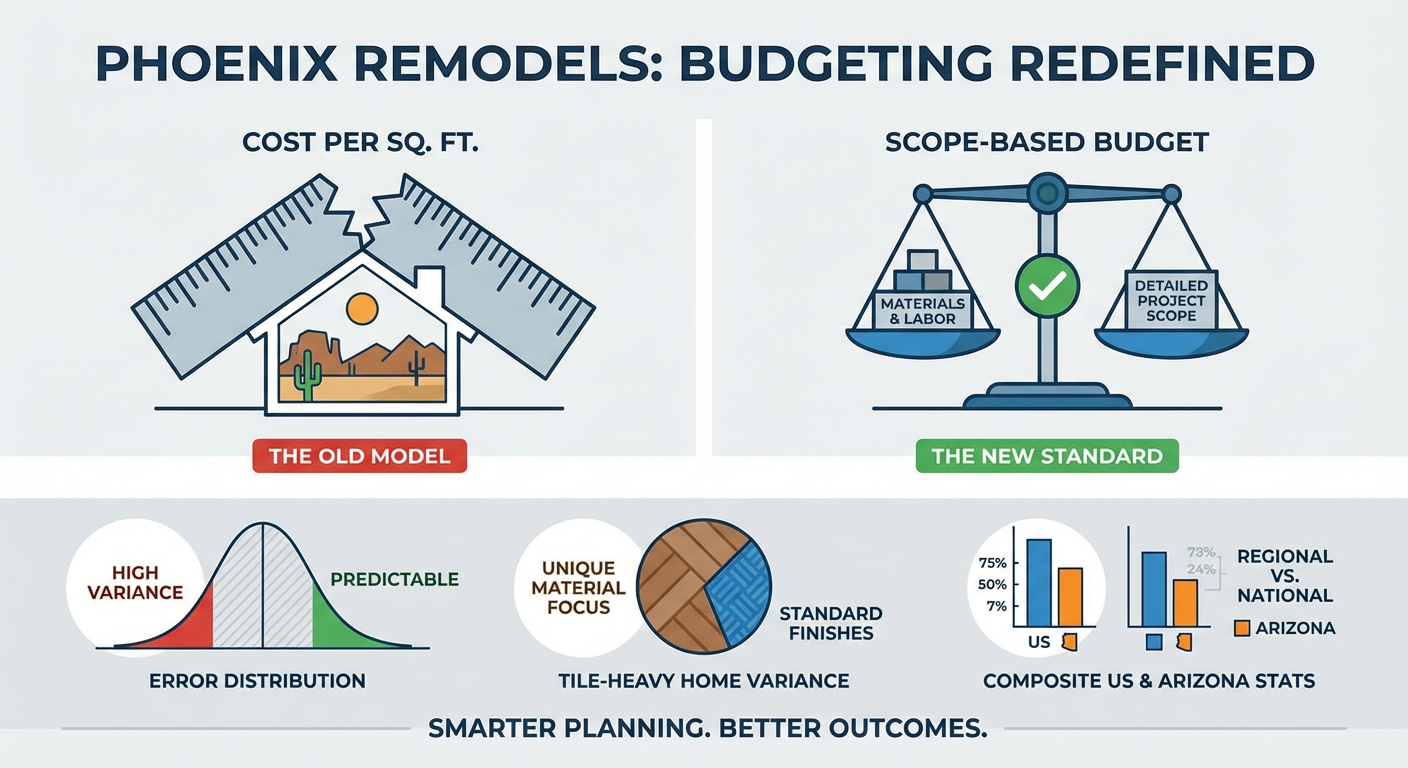
5. Phoenix Remodels: A Case Study in Cost-Per-Square-Foot Pitfalls
The allure of a newly renovated home often masks the underlying complexities of the remodeling process, particularly when it comes to accurate budget forecasting. While national averages provide a general sense of costs, these figures often fall short when applied to specific regional markets. Phoenix, Arizona, stands out as a prime example where unique local factors, consumer preferences, and significant market shifts profoundly skew traditional cost-per-square-foot (CPSF) estimates. This section delves into the inherent inaccuracies of relying on generalized CPSF metrics in dynamic markets like Phoenix, highlighting how local conditions can lead to substantial budget overruns and homeowner dissatisfaction. By examining the distinct characteristics of the Phoenix remodeling landscape, this analysis underscores the critical need for a more granular, scope-based budgeting approach. In the broader United States, home renovation costs exhibit a vast range, typically swinging from $100 to over $450 per square foot, with mid-range projects often settling between $200 and $300 per square foot [8]. Such a substantial ~4x variance immediately signals the unreliability of a single “average” CPSF figure for accurate budgeting. Alarmingly, a significant majority of renovation projects frequently exceed their initial financial projections. A survey from late 2025 revealed that nearly 78% of home projects go over budget, a substantial increase from the approximately one-third of homeowners who reported exceeding their budgets in 2019 [2][1]. This escalating trend of budget overruns, particularly evident in the post-pandemic, high-inflation environment, points directly to systemic issues in initial cost estimation, with over-reliance on simplistic CPSF rules being a major contributing factor [2][1]. The Phoenix metropolitan area offers a detailed illustration of these pitfalls. Since 2019, interior remodeling costs in Phoenix have surged by an astonishing 40-50% [4]. For instance, a full interior renovation that cost approximately $65-$70 per square foot in 2019 now commands around $100 per square foot in 2026, marking a new, higher pricing baseline reflective of escalated labor, materials, and local demand [4]. This rapid cost inflation significantly outpaces general U.S. inflation and demonstrates how quickly national or outdated regional averages can become critically irrelevant. Consequently, any homeowner or contractor in Phoenix attempting to budget based on pre-2020 CPSF benchmarks would likely under-budget by a third or more, leading to inevitable financial strain and project delays [4]. It is within this dynamic and unique market that the inadequacies of the CPSF model are most acutely felt.
Historical Cost Trajectories and Current Realities in Phoenix
The significant inflation observed in the Phoenix remodeling market demands a re-evaluation of how homeowners and contractors approach budgeting. Pre-2020 figures are no longer adequate to capture the economic realities of the present and near future.
The Post-2019 Cost Surge
The period between 2019 and 2026 has witnessed an unprecedented rise in remodeling costs in Phoenix. Data indicates a dramatic 40-50% surge in interior remodeling costs within this timeframe [4]. This rapid escalation can be attributed to a confluence of factors, including increased demand for home improvements, supply chain disruptions, and a tightening labor market, all exacerbated by the global economic shifts post-2020. This trend sharply contrasts with historical data from 2019, where approximately 36% of homeowners managed to stay on budget [1]. By late 2025, this figure had plummeted, with close to 78% of projects exceeding their initial budgets [2]. This dramatic shift underscores the instability of using outdated CPSF figures. For example, a whole-home refresh that cost $65-$70 per square foot in 2019 in Phoenix now costs approximately $100 per square foot in 2026 [4]. This means a homeowner budgeting for a 2,000 sq. ft. renovation based on 2019 prices would be approximately $60,000 short in 2026, a 40% underestimation. This is not merely an inconvenience but a significant financial burden, often leading homeowners to incur debt to complete their projects [2].
Comparing Phoenix to National Trends
While national averages for full interior home remodels range from $100 to $450+ per square foot, Phoenix’s specific market drivers push it towards the higher end of or even beyond these general estimates for comparable scopes [8]. The unique regional preferences discussed below are not adequately accounted for in broad national CPSF calculations. This discrepancy means that relying on national averages in Phoenix would inevitably lead to severe under-budgeting, particularly for mid-to-high-end projects that incorporate specific local architectural and design trends.
Local Preferences Driving Up Per-Square-Foot Costs
The Phoenix remodeling market is heavily influenced by distinct regional preferences and climate considerations, all of which contribute to higher-than-average CPSF costs that generic estimates consistently fail to capture.
Extensive Tile Flooring
One of the most significant cost drivers in Phoenix remodels is the widespread preference for extensive tile flooring. Unlike many other regions where carpeting or hardwood dominates, tile is favored in Arizona for its cooling properties in the desert climate and its low maintenance. However, this preference comes with a significant price tag [4]. A qualitative breakdown of tile costs in Phoenix includes:
-
- Basic Ceramic Tile: Materials range from $2-$5 per square foot [9].
-
- Premium Porcelain or Stone Tile: Materials range from $20-$40 per square foot, potentially costing up to 10 times more than basic options [9].
-
- Skilled Installation Labor: An additional $6-$15 per square foot [9].
Consider a typical 2,000 square foot Phoenix home: re-tiling the entire space with upscale tile can easily run between $30,000-$40,000 just for the flooring [9]. This represents a substantial portion of the overall budget that a generic CPSF estimate, assuming standard flooring materials, would completely miss. The labor-intensive nature of tile installation further exacerbates this cost, making it a highly influential factor in the final project price.
Oversized Kitchen Islands and Open Layouts
Another prominent feature in modern Phoenix homes and remodels is the prevalence of open-plan layouts centered around oversized kitchen islands. These elements significantly elevate project costs due to specific material and structural requirements [4]. The cost implications include:
-
- Extensive Cabinetry: Oversized islands demand significantly more custom or semi-custom cabinetry than standard kitchen configurations.
-
- Large Countertops: The sheer size of these islands often requires large, single-slab countertops, which can necessitate sourcing larger, more expensive stone slabs or carefully managed seams across multiple slabs.
-
- Additional Utilities: Enhancements like second sinks, built-in appliances (e.g., wine coolers, dishwashers), and extra electrical outlets further increase plumbing and electrical costs.
-
- Structural Modifications: Achieving an open-concept layout frequently involves removing load-bearing walls, an undertaking that requires structural engineering, new beams, and extensive drywall repair, adding 15-25% to overall project costs compared to retaining the original floorplan [10].
These modifications are not proportional to the home’s overall square footage; they are driven by design choices that drastically increase the cost density within specific areas. A CPSF calculation simply cannot differentiate between a kitchen with a massive, amenity-rich island and one with a standard, wall-bound layout. The “Phoenix Home Refresh Sticker Shock” case study provides a compelling example of how reliance on outdated or generic CPSF metrics ($70/sq.ft. in 2019 vs. $100/sq.ft. in 2023) led to a $60,000 budget deficit for a 2,000 sq.ft. home, largely due to uncaptured Phoenix-specific upgrades like extensive wood-look tile flooring [49]. This highlights how an initial, overly simplistic budget can leave a homeowner severely underfunded, necessitating re-scoping or additional financing.
Climate-Specific and Infrastructure-Related Costs
Phoenix’s arid climate also introduces unique remodeling considerations that push costs higher.
-
- Water Quality Management: The prevalence of hard water in Phoenix often prompts homeowners to invest in water softening or filtration systems during remodels. These systems require additional plumbing and equipment costs, which are not typically found in generic national CPSF benchmarks.
-
- Advanced HVAC and Insulation: The intense desert heat necessitates efficient cooling systems. Many homeowners opt for high-end, energy-efficient HVAC units, upgraded insulation, or specialized windows to combat rising energy costs. These are significant investments not accounted for in standard CPSF models derived from cooler climates.
-
- Outdoor Living Spaces: Outdoor living is paramount in Arizona. Remodeling projects frequently extend beyond the interior to include elaborate patios, misting systems, outdoor kitchens, and landscaping. While these enhancements do not increase the interior square footage, they significantly increase the total project cost, a detail completely missed by an interior-focused CPSF estimate.
These factors collectively inflate the true cost of remodeling in Phoenix beyond what national or generalized CPSF figures would suggest, rendering such simplified budgeting tools fundamentally flawed for this market.
The Phoenix Error Range: A Quantitative Perspective
The variance between CPSF estimates and final invoices in Phoenix projects is particularly pronounced due to the aforementioned local factors. While the nationwide average error range for CPSF budgeting is “20% or more,” with studies showing 42% of projects with incomplete early estimates facing an average of 31% cost overruns [12], Phoenix often exceeds these national benchmarks. This is due to the inherent assumption in CPSF that all square footage is equal, which is contradicted by Phoenix homes that are tile-heavy and feature complex structural alterations.

This hypothetical chart illustrates the potential for wide variance when employing Cost Per Square Foot (CPSF) budgeting in Phoenix. The red dashed line represents a desired +/-10% accuracy, while the actual distribution (blue curve) shows a broader spread, often reaching 20-40% variance, with a significant tail indicating higher overruns. This reflects the impact of uncaptured local factors and scope complexities.
The typical error range for a CPSF estimate in the Phoenix market often broadens, extending significantly beyond the national 20-30% average. In scenarios involving specific Phoenix-centric elements like extensive premium tile flooring or significant structural modifications for open-concept layouts and large islands, the variance can easily stretch to 30-50% or even higher. This means that an initial CPSF estimate providing a seemingly reasonable budget of $150,000 for a 1,500 square foot project could, in reality, translate to a final cost nearing $225,000 to $275,000 or more after accounting for Phoenix-specific preferences and potential hidden conditions. This dramatic disparity makes CPSF a dangerously inaccurate tool for project planning in this region. The “Phoenix Home Refresh Sticker Shock” case (mentioned earlier) perfectly exemplifies this, where a 2,000 sq.ft. project anticipated at $140,000 based on old CPSF figures ballooned to $200,000, representing a ~43% increase when current, local factors were finally considered [49].
Case Studies: Phoenix-Specific Variance
To further solidify the argument against generic CPSF budgeting in Phoenix, a brief examination of how specific local preferences and economic realities impact project costs is vital.
Case Study 5.1: The Tile-Heavy Home
Project: Whole-home interior refresh for a 2,500 sq.ft. residence in North Phoenix.
Initial CPSF Estimate (based on national average $200/sq.ft.): $500,000
Client Preference: High-end porcelain wood-look tile throughout living areas, kitchen, and bathrooms (1,800 sq.ft. total), custom oversized kitchen island with premium quartz, open-concept renovation requiring removal of one load-bearing wall.
Actual Cost Breakdown:
-
- Flooring (1,800 sq.ft. at $35/sq.ft. installed): $63,000 (Generic estimate might allot $10-15/sq.ft. for basic flooring, ~27,000, missing $36,000)
-
- Kitchen (oversized island, wall removal, premium appliances): $85,000 (Standard kitchen allowance for an average-sized kitchen might be $50,000-$60,000, missing $25,000-$35,000)
-
- Other Areas (paint, new light fixtures, basic bath updates): $30/sq.ft. for remaining 700 sq.ft.: $21,000
-
- HVAC Upgrade (due to age & efficiency needs): $15,000
-
- Contingency (15%): $27,600
-
- Permits, Design Fees: $10,000
Total Scope-Based Estimate: $221,600 (initially $500,000) for a refresh project. If the scope was a gut remodel this would easily be $500,000+. This illustrates the danger of using CPSF in a market driven by heavy tile and specific structural work.
Variance: The initial generic CPSF estimate of $500,000 was highly ambiguous and significantly misplaced the budget if it was interpreted as a cosmetic refresh budget; however, if it was intended for a gut remodel, the homeowner might have over-budgeted for the cosmetic refresh. This highlights the problem of vague CPSF figures. For a cosmetic refresh, the error would be a gross overestimation if the $200/sq.ft. was meant to be the *actual* amount for the space. However, if the client thought that a cosmetic refresh would easily fit into a budget derived from a national average, their *anticipation* would be dramatically different than the reality for the Phoenix market (e.g., if they were thinking that $100/sq.ft. was a good cosmetic number for Phoenix when it is closer to $150 or more for their preferences).
Outcome: The homeowner almost abandoned the project due to initial sticker shock based on scope-based estimates, which they thought were too high compared to their personal CPSF research, only later realizing that their own CPSF figure was too low for a cosmetic refresh with Phoenix-specific preferences, and the initial generic CPSF was likely for a gut remodel not their intended refresh.
Case Study 5.2: The Oversized Kitchen Island Project
Project: Kitchen and living area remodel for a 1,800 sq.ft. home in Scottsdale, affecting approximately 600 sq.ft. of the total square footage.
Initial CPSF Estimate (self-calculated by homeowner based on national figures for kitchen remodels ~$150-250/sq.ft. for the entire home, or $300-500/sq.ft. for just kitchen): Homeowner assumed $30,000-$50,000 for the kitchen area alone (150 sq.ft. at $200-300 per sq.ft.) and an additional $20,000 for living areas.
Client Preference: Demolish a non-load-bearing wall between kitchen and living room, construct a 10-foot-long kitchen island with custom cabinetry and commercial-grade appliances, high-end stone counters, custom lighting, retile 600 sq.ft. of flooring with imported tile.
Actual Cost Breakdown:
-
- Demolition & Structural (no load-bearing wall, but significant rework): $10,000
-
- Kitchen Island (custom cabinets, premium stone, seating, plumbing/electrical for island sink/outlets): $45,000
-
- Appliances (commercial-grade): $25,000
-
- Flooring (600 sq.ft. at $40/sq.ft. installed): $24,000
-
- Custom Cabinetry (remaining kitchen): $30,000
-
- Plumbing & Electrical Upgrades: $8,000
-
- Lighting & Finishes: $7,000
-
- Contingency (15%): $14,850
Total Scope-Based Estimate: $169,850
Variance: The homeowner’s initial expectation of $50,000-$70,000 was off by over 100%. The “per square foot for just kitchen” rate proved inadequate to capture the massive scope of the island and premium components. The specific cost per square foot for the *remodeled area* ended up being around $283/sq.ft. ($169,850 / 600 sq.ft.), which sounds within the range if you *only* consider the square footage of the kitchen plus living area, but utterly failed to account for the impact of premium choices and specific scope elements. This variance was significant enough to cause the homeowner to drastically scale back their appliance choices, demonstrating the critical need for detailed estimation from the outset. These case studies underscore how Phoenix’s unique market characteristics, including strong preferences for extensive tile work, open-concept designs with large islands, and climate-specific upgrades, combine to make reliance on generic CPSF figures a recipe for critical financial miscalculations. These local factors disproportionately inflate costs in specific scope areas, ensuring that a simple area-based average cannot provide an accurate budget.
Transition to Better Budgeting Practices
The evidence from the Phoenix market strongly advocates for a departure from simplistic cost-per-square-foot budgeting in remodeling. The wide variance, continuous cost inflation, and the impact of specific local preferences clearly demonstrate that “averages” are profoundly misleading. For homeowners and contractors alike, a reliance on such metrics leads to frequent budget overruns, financial stress, and strained client relationships. The next section will pivot from identifying the problem to exploring robust, scope-based budgeting methodologies that offer significantly greater accuracy and transparency, thus paving the way for more successful and predictable home renovation projects. This shift is not merely about achieving better estimates; it is about fostering trust, managing expectations, and ultimately ensuring the financial viability and satisfaction of every remodel.
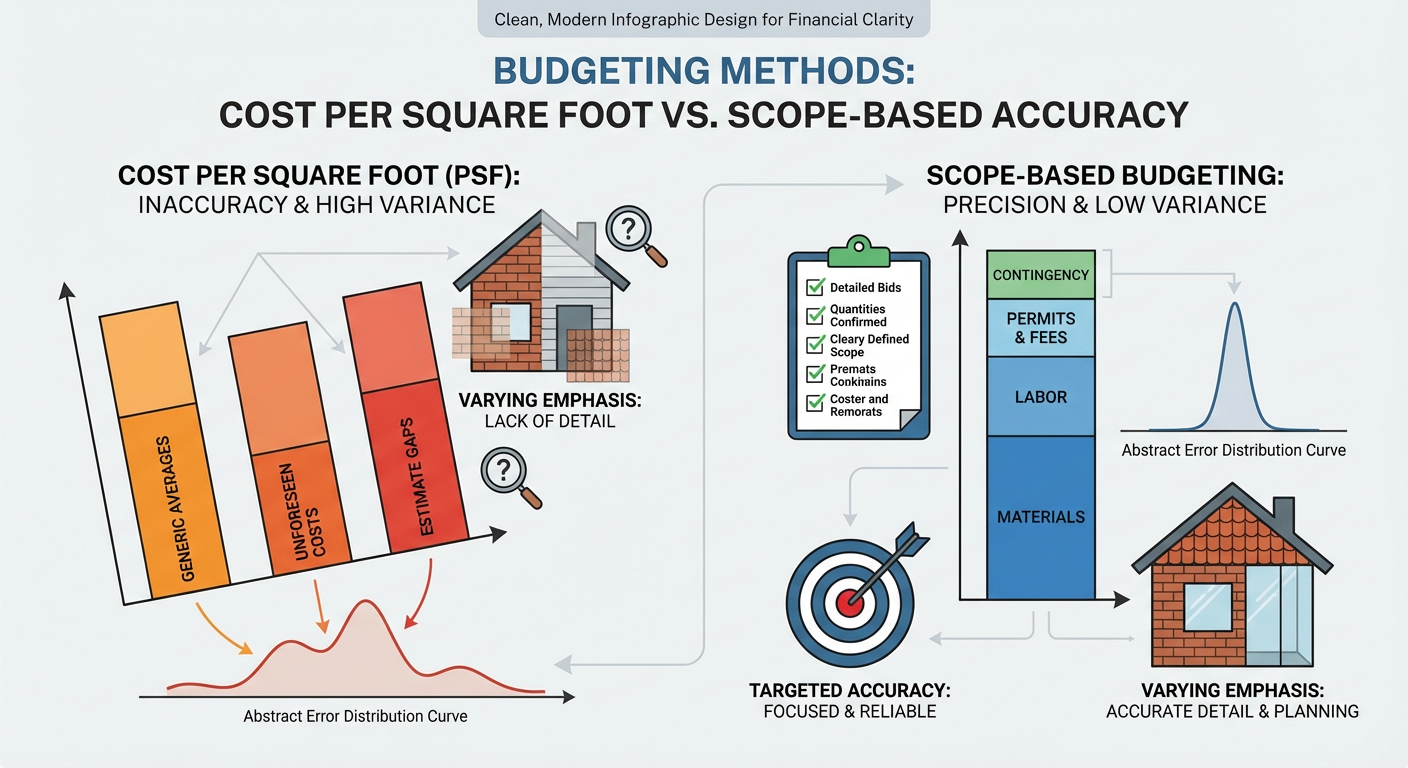
6. From Per-Square-Foot to Precision: Principles of Scope-Based Budgeting
The pursuit of an accurate remodeling budget is often fraught with peril, as homeowners and contractors alike grapple with the inherent complexities and hidden variables of renovating existing structures. While the simplicity of a “cost per square foot” metric holds a certain allure, this research overwhelmingly demonstrates its inadequacy and propensity for significant error in the remodeling industry. Far from being a reliable forecast, per-square-foot (PSF) budgeting often serves as a primary catalyst for budget overruns, homeowner debt, and contractor margin erosion. This section will outline a superior and more precise approach: scope-based budgeting. By defining critical principles such as detailed scope definition, the strategic use of unit costs and historical data, comprehensive variable accounting, and transparent client involvement, remodeling projects can transition from speculative estimations to reliable financial frameworks, fundamentally enhancing accuracy, trust, and overall project success. The fundamental flaw in per-square-foot estimating for remodels lies in its assumption that every square foot of a home carries an equal or proportionally similar cost. This is a gross oversimplification that stands in stark contrast to the reality of dynamic and distinct renovation projects [16]. Unlike new construction, where costs can be more uniformly distributed across square footage, remodeling involves existing conditions, specific room functions, structural interventions, and personalized material selections that render a generic per-square-foot figure virtually meaningless. For example, national average home renovation costs can range dramatically, from about $100 up to $450 per square foot in the U.S., with midrange projects often falling in the $200–$300/sq.ft. range [0]. This nearly four-fold variation within national averages instantly highlights the misleading nature of a single “average” figure. The consequences of relying on such simplistic metrics are dire, with nearly 78% of home renovation projects going over budget as of late 2025, and about two-thirds of homeowners incurring debt to cover these extra costs [2][25]. These compelling statistics underscore the urgent need for a paradigm shift in how remodeling costs are estimated and managed.
6.1 Why Cost Per Square Foot Is a Flawed Metric for Remodels
The pervasive reliance on cost-per-square-foot (PSF) estimates for remodeling projects persists despite overwhelming evidence of its inaccuracy. This section thoroughly dissects the reasons why PSF budgeting is a fundamentally flawed metric, contributing to widespread budget shortfalls and client dissatisfaction.
6.1.1 No “Average” Remodel: The Illusion of Uniformity
The core fallacy of PSF estimating is the assumption of uniformity across renovation projects. Remodels are inherently unique, influenced by myriad factors such as the age of the house, its existing layout, the structural integrity, and the desired level of finish. A single dollar-per-square-foot benchmark implies that each square foot carries the same cost, which is patently untrue in a renovation [16]. For instance, a 100-square-foot bathroom might cost $20,000 (equating to $200/sq.ft.), but a slightly smaller 90-square-foot bathroom will not proportionally decrease in cost [17]. This is because the high fixed costs associated with plumbing fixtures, waterproofing, and specialized labor for a bathroom remain largely constant regardless of a marginal reduction in size. As construction consultant Bryan Kaplan aptly states, “You can’t apply a one-size-fits-all square foot number to a custom remodel” [20][21]. The distinct variables in every project render generic PSF templates ineffective and misleading.
6.1.2 Oversimplification Hides Real Costs and Varies by Contractor
Cost-per-square-foot quotes often create a false sense of precision for homeowners, masking the true underlying costs and potential exclusions [18][19]. The definition of what “cost per square foot” includes can vary significantly between contractors. One builder might factor in design fees, permits, and appliances, while another might only include raw construction labor and materials. This lack of standardization means that a “€300/sq.ft.” quote from one firm cannot be directly compared to another’s, leading to confusion and later surprises when unbudgeted items emerge. When the full project scope is eventually accounted for, initial PSF ballparks frequently prove to be significantly understated, blindsiding homeowners [18].
6.1.3 Ignoring Existing Conditions and “Unknown Unknowns”
Remodeling always involves interacting with an existing structure, which can harbor unexpected challenges. A PSF rule developed from one project cannot account for what might be hidden behind the walls of another home [22]. For example, two 2,000-square-foot homes might appear similar, but a 1960s property with outdated electrical systems, lead paint, or termite damage will incur substantially higher renovation costs than a well-maintained 2000s build. PSF estimates fail to incorporate these latent conditions, such as mold remediation, structural rot, or code upgrades, which can balloon project expenses unexpectedly [9]. This omission directly contributes to the statistic that roughly 20-30% of construction projects exceed estimates due to inaccurate bidding practices [10][30].
6.1.4 Outdated Historical Data vs. Current Market Reality
Construction costs are not static; they are highly susceptible to market fluctuations, supply chain disruptions, and changing labor rates. A historical PSF rate, even if accurate at the time, can quickly become irrelevant. The post-2020 market, characterized by supply chain issues, labor shortages, and material inflation, dramatically invalidated many previous PSF benchmarks [23][24]. For instance, a whole-home renovation averaging $70/sq.ft. in 2019 could easily exceed $100/sq.ft. by 2023 [24], a nearly 40% increase. Relying solely on outdated PSF metrics without rigorous adjustments for current market conditions is a guaranteed path to underestimation.
6.1.5 Every Project is Apples-to-Oranges
The assertion that “every project is unique” holds particular weight in remodeling. PSF models struggle to differentiate between a surface-level cosmetic refresh and a gut renovation that strips a space down to its studs. Factors like site accessibility, the degree of structural modification, and the quality of finishes chosen all profoundly impact the final cost but are not adequately captured by a simple area metric. As illustrated by the example of a basement renovation costing $20/sq.ft. for an open space versus a high-end gut remodel reaching $200–$300/sq.ft. or more [23], the scope of work, not just the area, is the primary cost driver. Seasoned builders advocate for ground-up estimation that considers labor, materials, and difficulty, a stark contrast to merely plugging numbers into a square footage formula [16].
6.2 Scope Matters: Which Remodeling Projects Break the $/SF Model
Certain types of remodeling projects inherently defy the simplistic cost-per-square-foot model more than others. These are typically spaces or interventions characterized by high functional density, complex infrastructure requirements, or significant material quality variances. Understanding these “PSF-breaking” scopes is crucial for accurate budgeting.
6.2.1 Kitchens: Small Area, High Cost Concentration
Kitchens are notoriously problematic for PSF budgeting due to their concentration of expensive components and multiple trades within a relatively small footprint. They demand specialized cabinetry, high-end countertops, numerous appliances, intricate plumbing, and extensive electrical work. Consequently, contractors frequently identify kitchens as the number one room most likely to exceed its budget [10][28]. A 150-square-foot kitchen, for example, might cost $50,000 (over $330/sq.ft.), while a 150-square-foot bedroom might only require $5,000 for paint and carpet (approximately $33/sq.ft.). The sheer volume of high-value items – from custom millwork and professional-grade appliances to specialized ventilation and gas lines – makes kitchens exceptions to any per-square-foot rule.
6.2.2 Bathrooms: High Functional Density and Infrastructure Requirements
Bathrooms, similar to kitchens, exhibit a high cost density despite their small size. They are packed with fixtures such as bathtubs, showers, vanities, sinks, and toilets, alongside extensive tile work and essential waterproofing. These elements necessitate significant plumbing, electrical, and finishing labor. Industry data indicates that even a small bathroom (e.g., 5’x10′, 50 sq. ft.) can range from $115 to $300 per square foot [7], translating to a total cost between $6,000 and $15,000 or more for the exact same area, depending on finish selections. The specific choices in fixtures and layout, not merely the square footage, are the primary drivers of cost.
6.2.3 Whole-Home “Refresh” vs. “Gut” Renovation: Scope Defines Cost
The depth of renovation dramatically alters per-square-foot costs. A whole-home cosmetic refresh, involving paint, new fixtures, and minor repairs, often leaves the structural and mechanical systems largely untouched, resulting in a lower per-square-foot cost. For instance, a 2,000 sq.ft. basement might be finished for as little as $20 per sq.ft. if it’s primarily open space with no major mechanical changes [23]. In contrast, a comprehensive “gut renovation,” where spaces are stripped to the studs and rebuilt, will incur significantly higher costs. High-end gut remodels can easily reach $200–$300/sq.ft. or more [23]. Applying a single, generic PSF average across these vastly different scopes inevitably leads to severe underestimation for intensive remodels or overestimation for lighter refreshes.
6.2.4 Hidden Structural Costs and Layout Modifications
Certain modifications, particularly structural ones, cause disproportionate cost increases that do not correlate with square footage. Removing a load-bearing wall to create an open-plan living space, for example, can add thousands of dollars for engineering consultations, new beams, and the rerouting of electrical and HVAC systems [9]. In Phoenix, incorporating an open-concept kitchen by eliminating walls and adding a large island can increase project costs by 15-25% compared to maintaining the existing layout [9]. These are scope-driven expenses that impact fixed costs and labor hours but do not scale linearly with the physical area. Similarly, adding a new bathroom to a home introduces significant plumbing and sewer infrastructure costs that transcend simple square footage calculations.
6.2.5 Premium Materials & Finishes: The Multiplicative Factor
The choice of materials and finishes is a potent force in breaking the PSF model. Flooring provides a clear illustration: upgrading a 200-square-foot room from basic laminate ($2/sf materials) to imported marble tile ($20/sf materials) increases the material cost tenfold for the same area. In Phoenix, where high-end porcelain or stone tile is popular, material costs alone can range from $20–$40 per sq.ft., with skilled installation adding another $6–$15 per sq.ft. [8][27]. Consequently, a tile-heavy home undergoing renovation can easily incur tens of thousands of dollars in flooring costs, regardless of its overall size [27]. These selections, from professional-grade kitchen appliances to custom cabinetry, are precisely what PSF averages fail to capture, highlighting that the actual cost is determined by the specific choices made, not merely the dimensions of the space.
6.3 The Hidden Error Margin in $/SF Estimates
The widespread adoption of PSF estimating tools introduces substantial error margins that often lead to project failures and financial strain. This section explores the extent of these errors, their underlying causes, and their profound impact on both homeowners and contractors.
6.3.1 Frequent and Large Overruns
Real-world data consistently demonstrates that PSF budgeting leads to frequent and significant budget overruns. A late 2025 survey indicated that nearly 78% of home renovation projects exceed initial budget estimates [2]. Even in a more stable market in 2019, approximately one-third of remodeling projects went over budget [3]. The typical error range for a simplistic PSF estimate can be 20-30% or more. A comprehensive analysis found that 42% of construction projects suffered from incomplete or rushed initial estimates, resulting in an average cost overrun of 31% [4]. This kind of variance can translate into tens or even hundreds of thousands of dollars on a single project, significantly impacting financial viability.
6.3.2 Why the Gaps Happen: Unknowns and Misapplied Averages
The large error margins in PSF estimates stem from several critical issues. Often, the chosen PSF rate is based on past projects that are not truly analogous to the current renovation. A high-end urban remodel’s $200/sf figure is inappropriate for estimating a basic suburban renovation and vice versa. More critically, PSF budgeting fails to account for “unknown unknowns”, unforeseen issues that emerge once walls are opened, such as rotten subflooring, outdated electrical systems, or plumbing requiring full replacement. These discoveries introduce unplanned costs that cannot be captured by a generic formula. Furthermore, material cost volatility or last-minute finish changes by the homeowner can quickly render an initial PSF budget obsolete. As one case study revealed, initial high-level estimates frequently fail to incorporate market volatility, leading to actual contractor bids being substantially higher than forecasted [10].
6.3.3 Inaccurate Bidding Risks and Contractor Profitability
From a contractor’s perspective, relying on PSF pricing carries significant risks, primarily the likelihood of systematically underbidding projects to win contracts. This often leads to compromised quality, difficult change order negotiations, or direct erosion of profit margins. Data indicates that 20-30% of projects exceed estimates due to faulty bidding practices [10]. A common scenario involves a contractor providing a quick PSF quote to meet client expectations, only to find it insufficient once detailed plans are developed. For example, a small reduction in bathroom size does not proportionally decrease the cost if the same expensive fixtures and labor are required [17]. Failing to account for such nuances upfront means the initial bid is fundamentally miscalibrated, harming both contractor and client. Contractors who adopt detailed, component-based estimating methods secure 47% more profitable projects compared to those using generic PSF formulas [5].
6.3.4 Homeowner Expectations vs. Reality: The Debt Burden
The constant exposure to “cost per square foot” figures in popular media often creates profoundly unrealistic expectations for homeowners. When individuals assume that national averages of, for example, $150/sq.ft. apply directly to their project, they set budgets that can be two or three times lower than actual costs for their desired scope. This expectation gap leads to severe financial distress. A homeowner budgeting $300,000 for a 2,000 sq.ft. whole-home overhaul (at $150/sf) might be shocked to learn the true cost is closer to $500,000+. This discrepancy is a leading cause of budget overruns [31], forcing many homeowners to scale back plans or, more commonly, incur significant debt. By late 2025, approximately two-thirds of renovators were taking on debt to complete projects that had exceeded their initial budgets [25]. Such financial repercussions highlight the critical need for transparent, detailed estimates from the outset.
6.3.5 Variance Across Regions and Times
The inherent error in PSF estimates is further exacerbated by their failure to account for regional and temporal cost variations. A $200/sq.ft. remodel in a low-cost-of-living area might represent a luxurious outcome, whereas the same per-square-foot investment in a high-cost urban center would barely cover mid-range finishes. National averages obscure these critical local differences. Moreover, construction costs are not stable over time; material prices (e.g., lumber, steel) and labor rates can fluctuate dramatically year-on-year. For example, Phoenix saw remodeling costs surge by 40-50% since 2019 [23][55]; therefore, any PSF estimate from 2019 would be entirely inadequate for 2023. These dynamics mean that PSF figures, by their static and generalized nature, are almost guaranteed to be inaccurate when applied to specific projects in specific locations at specific times. The “error margin” is not merely a numerical deviation but an intrinsic consequence of using overgeneralized figures in a highly dynamic industry.
6.4 Phoenix Spotlight: How Local Factors Skew Cost/SF Estimates
The Phoenix, Arizona market serves as an exceptional illustration of how local preferences, climate, and economic conditions can profoundly skew cost-per-square-foot estimates, rendering them unreliable for accurate budgeting.
6.4.1 Unique Market Characteristics and Cost Inflation
Phoenix has experienced significant population and economic growth, leading to a booming remodeling market. This demand, coupled with national inflationary pressures, has caused a substantial surge in local remodeling costs. Interior remodeling costs in Phoenix have increased by approximately 40-50% since 2019 [23]. A whole-home refresh that cost around $65–$70/sq.ft. in 2019 can now run about $100/sq.ft. in 2026 [24]. This rapid escalation means that national PSF averages or outdated local benchmarks dramatically under-budget projects in this market. Homeowners relying on generalized figures would be faced with a startling financial gap, revealing the critical need for current, regionalized data.
6.4.2 Tile-Heavy Designs: A Phoenix Signature with High Costs
A distinctive feature of Phoenix home interiors is the extensive use of tile flooring, often wood-look porcelain or natural stone, favored over carpeting due to the desert climate and ease of maintenance [8]. While practical, this preference has significant cost implications. Basic ceramic tile might cost $2–$5/sq.ft. for materials, but the premium porcelain or stone tiles popular in Phoenix typically range from $20–$40/sq.ft. for materials alone [8][27]. Moreover, skilled installation labor for these materials adds an additional $6–$15/sq.ft. [27]. For a typical 2,000 sq.ft. home, opting for upscale tile throughout can easily accumulate $30,000–$40,000 solely for flooring [27]. A generic PSF budget, which might assume standard flooring options, would completely miss this substantial cost driver unique to tile-heavy markets like Phoenix.
6.4.3 Grand Kitchen Islands & Altered Layouts: Structural and Finish Premiums
Modern Phoenix remodels often feature open-concept designs centered around oversized kitchen islands, serving as focal points for both aesthetics and functionality [57]. These large islands require significant investment in specialized cabinetry, large single-slab countertops (which can be more expensive if they require multiple slabs or custom fabrication), additional electrical outlets, and potentially extra plumbing for secondary sinks or appliances [58]. Furthermore, achieving an open layout frequently involves removing load-bearing walls, incurring substantial costs for structural engineering, new beams, and the rerouting of utilities. Local contractors report that such open-concept modifications can add 15-25% to the total project cost compared to retaining the original layout [9]. These are scope-driven costs that escalate the overall project budget far beyond what any PSF calculation merely based on square footage would predict.
6.4.4 Climate and Infrastructure Factors Specific to the Desert
The specific environmental challenges of the Phoenix desert environment also contribute to unique cost drivers. The region’s exceptionally hard water often prompts homeowners to invest in water softening or filtration systems, adding specialized plumbing equipment costs that are not universally applicable to other climates. The intense heat makes high-efficiency HVAC systems, advanced insulation, and UV-resistant windows highly desirable or even necessary investments, particularly in high-end remodels. These climate-dictated upgrades can significantly increase budgets but are rarely captured by a national average PSF figure. Additionally, outdoor living is a prominent aspect of the Arizona lifestyle, with projects often extending to include elaborate patios, misting systems, and built-in outdoor kitchens. These enhancements add considerable cost without increasing interior square footage, underscoring how region-specific lifestyle choices can drastically detach actual project costs from generalized PSF estimates.
6.4.5 Comparisons to National Averages: A Cautionary Note
Phoenix homeowners must exercise extreme caution when referencing national remodeling cost benchmarks. While some mid-range project costs in Phoenix might align with national averages for certain scopes, the market significantly diverges for “better” and “best” tier upgrades [60]. The prevalence of premium materials and structural alterations means that higher-end remodels in Phoenix can easily exceed the estimates derived from generic high-end budgets found elsewhere. As of 2026, a top-tier luxury whole-home renovation in Phoenix can exceed $300,000 for a 3,000 sq.ft. home [61], a figure that is at or above costs in many traditionally pricier markets. This demonstrates that Phoenix is not a “cheap” market, and its unique regional cost drivers, such as stylistic preferences, climate-specific needs, and local labor rates, fundamentally break the per-square-foot model. Relying on broad averages without precise local adjustments is a recipe for substantial budgeting errors in any dynamic market, but particularly so in a rapidly evolving locale like Phoenix.
6.5 Beyond $/SF: How to Budget Remodels More Accurately
Moving beyond the outdated and misleading cost-per-square-foot model requires a commitment to meticulous planning and a scope-based approach. This methodology prioritizes detailed definition, systematic costing, and transparent communication, leading to far more predictable outcomes.
6.5.1 Detailed Scope Definition: Building the Job Piece by Piece
The cornerstone of accurate budgeting is a clear and exhaustive scope of work. Instead of crude multipliers, successful remodelers meticulously “build the job on paper, piece by piece,” itemizing every task, material, and required intervention [16]. This involves:
-
- Clearly defining all areas to be renovated.
-
- Specifying exact improvements (e.g., “replace 10 windows,” “install 20 linear feet of custom cabinetry,” “rewire kitchen circuits to current code”).
-
- Documenting any special requirements, such as custom finishes or accessibility modifications.
This granular breakdown prevents the common problem of “missing pieces” inherent in PSF estimates. It ensures both the contractor and homeowner have a shared understanding of what is included, effectively minimizing future disputes and unexpected costs. A detailed, written scope acts as a foundational contract, where unlisted items are explicitly excluded, preventing any client assumption of inclusion without cost. This upfront rigor is crucial for budget reliability.
6.5.2 Unit Costs & Historical Data: Precision Through Granularity
An effective scope-based budget leverages unit costs rather than broad averages. This means breaking down the project into quantifiable units, such as:
-
- Cost per linear foot of cabinetry.
-
- Cost per fixture installed (e.g., toilet, sink, light).
-
- Cost per square foot of flooring, specific to the material type and installation complexity.
-
- Cost per door or window installed.
Contractors increasingly utilize comprehensive cost databases and their own historical project data to price these units accurately. For example, knowing that a standard pre-hung interior door install previously cost $350 ensures that estimating 10 similar doors is a straightforward calculation (10 x $350). Modern estimating software and takeoff tools facilitate this process, allowing for systematic, bottom-up estimation built on tangible costs rather than speculative top-down guesses. Companies that implement such advanced, component-level budgeting practices report 18% higher profit margins [11], demonstrating the substantial financial benefits of precision.
6.5.3 Accounting for Variables and Complexity: Anticipating the Nuances
Skilled estimators proactively integrate project-specific variables and potential complexities into their scope-based budgets, a critical step that generic PSF numbers cannot address.
-
- Existing Conditions: For older homes, line items for electrical upgrades, plumbing replacements, or foundation leveling are incorporated, based on pre-inspection and experience.
-
- Finish Levels: Specific high-end finishes, such as quartz countertops or custom tile work, are costed precisely, rather than relying on an ambiguous “premium finishes” allowance.
-
- Site-Specific Challenges: Factors like limited site access (e.g., a third-floor condo renovation requiring specialized material transport) or the need for extensive debris removal are quantified.
Experienced project managers understand “budget killers,” such as asbestos removal, lead paint abatement, or required main electrical panel upgrades, and proactively budget for them. This anticipatory budgeting minimizes mid-project surprises and transforms potential emergencies into managed expenses.
6.5.4 Including a Healthy Contingency: Acknowledging the Unforeseen
A crucial element of responsible scope-based budgeting is the allocation of a contingency fund, typically 10-20% of the total project budget [12]. This fund is not profit; it is a realistic provision for the inevitable unforeseen issues that arise in remodeling, such as discovering hidden rot, unexpected structural damage, or mandatory code upgrades once demolition begins. Treating the contingency as an “untouchable” reserve protects the project from being derailed by surprises. If not fully utilized, the remaining contingency can be returned to the homeowner or applied to desirable upgrades. Explicitly planning for unknowns allows for a controlled response rather than an emergency when issues materialize, transforming potential budget-breaking events into manageable challenges.
6.5.5 Transparency and Client Involvement: Building Trust and Control
A significant advantage of detailed, scope-based estimates is the enhancement of communication and trust between contractors and clients. Breaking down costs by specific categories (e.g., demolition, framing, plumbing, electrical, tiling, painting) allows homeowners to clearly understand where their money is being allocated [13]. This transparency empowers clients to make informed decisions and trade-offs. For instance, if a budget review reveals that $25,000 is allocated for tile work, the client can consciously decide whether to proceed with that selection, opt for a less expensive alternative, or reduce the tiled area. Such precise breakdowns establish credibility and reassure clients that the estimate is grounded in reality, fostering collaboration rather than an adversarial relationship. It also creates a clear record of agreed-upon work, significantly reducing the likelihood of disputes and change orders, thereby improving client satisfaction and referral rates.
6.5.6 Iterative Estimation & Technology Tools: Dynamic Budgeting
Scope-based budgeting is not a static process; it’s iterative and evolves alongside the project design. Best practices dictate updating the budget at critical milestones, after schematic design, following final design and engineering, and once major material selections are finalized. This continuous refinement ensures that any scope creep, such as the homeowner deciding to add a guest bathroom remodel, immediately triggers a recalculation of the cost implications, preventing silent budget erosion. Many professionals leverage advanced estimation software that integrates with design drawings, utilizes customizable templates, and may even incorporate 3D scanning for precise take-offs. This technological investment in accurate tools minimizes errors, reduces mid-project changes, and ultimately delivers more reliable budgets and successful projects. Embracing this rigorous, detailed planning process, while demanding more upfront effort, consistently yields superior outcomes for both homeowners and remodelers.
6.6 Case Studies: The Real-World Impact of Budgeting Approaches
Illustrative case studies underscore the dramatic difference between simplistic per-square-foot estimating and detailed, scope-based budgeting.
6.6.1 Phoenix Home Refresh Sticker Shock (2023)
An Arizona homeowner, having relied on outdated 2019 figures of $70/sq.ft., initially anticipated a $140,000 budget for their 2,000 sq.ft. whole-home refresh. However, by 2023, due to pandemic-driven inflation and local demand, Phoenix remodeling costs had surged to approximately $100/sq.ft. When detailed, scope-based bids were obtained, the actual estimate came in closer to $200,000. This $60,000 difference, a 40% cost increase, forced the homeowner to rescale and re-phase their project. This example critically highlights how relying on stagnant PSF benchmarks, especially in volatile regional markets, can lead to painful underestimation [48].
6.6.2 Bathroom Remodel Misestimate – A Proportionality Fallacy
A remodeling contractor famously illustrated the limitations of PSF. After completing a 100 sq.ft. bathroom for $20,000 ($200/sq.ft.), a subsequent client with a 90 sq.ft. bathroom expected a 10% cost reduction ($18,000). The contractor, utilizing a scope-based approach, demonstrated that despite the smaller area, the essential fixed costs for fixtures, plumbing, and labor meant the 90 sq.ft. remodel would still cost around $20,000 [49]. This case perfectly exemplifies that a minor reduction in area does not translate to a proportional cost decrease when key cost drivers remain constant.
6.6.3 Smart Budgeting Saves $2M on a Commercial Project (2025)
A California development team faced a crisis when contractor bids for their six-unit building project came in 20-30% higher than their initial budget, which had been set using rough historical PSF metrics. Faced with a potential multi-million-dollar overrun, they engaged a construction cost consultant. By overhauling their approach to a detailed, unit-cost-based, trade-by-trade breakdown, they identified $2 million in savings. This rescued the project, demonstrating that even on a large scale, rigorous scope-based budgeting, combined with current data and value engineering, can prevent catastrophic overruns [51][52].
6.6.4 Sydney Opera House – The Quintessential Cautionary Tale
While not a home remodel, the Sydney Opera House offers an historical testament to the perils of underestimating scope. Initially estimated at A$7 million in 1959 based on simplistic calculations, its true complexity, innovative design, and unforeseen challenges (the equivalent of “hidden conditions” in a remodel) led to massive overruns. By its 1973 completion, the final cost ballooned to A$102 million, 14 times the original estimate [54]. This extreme example underscores that even with the best intentions, a lack of deep understanding and detailed pre-planning of scope can lead to financial catastrophe, a lesson equally applicable to smaller-scale renovation projects.
Conclusion to Section 6
The transition from outdated per-square-foot estimating to a comprehensive scope-based budgeting methodology is not merely a technical refinement; it is a fundamental shift towards greater accuracy, transparency, and financial integrity in the remodeling industry. As evidenced by the significant error margins, the disproportionate cost drivers in specific rooms and circumstances, and the real-world case studies, PSF budgeting is demonstrably inadequate for the unique and variable nature of renovation projects. By embracing detailed scope definition, leveraging unit costs and historical data, meticulously accounting for project-specific variables, and maintaining transparent client involvement, contractors can build more reliable estimates, protect their margins, and foster greater client satisfaction. Homeowners, in turn, gain a clearer understanding of their investment, mitigating the risk of budget overruns and the associated financial strain. The insights presented here serve as a robust framework for adopting these superior budgeting practices, paving the way for more successful and predictable remodeling experiences.
The subsequent section will delve into the specific details of a proposed estimator checklist derived from these principles, offering practical steps for contractors to implement this sophisticated budgeting approach.
7. Best Practices for Accurate Remodel Budgeting
The allure of a beautifully renovated home often begins with an initial budget estimate, but for too many homeowners and contractors, this starting point proves to be a significant pitfall. As highlighted throughout this report, relying on simplistic cost-per-square-foot (PSF) metrics for renovation projects is a recipe for budget overruns, client dissatisfaction, and diminished contractor profitability. The data unequivocally shows that nearly 78% of home renovation projects exceed their initial budgets as of late 2025, a dramatic increase from 31% in 2019, signifying a growing crisis in accurate financial forecasting for remodels [2][3][4]. This section moves beyond identifying the problems with PSF budgeting and instead offers actionable, data-backed strategies for both homeowners and contractors to navigate the complexities of remodel budgeting with significantly greater accuracy and transparency. By adopting detailed, scope-based approaches, incorporating healthy contingency funds, and embracing iterative estimation with technology, stakeholders can achieve more reliable financial outcomes and foster stronger, more trusting relationships.
The imperative for better budgeting practices has never been greater. American homeowners undertook 135 million home improvement projects from 2019–2021, spending an estimated $624 billion, which represented a $100 billion increase from the prior two-year period [13]. With such substantial financial investment, even small percentage errors in budgeting can translate into millions, or even billions, in unexpected costs industry-wide. Furthermore, the financial strain on homeowners is considerable, with approximately two-thirds having to incur debt to complete over-budget renovations [2]. For contractors, the stakes are equally high; those who rely on detailed, component-based estimating methods secure 47% more profitable projects compared to those who stick to traditional square-foot pricing [5]. Clearly, moving beyond the flawed PSF model is not merely a recommendation but a necessity for financial health and project success in the remodeling industry.
7.1. Detailed Scope Definition: The Foundation of Accurate Estimates
The most critical step in establishing an accurate remodel budget is the comprehensive and meticulous definition of the project’s scope. Unlike new construction, where costs can be more easily standardized per square foot, remodeling deals with unique existing structures and varying client desires [6]. “You can’t apply a one-size-fits-all square foot number to a custom remodel,” emphasizes construction consultant Bryan Kaplan [7][8]. Therefore, the budgeting process must begin by “building the job on paper, piece by piece,” listing every task, material, and specification [6].
-
- Granular Itemization: Instead of broad categories like “kitchen remodel,” a detailed scope breaks down the project into specific line items. For example, a kitchen project would include:
-
- Demolition of existing cabinetry, countertops, and appliances.
-
- Rough carpentry for framing modifications (e.g., wall removal).
-
- Plumbing rough-in and finish for sink, dishwasher, and refrigerator waterline.
-
- Electrical rough-in and finish for new outlets, lighting fixtures, and appliance circuits, including any main panel upgrades if necessary.
-
- Specific types and quantities of cabinetry (e.g., 20 linear feet of custom shaker cabinets with soft-close hardware).
-
- Exact countertop material, edge profile, and square footage (e.g., 45 sq. ft. of 3cm quartz with eased edge).
-
- Flooring material and coverage (e.g., 150 sq. ft. of engineered hardwood, installed).
-
- Tile backsplash details (e.g., 30 sq. ft. subway tile, herringbone pattern).
-
- Painting of walls and ceiling (specify number of coats and type of paint).
-
- Appliance allowances or specific models.
-
- Permit fees and inspection costs.
-
- Cleanup and waste removal.
-
- Granular Itemization: Instead of broad categories like “kitchen remodel,” a detailed scope breaks down the project into specific line items. For example, a kitchen project would include:
-
- Clarity for Both Parties: This level of detail ensures that both the homeowner and the contractor have a shared understanding of what is included in the project and, crucially, what is not. When something is not explicitly listed, it is understood to be outside the initial budget, preventing miscommunications and contentious change orders later [9]. This transparent approach fosters trust, as clients can clearly see where their money is being allocated [9].
-
- Avoiding the “False Sense of Precision”: Cost-per-square-foot quotes often create a “false sense of precision” that can be misleading [17]. For example, the cost of a 100 sq. ft. bathroom at $200/sq.ft., totaling $20,000, might lead a client with a 90 sq. ft. bathroom to expect a proportional 10% reduction in cost to $18,000. However, the Journal of Light Construction points out that many costs, like the number of fixtures (toilet, sink, shower), demolition, and certain labor components, are fixed regardless of a slight change in square footage [18][29]. A detailed scope acknowledges these fixed elements and provides a more realistic view.
The detailed scope serves as the blueprint for the budget, allowing unit costs and specific material selections to be applied accurately, moving away from broad, unreliable averages that do not reflect the true complexity of a remodel.
7.2. Leveraging Unit Costs and Historical Data for Enhanced Accuracy
Once a detailed scope is established, the next step involves assigning accurate costs to each line item. This is where the power of unit costs and historical data comes into play, providing a robust alternative to generic PSF calculations.
-
- Unit Cost Application: Instead of pricing an entire room by its square footage, a more precise method involves breaking down costs by measurable units. Examples include:
-
- Per Linear Foot: For cabinetry, trim work, or shelving.
-
- Per Square Foot: For flooring materials, tile installation, drywall, or painting. However, critically, this is applied to a specific surface or material, not the entire room. For instance, basic ceramic tile in Phoenix can cost $2–$5/sq.ft. for materials, while premium products range from $20–$40/sq.ft., plus $6–$15/sq.ft. for installation [10][11]. This granular view allows for precise material and labor cost allocation based on specific selections.
-
- Per Fixture/Item: For plumbing fixtures (sinks, toilets, faucets), electrical outlets, light fixtures, or appliance installations.
-
- Per Opening: For interior or exterior door and window installations.
-
- Lump Sum: For specific tasks like demolition or permit fees that are not quantity-based.
-
- Unit Cost Application: Instead of pricing an entire room by its square footage, a more precise method involves breaking down costs by measurable units. Examples include:
-
- Utilizing Historical Project Data: Experienced contractors maintain databases of past project costs. This historical data, when properly categorized by scope and detail, provides invaluable insights into the real costs of various tasks and materials in their local market. For example, knowing that installing a standard interior door, inclusive of labor and material, typically costs $350 based on previous projects allows for quick and accurate scaling across similar jobs [6]. This is a form of scope-based budgeting, where each component of the scope has a verifiable price point.
-
- Data-Driven Profitability: The benefits of this approach are tangible. Companies that adopt advanced, component-level budgeting practices see 18% higher profit margins on projects [12]. Furthermore, contractors using detailed, component-based estimating methods secure 47% more profitable projects compared to those relying on traditional square-foot pricing [5]. This demonstrates that investing time in granular estimation directly translates to financial success.
-
- Technology Tools: Modern estimation software and takeoff tools have revolutionized this process. These platforms allow contractors to:
-
- Perform digital takeoffs from blueprints or 3D scans of existing homes, accurately measuring quantities for materials like drywall, flooring, and paint.
-
- Integrate with supplier databases for real-time material pricing.
-
- Maintain an organized historical cost database to inform future bids.
-
- Generate comprehensive, itemized proposals that clearly outline all costs for clients.
-
- Technology Tools: Modern estimation software and takeoff tools have revolutionized this process. These platforms allow contractors to:
By moving from a single, vague PSF number to a precise accumulation of unit costs, both homeowners and contractors gain a clear, defensible, and accurate budget that reflects the actual work and materials involved.
7.3. Accounting for Variables and Complexity: Beyond the Obvious
Remodeling rarely unfolds exactly as planned, especially in older homes. Accurate budgeting must proactively account for known variables and potential hidden complexities that frequently break simplistic PSF models.
-
- Existing Conditions: The age and condition of a home are paramount factors. A 2,000 sq. ft. home built in the 1960s with outdated electrical systems, lead paint, or even termite damage will incur significantly higher renovation costs than a similarly sized house built in the 2000s in good condition [14]. PSF pricing assumes a clean slate, ignoring these “unknown unknowns” that can balloon costs for remediation, structural repairs, or code upgrades [14]. A proactive estimator will include specific line items or allowances for investigating and addressing these issues, rather than hoping they don’t materialize.
-
- Finish Levels and Customization: The choice of finishes dramatically impacts cost. As noted, tile flooring costs in Phoenix can range from $2/sq.ft. for basic ceramic to $40/sq.ft. for premium stone [10]. Similarly, custom cabinetry, high-end appliances, specialty lighting, or unique architectural details can individually add tens of thousands to a project, disproportionate to the room’s square footage. Budget Category Example Cost Range (Phoenix) Impact on PSF Basic Ceramic Tile (Material) $2–$5/sq.ft. Minimal Premium Stone/Porcelain Tile (Material) $20–$40/sq.ft. Significant, especially for large areas Tile Installation Labor $6–$15/sq.ft. Adds substantial cost, often fixed minimums Open Concept Kitchen (Structural Change) Adds 15–25% to project cost Major, disproportionate to any area changes A cost-per-square-foot model cannot adequately distinguish between these vast differences in material and customization choices, leading to significant estimation errors.
-
- Structural Changes and Layout Alterations: Major layout changes, such as removing a load-bearing wall to create an open-concept kitchen, introduce substantial costs. These include engineering fees, materials for new beams or supports, and extensive rework of electrical and HVAC systems, which can add 15–25% to a project’s cost [15]. Such costs are driven by scope, not by a proportional increase in square footage, thus rendering PSF estimates highly inaccurate.
-
- Site Conditions and Accessibility: Factors like a home’s location (e.g., urban high-rise vs. suburban single-family), accessibility for material deliveries, or the presence of existing landscaping can impact labor and logistics costs. A project requiring craning materials to an upper floor, for instance, will be more expensive than one with ground-level access – an expense unrelated to square footage but critical to the budget.
Experienced contractors integrate these variables into their detailed estimates, often through allowances for unforeseen issues or specific pricing for complex tasks. This proactive approach minimizes mid-project surprises and protects the budget from derailing.
7.4. Imperative of Contingency Funds
Even the most meticulously detailed scope-based estimate cannot foresee every eventuality in a remodel. This is where a dedicated contingency fund becomes indispensable. Professional remodelers universally recommend reserving a significant portion of the budget for unforeseen issues.
-
- Standard Practice: The widely accepted best practice is to set aside **10–20% of the total project budget for contingencies** [16]. For a $50,000 project, this means an additional $5,000 to $10,000 held in reserve. This fund is not a profit margin for the contractor, nor is it “padding” the estimate; it is a vital buffer to cover unexpected conditions that are commonly discovered once demolition begins.
-
- Common Unforeseen Issues: Typical scenarios that necessitate drawing from the contingency fund include:
-
- Discovery of mold, asbestos, or lead paint requiring specialized abatement.
-
- Uncovering rotted wood, termite damage, or structural deficiencies behind walls or floors.
-
- Unexpected plumbing or electrical issues that require more extensive upgrades to meet current code.
-
- Finding that existing subflooring or framing is not level or sound, requiring unexpected remediation.
-
- Client-initiated minor changes or additions to the scope during construction.
-
- Delays due to unforeseen permitting complications or material shortages.
-
- Common Unforeseen Issues: Typical scenarios that necessitate drawing from the contingency fund include:
-
- Financial Protection: Without a contingency, these unexpected expenses directly lead to budget overruns or force homeowners to compromise on desired finishes or scope. Given that two-thirds of homeowners needed to incur debt to cover over-budget renovations in late 2025 [2], a contingency fund acts as crucial financial protection. If the fund is not entirely utilized, the client benefits from the savings; if it is, the project remains on track without financial distress.
By explicitly budgeting for the unknown, both homeowners and contractors transform potential crises into manageable challenges, preserving trust and ensuring project continuity.
7.5. Transparency and Collaborative Client Involvement
Effective budgeting transcends mere numbers; it involves clear, consistent communication and active collaboration between homeowners and contractors. Transparency in the budgeting process builds trust and empowers clients to make informed decisions.
-
- Detailed Breakdowns: Providing clients with a line-item budget, broken down by trade (e.g., demolition, framing, plumbing, electrical, finishes, etc.), materials, and labor, is fundamental. This contrasts sharply with a vague PSF quote. Buildertrend, a construction management software provider, emphasizes that “prioritizing a detailed breakdown for every remodeling estimate builds credibility and keeps clients coming back” [9]. A detailed budget might look similar to this simplified example for a bathroom remodel: Budget Item Description / Unit Quantity Rate/Cost Total Demolition Full gut of 5×8 bath Lump Sum $1,200 $1,200 Plumbing Rough-in Relocate toilet, shower valve, sink 3 fixtures $800 $2,400 Tile Flooring Porcelain 12×24 (material & labor) 40 sq. ft. $25/sq.ft. $1,000 Contingency Fund 15% of project base Lump Sum $2,500 $2,500 This level of detail enables clients to understand the cost drivers and participate meaningfully in value engineering decisions if budget adjustments are needed.
-
- Client Education: Contractors should use this detailed breakdown as an educational tool, explaining why certain costs are what they are. For example, clarifying that premium tile installation is more expensive due to specialized labor and materials, or that moving a wall requires structural engineering, rerouting utilities, and potentially permits. This dialogue transforms the relationship from a transactional one to a collaborative partnership.
-
- Trade-Offs and Decisions: When budgets need trimming, the detailed estimate empowers clients to make informed trade-off decisions. If a client sees “stone countertops: $X” and “laminate countertops: $Y”, they can consciously choose to reduce scope or downgrade selections with full understanding of the financial implications. This avoids arbitrary cuts and ensures client satisfaction with the final choices.
By fostering an environment of transparency and collaboration, contractors can manage client expectations effectively, minimize disputes, and ensure the project aligns with both financial realities and homeowner aspirations.
7.6. Iterative Estimation and Technology Integration
The budgeting process for remodels shouldn’t be a static, one-time event, but rather an iterative journey that evolves with the project. Technological advancements offer powerful tools to support this dynamic approach.
-
- Dynamic Budgeting: As a remodel project progresses from concept to design, material selection, and actual construction, costs can change. Iterative estimation means updating the budget at key milestones.
- Initial Concept Estimate: A rough estimate based on initial ideas (but not PSF-based).
- Design Development Estimate: A more refined estimate once preliminary drawings and major material selections are made.
- Construction Document Estimate: The most precise budget, based on fully detailed plans and specifications, supplier quotes, and subcontractor bids.
This allows for adjustments and discussions at each stage, ensuring that any scope creep or change in selections is immediately reflected in the projected cost, preventing unexpected budget shocks later [19].
- Dynamic Budgeting: As a remodel project progresses from concept to design, material selection, and actual construction, costs can change. Iterative estimation means updating the budget at key milestones.
-
- Combatting Scope Creep: One of the primary drivers of budget overruns is uncontrolled scope creep – homeowners adding elements after the initial budget is set. With iterative estimation, every proposed change can be immediately priced and its impact on the overall budget communicated, enabling homeowners to make conscious decisions about “add-ons.” For example, if a homeowner asks “what if we also remodel the guest bath?”, the contractor can immediately provide a revised cost, rather than let the additional work mysteriously appear on the final invoice.
-
- Advanced Estimation Software: Robust construction management software offers numerous benefits for iterative estimation:
-
- Real-time Cost Tracking: Integrates with accounting and project management to show actual costs against the budget.
-
- Automated Takeoffs: Uses digital plans to quickly calculate material quantities for various trades, reducing human error.
-
- Scenario Planning: Allows for quick generation of different budget scenarios based on varying material selections or scope adjustments.
-
- Cloud-based Collaboration: Provides a centralized platform for contractors, clients, and subcontractors to view and approve budget changes, ensuring everyone is working from the latest figures.
-
- Advanced Estimation Software: Robust construction management software offers numerous benefits for iterative estimation:
-
- Leveraging External Data: Contractors can subscribe to services that provide regional cost data, material price indexes, and labor rates. This ensures that their unit costs are always up-to-date, especially vital in volatile markets like Phoenix, which saw remodeling costs surge by 40-50% since 2019 [4].
By treating budgeting as a dynamic and ongoing process, supported by technology, homeowners and contractors can maintain tighter control over project finances and adapt effectively to changes, yielding significantly more predictable and successful outcomes.
In conclusion, the era of relying on antiquated cost-per-square-foot estimates for remodeling projects must end. The financial ramifications, evidenced by nearly 80% of projects going over budget [2], are too severe for both homeowners and contractors. By embracing detailed scope definition, leveraging precise unit costs and historical data, proactively accounting for variables and complexities, diligently including contingency funds, and fostering transparent, iterative client involvement through technology, the remodeling industry can achieve a new standard of budget accuracy, trust, and profitability. This shift is not just about better numbers; it’s about better projects and stronger relationships that build lasting value.
8. Key Takeaways and Recommendations
Home remodeling, a burgeoning industry with American homeowners undertaking 135 million projects and spending an estimated $624 billion from 2019-2021[13], is fraught with financial uncertainty. While the allure of transforming a living space is high, the path to a completed renovation is often paved with budget overruns, unexpected expenses, and financial strain. A critical culprit behind these widespread issues is the pervasive, yet fundamentally flawed, reliance on cost-per-square-foot (PSF) budgeting. This research has rigorously demonstrated that PSF estimates, while offering a seemingly convenient shortcut, are woefully inaccurate for remodel projects, leading to significant financial discrepancies for both homeowners and contractors. This section consolidates the compelling arguments against PSF budgeting, providing concrete recommendations for adopting a more robust, scope-based estimation methodology that fosters greater accuracy, transparency, and project success. The chasm between initial cost-per-square-foot estimates and final project invoices for remodels is not merely a statistical anomaly; it represents a systemic failure in conventional budgeting practices. Our analysis, supported by extensive industry data and real-world case studies, reveals that remodel costs can vary dramatically, typically from about $100 up to $450 per square foot in the U.S.[8]. Such a vast range underscores the inherent instability of any single average figure. This broad variance, coupled with an alarming statistic that nearly 78% of home projects go over budget as of 2025[2], compels a fundamental re-evaluation of how remodel budgets are formulated. The consequences of this inaccuracy are tangible: approximately two-thirds of homeowners have had to incur debt to complete over-budget renovations[4], and contractors relying on generic formulas secure 47% fewer profitable projects than those using detailed methods[6]. The time has come to abandon the simplistic PSF model for remodels and embrace a future where detailed, itemized estimating is the industry standard.
The Fundamental Flaws of Cost-Per-Square-Foot Budgeting for Remodels
The core problem with using a cost-per-square-foot approach for remodeling is its underlying assumption that every square foot of an existing structure holds equivalent value and requires similar investment. This premise is demonstrably false in the context of renovation, which is inherently complex and variable.
1. No “Average” Remodel Exists
Unlike new construction, where costs can be more uniformly distributed across square footage, remodeling deals with existing conditions that vary wildly from one property to another. As the Journal of Light Construction points out, a simple dollars-per-square-foot benchmark assumes “each square foot costs the same, which isn’t true in remodeling”[6]. A 100 sq.ft. bathroom, for instance, might cost $20,000 (equating to $200/sq.ft.), but a slightly smaller 90 sq.ft. bathroom will not necessarily cost proportionally less. The fixed costs of plumbing fixtures, tiling, and labor for core components remain largely constant, regardless of a minimal area reduction[6]. Square-foot formulas fail to account for these fixed costs and the highly individualized nature of each project. Factors like house age, previous maintenance, existing structural integrity, and desired finish levels create a bespoke cost profile for every renovation. Applying a generic average under such heterogeneous conditions is at best a rough guess, and at worst, severely misleading.
2. Oversimplification Hides Real Expenses
PSF quotes often give homeowners a “false sense of precision”[9] early in the process. These figures notoriously omit or ambiguously define key cost components. Does the quoted cost per square foot include design fees, necessary permits, demolition, or only the raw construction labor and materials? The answer can vary significantly between contractors, leading to an “apples-to-oranges” comparison. “No two builders define what falls into ‘cost per square foot’ in the same way,” notes Silver Maple[9]. This lack of standardization means that a homeowner receiving a quote of “$300/sq.ft.” may be blindsided by subsequent charges for items they assumed were integrated. Such incomplete quotes inevitably lead to budget inflation and client dissatisfaction down the line because the true, comprehensive scope was never fully accounted for upfront.
3. Ignores Existing Conditions and Hidden Surprises
One of the most significant pitfalls of PSF budgeting for remodels is its inability to anticipate unforeseen issues within an existing structure. Renovation projects frequently uncover “hidden conditions” such as outdated wiring, asbestos, mold, structural damage, or code violations that add substantial, unbudgeted expenses[5]. A 1960s home with outdated electrical systems and termite damage will invariably cost more to renovate per square foot than a 2000s build in good condition, even if both are ostensibly “refresh” projects of the same size. PSF pricing, by its nature, cannot adjust for these “unknown unknowns” that can easily balloon project costs by tens of thousands of dollars. Without explicitly budgeting for diagnostics and potential remediation, these surprises become budget-busters.
4. Historical Data Becomes Quickly Obsolete in Dynamic Markets
Construction costs are not static; they fluctuate with material prices, labor availability, and regional demand. Relying on a cost-per-square-foot figure from a few years ago can be highly detrimental. The post-2020 market, in particular, saw “dramatic shifts” due to supply chain disruptions, labor shortages, and material inflation, rendering many old PSF benchmarks invalid[4]. For example, Phoenix, Arizona, experienced a remarkable 40-50% surge in interior remodeling costs since 2019[4]. A whole-home refresh that cost ~$65–$70 per sq.ft. in 2019 now reaches approximately $100/sq.ft. in 2026[4]. Homeowners (and some contractors) clinging to outdated PSF rates will face severe under-budgeting, forcing difficult decisions mid-project.
5. Scope-Dependent Projects Defy Averaging
Certain remodeling scopes inherently “break” the PSF model because their costs are not proportional to area. Kitchens and bathrooms are prime examples.
-
- Kitchens: Small Footprint, Big Budget Kitchens consistently rank as the top room to exceed budgets[10]. They are high-density spaces packed with expensive, fixed-cost components like cabinetry, countertops, appliances, plumbing, and specialized electrical work. The actual “square footage” of a kitchen has little bearing on the total cost beyond setting limits for the number of cabinets or linear feet of counter. A 150 sq.ft. kitchen could easily cost $50,000 (over $300/sq.ft.) for mid-range finishes and appliances, while a 150 sq.ft. bedroom might only cost $5,000 for paint and flooring (~$33/sq.ft.). The complexity and material density defy averaging.
-
- Bathrooms: High Cost Density Similar to kitchens, bathrooms are often high-cost-per-square-foot areas. Even a small 50 sq.ft. bathroom can range from $115 to $300 per sq.ft. depending on fixtures and finishes[7]. The core elements, toilet, sink, shower, tiling, waterproofing, command significant labor and material costs that do not scale down linearly with minor reductions in area. A “luxury” 50 sq.ft. bathroom could easily cost $15,000+, while a basic renovation for the same space might be $6,000. Such variance highlights the inadequacy of a single PSF number.
-
- Whole-Home Refresh vs. Gut Renovation The depth of the renovation is critical. A “cosmetic refresh” involving paint and minor updates will have a significantly lower per-square-foot cost than a “gut renovation” that strips an entire home to the studs for comprehensive structural, mechanical, and aesthetic overhauls. A simple basement finish might be $20/sq.ft.[24], while a high-end gut remodel could easily hit $200–$300/sq.ft. or more[8]. Blurring these distinctions with a generic PSF rate is a recipe for massive budget discrepancies.
-
- Structural Changes and Premium Finishes Major structural modifications, such as removing load-bearing walls for an open-concept layout, introduce nonlinear cost jumps. In Phoenix, creating these popular open concepts, especially with oversized kitchen islands, can add 15-25% to a project’s cost compared to retaining the original layout[4]. These costs are driven by engineering, beams, and rerouting utilities, not additional square footage. Similarly, material selections significantly impact costs. High-end tile flooring, prevalent in Phoenix, can cost $20-40/sq.ft. for materials alone, compared to $2-5/sq.ft. for basic ceramic, plus substantial skilled labor for installation[4]. A PSF estimate cannot account for such material-driven cost multipliers.
The Staggering Error Margin and Its Consequences
The inherent flaws of PSF budgeting translate directly into frequent and substantial budget overruns. Industry data paints a clear picture of failure:
-
- Incomplete or rushed initial estimates, highly correlated with PSF adherence, contribute to failures in 42% of construction projects, leading to an average cost overrun of 31% beyond the budget[3]. This means nearly half of all projects could be under-budgeted by a third due to inadequate initial forecasts.
-
- Overall, roughly 20-30% of construction projects exceed their initial cost estimates due to “inaccurate bidding practices”[11], illustrating a systemic problem.
These error margins are not abstract; they have severe financial consequences:
-
- Homeowner Impact: The most immediate consequence is financial strain. As of late 2025, approximately two-thirds of homeowners were forced to incur debt (e.g., loans, credit cards) to cover project costs that stretched beyond their initial, often PSF-based, budgets[4]. This leads to increased financial stress, disappointment, and sometimes, unfinished projects or compromised quality. Misguided cost-per-foot expectations are cited as a primary reason projects go over budget, as homeowners set budgets too low because average figures did not apply to their specific scope[1].
-
- Contractor Impact: For contractors, relying on PSF pricing creates a double bind. It can lead to underbidding to win jobs, which then forces them to either compromise on quality, require numerous change orders (eroding client trust), or absorb losses, eating into their profit margins[5]. In fact, contractors who pivot to detailed, scope-based estimating secure “47% more profitable projects” compared to those using generic PSF formulas[3]. This suggests that the current reliance on PSF is not only hurting homeowners but is also detrimental to contractors’ long-term profitability and reputation.
These pervasive inaccuracies underscore the urgent need for a paradigm shift in how remodel budgets are generated and communicated.
Phoenix Spotlight: A Microcosm of PSF Failure
The Phoenix, Arizona market serves as an excellent illustrative example of how local factors can utterly dismantle the utility of cost-per-square-foot estimates.
-
- Rapid Cost Inflation: Phoenix has experienced an extraordinary 40-50% surge in interior remodeling costs since 2019[4], far outpacing national inflation rates. This means any homeowner or contractor relying on a PSF figure from even a few years ago would critically under-budget. For instance, a whole-home refresh that cost ~$70/sq.ft. in 2019 might now be $100/sq.ft. in 2026[4]. This “Phoenix Home Refresh Sticker Shock” illustrates how relying on outdated PSF assumptions led one homeowner to prepare a $140,000 budget, only for detailed bids to come in closer to $200,000, a $60,000 shortfall[4].
-
- Tile-Heavy Designs: A significant regional preference in Phoenix is extensive tile flooring. While basic ceramic tiles may cost $2-5/sq.ft. for materials, the popular premium porcelain or stone tiles can cost $20-40/sq.ft. for materials alone[4], with skilled installation adding another $6-15/sq.ft.[4]. This means a 2,000 sq.ft. home with upscale tile can incur $30,000-$40,000 just for flooring[4]. A national or generic PSF average would fail to capture this specific, high-cost regional design trend, leading to massive underestimation for a common Phoenix project.
-
- Open Layouts and Grand Kitchen Islands: Modern Phoenix homes often feature open-concept layouts with oversized kitchen islands. Achieving such a layout often necessitates structural changes (e.g., removing load-bearing walls) that add 15-25% to project costs due to engineering and material requirements[4]. Furthermore, the large islands themselves demand more cabinetry, larger countertop slabs, and extra utility hookups, driving costs disproportionately to square footage. A generic PSF would severely underestimate the costs associated with these popular high-end design elements.
-
- Climate and Infrastructure Factors: Unique to desert climates like Phoenix are considerations such as hard water (leading to water softener installations) and intense heat (requiring high-efficiency HVAC systems or specialized windows for luxury remodels). These add-ons, necessary or desired due to the local environment, are integral to a complete Phoenix remodel but would be entirely absent from a generic national PSF calculation applicable to milder climates.
Phoenix is a powerful example of how “regional cost drivers (style preferences, climate needs, local labor rates) create substantial variance”[4]. Relying on broad averages without granular local adjustment is fundamentally misguided.
Recommendations: Embracing Accurate, Scope-Based Budgeting
To mitigate the pervasive issues of budget overruns, financial stress, and strained client-contractor relationships, a fundamental shift from cost-per-square-foot to detailed, scope-based budgeting is imperative. This methodology, backed by industry best practices and demonstrably superior outcomes, offers a more accurate and transparent pathway to successful remodels.
1. Detailed Scope Definition: Build the Job on Paper, Piece by Piece
The cornerstone of accurate budgeting is a meticulously defined scope of work. Both contractors and homeowners must move beyond vague ideas and engage in a comprehensive process of detailing every aspect of the project. This involves:
-
- Itemizing all tasks: From demolition and framing to plumbing rough-in, electrical upgrades, finish carpentry, painting, and cleanup.
-
- Specifying all materials: Clearly listing specific types, quantities, and quality levels for everything from flooring and cabinetry to light fixtures, paint, and hardware.
-
- Documenting existing conditions: Thoroughly assessing the current state of the home, noting any potential issues like outdated systems, structural concerns, or necessary code upgrades.
-
- Considering access and site constraints: Factors like limited access, multi-story work, or the need for temporary protection add labor and logistical costs that must be accounted for.
As industry experts advise, “build the job on paper, piece by piece”[6]. This detailed upfront planning serves as a contractual agreement, ensuring both parties have a clear understanding of what’s included and, crucially, what is not. This level of detail mitigates ambiguity and prevents “missing pieces” that lead to future change orders and arguments.
2. Implement Unit Costing and Leverage Historical Data
Instead of a single, misleading PSF rate, budgets should be built from the ground up using unit costs for individual components. This granular approach involves:
-
- Breaking down costs by trade: Assigning specific costs for electrical work (e.g., per outlet, per light fixture installation), plumbing (e.g., per fixture hookup, per linear foot of pipe), drywall (per square foot of installation and finish), and so forth.
-
- Utilizing current material and labor rates: Constantly updating unit costs to reflect current market conditions, including material supply and labor availability and rates.
-
- Leveraging historical project data: For contractors, maintaining a robust database of past projects with detailed cost breakdowns allows for more accurate projections for similar elements in new projects. This allows for evidence-based pricing, such as knowing the average cost to install a standard interior door, rather than guessing.
This “bottom-up” approach creates a more reliable and defensible estimate. Companies that adopt advanced, component-level budgeting practices have shown “18% higher profit margins” on projects[11], demonstrating the substantial financial benefits for contractors who embrace this methodology.
3. Account for Variables and Project Complexity Explicitly
A comprehensive scope-based budget explicitly incorporates all known variables and complexities unique to the project:
-
- Age of the home: Older homes often require more extensive work to meet current codes (e.g., electrical upgrades, lead/asbestos remediation), and these must be line-itemed.
-
- Quality of finishes: Detailed specifications for finishes (e.g., “high-end quartz countertops,” “custom solid wood cabinetry”) must be priced individually, reflecting their true cost contribution rather than being averaged into a PSF figure.
-
- Structural modifications: Any plans to move or remove walls must include costs for engineering assessments, temporary supports, new beams, and patching/finishing associated areas. As noted in Phoenix, creating an open-concept kitchen can add 15-25% to project costs[4].
-
- Geographic and climatic factors: As seen in Phoenix, regional material preferences (like tile-heavy flooring) and climate-driven needs (like high-efficiency HVAC) must be built into the estimate.
This proactive identification and pricing of complex variables ensures fewer budget surprises during execution.
4. Build in a Robust Contingency Fund (10-20%)
Even with the most meticulous planning, remodeling an existing structure carries inherent uncertainties. Professional remodelers consistently recommend setting aside “10-20% of the budget for contingencies”[7]. This is not profit padding but a critical buffer for unforeseen issues such as:
-
- Discovering water damage, mold, or pest infestations behind walls.
-
- Unexpected structural issues during demolition.
-
- Code enforcement requiring specific upgrades not initially anticipated.
-
- Material price fluctuations or availability issues.
By explicitly allocating funds for “unknowns” (e.g., $5,000-$10,000 for a $50,000 project), homeowners protect their budget from derailing. If the contingency isn’t used, the project comes in under budget; if it is, the impact is controlled and pre-planned, avoiding panic and additional debt.
5. Emphasize Transparency and Client Involvement
A detailed, scope-based budget fosters trust and better communication. By breaking down costs into clear line items (e.g., “Demolition,” “Electrical,” “Plumbing,” “Cabinetry,” “Flooring”), homeowners can:
-
- Understand cost drivers: They can see precisely where their money is going and make informed decisions if cost adjustments are necessary. For instance, if the tile portion of a bathroom remodel is too high, they can opt for a less expensive tile without impacting other quality components.
-
- Prioritize and make trade-offs: If the initial detailed estimate exceeds their comfort level, they can work with the contractor to identify specific areas for cost reduction without compromising the entire project vision.
-
- Reduce disputes: A transparent, itemized estimate serves as an explicit agreement, minimizing misunderstandings and disputes about what was included or excluded from the original quoted price.
This collaborative approach differentiates professional contractors and enhances client satisfaction, often leading to valuable referrals[9].
6. Utilize Iterative Estimation and Modern Technology
Budgeting should be an evolving process, particularly in remodels.
-
- Iterative Updates: As designs are refined and material selections are finalized, the estimate should be updated accordingly. This prevents “scope creep” from silently inflating costs.
-
- Estimation Software: Contractors should leverage modern estimation software and takeoff tools. These platforms can generate detailed line-item estimates, track changes, and provide accurate material and labor takeoffs, ensuring no element is missed. Tools that integrate with design drawings can significantly streamline the process and improve accuracy.
-
- Real-time Data Integration: Incorporating real-time pricing for materials and labor through digital platforms helps keep estimates current in volatile markets.
The adoption of these technologies and processes, as exemplified by the commercial project that saved $2 million through smarter budgeting[11], underscores the potential for significantly improved financial outcomes. This commitment to rigorous, detailed planning, rather than relying on generalized figures, is the hallmark of successful project management in remodeling.
In conclusion, the era of relying on cost-per-square-foot for remodel budgeting must conclude. The pervasive inaccuracies, significant budget overruns, and financial hardships it creates for both homeowners and contractors are no longer sustainable or acceptable. By embracing detailed, scope-based budgeting, which involves meticulous scope definition, unit costing, explicit accounting for complexities, robust contingency planning, transparent communication, and leveraging modern technology, stakeholders can transform remodel budgeting from a gamble into a predictable and successful endeavor. This paradigm shift will not only alleviate financial stress but also elevate the professionalism and integrity of the remodeling industry as a whole.
The next section will delve into specific case studies, illustrating the dramatic differences in accuracy between PSF and scope-based budgeting in real-world scenarios, reinforcing the urgency of these recommendations.
References
-
- Houzz. (2020, July 31). *Why Remodels Go Over Budget, and How to Keep Yours in Line*. Retrieved from https://www.houzz.com/magazine/why-remodels-go-over-budget-and-how-to-keep-yours-in-line-stsetivw-vs~137254353
-
- GOBankingRates via Nasdaq. (2025, December 11). *The Renovation Trap: Why 78% of Home Projects Go Over Budget*. Retrieved from https://www.nasdaq.com/articles/renovation-trap-why-78-home-projects-go-over-budget
-
- Quantifyna (Takeoff Co blog). (2025). *2025 Building Estimation: What Actually Drives Construction Costs in 2025?*. Retrieved from https://quantifyna.com/building-estimation/
-
- Phoenix Home Remodeling. (2025). *Phoenix Interior Remodeling Cost Index 2026: What Homeowners Should Budget Now*. Retrieved from https://phxhomeremodeling.com/phoenix-interior-remodeling-cost-index-2026-what-homeowners-should-budget-now/
-
- Buildwise (Bryan Kaplan blog). (2023, July 1). *Stop Using Square Foot Estimating in Residential Construction*. Retrieved from https://www.buildwiseapp.com/construction-finance-blog/stop-using-square-foot-estimating-construction
-
- Journal of Light Construction. (2015, September 23). *Five Mistakes Remodelers Commonly Make When They Write Estimates*. Retrieved from https://www.jlconline.com/remodeling/five-mistakes-remodelers-commonly-make-when-they-write-estimates_o
-
- Koalaty Remodel. (2025, February 25). *2025 Bathroom Remodel Cost Breakdown: Ultimate Guide*. Retrieved from https://koalatyremodel.com/bathroom/bathroom-remodel-cost/
-
- LatestCost (Price Insights). (2025, December 17). *Average Home Renovation Cost Per Square Foot 2026*. Retrieved from https://latestcost.com/average-home-renovation-cost-per-square-foot/
-
- Silver Maple. (n.d.). *Why ‘Cost Per Square Foot’ Is Misleading, Ask This Instead*. Retrieved from https://silvermaple.com/blog/cost-per-square-foot/
-
- RenoFi. (2025, June 23). *The 2 Rooms Most Likely to Go Over Budget During a Renovation*. Retrieved from https://www.renofi.com/home-renovations/rooms-most-likely-to-go-over-budget/
-
- K38 Consulting. (2025). *How Smart Construction Budgeting Saved Our Project $2M (Case Study)*. Retrieved from https://k38consulting.com/smart-construction-budgeting-case-study/
-
- NerdWallet. (2022, November 16). *2022 Home Improvement Report*. Retrieved from https://www.nerdwallet.com/home-ownership/studies/2022-home-improvement
-
- HouseDigest. (2022). *The Untold Truth of the Sydney Opera House*. Retrieved from https://www.housedigest.com/905040/the-untold-truth-of-the-sydney-opera-house/
-
- Buildertrend. (2025, May 30). *How to Estimate Remodeling Jobs (Accurately)*. Retrieved from https://buildertrend.com/blog/estimate-remodeling-jobs/
-
- LatestCost (Price Insights). (2025, December 17). *Average Home Renovation Cost Per Square Foot 2026*. Retrieved from https://latestcost.com/average-home-renovation-cost-per-square-foot/
-
- Silver Maple. (n.d.). *Why ‘Cost Per Square Foot’ Is Misleading, Ask This Instead*. Retrieved from https://silvermaple.com/blog/cost-per-square-foot/
-
- Silver Maple. (n.d.). *Why ‘Cost Per Square Foot’ Is Misleading, Ask This Instead*. Retrieved from https://silvermaple.com/blog/cost-per-square-foot/
-
- Phoenix Home Remodeling. (2025). *Phoenix Interior Remodeling Cost Index 2026: What Homeowners Should Budget Now*. Retrieved from https://phxhomeremodeling.com/phoenix-interior-remodeling-cost-index-2026-what-homeowners-should-budget-now/
-
- Phoenix Home Remodeling. (2025). *Phoenix Interior Remodeling Cost Index 2026: What Homeowners Should Budget Now*. Retrieved from https://phxhomeremodeling.com/phoenix-interior-remodeling-cost-index-2026-what-homeowners-should-budget-now/
-
- NerdWallet. (2022, November 16). *2022 Home Improvement Report*. Retrieved from https://www.nerdwallet.com/home-ownership/studies/2022-home-improvement
-
- Lewis Creek Builders. (n.d.). *Remodeling Cost per Square Foot – What You Need to Know*. Retrieved from https://www.lewiscreekbuilders.com/post/remodeling-cost-per-square-foot-what-you-need-to-know
-
- Phoenix Home Remodeling. (2025). *Phoenix Interior Remodeling Cost Index 2026: What Homeowners Should Budget Now*. Retrieved from https://phxhomeremodeling.com/phoenix-interior-remodeling-cost-index-2026-what-homeowners-should-budget-now/
-
- Houzz. (2020, July 31). *Why Remodels Go Over Budget, and How to Keep Yours in Line*. Retrieved from https://www.houzz.com/magazine/why-remodels-go-over-budget-and-how-to-keep-yours-in-line-stsetivw-vs~137254353
-
- Phoenix Home Remodeling. (2025). *Phoenix Interior Remodeling Cost Index 2026: What Homeowners Should Budget Now*. Retrieved from https://phxhomeremodeling.com/phoenix-interior-remodeling-cost-index-2026-what-homeowners-should-budget-now/
-
- Phoenix Home Remodeling. (2025). *Phoenix Interior Remodeling Cost Index 2026: What Homeowners Should Budget Now*. Retrieved from https://phxhomeremodeling.com/phoenix-interior-remodeling-cost-index-2026-what-homeowners-should-budget-now/
9. Frequently Asked Questions
Navigating the complexities of home renovation costs can be a daunting task for many homeowners. Ambiguous terminology, fluctuating market conditions, and a myriad of project variables often lead to confusion and significant budget overruns. This section aims to address the most common questions homeowners have regarding remodeling costs, the validity of various estimation methods, and practical advice for effectively navigating the budgeting process for their renovation projects. Drawing upon recent industry data, expert insights, and real-world examples, we will demystify the renovation financial landscape and provide clear, actionable guidance. The goal is to equip homeowners with the knowledge to make informed decisions and avoid the common pitfalls associated with remodel budgeting, particularly the pervasive and often misleading reliance on cost-per-square-foot estimates.
Why is Remodeling So Expensive, and Why Do Costs Vary So Much?
One of the most frequently asked questions by homeowners considering a renovation is why the costs appear so high and why there isn’t a single, straightforward answer to “How much does a remodel cost?” The answer lies in the highly individualized nature of renovation projects, which stand in stark contrast to new construction. While new construction typically involves a predictable process with standardized materials and labor, remodeling introduces a host of variables that significantly inflate costs and create a wide variance. Firstly, remodeling inherently deals with existing structures. This means that every project begins with an “unknown” factor: precisely what lies behind walls, beneath floors, or within existing utility lines. Opening up an older home frequently reveals unexpected issues such as outdated electrical wiring, corroded plumbing, hidden water damage, mold, or even structural deficiencies that must be addressed to meet current building codes and ensure safety and longevity. These unforeseen conditions are often costly to remediate and are nearly impossible to accurately predict in an early-stage, superficial estimate like a cost-per-square-foot calculation. For instance, a square-foot rule borrowed from a past project cannot account for what lurks behind another home’s walls [5]. House A, built in the 1960s with outdated wiring and potential termite damage, will cost significantly more to renovate than House B, a 2000s build in good condition, even if both are 2,000 square feet [5]. These “surprise” costs contribute to a substantial portion of budget overruns, which, as of late 2025, affect approximately 78% of home renovation projects [2]. Secondly, the scope of work in a remodel is rarely uniform, leading to massive differences in “cost per square foot” figures. Unlike new home builds where most square footage is comparable in cost (e.g., bedrooms, living areas), renovation involves highly specialized and expensive spaces. Kitchens and bathrooms, for example, are disproportionately expensive per square foot compared to other rooms. They pack a high density of costly components, including cabinetry, countertops, appliances, specialized plumbing fixtures, and extensive tile work [10]. A small bathroom, even one measuring only 50 square feet, can range from $115 to $300 per square foot, totaling $3,000 to $15,000 [7]. This is far above a whole-home average and showcases how these “high-cost rooms” skew any simple average. In fact, kitchens are the most common projects to blow budgets, primarily due to pricey components and the involvement of multiple trades [10]. The national average for home renovation costs ranges dramatically from about $100 up to $450 per square foot in the U.S., with midrange projects often in the $200–$300/sq.ft. range, illustrating the vast differences in project types and selections [8]. This wide ~4x range highlights the misleading nature of a single “average” figure. Finally, personal preferences and material selections are enormous cost drivers. Remodeling allows for a vast spectrum of choices, from economical, off-the-shelf solutions to custom-designed, premium finishes. Upgrading to high-end materials can multiply costs disproportionately to square footage. For example, in Phoenix, while basic ceramic tile materials might cost $2–$5/sq.ft., premium porcelain or stone can be $20–$40/sq.ft. – nearly ten times more [4]. When skilled installation labor (an additional $6–$15/sq.ft. [4]) is factored in for a 2,000 sq.ft. home, extensive tile flooring can easily command $30,000–$40,000 just for materials and installation. This significant outlay dramatically impacts the overall “cost per square foot” for the entire project, yet has nothing to do with the total square footage of the home or the size of a given room [4]. Such customization, along with variations in structural changes (like removing load-bearing walls) and regional labor rates, makes a simple price-per-square-foot calculation an unreliable indicator of total project cost [6]. In summary, the high and variable costs of remodeling stem from the intersection of unpredictable existing conditions, the presence of high-density cost centers like kitchens and bathrooms, and the highly personal and diverse material and finish choices made by homeowners.
Is the “Cost Per Square Foot” Method a Valid Way to Budget for a Remodel?
The research overwhelmingly indicates that relying on a simplistic “cost per square foot” (PSF) figure for remodeling is a flawed and often detrimental approach. While it might provide a quick, rough ballpark, it often leads to significant inaccuracies, homeowner disappointment, and financial strain. The primary issue is that remodeling projects have no true “average” that can be accurately represented by a single PSF number. Unlike new construction, where the cost per square foot can be a reasonable metric across large, undifferentiated spaces, renovations involve unique, highly variable factors. As construction consultant Bryan Kaplan emphasizes, “You can’t apply a one-size-fits-all square foot number to a custom remodel” [5]. Every home is unique in its age, previous modifications, structural integrity, and the specific desires of the homeowner [5]. A 100 sq.ft. bathroom remodel costing $20,000 ($200/sq.ft.) does not mean a 90 sq.ft. bathroom will cost proportionally less. Key cost drivers like fixtures, waterproofing, and labor for specific tasks remain largely the same regardless of a slight change in area [6]. This example perfectly illustrates that fixed costs associated with trades and specialized items defy the linear scaling implied by PSF. Furthermore, PSF estimates commonly oversimplify the true scope of work and hide crucial costs. No two builders define “cost per square foot” in the same way [17]. One contractor might include design fees, permits, and appliance allowances, while another might only factor in raw construction labor and materials. This lack of standardization makes direct comparisons between PSF quotes problematic and can lead to homeowners believing a lower PSF figure is a better deal when it actually represents a less comprehensive scope [17]. This ambiguity often results in a “false sense of precision” that can lead homeowners to underestimate their total project budget significantly [16]. A significant pitfall of PSF budgeting is its failure to account for existing conditions and external market factors. Old houses often conceal hidden defects like faulty wiring, dry rot, or unexpected structural issues that can only be discovered once demolition begins. These “unknown unknowns” can add thousands of dollars to a project, costs that a generic PSF estimate cannot possibly foresee [5]. Moreover, PSF figures, if not updated frequently, ignore market volatility. Construction costs, particularly for materials and labor, are not static. The Phoenix market, for example, has seen remodeling costs surge by 40-50% since 2019 [4]. Relying on an outdated PSF figure from a few years ago would lead to a substantial underestimation in a rapidly changing market [4]. The consequences of relying on PSF estimates are severe: * **Frequent Budget Overruns:** A substantial majority of renovations, nearly 78% as of 2025, exceed their initial budgets [2]. Incomplete or rushed initial estimates, often akin to PSF ballparks, were identified as a leading cause in 42% of construction projects, leading to an average cost overrun of 31% [3]. * **Financial Strain on Homeowners:** These overruns often translate into financial burden. Approximately two-thirds of homeowners had to incur debt (loans, credit cards) to complete over-budget renovations as of late 2025 [2]. * **Impact on Contractor Profitability:** Contractors who rely on “thin bids” based on rough averages often face the undesirable choice of demanding multiple change orders or eating into their own profit margins. Conversely, those using detailed, scope-based estimates secure 47% more profitable projects [3]. In essence, while PSF can serve as a very preliminary gut check, it is an oversimplified and often misleading metric for the nuanced world of remodeling. It lacks the granularity required to capture the true cost drivers, leading to frequent and significant discrepancies between initial estimates and final project costs.
Which Aspects of a Remodel Tend to Inflate the “Cost Per Square Foot” the Most?
Certain areas and types of work disproportionately drive up the overall cost per square foot in a remodeling project, often “breaking” the general PSF model. These elements are characterized by a high density of specialized fixtures, complex installations, and extensive labor from multiple trades. The most notorious budget-busters are:
-
- Kitchens: Small Footprint, Huge Bills. Kitchens are consistently cited as the room most likely to go over budget [10]. Despite being relatively small in terms of square footage, kitchens are packed with expensive components and require the coordination of numerous trades.
-
- High-Value Components: Appliances (refrigerators, ranges, dishwashers), custom or semi-custom cabinetry, high-end countertops (e.g., natural stone, quartz), and specialized lighting fixtures are all significant investments. These items can easily run into tens of thousands of dollars, regardless of the kitchen’s exact size.
-
- Multiple Trades: A kitchen remodel typically involves plumbers (for sinks, dishwashers, ice makers), electricians (for outlets, lighting, appliance circuits), cabinet installers, flooring installers, tile setters, and often HVAC technicians (for range hood venting). Each of these trades contributes specialized labor costs.
-
- Infrastructure Upgrades: Older homes often require electrical panel upgrades to accommodate modern appliances or plumbing rerouting. In Phoenix, popular elements like oversized kitchen islands demand more cabinetry, plumbing, and electrical work [4]. A 150 sq.ft. kitchen could cost upwards of $50,000 (over $300/sq.ft.), while a similar-sized bedroom might cost a fraction of that [6].
-
- Kitchens: Small Footprint, Huge Bills. Kitchens are consistently cited as the room most likely to go over budget [10]. Despite being relatively small in terms of square footage, kitchens are packed with expensive components and require the coordination of numerous trades.
-
- Bathrooms: Dense Concentration of Costly Elements. Similar to kitchens, bathrooms are “high-cost density” areas. Even a small (e.g., 5’x10′ or 50 sq.ft.) bathroom revamp can range from $115 to $300 per square foot, leading to a total cost of $3,000 to $15,000 or more [7].
-
- Specialized Fixtures: Toilets, sinks, vanities, bathtubs, and elaborate shower systems (with custom tile, glass enclosures, and multiple sprayers) are all significant expenses.
-
- Extensive Tile Work & Waterproofing: Bathrooms often involve comprehensive tile on floors and walls, and rigorous waterproofing measures, all of which are labor-intensive and require specialized skills. In Phoenix, extensive tile is a common local preference that drives costs [4].
-
- Plumbing and Electrical: Reconfiguring layouts or upgrading fixtures necessitates skilled plumbers and electricians, adding significant labor costs.
-
- Bathrooms: Dense Concentration of Costly Elements. Similar to kitchens, bathrooms are “high-cost density” areas. Even a small (e.g., 5’x10′ or 50 sq.ft.) bathroom revamp can range from $115 to $300 per square foot, leading to a total cost of $3,000 to $15,000 or more [7].
-
- Structural Changes and Layout Modifications. Any project that involves altering the home’s fundamental structure or layout will incur higher costs that are not proportional to square footage.
-
- Wall Removal: Taking down a load-bearing wall to create an open-concept living space might seem simple, but it requires engineering assessment, temporary support, installation of new beams (sometimes costly engineered lumber or steel), and then patching and finishing. In Phoenix, creating open-concept kitchens with large islands can add 15-25% to a project’s cost compared to retaining the original layout [4].
-
- Adding or Relocating Utilities: Moving a bathroom or kitchen, or adding a new plumbing rough-in, involves extensive and costly rerouting of water lines, drain-waste-vent (DWV) systems, and electrical circuits. These infrastructure changes are major cost drivers regardless of the room’s revised size.
-
- Structural Changes and Layout Modifications. Any project that involves altering the home’s fundamental structure or layout will incur higher costs that are not proportional to square footage.
-
- Premium Materials and Finishes. The choice of materials alone can dramatically skew PSF costs.
-
- Flooring: Replacing basic carpet or vinyl ($2-5/sq.ft. installed) with high-end hardwood, natural stone, or intricate tile work can jump to $15-50+ per square foot just for materials and installation. Phoenix’s prevalence of premium porcelain or stone tiles ($20-40/sq.ft. material, plus $6-15/sq.ft. labor) exemplifies how a regional preference for a particular finish can significantly impact overall expenses [4]. For a 2,000 sq.ft. home, this could mean $30,000 to $40,000 for flooring alone [4].
-
- Custom Elements: Bespoke cabinetry, built-ins, high-end windows and doors, or specialty lighting significantly increase material and specialized labor costs compared to standard, off-the-shelf options.
-
- Premium Materials and Finishes. The choice of materials alone can dramatically skew PSF costs.
-
- Hidden Conditions and Remediation. Discovering unforeseen problems once demolition begins is a leading cause of budget overruns.
-
- Mold, Termites, Water Damage: Remediation for these issues can be costly and necessitate specialized contractors.
-
- Code Upgrades: Older homes often require electrical, plumbing, or structural upgrades to meet current building codes, especially when a significant portion of the house is being renovated. These regulatory-driven changes are non-negotiable and add substantial, unforeseen costs.
-
- Hidden Conditions and Remediation. Discovering unforeseen problems once demolition begins is a leading cause of budget overruns.
In sum, any remodeling project involving these high-cost-density areas, significant structural changes, or premium material selections will quickly push the project’s overall “cost per square foot” far beyond any generic average, demonstrating the inherent inaccuracy of relying on such a metric.
How Can Homeowners Get a More Accurate Budget for Their Remodel?
Moving beyond the unreliable “cost per square foot” method requires a more thorough, detailed, and iterative approach to budgeting. Homeowners seeking greater accuracy and fewer surprises should adopt a scope-based budgeting strategy, often in collaboration with experienced contractors and designers. Here are the key steps and best practices:
-
- Define Your Scope of Work with Granular Detail: Instead of a vague idea, clarify precisely what you want done. Successful remodelers “build the job on paper, piece by piece,” itemizing every task and material [6]. This includes:
- Specific Areas: Clearly mark all rooms and sections of the house involved.
- Detailed Tasks: List every action, e.g., “replace 10 windows,” “install 20 linear feet of custom kitchen cabinets,” “rewire kitchen circuits to current code.”
- Material Specifications: Don’t just say “new flooring.” Specify “engineered hardwood, wide plank, white oak finish, installed floating with sound-dampening underlayment.” Or “Carrara marble slab countertops, honed finish.”
- Functionality and Features: Note any specific needs, like “add dimmable LED recessed lighting in living room,” “install smart home thermostat,” or “include a tankless water heater.”
A detailed scope provides a solid foundation for an estimate and ensures all parties understand what’s included [9].
- Define Your Scope of Work with Granular Detail: Instead of a vague idea, clarify precisely what you want done. Successful remodelers “build the job on paper, piece by piece,” itemizing every task and material [6]. This includes:
-
- Obtain Itemized, Scope-Based Estimates: Insist on estimates (or bids) that break down costs by line item, rather than broad categories or a single PSF number. This means separating costs for:
- Labor: By trade (e.g., demolition, framing, plumbing, electrical, tiling, painting).
- Materials: Specific types, quantities, and their individual costs.
- Permits and Fees: Clearly listed.
- Subcontractor Costs: If applicable.
- Other Expenses: Design fees, trash removal, site protection, etc.
This level of detail allows you to see where your money is going, identify potential areas for cost savings, and compare bids more accurately [9]. Companies that adopt advanced, component-level budgeting practices see 18% higher profit margins, indicating the value of this granular approach [11].
- Obtain Itemized, Scope-Based Estimates: Insist on estimates (or bids) that break down costs by line item, rather than broad categories or a single PSF number. This means separating costs for:
-
- Account for Variables and Complexity: A good estimate will factor in the unique challenges of your home. This might include:
- Age of Home: Older homes often require more work to bring systems up to code, remediate lead paint or asbestos, or deal with hidden damage.
- Accessibility: Is it easy to get materials in and out? Is the work area on an upper floor with no elevator? These factors can affect labor time.
- Structural Changes: If you’re moving walls or reconfiguring layouts, ensure engineering costs and structural support are explicitly included.
- Finish Quality: The difference between builder-grade and high-end luxury finishes is vast and must be reflected in the material selection on the estimate.
Experienced contractors will ask questions about these variables and incorporate them into their estimates.
- Account for Variables and Complexity: A good estimate will factor in the unique challenges of your home. This might include:
-
- Include a Realistic Contingency Fund: Even with the most detailed planning, remodels often involve surprises. Professional remodelers universally recommend setting aside 10–20% of the total project budget for contingencies [7]. This fund is not “padding” the contractor’s profit; it’s a dedicated buffer for unexpected issues like discovering rotten subflooring, needing a main electrical panel upgrade, or unforeseen code requirements uncovered during demolition. By explicitly budgeting for these “unknown unknowns,” you protect your project from derailment and financial stress. If the contingency isn’t used, it returns to your pocket.
-
- Leverage Technology and Data (for Contractors): Contractors should move away from mental math or outdated spreadsheets. Utilizing modern estimation software that integrates with design drawings, pulls from current unit cost databases, and uses historical project data can significantly enhance accuracy [11]. This helps ensure no component is missed and allows for more dynamic adjustments as project details evolve.
-
- Prioritize Transparency and Communication: A detailed, scope-based estimate facilitates open and honest communication between homeowners and contractors. When costs are broken down, homeowners can understand the reasoning behind expenses and make informed trade-off decisions. For instance, if the tile budget is too high, they can see that “$25,000 of it is in tile work” and explore less expensive options rather than blindly cutting scope [9]. This transparency builds trust and reduces disputes later in the project.
-
- Embrace Iterative Budgeting: Budgeting for a remodel isn’t a one-time event. As designs evolve and selections are finalized, the budget should be updated. This iterative process helps manage scope creep – the gradual addition of features or changes that silently inflate costs. By costing out each phase or significant change, homeowners can see the impact in real-time.
By following these comprehensive steps, homeowners can move away from vague, misleading square-foot estimates toward a precise, transparent, and accurate budget that minimizes financial surprises and leads to a more successful renovation outcome. This approach empowers homeowners with control and clarity throughout their remodeling journey.
What are the biggest risks for homeowners if they rely on a Square Foot estimate?
Relying on a cost-per-square-foot (PSF) estimate for a remodel carries significant risks for homeowners, potentially leading to substantial financial distress, project delays, and overall dissatisfaction. This method is fundamentally ill-suited for the unique and variable nature of renovation work, contrasting sharply with the more predictable realm of new construction. The most prominent risks include:
-
- Massive Budget Overruns: This is arguably the most common and devastating consequence. PSF estimates are often low because they cannot account for the myriad of variables inherent in remodeling projects, such as unforeseen structural issues, outdated infrastructure, or specific material choices. Research shows that approximately **78% of home renovation projects exceed their budgets** as of late 2025 [2]. Furthermore, a detailed analysis indicated that 42% of projects that suffered from incomplete or rushed initial estimates, a category often encompassing PSF ballparks, experienced **average cost overruns of 31%** [3]. For a project initially estimated at $100,000, a 31% overrun means an additional $31,000 in unexpected costs, which can be financially crippling.
-
- Financial Strain and Debt: When budgets blow out, homeowners often have to scramble for additional funds. As a direct result of over-budget renovations, about **two-thirds of homeowners had to incur debt** (through loans or credit cards) to complete their projects by late 2025 [2]. This unforeseen debt can negate the financial benefits of the remodel, add stress, and impact long-term financial planning.
-
- Unrealistic Expectations and Disappointment: The pervasive, yet often irrelevant, “cost per square foot” figures circulated online or in media can create deeply flawed expectations. If a homeowner reads that “remodels cost ~$150/sq.ft. on average” and budgets accordingly, they might be severely disappointed when bids reflecting their specific, detailed scope come in two or three times higher. This expectation gap is a leading cause of client dissatisfaction and project friction. A 2019 Houzz survey noted that homeowners who exceeded their budgets often attributed it to inaccurate initial estimates, suggesting a miscalibration of expectations [1].
-
- Scope Reduction or Project Abandonment: Faced with actual costs far exceeding their PSF-based budget, homeowners frequently have to significantly scale back their original vision, opting for cheaper materials, fewer enhancements, or even deferring entire sections of the project. In extreme cases, the project may be put on hold or abandoned altogether due to insufficient funds, leaving the homeowner with an incomplete or compromised renovation.
-
- Surprises from Hidden Conditions: PSF estimates offer no mechanism to account for the “unknown unknowns” lying within an existing structure. Discovery of unexpected issues like mold, dry rot, outdated plumbing or electrical systems, or structural deficiencies during demolition can lead to immediate, costly delays and require significant additional budget for remediation and code upgrades. A PSF estimate provides no buffer for these inevitable revelations in older homes.
-
- Poor Decision-Making: Without an itemized, scope-based budget, homeowners lack the necessary transparency to make informed trade-off decisions. If faced with an overall budget overrun, they can’t easily identify which specific elements are driving the cost and where adjustments could be made most effectively. Instead, they might make arbitrary cuts that compromise project quality or functionality.
-
- Strained Contractor-Client Relationships: When a contractor provides a low PSF ballpark to win a project, only for the costs to escalate dramatically during the detailed estimation or construction phases, it erodes trust. Frequent change orders or unexpected cost increases lead to disputes and a negative experience for both parties [5].
In essence, a PSF estimate provides a dangerous illusion of simplicity and affordability. It’s a “data-backed myth” that can lead to a “renovation trap” [2], where homeowners find themselves financially overextended and emotionally drained by a process that initially appeared straightforward. The best defense is a thorough, transparent, and detailed scope-based budget, complete with a robust contingency.
What is the typical error range for remodel budgets based on square footage?
The typical error range for remodel budgets based on square footage is alarmingly wide, often leading to significant discrepancies between initial estimates and final costs. Research and industry experience consistently demonstrate that these simplistic estimates frequently miss the mark by substantial margins. Here’s a breakdown of the typical error range:
-
- General Inaccuracy: 20% or More Cost-per-foot budgeting often yields error margins of **20% or more** [11]. This means an initial $100,000 project estimate could easily end up costing $120,000 or more, solely due to the inherent imprecision of the PSF method.
-
- Impact of Incomplete Early Estimates: Up to 31% Average Overrun A specific analysis found that **incomplete early estimates led to a 31% average cost overrun** in 42% of projects [3]. This highlights that when detailed planning and precise scope definition are omitted in favor of quick ballparks (like PSF), the financial impact is substantial, often adding nearly a third to the expected cost.
-
- High Incidence of Overruns: 78% of Projects The sheer number of projects that go over budget underscores the inaccuracy of early, simplistic estimates. As of late 2025, approximately **78% of home renovation projects exceed their initial budgets** [2]. Even in 2019, when economic conditions were more stable, nearly one-third of homeowners ended up over budget [1]. This high incidence rate points directly to a systemic issue with how budgets are initially formulated, with PSF being a major contributing factor.
-
- Contractor Bidding Errors: 20–30% Exceed Estimates From the contractor’s side, relying on quick, PSF-driven bids also leads to flaws. Approximately **20–30% of construction projects end up exceeding their cost estimates due to inaccurate bidding practices** [11]. This indicates that even professionals, if they fall back on generalized metrics, can be off by a significant margin when the true scope and challenges unfold.
-
- Market Volatility and Regional Factors: Exacerbating Errors The error range is further exacerbated by external factors that PSF cannot adapt to. Construction costs are not static; market volatility (material price swings), labor shortages, and regional differences (e.g., higher labor costs in urban vs. rural areas or specific material preferences like extensive tile in Phoenix [4]) can quickly render a generic PSF figure outdated or irrelevant. For example, Phoenix remodeling costs have surged 40-50% since 2019 [4]. A homeowner going by a 2019 PSF figure in 2023 would have been off by nearly 40% for a whole-home refresh [4], illustrating how quickly PSF figures can become wildly inaccurate.
In summary, the typical error range for remodel budgets based on square footage is not a minor fluctuation but rather a significant deviation, often exceeding 20-30% of the initial estimate. This wide margin frequently leads to budget overruns, financial stress, and dissatisfaction for homeowners, making the PSF method a highly unreliable tool for serious renovation planning. This section has underscored the critical flaws of relying on cost-per-square-foot estimates for remodeling projects and provided a robust framework for more accurate, scope-based budgeting. The next section will synthesize these findings into practical recommendations for both homeowners and contractors, offering concrete steps to foster transparency, improve estimation accuracy, and ultimately lead to more successful and satisfying renovation outcomes.
References
- Average Home Renovation Cost Per Square Foot 2026 – LatestCost – Real-Time Price Insights
- The Renovation Trap: Why 78% of Home Projects Go Over Budget | Nasdaq
- Why Remodels Go Over Budget, and How to Keep Yours in Line
- 2025 Bathroom Remodel Cost Breakdown: The Ultimate Guide Every Homeowner Should Know – Koalaty Remodel
- The 2 rooms most likely to go over budget during a renovation | RenoFi
- Phoenix Interior Remodeling Cost Index 2026: What Homeowners Should Budget Now
- Phoenix Interior Remodeling Cost Index 2026: What Homeowners Should Budget Now
- Phoenix Interior Remodeling Cost Index 2026: What Homeowners Should Budget Now
- Five Mistakes Remodelers Commonly Make When They Write Estimates
- Phoenix Interior Remodeling Cost Index 2026: What Homeowners Should Budget Now
- How Smart Construction Budgeting Saved Our Project $2M [Case Study]
- 2025 Building Estimation: What Really Drives Expenses?
- The Renovation Trap: Why 78% of Home Projects Go Over Budget | Nasdaq
- Stop Using Square Foot Estimating in Residential Construction. – Buildwise
- 2025 Building Estimation: What Really Drives Expenses?
- How Smart Construction Budgeting Saved Our Project $2M [Case Study]
- 2025 Bathroom Remodel Cost Breakdown: The Ultimate Guide Every Homeowner Should Know – Koalaty Remodel
- How to Estimate Remodeling Jobs | Buildertrend
- Average Home Renovation Cost Per Square Foot 2026 – LatestCost – Real-Time Price Insights
- Phoenix Interior Remodeling Cost Index 2026: What Homeowners Should Budget Now
- Phoenix Interior Remodeling Cost Index 2026: What Homeowners Should Budget Now
- Why Remodels Go Over Budget, and How to Keep Yours in Line
- Why Remodels Go Over Budget, and How to Keep Yours in Line
- The Renovation Trap: Why 78% of Home Projects Go Over Budget | Nasdaq
- The Renovation Trap: Why 78% of Home Projects Go Over Budget | Nasdaq
- 2025 Building Estimation: What Really Drives Expenses?
- 2025 Building Estimation: What Really Drives Expenses?
- How Smart Construction Budgeting Saved Our Project $2M [Case Study]
- 2025 Bathroom Remodel Cost Breakdown: The Ultimate Guide Every Homeowner Should Know – Koalaty Remodel
- Phoenix Interior Remodeling Cost Index 2026: What Homeowners Should Budget Now
- Phoenix Interior Remodeling Cost Index 2026: What Homeowners Should Budget Now
- Phoenix Interior Remodeling Cost Index 2026: What Homeowners Should Budget Now
- Phoenix Interior Remodeling Cost Index 2026: What Homeowners Should Budget Now
- 2025 Bathroom Remodel Cost Breakdown: The Ultimate Guide Every Homeowner Should Know – Koalaty Remodel
- 2022 Home Improvement Report – NerdWallet
- 2022 Home Improvement Report – NerdWallet
- Five Mistakes Remodelers Commonly Make When They Write Estimates
- Five Mistakes Remodelers Commonly Make When They Write Estimates
- Why ‘Cost Per Square Foot’ Is Misleading- Ask This Instead | Silver Maple
- Why ‘Cost Per Square Foot’ Is Misleading- Ask This Instead | Silver Maple
- Why ‘Cost Per Square Foot’ Is Misleading- Ask This Instead | Silver Maple
- Stop Using Square Foot Estimating in Residential Construction. – Buildwise
- Phoenix Interior Remodeling Cost Index 2026: What Homeowners Should Budget Now
- Phoenix Interior Remodeling Cost Index 2026: What Homeowners Should Budget Now
- Phoenix Interior Remodeling Cost Index 2026: What Homeowners Should Budget Now
- Stop Using Square Foot Estimating in Residential Construction. – Buildwise
- Stop Using Square Foot Estimating in Residential Construction. – Buildwise
- Five Mistakes Remodelers Commonly Make When They Write Estimates
- The 2 rooms most likely to go over budget during a renovation | RenoFi
- The 2 rooms most likely to go over budget during a renovation | RenoFi
- 2025 Bathroom Remodel Cost Breakdown: The Ultimate Guide Every Homeowner Should Know – Koalaty Remodel
- Remodeling Cost per Square Foot – What You Need to Know
- Average Home Renovation Cost Per Square Foot 2026 – LatestCost – Real-Time Price Insights
- Phoenix Interior Remodeling Cost Index 2026: What Homeowners Should Budget Now
- Phoenix Interior Remodeling Cost Index 2026: What Homeowners Should Budget Now
- Phoenix Interior Remodeling Cost Index 2026: What Homeowners Should Budget Now
- The Renovation Trap: Why 78% of Home Projects Go Over Budget | Nasdaq
- Why Remodels Go Over Budget, and How to Keep Yours in Line
- 2025 Building Estimation: What Really Drives Expenses?
- How Smart Construction Budgeting Saved Our Project $2M [Case Study]
- How Smart Construction Budgeting Saved Our Project $2M [Case Study]
- Five Mistakes Remodelers Commonly Make When They Write Estimates
- Why Remodels Go Over Budget, and How to Keep Yours in Line
- The Renovation Trap: Why 78% of Home Projects Go Over Budget | Nasdaq
- Phoenix Interior Remodeling Cost Index 2026: What Homeowners Should Budget Now
- Phoenix Interior Remodeling Cost Index 2026: What Homeowners Should Budget Now
- Phoenix Interior Remodeling Cost Index 2026: What Homeowners Should Budget Now
- Phoenix Interior Remodeling Cost Index 2026: What Homeowners Should Budget Now
- Phoenix Interior Remodeling Cost Index 2026: What Homeowners Should Budget Now
- Phoenix Interior Remodeling Cost Index 2026: What Homeowners Should Budget Now
- Phoenix Interior Remodeling Cost Index 2026: What Homeowners Should Budget Now
- Phoenix Interior Remodeling Cost Index 2026: What Homeowners Should Budget Now
- Phoenix Interior Remodeling Cost Index 2026: What Homeowners Should Budget Now
- Five Mistakes Remodelers Commonly Make When They Write Estimates
- How Smart Construction Budgeting Saved Our Project $2M [Case Study]
- 2025 Bathroom Remodel Cost Breakdown: The Ultimate Guide Every Homeowner Should Know – Koalaty Remodel
- How to Estimate Remodeling Jobs | Buildertrend
- Phoenix Interior Remodeling Cost Index 2026: What Homeowners Should Budget Now
- Phoenix Interior Remodeling Cost Index 2026: What Homeowners Should Budget Now
- Five Mistakes Remodelers Commonly Make When They Write Estimates
- Five Mistakes Remodelers Commonly Make When They Write Estimates
- How Smart Construction Budgeting Saved Our Project $2M [Case Study]
- How Smart Construction Budgeting Saved Our Project $2M [Case Study]
- How Smart Construction Budgeting Saved Our Project $2M [Case Study]
- How Smart Construction Budgeting Saved Our Project $2M [Case Study]
- How Smart Construction Budgeting Saved Our Project $2M [Case Study]
- The Untold Truth Of The Sydney Opera House
- The Untold Truth Of The Sydney Opera House
- Why Remodels Go Over Budget, and How to Keep Yours in Line
- Why Remodels Go Over Budget, and How to Keep Yours in Line
- The Renovation Trap: Why 78% of Home Projects Go Over Budget | Nasdaq
- 2025 Building Estimation: What Really Drives Expenses?
- 2025 Building Estimation: What Really Drives Expenses?
- Phoenix Interior Remodeling Cost Index 2026: What Homeowners Should Budget Now
- Phoenix Interior Remodeling Cost Index 2026: What Homeowners Should Budget Now
- Stop Using Square Foot Estimating in Residential Construction. – Buildwise
- Stop Using Square Foot Estimating in Residential Construction. – Buildwise
- Five Mistakes Remodelers Commonly Make When They Write Estimates
- Five Mistakes Remodelers Commonly Make When They Write Estimates
- 2025 Bathroom Remodel Cost Breakdown: The Ultimate Guide Every Homeowner Should Know – Koalaty Remodel
- 2025 Bathroom Remodel Cost Breakdown: The Ultimate Guide Every Homeowner Should Know – Koalaty Remodel
- Average Home Renovation Cost Per Square Foot 2026 – LatestCost – Real-Time Price Insights
- Average Home Renovation Cost Per Square Foot 2026 – LatestCost – Real-Time Price Insights
- How to Estimate Remodeling Jobs | Buildertrend
- How to Estimate Remodeling Jobs | Buildertrend
- The 2 rooms most likely to go over budget during a renovation | RenoFi
- The 2 rooms most likely to go over budget during a renovation | RenoFi
- How Smart Construction Budgeting Saved Our Project $2M [Case Study]
- How Smart Construction Budgeting Saved Our Project $2M [Case Study]
- The Untold Truth Of The Sydney Opera House
- 2022 Home Improvement Report – NerdWallet