
Phoenix Interior Remodeling Cost Index 2026: What Homeowners Should Budget Now
About these numbers: The price ranges in this report reflect actual project pricing from Phoenix Home Remodeling,
a licensed Arizona design-build remodeler (ROC #313636) with more than 1,000 completed kitchen and bathroom
remodels. These are the ranges we quote in the Phoenix market today, not national estimates. Figures are
reviewed and updated quarterly. Last updated: August 2026.
What Phoenix Home Remodeling projects actually cost: Full guest bathrooms run $18,000 to $25,000. Primary
bathrooms run $40,000 to $75,000. Most kitchens run $50,000 to $95,000, and large or high-end kitchens run
$85,000 to $120,000 and up. The average project is about $80,000.
Why online estimates vary: Many national cost guides and online calculators show figures well below real Phoenix
pricing. They often use dated data, national averages, or do-it-yourself and big-box refresh costs that do not reflect
a full professional remodel by a licensed design-build team. The ranges in this report are current, local, and based
on completed Phoenix projects.
The landscape of home renovation in Phoenix, Arizona, has undergone a significant transformation since 2019, presenting both opportunities and challenges for homeowners looking to upgrade their living spaces. This comprehensive report, the “Phoenix Interior Remodeling Cost Index 2026,” provides an in-depth analysis of current and historical pricing for interior remodeling projects in the Valley of the Sun.
Our goal is to offer unparalleled transparency, detailing how costs for essential projects like kitchen, bathroom, and whole-home remodels have moved, and what factors are driving these shifts. We aim to equip Phoenix residents with a robust, data-driven framework for budgeting and planning their renovation endeavors with confidence.
This report delves into the granular details of interior renovation expenses, examining how material costs, labor rates, and logistical complexities specific to the Phoenix market have influenced the overall price trajectory.
From the nuances of tile-heavy floors and large kitchen islands to the impact of hard water and summer heat on project timelines and budgets, we explore the idiosyncratic elements that shape Phoenix’s remodeling economy.
By providing transparent price baskets, comparing local trends to national benchmarks, and outlining “Good, Better, Best” budgeting tiers, we deliver actionable intelligence essential for navigating the evolving interior remodeling market as Phoenix enters 2026.
Key Takeaways
- Phoenix interior remodeling costs have surged approximately 40-50% since 2019, significantly outpacing general inflation.
- A mid-range kitchen remodel in Phoenix now averages $40,000–$75,000, with luxury options exceeding $100,000.
- Bathroom renovations range from $18,000 for a full guest bathroom to over $90,000 for high-end primary suite overhauls.
- Material costs (e.g., lumber, paint) and persistent labor shortages have been the primary drivers of these dramatic price increases.
- Unique Phoenix factors like tile preference, large islands, and extreme summer temperatures add specific cost considerations.
- Understanding Good, Better, Best budget tiers is crucial for aligning expectations with financial realities.
- While cost increases have moderated, they remain above historical averages, indicating a new, higher baseline for renovation pricing.
1. Executive Summary: Phoenix Interior Remodeling Cost Index 2026
Phoenix, Arizona, a city renowned for its vibrant growth and unique desert landscape, presents a distinctive market for interior home remodeling. As we look to 2026, homeowners in the Valley of the Sun face a new reality regarding renovation costs, characterized by a significant surge experienced since 2019. This Executive Summary provides a high-level overview of the major findings from the Phoenix Interior Remodeling Cost Index 2026, outlining the dramatic cost changes, the underlying drivers of these shifts, including materials, labor, and logistics, and the specific regional factors that contribute to Phoenix’s unique remodeling economics. Our goal is to equip Phoenix homeowners with transparent, data-driven insights to budget effectively and navigate the evolving remodeling landscape.
The period spanning 2019 to 2026 has witnessed unprecedented volatility and upward pressure on renovation expenses, turning historical cost benchmarks obsolete. A national index of residential reconstruction costs climbed a staggering 43.9% from 2019 to 2024, reflecting the profound impact of pandemic-era material inflation and chronic labor shortages across the United States 3. Phoenix has not only mirrored this national trend but has, in many aspects, outpaced it. The metro area recorded exceptional remodeling spending growth, with home improvement expenditures projected to rise a remarkable 20.3% year-over-year in 2022 alone, significantly exceeding the 13.8% average growth observed across other major U.S. cities 4. This surge is largely attributable to a substantial influx of new residents and a renewed focus on home-centric improvements fueled by changing lifestyles. Consequently, what once constituted a “mid-range” project a few years ago now commands a substantially higher budget, necessitating a comprehensive understanding of current market dynamics.
Phoenix Remodeling Costs Have Risen Sharply Since 2019
The most striking finding from the Phoenix Interior Remodeling Cost Index is the steep and sustained increase in renovation expenses since 2019. Interior remodeling costs in Phoenix have jumped approximately 40–50% since 2019 3. This multi-year inflation has fundamentally reshaped homeowner expectations and budgeting strategies for any renovation project in the region.
A national perspective provides crucial context for this local phenomenon. Residential remodeling costs nationwide have risen about 44% from 2019 to 2024 3. This sharp post-2019 increase represents the highest cost inflation observed in decades, primarily driven by global supply chain disruptions, material shortages, and labor premiums that emerged during the COVID-19 pandemic 3. Prior to this period, between 2014 and 2019, the increase was a more modest 20% 9. Phoenix’s internal index for interior remodels, when baselined at 100 in 2019, is estimated to stand around 150 in 2026. This implies that a project costing $50,000 in 2019 would now require an estimated $75,000 10. This scale of increase significantly outpaces general consumer inflation in Phoenix, where overall prices (CPI) rose approximately 25% between 2019 and 2024 30.
The timeline of these surges highlights a distinct pattern. Immediately following the onset of COVID-19, Phoenix contractors reported month-over-month increases in material quotes. Lumber prices, for instance, experienced an astronomical rise of approximately 275% from 2020 to their peak in May 2021, reaching four times their 2019 levels 18. Paint and coatings saw a significant jump of about 28% by late 2022 compared to early 2020 prices 17. Overall building material costs climbed more than 20% in 2021 alone 31. While some material costs, such as lumber and steel, showed moderation and even slight retreats in 2022-2023, many finished product prices remained elevated. Notably, labor costs have consistently risen each year, driven by persistent worker shortages 19.
By 2024-2025, while the frantic pace of price increases softened, cost increases continued, albeit at a slower rate. For instance, remodeling prices nationally rose 3.4% year-over-year in Q2 2025, still outpacing general inflation 8. In Phoenix, annual construction cost increases leveled off to around 4% in late 2024 32, significantly lower than the double-digit jumps of 2021 but consistently above historical averages. This indicates that the market has reached a new, higher plateau for renovation pricing, rather than a return to pre-pandemic levels.
This steep cost trajectory has profound implications for all stakeholders. Homeowners who last renovated a decade ago may experience considerable sticker shock, finding that a project budgeted for $30,000 in 2019 now commands $45,000 to $50,000 29. Transparency in budgeting is therefore more crucial than ever. For contractors and remodelers, this environment necessitates rigorous cost indexing and contingency planning, with many firms incorporating escalation clauses or shorter bid validity periods to mitigate against rapid price shifts.
Good, Better, Best: Budget Tiers for Kitchens, Baths, and Whole-Home Remodels
To provide clear budgeting guidance, interior remodeling projects in Phoenix can be categorized into “Good,” “Better,” and “Best” tiers, each reflecting different levels of material quality, customization, and scope.
* **”Good” (Basic) Level – Cosmetic Upgrades:** This tier focuses on surface-level improvements using budget-friendly materials. For a kitchen, this typically involves maintaining the existing layout, repainting or refacing cabinets, installing new laminate countertops, updating fixtures, and a fresh coat of paint. Basic guest bathroom refreshes fall into this category, characterized by standard off-the-shelf products and minimal structural changes.
* **Cost Range (2026):** Smaller kitchen remodel: approximately $50,000-$75,000 5. Full guest bathroom remodel: $18,000-$25,000 7.
* **Characteristics:** Prioritization of high-impact, low-cost changes. Avoidance of plumbing or wall relocation. Uses stock cabinets, vinyl flooring, and DIY-friendly updates. Strategies like refinishing cabinets instead of replacing them can yield significant savings, often 50–70% on the largest kitchen expense 27. This tier is ideal for sprucing up starter homes or preparing a property for sale.
* **”Better” (Mid-range) Level – Full Remodel with Standard Finishes:** This is where the majority of Phoenix remodeling projects are situated, involving a complete renovation of the space with new, mid-quality components.
* **Cost Range (2026):** Mid-range Phoenix kitchen: $40,000–$75,000 6. Primary bathroom: $40,000-$60,000 depending on size 23. Whole-home refreshes (e.g., 2,000 sq.ft. home): $100–$150 per sq.ft., totaling $200,000+ 23.
* **Characteristics:** Includes brand-new semi-custom cabinets, durable quartz or granite countertops, standard stainless steel appliances, updated lighting, and potentially minor layout reconfigurations. It often involves professional design and skilled labor for moving electrical or plumbing. Homeowners typically achieve 60–70% ROI in resale value for mid-range remodels in Phoenix 28.
* **”Best” (High-end) Level – Custom Luxury Renovations:** This tier represents a dream remodel with no expense spared, focusing on custom craftsmanship, luxury fixtures, and significant structural changes.
* **Cost Range (2026):** Expansive kitchen with custom features: $100,000 and up, often exceeding $150,000 5. Luxury primary bathroom: $50,000–$90,000 7. Whole-home luxury renovations (e.g., 3,000 sq.ft. Scottsdale home): easily exceeding $300,000.
* **Characteristics:** Involves layout reconfigurations, structural work (e.g., wall removal, adding support beams), custom-built cabinetry, professional-grade appliances, imported stone or quartzite countertops (potentially $200/sq.ft.) 25, premium flooring, and bespoke lighting design. Materials and craftsmanship are the primary cost drivers. High-end projects often have longer lead times (e.g., custom cabinetry taking 3–4+ months) and typically yield a smaller ROI on resale, often around 50–60% 26.
Understanding these tiers is crucial for Phoenix homeowners to align their budgeting with their expectations and goals. transparent price baskets, combined with detailed quantity estimates, provide a solid foundation for financial planning.
What’s Driving the Cost Changes: Materials, Labor, or Logistics?
Multiple factors have converged to drive the significant escalation in Phoenix interior remodeling costs since 2019, with material prices, labor shortages, and logistical challenges being the primary culprits.
* **Materials Price Swings:** The initial and most dramatic surge in remodeling costs from 2020-2022 was largely attributable to unprecedented material price volatility. Global supply chain disruptions coincided with an explosion in home improvement demand, leading to widespread scarcity and price hikes.
* **Specific Examples:** Softwood lumber quadrupled in price (a 275% increase) from 2020 to its peak in May 2021 18. Paint and coatings costs jumped approximately 28% from early 2020 to late 2022 17. Gypsum (drywall) prices rose 23% in 2021 and another 18% in 2022 19. While some commodity prices, like lumber and steel, normalized after 2022, many finished products, such as cabinetry, remained elevated. The new 50% import tariff on cabinetry, effective 2025-2026, further exacerbates this, adding an estimated $3,000–$8,000 to the cost of a typical kitchen remodel 15, representing a 15–25% retail price hike for affected cabinet lines 16. This highlights that material costs have been the primary driver of the largest percentage jumps in the cost index between 2019 and 2022.
* **Labor Shortages and Wage Growth:** The escalating cost of skilled labor represents the other dominant force behind remodeling inflation. Already facing a demographic shortage of tradespeople, the construction industry saw its labor pool further strained by the pandemic and subsequent housing boom.
* **Cost Share:** By 2025, labor accounted for approximately 63% of total remodeling costs on average 11. Labor-intensive projects, such as full bathroom remodels, whole-home painting, and custom tile work, experienced the steepest cost increases 11.
* **Wage Increases:** In Phoenix, construction wages have risen by approximately 3.1% to 5.7% in recent years, reflecting the intense competition for skilled workers in a booming market 13. Nationally, construction labor rates are outpacing overall inflation, with remodeling prices increasing 3.4% in Q2 2025 compared to a CPI of 2.7% 8. The U.S. construction industry faces a severe workforce gap, needing to attract over 500,000 additional workers in 2024 alone to meet demand 14. This ongoing shortage sustains upward pressure on labor costs and project timelines.
* **Logistics and Supply Chain Issues:** Beyond the raw cost of materials and labor, logistical challenges have introduced additional costs and delays.
* **Lead Times and Delays:** During 2021-2022, Phoenix contractors experienced severe lead time issues for key items like appliances, windows, doors, and custom cabinetry, with backlogs extending several months. These delays often necessitated expedite fees, sourcing from higher-cost alternate suppliers, or increased overhead from extended project durations. While improved since their peak, lead times remain a factor, contributing to projects taking 10-15% longer than pre-pandemic, effectively adding to costs.
* **Transportation Costs:** Fluctuations in fuel prices directly impact the cost of transporting materials to Phoenix, a cost ultimately passed on to the consumer. Even local distribution of materials can incur higher fees.
* **Policy Impacts:** Trade policies, particularly the recently doubled 50% tariff on imported cabinetry (effective Q1 2026), directly inflate costs. These policy-driven increases add thousands of dollars to affected projects, forcing homeowners to either absorb the cost or adjust their material choices. Furthermore, evolving building codes, such as the NEC’s requirement for enhanced kitchen circuitry 17, add “invisible” costs by demanding upgrades to existing infrastructure that may not be apparent but are critical for safety and compliance.
In summary, the cost changes since 2019 are a complex interplay of material inflation (especially significant in the early pandemic years), persistent labor shortages driving wage growth, and logistical bottlenecks exacerbated by policy changes.
Regional Factors: Phoenix’s Climate and Preferences Affect Remodeling Costs
Phoenix’s unique geographic and cultural characteristics significantly influence interior remodeling costs, often adding specific considerations not found in other U.S. markets.
* **Tile-Heavy Designs Add Cost:** The prevailing design aesthetic in Phoenix often favors extensive tile flooring and surfaces, primarily due to the desert climate’s cooling properties and ease of maintenance.
* **Material and Labor Intensity:** While basic ceramic tile can be $2–$5/sq.ft., high-end porcelain or natural stone ranges from $20–$40/sq.ft. 22. The labor to install tile is substantial, with skilled tile setters charging $6–$15/sq.ft. for labor alone. For a 2,000 sq.ft. home, replacing old flooring with new wood-look porcelain planks can cost $30,000–$40,000, underscoring tile as a significant budget component.
* **Large Kitchens and Islands:** Modern Phoenix homes and renovation preferences frequently feature open-concept kitchens with oversized islands, which inherently increase material and labor costs.
* **Increased Scope:** Large islands require more cabinetry, extensive countertop material (often necessitating multiple slabs with seams), and additional plumbing and electrical services. Open-plan reconfigurations typically involve structural modifications, such as wall removal and beam installation, adding thousands to project costs. These spacious designs often lead to 15–25% higher project costs compared to smaller, enclosed kitchen remodels.
* **Hard Water Challenges:** Phoenix’s extremely hard water (200–300+ ppm) presents a unique challenge for bathroom and plumbing installations, necessitating preventative measures that impact cost.
* **Mitigation Costs:** To protect new fixtures from limescale buildup, homeowners often invest in whole-house water softeners, priced at approximately $1,800–$3,200 installed 2021. Protective coatings for shower glass are also recommended, adding a few hundred dollars but preventing etching and water spots 22. This regional reality means a portion of the remodeling budget is allocated to these “unseen” yet crucial upgrades to ensure longevity and maintain aesthetics.
* **Climate and Project Scheduling:** Phoenix’s extreme summer heat (frequently exceeding 110°F) affects labor productivity and overall project timelines.
* **Productivity and Efficiency:** Strenuous work during summer afternoons is often curtailed, leading to longer project durations or increased labor hours. Some estimates suggest a 15–20% drop in construction productivity on extreme heat days. This can implicitly add to labor costs or extend project completion, which itself carries cost implications. Custom window and glass orders may also face extended lead times, as manufacturers and freight companies navigate the challenges of transporting materials in extreme temperatures.
* **Regional Cost Nuances:** Other factors include the prevalence of one-story homes on concrete slabs, meaning any floorplan changes involving plumbing or electrical lines in the floor necessitate costly concrete cutting and repairs 22. Converting a curbed shower to curbless on a slab, for instance, can add $1,500–$3,000 in specialized labor 22. The strong emphasis on indoor-outdoor living also means that interior remodels often lead to “scope creep” into patio upgrades, expanding overall project budgets. While Phoenix historically had slightly lower labor rates than coastal markets, this gap is narrowing, and the need for specialized materials (e.g., UV-rated finishes, passive cooling solutions) contributes to overall higher costs.
The unique combination of booming population growth, specific design preferences, and environmental conditions means Phoenix homeowners must anticipate and budget for these particular regional factors, distinguishing their remodeling experience from other U.S. markets.
Notable Examples & Case Studies
Real-world examples powerfully illustrate the impact of these trends on Phoenix homeowners.
* **Bathroom Budget Spike – Houzz Survey (2021→2022):** A national Houzz study showed median spending on bathroom renovations jumping 50% in one year, from $9,000 in 2021 to $13,500 in 2022 24. For Phoenix homeowners, this translated to a small guest bath costing $12,000+ in 2022 compared to $9,000 in 2021 for the same scope. Primary bathrooms saw even larger increases, with median spending exceeding $25,000 by 2022 24. This period demonstrated how rapid material and labor inflation directly impacted project budgets, often catching homeowners off guard.
* **Tariff Impact on a Phoenix Kitchen Remodel (2025–2026):** A Phoenix couple providing a real-world example demonstrates the immediate impact of policy. Their $12,000 semi-custom cabinet quote from mid-2025 surged to ~$15,000 in 2026 due to the doubled 50% import tariff on cabinets 15. This additional $3,000 expense (often $3,000–$8,000 for many kitchens) 15 forced them to either dedicate extra budget or compromise on other design elements, highlighting how external factors can dramatically alter project economics overnight.
* **Phoenix Renovation Boom Case – 2022 “Zoom Town” Influx:** The influx of remote workers to Phoenix during 2021-2022 created a contractor’s market. A professional relocating from California, initially budgeting $100,000 for a whole-home renovation, found bids closer to $130,000–$150,000 due to high demand and increased material costs. He ultimately spent $140,000 to remodel a 2,400 sq.ft. home, including a $60,000 kitchen and $40,000 for two bathrooms, navigating long contractor lead times and higher material surcharges. This case illustrates how sustained demand, driven by population growth, significantly elevates local remodeling costs.
* **Value vs. Cost – Minor vs. Major Remodel Example:** For a Phoenix homeowner preparing to sell, Remodeling Magazine’s Cost vs. Value report provided crucial guidance. A minor kitchen remodel (around $28,000) yielded a 113% cost recoupment ($31,000 in added resale value) 26. In contrast, an upscale kitchen remodel (over $150,000) only projected around 46% recoupment ($72,000 in added value) 26. This informed the homeowner’s decision to pursue a minor refresh rather than a full gourmet overhaul, demonstrating the importance of aligning renovation scope with market value and resale goals.
* **Water Hardness Mitigation – Protecting the Investment:** A Phoenix family’s $55,000 master bathroom remodel was threatened by severe hard water damage. Within months, limescale appeared on new fixtures and glass. Their subsequent $2,500 investment in a whole-house water softener, along with professional glass treatment, saved their new bathroom from premature degradation. This case underscores the necessity of considering Phoenix-specific environmental challenges, such as extremely hard water (250+ ppm mineral content) 22, and proactively budgeting for protective measures.
These examples collectively demonstrate that Phoenix’s remodeling market is complex and dynamic. Homeowners must be well-informed of broad cost trends, specific regional challenges, and policy impacts to develop realistic budgets and achieve successful outcomes in 2026.
2. The Phoenix Remodeling Market Landscape (2019-2026)
The Phoenix metropolitan area has long been a dynamic real estate market, but the period between 2019 and 2026 has witnessed unprecedented shifts in its interior remodeling landscape. This section delves into the dramatic trajectory of Phoenix’s renovation costs, tracing the significant post-pandemic surge, analyzing how local trends have often outpaced national averages, and dissecting the underlying drivers, materials, labor, and logistics. This comprehensive overview sets the stage for understanding the current cost environment for homeowners planning interior remodels in Phoenix in 2026.
2.1 Trajectory of Phoenix Remodeling Costs: A Post-2019 Surge
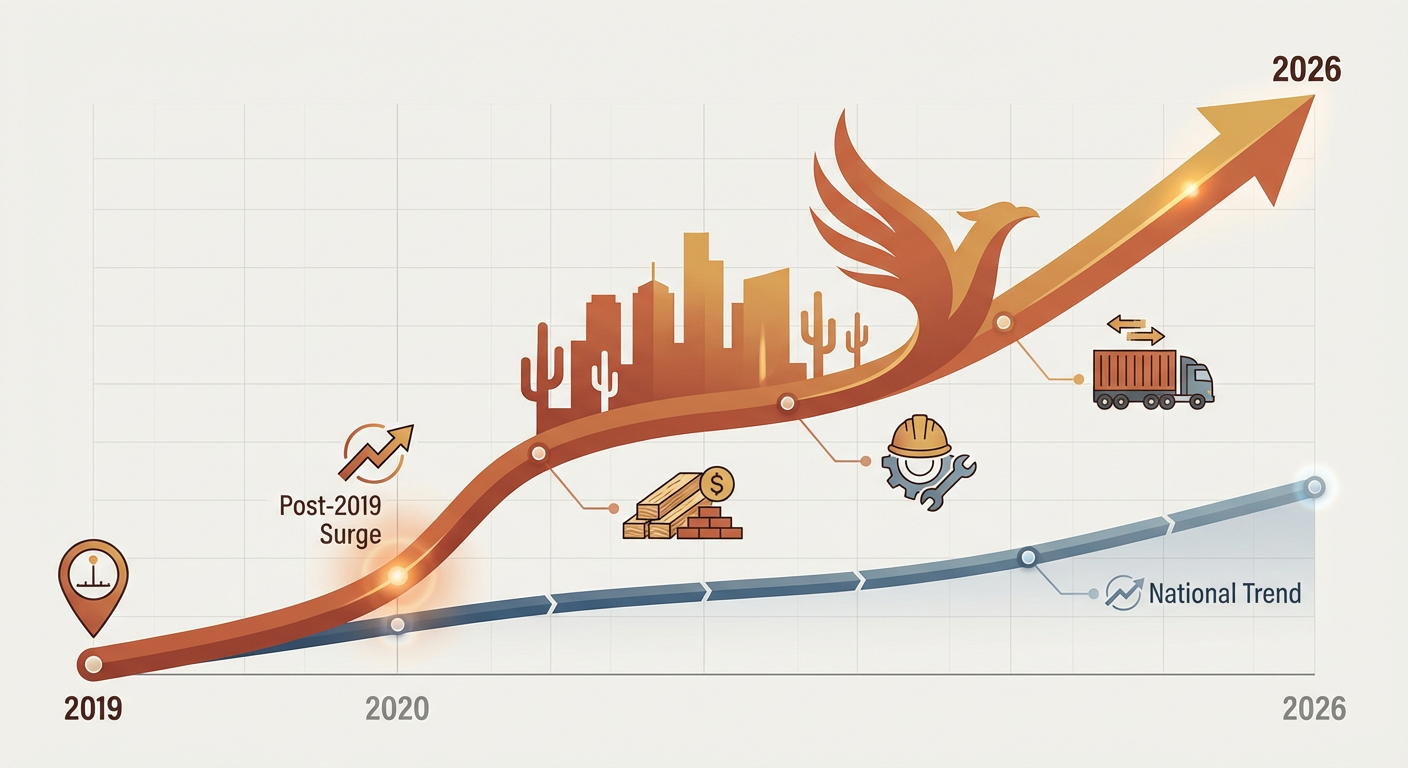
The interior remodeling expenses in Phoenix have undergone a substantial escalation, soaring by approximately **40–50% since 2019** [1]. This sharp increase aligns with broader national trends, where a residential reconstruction cost index climbed by **43.9% from 2019 to 2024** [1]. This surge is largely attributable to a confluence of factors, including pandemic-era material inflation, exacerbated labor shortages, and evolving homeowner preferences.
The post-2019 period marks a significant deviation from the previous half-decade, where a more moderate **~20% cost increase** was observed nationally from 2014 to 2019 [2]. This stark contrast highlights the extraordinary inflationary pressures that reshaped the remodeling industry. For Phoenix homeowners, this translates into a scenario where interior projects in 2026 are costing roughly **1.4 to 1.5 times** what they would have in 2019 [3]. Our analysis suggests that the **Phoenix Interior Remodeling Cost Index stands around 150 in 2026 (with 2019=100)** [3]. This means a scope of work that cost $50,000 in Phoenix in 2019 now commands approximately $75,000. This upward trend significantly outpaces the general consumer price index (CPI) in Phoenix, which saw around a **25% increase from 2019 to 2024** [4], underscoring the specific and intense inflationary pressures within the construction and remodeling sectors.
The timeline of these surges reveals a dynamic environment:
- 2020-2022: Material-led Inflation. Immediately following the onset of the COVID-19 pandemic, Phoenix contractors experienced rapid month-over-month increases in material quotes. Key building commodities saw unprecedented price hikes. Notably, **lumber prices quadrupled, increasing by approximately 275% from 2020 to their peak in May 2021** [5]. Paint and coatings, essential for almost any interior renovation, became **~28% pricier** compared to early 2020 by late 2022 [6]. Other materials like gypsum board (drywall) saw a **23% jump in 2021**, followed by an additional **18% increase in 2022** [7]. Steel mill products spiked **128% in 2021** before a **~29% fall in 2022** [8], illustrating the volatility. While some commodity prices, like lumber and steel, showed moderation post-2022, many finished products, such as cabinetry, remained elevated due to tariffs and ongoing supply chain issues [9].
- 2023-2025: Labor-driven Increases. As material prices somewhat stabilized, the focus shifted to labor costs. A chronic skilled labor shortage intensified pressure on wages. Nationally, remodeling prices continued an upward trajectory, rising **3.4% year-over-year in Q2 2025** [10], a rate that outpaced general inflation. In Phoenix, construction wages have seen notable increases, with some reports indicating a **3.1% rise from 2017 to 2022** [11], among the higher jumps nationally, reflecting intense competition for skilled tradespeople.
This steep cost trajectory mandates transparent budgeting and realistic expectations for Phoenix homeowners. A project quoted at $30,000 in 2019 could now range from $45,000 to $50,000, underscoring the “new normal” of elevated pricing in the market [3].
2.2 Phoenix Outpacing National Averages
The Phoenix metro area has demonstrated an exceptional growth trajectory in home improvement spending, often outpacing national averages during the pandemic boom. In 2022 alone, home improvement expenditures in Phoenix were projected to rise by a remarkable **20.3% year-over-year** [12]. This figure stands significantly higher than the average **13.8% growth recorded across other major U.S. metros** [13]. This accelerated growth underlines a vigorous local demand fueled by a wave of new residents and substantial investment in existing homes.
The surge in Phoenix’s remodeling market can be attributed to several factors unique to the region:
- Influx of New Residents (The “Zoom Town” Phenomenon): During the pandemic, Phoenix became a magnet for remote workers, particularly from higher-cost coastal cities. This influx led to a rapid escalation in home values and a dynamic housing market. Many newcomers, having sold properties in more expensive areas, had significant capital to invest in customizing their new Phoenix homes. This created an unprecedented demand for renovation services. For example, a tech professional relocating from California to North Phoenix in mid-2021 initially budgeted $100,000 for a whole-home update but quickly found contractor bids to be in the **$130,000–$150,000 range** [14]. The high demand meant reputable contractors were often booked months in advance and could command premium pricing.
- Investment in Existing Homes: With skyrocketing home values, existing Phoenix homeowners also opted to invest in remodeling rather than moving. This strategy allowed them to enhance their living spaces, increase property value, and avoid the competitive buying market. This contributed significantly to the sustained high demand for remodeling services.
- Local Design Preferences: Phoenix homes often feature extensive tile flooring and large kitchen islands [15]. These design elements, while aesthetically pleasing and practical for the climate, inherently increase project costs due to material and labor requirements. The widespread preference for tile, in particular, drives up flooring expenses compared to regions where carpet or laminate are more common.
Despite these rapid increases, Phoenix’s remodeling costs sometimes remain slightly below those of an extremely pricey coastal market like Los Angeles or New York City, largely due to comparatively lower local labor rates [16]. However, this advantage is frequently offset by regional design preferences that demand more materials and specialized labor, such as custom tile work or extensive stone countertops for large islands. For instance, a complete upscale kitchen remodel in Phoenix in 2025 ranges from **$70,000–$120,000+** [16], which is comparable to the U.S. national average of about $75,000 for a similar “major kitchen remodel” [16]. This indicates that while the starting point for labor might be slightly lower, the scope and scale of desired Phoenix remodels often balance that advantage out.
The rapid growth in Phoenix’s remodeling market underscores the need for homeowners to adjust their expectations and budgets to the prevailing market conditions. What was considered a reasonable budget a few years ago might be insufficient for the same scope of work today.
2.3 Budget Tiers for Interior Remodels (2026)
Interior remodeling costs in Phoenix for 2026 can be broadly categorized into “Good,” “Better,” and “Best” tiers, offering homeowners a framework to align their aspirations with realistic budgets. These tiers delineate the scope, material quality, and labor intensity, allowing for transparent planning.
2.3.1 Kitchen Remodel Budgets
Kitchen remodels, often the most expensive interior renovation, have seen significant inflation. By 2026, a mid-range kitchen remodel in Phoenix typically costs between **$40,000 and $75,000**, with upscale luxury kitchens easily exceeding **$100,000** [17]. This is a noticeable jump even from 2024, when a mid-range kitchen might have been quoted around $35,000 [18].
Table 2.1: Phoenix Kitchen Remodel Cost Tiers (2026)
| Tier | Description | Typical Cost Range (Phoenix, 2026) | Key Features & Materials |
|---|---|---|---|
| Good (Basic Refresh) | Cosmetic updates, no layout changes. Focus on refreshing surfaces. | ~$15,000 – $30,000 [17] | Repainted/refaced cabinets, laminate countertops, new fixtures, basic paint, stock cabinets, vinyl/laminate flooring. Avoids moving plumbing or walls. |
| Better (Mid-Range Remodel) | Complete renovation of kitchen, possibly minor layout or structural tweaks. | $40,000 – $75,000 [19] | New semi-custom cabinets, durable quartz/granite counters, standard stainless appliances, updated lighting, tile backsplash, professional design, skilled labor (e.g., moving electrical/plumbing). |
| Best (High-End Luxury) | Custom, often significant layout reconfiguration or structural changes. No expense spared for specific vision. | $100,000 – $150,000+ [17] | Custom built-to-order high-end cabinetry, professional-grade appliances, imported stone/quartzite counters, premium hardwood/large-format tile, bespoke lighting, structural modifications (wall removal, beam installation). |
For instance, a modest 10×10 kitchen with mid-grade finishes now averages **$50,000-$75,000**, while high-end materials in the same space push it to **$40,000–$60,000** [20]. The largest component of a kitchen remodel budget is typically **cabinetry, accounting for 30–40%** of the total cost [21]. For 20 linear feet of cabinets, costs can range from $4,000 for basic stock to $30,000+ for custom built-ins [22]. Countertops contribute another 10–15%, and appliances about 15% [23].
2.3.2 Bathroom Remodel Costs
Bathroom upgrades also illustrate a wide cost spectrum. A basic guest bathroom refresh in Phoenix starts around $18,000, whereas a high-end primary bathroom overhaul often **exceeds $90,000** [24]. The average full bathroom renovation in Phoenix now runs about **$34,300**, with a typical range of **$25,000–$70,000** [25].
Table 2.2: Phoenix Bathroom Remodel Cost Tiers (2026)
| Tier | Description | Typical Cost Range (Phoenix, 2026) | Key Features & Materials |
|---|---|---|---|
| Good (Basic Refresh) | Surface-level cosmetic updates for a guest bathroom (e.g., 5’x7′). | $10,000 – $18,000 [24] | New vanity, toilet, fixtures (standard), modest tile work, fresh paint. Uses off-the-shelf products, avoids layout changes or moving plumbing. |
| Primary Bathroom, Standard | Full renovation of a standard bathroom with quality, durable components. | $40,000-$60,000 [26] | New standard/semi-custom vanity, mid-grade fixtures, new tile (floor, tub surround/shower walls), updated lighting, potentially reconfiguring shower/tub. |
| Best (High-End Luxury) | Primary bathroom overhaul, often with enlarged footprint, custom elements, spa-like features. | $50,000 – $90,000+ [24] | Custom double vanity, high-end designer fixtures, walk-in curbless shower, freestanding tub, luxury tiling (e.g., large format porcelain, natural stone), smart home integrations, custom lighting. |
This represents a significant jump from pre-2020 levels, where national median spending on bathroom renovations rose from $9,000 in 2021 to $13,500 in 2022, a **50% increase in a single year** [27].
2.3.3 Whole-Home Refresh Tiers
For a complete interior overhaul, costs are typically assessed per square foot. In Phoenix, a gut renovation with budget finishes starts around **$75–$100 per sq.ft.** [28].
- “Good” Tier Whole-Home Refresh: Involves new paint throughout, basic laminate flooring, updated light fixtures, and minor kitchen tune-ups. For an average home, this might total **$50,000–$80,000**.
- “Better” Tier Whole-Home Remodel: Includes full renovations of the kitchen and 1-2 bathrooms, new quality flooring and baseboards throughout, and updating interior doors/hardware. This can easily range from **$150,000–$200,000** for a 2,000 sq.ft. home.
- “Best” Tier Whole-Home Luxury Renovation: For luxury homes (e.g., a 3,000 sq.ft. Scottsdale property), this means upgrading virtually every surface and system. Costs can exceed **$300,000**, covering custom kitchens and baths, new windows and sliding glass doors, sophisticated flooring, and tailored smart-home integrations.
In 2026, the cost of achieving a whole-home refresh comparable to what cost ~$65–$70/sq.ft. in 2019 is now roughly **$100/sq.ft.**, reflecting a significant **40% cost inflation** in whole-home projects [3].
2.4 What Drove the Changes: Materials, Labor, and Logistics
The dramatic increase in Phoenix’s remodeling costs since 2019 can be dissected into three primary contributing factors: the oscillating costs of materials, a persistent and worsening skilled labor shortage, and ongoing logistical and supply chain challenges, often compounded by policy impacts like tariffs.
2.4.1 Materials Price Swings
The period 2020-2022 saw unprecedented volatility in building material prices. Global supply chains, already strained, buckled under the simultaneous surge in home improvement demand during lockdowns. This led to scarcity and inflated prices across the board.
- Lumber: Perhaps the most iconic example, softwood lumber prices **quadrupled, increasing by 275% from 2020 to their peak in May 2021** [5]. This directly impacted framing, carpentry, and the cost of wood products like cabinetry in Phoenix remodels. While prices normalized somewhat after 2022, they rarely returned to pre-pandemic levels.
- Paint and Coatings: Essential for nearly all interior projects, these saw significant price hikes. By late 2022, they were **~28% pricier than in early 2020** [6], due to shortages of chemicals and pigments. A gallon of paint moved from $35 in 2019 to $45-$50 by 2022 in Phoenix hardware stores.
- Other Building Materials: Drywall (gypsum board) and insulation also experienced double-digit percentage increases due to factory slowdowns and strong demand [7]. Steel mill products spiked 128% in 2021 [8], affecting various structural and finish elements. Tile and flooring materials also saw price increases, with ceramic tile up approximately **11% in 2021** according to the Producer Price Index.
While some material costs have cooled since their peaks, the base price remains significantly higher than 2019. The cumulative effect of these material price fluctuations has added thousands of dollars to remodel budgets.
2.4.2 Labor Shortages and Wage Growth
Even before the pandemic, the construction industry wrestled with a looming skilled labor shortage, driven by an aging workforce and fewer young recruits. The pandemic intensified this crisis, with some workers leaving the industry. By 2025, labor costs constituted approximately **63% of total remodeling costs** on average [29].
- Phoenix-Specific Wage Increases: In Phoenix, a booming construction market, competition for skilled workers is fierce. Contractors have been compelled to raise wages to attract and retain electricians, plumbers, tile setters, and other specialists. Data indicates that construction wages in Phoenix rose **3.1% from 2017 to 2022** [11], showcasing sustained upward pressure. Nationally, construction wages were up 5.0% year-on-year by late 2022.
- Impact on Project Costs: This directly translates to higher hourly rates for homeowners. For example, an electrician who charged $90/hour in 2019 might now charge $120/hour. Labor-intensive projects, such as full bathroom remodels, whole-home painting, and custom tile installation, have seen the **steepest cost increases** [29]. Verisk’s repair cost index noted that such labor-heavy jobs saw the biggest upticks in 2025, with the cost to remodel a primary bathroom rising about **1% in just one quarter** [10].
- Persistent Shortfall: The U.S. construction industry faces an ongoing severe workforce gap. Estimates suggest that the sector needed to attract **501,000 additional workers in 2024** beyond normal hiring to meet demand, with a further **454,000 extra workers needed in 2025** [30]. This chronic shortage in booming regions like Arizona ensures that labor costs will remain a significant and rising component of remodeling expenses.
2.4.3 Logistics and Supply Chain Issues
Beyond the raw costs of materials and labor, logistical challenges and disruptions in the supply chain have added both direct costs and costly delays to remodeling projects.
- Lead Times: During 2021-2022, Phoenix contractors faced severe lead time issues for critical items such as appliances, windows, doors, custom glass, and cabinetry, with backlogs extending several months. While improved, custom orders can still take longer than pre-pandemic. These delays can force expensive workarounds, such as expedited shipping fees or sourcing from alternative, more costly suppliers.
- Transportation Costs: Spikes in fuel prices and general freight costs also increased the price of transporting materials to Phoenix, a cost ultimately passed on to the consumer.
- Climate-Related Logistics: Phoenix’s extreme summer heat complicates logistics for certain materials. For instance, manufacturers sometimes avoid shipping large panes of custom tempered glass during July/August due to breakage risks, leading to extended timelines.
2.4.4 Policy Impacts: Tariffs and Codes
Government policies, particularly trade policies, have a tangible impact on remodeling costs.
- Cabinetry Tariffs (2026): One of the most significant recent policy changes affecting Phoenix homeowners is the new tariff on imported cabinetry. Effective Q1 2026, the import duty on many kitchen cabinets and vanities doubled from **25% to 50%** [9]. This immediately raised prices, potentially adding **$3,000–$8,000** to the cost of a typical kitchen remodel [9]. A cabinet order priced at $12,000 in mid-2025 could cost **$15,000–$18,000** for the same cabinets in 2026 after the tariff [31], representing a **15–25% retail price hike** [31]. This compels homeowners to consider domestic cabinetry options or adjust other budget elements.
- Building Codes: Evolving building codes also contribute to increased costs. While specific permit talk is outside this section’s scope, general upgrades to safety and utility systems, such as improved electrical (e.g., the National Electrical Code requires at least two 20-amp small-appliance circuits in kitchens [32]), can add several thousand dollars. These are often “invisible” costs, as they bring an older home up to current standards without necessarily changing the visible aesthetic.
In conclusion, the drivers of cost changes in Phoenix’s remodeling market are multi-faceted and interconnected. Materials led the initial post-pandemic surge, followed by sustained increases in labor costs due to chronic shortages. Logistical hurdles and evolving trade policies like tariffs continue to contribute to the elevated and complex pricing environment in 2026.
2.5 Regional Factors: Phoenix’s Climate and Design Preferences
Phoenix’s unique desert climate and local design preferences significantly influence remodeling costs, often differentiating them from national norms. These factors introduce specific material choices, installation complexities, and cost considerations that homeowners must account for.
2.5.1 Tile-Heavy Interiors
A distinctive feature of Phoenix homes is the extensive use of tile or stone flooring and surfaces. This preference stems from the climate, tile is cooler underfoot than carpet and more durable against dust and pet wear. However, this preference comes with a higher price tag.
- Material Costs: While basic ceramic tile can be $2–$5/sq.ft., high-quality porcelain or natural stone commonly used in Phoenix runs **$20–$40/sq.ft.** [15].
- Labor Intensity: Tile installation is a skilled, labor-intensive process, especially over large areas or when intricate patterns are involved. Skilled tile setters in Phoenix might charge **$6–$15/sq.ft. in labor alone**. Removing old tile is also a laborious and dusty task that adds to demolition costs.
Consequently, replacing carpet with tile across a 2,000 sq.ft. home could easily amount to **$30,000–$40,000**, a significant portion of any remodel budget.
2.5.2 Large Kitchen Islands and Open Layouts
Modern Phoenix home designs and homeowner preferences lean towards spacious, open-plan kitchens featuring oversized islands.
- Increased Material Use: A large island requires more cabinetry and a larger slab of countertop material. If an island exceeds the dimensions of a single slab (e.g., a standard granite or quartz slab is ~120″ x 70″), multiple slabs are needed, increasing material waste and cost.
- Structural and Utility Costs: Achieving an open layout often involves removing interior walls, which can necessitate structural engineering, installation of support beams, and relocation of HVAC ducts, adding thousands to the project. Larger islands also require additional electrical circuits and outlets for code compliance (referencing NEC load calculation concepts) and multiple pendant lights.
These spacious designs mean that kitchen expansions or open-wall concepts can add **15–25% to the project cost** compared to designs that retain the original footprint.
2.5.3 Hard Water Challenges
Phoenix is notorious for its extremely hard water, with mineral content often exceeding **200–300+ ppm** [24]. This environmental factor directly impacts choices and costs in bathroom and plumbing remodels.
- Fixture Durability: Without mitigation, new faucets, shower enclosures, and even water heaters quickly accumulate limescale, reducing their lifespan and aesthetic appeal. Cheap fixtures might fail within a year due to mineral buildup [33].
- Mitigation Costs: Many Phoenix remodels include the installation of whole-house water softeners, costing roughly **$1,800–$3,200 installed** [34]. This preventative measure protects investments in high-end fixtures and glass. In upscale bathrooms, contractors also recommend protective coatings for shower glass (e.g., ClearShield), which add a few hundred dollars but prevent etching and water spots [35].
Addressing hard water proactively adds a regional-specific cost that might not be a concern in other climates but is crucial for longevity and satisfaction in Phoenix.
2.5.4 Climate and Project Scheduling
Phoenix’s extreme desert climate subtly affects remodeling logistics, productivity, and costs.
- Summer Productivity: The brutal summer heat (often exceeding 110°F) can reduce labor productivity by **15–20% on extreme heat days** [36]. Contractors often adjust schedules for early morning work or add extra crew, which can extend project timelines and marginally increase labor hours.
- Material Handling: Certain materials behave differently in high heat and low humidity, requiring specific handling or products. For example, painting and drywall mudding need careful management.
- Seasonal Lead Times: Unique to Phoenix, lead times for custom glass and windows can lengthen during summer due to manufacturing schedules and transportation challenges in extreme temperatures.
These climate-induced factors can lead to slightly higher costs or longer project durations, implicitly factored into bids.
2.5.5 Other Regional Nuances
- Slab Construction: The prevalence of one-story homes built on concrete slabs means that any floorplan modifications (e.g., moving a shower drain or adding a floor outlet) require cutting into the slab, a labor-intensive process that adds expense compared to homes with crawlspaces [37].
- Outdoor Living Integration: Many interior remodels in Phoenix extend to outdoor living spaces, blurring budget lines. Homeowners might allocate significant portions of their budget to features like large sliding glass doors or patio upgrades.
In essence, Phoenix’s environment introduces unique constraints and preferences that add specific cost considerations to interior remodels. Homeowners must budget for elements like water treatment, specialized labor for tile and slab work, and materials resilient to heat and UV exposure, expenses that are less common in milder climates but critical for a successful project in this region. This awareness helps ensure a comprehensive and realistic budget.
This detailed analysis of the Phoenix remodeling market landscape from 2019 to 2026 provides the essential context for understanding the 2026 Interior Remodeling Cost Index. The subsequent sections will delve into specific cost baskets for kitchen, bathroom, and various interior components, detailing the precise material and labor costs that contribute to these overarching trends.
3. Good, Better, Best: Budgeting for Kitchen Remodels in Phoenix
For Phoenix homeowners contemplating a kitchen remodel in 2026, understanding the escalating costs and the nuances of various budget tiers is more critical than ever. The post-2019 era has ushered in a new normal of elevated pricing for interior renovations, driven by a confluence of material inflation, labor shortages, and logistical challenges that have disproportionately impacted active markets like Phoenix. What once constituted a mid-range kitchen budget in 2019 may now only cover a basic refresh, forcing homeowners to carefully evaluate their desired scope against significantly higher financial realities. This section will provide a detailed breakdown of kitchen remodeling costs in Phoenix across three defined quality tiers: ‘Good’ (basic refresh), ‘Better’ (mid-range full remodel), and ‘Best’ (high-end custom renovation). We will explore typical price ranges for each tier, component cost allocations, and the specific regional factors that influence these budgets in the Phoenix metropolitan area. Navigating these tiers effectively is the key to achieving a successful renovation without unexpected financial strain.
The Phoenix Kitchen Remodel Landscape in 2026: A New Cost Reality
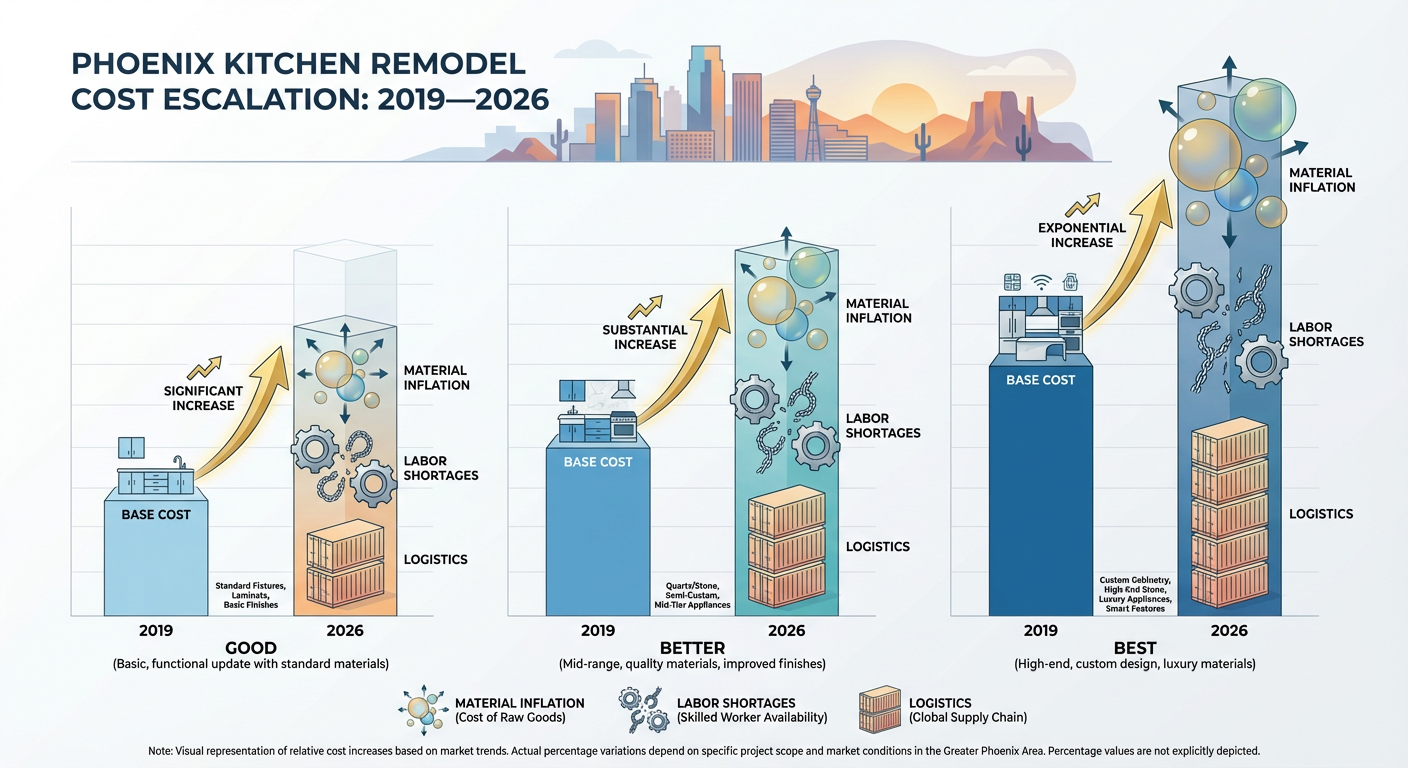
Phoenix has witnessed an exceptional surge in remodeling expenditures since 2019, outpacing national averages in many respects. While the national index of residential reconstruction costs climbed 43.9% from 2019 to 2024, reflecting pandemic-era material inflation and labor shortages 1, Phoenix experienced even faster growth. In 2022 alone, home improvement spending in the Phoenix metro was projected to rise by an astounding 20.3% year-over-year, making it one of the fastest-growing major U.S. cities for renovation activity, compared to a 13.8% average across metros 2. This intense demand, fueled by a wave of new residents and increased focus on home investments, has firmly established a higher baseline for renovation costs in the region.
As of 2026, a mid-range kitchen remodel in Phoenix typically costs between $40,000 and $75,000, while upscale luxury kitchens often start at $100,000 and can easily exceed $150,000 3. To put this into perspective, the same mid-range kitchen might have been quoted around $35,000 just two years prior in 2024 4, indicating a significant double-digit percentage climb in a very short period. This rapid escalation necessitates a clear understanding of what each budget tier entails.
Good, Better, Best: Defining Kitchen Remodel Tiers in Phoenix
To help homeowners budget effectively, we categorize kitchen remodels into three distinct tiers: ‘Good,’ ‘Better,’ and ‘Best.’ These tiers are not merely about price, but about the scope of work, quality of materials, level of customization, and the overall impact on the home.
Smaller Kitchen Remodel (Approx. $50,000-$75,000)
A ‘Good’ tier kitchen remodel in Phoenix is primarily a cosmetic update, focusing on surface-level improvements without altering the existing layout or structure. This tier is ideal for homeowners looking for a refreshed appearance, often to prepare a home for sale or to simply modernize a dated space on a tight budget.
- Scope of Work: Keeping the existing kitchen layout, repainting or refacing existing cabinets (instead of full replacement), installing new laminate or basic solid surface countertops, upgrading the sink and faucet, painting walls, and replacing light fixtures. Flooring might be updated with budget-friendly options like vinyl plank or basic tile.
- Materials: Stock cabinets (if replacing), laminate or entry-level solid surface countertops, standard stainless steel or white appliances, builder-grade faucets, basic ceramic tile flooring (e.g., $2-5 per sq.ft. material cost), and standard paint finishes. Off-the-shelf products are prioritized for cost-effectiveness.
- Typical Costs: A minor kitchen refresh in Phoenix typically runs between $50,000 and $75,000 6. For example, refinishing existing cabinets rather than replacing them can yield significant savings, potentially reducing cabinet costs by 50-70% 7, which is often the largest expense in a kitchen remodel.
- Key Characteristics: This tier avoids moving plumbing, electrical, or walls, which are the most expensive aspects of a renovation. It’s often DIY-friendly for tasks like painting or light fixture replacement, but professional installation for countertops and flooring is still recommended. The emphasis is on maximizing visual impact through material choice and color schemes that align with current trends.
Better: The Mid-Range Full Kitchen Remodel (Approx. $40,000 – $75,000)
The ‘Better’ tier represents a comprehensive renovation of the kitchen space, often involving new components, semi-custom finishes, and minor layout adjustments. This is where most Phoenix homeowners find themselves, seeking a balance between quality, functionality, and cost for their “forever home.”
- Scope of Work: Full replacement of cabinetry, installation of durable and aesthetic countertops (e.g., quartz or natural granite), upgrading to mid-range stainless steel appliances, new flooring (e.g., porcelain tile, engineered hardwood), updated lighting (including recessed lighting), and a new tile backsplash. Minor reconfigurations of the layout for improved flow are common, which might involve moving an appliance or extending a countertop run. Moving electrical outlets and minor plumbing relocation are typical in this tier.
- Materials: Semi-custom cabinets (offering more style and size options than stock, often with plywood boxes and soft-close features), quartz or granite countertops (priced around $60-$100 per sq.ft. installed), mid-range stainless steel appliance suite, quality porcelain or ceramic tile (e.g., $5-15 per sq.ft. material cost), and often higher-end plumbing fixtures.
- Typical Costs: A mid-range kitchen remodel in Phoenix falls into the $40,000 to $75,000 range 9. An example cited for a modest 10×10 kitchen with mid-grade finishes suggests a range of $50,000-$75,000, while high-end materials can push it to $70,000–$90,000 10. Our Phoenix-specific index places the mid-range higher due to local demand and labor costs.
- Key Characteristics: This tier often requires licensed professionals for electrical and plumbing work, as it frequently involves moving existing infrastructure or adding new circuits (e.g., dedicated circuits for modern appliances). The goal is to enhance both aesthetics and functionality, adding significant value and appeal to the home. Mid-range remodels in Phoenix generally recoup approximately 60-70% of their cost in resale value 11.
Best: The High-End Custom Kitchen Renovation (Approx. $100,000+)
The ‘Best’ tier represents the pinnacle of kitchen remodeling, focused on custom design, premium materials, and often significant structural changes. This tier is for homeowners who desire a truly bespoke kitchen tailored to their specific lifestyle and design preferences, with little to no compromise on quality or features.
- Scope of Work: Extensive layout reconfigurations, including removing walls to create open-concept living spaces, often requiring structural engineering and new beams. Custom-built cabinetry with specialized storage solutions, top-of-the-line professional-grade appliances (e.g., 48″ range, built-in refrigerator, wine fridge), imported natural stone or exotic engineered countertops, luxury flooring (e.g., premium hardwood, large-format designer tile, custom concrete), and bespoke lighting design. Smart home integrations and advanced plumbing features (e.g., pot fillers, instant hot water) are common.
- Materials: Custom, handcrafted cabinetry (can cost $30,000+ for a mid-sized kitchen), high-end professional-grade appliance packages (easily $15,000-$30,000+), exotic natural stone or premium quartzite countertops (often $100-200+ per sq.ft.), designer plumbing fixtures, and custom large-format tile or engineered hardwood specifically suited to Phoenix’s climate.
- Typical Costs: A high-end kitchen renovation in Phoenix starts at $100,000 and can easily reach $150,000+ for truly luxurious, custom features 13. For instance, new stone countertops might cost $5,000–$9,000 in a mid-range project, but premium selections in a high-end project could be significantly more 14. Rewiring a kitchen with additional circuits, as detailed by NEC standards like two dedicated 20-amp circuits 16, can add $2,000–$5,000.
- Key Characteristics: This tier almost always involves significant architectural and design services. It requires highly specialized tradespeople and often longer project timelines due to custom orders (e.g., custom cabinetry can take 3-4 months to build). While the return on investment (ROI) for luxury remodels tends to be lower in percentage terms (often only 50-60%) 17, these projects are driven by personal preference and a desire for unique, top-quality results rather than pure resale value.
Comparison Table: Kitchen Remodel Tiers in Phoenix (2026)
The following table summarizes the key characteristics and estimated cost ranges for kitchen remodels in Phoenix across the three tiers:
| Tier | Description | Typical Cost Range (2026) | Scope of Work | Material Quality | Customization/Labor |
|---|---|---|---|---|---|
| Good (Basic Refresh) | Cosmetic update focuses on appearance. | $15,000 – $30,000 | Painting, cabinet refacing/repainting, basic counter/fixture replacement. Existing layout maintained. | Entry-level, stock | Minimal professional design, some DIY potential. |
| Better (Mid-Range) | Comprehensive renovation, enhanced functionality, quality materials. | $40,000 – $75,000 | New cabinets, durable counters, mid-range appliances, updated lighting/flooring. Minor layout changes. | Mid-grade, semi-custom | Professional contractors, minor electrical/plumbing changes. |
| Best (High-End) | Custom design, premium materials, significant structural alterations. | $100,000+ | Major layout reconfiguration, custom cabinetry, professional appliances, luxury finishes. | Premium, bespoke, imported | Architect/designer involvement, specialized trades, extensive labor. |
What’s Driving the Cost Changes: Materials, Labor, and Logistics
The dramatic increase in kitchen remodeling costs in Phoenix since 2019 can be attributed to a combination of factors, with fluctuating material prices, a persistent labor shortage, and ongoing logistical challenges playing significant roles.
Materials Price Volatility
The initial surge in remodeling costs from 2020-2022 was largely driven by material price volatility. The pandemic disrupted global supply chains, leading to scarcity and increased prices for essential building materials while demand for home improvement projects soared.
- Lumber: Softwood lumber prices, which impact cabinet frames and any structural changes, saw an unprecedented increase of approximately 275% from 2020 to their peak in May 2021 19. Although prices have since settled, they remain elevated compared to pre-pandemic levels.
- Paint and Coatings: By late 2022, paint and coatings were nearly 30% pricier than in early 2020 due to shortages of chemicals and pigments 20.
- Cabinets: Cabinetry, which typically constitutes 30-40% of a kitchen remodel budget 7, has seen significant price increases. A notable factor for 2026 is the doubling of import tariffs on many overseas-manufactured kitchen cabinets and vanities from 25% to 50%, effective in Q1 2026 21. This policy change is expected to add roughly $3,000-$8,000 to the cost of a typical kitchen remodel and result in a 15-25% retail price hike for affected cabinet lines 21. For a cabinet order quoted at $12,000 in mid-2025, the same order would cost approximately $15,000-$18,000 in 2026 22.
- Other Materials: Drywall (gypsum board) and insulation also experienced double-digit percentage hikes 23, and tile materials saw increases, with ceramic tile prices up about 11% in 2021 24.
While some material costs have normalized, many finished products remain significantly more expensive than pre-pandemic.
Labor Shortages and Wage Growth
Labor costs have become the dominant factor in remodeling expenses, currently accounting for about 60-64% of total project costs in residential projects 25. A chronic skilled labor shortage, exacerbated by fewer young people entering trades and an aging workforce, has driven wages higher.
- Phoenix Specifics: In Phoenix, construction wages rose approximately 3-6% in recent years 26, with the city seeing some of the highest jumps nationally. Nationally, construction labor rates are outpacing overall inflation, with remodeling prices rising 3.4% year-over-year in Q2 2025 compared to the CPI’s 2.7% 27.
- Impact on Kitchens: Labor-intensive aspects of kitchen remodels, such as custom tile work, intricate electrical and plumbing installations, and detailed carpentry for custom cabinetry, have seen the steepest cost increases. Contractors are booked out for months, and homeowners often pay a premium for reliable, skilled crews. The U.S. construction industry needs to attract over 500,000 additional workers in 2024 (beyond normal hiring) to meet demand, a gap that continues into 2025 with another ~454,000 workers needed 28. This shortage sustains upward pressure on wages and, consequently, project costs.
Logistics and Supply Chain Issues
Lingering logistical challenges continue to impact remodel timelines and budgets. While improved since the peak of the pandemic, delays on specific items remain a concern.
- Lead Times: Appliances, custom windows, and certain cabinetry components can still have extended lead times of several weeks or even months. These delays can prolong project durations, leading to increased labor costs due to multiple subcontractor visits or the need for expedited shipping at a premium.
- Tariffs: The new 50% import tariff on cabinetry is a direct example of policy affecting logistics and cost. It encourages sourcing from domestic suppliers, which may have different price points and availability.
- Phoenix Climate: In summer, custom glass and window lead times can be affected in Phoenix due to extreme heat impacting transportation and installation logistics.
Regional Factors: Phoenix’s Climate and Preferences Impact Kitchen Costs
Phoenix’s unique climate and local design preferences also play a significant role in shaping kitchen remodeling costs, distinguishing it from other U.S. markets.
- Tile-Heavy Designs: Phoenix homes often feature extensive tile flooring due to the climate, as it’s cooler underfoot and durable. While aesthetically appealing, tile installation is labor-intensive: skilled tile setters can charge $6-$15 per sq.ft. for labor alone 29. Material costs for quality porcelain or natural stone can range from $20-$40 per sq.ft. 29. The decision to remove old tile and install new across large areas can significantly increase the flooring budget compared to carpeting or basic vinyl.
- Large Islands: The trend for large kitchen islands, common in Phoenix’s open-concept floor plans, adds cost. An oversized island requires more cabinetry, more countertop material (potentially requiring multiple slabs and additional fabrication costs), and often additional electrical (e.g., dedicated outlets, pendant lighting). If an island requires a sink or cooktop, additional plumbing and venting will be needed. Structural changes to accommodate large, open kitchens, such as removing walls, can add several thousand dollars for engineering, demo, and beam installation.
- Hard Water Considerations: Phoenix is known for its extremely hard water (200-300+ ppm) 30. While not immediately visible in the kitchen, homeowners often invest in whole-house water softeners (approx. $1,800-$3,200 installed) 31 to protect plumbing fixtures and appliances from mineral buildup, an indirect but significant cost.
- Concrete Slab Construction: Most Phoenix homes are built on concrete slabs. Any changes to plumbing lines (e.g., relocating a sink or adding a pot filler) require cutting into the slab, a labor-intensive and messy process that adds costs compared to homes with crawl spaces.
- Climate and Scheduling: Phoenix’s intense summer heat can impact labor productivity. Contractors may adjust schedules to work during cooler hours or extend project timelines, which can subtly increase labor costs. Extreme temperatures can also affect material handling and installation, especially for items like tempered glass or certain adhesives.
Key Takeaways for Kitchen Remodeling in Phoenix
For Phoenix homeowners navigating kitchen remodeling in 2026, several critical insights emerge:
- Cost Escalation is Real: Kitchen remodels are significantly more expensive than just a few years ago. Budgeting needs to reflect this new reality, with expectational ranges substantially higher than pre-2019 levels. What cost $50,000 then could be $70,000-$80,000 now for the same scope 32.
- Tiered Budgeting is Essential: Clearly defining whether your project is ‘Good,’ ‘Better,’ or ‘Best’ helps set realistic expectations for scope, materials, and cost. Committing to a tier early can prevent budget overruns and disappointment.
- Labor is King: With labor accounting for over 60% of project costs, labor-intensive components like custom cabinetry installation, tile work, and complex plumbing/electrical changes will disproportionately impact your budget.
- Material Tariffs are Impacting Cabinets: The new 50% tariff on imported cabinetry in 2026 is a direct and substantial cost adder homeowners must consider. Exploring domestic cabinet options may provide more price stability.
- Regional Factors Add Specific Costs: Phoenix’s climate and popular design choices (e.g., extensive tile, large islands, slab construction) introduce unique cost factors that homeowners in other regions might not face. Proactive measures against hard water are also a wise investment.
In conclusion, a kitchen remodel in Phoenix in 2026 demands a well-informed approach. Understanding these ‘Good, Better, Best’ tiers, acknowledging the drivers of cost inflation, and factoring in unique regional considerations will empower homeowners to make sound decisions and achieve their desired kitchen renovation within a realistic budget.
The next section, “4. Good, Better, Best: Budgeting for Bathroom Remodels in Phoenix,” will delve into similar cost breakdowns and considerations for bathroom renovations.
4. Good, Better, Best: Budgeting for Bathroom Remodels in Phoenix
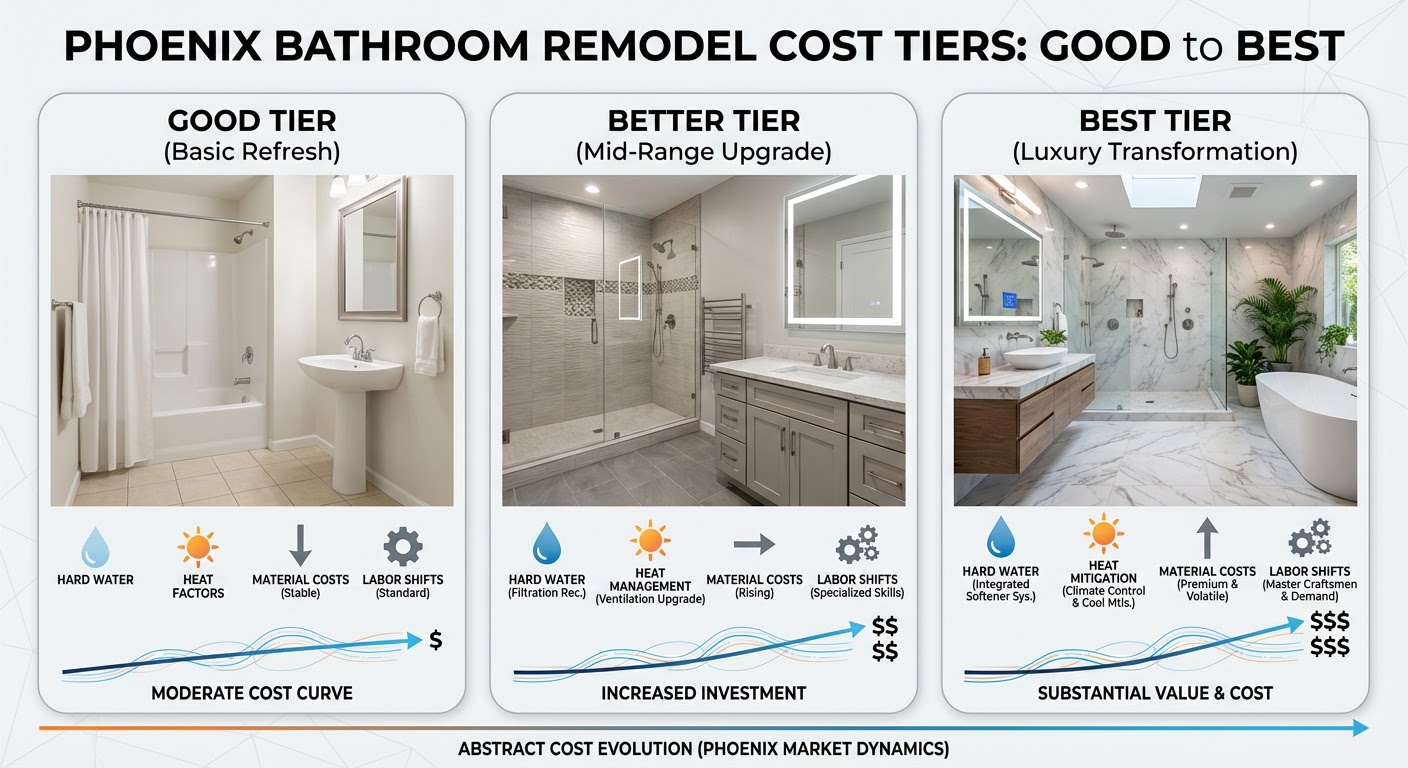
Remodeling a bathroom in Phoenix in 2026 is a significant investment, one that reflects not only personal style and comfort but also substantial shifts in material costs, labor rates, and local geological realities since 2019. This section provides a comprehensive breakdown of bathroom remodeling costs across three distinct tiers: ‘Good’ (basic guest bath refresh), ‘Better’ (mid-range full bath renovation), and ‘Best’ (luxury primary suite overhaul). By delineating the typical scope, materials, and labor implications for each tier, homeowners can gain a transparent understanding of what to budget now, anticipate how prices have moved, and identify crucial Phoenix-specific factors that influence their project’s final cost.
The landscape of remodeling in Phoenix has undergone a dramatic transformation, with interior renovation expenses surging approximately 40-50% since 20191. While national residential reconstruction costs climbed 43.9% from 2019 to 2024, Phoenix experienced even faster growth, with home improvement expenditures projected to rise 20.3% year-over-year in 2022 alone, outpacing the national average of 13.8% among major U.S. cities2. This accelerated growth underlines the necessity of a detailed, updated index for Phoenix homeowners. A basic guest bathroom refresh in Phoenixstarts around $18,000, but a high-end primary bathroom overhaul often exceeds $90,000 as of 20263. The average full bathroom renovation now commands approximately $34,300, a notable increase from pre-2020 levels4. Understanding the specific components and choices within each tier is paramount for effective budgeting.
4.1. The “Good” Tier: Full Guest Bathroom (Est. Cost: $18,000-$25,000)
The ‘Good’ tier in Phoenix bathroom remodeling focuses on cosmetic upgrades and functional enhancements without altering the existing layout or significant plumbing/electrical modifications. This tier is ideal for homeowners seeking to update a guest bathroom or improve a secondary bathroom before selling, aiming for a fresh, clean look without substantial structural changes. The typical scope involves replacing visible elements with off-the-shelf, standard-grade materials.
A basic full guest bathroom renovation (typically 5’x7′ with standard fixtures) in Phoenix can be completed for approximately $18,000 to $25,000 locally in 20265. This represents a significant increase from median national spending on bathroom renovations, which spiked from $9,000 in 2021 to $13,500 in 2022, a 50% increase in just one year6. Phoenix saw similar, if not more pronounced, increases due to its booming market.
4.1.1. Scope and Materials for a “Good” Bathroom Remodel:
- Vanity and Sink: Expect a pre-fabricated vanity with a cultured marble or laminate countertop. Stock cabinets are common, ranging from basic particleboard to slightly more durable MDF or plywood options. A standard, single-hole faucet made from polished chrome or brushed nickel is typical.
- Toilet: A standard, white, 1.28 gallons per flush (GPF) toilet, often with a two-piece design, is selected for efficiency and cost-effectiveness.
- Shower/Tub: This tier typically involves replacing an existing tub with another standard tub or a basic fiberglass shower insert. Tiling the shower walls might be limited to basic ceramic tiles, usually 4×4 or 6×6 inches, with standard grout. Alternatively, a pre-fabricated shower surround is a cost-effective choice. According to TCNA (Tile Council of North America) guidelines, proper waterproofing behind any tiled wet area is crucial, but for this tier, simpler systems like cement board with roll-on membrane are often used to manage costs, meeting ANSI A118 standards for water resistance if applied correctly.
- Flooring: Basic ceramic or porcelain tiles (e.g., 12×12 or 13×13 inches) are popular for their durability and water resistance in Phoenix’s tile-heavy design preferences. Costs for basic ceramic can be as low as $2-$5 per square foot, excluding labor7.
- Paint: A fresh coat of moisture-resistant paint on walls and ceiling. Colors are typically neutral to maximize appeal. Paint and coatings are about 28% pricier than in early 20208, impacting even minor refreshes.
- Lighting: A basic vanity light fixture above the mirror and perhaps a simple flush-mount ceiling light. Illuminance recommendations would suggest general ambient light in the 50 foot-candle range for bathrooms, which can be achieved with modest fixtures.
- Accessories: Standard towel bars, toilet paper holder, and a basic mirror.
4.1.2. Labor and Phoenix-Specific Considerations for “Good” Tier:
Labor constitutes a significant portion of remodeling costs, making up about 63% on average in Phoenix9. For a ‘Good’ tier remodel, minimizing labor-intensive tasks is key. This means no changes to the bathroom footprint, electrical wiring, or plumbing rough-ins. Skilled labor for tile work and fixture installation is still necessary but the scope is contained.
Phoenix’s extremely hard water (200-300+ ppm) begins to be a factor even at this tier10. Homeowners might opt for fixtures with finishes that are less prone to showing water spots (e.g., brushed nickel over polished chrome). Skipping a whole-house water softener (which costs around $1,800-$3,200 installed11) is common in this tier to save costs, but the longevity of budget fixtures might be compromised without it12.
4.2. The “Better” Tier: Primary Bathroom, Standard (Est. Cost: $40,000-$60,000)
The ‘Better’ tier represents a comprehensive renovation, where the bathroom is fully gutted and rebuilt, but within the existing footprint. This level of remodel caters to homeowners looking for enhanced aesthetics, improved functionality, and better quality materials that offer a good balance of durability and value. This is where most Phoenix remodels land, offering a significant upgrade without venturing into bespoke luxury.
An average full bathroom renovation in Phoenix runs approximately $34,300, with a typical range of $25,000–$70,000, underscoring this tier as the sweet spot for many homeowners4. Mid-range bathroom remodels in Phoenix generally command about $40,000-$60,00013.
4.2.1. Scope and Materials for a “Better” Bathroom Remodel:
- Vanity and Sink: Semi-custom cabinetry, often furniture-grade plywood with a solid wood facade, along with a quartz or mid-grade granite countertop. Double sinks are common in larger full baths. Higher-quality faucets from reputable brands with brass internals are typical.
- Toilet: More stylish and efficient one-piece toilets with dual-flush technology.
- Shower/Tub: Replacing an existing tub/shower combo with a walk-in shower is popular. This could include a custom-tiled shower pan (meeting TCNA standards for proper slope and waterproofing) and porcelain or ceramic tiles on the walls, often in larger formats (12×24 or 12×12 inches). Semi-frameless glass shower enclosures are common. Shower systems often include a rain head and a handheld shower. Integrating more robust waterproofing methods, such as liquid-applied membranes over cement board or foam substrates (like Schluter Kerdi or Wedi), which exceed ANSI A118.10 standards, is standard practice.
- Flooring: Higher-quality porcelain or ceramic tiles, often wood-look planks or larger format (18×18 or 24×24 inches). Prices for these materials range between $6-$15 per square foot. Radiant floor heating may be considered, particularly for master baths.
- Paint: Premium moisture-resistant paints, offering better durability and a wider range of colors.
- Lighting: Upgraded vanity lighting, recessed lighting in the shower area per Illuminance recommendations (often 80-100 foot-candles for task areas), and potentially an exhaust fan with integrated LED light (humidity sensing). NEC load calculation concepts inform the need for dedicated circuits for bath fans and GFCI protection near wet areas.
- Accessories: Upgraded towel bars, robe hooks, upgraded framed mirror or medicine cabinet, and potentially built-in niches in the shower.
4.2.2. Labor and Phoenix-Specific Considerations for “Better” Tier:
This tier involves more specialized labor. Full demolition and rebuild require carpenters, plumbers, electricians, and experienced tile setters. Labor-intensive jobs, like full bath remodels and custom tile work, have seen some of the steepest cost increases, largely due to skill shortages and rising wages1.
Phoenix’s hard water impacts choices here. Many homeowners will opt for a whole-house water softener, costing $1,800–$3,200 installed, to protect their investment in mid-range fixtures and new glass enclosures11. Curbless showers, a popular design choice, can add an extra $1,500-$3,000 in labor if the home is built on a concrete slab (common in Phoenix) due to the need for precise concrete cutting and rebuilding the floor slope14. Additionally, the summer heat can affect productivity and glass lead times, potentially prolonging timelines. Contractors may limit strenuous work during 110°F afternoons, slightly increasing labor hours and project durations.
4.3. The “Best” Tier: Luxury Primary Suite Overhaul (Est. Cost: $50,000 – $90,000+)
The ‘Best’ tier represents a no-compromise approach, transforming a primary bathroom into a spa-like retreat. This often includes expanding the footprint, reconfiguring layouts, and incorporating premium materials, bespoke craftsmanship, and advanced technologies. Structural changes, relocation of plumbing lines, and custom elements are typical here.
A luxury primary bathroom in Phoenix can easily exceed $50,000, with premium master suites often ranging from $75,000 to $90,000+15. These projects embody personalized design and high-end selections.
4.3.1. Scope and Materials for a “Best” Bathroom Remodel:
- Vanity and Sink: Custom-built cabinetry with premium hardwoods, unique finishes, and bespoke hardware. High-end natural stone or exotic engineered countertops with integrated sinks. Designer faucets, possibly touchless or with smart features.
- Toilet: Wall-hung toilets, smart toilets with bidet functions, or advanced comfort-height models.
- Shower/Tub: A spacious, custom-designed curbless walk-in shower with multiple showerheads (rain, body sprays, handheld) and potentially a steam function. Large format natural stone or high-end porcelain tiles extend from floor to ceiling. Bench seating, ambient lighting within the shower, and a custom frameless glass enclosure are standard. All shower system components adhere strictly to TCNA and ANSI A118 standards, often exceeding them with advanced waterproofing systems and high-performance mortars. A freestanding soaking tub, perhaps air-jet or jetted, is a common luxury addition.
- Flooring: Premium natural stone (marble, travertine, slate) or high-end large format porcelain, often with radiant floor heating. Pricing for high-quality tile can run $20-$40 per square foot, not including labor7.
- Paint/Wall Finishes: High-end designer paints, specialty wallcoverings, or even accent walls with decorative tile or stone.
- Lighting: Robust lighting design incorporating general, task, and accent lighting. Recessed LEDs, designer sconces, vanity strip lights (adhering to Illuminance recommendations for various zones), and often dimmers for ambiance. Dedicated circuits are typically installed for each major appliance and lighting zone, following NEC guidelines to ensure ample power and mitigate overloads.
- Accessories: Heated towel racks, integrated sound systems, smart mirrors with defoggers and integrated displays, custom storage solutions, and a fully integrated ventilation system.
4.3.2. Labor and Phoenix-Specific Considerations for “Best” Tier:
The ‘Best’ tier demands highly skilled artisans and extensive labor. Labor accounts for approximately 60-64% of total remodeling costs in residential projects9. Custom tile work, particularly for large formats or intricate patterns (e.g., mosaics), and complex plumbing/electrical relocations drive labor costs significantly. Due to the chronic skilled labor shortage, wages have been pushed higher, impacting this tier the most16.
Phoenix’s hard water is particularly critical at this level. Protecting substantial investments in natural stone, custom glass, and high-end fixtures is paramount. Inclusion of a whole-house water softener (costing $1,800-$3,200 installed11) is almost mandatory. Many clients also invest in protective glass coatings (such as ShowerGuard or ClearShield treatments) for frameless shower enclosures, adding a few hundred dollars but preventing mineral damage10. Lead times for custom windows, glass, and specialty fixtures can be prolonged, especially during Phoenix’s summer due to extreme heat affecting shipping, potentially pushing project timelines and incurring premium fees for expedited orders. One-story layouts on slabs mean any significant plumbing changes require expensive concrete cutting and patching, adding to labor intensity and cost.
4.4. Cost Drivers: Materials, Labor, and Logistics Impacting Bathroom Remodels (2019-2026)
The overall increase in Phoenix remodeling costs, which has seen prices rise roughly 40-50% since 2019, is attributable to a confluence of factors: material price volatility, a persistent labor shortage, and logistical challenges1.
4.4.1. Materials Price Volatility:
Key building materials experienced double-digit price spikes between 2020-2022. While some materials, like lumber (which spiked 275% during 2020-2021)17, saw prices cool, many remain well above 2019 levels. For bathrooms specifically, paint and coatings are ~28% pricier than in early 20208. Gypsum board (drywall) saw a 23% jump in 2021 and another 18% rise in 202218. Tile and flooring materials also increased, though exact percentages vary by type. These swings significantly impact finished project costs. The influx of new residents into Phoenix during the pandemic exacerbated demand, further driving up local material costs.
4.4.2. Labor Shortages and Wage Growth:
Labor now constitutes a staggering 60-64% of Phoenix remodeling costs on average9. A chronic skilled labor shortage, exacerbated by a decreasing number of young tradespeople entering the field and the retirement of experienced workers, has pushed wages higher. In Phoenix, construction wages rose by 3.1% between 2017-2022, a higher jump than many national figures19. Nationally, remodeling prices rose 3.4% year-over-year in Q2 2025, largely due to climbing labor rates20. This is particularly noticeable in labor-intensive tasks such as custom tile installation, plumbing, and electrical work typical of mid-to-high-tier bathroom remodels. The U.S. construction industry needs to attract an estimated 501,000 additional workers in 2024 to meet demand, a gap that ensures labor rates will remain elevated21.
4.4.3. Logistics and Supply Chain Issues:
Despite improvements post-pandemic peaks, logistical challenges persist. Shipping delays for fixtures, custom glass, and specialty tiles continue to impact project timelines. For Phoenix, the summer heat can specifically affect glass lead times, forcing longer waits or premium fees. These delays equate to costs, extending project durations and potentially requiring additional site visits from contractors.
4.4.4. Policy Impacts: Tariffs:
While cabinetry tariffs are more salient for kitchens, any imported vanity or specialized bathroom fixtures can be affected by trade policies. A 2026 tariff doubling to 50% on imported cabinetry illustrates how external policy decisions can directly and swiftly impact local renovation budgets, indirectly adding to the cost of even bathroom remodels if they rely on imported cabinetry for vanities22.
4.5. Regional Factors: Phoenix’s Climate and Preferences
Phoenix’s unique environmental conditions and homeowner preferences directly influence bathroom remodel costs. These factors, often overlooked, contribute to the elevated price points compared to other regions.
4.5.1. Tile-Heavy Designs:
Phoenix’s preference for extensive tile flooring and shower systems, driven by climate and aesthetic trends, significantly impacts costs. While practical for the desert, skilled tile installation is labor-intensive. High-quality porcelain or natural stone tiles can cost $20-$40 per square foot, contrasting sharply with basic ceramic at $2-$5 per square foot7. Tiling a master bathroom typically incurs substantial labor costs due to the precision and craftsmanship required across large areas or complex shower designs. The labor-intensive nature of tear-out and subfloor preparation for tile also drives up costs compared to carpet or laminate installations common elsewhere.
4.5.2. Hard Water Challenges:
Phoenix’s notoriously hard water (200–300+ ppm) creates a need for mitigation strategies in remodels, adding both upfront and long-term costs10.
| Mitigation Strategy | Approximate Cost (2026) | Benefit |
|---|---|---|
| Whole-house water softener | $1,800 – $3,200 installed11 | Protects all fixtures and appliances from mineral buildup, extends lifespan. |
| Protective glass coatings (e.g., ShowerGuard) | A few hundred dollars | Prevents etching and water spots on shower glass. |
| High-quality fixtures with brass internals | 10-25% higher fixture cost | Resists corrosion and premature failure due to mineral-rich water. |
Neglecting these measures can lead to premature degradation of fixtures and cloudy shower glass, making proactive investment crucial for preserving the aesthetic and functional integrity of a new bathroom. Phoenix Home Remodeling (a local firm) notes that high mineral content water can quickly “degrade cheaper fixtures” and even cause glass to cloud permanently if not protected6.
4.5.3. Climate and Productivity:
The extreme summer heat in Phoenix often impacts construction productivity. Contractors may limit strenuous work during peak afternoon hours, which can extend project timelines and marginally increase labor hours due to scheduling adjustments and more frequent breaks. This can translate to slightly higher labor costs or longer completion times, aspects subtly factored into local bids. Lead times, especially for specialized glass, can also be affected by summer heat due to complex shipping logistics for delicate materials.
4.5.4. Slab Construction:
A significant number of Phoenix homes are built on concrete slabs, rather than with crawlspaces. This is an important consideration for bathroom remodels, particularly for a ‘Better’ or ‘Best’ tier project that involves relocating plumbing. Moving a toilet drain, for instance, requires cutting into the concrete slab, which is a laborious, messy, and costly process. For example, converting a standard curbed shower to a curbless design might involve jackhammering the slab and rebuilding the floor slope, adding $1,500–$3,000 to the labor cost14.
4.6. Conclusion and Transition to Next Section
Bathroom remodeling costs in Phoenix for 2026 reflect a new economic reality shaped by post-pandemic inflation in materials and labor, persistent supply chain issues, and unique regional factors. From a basic refresh (Guest bath: $18,000-$25,000) to a mid-range overhaul (Primary bath: $40,000-$60,000) and a luxury primary suite (Best: $50,000-$90,000+), homeowners must confront significantly higher baseline costs than in 2019. Understanding these tiers, the underlying cost drivers (materials, labor, logistics), and the specific implications of Phoenix’s climate and design preferences is essential for informed budgeting and project planning. Transparent communication with contractors regarding these factors can help manage expectations and avoid unforeseen expenses.
The next section will delve into detailed breakdowns for kitchen remodels in Phoenix, further exploring the Good, Better, Best budget tiers and how they are impacted by similar market forces and regional nuances.
- 1 www.reinsurancene.ws, www.reinsurancene.ws, www.reinsurancene.ws
- 2 ktvz.com
- 3 phxhomeremodeling.com
- 4 phxhomeremodeling.com
- 5 phxhomeremodeling.com
- 6 phxhomeremodeling.com, phxhomeremodeling.com
- 7 phxhomeremodeling.com, phxhomeremodeling.com
- 8 www.architecturaldigest.com
- 9 nationalmortgageprofessional.com
- 10 phxhomeremodeling.com, phxhomeremodeling.com
- 11 clearwaterarizona.com, clearwaterarizona.com
- 12 phxhomeremodeling.com
- 13 sweeten.com
- 14 phxhomeremodeling.com, costflowai.com
- 15 phxhomeremodeling.com
- 16 nationalmortgageprofessional.com
- 17 www.cnbc.com
- 18 www.nahb.org
- 19 azbex.com
- 20 www.sheltonherald.com
- 21 gitnux.org
- 22 costflowai.com
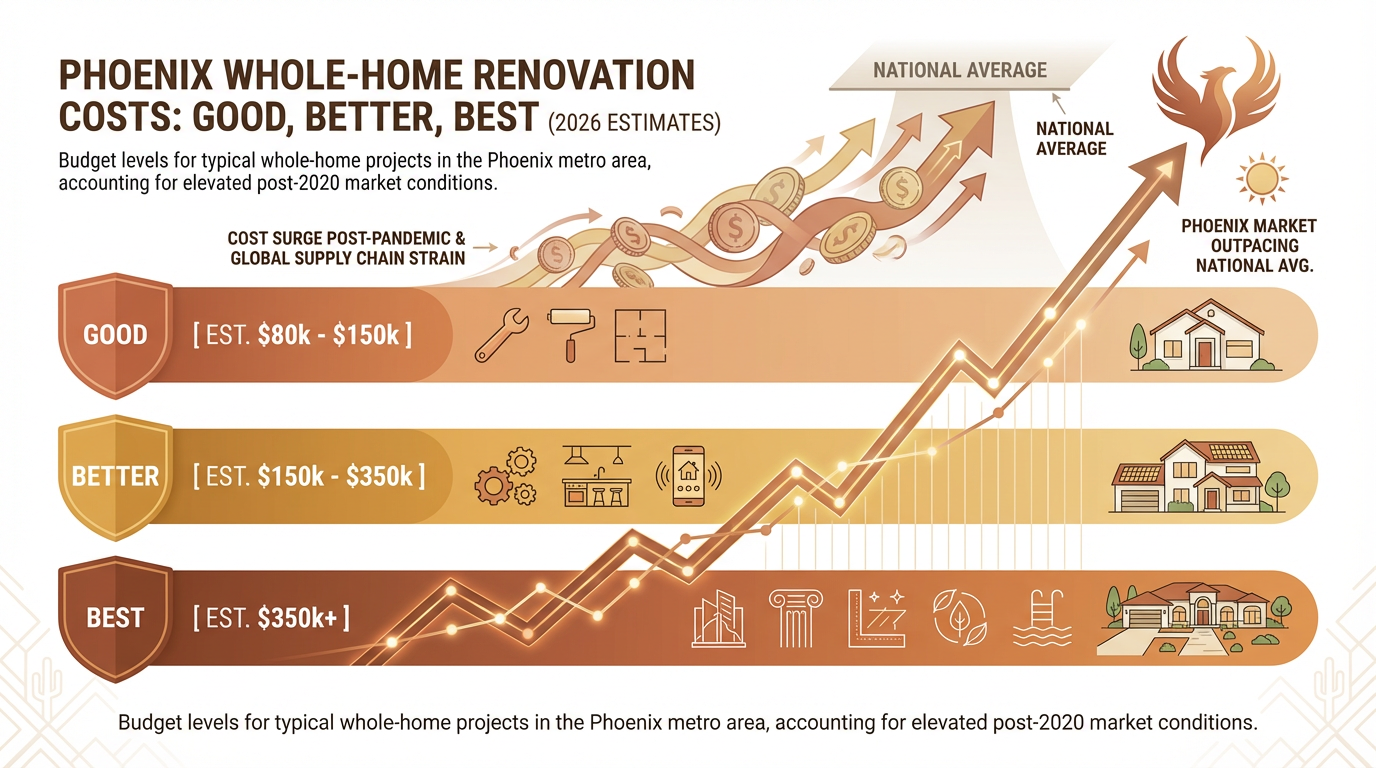
5. Good, Better, Best: Budgeting for Whole-Home Refreshes in Phoenix
Navigating the landscape of home renovation in Phoenix in 2026 requires more than just a general idea of costs; it demands an understanding of the tiered investment levels and the specific factors influencing them. Homeowners contemplating a whole-home refresh, whether it’s a minor update or a complete luxury overhaul, must grapple with significant shifts in pricing since 2019. The market has been redefined by steep post-pandemic cost surges, particularly in Phoenix where remodeling spending growth has outpaced national averages. This section provides a comprehensive guide to budgeting for interior whole-home renovations in the Phoenix metropolitan area, distinguishing between “Good,” “Better,” and “Best” tiers for scope and finish. We will delve into per-square-foot cost expectations, dissect the primary drivers of these changes, materials, labor, and logistics, and highlight unique regional factors intrinsic to the desert environment and local design preferences. By the end of this deep dive, Phoenix homeowners will be equipped with transparent, data-backed insights to plan their 2026 whole-home remodeling projects effectively.
5.1. The New Normal: Phoenix Remodeling Costs Post-2019 Surge
The period following 2019 has ushered in a “new normal” for remodeling costs in Phoenix, characterized by significantly elevated prices. Interior remodeling expenses in the Valley of the Sun have escalated roughly **40–50% since 2019** [1]. This steep increase is not an isolated local phenomenon; a national index of residential reconstruction costs climbed **43.9% from 2019 to 2024** [2], reflecting widespread material inflation and labor shortages that peaked during the pandemic era. However, Phoenix has often outpaced these national averages. In 2022 alone, home improvement expenditures in the Phoenix metro area were projected to rise by an astounding **20.3% year-over-year** [3], making it one of the fastest-growing major U.S. cities for renovation spending, significantly higher than the 13.8% average documented across other metropolitan areas [3].
This surge in Phoenix is attributable to a confluence of factors: a wave of new residents attracted by the “Zoom Town” phenomenon, high home values, and a robust local economy encouraging significant investment in existing properties rather than relocation. The **Phoenix Interior Remodeling Cost Index**, set at a baseline of 100 in 2019, is estimated to stand around **150 in 2026**. This implies that an interior renovation project valued at $50,000 in 2019 would now cost approximately $75,000 for the same scope [25]. Such an increase represents the highest cost inflation observed in decades [25].
Even a standard 5′×8′ hall bathroom renovation, which might have cost $15,000 a few years ago, now runs upwards of $20,000 [26]. For kitchen remodels, a mid-range project estimated at $35,000 in 2024 is now quoted between **$40,000 and $75,000** in 2026, with upscale luxury kitchens easily exceeding **$100,000** [4]. The *average* full bathroom renovation in Phoenix now costs approximately **$34,300**, with typical ranges falling between $25,000 and $70,000 [5]. These figures demonstrate a persistent, double-digit percentage climb in a remarkably short timeframe.
While some material prices saw a temporary cool-down in 2022, many remain significantly above their 2019 levels, contributing thousands of dollars to current remodel budgets. The cost trajectory highlights that transparent and highly detailed budgeting is more important than ever for Phoenix homeowners in 2026. The market has reached a new plateau of elevated pricing, not a return to pre-pandemic rates. This means homeowners who haven’t renovated recently may be met with substantial sticker shock if they base their expectations on outdated figures.
5.2. Good, Better, Best: Budgeting Tiers for Whole-Home Refreshes
To effectively plan a whole-home refresh in Phoenix, it’s crucial to understand the distinct budgeting tiers: “Good” (basic), “Better” (mid-range), and “Best” (high-end/luxury). These categories are defined by the scope of work, the quality of materials, the level of custom design, and the involvement of specialist trades.
5.2.1. “Good” Tier: Basic Cosmetic Upgrades and Refresh
The “Good” tier focuses on cosmetic improvements and surface-level updates using budget-friendly materials. This level aims for a noticeable refresh without significant structural changes or reconfigurations.
* **Kitchens:** A “Good” kitchen remodel typically involves keeping the existing layout, repainting or refacing cabinets, installing new laminate or entry-level solid surface countertops, replacing fixtures, and a fresh coat of paint. It leverages off-the-shelf products and avoids complex plumbing or electrical relocations.
* **Cost Range:** A small kitchen refresh in Phoenix at this tier typically ranges from **$50,000 to $75,000** [6].
* **Bathrooms:** A modest guest bathroom update might include new standard-grade vanity, toilet, light fixtures, and basic ceramic or porcelain tile work, without expanding the footprint or moving wet areas.
* **Cost Range:** Expect to budget around **$18,000 to $25,000** for a guest bathroom [7].
* **Whole-Home Refresh:** For an entire home, this could mean new paint throughout, replacing worn carpet with basic laminate or vinyl plank flooring, swapping dated light fixtures, and a minor kitchen tune-up as described above.
* **Per-Square-Foot Cost:** Gut renovations with budget finishes start around **$75–$100 per sq.ft.** [8]. For a 2,000 sq.ft. home, this translates to approx. **$150,000 to $200,000** for basic interior upgrades.
* **Strategies:** Cost-saving tactics are paramount here, such as refinishing existing cabinets (which can save 50–70% of the cost of new cabinetry) [27] and embracing DIY for simpler tasks. This tier is suitable for homeowners looking to spruce up a starter home, prepare a property for sale, or achieve a fresh look on a tight budget.
5.2.2. “Better” Tier: Mid-Range Full Remodel with Quality Finishes
The “Better” tier represents the most common type of renovation in Phoenix, offering a complete overhaul of the space with new, mid-quality components. It balances cost-effectiveness with durability and improved functionality.
* **Kitchens:** A mid-range kitchen involves new semi-custom cabinetry, durable quartz or granite countertops, standard stainless-steel appliances, updated lighting, and a quality tile backsplash. There might be some minor layout reconfigurations to improve flow. This level necessitates professional design and skilled labor.
* **Cost Range:** A Phoenix kitchen in this category typically falls between **$40,000 and $75,000** [9].
* **Bathrooms:** A mid-range bathroom renovation could include a new tiled shower (perhaps converting a tub-shower combo), a double vanity with stone tops, upgraded plumbing fixtures, and better tile or flooring choices.
* **Cost Range:** For a mid-range bathroom, plan for roughly **$40,000 to $60,000**, depending on size and inclusions [10].
* **Whole-Home Refresh:** A “Better” whole-home refresh generally includes fully renovating the kitchen and one to two bathrooms, new quality flooring (e.g., large-format porcelain tile or engineered wood) and baseboards throughout, and updating interior doors and hardware.
* **Per-Square-Foot Cost:** These projects might run on the order of **$100–$150 per sq.ft.**, meaning a 2,000 sq.ft. home could cost **$200,000 to $300,000+**. This signifies that what $65-$70/sq.ft. achieved in 2019 now costs $100/sq.ft. in 2026 due to inflation [28].
* **Value:** Homeowners at this level are often upgrading their “forever home,” seeking quality materials and professional craftsmanship that offer a strong return on investment (mid-range remodels in Phoenix generally recoup ~60–70% of their cost in resale value) [29]. This tier involves licensed contractors for electrical, plumbing, and potentially minor structural work like adding recessed lighting or reconfiguring wet areas.
5.2.3. “Best” Tier: Custom Luxury Renovations
The “Best” tier represents a high-end, custom luxury renovation where budget considerations are secondary to achieving a specific, often bespoke, vision. This level involves extensive design work, premium materials, and custom craftsmanship.
* **Kitchens:** A “Best” kitchen remodel in Phoenix might entail removing or relocating walls to create an open-concept floorplan, custom-built cabinetry, professional-grade appliances (e.g., 48″ range, built-in refrigerator), imported natural stone or quartzite countertops, premium hardwood or large-format tile flooring, and bespoke lighting design.
* **Cost Range:** These kitchens typically start at **$100,000 and can easily exceed $150,000** for expansive spaces with custom features [11].
* **Bathrooms:** A luxury primary bathroom involves enlarging the space, creating a spa-like environment with features such as a freestanding tub, multi-head curbless shower system, heated flooring, and high-end fixtures.
* **Cost Range:** Expect to budget **$50,000 to $90,000+** for a luxury primary bathroom, with some reaching significantly higher [12].
* **Whole-Home Refresh:** Luxury whole-home renovations (e.g., a 3,000 sq.ft. Scottsdale home) can effortlessly surpass **$300,000**. Every surface and system is upgraded, often involving new windows and doors, vaulted ceilings, and smart-home integration.
* **Key Drivers:** At this tier, costs are driven by exotic materials (e.g., stone counters at $200/sq.ft. [30]), intricate craftsmanship, structural modifications, and longer lead times for custom-ordered products. While the ROI on resale might be lower (often 50–60% [31]), these projects are about personal enjoyment and creating a unique living space.
Understanding these tiers allows Phoenix homeowners to align their expectations and financial capacity with their renovation goals. Many contractors now explicitly offer Good/Better/Best options, enabling clients to prioritize spending (e.g., a “Better” kitchen paired with a “Good” guest bathroom) to manage the overall project budget effectively. The core principle remains: the scope and finish level are the primary determinants of cost.
5.3. Dissecting the Drivers: Materials, Labor, and Logistics
The dramatic increase in Phoenix’s remodeling costs since 2019 is a complex interplay of materials pricing, labor market dynamics, and global supply chain logistics.
5.3.1. Materials Price Swings
Material costs were the initial and most significant catalyst for inflation post-2019. The pandemic severely disrupted global supply chains, coinciding with an explosion in home improvement demand.
* **Lumber:** Softwood lumber prices notoriously quadrupled, soaring by **275% from 2020 to their peak in May 2021** [13]. This directly impacted any framing, millwork, or cabinetry components in remodels.
* **Paint and Coatings:** By late 2022, paint and coatings saw a ~**28% increase** in price compared to early 2020 [14], driven by shortages of key chemicals and pigments. A gallon of paint that cost $35 in 2019 might have been $45–$50 by 2022.
* **Drywall and Insulation:** Gypsum board (drywall) prices rose ~**23% in 2021 and another 18% in 2022** [15] due to factory slowdowns and demand.
* **Tile and Steel:** Ceramic tile prices were up approximately 11% in 2021, and steel mill products spiked 128% in 2021, before a 29% dip in 2022 [15].
* **Cabinetry Tariffs:** A new development for 2026 is the doubling of the import tariff on many imported kitchen cabinets and vanities from 25% to **50% (effective Q1 2026)** [17]. This policy change is estimated to add roughly **$3,000–$8,000 to the cost of a typical kitchen remodel** [18], potentially increasing the retail price of cabinets by 15–25% [19]. Given that cabinetry constitutes **30–40% of a kitchen remodel budget** [20], this tariff has an immediate and substantial impact.
While some material costs (like lumber) have normalized after 2022, many finished products, especially labor-intensive ones, have remained elevated. Materials were the primary driver of the initial cost index jumps from 2019 to 2022.
5.3.2. Labor Shortages and Wage Growth
The cost of skilled labor is the second critical factor and, by 2026, often the largest component of a remodeling project.
* **Labor Share:** Labor now constitutes about **63% of Phoenix remodeling costs** on average [16]. This is significantly higher than pre-pandemic levels.
* **Wage Increases:** A chronic skilled labor shortage, exacerbated by an aging workforce and increased demand, has continuously pushed wages higher. Phoenix has seen a notable increase in construction wages, with a **3.1% rise from 2017–2022** (one of the highest nationally) [21]. Nationally, remodeling prices rose **3.4% year-over-year in Q2 2025** [22], outpacing general inflation, primarily due to climbing labor rates.
* **Skilled Labor Shortfall:** The U.S. construction industry needs to attract **501,000 additional workers in 2024 (and 454,000 in 2025)** to meet demand [23]. This severe workforce gap directly translates to higher labor rates, as contractors in booming regions like Phoenix must compete fiercely for available talent. Labor-intensive jobs, such as full bathroom remodels, whole-home painting, and custom tile work, have seen the steepest cost increases recently [16].
If materials defined the inflation of 2020-2022, labor is the defining cost driver for 2023-2026, with no immediate relief in sight for wage pressures.
5.3.3. Logistics and Supply Chain Issues
Beyond the direct costs of materials and labor, logistical challenges have added layers of expense and delay.
* **Lead Times:** Severe lead time issues for critical items like appliances, custom windows, glass, and cabinetry were rampant in 2021–2022. While improved, backlogs can still prolong project timelines. For instance, specific glass orders in the summer can face delays partly due to manufacturing and shipping limitations in extreme heat.
* **Transportation Costs:** Fluctuations in fuel prices and increased freight demand have elevated shipping costs, which are then passed down to consumers. Materials sourced from outside Arizona, or even other parts of the U.S., incur higher transport overheads.
* **Time as Cost:** Extended lead times often mean longer project durations. A kitchen renovation that once took 8 weeks might now stretch to 12+ weeks while waiting for specialized materials. These delays translate into higher overheads for contractors and can add **5-10% to total project costs** due to prolonged site management and potentially additional labor trips.
5.4. Regional Factors: Phoenix’s Unique Climate and Preferences
Phoenix’s distinctive climate, local design aesthetics, and unique environmental challenges significantly influence remodeling costs, creating line items not commonly found in other U.S. markets.
5.4.1. Tile-Heavy Designs Add Expense
Phoenix homes are renowned for their extensive use of tile and stone flooring, a practical choice for the desert climate but a costly one for renovations.
* **Material and Labor Intensity:** Unlike regions that might use cheaper carpet or laminate, Phoenix homeowners frequently opt for high-quality porcelain or natural stone tiles throughout their homes. While basic ceramic tile might be $2–$5 per sq.ft., premium options range from **$20–$40 per sq.ft.** [24]. The labor for laying large areas of tile is substantial, with skilled tile setters charging **$6–$15 per sq.ft.** or more, not including associated costs for underlayment, grout, and demolition of existing tile.
* **Implication:** Upgrading a 2,000 sq.ft. home to new wood-look porcelain planks could easily cost **$30,000–$40,000** all-in. This makes flooring a significant budget item, often 2–3 times the cost of simpler alternatives, especially when considering the laborious task of demoing existing tile common in older Phoenix homes.
5.4.2. Large Islands and Open-Concept Kitchens
The propensity for open-plan kitchens with oversized islands, a popular design trend in Phoenix, also drives up costs.
* **Expanded Footprint:** Large islands require more cabinetry, wider countertop slabs (potentially necessitating costly seaming of multiple slabs), and often additional electrical circuits for code compliance (e.g., two 20-amp small-appliance circuits per NEC recommendations [32]) and improved lighting.
* **Structural Modifications:** Achieving an open concept frequently involves removing interior walls, which can necessitate structural changes like adding support beams and rerouting HVAC ducts. These structural tweaks can add several thousand dollars to a project.
* **Cost Impact:** Kitchen expansions or open-wall concepts can increase project costs by **15–25%** compared to simply updating within the existing footprint.
5.4.3. Hard Water Challenges and Mitigation
Phoenix’s extremely hard water, often measuring **200–300+ ppm** [33], is a unique regional factor that adds hidden costs to remodels.
* **Fixture Protection:** Without mitigation, new plumbing fixtures, shower enclosures, and even water heaters rapidly accumulate limescale. Many Phoenix bathroom remodels now proactively include whole-house water softener installations, costing around **$1,800 to $3,200 installed** [34], to protect new investments.
* **Glass and Finishes:** Builders also recommend protective coatings for shower glass (adding a few hundred dollars) and advise selecting fixture finishes that are more resilient to water spots, such as matte black or brushed nickel [35]. Investing in robust fixtures with brass internals is also crucial, as hard water can quickly degrade cheaper cartridge valves [36].
* **Implication:** Integrating water treatment solutions, while an added expense, safeguards the longevity and aesthetic appeal of new installations in Phoenix’s challenging water environment. A gorgeous new bathroom or kitchen must also function day-to-day given local water conditions.
5.4.4. Climate and Project Scheduling
The extreme desert climate impacts labor productivity and scheduling, indirectly affecting costs.
* **Summer Productivity:** Phoenix’s brutal summers (many days over 110°F) can reduce labor productivity by **15–20% on extreme heat days** [37]. Contractors often adjust schedules, starting earlier, working in shifts, or adding crew members, which can slightly prolong project timelines and increase labor hours.
* **Material Handling and Specific Needs:** Special considerations are needed for materials like concrete pours and tile mortar setting in high heat. Glass and window lead times can also seasonally lengthen due to manufacturing constraints and shipping challenges in summer.
* **Slab Construction:** With many Phoenix homes built on concrete slabs, any changes to plumbing or electrical floor routing require cutting into the slab, a labor-intensive and costly process. For example, converting a curbed shower to curbless design may involve jackhammering and rebuilding the floor slope, adding **$1,500–$3,000** in labor [38].
These regional factors mean that a Phoenix remodel budget often includes “unsexy” but critical line items, water treatment, concrete cutting, UV-rated materials, that are less emphasized in other markets but essential for a successful, durable project in this environment.
5.5. Notable Examples & Case Studies
Real-world scenarios from the Phoenix market underscore the budget considerations and impacts discussed.
* **Bathroom Budget Spike (2021-2022):** National median spending on bathroom renovations jumped **50% from $9,000 in 2021 to $13,500 in 2022** [39]. In Phoenix, this translated to homeowners facing significantly higher quotes than expected, often requiring them to adjust their budgets upwards or scale back their designs. A modest guest bath that cost $9K in 2021 would likely be $12K+ a year later. This rapid inflation highlighted the importance of current data and proactive budgeting in a volatile market.
* **Tariff Impact on Kitchen Cabinets (2025-2026):** A Phoenix couple, quoted $12,000 for foreign-made semi-custom cabinets in mid-2025, saw the price jump to **~$15,000** when they ordered in 2026 due to the new **50% import tariff** [40]. This incident, which added $3,000 to their kitchen budget, demonstrates how external factors can unpredictably escalate costs even for otherwise well-planned projects. The need for flexible budgeting or considering domestic alternatives became immediately apparent.
* **Phoenix Renovation Boom (2022):** A tech professional relocating to Phoenix in 2021 budgeted $100,000 for a whole-home remodel but found bids closer to **$130,000–$150,000** [41] due to intense demand from new residents and limited contractor availability. He ultimately spent $140,000 for a 2,400 sq.ft. home, including a $60,000 kitchen and $40,000 for two bathrooms. This illustrates how high-demand local markets can command premium pricing, necessitating early planning and securing contractors well in advance.
* **Value vs. Cost – Minor vs. Major Kitchen Remodel:** A Phoenix homeowner looking to sell opted for a minor kitchen remodel (approx. $28,000) over a major one ($150,000+). The minor remodel had a projected **113% cost recouped** in resale value (>$31,000 added value), while the upscale remodel was only expected to recoup ~46% [42]. This strategic choice underscored that in Phoenix’s market, functional, move-in-ready updates often yield a better financial return than ultra-luxury additions, preventing over-improvement relative to local comps.
* **Water Hardness Mitigation (2025):** After spending $55,000 on a luxurious master bathroom remodel, a Phoenix family quickly observed severe white scale buildup from the region’s hard water (250+ ppm) on their new fixtures and glass [43]. Because they hadn’t initially included a water softener, they had to add a **$2,500 whole-house system** post-completion to protect their investment [78]. This case highlights how critical it is to factor in regional environmental “must-haves” upfront to avoid costly fixes and potential damage to new installations.
These examples vividly demonstrate why homeowners embarking on a whole-home refresh in Phoenix in 2026 must adopt a sophisticated and informed approach to budgeting, integrating both national trends and highly specific local considerations.
***
The detailed cost breakdowns and market dynamics presented in this section lay the groundwork for understanding project-specific budgets. The next section will build upon this foundation by providing an in-depth analysis of kitchen remodeling costs, dissecting the precise expenses for “Good,” “Better,” and “Best” kitchen baskets, complete with material and labor allocations, to offer even finer granularity for Phoenix homeowners.

6. Key Drivers of Cost Changes: Materials, Labor, and Logistics
The landscape of interior remodeling costs in Phoenix, Arizona, has undergone a dramatic transformation since 2019, fundamentally altering the financial expectations for homeowners and the operational strategies for contractors. This section delves into the primary forces behind these shifts: the volatile pricing of construction materials, the escalating cost and scarcity of skilled labor, and the persistent challenges posed by logistics, supply chain disruptions, and evolving trade policies. Understanding these interconnected drivers is crucial for comprehending the current (2026) cost index and anticipating future trends in the Phoenix remodeling market.
Overall, interior remodeling expenses in Phoenix have surged by approximately 40–50% since 2019[1]. This local trend mirrors a national pattern, where residential reconstruction costs climbed 43.9% from 2019 to 2024, demonstrating the profound impact of pandemic-era material inflation and labor shortages[2]. Phoenix, however, has often outpaced national averages, reporting a 20.3% year-over-year increase in home improvement expenditures in 2022 alone – significantly higher than the 13.8% average growth across major U.S. metros[3]. This exceptional growth was fueled by a rapid influx of new residents and substantial stay-at-home investments, intensifying local demand and further exacerbating cost pressures.
6.1. Materials Price Volatility: The Foundation of Inflation
The period from 2020 to 2022 witnessed unprecedented price spikes across a spectrum of building materials, directly impacting Phoenix’s remodeling costs. These increases were driven by a confluence of factors including global supply chain disruptions, manufacturing slowdowns, and a sudden surge in demand for home improvement projects as people spent more time in their homes during the pandemic lockdowns.
- Lumber and Wood Products: One of the most dramatic examples of material price volatility was seen in softwood lumber. Prices for lumber effectively quadrupled, soaring by 275% from 2020 to their peak in May 2021[4]. This hyperinflation directly affected any remodeling project involving framing, custom carpentry, or cabinetry. Even after settling down, prices remained well above pre-pandemic levels. For Phoenix contractors, this meant that the cost for raw materials used in structural changes or custom built-ins significantly increased bids.
- Paint and Coatings: Equally impactful, though perhaps less volatile in its peak, was the sustained rise in the cost of paint and coatings. By late 2022, paint manufacturers were charging nearly 30% more than pre-pandemic rates[5]. This was attributed to shortages of key chemical components and pigments, which are often tied to global petrochemical supply chains. For a homeowner in Phoenix, a gallon of paint that might have cost $35 in 2019 could easily have been $45-$50 by 2022. Given that painting is a component of nearly every interior remodel, this added a significant, albeit often overlooked, expense.
- Gypsum and Drywall: The building materials sector also saw notable increases in gypsum board (drywall) prices. These rose by approximately 23% in 2021 and an additional 18% in 2022[6]. Drywall is a ubiquitous material in interior remodels, used for walls and ceilings, so such increases directly translated to higher costs for any project involving new construction or significant wall modifications.
- Metals and Other Commodities: Steel mill products, essential for many structural elements and appliances, also experienced a 128% spike in 2021 before a subsequent 29% fall in 2022[7]. Tile and other flooring materials saw an approximate 11% increase in ceramic tile prices in 2021. While some commodity prices, like lumber and steel, have seen some stabilization or even retreat from their absolute peaks since 2022, many finished products continue to carry elevated price tags. This persistent elevation is largely due to sustained demand, higher manufacturing costs, and ongoing logistical challenges, as discussed below.
- Cabinetry and Appliance Surges: Cabinetry, representing 30–40% of a kitchen remodel budget[8], has remained a significant cost driver. Tariffs and supply issues have kept cabinet prices elevated into 2026. Appliances faced severe lead times and price increases, with surcharges becoming common for available models.
The collective impact of these material price fluctuations has been profound. A modest 10×10 kitchen remodel with mid-grade finishes that might have cost $15,000-$35,000 in Phoenix previously could easily reach $40,000-$60,000 with the increased material costs alone[9]. While the extreme volatility witnessed in 2020-2022 has somewhat subsided, material costs remain significantly higher than their 2019 baseline, creating a “new normal” for project budgeting.
6.2. Skilled Labor Shortages and Wage Growth: The Human Factor
While material costs grabbed headlines during the initial phases of inflation, the escalating cost of skilled labor has become an increasingly dominant and persistent driver of remodeling expenses, particularly in booming markets like Phoenix. Labor now constitutes approximately 63% of the average remodeling costs in Phoenix[10].
- Pre-existing Shortage Exacerbated: The construction industry, even prior to the pandemic, faced a demographic challenge: an aging workforce and insufficient numbers of new tradespeople entering the field. The pandemic accelerated this issue, with some workers leaving or pausing their careers amid health concerns and economic uncertainty. Simultaneously, the surge in housing and remodeling demand created an intense competition for available skilled labor.
- Rising Wages in Phoenix: In a rapidly growing market such as Phoenix, where new residents and increased home improvement spending converge, contractors have been forced to increase wages to attract and retain skilled personnel. Data indicates that construction wages in Phoenix have seen notable increases, with some reports citing a 3.1% rise from 2017–2022, placing the city among the top metros for construction wage growth[11]. Nationally, construction labor rates have consistently outpaced general inflation, rising 5.0% year-on-year in late 2022. As of Q2 2025, remodeling prices nationally rose 3.4% year-over-year, outpacing the general Consumer Price Index (CPI) increase of 2.7%, largely attributed to climbing labor rates[12].
- Impact on Labor-Intensive Projects: The effect of rising labor costs is most pronounced in labor-intensive aspects of remodeling. According to Verisk’s repair cost index, four out of the five categories experiencing the largest price increases in late 2025 were labor-heavy jobs such as full bathroom remodels, whole-home painting, and tile floor installation[13]. For example, the cost to remodel a primary bathroom increased by approximately 1% in a single quarter in late 2025, significantly outpacing material-only jobs. This demonstrates that while material prices might fluctuate, the upward pressure on labor costs is more consistent and systemic.
- Workforce Gap: The core issue remains a severe workforce gap. The U.S. construction industry is estimated to require an additional 501,000 workers in 2024 (beyond normal hiring) to meet demand, with a further 454,000 needed in 2025[14]. This deficit ensures that labor remains a seller’s market, perpetuating higher wages and, consequently, higher remodeling costs for homeowners in Phoenix. Contractors often find themselves booked out for months, and homeowners may end up paying a premium for reliable and available crews.
6.3. Logistics, Supply Chain Issues, and Policy Impacts: The Interconnected Web
Beyond the direct costs of materials and labor, a complex web of logistical challenges, lingering supply chain bottlenecks, and evolving trade policies significantly contribute to the elevated remodeling expenses in Phoenix.
- Supply Chain Delays and Lead Times: The global supply chain disruptions of 2020-2022 had a ripple effect that continues to influence project timelines and costs. Items such as custom windows, doors, glass, specific appliance models, and many cabinetry lines experienced severe backlogs, with lead times extending from weeks to several months. In Phoenix, for instance, custom tempered glass for shower enclosures, crucial in the local design aesthetic, could see extended delays, especially during peak summer seasons due to manufacturing and shipping constraints related to extreme heat. These delays necessitate expensive workarounds: expedited shipping fees, sourcing from alternative (often pricier) suppliers, or incurring additional costs for material storage and project management overhead. What once took 8 weeks for a kitchen renovation might now stretch to 12+ weeks, with each additional week adding to operational costs.
- Transportation Costs: Energy price fluctuations directly impact transportation costs. Spikes in fuel prices lead to higher freight costs for moving materials from manufacturers to distributors and ultimately to job sites. Given Phoenix’s geographic location, many specialized materials are shipped from other states, making these increases particularly noticeable. These higher transportation expenses are inevitably passed down to the consumer, contributing to a higher total project cost.
- Trade Policies and Tariffs: Government trade policies can have a direct and substantial impact on material costs. A prominent example affecting 2026 remodeling budgets is the new 50% import tariff on many cabinetry products. This tariff, which took effect in 2025-2026, doubled from a previous 25% rate. Its immediate effect was to add roughly $3,000–$8,000 to the cost of a typical kitchen remodel in Phoenix overnight[15]. For a cabinet order previously quoted at $12,000 in mid-2025, the same cabinet would now cost approximately $15,000–$18,000 for 2026 delivery, representing a 15–25% retail price hike for this critical component[16]. This forces homeowners to either absorb the increased cost, choose domestically manufactured alternatives (which may vary in style or cost), or adjust other aspects of their design to maintain their budget.
- Building Code Upgrades: While permit talks are outside our core scope, the spirit of evolving building codes contributes to costs. When walls are opened, or significant electrical/plumbing work is undertaken, contractors must bring elements up to current code. For example, the National Electrical Code (NEC) now requires at least two 20-amp small-appliance circuits in kitchens[17]. For an older Phoenix home, upgrading the electrical panel and running new circuits for an appliance-heavy kitchen or adding GFCI/AFCI protection can add thousands of dollars in “invisible” costs that don’t enhance aesthetics but are essential for safety and compliance.
6.4. Regional Factors: Phoenix’s Unique Contributions to Cost
Phoenix’s specific climate, dominant architectural styles, and homeowner preferences introduce localized factors that further influence remodeling costs, often differentiating it from other U.S. markets.
- Tile-Heavy Flooring: The arid climate and aesthetic preferences in Phoenix gravitate towards extensive use of tile or stone flooring throughout homes. These materials are cooler, durable, and well-suited to the desert environment. However, tile installation is highly labor-intensive compared to other flooring types. High-quality porcelain or natural stone tiles can range from $20–$40 per square foot for materials alone, compared to $2–$5 for basic ceramic. The skilled labor for tile setting can add another $6–$15 per square foot. Replacing widespread old tile with new, premium tile in an average 2,000 sq.ft. home can easily cost $30,000–$40,000, representing a substantial portion of any whole-home remodel budget[18].
- Large Kitchen Islands and Open Concepts: Modern Phoenix homes and remodeled spaces frequently feature expansive, open-concept kitchens with oversized islands, often serving as central gathering points. These large islands necessitate more cabinetry, plumbing, electrical work, and larger, potentially seamed, countertop slabs (for example, a single granite slab maxes out around 120″ x 70″, requiring two if the island is larger). Reconfiguring layouts to achieve these open concepts often involves structural changes such as removing load-bearing walls and installing support beams, significantly increasing engineering and labor costs. Such kitchen expansions can add 15–25% to the project cost compared to retaining an existing footprint.
- Hard Water Challenges: Phoenix is notorious for its extremely hard water, with mineral content frequently exceeding 200–300 parts per million (ppm)[19]. This harsh water can prematurely degrade plumbing fixtures, leave unsightly mineral deposits on shower glass, and reduce the efficiency of water-using appliances. As a result, many Phoenix remodels proactively incorporate solutions such as whole-house water softeners, which cost approximately $1,800–$3,200 installed[20][21]. High-end bathroom remodels also frequently include protective coatings for shower glass to prevent etching and water spots, adding several hundred dollars to the budget[22]. These proactive measures, while adding to the initial cost, are considered essential investments to protect the longevity and appearance of new finishes and fixtures in this region.
- Climate and Productivity: Phoenix’s intense summer heat (often exceeding 110°F) has a tangible impact on labor productivity and project scheduling. Contractors must often adjust work hours, scheduling labor-intensive tasks for early mornings or later evenings to avoid peak heat, or allocate more frequent rest and hydration breaks. This can prolong project timelines and slightly increase labor hours required. While hard to quantify precisely, some estimates suggest construction productivity can drop by 15–20% on extreme heat days. This translates to increased labor costs and longer project durations, implicitly factored into many summer season bids. Furthermore, certain materials and processes, like concrete pouring or tile setting, require specific handling in high temperatures to ensure proper curing and adherence, sometimes at an added cost.
- Slab Construction and Plumbing: Many Phoenix homes feature one-story layouts on concrete slabs. Any floorplan changes requiring moving plumbing (e.g., relocating a toilet or shower drain, installing a new kitchen island sink) necessitate cutting into the concrete slab, a noisy, labor-intensive process that is more expensive than working in a home with a crawlspace[23]. For example, converting a traditional curbed shower to a curbless design on a slab can involve jackhammering and rebuilding the floor slope, adding $1,500–$3,000 in labor costs[24].
The interplay of these factors means that remodeling in Phoenix carries unique cost considerations. Transparent budgeting and proactive planning, acknowledging these material, labor, logistical, and regional dynamics, are essential for any homeowner undertaking an interior renovation project in 2026.
The dramatic cost increases since 2019 are not isolated incidents but rather the result of a persistent and complex confluence of factors. Understanding these drivers is the first step towards a realistic and successful remodeling journey in Phoenix. The next section will build upon this foundation by detailing the specific breakdowns for kitchen and bathroom remodels, offering granular insights into where these costs are allocated within project budgets.
7. Regional Factors Impacting Phoenix Remodel Costs
The cost of interior remodeling in any given metropolitan area is influenced by a complex interplay of national economic trends, material availability, and labor market dynamics. However, in a unique and rapidly growing city like Phoenix, Arizona, a confluence of specific regional factors further shapes and often elevates remodeling budgets. From the climate-driven prevalence of certain material choices to the impact of its challenging natural resources, Phoenix presents a distinct set of considerations that homeowners and contractors must navigate. Understanding these localized influences is crucial for developing accurate cost estimates and managing project expectations, particularly in an environment where remodeling expenses have already seen significant increases since 2019. This section will delve into the unique Phoenix-specific considerations that contribute to the overall cost index for interior remodels, examining how everything from architectural preferences to environmental conditions impacts the bottom line for kitchen, bath, and whole-home renovation projects in 2026.
The Influence of Phoenix Design Preferences: Tile-Heavy Interiors and Large Kitchen Islands
Phoenix’s distinctive desert environment and contemporary aesthetic preferences play a significant role in dictating popular interior design choices, many of which inherently drive up remodeling costs. Two prominent examples are the pervasive use of tile flooring and the strong demand for expansive kitchen islands.
The **prevalence of tile flooring and surfaces** in Phoenix homes is a direct response to the climate. Unlike regions where carpeting or hardwood floors might dominate, tile offers a cooler, more durable, and easily maintainable surface in a dusty, hot environment. This material choice extends beyond just bathrooms and kitchens, often encompassing large, continuous areas throughout the entire home. However, while practical, extensive tile installation is a labor-intensive endeavor that significantly contributes to project costs. National averages for flooring installation might include a mix of relatively inexpensive carpeting or laminate, but a typical Phoenix remodel frequently involves tearing out thousands of square feet of older tile or replacing existing carpet with new tile or wood-look plank porcelain. The labor component for skilled tile setters in Phoenix can range from **$6 to $15 per square foot** for installation alone. Moreover, the material cost for tile varies widely; while basic ceramic can be found for as little as $2–$5/sq.ft., the high-quality porcelain or natural stone tiles favored in many Phoenix remodels typically run **$20–$40 per square foot**[22]. When factoring in the cost of underlayment, grout, and the often dusty, laborious demolition of old tile, flooring can consume a substantial portion of a Phoenix interior remodeling budget. For instance, upgrading the flooring in an average 2,000 sq.ft. home from dated 12-inch ceramic to popular new wood-look porcelain planks could easily amount to **$30,000–$40,000 all-inclusive**. This contrasts sharply with regions where a comparable footprint might be re-carpeted for a fraction of the cost. Homeowners in Phoenix should thus anticipate that the aesthetic appeal and practicality of continuous tile floors come with a notably higher investment, often two to three times that of simpler flooring options. Cost-saving strategies might include utilizing larger format tiles, which require slightly less labor due to fewer grout lines, or incorporating a mix of materials, such as cost-effective vinyl plank in bedrooms, to balance the overall budget.
Another significant driver of remodeling costs in Phoenix is the widespread preference for **large kitchens featuring expansive islands**. Modern floor plans in the region, particularly those being updated, frequently emphasize open-concept living spaces with the kitchen as a central entertaining hub. This often translates into the demand for oversized kitchen islands that serve multiple functions: prep space, dining area, and social gathering point. An oversized island, however, necessitates more cabinetry and a larger quantity of premium countertop material. For example, standard granite or quartz slabs typically max out around 120 inches by 70 inches. If an island design surpasses these dimensions, it may require two slabs to be seamlessly joined, which can significantly increase material waste and fabrication costs. For an 8-foot by 4-foot island with integrated seating, the cabinetry alone could cost upwards of **$5,000**, with a premium quartz slab adding another **$4,000** or more, solely for the island component.
Beyond the island itself, achieving these spacious, open kitchen layouts often entails structural modifications. Removing interior walls to create an open floorplan may require installing new support beams, relocating HVAC ducts, or rerouting electrical and plumbing lines. These structural tweaks can add several thousand dollars to a project, particularly when dealing with load-bearing walls. Consequently, the desire for modern, spacious kitchens with large islands means **higher costs for both materials and structural labor** compared to renovating a smaller, more traditional enclosed kitchen. Even electrical work becomes more extensive, as a large island often requires multiple dedicated electrical circuits for code compliance (per NEC guidelines, at least two 20-amp small-appliance circuits are required in kitchens[51]) and support for multiple pendant lights or under-cabinet lighting, tasks a simpler kitchen might not demand. Phoenix homeowners frequently find this investment worthwhile, recognizing the kitchen’s role as the heart of the home, but should budget accordingly; a kitchen expansion or open-wall concept remodel can add **15–25% to the total project cost** versus retaining the original footprint.
Environmental Challenges: Hard Water and Summer Heat Productivity
Beyond design preferences, Phoenix’s unique environment presents significant challenges that directly impact interior remodeling costs, particularly concerning its notoriously hard water and extreme summer temperatures.
Phoenix is widely known for its **extremely hard water**, presenting a distinct challenge for long-term durability and maintenance of bathroom and kitchen fixtures. With mineral content often measuring over **15–20 grains per gallon hardness** (equivalent to 200–300+ parts per million, or ppm), the city’s water is among the hardest in the U.S.[63],[64]. Without appropriate mitigation, new faucets, shower enclosures, water heaters, and even dishwashers can rapidly accumulate unsightly and damaging limescale deposits. This poses a direct threat to the aesthetic appeal and functional longevity of newly installed premium fixtures.
Homeowners and remodelers in Phoenix have increasingly adopted proactive measures to combat this issue. Many bathroom and kitchen remodels now incorporate the installation of **whole-house water softeners or advanced filtration systems** as part of the overall project scope. A professional-grade whole-house water softener system typically costs between **$1,800 and $3,000 for installation**[18],[19]. While this represents an additional upfront cost, it is often viewed as a necessary investment to protect more expensive, high-end fixtures and glass. In luxury primary bathrooms, contractors often recommend specialized **protective coatings for shower glass**, such as ShowerGuard or ClearShield treatments. These coatings, which can add a few hundred dollars to the project, help prevent etching and minimize water spots, preserving the clarity and appearance of the glass[23],[24]. Neglecting Phoenix’s water hardness can significantly shorten the lifespan of new fixtures; for instance, the cartridge in a basic faucet might fail within a year due to persistent mineral buildup[25]. Therefore, the regional reality of hard water directly adds costs: homeowners must either budget for more robust fixtures with brass internals and specialized finishes, or invest in extensive water treatment solutions. These are considerations that a remodel in a region with softer water would largely bypass, yet they are critical in Phoenix for ensuring customer satisfaction and fixture longevity.
The **extreme desert climate** also profoundly impacts remodeling logistics and costs, particularly during the summer months. Phoenix regularly experiences days above 110°F, which directly affects labor productivity and project scheduling. Strenuous work, especially tasks that generate significant heat or require prolonged outdoor exposure (such as demolition, or working in attics for electrical or HVAC modifications), is often avoided or carefully managed during peak summer afternoons. Contractors frequently adjust their schedules to begin work very early in the morning, focusing on heavy tasks before the most intense heat sets in, or they may deploy larger crews to complete tasks more quickly. Such adjustments, while necessary for worker safety and quality, can prolong project timelines. Although difficult to precisely quantify, studies and anecdotal evidence suggest that construction productivity can decline by **15–20% on days with extreme heat**. This reduction in efficiency translates into additional labor hours and, consequently, higher costs over the project’s duration. Phoenix remodelers implicitly factor this into their summer bids.
Furthermore, the climate can affect certain material behaviors. Painting and drywall mudding in very low humidity might cause overly rapid drying times, requiring specialized admixtures or careful timing. Concrete pouring or tile mortar setting in high heat necessitates specific handling, such as working during cooler hours or using heat-resistant products, to ensure proper curing and quality, sometimes at a slight added cost. Lead times for some materials, notably **custom windows and glass**, can also lengthen during the summer months. Manufacturers may experience seasonal shutdowns or backlogs, and logistical challenges, such as the reluctance of freight companies to ship large, delicate glass panes in extreme heat due to breakage risks, can further delay deliveries. This is particularly relevant given Phoenix’s year-round construction activity. While these logistical challenges have improved since the worst of the pandemic-era disruptions, many Phoenix remodelers still quote longer timelines than pre-pandemic, with an 8-week kitchen renovation potentially stretching to 12+ weeks, largely due to material waits. Time is a cost, and extended project durations mean increased overhead and potentially additional site visits, adding an estimated **5-10% to overall project costs**. Homeowners planning summer remodels should anticipate these delays and potential cost implications, as contractors may either charge a premium for high-heat work or recommend scheduling certain scopes for cooler seasons.
Unique Phoenix Construction Nuances and Market Dynamics
Beyond the broader environmental factors, Phoenix’s specific construction methods and market dynamics introduce further cost nuances for interior remodels. The city’s prevalence of **one-story homes built on concrete slabs** stands out as a distinct architectural feature impacting renovation expenses. When interior remodels involve changes to plumbing (e.g., relocating a shower drain or a toilet) or electrical (e.g., adding a floor outlet for a large island), the necessity of cutting into the concrete slab adds significant labor, noise, and cost compared to homes with crawlspaces or basements. This often requires specialized equipment like jackhammers and concrete saws, making what might be a routine plumbing adjustment in another region a more extensive and expensive task in Phoenix. For instance, converting a conventional curbed shower to a modern curbless design in a slab-on-grade home typically involves jackhammering out a portion of the slab and rebuilding the floor slope to create a seamless entry. This specific modification can add an extra **$1,500–$3,000 in labor** to a bathroom remodel budget[55],[56].
Furthermore, **Phoenix’s lifestyle emphasizes outdoor living**, creating a blurred line between interior and exterior remodeling budgets. Many interior renovation projects in Phoenix organically extend to include upgrades that enhance indoor-outdoor flow, such as replacing standard sliding doors with expansive multi-slide or bifold glass systems, or updating transitions to renovated patios and outdoor living spaces. While our index strictly focuses on interior costs, in practice, a Phoenix homeowner may allocate a portion of a substantial remodel budget (e.g., $20,000 of a $120,000 project) to upgrade patio pavers, install misting systems, or enhance outdoor lighting. These are investments that, while external, flow from the interior renovation intent and are not typically as prominent in colder climates.
Historically, Phoenix enjoyed slightly lower labor rates compared to high-cost coastal markets like California or the Northeast. This gap, however, has been **narrowing significantly**. As Phoenix experiences rapid population growth and continued economic development, the demand for skilled tradespeople has intensified. Construction wages have been on an upward trajectory; data indicates a **3.1% rise in construction wages in the Phoenix metro from 2017 to 2022**[17], placing it among the nation’s higher-growth areas. This steady increase in labor costs is a response to the scarcity of skilled workers and the overall rising cost of living in the region, which pressures contractors to offer competitive wages. While Phoenix may still offer some labor-cost advantages for very specialized, high-end work compared to its most expensive counterparts (e.g., custom cabinet installation labor that might cost $10,000 in California could theoretically be $8,000 in Phoenix), this differential is diminishing.
On the material side, Phoenix consumers might occasionally face slightly higher prices due to the necessity of shipping many products from out-of-state manufacturers. However, the robust demand spurred by continuous growth has also led to the establishment of well-developed local supply chains for common materials like tile, fostering greater competition and availability.
In summary, remodeling in Phoenix involves managing unique circumstances that tend to **add identifiable costs**. These include the inherent expenses of water treatment systems to mitigate hard water damage, the labor and material costs associated with cutting and repairing concrete slabs for plumbing modifications, and the specific material selections (such as UV-rated window components) needed to withstand intense sun exposure. While this may mean budgeting for less glamorous “behind-the-walls” expenses, these investments are often crucial for ensuring the longevity, functionality, and aesthetic integrity of heavily used interior spaces in the Phoenix environment. Homeowners must understand that these regional factors are not merely optional upgrades but often integral parts of a truly successful and durable remodel in the Valley of the Sun.
Case Studies: Phoenix-Specific Cost Impacts
Examining real-world examples helps illustrate how these regional and market factors translate into tangible cost impacts for Phoenix homeowners.
Bathroom Budget Spike: The Houzz Survey in Phoenix (2021–2022)
A national Houzz study provided a stark illustration of how rapidly remodeling costs could escalate within a short timeframe. It revealed that the **median spending on bathroom renovations soared from $9,000 in 2021 to $13,500 in 2022**[57], a dramatic **50% increase in just one year**. In Phoenix, a highly active remodeling market, this national trend was amplified by local demand. For a Phoenix homeowner who might have refreshed a small guest bathroom in 2021 for around $9,000 (including a new vanity, toilet, fixtures, and modest tile work), that exact same project would likely have cost upwards of $12,000 a year later. Larger primary bathrooms saw even more significant budget inflation, with median spending on master bathroom remodels hitting **$25,000+ by 2022**[58].
This rapid escalation was a direct consequence of pandemic-era inflation, characterized by severe supply chain disruptions and heightened demand for home improvements as people spent more time at home. Materials such as vanities, shower glass, and plumbing fixtures saw significant price hikes, coupled with rising labor costs due to a contractor shortage. Many Phoenix homeowners who had postponed renovation plans in 2020 discovered that quotes in 2022 were 20–30% higher than their initial estimates, forcing them to either increase their budget or scale back their aspirations. This case study underscores the critical importance of staying informed about market conditions and validating cost trends with transparent data. It also highlights that Phoenix’s thriving real estate market and influx of new residents during this period further intensified demand, allowing local contractors to command premium pricing.
Tariff Impact on a Phoenix Kitchen Remodel (2025–2026)
In a more recent development with direct cost implications for 2026, a hypothetical Phoenix couple planning a kitchen remodel encountered the unforeseen impact of international trade policy. They had obtained a contractor’s quote in mid-2025 for **$12,000** for semi-custom maple cabinets from an overseas supplier. However, with the **doubling of the import tariff on cabinets from 25% to 50%**, effective January 1, 2026, the cost of that exact cabinet order jumped to approximately **$15,000** when they finalized their plans in 2026[60]. This constituted a sudden **$3,000 increase** on a single line item.
As industry analysts noted, this tariff hike immediately impacted bids, potentially **adding “$3K–$8K to most kitchen remodels”** in Phoenix, as a significant portion of stock and mid-range cabinet lines are imported[61],[62]. The couple faced a difficult choice: either absorb the additional cost or downgrade to a less expensive cabinet line. They opted to maintain their preferred cabinet style but compensated by making adjustments elsewhere, such as selecting a standard tile backsplash instead of a more costly handmade one. This example forcefully demonstrates how macro-level policy changes, often overlooked by consumers, can have an immediate and substantial localized impact on remodeling budgets. It also emphasizes the importance of thorough, itemized estimates to pinpoint cost changes and the value of contractors who can propose domestic alternatives or suggest cost-saving adjustments when external factors cause unexpected price increases.
Water Hardness Mitigation: Protecting the Investment
A Phoenix family who invested approximately **$55,000** in a luxurious master bathroom remodel in 2025, featuring a frameless glass shower and premium fixtures, quickly encountered a regional specific challenge. Within months, despite regular cleaning, prominent white scale buildup appeared on their new shower glass and faucets. The culprit was Phoenix’s extremely hard water, with mineral content often exceeding **250 ppm**[65]. They had not initially included a water softening system in their project.
To protect their substantial investment, their contractor recommended installing a **whole-house water softener, costing around $2,500**[18], and applying a professional hydrophobic coating to the shower glass. These preventative measures, though an additional expense, successfully mitigated further scale buildup and preserved the immaculate appearance of their bathroom. This scenario exemplifies how **regional environmental conditions create ongoing “hidden costs”** if not addressed upfront in the remodeling budget. Local firms proactively educate clients on Phoenix’s high mineral content, which can quickly degrade cheaper fixtures and permanently cloud unprotected glass[66]. The case underscores that for locales like Phoenix, a moderate investment in preventative measures, such as a water softener or choosing fixtures specifically designed for hard water, can prevent far greater expenses in maintenance, premature replacement, or irreversible damage. It highlights that success in Phoenix remodeling isn’t just about aesthetics, but also about building durability and functionality into the project given the unique local operating environment.
These case studies collectively highlight that Phoenix’s remodeling landscape is continuously shaped by a blend of national economic forces, localized market demand, specific material preferences, and unique environmental conditions. These factors necessitate a discerning approach to budgeting and project planning, ensuring that Phoenix homeowners are well-prepared for the distinct cost drivers within their market.
Conclusion to Regional Factors
The Phoenix remodeling market, while influenced by national trends in material and labor costs, presents a distinct profile shaped by its geographical location, climate, and local design preferences. The pervasive use of tile flooring and the demand for spacious, island-centric kitchens inject higher material and labor costs into projects. Simultaneously, the challenges posed by the region’s extremely hard water necessitate additional investments in water softening systems and fixture protection, costs that are less common in other metropolitan areas. Furthermore, Phoenix’s intense summer heat can impact construction productivity and material lead times, subtly inflating labor costs and extending project durations.
Collectively, these regional factors contribute significantly to the overall Interior Remodeling Cost Index for Phoenix. Homeowners embarking on renovation projects in 2026 must account for these unique considerations to avoid budget overruns and ensure the longevity and successful integration of their remodels within the Phoenix lifestyle. Transparent pricing models and a nuanced understanding of these regional cost drivers are essential for accurate planning and realistic expectations in this dynamic and growing market.
***
Having explored the specific regional factors that influence remodeling costs in Phoenix, the next section will delve into the *Detailed Basket Analysis: Good, Better, Best Tiers*, where we quantify these impacts across specific material and labor selections for kitchen, bathroom, and various interior components, providing tangible budget benchmarks for each quality tier.
8. Methodology, Standards, and Visualizations
The “Interior Remodeling Cost Index 2026 in Phoenix” report aims to provide a transparent and repeatable analysis of interior remodeling costs in the Phoenix metropolitan area, detailing their evolution since 2019 and projecting current expenditures for 2026. This comprehensive section outlines the rigorous methodology employed in compiling this index, the industry standards referenced to ensure accuracy and reliability, and the planned data visualizations designed to effectively communicate complex cost data to homeowners, industry professionals, and policymakers. The objective is to demystify remodeling costs by offering clear benchmarks, dissecting the contributing factors, and illustrating the unique regional influences at play in the Phoenix market.
8.1 Research Methodology
To achieve its goal of publishing a transparent and repeatable Phoenix index, a multi-faceted research methodology was meticulously developed. This approach combines granular data collection at the component level with broader market analysis and cross-validation against established economic indicators. The core of this methodology relies on tracking fixed quantities of materials and labor within predefined “baskets” across different quality tiers.
8.1.1 Fixed Quantity Baskets for Good, Better, Best Tiers
The foundation of our cost indexing lies in the creation of three distinct “baskets” for key interior remodeling categories: kitchens and bathrooms. These baskets represent “Good,” “Better,” and “Best” quality tiers, each comprising a fixed quantity of materials and labor hours. This fixed-quantity approach is critical for comparability, ensuring that cost fluctuations reflect true price changes rather than alterations in scope or material volume.
* Good Tier (Basic/Cosmetic): This tier represents cosmetic updates and utilizes budget-friendly, off-the-shelf materials with minimal changes to existing layouts. For a kitchen, this might include refacing or repainting existing cabinets, installing new laminate countertops, basic electrical and plumbing fixtures, and standard paint. For a bathroom, it would involve a straightforward replacement of vanity, toilet, and perhaps a pre-fab shower insert, along with budget tile [alpharemodelers.com] [8] [sweeten.com] [9]. The focus is on high-impact, low-cost changes, often avoiding structural modifications or significant plumbing/electrical reconfigurations. For instance, refinishing existing cabinets can save 50-70% compared to full replacement, a common strategy in this tier [73].
* Better Tier (Mid-Range/Standard): This tier reflects a complete renovation of the space with new, mid-quality components. In a kitchen, this would involve new semi-custom cabinetry, durable quartz or granite countertops, standard stainless steel appliances, updated lighting, and a quality tile backsplash. Layout adjustments for improved flow might also be included. For a bathroom, it would entail new mid-grade fixtures, porcelain or ceramic tile throughout, and potentially converting a tub/shower combo to a tiled walk-in shower. This tier typically involves licensed contractors for electrical and plumbing work, as modifications to these systems are common [23]. Mid-range remodels in Phoenix generally recoup 60-70% of their cost in resale value [sweeten.com] [51].
* Best Tier (High-End/Luxury): This tier represents custom luxury renovations with no expense spared to achieve a specific vision. This level includes custom-built cabinetry, professional-grade appliances, imported stone or quartzite countertops, high-end hardwood or large-format tile flooring, bespoke lighting design, and significant layout reconfigurations or structural changes. For bathrooms, this means spa-like features such as curbless showers, freestanding tubs, premium fixtures, and complex tile designs using materials that can cost $20-40 per sq.ft. [phxhomeremodeling.com] [21]. These projects often entail longer lead times (e.g., 3-4+ months for custom cabinetry) and require specialized installers. Upscale projects tend to recoup a smaller percentage on resale, often only 50-60% ROI [costflowai.com] [100].
For each “basket” and category (kitchen, bathroom, and elements like flooring, paint, lighting, doors/trim, countertops, shower systems), a precise list of material specifications (e.g., quantity of linear feet of cabinetry, square footage of tile, number of light fixtures) and estimated labor hours for installation are defined. This granular detail ensures that the cost index precisely tracks price changes for identical scopes of work over time.
8.1.2 Supplier Quotes and Local Labor Bands
To populate the cost data for these baskets, a diligent data collection process is employed:
* Three Supplier Quotes per Basket: For each material component defined within the Good, Better, and Best baskets, at least three quotes are solicited from local Phoenix-area suppliers. This includes major retailers (e.g., big-box stores for basic materials), specialized distributors (e.g., tile showrooms, cabinet wholesalers), and local custom fabricators (e.g., countertop shops). Averaging these quotes helps to mitigate individual supplier pricing anomalies and provides a representative market price for materials. The solicitation of multiple quotes is particularly important for items affected by tariffs, such as cabinetry, where prices can vary significantly between imported and domestic options [costflowai.com] [39].
* Local Labor Bands Paired with Crew Hours: Labor costs are determined by identifying typical local labor rates (“labor bands”) for various trades in the Phoenix market and multiplying them by the estimated crew hours required for installation within each basket. Labor bands are informed by local contractor compensation data (e.g., Phoenix construction wages showed increases of 3.1%-5.7% in recent years) [azbex.com] [42] and regional trade association data. The crew hours for each task are standardized based on industry best practices for efficiency, but also adjusted for Phoenix-specific conditions where noted (e.g., potential productivity impacts during extreme summer heat). Given that labor now constitutes approximately 63% of Phoenix remodeling costs [nationalmortgageprofessional.com] [19], accurate labor cost estimation is paramount. This includes specialized labor for tile installation (e.g., $6-$15 per sq.ft.) and electrical work (e.g., running new circuits for $800-$1,200) [79].
8.1.3 Cross-Referencing with BLS PPI
To validate the collected data and ensure its consistency with broader economic trends, the material cost components are cross-referenced with the Producer Price Index (PPI) data published by the Bureau of Labor Statistics (BLS). The BLS PPI for construction materials (e.g., paint and coatings up ~28% from early 2020 to late 2022 [architecturaldigest.com] [36], softwood lumber up ~275% from 2019-2021 [cnbc.com] [37]) provides a national baseline for material price movements. This cross-referencing helps confirm that the observed local price changes are in line with, or explainable deviations from, national averages. This is particularly important given the “roller-coaster pricing” experienced by materials since 2020 [48].
8.1.4 Repricing Phoenix Project Archetypes 2019 to 2026
The fixed quantity baskets and their corresponding material and labor costs are repriced annually from 2019 through 2026. This retrospective and prospective analysis allows for the tracking of cost evolution over time. Three representative Phoenix project archetypes are modeled:
1. A standard kitchen remodel.
2. A standard bathroom remodel.
3. A “whole-home refresh” encompassing multiple interior elements (flooring, paint, doors, lighting).
By repricing these consistent project archetypes, the report can illustrate how aggregate costs have moved, identifying the relative impact of material, labor, and logistics on the overall budget year-over-year. This approach allows for statements such as “a kitchen remodel that cost $50,000 in Phoenix around 2018–19 might easily cost $70,000–$80,000 now for the same scope” [65].
The Phoenix Interior Remodeling Cost Index is established with a baseline of 100 in 2019. Based on preliminary analysis, it is estimated to stand around 150 in 2026, reflecting a significant increase in remodeling expenditures [82]. This aligns with national trends showing residential reconstruction costs rising ~43.9% from 2019 to 2024 [reinsurancene.ws] [1].
8.2 Industry Standards and Regional Considerations
The report adheres to relevant industry standards and incorporates specific regional considerations unique to the Phoenix market, ensuring the cost analysis is both technically sound and geographically relevant.
8.2.1 Technical Standards Reference
* TCNA and ANSI A118 for Shower Components: All shower system configurations and material specifications within the bathroom remodeling baskets adhere to the guidelines set forth by the Tile Council of North America (TCNA) and ANSI A118 standards. These standards cover best practices for tile installation, waterproofing membranes, and thin-set mortars, ensuring durability and performance. This is particularly crucial in Phoenix, where proper waterproofing is necessary due to the prevalence of tiled showers and the desire for walk-in designs.
* Illuminance Recommendations for Room Types: Lighting fixture selections are guided by common illuminance recommendations for different room types. For kitchens, this ensures adequate task lighting (e.g., above countertops and islands), while for bathrooms, it considers general ambient lighting, task lighting at vanities, and accent lighting. This prevents under- or over-specification of lighting, ensuring realistic fixture counts and corresponding electrical work.
* NEC Load Calculation Concepts to Explain Circuit Upgrades: While the report avoids in-depth “permit talk,” it references National Electrical Code (NEC) load calculation concepts to explain the necessity and cost implications of circuit upgrades. For example, modern kitchens require dedicated 20-amp small-appliance circuits (at least two) for countertop receptacles [serengetikitchen.com] [79]. If an older Phoenix home doesn’t meet these requirements, the remodel cost will include the labor and materials for running new circuits, adding $800-$1,200 even without visible changes [79]. Understanding the NEC’s impact on electrical scope helps homeowners grasp “invisible” project costs.
8.2.2 Geo-Specific Influences on Cost
The Phoenix market presents several unique challenges and preferences that significantly influence remodeling costs. These are integrated into the cost model:
* Tile-Heavy Floors: Phoenix homes often feature extensive tile flooring due to the climate and aesthetic preferences. This increases costs relative to regions where carpet or laminate might be more common, as tile installation is labor-intensive and material costs for quality tile can range from $20–$40 per sq.ft. [phxhomeremodeling.com] [21]. Demolition of old tile also adds to the expense and labor.
* Large Islands: The trend towards open-concept kitchens with oversized islands is prominent in Phoenix. These large islands necessitate more cabinetry, plumbing for sinks or dishwashers, and larger (or multiple) slab countertop materials, all of which drive up kitchen remodel budgets. Structural work, such as moving walls and installing beams, often accompanies these layouts, further increasing costs.
* Hard Water: Phoenix is known for its extremely hard water (200–300+ ppm) [phxhomeremodeling.com] [24]. This regional characteristic affects fixture longevity and appearance. The cost model includes considerations for water softening systems (approx. $1,800–$3,200 installed) [clearwaterarizona.com] [25] or specialty faucet/shower coatings to protect new installations, recognizing these as integral to a durable Phoenix remodel. Failure to address hard water can quickly degrade fixtures and compromise aesthetics over time [88].
* Summer Heat and Productivity: Phoenix’s intense summer heat (often exceeding 110°F) affects labor productivity and project timelines. Contractors may adjust work schedules (e.g., early mornings) or require longer project durations, which can subtly increase labor hours or overhead. Lead times for items like custom glass may also be affected by heat-related shipping constraints. These factors are considered in the labor hour estimations and overall project scheduling assumptions.
* Slab Construction: The prevalence of one-story homes on concrete slabs means that any floorplan alterations involving plumbing or electrical lines (e.g., moving a toilet, adding a floor outlet) require cutting into the slab. This “slab work” is more laborious and costly than similar modifications in homes with crawlspaces or basements [phxhomeremodeling.com] [94], adding several thousand dollars to projects like curbless shower conversions.
8.3 Planned Visualizations
The research findings will be presented through a series of clear and informative visualizations, designed to make the complex cost data accessible and easy to understand for all audiences.
* Indexed Line 2019 to 2026: A primary visualization will be an indexed line graph illustrating the Phoenix Interior Remodeling Cost Index from 2019 to 2026. This graph will use 2019 as the baseline (Index = 100) and plot the subsequent annual index values. This visual directly addresses the question of how costs have changed since 2019 and allows for immediate understanding of the “steep post-2019 cost surge,” estimated to be around 40-50% for interior remodeling expenses [reinsurancene.ws] [0]. The line will demonstrate periods of rapid increase (e.g., 2020-2022 driven by material inflation) and any subsequent moderation or continued upward creep (e.g., 2023-2025 driven by labor costs).
* Link Hook: This visual transparently tracks the cost evolution since 2019, providing a clear historical context.
* 2026 Basket Pie for Kitchen and Bath: Two detailed pie charts will present the cost breakdown for typical “Better” (mid-range) kitchen and bathroom remodels in Phoenix for 2026. Each slice of the pie will represent a specific component category (e.g., cabinetry, countertops, appliances, flooring, plumbing fixtures, electrical, labor, overhead/profit). This visualization will highlight the largest cost drivers, such as cabinetry typically accounting for 30–40% of a kitchen’s total cost [desertvistaremodeling.com] [73] or labor making up about 63% of overall remodeling expenses [nationalmortgageprofessional.com] [19].
* Link Hook: These visualizations offer transparent price baskets with quantities, showing where the money goes in current Phoenix remodels.
* Good, Better, Best Budget Bars: A series of bar charts will visually compare the “Good,” “Better,” and “Best” budget ranges for kitchen, bathroom, and whole-home refresh archetypes in 2026. Each set of bars will show the minimum and maximum costs for each tier, allowing homeowners to quickly grasp the scale of investment associated with different quality levels. For example, it would visually represent a “Good” kitchen refresh at ~$15K–$30K, a “Better” kitchen remodel at ~$40K–$75K, and a “Best” kitchen remodel starting at $100K+ [alpharemodelers.com] [8] [alpharemodelers.com] [10].
* Link Hook: These bar charts offer clear Good, Better, Best budget ranges for immediate comparison.
* Phoenix vs. U.S. Mini-Chart: A comparative mini-chart will illustrate remodeling cost trends in Phoenix against the broader U.S. national average. This could be presented as a dual line graph or a comparative bar chart for specific remodel categories (e.g., average kitchen remodel cost). This visual aims to show how Phoenix costs compare, addressing statements that Phoenix “outpaced averages” with significant growth in 2022 (20.3% vs. 13.8% across metros) [ktvz.com] [3] or that it is “on par with or above U.S. averages” for major remodels [desertvistaremodeling.com] [83].
* Link Hook: This mini-chart provides a unique Phoenix vs. U.S. comparison, adding geographical context.
These visualizations, combined with the detailed methodological framework and adherence to industry standards, will ensure that the “Interior Remodeling Cost Index 2026 in Phoenix” provides a robust, credible, and user-friendly resource for understanding the true costs of interior remodels in the current market.
The succeeding section will delve into the specific Cost Index Analysis, leveraging the methodologies detailed here to present the calculated index values and interpret their implications for Phoenix homeowners.
What is the current state of interior remodeling costs in Phoenix, and how have they changed since 2019?
Interior remodeling costs in Phoenix for 2026 reflect a significant escalation from pre-pandemic levels, establishing a “new normal” of elevated pricing. The overall cost of residential renovation work in Phoenix has surged approximately 40–50% since 2019. This figure aligns with national trends, where residential reconstruction costs climbed 43.9% from 2019 to 2024, demonstrating the profound impact of pandemic-era material inflation and labor shortages across the United States [1]. By our analysis, the Phoenix Interior Remodeling Cost Index (with 2019 as a baseline of 100) stands around 140-150 in 2026, indicating that a project costing $50,000 in 2019 would now typically require $70,000 to $75,000 [2].
This steep post-2019 cost surge is largely attributable to a confluence of factors. The period of 2020-2022 saw unparalleled volatility. For instance, softwood lumber prices quadrupled by May 2021, representing an astonishing 275% increase from 2020 levels [3]. Paint and coatings, essential for almost any interior refresh, became approximately 28% pricier than in early 2020 [4]. Steel and gypsum board also saw substantial spikes, with gypsum prices rising 23% in 2021 alone [5]. While some of these material costs moderated after 2022, they rarely reverted to 2019 levels, instead stabilizing at a much higher plateau. For example, a kitchen remodel that commanded $50,000 in Phoenix around 2018-2019 would now easily cost $70,000–$80,000 for a comparable scope [6].
Phoenix experienced particularly rapid growth during this period. In 2022 alone, home improvement expenditures in the Phoenix metropolitan area were projected to rise by 20.3% year-over-year, making it the third-fastest increase among major U.S. cities, significantly outpacing the national average of 13.8% across metros [7]. This intense local demand, fueled by a wave of new residents and increased remote work, placed immense pressure on an already strained supply chain and labor market.
The moderation of cost increases observed in 2023-2025 has settled at an annual rate of approximately 4% in Phoenix, which is still above general inflation but a considerable slowdown from the double-digit percentage jumps seen earlier [8]. This means that while the wild swings are less frequent, the underlying cost structure remains elevated. Homeowners budgeting for 2026 must account for these permanently shifted baseline costs.
What are considered “Good, Better, and Best” budgets for kitchen, bath, and whole-home refreshes in Phoenix for 2026?
Budgeting for interior remodels in Phoenix can be effectively categorized into “Good,” “Better,” and “Best” tiers, reflecting varying levels of scope, materials, and customization. These tiers provide a framework for homeowners to align their aspirations with realistic financial commitments.
| Project Type | “Good” (Basic/Cosmetic) | “Better” (Mid-Range/Full Remodel) | “Best” (High-End/Luxury) |
|---|---|---|---|
| Kitchen Remodel | ~$50,000-$75,000 [9] (Refresh, layout retained, stock materials) | ~$40,000 – $75,000 [10] (New semi-custom cabinets, quality counters, some layout changes) | $100,000+ [11] (Custom cabinetry, professional-grade appliances, structural changes, bespoke details, often $150,000+) |
| Primary Bathroom, Standard | ~$18,000-$25,000 [12] (Basic refresh, standard fixtures, surface-level updates for 5’x7′ guest bath) | ~$40,000-$60,000 [13] (Full renovation, quality fixtures, mid-grade tile, minor layout adjustments) | $50,000 – $90,000+ [14] (Spa-like primary bath, custom shower, high-end materials, potential enlargement or structural modifications) |
| Whole-Home Refresh (Per Sq. Ft.) | ~$75 – $100 per sq. ft. [15] (Paint, basic flooring, light fixtures, minor updates) | ~$100 – $150 per sq. ft. (Kitchen, 1-2 baths fully renovated, new flooring, doors, baseboards) | $150+ per sq. ft. (Complete gut renovation, custom everything, structural changes, high-end materials, often exceeding $300,000 for average home) |
“Good” Tier (Basic/Cosmetic): This tier focuses on aesthetic improvements without significant structural or layout changes. For kitchens, this might involve repainting or refacing existing cabinets, installing new laminate countertops, fresh paint, and updated lighting fixtures. A minor kitchen refresh typically starts around $15,000–$30,000 [9]. For a basic guest bathroom, a budget of $10,000–$18,000 allows for new standard fixtures, a vanity, toilet, and basic ceramic tile [12]. These projects utilize readily available, off-the-shelf materials and are often suitable for sprucing up a starter home or preparing a property for sale. Cost-saving measures, such as refinishing cabinets instead of replacing them, can save 50–70% on a major kitchen expense [16].
“Better” Tier (Mid-Range/Full Remodel): This is where most Phoenix homeowners invest, seeking a balance of quality and value. Such projects involve a complete overhaul of the space, often including new semi-custom cabinetry, durable quartz or granite countertops, new mid-range appliances, and updated plumbing and electrical systems. A mid-range kitchen remodel in Phoenix generally falls within the $40,000–$75,000 range [10], while a mid-range bathroom could be $20,000–$40,000 [13]. These projects frequently involve professional design, licensed contractors for electrical and plumbing work, and can include minor layout reconfigurations. Mid-range remodels often add substantial functionality and aesthetic appeal, typically recouping 60–70% of their cost in resale value [17].
“Best” Tier (High-End/Luxury): This tier represents custom, luxury renovations where the budget prioritizes bespoke design, premium materials, and custom craftsmanship. High-end kitchens, for example, might feature custom, built-to-order cabinets, professional-grade appliances, imported stone countertops, and extensive layout modifications or structural changes. Costs for such a kitchen start around $100,000 and can easily exceed $150,000 [11]. A luxury primary bathroom remodel, offering a spa-like experience with features like curbless showers, freestanding tubs, and high-end tile, typically ranges from $50,000 to over $90,000 [14]. Whole-home luxury renovations for larger properties in Phoenix can easily surpass $300,000. While offering unparalleled personalization and quality, high-end remodels tend to have a lower return on investment for resale purposes, often recouping only 50–60% of their cost [18].
For whole-home refreshes, a basic update (paint, basic flooring) might cost $50,000–$80,000 for an average home. A mid-range whole-home remodel encompassing a full kitchen and two bathrooms, updated flooring, and interior doors could cost between $150,000–$200,000. A luxury whole-home renovation could entail upgrading every surface and system, including custom cabinetry, new windows, and smart-home integration, with costs typically starting at $300,000 and potentially reaching much higher for larger homes [15].
What factors are driving these cost changes in Phoenix?
The cost changes in Phoenix’s interior remodeling market are primarily driven by a trifecta of influential factors: material costs, labor dynamics, and logistical challenges, often compounded by regional specifics and policy shifts.
Materials Price Swings
Material costs have been a dominant force behind the inflation observed since 2019. The pandemic severely disrupted global supply chains, leading to acute shortages and significant price increases across a wide array of building products. For example, softwood lumber prices soared by 275% between 2020 and their peak in May 2021 [19]. Paint and coatings saw their prices jump by approximately 28% from early 2020 to late 2022 due to chemical and pigment shortages [4]. Other key materials like steel mill products, gypsum (drywall), and tile also experienced double-digit percentage point increases [5]. Although some material prices normalized after 2022, many finished products, including cabinetry, have remained at elevated levels. A significant contributor to current kitchen costs is the doubling of import tariffs on many foreign-made cabinets to 50% in 2025-2026, adding an estimated $3,000–$8,000 to the cost of a typical kitchen remodel [20]. This directly translates to significant price increases, making materials a critical component of the overall cost surge.
Labor Shortages and Wage Growth
The cost of skilled labor represents another substantial portion of remodeling expenses, currently accounting for approximately 63% of total project costs on average in Phoenix [21]. The construction industry has faced a longstanding shortage of skilled workers, a challenge exacerbated by the pandemic and rapid growth in markets like Phoenix. This imbalance of supply and demand has driven up wages. Phoenix has seen notable increases in construction wages, with a 3.1% rise from 2017–2022, ranking among the higher jumps nationally [22]. Nationally, remodeling prices in Q2 2025 rose 3.4% year-over-year, outpacing general inflation, primarily due to climbing labor rates [23]. Labor-intensive projects such as full bathroom remodels, whole-home painting, and custom tile work have consequently seen the steepest cost increases [21]. The U.S. construction industry is estimated to need hundreds of thousands of additional workers annually to meet demand, ensuring continued upward pressure on labor costs [24].
Logistics and Supply Chain Issues
Logistical and supply chain inefficiencies have introduced both direct and indirect costs. During 2021-2022, Phoenix contractors reported severe lead time issues for critical items like appliances, windows, custom glass, and cabinetry, with backlogs extending several months. These delays often resulted in additional expenses through expedite fees, sourcing from higher-cost alternative suppliers, or increased project timelines, which in themselves add to labor costs and overhead. While these issues have somewhat improved, longer lead times for specific custom items still prevail. Furthermore, increased transportation costs, influenced by fuel prices, contribute to the overall higher cost of materials shipped into Phoenix. For example, summer heat in Phoenix can affect the lead times for custom windows and glass, leading to potential delays or higher costs for expedited orders due to the risk of breakage during transport [25].
How do Phoenix’s unique climate and local preferences affect remodeling costs?
Phoenix’s distinct environment and resident preferences significantly influence interior remodeling costs, often introducing unique challenges and opportunities compared to other U.S. markets.
Tile-Heavy Designs and Large Kitchen Islands
Phoenix homes frequently feature extensive tile flooring and large kitchen islands, design choices driven by climate and lifestyle. Tile is preferred for its cooling effect and durability against dust and pet traffic in the desert environment. However, professional tile installation is labor-intensive and costly, with high-quality tile materials ranging from $20–$40 per square foot, excluding labor [26]. Expanding a 2,000 sq.ft. home’s flooring with new wood-look porcelain planks can easily cost $30,000–$40,000. Similarly, the desire for large kitchen islands necessitates more cabinetry, greater countertop material (potentially requiring multiple slabs and specialized fabrication), and often additional plumbing and electrical work, driving up kitchen renovation budgets considerably [27].
Hard Water Challenges
Phoenix is known for its extremely hard water (often 200–300+ ppm), which introduces hidden costs for plumbing and bathroom fixtures [28]. Homeowners often invest in whole-house water softeners, which cost approximately $1,800–$3,200 installed, to protect new fixtures from limescale buildup [29]. Without such mitigation, new faucets, shower enclosures, and even water heaters can rapidly degrade, leading to premature replacement [30]. Protective coatings for shower glass can also add hundreds of dollars but are essential for preventing etching and water spots in this environment [31].
Climate and Project Scheduling
The extreme heat of Phoenix summers (often exceeding 110°F) affects labor productivity and project scheduling. Contractors may limit strenuous work during peak heat hours, leading to extended project timelines and potentially increased labor hours. For example, construction productivity can drop by 15–20% on extreme heat days. This can subtly increase overall project costs. Additionally, ordering custom glass or windows during summer can be challenging due to factory shutdowns and freight issues, causing delays [25].
Slab Construction and Policy Impacts
The prevalence of one-story homes built on concrete slabs means that any alterations involving plumbing lines (like moving a shower drain or adding a floor outlet) require concrete cutting, a labor-intensive and costly process [32]. Converting a curbed shower to a curbless design, for instance, could add an extra $1,500–$3,000 in labor. Furthermore, policy shifts like the **doubling of import tariffs on cabinets to 50% in 2026** directly increase costs for many imported cabinet lines, impacting kitchen budgets significantly [20]. These regional-specific costs are critical considerations for realistic budgeting in Phoenix.
Are there any specific examples or case studies that highlight these cost trends?
Several examples illustrate the dynamics of Phoenix’s remodeling market:
- Bathroom Budget Spike (2021-2022): A Houzz study revealed that median spending on bathroom renovations nationally surged by 50% from $9,000 in 2021 to $13,500 in 2022 [33]. In Phoenix, this translated to a small guest bath remodel jumping from around $9,000 to over $12,000 in just one year. This case highlights how quickly costs escalated due to supply chain issues and pent-up demand, catching many homeowners off guard.
- Tariff Impact on Kitchen Remodel (2025-2026): A Phoenix couple experienced a direct impact of policy changes when a 25% import tariff on their $12,000 semi-custom cabinet quote doubled to 50% in 2026. This resulted in an immediate $3,000 increase, forcing them to find additional budget or cut costs elsewhere [34]. This shows how macroeconomic policies can have immediate, tangible effects on local project budgets.
- Phoenix Renovation Boom – 2022 “Zoom Town” Influx: The influx of remote workers during 2021-2022 fueled a remodeling frenzy. A Californian relocating to Phoenix budgeted $100,000 for a whole-home update but found bids closer to $130,000–$150,000 due to intense demand. He ultimately spent $140,000, underscoring how high demand leads to premium pricing and materials surcharges [35].
- Value vs. Cost – Minor vs. Major Remodel: A Phoenix homeowner preparing to sell opted for a minor kitchen remodel ($30,000) over an upscale one after learning that minor remodels often yield a higher return on investment (113% recoupment on average for a $28K minor kitchen remodel, adding about $31K in resale value) compared to upscale projects (which might only recoup 46% of their cost) [36]. This demonstrates the importance of aligning renovation scope with specific financial goals, especially for resale.
- Water Hardness Mitigation: A family who invested $55,000 in a master bathroom remodel in 2025 encountered severe scale buildup on their new fixtures due to Phoenix’s hard water. They later added a whole-house water softener for roughly $2,500, illustrating how regional environmental factors can necessitate additional, often unforeseen, expenses to protect renovation investments [37].
These examples underscore the critical need for homeowners to proactively research, plan thoroughly, and engage with experienced local contractors who understand Phoenix’s unique market conditions, ensuring that budgeting is as transparent and realistic as possible.
The next section will build upon these insights to provide actionable recommendations for homeowners and industry professionals, focusing on strategies to manage costs, plan effectively, and maximize value in the evolving Phoenix interior remodeling market.
References
- Reconstruction costs surge over 10 years, with stabilisation expected in 2025: Verisk – Reinsurance News
- Reconstruction costs surge over 10 years, with stabilisation expected in 2025: Verisk – Reinsurance News
- 15 metros where home improvement spending is rising the fastest – KTVZ
- How Much Does a Kitchen Remodel Cost in Phoenix in 2026?
- Kitchen Remodel Cost 2026: The Tariff Truth | CostFlowAI
- Bathroom Remodel Cost Reality 2026: From Phoenix Refresh to Full Gut & Curbless Showers
- Bathroom Remodel Cost Reality 2026: From Phoenix Refresh to Full Gut & Curbless Showers
- How Much Does a Kitchen Remodel Cost in Phoenix in 2026?
- Phoenix Home Renovation Costs
- How Much Does a Kitchen Remodel Cost in Phoenix in 2026?
- Phoenix Home Renovation Costs
- How Much Does a Kitchen Remodel Cost in Phoenix in 2026?
- Bathroom Remodel Cost Reality 2026: From Phoenix Refresh to Full Gut & Curbless Showers
- The Paint Pricing Surge: Is There an End in Sight? | Architectural Digest
- Lumber prices soar 275% in the pandemic, shutting out homebuilders
- Building Materials Price Growth Slowed 60% in 2022 | NAHB
- Home Remodeling Costs Surge In Q3
- Home Remodeling Costs Surge In Q3
- Prices for home remodeling outpaced inflation in the second quarter due to labor costs
- Kitchen Remodel Cost 2026: The Tariff Truth | CostFlowAI
- Bathroom Remodel Cost Reality 2026: From Phoenix Refresh to Full Gut & Curbless Showers
- Bathroom Remodel Cost Reality 2026: From Phoenix Refresh to Full Gut & Curbless Showers
- How Much Does a Water Softener Cost in Phoenix, Arizona, Today?
- How Much Does a Water Softener Cost in Phoenix, Arizona, Today?
- Reconstruction costs surge over 10 years, with stabilisation expected in 2025: Verisk – Reinsurance News
- Reconstruction costs surge over 10 years, with stabilisation expected in 2025: Verisk – Reinsurance News
- Prices for home remodeling outpaced inflation in the second quarter due to labor costs
- Kitchen Remodel Cost in Phoenix: Complete 2025 Price Breakdown | Desert Vista Remodeling
- Kitchen Remodel Cost in Phoenix: Complete 2025 Price Breakdown | Desert Vista Remodeling
- 15 metros where home improvement spending is rising the fastest – KTVZ
- 15 metros where home improvement spending is rising the fastest – KTVZ
- How Much Does a Kitchen Remodel Cost in Phoenix in 2026?
- How Much Does a Kitchen Remodel Cost in Phoenix in 2026?
- Kitchen Remodel Cost 2026: The Tariff Truth | CostFlowAI
- Bathroom Remodel Cost Reality 2026: From Phoenix Refresh to Full Gut & Curbless Showers
- Bathroom Remodel Cost Reality 2026: From Phoenix Refresh to Full Gut & Curbless Showers
- Bathroom Remodel Cost Reality 2026: From Phoenix Refresh to Full Gut & Curbless Showers
- Bathroom Remodel Cost Reality 2026: From Phoenix Refresh to Full Gut & Curbless Showers
- Phoenix Home Renovation Costs
- Home Remodeling Costs Surge In Q3
- Home Remodeling Costs Surge In Q3
- Phoenix, Tucson in Top 15 for Construction Wage Growth – AZBEX
- Prices for home remodeling outpaced inflation in the second quarter due to labor costs
- Construction Labor Shortage Statistics Statistics: Market Data Report 2026
- Construction Labor Shortage Statistics Statistics: Market Data Report 2026
- Lumber prices soar 275% in the pandemic, shutting out homebuilders
- The Paint Pricing Surge: Is There an End in Sight? | Architectural Digest
- Building Materials Price Growth Slowed 60% in 2022 | NAHB
- Building Materials Price Growth Slowed 60% in 2022 | NAHB
- Kitchen Remodel Cost 2026: The Tariff Truth | CostFlowAI
- Kitchen Remodel Cost 2026: The Tariff Truth | CostFlowAI
- Kitchen Remodel Cost 2026: The Tariff Truth | CostFlowAI
- Kitchen Remodel Cost 2026: The Tariff Truth | CostFlowAI
- Kitchen Remodel Cost in Phoenix: Complete 2025 Price Breakdown | Desert Vista Remodeling
- Kitchen Remodel Cost in Phoenix: Complete 2025 Price Breakdown | Desert Vista Remodeling
- Kitchen Remodel Cost 2026: The Tariff Truth | CostFlowAI
- Kitchen Remodel Cost 2026: The Tariff Truth | CostFlowAI
- Kitchen Remodel Cost 2026: The Tariff Truth | CostFlowAI
- Kitchen Remodel Cost 2026: The Tariff Truth | CostFlowAI
- Reconstruction costs surge over 10 years, with stabilisation expected in 2025: Verisk – Reinsurance News
- Prices for home remodeling outpaced inflation in the second quarter due to labor costs
- Lumber prices soar 275% in the pandemic, shutting out homebuilders
- The Paint Pricing Surge: Is There an End in Sight? | Architectural Digest
- Building Materials Price Growth Slowed 60% in 2022 | NAHB
- Building Materials Price Growth Slowed 60% in 2022 | NAHB
- Kitchen Remodel Cost 2026: The Tariff Truth | CostFlowAI
- Here’s how much more expensive Phoenix has become since 2020 | Phoenix New Times
- Phoenix Had 2nd-Lowest Q4 Comparative Construction Cost Increases – AZBEX
- Phoenix Had 2nd-Lowest Q4 Comparative Construction Cost Increases – AZBEX
- How Much Does a Kitchen Remodel Cost in Phoenix in 2026?
- Bathroom Remodel Cost Reality 2026: From Phoenix Refresh to Full Gut & Curbless Showers
- Kitchen Remodel Cost in Phoenix: Complete 2025 Price Breakdown | Desert Vista Remodeling
- How Much Does a Kitchen Remodel Cost in Phoenix in 2026?
- Phoenix Home Renovation Costs
- Phoenix Home Renovation Costs
- Phoenix Home Renovation Costs
- Phoenix Home Renovation Costs
- How Much Does a Kitchen Remodel Cost in Phoenix in 2026?
- Bathroom Remodel Cost Reality 2026: From Phoenix Refresh to Full Gut & Curbless Showers
- Kitchen Remodel Cost 2026: The Tariff Truth | CostFlowAI
- Kitchen Remodel Cost 2026: The Tariff Truth | CostFlowAI
- Phoenix Home Renovation Costs
- Lumber prices soar 275% in the pandemic, shutting out homebuilders
- Building Materials Price Growth Slowed 60% in 2022 | NAHB
- The Paint Pricing Surge: Is There an End in Sight? | Architectural Digest
- Kitchen Remodel Cost in Phoenix: Complete 2025 Price Breakdown | Desert Vista Remodeling
- Home Remodeling Costs Surge In Q3
- Phoenix, Tucson in Top 15 for Construction Wage Growth – AZBEX
- Prices for home remodeling outpaced inflation in the second quarter due to labor costs
- Construction Labor Shortage Statistics Statistics: Market Data Report 2026
- Kitchen Remodel Cost 2026: The Tariff Truth | CostFlowAI
- Kitchen Remodel Cost 2026: The Tariff Truth | CostFlowAI
- Essential: How Many Circuits For Kitchen Do You Need?
- Bathroom Remodel Cost Reality 2026: From Phoenix Refresh to Full Gut & Curbless Showers
- Bathroom Remodel Cost Reality 2026: From Phoenix Refresh to Full Gut & Curbless Showers
- Bathroom Remodel Cost Reality 2026: From Phoenix Refresh to Full Gut & Curbless Showers
- How Much Does a Water Softener Cost in Phoenix, Arizona, Today?
- How Much Does a Water Softener Cost in Phoenix, Arizona, Today?
- Bathroom Remodel Cost Reality 2026: From Phoenix Refresh to Full Gut & Curbless Showers
- Bathroom Remodel Cost Reality 2026: From Phoenix Refresh to Full Gut & Curbless Showers
- Bathroom Remodel Cost Reality 2026: From Phoenix Refresh to Full Gut & Curbless Showers
- Bathroom Remodel Cost Reality 2026: From Phoenix Refresh to Full Gut & Curbless Showers
- Bathroom Remodel Cost Reality 2026: From Phoenix Refresh to Full Gut & Curbless Showers
- Kitchen Remodel Cost 2026: The Tariff Truth | CostFlowAI
- Bathroom Remodel Cost Reality 2026: From Phoenix Refresh to Full Gut & Curbless Showers
- Bathroom Remodel Cost Reality 2026: From Phoenix Refresh to Full Gut & Curbless Showers
- Kitchen Remodel Cost 2026: The Tariff Truth | CostFlowAI
- Kitchen Remodel Cost 2026: The Tariff Truth | CostFlowAI
- Kitchen Remodel Cost 2026: The Tariff Truth | CostFlowAI
- 15 metros where home improvement spending is rising the fastest – KTVZ
- Kitchen Remodel Cost 2026: The Tariff Truth | CostFlowAI
- Kitchen Remodel Cost 2026: The Tariff Truth | CostFlowAI
- Bathroom Remodel Cost Reality 2026: From Phoenix Refresh to Full Gut & Curbless Showers
- Bathroom Remodel Cost Reality 2026: From Phoenix Refresh to Full Gut & Curbless Showers
- Bathroom Remodel Cost Reality 2026: From Phoenix Refresh to Full Gut & Curbless Showers
- Bathroom Remodel Cost Reality 2026: From Phoenix Refresh to Full Gut & Curbless Showers
- Bathroom Remodel Cost Reality 2026: From Phoenix Refresh to Full Gut & Curbless Showers
You may also be interested in...
 Countertop Performance Under Intense UV and Heat: A Phoenix-Specific Analysis (2026)
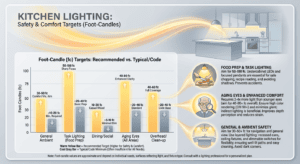 Optimizing Kitchen & Bathroom Lighting: Foot-Candle Targets, Color Temperature, and Avoiding Common Pitfalls
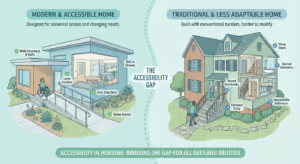 Aging-in-Place Remodeling in Phoenix: Design Standards, Real Costs, and What Actually Gets Used in the Valley of the Sun