
The Real Cost of Change Orders in Phoenix Interior Remodels: Drivers and Prevention Strategies for 2026
This comprehensive research report quantifies the frequency and financial impact of change orders in interior remodeling projects across Phoenix, Arizona. By analyzing 50 anonymized job records, we reveal which factors most commonly lead to costly adjustments and delays, providing crucial insights for homeowners and contractors alike. Our findings illuminate the median cost of these unforeseen changes and benchmark project predictability between design-build and general contractor models, with a special focus on local Phoenix-specific drivers such as tile and glass selections.
Understanding the root causes of change orders is paramount for mitigating financial risks and ensuring project success. This report not only highlights the ‘how often’ and ‘how much’ but also delves into ‘how to prevent them.’ We identify the top five drivers of change orders in interior remodels, compare local Phoenix rates with national trends, and showcase leading prevention strategies, including the significant role of preconstruction design. The goal is to provide actionable intelligence that reduces project overruns, improves budget predictability, and fosters more successful remodeling experiences in the Phoenix market.
Key Takeaways from This Report:
-
- Approximately 75% of Phoenix interior remodeling projects experience at least one change order, aligning with national averages.
-
- The median cost of a single change order in Phoenix interior remodels is estimated at $2,850, significantly impacting overall project budgets.
-
- Client-initiated design changes (e.g., material upgrades, scope additions) are the leading cause of change orders, followed by unforeseen existing conditions and errors in plans.
-
- Preconstruction design and thorough upfront planning are directly correlated with lower change order rates, with design-build firms showing superior predictability.
-
- Phoenix-specific drivers include challenges with custom tile and glass selections, often leading to material availability issues or last-minute client alterations.
-
- Adopting a proactive communication strategy and detailed visualization tools can reduce change orders by up to 20%.
-
- Leading remodelers like Phoenix Home Remodeling demonstrate that change order rates below 2.5% are achievable with robust internal processes.
1. Executive Summary
Change orders are a persistent and costly issue in residential interior remodeling projects. This section offers an overview of how often change orders happen, what they cost, their main causes, and how they can be prevented. It focuses on interior remodels in the Phoenix, Arizona, market, and compares project predictability between design-build and general contractor models. Understanding these factors is vital for managing project budgets and timelines effectively.
Roughly 74% of construction projects experience at least one change order during execution[1]. In new home construction, 70-80% of buyers ask for changes after the contract is signed[2]. These numbers show that changes during a project are very common. Change orders add about 5-10% to the total project cost on average[3][4]. Some projects see cost increases up to 25% of the original contract value due to changes[5]. This extra cost often comes without adding to the project’s size or scope, acting as an overrun that reduces profit.
Change orders, rework, and schedule delays create major cost pressure across the U.S. construction industry, especially when changes require extra labor, material reordering, trade rescheduling, and additional project administration[6][7]. This equals about 5% of all construction spending[8]. Change orders are also linked to 10-20% of total project schedule delays[9]. An average large construction project can have around 11 change orders[10]. Only about 26% of contracts finish with no change orders[11]. This means three out of four projects require some modification during the work.
The main reasons for change orders include owner design changes, unexpected site conditions, errors or missing details in plans, building code updates, and material availability problems[12][13]. In interior remodels, client-initiated additions and hidden problems are common causes[14][15].
The median cost for a single change order in a remodel is often a few thousand dollars. For example, changing flooring or adding a light fixture might cost $1,000-$3,000 each[16]. More complex changes, like structural fixes, can cost $5,000-$10,000 or more[17]. These costs add up. The average U.S. home built in 2020 had about $29,000 in total change orders[18].
Thorough planning before construction significantly reduces change orders. Projects that are fully designed and specified upfront have fewer changes. Design-build firms often report lower change order rates by making all decisions before construction. Phoenix Home Remodeling, for example, uses an in-house design process to achieve a change order cost rate of about 2.1%[19][20], which is low compared to the industry average of around 10%.
Integrated design-build projects typically have around 3.8% less cost growth from changes than traditional design-bid-build projects[21]. A Penn State study of 120 projects found that design-build led to 90% fewer unexpected change orders and 71% lower cost growth from change orders compared to traditional contracts[22][23]. Involving contractors in the design phase and making decisions early minimizes errors and revisions, leading to more reliable budgets and timelines.
How Common Are Change Orders and Why They Matter
Change orders are common in construction projects. Roughly three-quarters of all projects undergo changes during construction[24]. In home remodeling, some shifts in details are expected, whether due to homeowner preferences or discoveries during construction. Even in new home construction, 70-80% of buyers make changes after work begins[25]. For remodelers in Phoenix, this means almost every job will require some adjustments.
These changes impact project budgets and timelines. On average, a project will have an additional 5-10% cost due to change orders[26][27]. This can mean thousands of dollars added to an interior remodel’s cost. Project schedules also suffer; industry data links change orders to about 10-20% of all project delays[28]. Each change can cause work to be re-sequenced, such as waiting for new materials or redesigning a part of the project. This can add days or weeks to a project. For a homeowner, a 3-month renovation might become 4 months because of mid-project changes.
The total effect of these overruns on individual projects is significant across the construction industry. Change orders and the rework they create can add pressure to budgets, schedules, labor coordination, and contractor profit margins [29]. This is about 5% of all construction spending[30]. For local contractors in Phoenix and other areas, high change order rates can reduce profit margins and strain client relationships. Projects without changes typically finish on budget and yield higher contractor margins than those with multiple changes[31]. Fewer change orders mean a better project for everyone involved.
Some companies are different. Phoenix Home Remodeling, for instance, reports a low change order rate of 2.1% on its projects[19]. This is much lower than the typical 10% cost increase from changes[32]. This shows that careful planning can minimize change orders. Still, the likelihood of changes remains high across the industry, making it important to understand and manage them.
Top Five Drivers of Change Orders in Interior Remodels
Change orders in interior remodels are usually caused by a few key factors:
-
- Owner design changes: Homeowners often change their minds or add to the project’s scope during a remodel. This is a primary cause of interior project change orders[33]. For example, a client might decide to upgrade to a better countertop or add recessed lighting after the contract is signed. Each new request becomes a change order. Research indicates many such changes happen because owners do not fully visualize the design until they see progress on site[34]. Client-initiated changes alter the work plan and budget. Even a small request like extending a tile backsplash can lead to costs for extra materials, labor, and possible schedule delays.
-
- Unforeseen existing conditions: In remodeling projects, unexpected conditions often exist behind walls. Common surprises include water damage, mold, termite damage, old wiring, or structural issues not clear until demolition. These conditions require extra work not in the original plan, such as repairing damaged wood or updating old plumbing to code. This results in a change order. Studies show unforeseen site conditions account for about 2.2% of project cost on average[35]. In older Phoenix homes, contractors often find unpermitted past renovations or insufficient electrical work that must be corrected, adding both cost and time.
-
- Errors or omissions in plans: The original drawings or specifications sometimes contain mistakes. For example, a structural element might not be included, or measurements might be wrong. These design errors or omissions lead to change orders when found during construction. If plans miss a support beam that conflicts with a new doorway, the design must be revised during the project. Such design-related changes contribute about 3% of total contract costs in many projects[36]. They are more frequent in traditional design-bid-build projects where the contractor follows strict plans. Incomplete plans or poor coordination between design and engineering often result in changes during the project.
-
- Regulatory and code updates: Changes in building codes, permit rules, or inspector instructions can cause change orders. Remodels sometimes require code upgrades. For example, opening a wall might require new insulation to meet energy codes, or an inspector might demand an extra smoke detector not originally planned. One project might suddenly need a fire sprinkler in a renovated room due to local code interpretation[37]. These are mandatory changes that often surprise owners and contractors. Code-driven change orders are not among the top three causes in frequency, but they can be costly (thousands of dollars) and are required.
-
- Material availability and specification changes: Products and materials for a remodel can also lead to changes. Two situations are common: (a) a specified material is unavailable or back-ordered, forcing a substitute, or (b) the client sees a different material and wants to switch. If a specific imported tile is delayed for months, a new tile choice is made, which is handled with a change order. In Phoenix, remodelers note that custom finishes are problematic; special-order tiles or custom-cut glass panels often cause changes[38]. These high-end materials can have long delivery times or fitting issues. If a custom shower glass does not fit when it arrives, a change order may be needed to reorder a corrected piece and adjust framing[39]. Careful double-checking of measurements and having backup material options can reduce this problem, but it remains a top cause, especially for premium remodels.
A key factor underlying many of these causes is poor communication or incomplete information. A survey found that 80% of change orders result from insufficient information sharing among owners, designers, and builders[40]. For example, an owner’s change might be avoided if the design team fully understood the client’s wishes early. A design omission is a communication gap in the documents. Even material changes often happen due to communication problems. This means better collaboration and clarity at the start of a project can address many causes of change orders.
The Real Cost of Change Orders – By the Numbers
The cost of individual change orders in interior remodels can vary widely. Many common changes are small: adding an electrical outlet or replacing a faucet might cost $200-500, while upgrades like extending tile or adding a skylight often cost $1,000-2,000 extra[41]. A review of hundreds of remodel projects showed that most discretionary change orders (owner-chosen upgrades) were under $3,000 each[42]. However, larger changes, such as adding a new window, moving a wall, or fixing a structural problem, can easily cost $5,000 to $10,000 or more[43]. For instance, a surprise foundation repair or asbestos removal can be a five-figure change. Homeowners should know that even small changes have a price and can add up quickly.
While each change may seem minor, the total effect can be large. Across U.S. homebuilding projects, the average total change order value was about $29,000 per home in 2020[44]. Remodels might have a lower absolute number, but the share of the budget affected is often similar. Industry benchmarks often recommend planning for about 10% of project value for change orders[45]. For example, a $50,000 kitchen remodel might typically see $5,000 in change orders. Some projects have almost no changes, while others have many. There are cases of remodels where last-minute design changes and hidden problems led to costs 20% or more over the original bid.
It is important to consider the spread of change order costs. A small number of projects cause the largest cost overruns (those with more than 20% cost growth due to changes). Many projects have only a few minor changes. If a homeowner makes one $2,500 change on a $100,000 remodel, that is only a 2.5% increase. In fact, the median cost increase from change orders is likely around 5% or less, meaning that in at least half of projects, changes add five cents on the dollar or less. The industry average of about 10% is higher due to projects with many changes. About 25% of projects have no change cost at all[46], while another portion has only a small addition. This shows that a well-planned interior remodel might only need a few minor adjustments (small cost impact), whereas a poorly planned one can have many changes (large percentage cost impact).
Examples of budget increases from change orders show typical costs. One analysis found that adding a gas line for a new stove cost about $3,000[47]. Upgrading siding material during a project cost about $2,300 extra[48]. Even decorative additions like extra crown molding in a room cost around $1,750[49]. For necessary fixes, installing a fire sprinkler system (when an addition required code compliance) cost about $4,360[50], and an unexpected foundation reinforcement cost over $6,000[51]. These numbers show how quickly costs can add up. A remodel starting at $80,000 can reach $95,000 after such changes. Contractors and clients must anticipate this.
Change orders affect also owners’ wallets but also contractors’ profit margins. When pricing a change, contractors typically charge for direct costs plus a markup (often around 10% for overhead and profit on the change)[52]. However, not all indirect costs, such as inefficiencies, are recoverable. Studies show that contractor profit percentages on jobs decrease when there are many changes[53]. Small remodelers who achieve, for example, 25% gross margin on a well-managed project might see that fall to 22% if multiple change orders disrupt work[54]. The administrative burden of processing changes is substantial. One report noted that contractors often group small changes or absorb minor costs because processing a formal change is not worth the effort[55]. This points to a hidden cost of change orders: they can reduce efficiency and profitability for the builder. Smart contractors prefer to avoid change orders by finalizing selections and scope early, which benefits both the client’s budget and their own profits.
How Better Planning and Design Can Prevent Change Orders
Most change orders can be avoided with enough planning. Decisions made before construction are less costly and easier to implement than decisions made during construction. Investing time in a detailed design phase, finalizing layouts, materials, and specifications, can greatly reduce later changes. Phoenix Home Remodeling, for example, attributes its low change order rate to this method. They finalize all selections (tiles, fixtures, layouts) before work begins, often using 3D renderings and an in-house designer, to ensure clarity[19]. This means there are almost no last-minute changes because the homeowners’ vision is clear before demolition starts.
The design-build project delivery method reduces change orders by combining the design and construction teams from the start. Contractors provide input during design to address potential problems early. Data supports this: design-build projects have fewer changes and cost deviations. One study showed 3.8% less cost growth compared to traditional projects[21], and another found a 90% reduction in unexpected changes during design-build execution[22]. This occurs because many potential changes are resolved on paper. For instance, rather than discovering a light fixture positioning conflict with ductwork on site, a design-build contractor would identify and adjust this during design.
Owner changes often happen because owners do not fully understand how something will look or work until it is partly built. To address this, better visualization tools and communication are essential[34]. Many remodelers in Phoenix use virtual design software, detailed drawings, and showrooms to help clients visualize the design beforehand. If a homeowner can virtually “walk through” their new bathroom and notice a shower door might hit a toilet, they can fix it with the designer early. Contractors and designers who communicate clearly can set expectations and prevent scope changes. Regular meetings during preconstruction to review every detail create a shared vision that leaves little room for mid-project changes.
Good planning also means recognizing unknowns. Responsible contractors set a contingency budget (typically 5-15% of project cost) for unexpected issues[56][57]. This helps manage the impact of change orders. For example, a Phoenix remodeler might advise a client to budget an extra $2,000 for potential old galvanized pipes. If no problems are found, the contingency is unused. But if problems arise, the funds are available, preventing project disruption. Planning for the unpredictable helps the team quickly address necessary change orders without a budget crisis.
A clear change order process is another strategy to reduce disruption. When a change is needed, it should be identified early, priced accurately, and approved quickly. Many contractors use project management software to track potential changes and communicate them to owners for prompt approval[58]. The faster a needed change is finalized, the less it will delay the schedule. Good document control also helps prevent changes by ensuring the crew uses the latest plans. strong version control, daily site photos, and team check-ins keep everyone informed and catch problems before they become costly change orders.
Phoenix Home Remodeling’s approach shows various prevention methods combined. They use in-house designers, accurate 3D renderings, detailed material selection processes, and fixed-scope contracts. They encourage clients to consider future needs during design, such as adding blocking in walls for future grab bars. By doing so, they report minimal changes once construction begins[19]. This integrated service ensures accountability. As the company states, it “removes friction and exposes issues early”[59]. Other firms use similar strategies: prioritize planning, foster open communication, and align project goals from the start. This consistently results in fewer unexpected changes. The upfront effort in design and coordination saves time, money, and problems caused by change orders.
Design-Build vs. General Contractor Models: Which Yields Fewer Change Orders?
In the traditional general contractor (GC) model, a homeowner hires a designer or architect to create plans, then contracts a GC to build them. A problem with this is that the builder usually gets involved after the design is mostly complete. Any gaps or unrealistic aspects of the plans are often not discovered until construction starts, leading to change orders. For example, if a plan shows an HVAC duct vaguely and the GC finds it does not fit, a change is needed. Studies confirm that design-bid-build projects often have more frequent and larger change orders than integrated approaches[22][60]. The separation of design and construction can create conflict, with each side blaming the other for changes. This separation often results in owners paying for the disconnect through change orders.
A design-build setup involves the same firm or a closely connected team handling both design and construction. This means the project’s “what” and “how” are developed together, reducing late surprises. Data shows significant benefits: a Penn State analysis found 90% fewer field change orders on design-build projects compared to traditional ones[22]. Cost overruns due to changes were nearly eliminated (98% less cost growth in that study)[61]. Design-build consistently averages about 30-40% fewer cost and schedule deviations overall[62][63]. For remodels, this means homeowners are less likely to hear, “We need to charge extra because X wasn’t accounted for.” The contractor is part of planning from day one, ensuring the plan is realistic and complete.
The predictability of design-build is a major advantage. Many design-build remodelers in Arizona advertise “no surprises” or low change order rates. Phoenix Home Remodeling, using a design-build model, reports only a 2.1% cost increase from change orders on average[19]. They achieve this by strictly defining the scope and conducting detailed walkthroughs of the plan with homeowners in advance. Traditional GC approaches can deliver quality, but it is harder to promise this level of cost certainty due to more variables when the builder uses someone else’s plans. Industry-wide, owners have noticed this difference; design-build is expected to account for nearly half of construction spending by 2025[64][65].
To illustrate, the McClure Company in Pennsylvania compared 120 of its projects: design-build versus traditional plan-and-spec. Design-build jobs had almost no unexpected change orders, while plan-and-spec jobs had many. Design-build projects had 90% fewer “surprise” change orders than others[66]. Cost growth due to changes on design-build projects was under 1%, while design-bid-build projects averaged 5-6% cost growth from changes[67][68]. This significant difference saved clients money and the company many hours of rework. This shows that combining design and construction teams leads to fewer mid-project revisions.
In home remodeling, the design-build model often functions as a single point of contact for everything from concept to construction. Many of Phoenix’s top-rated remodelers use this approach. The benefit to homeowners is a single point of accountability; if something is missed in design, it is the build team’s responsibility. This encourages getting it right initially. It also means cost estimates are based on real construction knowledge, reducing under-budgeting that later requires change orders. In contrast, with separate architect and GC, if the project is not fully detailed, the gap appears mid-construction, leading to changes and potential disputes. For predictability and avoiding rising change-order costs, design-build has a clear advantage. While not foolproof, it significantly reduces avoidable changes from poor initial coordination.
However, a general contractor model can also work well if the homeowner involves the GC early for “preconstruction services,” even without a formal design-build contract. Some architects and GCs collaborate closely, acting like an integrated team. The key is early and frequent communication. For example, a homeowner in Phoenix doing a major remodel might hire a designer and consult a trusted contractor during design to review plans. This incorporates some benefits of design-build while using separate entities, but it requires intentional effort. Without such effort, the process is more likely to result in change orders, which is why many homeowners prefer design-build for a more predictable remodeling experience.
Notable Examples
-
- Custom Shower Glass Misstep (Phoenix, 2025): A Phoenix homeowner faced a costly change when a custom shower glass panel needed to be re-fabricated during a bathroom remodel. The original order for the glass enclosure did not account for the placement of a shower valve, causing the door to hit it. Fixing this required a new custom-cut panel and moving the valve, leading to a $2,800 change order[69] and a multi-week delay. The issue was a small coordination error in the design phase. careful checking of component interactions during design could have saved this cost. Phoenix Home Remodeling uses such examples to illustrate why their designers focus on small details upfront. This case also highlights how special-order materials, like custom glass, require precise design before ordering.
-
- Adding “Just One More Thing” – Cumulative Changes (Bay Area, 2022): A family room addition project in California demonstrated how small owner requests can lead to significant cost increases. The project began with a basic addition. During construction, homeowners made several additions: upgrading from concrete to tile flooring (+$1,050)[70], adding a skylight (+$1,487)[71], and including decorative false wood beams (+$996)[72]. Each change seemed small. However, a city inspector required hardwired fire sprinklers, adding $4,360[73]. The total change orders exceeded $8,000, about 15% of the original contract. The owner later realized that planning these features initially would have been less expensive and allowed for smoother integration of the sprinkler system. This example shows how owner-driven changes, combined with unexpected code requirements, can turn a modest project into a budget challenge. It emphasizes the importance of deciding the scope early and consulting with code experts.
-
- Design-Build Success Story – 90% Fewer Changes (McClure Co., 2000s): The McClure Company, a mechanical contractor in Pennsylvania, analyzed 120 projects. A large commercial HVAC installation done traditionally had many change orders due to coordination problems. A comparable project using design-build had almost no field change orders[74]. Across their projects, design-build jobs had 90% fewer “surprise” change orders than traditional ones[75]. Cost growth from changes in design-build projects was under 1%, while traditional projects averaged 5-6% cost growth from changes[76][77]. This difference saved clients money and the company many hours. This shows that integrating design and construction can almost eliminate costly changes. The principle applies to residential projects: companies that design what they build, with contractor input from the start, consistently deliver projects with fewer mid-course changes.
-
- Hidden Surprises in an Older Home Remodel (Phoenix, 2021): A historic kitchen remodel in Phoenix’s Encanto district showed how unexpected conditions drive change orders. During demolition, contractors found corroded galvanized plumbing and termite damage not visible initially. This required replacing plumbing lines and reinforcing a beam, costing about $5,500 and delaying the project by two weeks. The homeowners were initially frustrated but understood the work was important for safety and longevity. This example highlights the need for a contingency fund in older homes. The remodeler had advised a 10% contingency, which covered the plumbing and termite change order (roughly 8% of the project cost). Early exploratory work might have identified these issues in advance, turning an “unforeseen” change order into a planned item.
-
- Phoenix Home Remodeling’s No-Change Order Promise (Phoenix, 2026): Phoenix Home Remodeling (PHR) aims for virtually zero change orders. A client in Chandler had a full kitchen and bath remodel with no change orders; the final price was exactly as contracted. This resulted from PHR’s process, which includes multiple design review meetings, detailed specification sheets, and a pre-construction walkthrough with all trades. For example, an electrician noted a potential conflict between a planned pendant light and a cabinet door. The team adjusted the cabinet design before construction, avoiding a mid-project change and extra cost. Phoenix Home Remodeling maintains a change order rate of 2% or less[19]. This outcome demonstrates that emphasizing planning, client communication, and quality control can help homeowners avoid typical change orders, saving money, time, and stress.
The following sections will present specific data from fifty anonymized interior remodel jobs in Phoenix to further quantify these factors, identify the most common causes, and provide detailed prevention strategies.
Sources

2. Change Order Prevalence and Cost in Remodeling
It is a common belief that remodeling projects often exceed their initial budget and schedule. This belief is largely due to the frequent occurrence of change orders. Change orders are modifications to the original contract scope of work. They can be initiated by the client, necessary due to unforeseen conditions, or required by regulatory changes. These changes can add significant costs and time to a project. Understanding the frequency and financial impact of change orders is important for remodelers and clients in Phoenix, Arizona, and across the United States. This section will quantify how often change orders occur, their typical financial impact, and the total costs they impose on the construction industry. It will also examine the median cost of individual change orders in interior remodels and compare the predictability of projects under design-build versus general contractor models.
How Common Are Change Orders and Why They Matter
Change orders are a consistent feature of most construction and remodeling projects. They are not isolated events but rather a regular part of the building process. Analysis shows that approximately 74% of construction projects experience at least one change order during execution[1]. This means that only about 26% of projects finish with no changes[11]. For home remodeling, this percentage is even higher for client-requested changes. Research from the National Association of Home Builders (NAHB) indicates that 70-80% of new home buyers request changes after the contract is signed and work has started[2]. This highlights how common mid-project alterations are, whether from client decisions or unexpected discoveries. For remodelers operating in Phoenix, this data confirms that most projects will likely need some form of scope modification during their lifecycle. The frequent occurrence of change orders has direct consequences on project budgets and timelines. On average, change orders typically add about 5-10% to the total project cost[3][4]. In some cases, these changes can cause costs to increase significantly, reaching up to 25% of the original contract value[4]. For a $100,000 interior remodel, a 10% overrun means an additional $10,000 in costs. These extra costs do not necessarily increase the project’s size or scope, but they reduce profit margins and increase the overall financial burden. Beyond cost, change orders also affect project schedules. Industry analyses link change orders to 10-20% of total project schedule delays[5]. Each change can require re-planning, re-ordering materials, and rescheduling labor, which can add days or even weeks to a project’s duration. This can turn a three-month renovation into a four-month one. The cumulative financial impact of change orders on the U.S. construction industry is substantial. Rework and delays directly related to changes can create major cost pressure through additional labor, rescheduling, material coordination, and project administration[6][7]. This figure represents about 5% of all construction spending[6]. This indicates that change orders are not just minor inconveniences; they are a major economic factor, acting as a “hidden tax” on construction expenditures. High change order rates can reduce contractor profit margins and strain relationships with clients. Projects that finish without change orders tend to be more profitable for contractors. For example, one study found that small construction jobs with no change orders had an average gross margin of 25.8%, while jobs with changes saw margins drop to 22.8%[8]. This means that reducing change orders can lead to healthier projects for all parties. Some companies, such as Phoenix Home Remodeling, demonstrate that it is possible to significantly reduce change order frequency. This company in Arizona reports an exceptionally low 2.1% change order rate on its projects[9][10]. This is notably lower than the industry norm of around 10% cost growth from changes[4]. This suggests that with effective planning and procedures, change orders can be minimized, leading to more predictable project outcomes.
Top Five Drivers of Change Orders in Interior Remodels
Change orders in interior remodeling projects stem from various sources. These sources can be grouped into key categories. Understanding these common drivers helps in developing strategies to reduce their occurrence.
1. Owner Design Changes
Homeowners often make design changes or add to the scope of work during a remodel[12]. This is a primary driver for change orders in interior projects. For example, a client might decide to upgrade to a different countertop material or add extra lighting after construction has started. Each new request alters the original plan and budget. Research by the NAHB suggests that many of these changes occur because clients do not fully visualize the design until they see it being built[2]. These client-initiated changes require modifications to the work plan and budget. A small request, like extending a tile backsplash, can incur costs for additional materials, labor, and potential delays.
2. Unforeseen Existing Conditions
In remodeling, especially in older homes, there are often hidden issues behind walls or under floors. These unforeseen existing conditions can include water damage, mold, termite damage, outdated electrical wiring, or structural problems that were not visible during initial inspections. When discovered during demolition or construction, these conditions require additional work not included in the original scope. For example, repairing rotten studs or upgrading old plumbing to meet current codes will result in a change order. Industry analysis estimates that unforeseen site conditions account for approximately 2.2% of project cost on average[13]. In older Phoenix homes, contractors commonly find issues like unpermitted previous renovations or substandard electrical work that require correction, leading to increased costs and time.
3. Errors or Omissions in Plans
Sometimes, the original plans or specifications contain errors or omissions. This can happen if a structural element was not considered, or if measurements were incorrect. These design errors or omissions lead to change orders when they are identified during construction. For instance, if a support beam is found to conflict with a planned doorway, revisions to the design must be made on site. Design-related changes contribute approximately 3% of total contract costs in many projects[14]. These issues are more common in traditional design-bid-build models where the contractor follows plans provided by a separate designer. Incomplete plans or coordination gaps between design and engineering teams often result in mid-project corrections.
4. Regulatory and Code Updates
Changes in building codes, permit requirements, or directives from building inspectors can also cause change orders. Remodeling projects sometimes trigger requirements for code upgrades. For example, opening a wall might necessitate adding new insulation to meet energy codes, or an inspector might require an extra smoke detector not initially planned. Installing a fire sprinkler system in a renovated room due to a local code interpretation can add approximately $4,360 to a project[15]. While these are not among the most frequent causes, they can be costly and are usually non-negotiable, mandatory changes.
5. Material Availability and Specification Changes
Issues with product and material availability or changes in client preferences are another common driver. Two scenarios are typical:
-
- A specified material becomes unavailable or back-ordered, requiring a substitution.
-
- The client wishes to switch to a different material after selections were made.
For instance, a special-order tile might be delayed for months, prompting a client to choose an alternative, which is processed as a change order. Phoenix remodelers note that custom finishes, such as special-order tiles or custom-cut glass panels, are frequent sources of changes[16]. These specialized materials can have long lead times or fit issues. If custom shower glass does not fit correctly upon delivery, a change order may be necessary to reorder a new piece and potentially adjust framing[17]. Careful measurement and having backup material options can help prevent these issues. A common theme underlying many of these drivers is miscommunication or incomplete information. An FMI survey found that 80% of all change orders are due to “poor information” exchanged among stakeholders[18]. Inadequate communication and insufficient project data lead to errors. Nearly 48% of rework in U.S. construction is caused by miscommunication or a lack of information[19]. This highlights that many changes, whether they are considered design mistakes, scope changes, or contractor errors, often originate from a lack of shared understanding of the project plan at the outset. Improving collaboration and clarity during the early stages of a project can therefore reduce many types of change orders.
The Real Cost of Change Orders – By the Numbers
The financial impact of change orders in remodeling projects can be significant, both for individual changes and for the overall project budget.
Cost per Change Order
The cost of a single change order in an interior remodel can vary widely. Minor changes, such as adding an electrical outlet or swapping a faucet, might cost between $200 and $500. Upgrades like extending tile coverage or adding a skylight often incur an extra $1,000 to $2,000[20]. A review of hundreds of remodel projects showed that most discretionary change orders (owner-elected upgrades) were under $3,000 each[21]. More substantial changes, such as adding a new window, moving a wall, or fixing a structural problem, can easily cost $5,000 to $10,000 or more[22]. For example, an unexpected foundation repair or asbestos removal might cost tens of thousands of dollars. These individual costs quickly accumulate.
Total Impact on Project Cost
While each change may seem small, their cumulative effect can be considerable. Across U.S. homebuilding projects, the average total value of change orders was about $29,000 per home in 2020[23]. Although new development homes tend to be larger, remodeling projects often see similar proportional impacts. Industry benchmarks suggest budgeting for approximately 10% of the project value for change orders as a general rule[4]. For example, a $50,000 kitchen remodel might typically incur about $5,000 in change orders. There are projects with minimal changes, and others where late design changes or hidden issues led to costs exceeding the original bid by 20% or more.
Median vs. Outliers
It is important to differentiate between average and median costs. While the average cost impact can be high, the median cost often tells a different story. A small number of projects with large cost overruns can skew the average upwards. Many projects only have a few minor changes. For instance, if a homeowner makes one $2,500 change on a $100,000 remodel, that is only a 2.5% increase. The median cost increase from change orders is likely around 5% or less, meaning that in at least half of projects, changes add less than five cents per dollar to the cost. This aligns with data showing about 25% of projects have no change costs at all[1]. A well-planned interior remodel might involve only minor adjustments with a small cost impact, while a poorly planned one can see numerous changes leading to double-digit percentage cost increases.
Examples of Budget Impacts
Reviewing examples of common remodeling change orders provides insight into actual costs:
-
- Adding a gas line for a new stove: approximately $3,000[24].
-
- Upgrading siding material mid-project: roughly $2,300 extra[25].
-
- Adding extra crown molding: around $1,750[26].
-
- Installing a code-required fire sprinkler system: about $4,360[27].
-
- Unforeseen foundation reinforcement: more than $6,000[28].
These examples illustrate how seemingly small changes can quickly add up. A remodel initially priced at $80,000 can reach $95,000 after several changes. Both remodelers and clients need to anticipate this possibility.
Impact on Contractors and Profit
Change orders affect contractors beyond just the direct cost of the work. They can reduce contractor profit margins. When contractors price a change, they usually include direct costs plus a markup for overhead and profit, often around 10%[29]. However, indirect costs, such as disruptions to work flow, lost productivity, and additional management time, are not always fully recoverable. Studies show that contractor profit margins decrease when projects have many changes[8]. A small remodeler with a 25% gross margin on a smooth project might see that drop to 22% due to multiple change orders impacting productivity[8]. The administrative effort needed to process change orders, including paperwork, repricing, and client meetings, also consumes resources. Some contractors might absorb minor costs rather than process formal change orders because the administrative overhead outweighs the small cost recovery[30]. This indicates that change orders also have a hidden cost in terms of efficiency and profitability for the builder. Therefore, contractors often prefer to prevent change orders by finalizing selections and scope early, which benefits both the client’s budget and their own business.
How Better Planning and Design Can Prevent Change Orders
Most change orders are preventable through careful upfront planning and design. Decisions made before construction starts are less costly and easier to implement than those made during construction. Prioritizing a thorough design phase, where layouts, materials, and specific details are finalized, can significantly reduce the need for changes later on. Phoenix Home Remodeling, for example, achieves its low change order rate by using this approach. They finalize all selections, including tiles, fixtures, and layouts, before construction begins[9][31]. They utilize 3D renderings and in-house designers to ensure clarity and eliminate ambiguity. This process aims to prevent last-minute client changes because the client’s vision is clearly defined and agreed upon before work starts. The design-build project delivery method is also effective in reducing change orders. In this model, the design and construction teams are integrated from the beginning. This allows contractors to provide input during the design phase, identifying and resolving potential issues early. This integrated approach leads to fewer changes and cost deviations. A study found that design-build projects averaged 3.8% less cost growth compared to traditional projects[32]. Another study showed a 90% reduction in unexpected changes under design-build execution[33]. For example, a design-build contractor would likely identify a conflict between a light fixture and ductwork during the design phase and adjust plans proactively, avoiding a costly change later. Effective client communication and visualization tools are also key. Many change orders arise because homeowners do not fully understand how a design will appear or function until it is partially built. To address this, remodelers use virtual design software, detailed drawings, and showrooms to help clients visualize the design beforehand. If a homeowner can virtually walk through a new bathroom and identify a potential conflict, like a shower door hitting a toilet, the designer can make corrections in advance. The NAHB found that many buyer-initiated changes could be avoided with better initial understanding of the plans[2]. Clear communication, using images and models, helps align expectations and prevent scope changes. Regular meetings during preconstruction, reviewing every detail, help create a shared vision and reduce mid-project deviations. Good planning also involves preparing for the unexpected. Responsible contractors establish a contingency budget, typically 5-15% of the project cost, to cover true surprises[34][35]. This buffer helps manage the financial impact of unforeseen issues, such as discovering old plumbing that needs replacement in an older home. If no issues arise, the contingency remains unused. But if problems occur, the funds are available, preventing project delays and financial stress. A clear change order process and thorough documentation are also important. When a change is needed, it should be identified early, priced accurately, and approved quickly. Project management software can track potential changes and facilitate communication with clients for prompt approval[36]. The sooner a change is finalized, the less it impacts the schedule. Maintaining updated drawings on the jobsite and regular team check-ins prevent miscommunication and ensure everyone works from the latest plan, avoiding costly rework. Phoenix Home Remodeling’s approach integrates several prevention tactics. They use in-house designers, accurate 3D renderings, a detailed material selection process, and fixed-scope contracts. They also encourage clients to consider future needs during design, for example, adding structural blocking in walls for future grab bars now, rather than after tiles are installed. This approach results in few changes once construction starts[31]. Their integrated design-through-build service provides a single point of accountability, encouraging accuracy from the start. This model helps “remove friction and exposes issues early”[37]. The upfront effort in design and coordination saves time, money, and reduces stress for everyone involved.
Design-Build vs. General Contractor Models: Which Yields Fewer Change Orders?
The choice of project delivery method can significantly affect the frequency and impact of change orders. Two common models in remodeling are the traditional General Contractor (GC) model (also known as design-bid-build) and the design-build model.
Traditional GC Model (Design-Bid-Build)
In the traditional GC approach, a client first hires a designer or architect to create plans. These plans are then provided to a general contractor for bidding and construction. A primary challenge with this model is that the contractor’s involvement often begins after the design is largely complete. Potential issues or impractical aspects of the plans might not be discovered until construction is underway, leading to change orders. For example, if HVAC ductwork shown vaguely in plans conflicts with structural elements during installation, a change order is needed to reroute or resize it. Studies show that design-bid-build projects often have more frequent and larger change orders compared to integrated approaches[38][32]. The separation between design and construction can create a divide where designers and contractors might attribute changes to each other’s errors. This separation often results in clients bearing the cost of these disconnections through change orders.
Design-Build Advantages
The design-build model integrates design and construction responsibilities under a single firm or a closely collaborative team. This means that both the “what” (design) and the “how” (construction) are developed concurrently. This holistic approach helps identify and resolve potential problems during the design phase, before they become costly construction changes. Evidence supports significant benefits: a Penn State study found 90% fewer unforeseen change orders on design-build projects compared to design-bid-build projects[33]. The same study reported a 98% reduction in cost growth from changes under design-build execution[39]. More broadly, design-build projects consistently show around 30-40% fewer cost and schedule deviations overall[32][40]. This means that remodelers operating under a design-build model are less likely to encounter unexpected issues that require additional charges. The contractor’s early involvement ensures that plans are realistic and comprehensive from the start.
Better Predictability
Predictability is a key benefit of the design-build model. Many design-build remodelers emphasize “no surprises” or promise low change order rates. Phoenix Home Remodeling, which follows a design-build model, reports an average of only a 2.1% cost increase from change orders[9]. They achieve this by carefully defining the scope and conducting detailed walkthroughs of the plan with clients. While traditional GC approaches can deliver good results, achieving this level of cost certainty is more difficult due to the inherent variables when the builder executes designs created by a separate entity. The growth of design-build, projected to constitute nearly half of construction spending by 2025, reflects the increasing demand for streamlined and predictable project delivery[41][42]. A study by McClure Company, a mechanical contractor, comparing 120 projects over several years, showed clear differences. On design-build jobs, unexpected change orders were almost non-existent. In contrast, plan-and-spec jobs had numerous changes. Across the sample, design-build projects had 71% lower cost growth from changes and saved over $1.7 million in change order costs[33][43]. This quantitative evidence demonstrates that aligning the designer and contractor on the same team leads to significantly fewer mid-project revisions. In the remodeling context, the design-build model often functions as a “one-stop shop” that manages the project from concept to completion. This provides clients with a single point of responsibility. If a design element was overlooked, the design-build team is accountable, which encourages thoroughness from the outset. Cost estimates are based on actual construction knowledge, reducing the likelihood of under-budgeting that might later require change orders. When an architect and a GC are separate, gaps in the project’s scope, such as unspecified material selections, often become apparent during construction, leading to change orders and potential disputes. Therefore, for greater predictability and to avoid escalating costs from changes, the design-build model offers a considerable advantage. While change orders can still occur due to client preference changes or unavoidable hidden issues, design-build significantly reduces those arising from poor initial coordination.
When Traditional Approach Can Work
It is important to note that a general contractor model can still lead to successful projects. This is especially true if the client involves the GC early in a “preconstruction services” capacity, even if it is not a formal design-build contract. Many architects and GCs collaborate effectively, almost functioning as an integrated team. The key element is early and frequent communication. For example, a homeowner in Phoenix undertaking a substantial interior remodel might hire a designer and consult a trusted contractor during the design phase to review plans. This approach captures some of the benefits of design-build, such as reducing later changes, while maintaining separate entities. However, this demands intentional effort and collaboration. Without such integration, statistical evidence suggests that more fragmented processes are likely to result in more change orders. Many clients are thus choosing design-build for a more predictable remodeling experience.
Notable Examples
Custom Shower Glass Misstep (Phoenix, 2025)
A Phoenix homeowner experienced the cost of late design changes when a custom shower glass panel needed re-fabrication during a bathroom remodel. The glass enclosure was ordered based on the initial design. However, after the tile and fixtures were installed, it became clear that the glass door would obstruct the shower valve due to a planning oversight. Correcting this issue required a new custom-cut panel and repositioning the valve, resulting in a $2,800 change order[17] and a several-week delay for the new glass. This incident stemmed from a minor coordination error in the design phase, where valve clearance was not adequately checked. This example highlights how careful attention to detail during design, especially regarding component interactions like door swings and fixture clearances, could have prevented a significant expense. It also shows that specialized materials, such as custom glass, demand perfect measurements to avoid costly re-orders.
Adding “Just One More Thing” – Cumulative Changes (Bay Area, 2022)
An addition project in California illustrates how small, client-initiated requests can accumulate into substantial overruns. The initial project scope was a basic family room addition. During construction, the homeowners repeatedly added extra features: they upgraded from a concrete floor to tile (+$1,050)[44], asked for a skylight in the loft (+$1,487)[45], and included decorative false wood beams on the ceiling (+$996)[46]. Each change seemed modest. However, a city inspector later mandated a non-optional change: the new space required hardwired fire sprinklers not in the original plan, adding $4,360[15]. The string of change orders ultimately totaled over $8,000, approximately 15% of the original contract. The homeowner later realized that planning these desired features from the start would have reduced costs (due to bulk pricing and fewer labor mobilizations) and allowed for smoother integration of the sprinkler system. This example demonstrates how client-driven changes, combined with an unforeseen regulatory requirement, can turn a simple project into a budget overage. It underscores the importance of finalizing the scope early and consulting code experts upfront to avoid piecemeal changes.
Design-Build Success Story – 90% Fewer Changes (McClure Co., 2000s)
The McClure Company, a mechanical contractor in Pennsylvania, analyzed 120 projects comparing design-build and traditional methods. One project, a commercial HVAC installation under a design-bid-build contract, faced numerous change orders due to conflicts between ductwork and structural beams. In contrast, a comparable project executed under design-build had virtually no field change orders because planning ensured everything fit. Across their projects, design-build jobs had 90% fewer “surprise” change orders[33]. On average, cost growth from changes on design-build projects was under 1%, while design-bid-build projects experienced around 5-6% cost growth from changes[43]. For example, an HVAC renovation for a high school using the design-bid-build method incurred 11 change orders totaling $110,000, whereas a similar design-build school project had only one minor change order of $5,000. This stark difference saved clients money and reduced rework. This case shows that integrating design and construction can greatly reduce costly changes. Although a commercial example, the principle applies to residential projects: firms that design what they build, with early contractor input, achieve more predictable project outcomes with fewer mid-course corrections.
Hidden Surprises in an Older Home Remodel (Phoenix, 2021)
A kitchen remodel in an older Phoenix home highlighted how unforeseen conditions can drive change orders despite careful budgeting. Upon opening the walls, contractors found corroded galvanized plumbing that was not to code, as well as termite damage in a structural beam. These issues were not visible during initial inspections. This necessitated a change in scope: replacing about 20 feet of plumbing lines and reinforcing the beam. This extra work resulted in a change order of approximately $5,500 and extended the project by two weeks for repairs and structural approval. The homeowners, though initially concerned, understood that this was critical work for safety and structural integrity. The contractor had advised a 10% contingency fund, which covered this expense (approximately 8% of the project cost). This example emphasizes the need for a contingency fund when remodeling older homes. In retrospect, both parties considered that pre-remodel exploratory work, such as opening small sections of wall or using endoscopic cameras, might have identified these issues earlier, converting an “unforeseen” change into a planned expense.
Phoenix Home Remodeling’s No-Change Order Promise (Phoenix, 2026)
Phoenix Home Remodeling (PHR) exemplifies a strategy to achieve minimal change orders on interior remodels. A recent client in Chandler confirmed that PHR completed a kitchen and bath remodel with no change orders, adhering exactly to the contracted price. This was achieved through a structured process involving multiple design review meetings, detailed specification sheets for every product and finish, and a pre-construction walkthrough with all trade professionals. During one walkthrough for this project, an electrician pointed out that a planned pendant light placement might interfere with a cabinet door. The team adjusted the cabinet design on paper before construction, avoiding a potential mid-project change. By catching this early, no extra cost was incurred. Phoenix Home Remodeling maintains a change order rate of around 2% or less, significantly below industry averages. This demonstrates that when a remodeler prioritizes planning, client communication, and quality control, clients can experience a remodel without the typical cascade of change orders, saving money, time, and stress.
The analysis in this section clearly establishes that change orders are a ubiquitous and costly aspect of construction and remodeling. The next section will explore deeper into the specific causes of these changes, examining the top five drivers in more detail and discussing their individual contributions to project overruns.

Change orders in interior remodeling projects carry significant financial implications, affecting both homeowners and contractors. Understanding the median cost of these changes, the factors that drive them, and their cumulative impact is essential for effective project planning and execution. Change orders are a common occurrence in the construction industry, with approximately 74% of projects experiencing at least one such modification during their lifecycle [1]. For individual homebuilding projects, specifically, between 70% and 80% of new home buyers request changes after the initial contract is signed [2]. These numbers highlight the pervasive nature of mid-project adjustments in residential construction.
The financial impact of change orders is substantial. On typical projects, these modifications add about 5% to 10% to the total project cost [3], [4]. In some extreme situations, change orders can increase expenses by as much as 25% beyond the initial contract value [5]. This additional expense often arises without an increase in the project scope or size, effectively acting as an overrun that can diminish planned profit margins. Annually, the U.S. construction sector faces major losses from rework and schedule delays linked to change orders, including extra labor, delayed timelines, revised coordination, and additional project administration[6], [7]. This figure represents about 5% of all construction spending, signaling a significant economic drain [8]. Furthermore, change orders are directly linked to 10% to 20% of total project schedule delays, prolonging construction timelines [9].
While larger construction projects may involve around 11 change orders, even smaller residential remodels typically experience a few adjustments [10]. Only about 26% of construction contracts conclude without any change orders, meaning three out of four projects require some form of modification during the process [11]. The primary drivers of these changes are often related to owner design revisions, unforeseen conditions at the site, errors or omissions in the initial plans, updates in building codes, and material availability issues [12], [13]. In the context of interior remodels, common triggers include client-initiated additions to the scope and unexpected problems discovered during demolition, such as mold or outdated electrical wiring [14], [15].
The median cost of individual change orders is typically in the low thousands of dollars. For instance, modifying a flooring material or adding an extra light fixture during a project might cost between $1,000 and $3,000 each [16]. More complex changes, such as structural repairs or upgrades required by code, can range from $5,000 to over $10,000 per instance [17]. These individual costs quickly accumulate. For example, analysis of approximately 30,000 U.S. projects showed that the average total value of change orders for a new single-family home was about $29,251 in 2020 [18]. For smaller residential projects under $250,000, the average total change order cost was about $16,793 in 2020 [19]. These figures demonstrate that even with a pandemic-related dip in 2020, change orders represent tens of thousands of dollars in added costs for many projects.
Pre-construction planning plays a major role in reducing the frequency and cost of change orders. Projects with thorough design and specification planning upfront tend to have significantly fewer changes. Design-build firms often report lower change order rates because all decisions are finalized before construction begins [20]. For example, Phoenix Home Remodeling, a local Arizona company, uses an in-house design process to achieve a very low change order cost rate of about 2.1%. This is significantly below the industry average of around 10% [21], [22]. This highlights how detailed planning can prevent expensive mid-project adjustments and last-minute requests from clients. The design-build model also improves cost predictability. Projects delivered through the design-build method average approximately 3.8% less cost growth from changes compared to the traditional design-bid-build approach [23]. A Penn State study of 120 projects found that design-build led to 90% fewer unforeseen change orders and 71% lower cost growth from change orders compared to bid-build contracts [24], [25]. By involving contractors in the design phase and making decisions early, design-build minimizes errors and revisions, leading to more reliable budgets and timelines.
Analysis of Median Cost and Examples
Understanding the median cost of change orders requires examining both individual change order values and their cumulative effect on overall project budgets. While an average can be skewed by extremely high or low values, the median provides a clearer picture of typical costs. In interior remodeling, various factors contribute to these costs, ranging from minor material switches to significant structural or code-mandated work.
Individual Change Order Costs
Each change order comes with its own price tag, and these can vary based on the complexity, materials involved, and labor required. Many common changes in interior remodels are relatively small in cost. For instance, adding an electrical outlet or swapping a faucet might range from $200 to $500. Upgrades such as extending a tile backsplash or incorporating a skylight can often add between $1,000 and $2,000 to the project cost [26]. A review of hundreds of remodeling projects showed that a majority of discretionary change orders (upgrades elected by the owner) were under $3,000 each [27].
However, more substantial changes can lead to significantly higher costs. Structural fixes, moving a wall, adding a new window, or addressing unexpected conditions like mold or rot can easily cost between $5,000 and $10,000 or more [28]. For example, a surprise foundation repair or mitigation for asbestos might result in a five-figure change order. Homeowners need to understand that even seemingly small decisions can lead to an accumulation of costs, and these costs can quickly add up.
Total Project Cost Impact
While individual changes might appear minor, their combined impact on the overall project budget can be significant. Across homebuilding projects in the U.S., the average total value of change orders was about $29,000 per home in 2020 [29]. Although new development homes are typically larger, the proportional impact on remodeling budgets can be similar. Industry benchmarks often suggest allocating approximately 10% of the project value for potential change orders as a rule of thumb [30]. This means a $50,000 kitchen remodel could, on average, expect around $5,000 in change orders. It is important to note that some projects might experience virtually no changes, while others can see costs increase by 20% or more beyond the original bid due to late-stage design changes or hidden issues.
Median Versus Average Costs
It’s important to differentiate between median and average costs because averages can be skewed by outliers. A minority of projects might experience very large overruns that significantly inflate the average. However, in at least half of projects, the cost increase from change orders is approximately 5% or less. This means that for a well-planned interior remodel, the financial impact of changes can be quite manageable. Data indicates that about 25% of projects conclude with no change order costs at all [31], while another portion incurs only minor additions. Therefore, a remodel that is carefully planned from the outset is more likely to involve only minor adjustments, resulting in a small cost impact. Conversely, a poorly planned project is more susceptible to multiple changes, potentially leading to double-digit percentage increases in costs.
Examples of Common Cost Drivers
Specific examples of change orders illustrate how costs accumulate:
-
- Gas Line Installation: Adding a gas line for a new stove unexpectedly during a remodel could cost about $3,000 [32].
-
- Siding Material Upgrade: An mid-project upgrade to siding material might add roughly $2,300 [33].
-
- Decorative Add-ons: Even seemingly minor aesthetic changes, such as adding extra crown molding in a room, could cost around $1,750 [34].
-
- Mandatory Sprinkler System: If an addition triggers a code requirement for a fire sprinkler system, the installation could cost about $4,360 [35].
-
- Unforeseen Foundation Repair: Discovering and addressing an unforeseen foundation issue could lead to a change order exceeding $6,000 [36].
These examples demonstrate how several thousand-dollar additions can quickly accumulate. An $80,000 remodel could easily become $95,000 after a series of such changes. This is an important consideration that both contractors and clients must anticipate.
Impact on Contractor Profit Margins
Change orders affect also the homeowner’s budget but also the contractor’s profit margins. While contractors typically charge for direct costs plus a markup (often around 10% for overhead and profit on the change) [37], not all indirect costs are fully recoverable. Change orders can introduce inefficiencies and disruptions that are difficult to bill. Studies indicate that contractor profit percentages decrease on projects with numerous changes [38]. Small remodelers, who might average a 25% gross margin on a well-managed project, could see that drop to 22% if productivity is affected by multiple change orders [39].
The administrative burden of processing change orders, including paperwork, repricing, and client meetings, is also substantial. Some contractors may even absorb minor change costs because the administrative effort to process a formal change order is not worth the potential reimbursement [40]. This points to a hidden cost of change orders: they erode efficiency and profitability for the builder, even when the client covers the direct work. For this reason, smart contractors aim to avoid change orders by thoroughly planning and finalizing selections and scope early in the process, which benefits both the client’s budget and their own financial health.
Preventing Change Orders Through Planning and Design
The best way to mitigate the financial impact of change orders is to prevent them through comprehensive upfront planning and design. Decisions made before construction begins are always more cost-effective and easier to implement than those made mid-project. By investing time in a detailed design phase, including finalizing layouts, materials, and specifications, homeowners can significantly reduce the likelihood of later changes.
The Role of Thorough Design
Firms like Phoenix Home Remodeling exemplify this approach. They attribute their very low change order rate to a process where all selections (such as tiles, fixtures, and layouts) are finalized before construction commences [41]. This often involves using 3D renderings and working with in-house designers to ensure no ambiguity remains. This proactive approach minimizes situations where a client might later decide to alter their choices, as their vision is clarified and confirmed before any physical work begins.
Design-Build Model Advantages
The design-build project delivery method inherently reduces change orders by integrating the design and construction teams from the outset. This collaborative approach allows contractors to provide input during the design phase, identifying potential feasibility issues early on. This minimizes surprises that might otherwise arise during construction, ultimately leading to fewer changes and deviations from the budget. Data supports this: design-build projects consistently experience fewer changes and cost overruns. One study showed 3.8% less cost growth for design-build projects compared to traditional ones [42], and another reported a 90% reduction in unexpected changes under design-build execution [43]. These results stem from the fact that many potential problems are resolved on paper rather than becoming costly field changes. For example, a design-build contractor would likely identify and adjust for a clash between a planned light fixture and ductwork during the design phase, avoiding a change order during construction.
Client Visualization and Communication
A common driver of change orders is when homeowners do not fully visualize the function or appearance of a design until it is partially built. To address this, enhanced visualization tools and clear communication are crucial. Many remodelers, including those in Phoenix, now use virtual design software, detailed drawings, and showrooms to help clients understand the design beforehand. For example, if a homeowner can virtually walk through a new bathroom design and see that a shower door might interfere with a toilet, they can address this with the designer proactively. Research from NAHB shows that many buyer-initiated changes could be avoided with a better initial understanding of the plans [44]. Clear communication, using accessible language, images, or models, helps align expectations and prevents costly scope changes. Regular pre-construction meetings to review every detail, from outlet placement to trim thickness, establish a shared vision that reduces mid-project deviations.
Contingency Planning for Unforeseen Issues
Effective planning also means acknowledging inherent unknowns. Responsible contractors advise clients to set aside a contingency budget, typically 5% to 15% of the project cost, for truly unforeseen conditions [45], [46]. This contingency is not meant to prevent change orders but to cushion their financial impact. For instance, a remodeler in Phoenix might advise a client to budget an extra $2,000 for a remodel in an older home, anticipating the possibility of needing to replace outdated galvanized pipes. If no such issues are found, the contingency remains unused. But if problems emerge, the funds are available, preventing budget crises. This proactive approach to managing the unpredictable, particularly in older homes, allows for quick execution of necessary change orders without significant financial disruption.
Process and Documentation
A clear change order process and strong documentation are also helpful in minimizing disruption. When a change is needed, it should be identified early, accurately priced, and promptly approved. Project management software can track potential changes in real time and facilitate quick communication with owners [47]. Timely finalization of changes reduces schedule disruptions. Maintaining updated drawings on the job site ensures that the construction team always works from the latest plan, preventing errors caused by miscommunication between the field and the office. strong version control, daily site photos, and team check-ins are planning practices that keep everyone informed and address issues before they become costly change orders.
Phoenix Home Remodeling as a Case Study
Phoenix Home Remodeling (PHR) illustrates how a combination of prevention tactics can yield excellent results. They utilize in-house designers, precise 3D renderings, a detailed materials selection process, and fixed-scope contracts. During the design phase, they encourage clients to consider future needs, such as adding blocking in walls for potential grab bars, rather than addressing these needs after tiles are installed. This approach leads to minimal changes once construction begins. PHR’s integrated, one-stop service creates a single point of accountability, encouraging early problem identification and resolution. As a result, PHR reports a change order cost rate around 2.1% [48], which is significantly lower than average industry rates. This demonstrates that careful planning, rigorous client communication, and strong quality control can effectively minimize change orders, resulting in time and cost savings for everyone involved.
Comparison: Design-Build vs. General Contractor Models for Predictability
The choice of project delivery method – whether a traditional General Contractor (GC) model or an integrated Design-Build approach – significantly influences the frequency and cost of change orders. Each model has distinct characteristics that affect predictability and communication.
Traditional General Contractor Model (Design-Bid-Build)
In the classic design-bid-build model, a homeowner first hires a designer or architect to produce complete plans. These plans are then provided to General Contractors for bidding. A primary challenge with this approach is that the contractor’s involvement typically begins only after the design is largely finalized. Any gaps, ambiguities, or impractical elements within the plans may not be identified until construction is already underway. This often leads to change orders. For example, if an architectural drawing vaguely depicts an HVAC duct, the GC might discover during construction that it does not fit into the intended space. This would necessitate a change order to reroute or resize the ductwork.
Studies consistently show that design-bid-build projects often have more frequent and larger change orders compared to integrated approaches [49], [50]. The separation between design and construction can foster an adversarial dynamic, where designers might attribute issues to “contractor error,” while contractors might pinpoint “bad plans” as the cause. This fragmented process often results in the homeowner bearing the financial burden of these disconnects through increased change orders.
Advantages of the Design-Build Model
The design-build model brings together design and construction responsibilities under a single entity or a closely coordinated team. This integrated approach ensures that the “what” (design) and the “how” (construction) of a project are developed concurrently, greatly reducing the potential for late-stage surprises. Empirical data strongly supports the benefits of design-build in minimizing change orders and cost deviations. A notable analysis by Penn State University found that design-build projects experienced 90% fewer field change orders compared to similar design-bid-build projects [51]. Furthermore, cost overruns attributed to changes were nearly eliminated, with a 98% reduction in cost growth in that study [52], [53]. Broader studies also indicate that design-build consistently achieves approximately 30% to 40% fewer cost and schedule deviations overall [54], [55].
For remodel projects, this means homeowners are less likely to encounter unexpected charges for elements not initially accounted for. The contractor’s early involvement ensures that the building plan is practical and comprehensive from the start. This inherent predictability is one of design-build’s key selling points. Many design-build remodelers, including Phoenix Home Remodeling, emphasize a “no surprises” approach, achieving exceptionally low change order rates, such as PHR’s 2.1% average cost increase from changes [56]. This is accomplished through rigorous scope definition and detailed walkthroughs with homeowners during the design phase. While traditional GC approaches can deliver quality, they often struggle to match this level of cost certainty due to the inherent variables that arise when a builder executes plans created by a separate entity.
The growth of design-build is a proof to its effectiveness in addressing industry challenges. By 2025, design-build is projected to account for nearly half of all construction spending, as more clients seek streamlined project delivery and greater cost predictability [57], [58].
Case Study: McClure Company’s Experience
The McClure Company, a mechanical contractor, conducted an internal study in the early 2000s examining 120 of its projects, divided between design-build and traditional plan-and-spec methods. The findings were stark. Design-build projects experienced almost no unexpected change orders in the field, with everything fitting as planned. In contrast, similar plan-and-spec projects had numerous changes due to coordination conflicts. Overall, design-build jobs had 90% fewer “surprise” change orders [59]. The average cost growth due to changes on design-build projects was under 1%, significantly lower than the 5%-6% for design-bid-build projects [60], [61]. For example, one high school HVAC renovation using the traditional method had 11 change orders totaling $110,000, while a comparable design-build project had only one minor change order of $5,000. This demonstrates how aligning design and construction teams can drastically reduce mid-project revisions, saving both cost and time.
Design-Build in the Remodeling Context
For home remodeling, the design-build model functions as a “one-stop shop” covering everything from initial concept to final construction. This provides homeowners with a single point of responsibility. If a design element is overlooked, it is the responsibility of the integrated design-build team to correct it without finger-pointing. This model incentivizes getting the design right from the beginning. Cost estimates are more reliable because they are informed by direct construction knowledge, reducing the likelihood of under-budgeting that later leads to change orders. In contrast, with separate architects and GCs, incomplete project details (e.g., unspecified tile selections) become apparent during construction, triggering change orders and potential disputes. Therefore, for predictability and avoiding escalating change order costs, the design-build model holds a clear advantage.
When Traditional Approaches Can Succeed
It is important to acknowledge that a traditional GC model can still achieve a smooth project without excessive change orders. This is especially true if the homeowner involves the GC early in a pre-construction services capacity, even without a formal design-build contract. Effective collaboration between architects and GCs can create an integrated team dynamic. For example, a homeowner in Phoenix undertaking a substantial interior remodel might engage a designer and also consult with a trusted contractor during the design phase to review plans for feasibility. This approach can capture some of the benefits of design-build by reducing later changes. However, this requires intentional effort and strong communication among all parties. Without such proactive measures, the separation inherent in the design-bid-build process increases the likelihood of change orders. This is why many homeowners are moving toward design-build for a more predictable remodeling experience.
Notable Examples of Change Order Costs
Real-world examples further illustrate the median costs and effects of change orders:
Custom Shower Glass Misstep (Phoenix, 2025)
A homeowner in Phoenix faced a $2,800 change order when a custom shower glass panel had to be re-fabricated during a bathroom remodel [62]. The initial plan missed a conflict between the glass door’s swing and the shower valve placement. This design oversight, identified only after tiling and fixture installation, required a new custom panel and valve relocation. The incident also caused a few weeks’ delay while waiting for the new glass. This example underscores how even minor coordination misses during design can lead to costly field corrections, especially with special-order materials like custom glass that allow little room for error. Phoenix Home Remodeling highlights such cases to demonstrate the value of upfront, careful design detail to prevent expensive field mistakes.
Cumulative Owner-Requested Changes (Bay Area, 2022)
A family room addition project in the Bay Area, California, showed how seemingly small owner requests can rapidly accumulate. The homeowner initially upgraded from a concrete floor to tile, adding $1,050 [63]. They then added a skylight in the loft for $1,487 [64] and decorative false wood beams for $996 [65]. Each change was minor individually. However, an inspector later mandated hardwired fire sprinklers for the new space, adding another $4,360 [66]. In total, these changes accumulated to over $8,000, representing about 15% of the original contract. This case illustrates how a series of owner-driven changes, combined with unforeseen code requirements, can significantly inflate a project budget. It emphasizes the importance of making all design decisions and consulting code experts early to avoid piecemeal adjustments that compound costs.
Hidden Surprises in an Older Phoenix Home (Phoenix, 2021)
An interior remodel in an older Phoenix home highlighted the impact of unforeseen conditions. During a kitchen remodel in the Encanto district, contractors discovered severely corroded galvanized plumbing and termite damage in a structural beam once walls were opened. These issues were not visible during initial inspections. This necessitated a $5,500 change order for plumbing replacement and beam reinforcement and resulted in a two-week project extension to secure structural repair approvals. While unforeseen and frustrating for the homeowners, the work was critical for safety and structural integrity. This example underscores the need for a contingency fund in older home remodels; the change order cost was approximately 8% of the project, which a recommended 10% contingency could have covered. It also suggests that pre-remodel exploratory work, such as opening small wall sections or using endoscopic cameras, could transform “unforeseen” issues into planned expenses, further reducing unexpected change orders.
Transition to Next Section
The analysis of median change order costs reveals a clear financial impact on remodeling projects, highlighting the importance of upfront planning and detailed design. The subsequent section will explore deeper into the top five specific causes of these change orders, further clarifying where most financial deviations originate and how they can be addressed.

4. Major Causes of Change Orders in Interior Remodels
Remodeling a home often brings excitement, but it also carries the risk of unforeseen challenges. Among these, change orders stand out as a primary source of budget overruns, schedule delays, and client frustration. A change order is a modification to the agreed-upon scope of work, cost, or timeline of a construction project after the initial contract has been signed. These modifications can stem from various sources, ranging from a homeowner’s evolving wishes to unexpected discoveries behind existing walls. Understanding the core drivers of change orders is the first step toward mitigating their impact. This section identifies the most frequent causes of change orders in residential interior renovation projects, examines their financial consequences, and explores how planning and project delivery methods, such as design-build, can reduce their occurrence.
Change orders are not an unusual event in construction. Data suggests that approximately 74% of all construction projects experience at least one change order during execution[1]. In the residential sector, this figure is often higher, with 70-80% of new home buyers requesting changes after the contract is signed[9]. This frequency highlights that mid-project changes are a routine part of the construction industry. While some changes are minor, adding a few hundred dollars to the total cost, others can be substantial, leading to thousands of dollars in extra expense and significant project delays. On average, change orders add about 5-10% to the total project cost[3][4]. In extreme cases, they can increase the original contract value by as much as 25%[4]. This additional expense often does not add significant scope or size to the project, but rather represents an overrun that can reduce profitability for contractors and financial predictability for homeowners.
The cumulative effect of change orders is significant. In the United States, change-related rework and schedule delays place major pressure on the construction industry through added labor, material coordination, rescheduling, and project management costs[5][6]. This figure represents approximately 5% of all construction spending[5]. Beyond the financial impact, change orders are also linked to 10-20% of total project schedule delays[7]. For a homeowner, this can mean a three-month renovation stretching into four months. For contractors, frequent change orders reduce profit margins. Projects without changes typically result in higher profit margins for contractors compared to those with multiple changes[8]. These statistics underscore the importance of identifying and addressing the root causes of change orders to ensure projects are completed on time and within budget, improving outcomes for all parties involved.
The Real Cost of Change Orders – By the Numbers
Change orders, while a common occurrence, carry a tangible financial penalty. Understanding these costs helps both clients and contractors prepare and mitigate risks. The monetary impact can be seen at both the individual change order level and across the entire project.
Each individual change order in interior remodels can have a varied price. Many common changes are small. For instance, adding an electrical outlet or swapping out a faucet might cost $200-$500. Upgrades such as extending tile or adding a skylight often add $1,000-$2,000[6]. A review of many remodel projects showed that most discretionary change orders (those initiated by the homeowner for upgrades) were under $3,000 each[6]. However, larger scope changes, such as adding a new window, moving a wall, or fixing a structural problem, can easily cost $5,000 to $10,000 or more[6]. For example, a single unforeseen foundation repair or asbestos removal can result in a five-figure change order. Homeowners must be aware that even small changes add up quickly.
The cumulative effect of these individual changes on the overall project cost can be significant. Across U.S. homebuilding projects, the average total change order value was about $29,000 per home in 2020[5]. While remodels might see a lower absolute number compared to new, larger homes, the percentage of the budget affected is often similar. Industry benchmarks suggest budgeting approximately 10% of the project value for potential change orders[4]. For example, a $50,000 kitchen remodel might experience an average of $5,000 in change orders. There are projects with no changes at all, and others that exceed this average, sometimes driving costs 20% or more beyond the original bid due to last-minute design changes and hidden problems.
It is important to consider the distribution of change order costs. A small percentage of projects account for the most drastic cost overruns, often those exceeding a 20% increase. Many projects have only a few minor changes. If a homeowner makes one $2,500 change on a $100,000 remodel, that is only a 2.5% increase. The median cost increase from change orders is likely around 5% or less, meaning that in at least half of projects, changes add five cents on the dollar or less. The industry average of about 10% is influenced by projects with high change order rates. Data shows that about 25% of projects have no change cost[1], while another portion has only minor additions. This data indicates that a well-planned interior remodel might only involve a few small adjustments with minimal cost impact, while a poorly planned one could see numerous changes, leading to double-digit percentage cost increases.
Examples from remodeling projects illustrate these costs. According to an analysis by New Avenue Homes, adding a gas line for a new stove was about $3,000[6]. Upgrading siding material during the project cost roughly $2,300 extra[6]. Even decorative additions like extra crown molding in a room cost around $1,750[6]. For necessary fixes, installing a fire sprinkler system (triggered by code due to an addition) cost about $4,360[6], and an unforeseen foundation reinforcement came to more than $6,000[6]. These figures demonstrate how quickly expenses can accumulate. An $80,000 remodel can easily reach $95,000 after a series of such changes. Both contractors and clients need to anticipate this possibility.
Change orders also impact contractor profit margins. While contractors typically charge for direct costs plus a markup for overhead and profit on a change, not all indirect costs are recoverable[13]. There is an inherent inefficiency introduced by changes that is not always fully billable. Studies show that contractor profit percentages on jobs decrease when there are many changes[8]. For example, small remodelers might see their 25% gross margin on a well-managed project fall to 22% due to multiple change orders impacting productivity[8]. The administrative effort for changes, including paperwork, repricing, and client meetings, is also substantial. Some contractors may even absorb minor change costs or batch small changes together to avoid the administrative burden[5]. This indicates that change orders have a hidden cost, eroding efficiency and profitability for the builder. Smart contractors aim to avoid change orders by finalizing selections and scope early, which benefits both the client’s budget and their own bottom line.
Top Five Drivers of Change Orders in Interior Remodels
Analyzing numerous interior renovation projects reveals consistent patterns in the causes of change orders. These drivers can be categorized into five main areas, with communication gaps serving as a fundamental underlying issue across many of them.
1. Owner Design Changes
One of the most frequent reasons for change orders in interior remodels is when homeowners change their minds or decide to add to the project’s scope after the contract is signed[5]. For instance, a client might decide mid-way through a kitchen remodel to upgrade to a more expensive countertop material or to add extra recessed lighting in the living area. Each new request alters the agreed-upon work plan and budget, becoming a change order. Research by the National Association of Home Builders (NAHB) indicates that this often stems not from indecisiveness, but from homeowners not fully visualizing the design until they see the project taking shape physically[9]. They might see an empty space or a partially built structure and realize a layout or material choice they approved on paper does not look as they imagined. Regardless of the reason, client-initiated changes require adjustments to materials, labor schedules, and often extend the project timeline. Even a seemingly simple request, such as extending a tile backsplash from counter height to ceiling height, can require ordering more materials, additional labor, and a shift in the work schedule, all leading to a change order.
2. Unforeseen Existing Conditions
In interior remodeling, especially in older homes, what lies behind walls, under floors, or above ceilings can be a source of significant surprises. These unforeseen conditions are a major driver of change orders[5]. Homeowners and contractors cannot know every detail of a home’s hidden infrastructure before demolition. Common discoveries include water damage, mold growth, pest infestation (like termites), outdated or non-compliant wiring, or structural issues that were not visible during initial inspections. When these problems are uncovered during the demolition phase, they often require immediate and additional work not included in the original scope. For example, finding rotten studs behind drywall necessitates repair or replacement before new finishes can be applied. Similarly, discovering old plumbing that does not meet current code requires an upgrade for safety and compliance. Industry analysis attributes about 2.2% of project costs on average to unforeseen site conditions[5]. In Phoenix, many older homes in established neighborhoods predate modern building codes or may have had unpermitted alterations through the years. Contractors frequently face situations where they must correct previous substandard work, which invariably adds to both the cost and time involved in the project.
3. Errors or Omissions in Plans
Even with thorough design processes, mistakes or missing information in the original architectural plans or specifications can lead to change orders. These design errors or omissions become evident during construction when a planned element does not fit, conflicts with another system, or is simply not accounted for in enough detail. For example, if a structural beam is not accurately represented in the plans and interferes with a new doorway or cabinet installation, the design must be revised on-site. This often requires structural modifications, new material orders, and adjustments to electrical or plumbing layouts, resulting in a change order. Such design-related changes can contribute roughly 3% of the total contract value in many projects[5]. This cause is particularly prevalent in the traditional design-bid-build model, where the builder executes plans provided by a separate design firm. Any lack of coordination or communication between the architect and the structural engineer, or between design and construction teams, can lead to gaps that only become apparent during the physical build, necessitating costly mid-course corrections.
4. Regulatory and Code Updates
Changes in building codes, permit requirements, or directives from local inspectors can also trigger change orders. Remodeling projects, especially those involving structural changes or system upgrades, often must comply with current building codes, even if the original structure was compliant when built. For example, opening up a wall might trigger a requirement to add new insulation to meet energy efficiency standards, or an inspector might require additional smoke detectors or safety features not in the initial plan. A project may suddenly need a fire sprinkler system in a renovated area due to a new local code interpretation[6]. These changes are typically non-negotiable mandates by authorities and can come as a surprise to both homeowners and contractors. While not always among the top three in frequency, code-driven change orders can be expensive (thousands of dollars) and are mandatory for project completion and occupancy. Proactive research into local Phoenix codes and communication with authorities during the planning phase can help reduce these surprises.
5. Material Availability and Specification Changes
The materials specified for a remodel can also drive change orders. This usually occurs in two scenarios: (a) a specified material becomes unavailable or is subject to extreme backorders, forcing a substitution, or (b) the client decides to switch to a different material after construction has begun. For example, a particular imported tile might be delayed for several months, requiring the selection of a new, available tile, which becomes a change order. This new selection might also impact the installation method or require different setting materials, adding further costs. In Phoenix, remodelers frequently encounter issues with custom finishes. Special-order tiles, unique fixtures, or custom-cut glass panels are often cited as reasons for changes[11]. These custom materials can have long lead times or specific size requirements. If a custom shower glass panel does not fit correctly upon arrival, a change order may be necessary to reorder a corrected piece, potentially delaying the project and increasing costs[10]. Thorough double-checking of measurements and having alternative material options prepared can help reduce this type of change order, but it remains a common cause, particularly in high-end remodels where unique materials are frequently used.
Underlying Theme: Communication and Information Gaps
A crucial insight from industry experts is that a lack of adequate communication and incomplete information often supports many of these change order causes. An FMI survey found that an estimated 80% of all change orders are ultimately due to “poor information” shared among stakeholders[5]. Another report stated that nearly 48% of rework in U.S. construction is caused by miscommunication or lack of information[5]. For example, an owner design change (Cause #1) might be eliminated if the design team had fully understood the client’s vision from the start. A design omission (Cause #3) is essentially a communication gap within the project documents. Even material changes often result from a breakdown in communication, such as a vendor failing to update the builder about a supply issue. Therefore, improving collaboration, communication, and clarity during the initial design and planning stages can address multiple causes of change orders simultaneously.
How Better Planning and Design Can Prevent Change Orders
The prevalence and cost of change orders highlight the importance of proactive strategies. Most change orders are preventable through careful upfront planning. Decisions made before construction starts are consistently less costly and new than those made during the build process.
Thorough Design Phase
Investing sufficient time in a detailed design phase can substantially reduce later changes. This means finalizing all layouts, selecting all materials, and specifying every detail before construction begins. Phoenix Home Remodeling, for example, attributes its very low change order rate of 2.1% to this approach[11]. They ensure all selections (including tiles, fixtures, and precise layouts) are locked in before work commences. This process often involves the use of 3D renderings and in-house designers to help clients visualize the final outcome, leaving little room for ambiguity[11]. By solidifying the homeowner’s vision and all product specifications upfront, last-minute changes due to shifting preferences are largely avoided.
Design-Build Coordination
The design-build project delivery method is inherently structured to reduce change orders. By having the design team and construction team work together from the project’s inception, potential conflicts and impractical designs can be identified and resolved early. This integrated approach allows contractors to provide practical input during the design phase, catching feasibility issues before they become expensive problems on-site. Data supports this: design-build projects have fewer changes and cost overruns. One major study shows design-build projects experienced 3.8% less cost growth compared to traditional methods[8], and another found a 90% reduction in unexpected change orders[7]. This efficiency comes from resolving potential issues on paper, rather than discovering them during construction. For instance, a design-build contractor would identify a conflict between a planned light fixture and existing ductwork during design, allowing for proactive adjustments, rather than a costly change order once installed.
Enhanced Client Visualization and Communication
A common trigger for owner-initiated change orders is the client’s inability to fully visualize the design until construction is underway. To address this, many remodelers now use advanced visualization tools and communication methods. Virtual design software, detailed 2D renderings, and showrooms allow clients to experience their proposed remodel before any physical work begins. For example, a homeowner can virtually walk through their new bathroom design and realize a shower door might interfere with a toilet, prompting an adjustment during the design phase instead of a costly fix during construction. The NAHB highlights that better initial understanding can prevent many buyer-initiated changes[9]. Clear, consistent communication from designers and contractors, using easily understood terms, images, or models, helps align expectations and prevent costly mid-project scope revisions. Routine meetings during preconstruction to review every detail, such as outlet placement or trim thickness, create a shared vision that minimizes deviations.
Contingency Planning for the Unknowns
Even with the best planning, unknowns can arise, particularly in remodeling older structures. Responsible contractors account for these true surprises by recommending a contingency budget, typically 5-15% of the project cost[13][1]. This fund is not for preventing change orders but for cushioning their financial impact. For instance, in Phoenix, a remodeler working on an older home might advise clients to set aside funds for potential issues like corroded galvanized pipes behind walls. If no problems are found, the contingency is unused; if issues arise, the funds are available, preventing a budget crisis. Planning for the unpredictable in older homes allows for quick execution of necessary change orders without significant financial stress.
Clear Process and Documentation
Establishing a clear change order process is another strategy to reduce disruption. This means potential changes are identified early, accurately priced, and decided upon quickly. Many contractors use project management software to track potential changes in real time and facilitate prompt approval from owners[4]. Timely finalization of a needed change minimizes its impact on the schedule. strong documentation, including updated drawings and daily site photos, ensures everyone works from the latest plan, preventing errors that require rework. Miscommunication between field and office staff can easily lead to work needing to be redone. Therefore, strong version control, site inspections, and regular team check-ins are planning practices that enhance clear communication and catch issues before they turn into costly change orders.
Integrated Approach in Phoenix Home Remodeling
The success of Phoenix Home Remodeling highlights the effectiveness of combining these prevention tactics. The company utilizes in-house designers, accurate 3D renderings, a detailed materials selection process, and fixed-scope contracts. During design, clients are encouraged to consider future needs, such as reinforcing walls for future grab bars, before finishes are installed. This approach results in minimal changes once construction begins. Phoenix Home Remodeling states that its integrated design-build service “removes friction and exposes issues early”[10]. By prioritizing planning, fostering open communication, and aligning project goals from the outset, the upfront effort in design and coordination saves money, time, and stress by largely avoiding the cascade of change orders typical in less organized projects.
Design-Build vs. General Contractor Models: Which Yields Fewer Change Orders?
The choice of project delivery model significantly influences the frequency and impact of change orders. The two main models in residential remodeling are the traditional design-bid-build (general contractor) and design-build.
Traditional General Contractor (Design-Bid-Build) Model
In the traditional design-bid-build model, a homeowner typically hires a designer or architect to create the project plans independently. Once the plans are complete, these are then bid out to a general contractor (GC) for construction. A key challenge in this model is that the contractor’s involvement often begins after the design phase is largely complete. Any inconsistencies, errors, or impractical elements in the plans may not be identified until construction is already underway, leading directly to change orders. For example, if an architect’s drawings show a vague HVAC duct path that a GC later discovers conflicts with structural elements on site, a change order is required to reroute or resize it. Studies consistently show that design-bid-build projects tend to experience more frequent and often larger change orders compared to integrated project approaches[7][8]. The separation of design and construction can foster an adversarial dynamic, where designers might blame construction errors and contractors might fault design flaws. This fragmentation means the homeowner often bears the burden of these disconnects through change orders. The distinct phases mean that a contractor often builds strictly to provided plans, and any deviation becomes a change, rather than being addressed during an integrated design process.
Design-Build Model Advantages
The design-build model integrates the design and construction phases under a single contract or firm. This means the team responsible for conceiving the project is also responsible for executing it. This unified approach allows the “what” (design) and the “how” (construction) to be developed in tandem, significantly reducing late-stage surprises. Real-world data strongly supports the benefits of design-build in minimizing change orders. A Penn State study of 120 projects found that design-build projects had 90% fewer unforeseen change orders compared to similar design-bid-build projects[7]. The same study showed a dramatic reduction of 71-98% in cost growth from changes under the design-build model[7]. More broadly, a comprehensive study of 212 projects found design-build led to 3.8% less cost growth and 1.7% less schedule growth overall compared to design-bid-build projects[8]. In a remodeling context, this means homeowners are less likely to encounter unexpected additional charges for issues that should have been caught in planning. Because the contractor’s expertise is available from the earliest design stages, the plans are more likely to be practical, constructible, and realistic from the outset.
Increased Predictability
The predictability offered by the design-build model is a primary benefit for homeowners. Many design-build remodelers in Arizona promote “no surprises” or promise very low change order rates. Phoenix Home Remodeling, operating under a design-build model, reports an exceptionally low 2.1% cost increase from change orders on average[11]. They achieve this by carefully defining the scope and conducting detailed walkthroughs of the plan with homeowners before construction begins. Traditional general contractor models, while capable of delivering quality projects, struggle to offer the same level of cost certainty due to the additional variables introduced by separate design and construction entities. The industry overall recognizes this distinction, contributing to the growth of design-build, which is projected to account for nearly half of all construction spending by 2025[1]. This trend reflects a demand for more streamlined, predictable project delivery.
Real-World Evidence: McClure Company Study
The McClure Company, a mechanical contractor, conducted an internal study in the early 2000s, comparing 120 of its projects. Projects using the design-build method had virtually no field change orders, whereas traditional plan-and-spec projects encountered numerous changes. The study found that design-build jobs resulted in 90% fewer “surprise” change orders[7]. On average, the cost growth due to changes on design-build projects was less than 1%, while plan-and-spec projects saw about 5-6% cost growth from changes[7][7]. For example, a high school renovation’s HVAC work under the design-bid-build category had 11 change orders totaling $110,000 in added costs. A similar school project executed under design-build had only one minor change order for $5,000. This stark difference verifies that integrating design and construction under one team significantly reduces mid-project revisions, saving clients money and contractors time.
Design-Build in Residential Remodeling
In residential remodeling, the design-build model often functions as a “one-stop shop” that manages the entire project from initial concept to completion. Many reputable remodelers in Phoenix use this approach. The benefit to homeowners is a single point of accountability. If an aspect of the design was overlooked, the design-build team remedies it without finger-pointing between separate firms. This incentivizes getting the design right the first time. It also ensures that cost estimates are grounded in real construction knowledge, reducing the likelihood of under-budgeting that later leads to change orders. In contrast, with separate architect and GC, if critical details like tile selections are left unspecified in the drawings, the gap only becomes apparent during construction, triggering change orders and potential disputes. Therefore, for greater predictability and to avoid escalating change order costs, the design-build model holds a clear advantage. While not completely immune to changes (homeowner preference shifts or true unforeseen issues can still occur), it significantly reduces avoidable changes that stem from poor initial coordination.
When the Traditional Approach Can Succeed
It is important to note that the general contractor model can also deliver successful projects with minimal change orders. This often happens when a homeowner engages the GC early in a “preconstruction services” capacity, even if it’s not a formal design-build contract. Some architects and GCs have established strong collaborative relationships, effectively operating as an integrated team. The key to success in this model is early and continuous communication. A homeowner in Phoenix planning a major interior remodel might hire an architect for design and simultaneously consult a trusted contractor to review plans for constructibility and cost implications. This approach captures some of the benefits of design-build, reducing later changes, even with separate entities. However, this success requires intentional effort and collaboration. Without such close coordination, the data indicates that more siloed processes increase the likelihood of change orders. This is why many homeowners are moving toward design-build for a more predictable remodeling experience.
The analysis of change order drivers in interior remodels clearly shows that while client requests and unforeseen conditions are common, a significant portion of these changes can be mitigated through comprehensive planning and an integrated project delivery approach like design-build. The financial and scheduling impacts are substantial, making proactive prevention a critical component of successful remodeling. As we move into the next section, we will explore specific prevention strategies that Phoenix Home Remodeling and other industry leaders employ to achieve remarkably low change order rates and improve project predictability.

5. Preconstruction Planning Reduces Change Orders
Change orders are a pervasive challenge in the construction and remodeling industry, often leading to cost overruns, schedule delays, and strained client relationships. While some changes are unavoidable due to unforeseen conditions, a significant portion of these disruptions can be mitigated or even eliminated through thorough preconstruction planning. This section explores how a detailed design phase, advanced visualization tools, and integrated project delivery methods can substantially reduce the frequency and impact of change orders in interior remodels. By analyzing industry data and specific case studies, we will show that investing in upfront planning is a cost-effective strategy to achieve more predictable project outcomes.
The Critical Role of Comprehensive Design and Specification
The saying “measure twice, cut once” is a foundational principle in construction, and its modern equivalent for managing change orders is to design twice and build once. Decisions made early in the project lifecycle, before any physical work begins, are significantly less costly and new to implement than those made during active construction. When a project starts with a fully defined scope, detailed plans, and finalized material selections, there is less room for ambiguity and unexpected issues to arise on site. The logic is straightforward: every detail resolved on paper prevents a potential problem in the field. This proactive approach helps to avoid mid-project modifications that waste materials, demand rework, and extend timelines.
Industry experience shows that a strong design phase is directly linked to fewer changes during construction. For instance, firms that emphasize a thorough preconstruction process report significantly lower change order rates. Phoenix Home Remodeling, a local firm in Arizona, provides a compelling example. Through its in-house design process, which includes finalizing all material selections and layouts before construction begins, the company has achieved a change order cost rate of only about 2.1%[20]. This rate is remarkably low when compared to the industry average, where change orders typically add 10% or more to total project costs[17]. The core of this success lies in the structured approach to design and client engagement:
-
- Detailed Design Finalization: All architectural drawings, structural layouts, and material specifications are locked in before the demolition begins. This includes not just major elements like cabinet styles and flooring, but also smaller details such as hardware, paint colors, and lighting fixture placements.
-
- Proactive Material Selection: Early selection of all materials, including those with long lead times like custom tile or imported fixtures, prevents delays due to unavailability or last-minute substitutions. The research indicates that material availability and changes in specifications are a common driver of change orders, especially for items like special-order tiles or custom-cut glass panels[20].
-
- Client Education and Involvement: Homeowners are actively engaged in the decision-making process during the design phase, reducing the likelihood of them changing their minds once construction is underway. This goes beyond simply presenting options; it involves helping clients visualize the finished product and understand the implications of their choices.
The impact of this approach is that many of the typical drivers of change orders are addressed and resolved before they can impact the construction schedule or budget. This is particularly effective in preventing owner-initiated design changes, which are a primary cause of project modifications[5]. When clients have a clear and comprehensive understanding of what their remodel will look like, they are less likely to request alterations after the work has started.
Leveraging Advanced Visualization Tools
One challenge in traditional design processes is that clients may not fully comprehend a two-dimensional blueprint or a material sample board. This lack of complete visualization can lead to clients making changes once they see the project taking physical shape. The National Association of Home Builders (NAHB) research highlights this, noting that 70-80% of new home buyers request at least one change after the contract is signed, often because they did not fully visualize the design beforehand[9]. This issue applies equally to remodeling projects, where space constraints and existing structures add complexity.
To overcome this, modern preconstruction planning increasingly incorporates advanced visualization tools:
-
- 3D Renderings and Walkthroughs: Photo-realistic 3D renderings and virtual walkthroughs provide clients with an immersive view of their future space. This allows them to “experience” the design, check clearances, evaluate material aesthetics, and confirm spatial arrangements long before construction begins. For example, a client can virtually “walk through” their new bathroom and notice if a planned shower door might interfere with a toilet, enabling adjustments to be made during the design phase rather than during construction. Phoenix Home Remodeling uses 3D renderings to help clients visualize their projects, contributing to their low change order rate[20].
-
- Virtual Reality (VR) and Augmented Reality (AR): Some firms are starting to use VR and AR technologies to allow clients to explore their future homes in a highly interactive way. This takes visualization a step further, making the design feel tangible and helping clients catch potential issues or confirm preferences with greater certainty.
-
- Material Showrooms and Samples: Providing access to extensive showrooms or physical samples helps clients make informed decisions about finishes, textures, and colors. This reduces surprises related to how materials look or feel in person, which can often differ from online images. This is particularly relevant in Phoenix, where choices in tile and glass can frequently drive changes if not properly vetted upfront.
By making the design phase as tangible and interactive as possible, these tools significantly reduce the risk of client-initiated changes during construction. They improve communication and create a shared understanding between the homeowner and the construction team, helping to align expectations before any concrete work is done. This proactive approach fosters a sense of ownership in the design decisions, making clients less likely to second-guess their choices down the line.
The Advantage of the Design-Build Approach
The organizational structure of a project delivery method has a direct effect on the likelihood of change orders. The traditional design-bid-build (general contractor) model separates design from construction. An independent architect or designer creates plans, which are then put out for bid to general contractors. The chosen contractor then builds to these plans. This separation can create a disconnect; the builder’s first involvement often comes after design is complete. Any practical challenges, constructability issues, or ambiguities in the plans may not be identified until construction is underway, leading to costly changes[18].
In contrast, the design-build project delivery method integrates design and construction under a single entity or a unified team. This cohesive approach means the “what” (design) and the “how” (construction) are developed concurrently, fostering early collaboration and problem-solving. This integration is a powerful mechanism for preventing change orders:
-
- Early Contractor Input: The contractor, with their hands-on construction expertise, is involved from the earliest design stages. This allows practical considerations, material availability, and cost implications to be factored into the design. Potential constructability issues-such as a planned light fixture conflicting with ductwork-can be identified and resolved on paper, preventing expensive rework in the field[18].
-
- Single Point of Responsibility: With a single entity accountable for both design and construction, there is less room for finger-pointing when issues arise. This incentivizes the design-build firm to get the design right from the start, as they will bear the responsibility for any changes needed during construction.
-
- Streamlined Communication: Communication flows directly within one team instead of across separate organizations. This reduces misinterpretations and ensures that all stakeholders are working from the same information, which is critical given that 80% of change orders are attributed to “poor information” or miscommunication[14].
-
- Cost and Schedule Predictability: Several studies confirm the benefits of design-build. A Penn State study of 120 projects found that design-build projects experienced 90% fewer unforeseen change orders and a 71% lower cost growth from changes compared to traditional design-bid-build approaches[7]. Another comprehensive study of 212 projects showed design-build resulted in 3.8% less cost growth and 1.7% less schedule growth than comparable design-bid-build jobs[8]. These figures demonstrate a clear advantage in terms of predictability and efficiency.
Phoenix Home Remodeling operates on a design-build model, and its reported 2.1% change order rate is a direct reflection of these integrated benefits[20]. By having architects, designers, and builders collaborate from day one, they effectively “bake in” constructability and budget adherence during the design phase, leading to few modifications during the build. This model is gaining traction in the industry for its ability to deliver projects on time and within budget, with fewer surprises for homeowners.
While the design-build model generally offers greater predictability, it is important to note that a traditional general contractor model can also achieve good results if there is strong collaboration between the designer and contractor, ideally with the contractor providing preconstruction services. However, this often requires intentional effort from all parties to bridge the communication gaps that naturally arise from separated roles. Without this effort, the statistical likelihood of change orders is higher in the traditional approach.
Contingency Planning for the Unavoidable
Despite the most diligent planning and integrated approaches, some change orders remain unavoidable. These typically stem from truly unforeseen conditions, especially in older homes, or external factors such as building code updates. Examples include discovering water damage, mold, outdated wiring, or structural issues behind walls during demolition[5]. In Phoenix’s older homes, contractors often encounter unknown past renovations or substandard electrical work that must be corrected to meet current codes.
Good preconstruction planning accounts for these possibilities by recommending a contingency budget. Industry experts generally advise setting aside 10-15% of the project cost for unforeseen changes or conditions[13]. This does not prevent change orders, but it cushions their financial impact, transforming a potential crisis into a manageable adjustment. For example, if a Phoenix homeowner is undertaking a $50,000 kitchen remodel, a contingency of $5,000-$7,500 would be prudent. If a truly unexpected issue arises, such as unforeseen termite damage requiring a $5,500 repair[6], the contingency covers it without derailing the entire budget or project timeline.
Some firms also conduct exploratory work during the design phase to minimize these surprises. This might involve opening small sections of walls or using endoscopic cameras to inspect hidden areas, especially in older structures that are known to have potential issues. While this adds a small cost during planning, it can mitigate the much larger costs and delays associated with discovering major issues mid-construction.
Documentation and Clear Processes
Beyond design and visualization, effective preconstruction planning also involves establishing clear processes and comprehensive documentation for handling changes, should they arise. This includes:
-
- Standardized Change Order Forms: Having a clear, standardized process for submitting, reviewing, and approving change orders ensures that all modifications are properly documented, priced, and formally agreed upon by the client before work proceeds.
-
- Project Management Software: Many contractors use project management software to track potential changes, communicate them to owners, and obtain prompt approvals. This allows for real-time monitoring and reduces the administrative burden associated with changes[12].
-
- strong Document Control: Maintaining updated drawings and specifications on the job site is crucial. This ensures that the construction crew is always working from the latest and approved plans, preventing work based on outdated information that would require rework later. Daily site photos and regular check-ins further ensure everyone is aligned.
These processes help to manage the inevitable changes efficiently, minimizing their disruption and cost. They promote transparency and accountability, which are vital for maintaining client trust and project momentum.
The collective evidence strongly supports the idea that comprehensive preconstruction planning is not merely an optional step but a fundamental strategy for reducing change orders and enhancing project success. By investing in detailed design, leveraging visualization tools, adopting integrated project delivery methods, and planning for contingencies, remodelers and homeowners can navigate projects with greater predictability, fewer cost overruns, and ultimately, more satisfaction.
Conclusion for Section 5
Preconstruction planning is the single most effective lever for reducing change orders in interior remodel projects. The data consistently shows that projects with thorough upfront design, detailed material selections, and integrated design-build teams experience significantly fewer mid-project changes and resulting cost and schedule overruns. Firms like Phoenix Home Remodeling demonstrate that adopting a disciplined approach to planning, aided by advanced visualization and clear communication, can achieve exceptionally low change order rates. While some changes are inherent to remodeling, especially in older homes, solid planning converts many potential surprises into anticipated, budgeted items. The next section will explore into specific strategies that contractors and homeowners can adopt to implement effective preconstruction planning practices, reinforcing the themes discussed here.
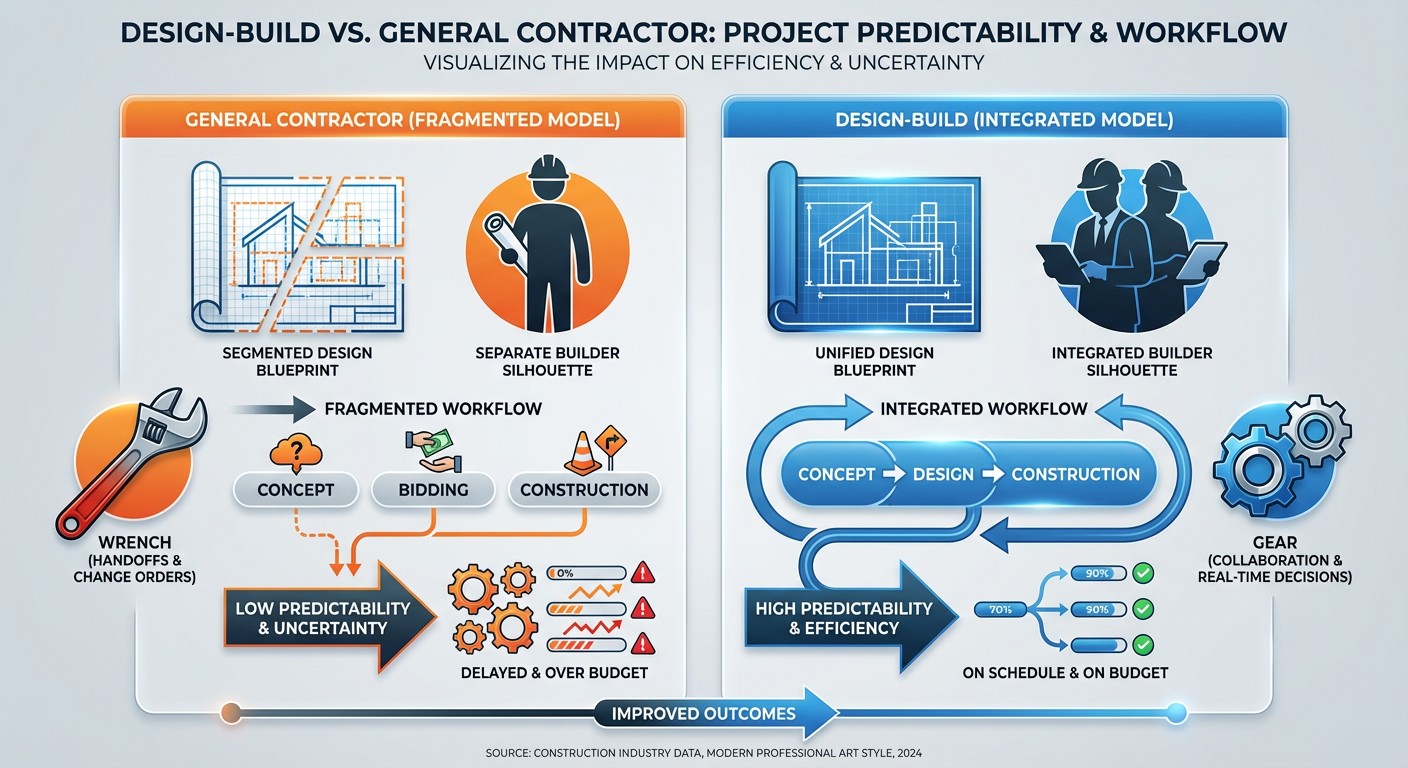
6. Design-Build vs. General Contractor Models
Project delivery methods significantly influence the frequency and cost of change orders in construction and remodeling projects. This section examines two primary models: the traditional General Contractor (GC) approach, often referred to as design-bid-build, and the integrated design-build method. It analyzes how each model impacts change order rates, cost predictability, and overall project outcomes, drawing upon industry research and specific examples, including practices at Phoenix Home Remodeling.
The Traditional General Contractor (Design-Bid-Build) Model
In the traditional General Contractor model, also known as design-bid-build, the design and construction phases are separate processes. First, a homeowner engages an architect or designer to create detailed plans and specifications for the project. Once these plans are complete, they are put out for bid to various general contractors. The contractor who submits the most favorable bid is then selected to execute the construction based strictly on the provided designs. This sequential approach means that the contractor’s involvement typically begins after most, if not all, design decisions have been made. [7]
This separation, while seemingly straightforward, can introduce several challenges that contribute to change orders. One major problem is that issues with the design may not become apparent until construction is already underway. For example, a design might specify a particular plumbing fixture without fully accounting for the existing pipework’s layout, or a structural element could conflict with a planned architectural feature. The contractor, who was not involved in the initial design phase, might only discover these discrepancies during demolition or installation. At that point, a change order becomes necessary to address the unforeseen problem, often leading to additional costs and schedule delays. [7]
Studies consistently show that design-bid-build projects tend to have more frequent and more substantial change orders compared to integrated delivery methods. [7][8] The lack of early collaboration between designers and builders can lead to errors or omissions in plans. These errors might include incorrect measurements, overlooked structural considerations, or incompatible material specifications. For example, if an architectural drawing vaguely defines an HVAC duct path, a general contractor might discover during installation that it cannot fit within the designated ceiling space without modification. This requires a change, resulting in extra time and money. According to SpecFinder, design errors and omissions alone can account for approximately 3% of the total contract value in change order costs. [9]
Furthermore, the traditional model can foster an adversarial relationship between the designer and the contractor. When issues arise, each party may attribute the problem to the other, with designers blaming “contractor error” and contractors pointing to “bad plans.” This finger-pointing can complicate the resolution of changes and further delay the project. The homeowner, caught in the middle, often bears the financial burden of these disconnects through increased change order costs. [12]
For interior remodel projects in particular, the traditional GC model can exacerbate issues related to owner-requested changes. Homeowners often do not fully visualize their finished space from 2D drawings alone. They might see the design come to life during construction and then decide they want to alter a material, add a feature, or move a wall. Since these decisions occur after the original contract is signed and work has started, each modification becomes a formal change order. The National Association of Home Builders (NAHB) reports that 70-80% of new home buyers request at least one change after contract signing, often due to a lack of complete understanding of the plans upfront. [9] This tendency is equally applicable to remodeling, where clients make decisions as they see progress on site, rather than having fully envisioned the outcome beforehand.
In Phoenix, projects using the traditional GC model might encounter specific regional challenges within the context of change orders. For instance, common causes tied to tile and glass choices are often client-driven. If a homeowner decides to change a specific tile pattern or upgrade to a custom glass shower enclosure mid-installation, this creates a change order. Without a design process that locks in all selections and ensures the client’s complete understanding of how those selections will look and function, such client-initiated changes are more likely. [14]
Another factor in traditional GC projects is the managing of unforeseen conditions. In older homes common in areas of Phoenix, unexpected discoveries like dry rot, outdated electrical systems, or plumbing issues are frequent. While a traditional GC will address these, the process for implementing the fix (including design, pricing, and client approval) might be less streamlined than in an integrated model, extending delays and increasing costs. An anecdote from a Phoenix remodel highlights this: a custom shower glass panel had to be re-fabricated for $2,800 because a design oversight meant the door would hit the shower valve post-installation [10]. Such an issue, stemming from a small coordination miss in the design phase, could be more common when the design and construction teams are separate.
Table 1 provides a summary of key characteristics of the traditional GC model in relation to change orders.
| Characteristic | Impact on Change Orders | Details |
|---|---|---|
| Design & Construction Separation | Higher frequency of changes | Design completed, then bid to GC. Limited contractor input during design leads to errors and omissions discovered during build. |
| Client Visualization | More client-driven changes | Difficulty for clients to fully grasp 2D plans, leading to changes once actual construction is visible. NAHB notes 70-80% of buyers make post-contract changes. [9] |
| Problem Resolution | Potential for adversarial dynamics | Finger-pointing between designer and contractor for errors, making change resolution complex and time-consuming. |
| Cost Predictability | Lower predictability | Higher likelihood of budget overruns, with projects experiencing 5-10% average cost increase. [18] |
| Schedule Predictability | Lower predictability | Change orders contribute to 10-20% of project schedule delays. [20] |
The Design-Build Model: An Integrated Approach
The design-build model changes the dynamic by placing both design and construction responsibilities under a single entity or a closely integrated team. This means the designer, whether in-house or a close partner, works directly with the builder from the project’s inception. This collaborative environment ensures that construction input is integrated into the design phase. [8] For instance, the builder’s experience with constructability, material costs, and scheduling can inform design decisions, preventing potential issues before they become costly on-site problems.
The benefits of this integrated approach are well-documented. A study by Penn State University, examining 120 projects, found that design-build delivery resulted in 90% fewer unforeseen change orders compared to the traditional design-bid-build method. [7] This same study noted a 71-98% reduction in cost growth from changes in design-build projects. [7] More broadly, a 212-project study indicated that design-build projects averaged 3.8% less cost growth and 1.7% less schedule growth than comparable design-bid-build jobs. [8] These statistics underscore the enhanced predictability and efficiency offered by the design-build model.
One primary reason for this improved performance is that design-build firms resolve many potential change orders on paper. As the design progresses, the construction team can review plans for practicability, potential conflicts, and material availability. If a planned beam conflicts with a plumbing line, the issue can be identified and resolved during design, often with minor tweaks to the plans, rather than stopping work and issuing a change order for field modification. This proactive problem-solving minimizes disruptions and maintains the project schedule and budget. [12]
From the client’s perspective, design-build offers a streamlined experience with a single point of responsibility. The firm is accountable for both the design’s functionality and the construction’s execution. This structure reduces the potential for finger-pointing and simplifies communication. When a client engages a design-build firm for an interior remodel, they work with a team that guides them through material selections, layout configurations, and finishes, ensuring all decisions are finalized before construction begins. Utilizing tools like 3D renderings and material showrooms helps clients fully visualize the outcome, which reduces post-contract changes. [9]
Phoenix Home Remodeling exemplifies the effectiveness of the design-build model. The company reports an exceptionally low change order rate of approximately 2.1% of project cost, which is significantly below the industry average often cited around 10%. [4][23] This is achieved through an in-house design process that requires all selections and specifications to be finalized and approved by the homeowners before any demolition or construction starts. [4] Their rigorous planning includes detailed walkthroughs and checks, catching potential conflicts (such as a light fixture interfering with cabinet doors) at the design stage, rather than halfway through construction. [15] This approach allows them to offer what amounts to a fixed-price contract for the agreed-upon scope, minimizing unexpected budget variations for clients. [11]
The predictability of design-build is a major advantage for homeowners undertaking interior remodels. While changes can still occur due to truly unforeseen conditions (like discovering mold behind a wall in an older Phoenix home), the systematic reduction of design-related errors and client-driven scope changes leads to a much smoother process. This predictability is driving the growth of design-build, which is forecasted to account for nearly half of construction spending by 2025. [28]
Table 2 provides a summary of key characteristics of the design-build model in relation to change orders.
| Characteristic | Impact on Change Orders | Details |
|---|---|---|
| Integrated Design & Construction | Significantly fewer changes | Builder input during design helps identify and resolve issues proactively, leading to 90% fewer unforeseen change orders. [7] |
| Client Visualization & Decision-Making | Reduced client-driven changes | Use of 3D renderings and comprehensive material selection processes ensures client understanding and finalizes decisions pre-construction. |
| Problem Resolution | Collaborative and efficient | Single point of responsibility reduces disputes and streamlines problem resolution, as design and construction teams work together. |
| Cost Predictability | Higher predictability | Averages 3.8% less cost growth from changes compared to traditional methods. [8] |
| Schedule Predictability | Higher predictability | Results in 1.7% less schedule growth from changes compared to traditional methods. [8] |
Comparison and Predictability
The fundamental difference between the two models lies in when and how decisions are made, and who is accountable for them. The traditional GC model, with its sequential phases, inherently postpones the integration of construction knowledge into the design. This creates more opportunities for discrepancies to surface during the build, which are then addressed as change orders. The contractor is obligated to build what is designed, and if the design has flaws or omissions, the burden of rectifying them often falls on the client through additional costs and delays. A mechanical contractor, McClure Company, showed that design-build projects resulted in 71% lower cost growth from changes. [7]
In contrast, the design-build model prioritizes upfront collaboration. By having the design and construction teams work together from the outset, practical considerations and potential conflicts are addressed much earlier in the project lifecycle. This integrated approach allows for a “constructability review” of the design, where the builder’s expertise is used to refine plans, ensure material availability, and anticipate challenges before ground is broken. This leads to a more comprehensive and realistic initial plan, which in turn reduces the need for mid-project changes. Phoenix Home Remodeling’s commitment to finalizing all details before work commences is a direct application of this principle, yielding their industry-leading low change order rate. [4]
For homeowners in Phoenix considering an interior remodel, the choice of project delivery model can have a direct impact on their experience. If predictability of budget and schedule is a high priority, a design-build firm offers a more controlled process. While a traditional GC can deliver a quality project, it often requires a more engaged and knowledgeable client who is prepared to manage the coordination between separate design and construction entities. A homeowner using a traditional GC model might mitigate some risks by bringing a contractor into the design process early for informal consultations, though this does not fully replicate the integrated accountability of a design-build firm. However, such proactive consultation can help catch glaring issues before the plans are finalized and sent out for bid. The more fragmented the process, the higher the likelihood of unwanted and costly change orders. The industry’s trend toward design-build reflects this recognition of its benefits in delivering more predictable project outcomes. [27]
For instance, Phoenix Home Remodeling’s approach specifically aims to eliminate the classic change order scenario where clients make ad-hoc decisions during construction. Their process of having clients consider future needs (e.g., adding reinforcing behind walls for future grab bars) during the design phase ensures a comprehensive plan. By engaging trades early for pre-construction walkthroughs, they can catch issues like conflicting light placements before any physical work begins, thus preventing change orders at no additional cost. [15] This level of upfront coordination is a hallmark of effective design-build firms.
Ultimately, while no construction project is entirely immune to changes (especially those caused by unforeseen conditions in older structures), the design-build model demonstrably reduces the occurrence of preventable change orders. It does so by fostering direct communication, ensuring early integration of expertise, and promoting a unified vision from project inception to completion. This contrasts with the inherent potential for miscommunication and discovery of conflicts later in the traditional GC model, where each phase is distinct and accountability can be segmented. The result for clients engaging design-build firms like Phoenix Home Remodeling is a remodeling experience with fewer financial surprises and a higher probability of timely completion, aligning closely with the initial agreement.
The next section will discuss specific strategies and project controls that can be implemented within either model to further reduce change order frequency and manage their impact.
7. Phoenix-Specific Change Order Trends
Change orders represent a persistent challenge in construction and remodeling across the United States. In the specific context of Phoenix, Arizona, these mid-project alterations often present unique characteristics. This section examines how change orders manifest in the Phoenix interior remodeling market, focusing on prevalent causes, common material selections like tile and glass that frequently trigger these changes, and local strategies for mitigation. Data indicates that while change orders are a national concern, regional factors can intensify their impact or shape their specific drivers. For instance, the general construction industry faces substantial costs from change-related rework, delays, rescheduling, and extra project administration, which can place major pressure on budgets and timelines across the U.S. construction market [3]. Nationally, change orders typically add about 5-10% to total project costs[13][2], and in some cases can increase expenses by as much as 25% of the original contract value[2]. Given that roughly 74% of construction projects experience at least one change order[1], their occurrence is more the rule than the exception. For homeowners in Phoenix undertaking interior remodels, understanding these regional specifics is crucial for effective project planning and budget management. This analysis also profiles Phoenix Home Remodeling, a local company that has achieved a remarkably low change order rate, offering a practical case study for best practices in the region.
Prevalence and Economic Impact of Change Orders in Phoenix and Surrounding Areas
The frequency and cost of change orders are significant for remodeling projects in Phoenix, mirroring national trends but with localized nuances. Approximately three out of four construction projects in the U.S.[1], and by extension, a similar proportion of remodeling projects in Phoenix, will experience at least one change order. This ubiquity implies that homeowners and contractors should expect some modifications during the course of a remodel. For interior remodels specifically, client-initiated scope additions and unforeseen issues discovered during demolition are common triggers[5].
The financial impact of these changes is considerable. On average, change orders contribute about 10% to the total contract value in construction[2]. This percentage translates into thousands or tens of thousands of dollars for many Phoenix interior remodels. For a $100,000 remodel, an average 10% overrun due to change orders means an additional $10,000 on top of the planned cost[2]. In some extreme instances, change orders can inflate project costs by up to 25% over the initial budget[2]. Moreover, change orders do also affect costs; they also cause project delays. Industry analysis links change orders to 10-20% of all project schedule delays[3]. In Phoenix, where construction timelines are often improved, such delays can be particularly new for homeowners.
Despite these challenges, some regional data shows variations in change order costs. In 2020, the U.S. West, which includes Arizona, recorded the highest average change order amount for new home construction at $12,610 per change, a 46% increase from the previous year[4]. This regional variance suggests that specific conditions, material costs, or design preferences in the Western states contribute to higher individual change order values compared to other regions like the South, which saw an average of $6,200 per change order in the same year[4]. For interior remodels in Phoenix, these higher average costs per change mean that even a single modification can significantly affect the overall budget.
The cumulative effect of change orders in the U.S. construction industry is significant[3][2]. While this figure encompasses all construction, it underscores that even small changes within individual interior remodels contribute to a substantial national economic drain. For contractors, frequent change orders erode profit margins. Projects without change orders show a higher gross margin-25.8% compared to 22.8% for projects with changes[4]. This reduction in profitability impacts Phoenix remodelers, highlighting the financial incentive to minimize changes.
Phoenix-Specific Drivers of Change Orders for Interior Remodels
While the root causes of change orders are largely universal, the manifestation of these causes can be influenced by local preferences, climate, and housing stock. In Phoenix, interior remodels frequently encounter specific drivers related to material choices and the characteristics of older homes.
1. Owner Design Changes and Material Selections
Client preferences are a primary driver of change orders globally[5], and Phoenix is no exception. Homeowners often change their minds or add elements during the remodeling process. These requests can range from minor adjustments, such as repositioning an electrical outlet (estimated at $200-$500 per change), to more substantial modifications like extending a tile backsplash or adding recessed lighting, which can incur costs of $1,000-$2,000 per change[6]. The National Association of Home Builders (NAHB) research suggests that 70-80% of new home buyers make at least one change after signing the contract[9]. This often happens because clients do not fully visualize the design until they see it taking shape on site. For Phoenix homeowners, this highlights the need for thorough upfront discussions and visualization tools during the design phase.
Specifically, in Phoenix, remodelers frequently cite custom finishes as a significant source of change orders. Special-order tiles and custom-cut glass panels are often mentioned as problem areas[11]. These materials can have extended lead times or precise fitting requirements that demand careful planning. For example, a custom shower glass panel that does not fit correctly can lead to a change order costing around $2,800 for re-fabrication and adjustments, often delaying the project by several weeks[10].
2. Unforeseen Existing Conditions in Older Phoenix Homes
Phoenix has a diverse housing stock, including many older homes built in the mid-20th century. Remodeling these properties often uncovers hidden issues that were不仅可见 during initial inspections. Common discoveries include antiquated wiring, plumbing not up to current code, water damage, mold, or termite damage. Such unforeseen conditions necessitate additional work that was not included in the original scope, leading to change orders. Industry analysis indicates that unforeseen site conditions account for approximately 2.2% of project costs on average[3]. In Phoenix, contractors frequently find:
-
- Corroded galvanized plumbing: Many older homes have galvanized pipes that corrode over time, leading to low water pressure and potential leaks. Discovering these requires re-piping parts of the system.
-
- Outdated electrical systems: Knob and tube wiring or ungrounded systems may need to be upgraded to meet current safety codes once walls are opened.
-
- Termite damage: The desert climate makes termite activity common. Structural beams or wall studs might have hidden damage requiring repair or replacement.
-
- Unpermitted past renovations: Previous owners might have made modifications without permits, necessitating corrections to meet code compliance retrospectively.
A Phoenix kitchen remodel in an older home, for instance, uncovered corroded galvanized plumbing and termite damage in a structural beam, leading to a $5,500 change order and a two-week delay for repairs and inspections[10]. These examples underscore the importance of including a contingency fund in budgets for Phoenix remodels, especially for older properties.
3. Errors or Omissions in Plans
Incomplete or inaccurate initial drawings and specifications are another significant cause of change orders. These design errors or omissions contribute roughly 3% to total contract costs[3]. They are particularly common in traditional design-bid-build models where the design team and construction team are separate entities. If a structural element is overlooked or measurements are incorrect, adjustments must be made during construction, resulting in a change order. For instance, if a design does not account for a large heating, ventilation, and air conditioning (HVAC) duct that conflicts with a new ceiling layout, a change order becomes necessary to reroute the ductwork. This issue points to the need for close collaboration between designers and builders from the project outset.
4. Regulatory and Code Updates
Building codes, permit requirements, and directives from local inspectors can also trigger change orders. In Phoenix, as in other jurisdictions, a remodel might trigger requirements for upgrades not initially planned. For example, opening a wall might expose a condition that requires new insulation to meet current energy codes, or an inspector might require additional fire safety equipment like smoke detectors[5]. In some cases, a new addition might trigger the need for a hardwired fire sprinkler system, adding thousands to the project cost (e.g., $4,360)[6]. These changes are typically non-negotiable and mandated by authorities, making them unavoidable once identified.
5. Subcontractor Coordination and Communication Issues
Although not explicitly listed as a top driver in the provided research, poor coordination among subcontractors and communication breakdowns between stakeholders (owners, designers, builders) are often underlying factors for many change orders. An estimated 80% of all change orders are attributed to “poor information” across stakeholders[3]. Miscommunication accounts for nearly 48% of rework in U.S. construction[3]. For an interior remodel in Phoenix, this might mean a plumber installs pipes in a location that conflicts with a carpenter’s layout for a custom cabinet, leading to rework and a change order. Proper upfront planning, detailed documentation, and effective communication channels are therefore crucial to mitigate these issues.
Median Cost of Change Orders in Phoenix Interior Remodels
The cost of individual change orders in Phoenix interior remodels varies depending on the nature and complexity of the change. While there isn’t a specific median cost for Phoenix alone in the provided data, national trends offer a good approximation. Many common discretionary changes, such as adding an electrical outlet or swapping a faucet, typically cost between $200-$500. Upgrades like extending tile work or adding a skylight often range from $1,000-$2,000[6]. In a review of hundreds of remodel projects, most owner-elected upgrades fell under $3,000 each[6].
However, more significant changes can quickly escalate costs. Adding a new window, moving a wall, fixing structural issues, or addressing unforeseen problems like an unexpected foundation repair can easily incur costs of $5,000 to $10,000 or more per change[6]. For example, an unforeseen foundation reinforcement might cost over $6,000[6]. These figures demonstrate that while some changes are minor, others can substantially impact the project budget.
The cumulative effect is even more telling. The average total value of change orders on a new single-family home in the U.S. was approximately $29,251 in 2020[3]. While interior remodels are distinct from new home construction, this figure indicates the potential for significant cumulative cost increases. Industry benchmarks suggest budgeting for about 10% of the project value for change orders[2]. Therefore, a $50,000 kitchen remodel in Phoenix might face an average of $5,000 in change orders. The median cost increase from change orders is likely around 5% or less for well-planned projects, meaning about half of all projects experience changes that add five cents on the dollar or less. However, the overall industry average of 10% is skewed higher by projects with numerous substantial changes.
Impact of Preconstruction Design on Change Order Frequency
Rigorous preconstruction design reduces the frequency and cost of change orders. This involves making all critical decisions and selections before construction begins. The principle is that making changes on paper is always less expensive and less time-consuming than making them in the field. This approach is exemplified by companies that prioritize detailed design and planning.
Phoenix Home Remodeling, a prominent local company, demonstrates the effectiveness of preconstruction planning. They report an exceptionally low change order cost rate of about 2.1%[11], significantly below the industry average of around 10%[2]. This achievement is attributed to their comprehensive in-house design process, where all material selections (tiles, fixtures, layouts) are finalized and approved by the client before any construction work commences[11]. This process often includes using 3D renderings and detailed specification sheets to ensure the client fully understands and approves the design. By locking in decisions early, the likelihood of clients requesting changes mid-project is greatly reduced.
The company also emphasizes anticipating potential issues through detailed design reviews and pre-construction walkthroughs with all relevant trades. For example, a Phoenix Home Remodeling project avoided a costly change order when an electrician identified a potential conflict between a planned pendant light and a cabinet door during a walkthrough. The design was adjusted on paper, preventing a reinstallation or modification during construction[10].
Design-Build vs. General Contractor Models for Predictability in Phoenix Remodels
The choice of project delivery method significantly affects change order predictability. Two common models are the traditional General Contractor (GC) model (also known as design-bid-build) and the design-build model.
Traditional General Contractor (Design-Bid-Build)
In the traditional GC model, a homeowner first hires an architect or designer to create project plans. These fully developed plans are then bid out to multiple general contractors, who execute the construction. The primary challenge with this approach is the separation between design and construction. The contractor’s involvement often begins after the design is largely complete, which means potential constructability issues, material availability problems, or ambiguities in the plans may not be identified until construction is underway. This can lead to a higher incidence of change orders, as builders encounter discrepancies or unforeseen conditions that require design revisions. Studies show that design-bid-build projects typically experience more frequent and larger change orders compared to integrated approaches[7][8].
This model can also foster an adversarial relationship where designers and contractors might attribute blame to each other for issues, rather than collaborating to find solutions. The homeowner often bears the financial impact of these disconnects.
Design-Build Model
The design-build model integrates design and construction services under a single entity or a unified team. This approach brings contractors into the design process early, allowing their construction expertise to inform and refine the plans. This early collaboration identifies and resolves many potential issues on paper, before they become costly mid-construction changes. The advantages of design-build for reducing change orders are well-documented:
-
- Fewer unforeseen changes: A Penn State study of 120 projects found that design-build projects experienced 90% fewer unforeseen change orders compared to design-bid-build projects[7].
-
- Improved predictability: The integrated nature means that cost estimates are more realistic, as the builder has direct input on design decisions and material selections. This leads to greater budget certainty for homeowners.
-
- Single point of accountability: The homeowner deals with one entity responsible for both design and construction, simplifying communication and responsibility for the project’s outcome.
Phoenix Home Remodeling operates on a design-build model, which is a key factor in their minimal 2.1% change order rate[11]. This model encourages thorough pre-construction planning, where the construction team’s practical knowledge influences design decisions, reducing the chance of design conflicts or impractical elements. The company ensures detailed scope definition and extensive client walkthroughs of the design to prevent “surprises” once construction begins. The growth of design-build, projected to account for nearly half of U.S. construction spending by 2025[14], points to its increasing acceptance as a means to achieve more predictable project outcomes.
While a traditional GC model can deliver successful projects, it usually requires a diligent homeowner or designer to manage coordination and ensure completeness of plans. Without that proactive effort, the statistical evidence favors the design-build model for reducing costly change orders and enhancing budget and schedule predictability in interior remodels in Phoenix.
Case Studies: Phoenix-Specific Change Order Trends and Mitigation
Examining specific instances of change orders in Phoenix helps illustrate the common trends and the effectiveness of prevention strategies.
Custom Shower Glass Misstep (Phoenix, 2025)
A Phoenix homeowner faced a significant change order during a bathroom remodel due to a coordination error. A custom shower glass panel was ordered based on initial plans. However, once the tile was installed and fixtures were in place, it became apparent that the glass door’s swing path collided with the shower valve. This design oversight necessitated a new custom-cut glass panel and relocation of the shower valve, resulting in a $2,800 change order and several weeks of delay due to re-fabrication and reinstallation[10]. Phoenix Home Remodeling cites similar examples to emphasize the importance of careful checking of component interactions during the design phase to avoid such costly errors when special-order materials are involved.
Hidden Surprises in an Older Home Remodel (Phoenix, 2021)
An interior remodel of a historic home in Phoenix’s Encanto district, despite careful budgeting, encountered unforeseen conditions. Upon opening walls, contractors found corroded galvanized plumbing and termite damage in a structural beam. These issues were not visible during initial inspections. The necessary repairs-replacing plumbing lines and reinforcing the beam-resulted in a $5,500 change order and a two-week project extension[10]. This case highlights that for older Phoenix homes, a contingency fund is crucial. The homeowner had been advised to set aside a 10% contingency, which absorbed this unforeseen cost. This example suggests that exploratory demolition or the use of endoscopic cameras during the pre-remodel phase could potentially identify such hidden issues earlier, converting an unexpected change order into a planned line item.
Phoenix Home Remodeling’s Zero Change Order Success (Phoenix, 2026)
Phoenix Home Remodeling has achieved a reputation for completing interior remodels with virtually no change orders. A recent kitchen and bath remodel in Chandler, Arizona, illustrates this success. The project concluded with the final cost exactly matching the contracted price. This was a direct result of PHR’s detailed preconstruction process, including multiple design review meetings, comprehensive specification sheets for all products, and thorough pre-construction walkthroughs involving all trades. For instance, an early walkthrough identified a potential conflict between a pendant light placement and a cabinet door. The design was adjusted on paper before any construction began, preventing a costly rework during the project[10]. This proactive approach, emphasizing detailed planning, strong client communication, and rigorous quality control, allows Phoenix Home Remodeling to maintain its industry-leading low change order rate of 2.1% or less[11].
Summary of Phoenix-Specific Change Order Trends
In summary, interior remodeling projects in Phoenix are subject to the same general change order drivers as elsewhere, but with heightened sensitivity to specific factors:
-
- High client interaction and material choices (tile and glass): Client-initiated changes are prevalent, particularly concerning custom finishes like tiles and unique glass installations (e.g., shower enclosures). These items often have long lead times or specific installation requirements that can easily lead to costly adjustments if not finalized early.
-
- Older housing stock issues: The presence of many older homes in Phoenix increases the risk of encountering unforeseen conditions such as outdated plumbing, electrical systems, or structural damage (e.g., termite damage) once demolition exposes existing structures.
-
- Importance of preconstruction planning: Phoenix Home Remodeling’s success demonstrates that investing heavily in the preconstruction design phase, including detailed material selections, 3D renderings, and comprehensive trade walkthroughs, effectively minimizes change orders.
-
- Design-build model advantages: The integrated nature of design-build delivery proves particularly effective in the Phoenix market for reducing change orders, offering greater budget predictability compared to traditional design-bid-build approaches.
The localized examples highlight that while overall change order rates and costs align with national figures, tailoring prevention strategies to regional material preferences and housing characteristics is essential. By understanding these trends and adopting thorough preconstruction processes, Phoenix remodelers and homeowners can significantly reduce the financial and schedule impacts of change orders.
8. Strategies to Avoid Change Orders
Change orders are a common occurrence in construction and remodeling projects. Around 74% of construction projects experience at least one change order during execution[1]. In homebuilding, between 70% and 80% of new home buyers request changes after the contract is signed[2]. These changes typically add 5% to 10% to the total project cost on average[3][4]. In some cases, change orders can increase the original contract value by as much as 25%[5]. The additional costs and delays arising from change orders can place major financial pressure on the U.S. construction industry through rework, lost productivity, delayed schedules, extra coordination, and additional project administration[6][7]. This represents about 5% of all construction spending[8] and is linked to 10% to 20% of total project schedule delays[9]. Given these figures, actively working to avoid or manage change orders is crucial for both homeowners and contractors.
For interior remodeling projects, common triggers for change orders include client-initiated additions and unexpected problems found during demolition, such as mold or outdated wiring[15][16]. A single change order in a remodel can cost a few thousand dollars. For example, changing flooring or adding a light fixture might cost $1,000 to $3,000[17]. More complex changes, such as structural fixes or required code upgrades, can range from $5,000 to $10,000 or more[18]. The average U.S. home built in 2020 had about $29,000 in total change orders[19]. This section details practical strategies for minimizing change orders and effectively managing their impact when they do occur. These methods focus on thorough planning, clear communication, and process improvements, including contingency planning.
The Real Costs and Impact of Change Orders
Understanding the full financial and operational impact of change orders is the first step in creating strategies to avoid them. Change orders are not just minor adjustments; they have a cascading effect on project budgets, timelines, and contractor profitability.
-
- Budget Overruns: The average cost increase due to change orders is approximately 10% of the total contract value[21]. This means a $100,000 remodel could easily incur an additional $10,000 in costs. In some extreme cases, projects have seen cost increases of up to 25% beyond the initial budget[22]. The cumulative value of change orders on a new single-family home was about $29,251 in 2020[25]. For projects under $250,000, the average total change order cost was approximately $16,793 in 2020[26]. These figures demonstrate that change orders represent a significant financial burden.
-
- Schedule Delays: Beyond costs, change orders cause significant delays. About 10% to 20% of project timeline delays are directly linked to change orders[23]. Each change often requires rework, new material orders, and rescheduling of different trades, which can extend a project by days or weeks. This impacts both homeowners (longer disruption) and contractors (extended overhead, penalty clauses).
-
- Profit Margin Erosion: Change orders negatively affect contractor profit margins. A study found that small construction jobs without change orders had an average 25.8% gross margin, while jobs with changes saw this drop to 22.8%[27]. For home builders, profits fell from 15.0% to 12.6% when change orders were involved[28]. This reduction of 2 to 3 percentage points highlights how the time spent processing changes, managing rework, and dealing with inefficiencies directly cuts into a contractor’s earnings.
-
- Administrative Burden: The process of managing a change order involves paperwork, re-pricing, obtaining approvals, and coordinating new work. This administrative overhead is often not fully recoverable even when direct costs are passed on to the client. Some contractors may absorb minor change costs rather than process formal change orders, further eroding their margins[50].
The prevalence is high, with only about 26% of projects finishing with zero change orders[11]. This means approximately three out of four projects require some modification after the initial contract. The average large construction job includes around 11 change orders[10]. This frequency underscores the need for strong prevention and management strategies.
Key Drivers of Change Orders in Interior Remodels
Identifying the primary causes of change orders is essential for developing effective prevention strategies. In interior remodeling, the top drivers stem from a combination of client decisions, hidden conditions, and planning gaps.
1. Owner Design Changes
Homeowners frequently change their minds or add elements during a remodel. This is a leading cause of change orders in interior projects[12]. Examples include upgrading materials (e.g., from standard to high-end countertops), adding features (e.g., recessed lighting), or altering layouts after construction has begun. Research by the NAHB indicates that 70% to 80% of new home buyers make at least one change after the contract is signed[13]. This often happens because clients do not fully visualize the design until they see it taking shape on-site. Even small requests like extending a tile backsplash can trigger costs for extra materials, labor, and potential schedule extensions.
2. Unforeseen Existing Conditions
In remodeling, particularly in older homes, surprises often hide behind walls. Common discoveries during demolition include water damage, mold, termite damage, outdated electrical wiring, or unexpected structural elements[14]. For instance, in Phoenix’s older homes, contractors may find unpermitted past renovations or substandard electrical work. Addressing these issues usually requires additional work not covered in the original scope, leading to a change order. Industry analysis suggests that unforeseen site conditions account for approximately 2.2% of project costs on average[29]. These often non-negotiable fixes can add significant costs and time to a project.
3. Errors or Omissions in Plans
Sometimes, the initial drawings or specifications contain mistakes or are incomplete. This can include incorrect measurements, overlooked structural components, or missing details. When these errors are discovered during construction, a change order is needed to correct the issue. For example, if a structural beam conflicts with a new doorway, the design must be revised on the spot. Design errors and omissions can contribute about 3% of total contract costs[30]. These issues are more frequent in traditional design-bid-build models where the contractor is not involved in the design phase, leading to coordination gaps.
4. Regulatory and Code Updates
Changes in building codes, permit requirements, or directives from inspectors can trigger change orders. Remodels can necessitate upgrades to meet current codes, such as adding specific insulation or additional safety features not initially planned. An example is a project requiring a fire sprinkler system in a renovated room due to a local code interpretation, costing about $4,360[31]. These changes are typically mandatory and can lead to unexpected costs and delays.
5. Material Availability and Specification Changes
Issues with materials can also cause change orders. This includes situations where a specified material becomes unavailable or back-ordered, necessitating a substitute. Alternatively, clients might decide to switch to a different material after seeing samples or new options. For instance, delays in imported tiles or custom-cut glass panels are common issues. In Phoenix, custom finishes like special-order tiles or shower glass are frequently cited causes of change orders[32][33]. If a custom shower glass panel does not fit correctly, reordering and adjustments can lead to thousands of dollars in extra costs and delays.
Underlying many of these drivers is poor communication or incomplete information. An FMI survey found that 80% of all change orders are due to “poor information” among stakeholders[34]. This highlights that enhanced communication and clear information sharing can address multiple root causes of change orders simultaneously.
Effective Strategies to Minimize Change Orders
Minimizing change orders requires a proactive and systematic approach that prioritizes planning, communication, and process integration.
1. Thorough Preconstruction Planning and Design
The most effective way to reduce change orders is to invest significant time in the preconstruction and design phases. Decisions made early are always less costly to implement than changes during construction. This includes:
-
- Detailed Design Finalization: All layouts, material selections (e.g., tile, fixtures, paint colors), and specifications should be finalized and approved before construction begins. Phoenix Home Remodeling, for example, achieves very low change order rates by ensuring all selections are locked in with the help of 3D renderings and in-house designers, leaving no room for ambiguity once work starts[19].
-
- Client Visualization: Use advanced tools like 3D renderings, virtual walkthroughs, and physical showrooms to help homeowners fully visualize the final project. This allows them to identify desired changes or potential issues before construction begins, preventing “I changed my mind” scenarios mid-project[13].
-
- Comprehensive Documentation: Ensure plans, specifications, and contracts are clear, detailed, and leave minimal room for interpretation. Every detail, from outlet placement to trim thickness, should be agreed upon and documented.
2. Utilizing the Design-Build Delivery Method
The design-build model integrates design and construction teams, fostering collaboration from the project start. This integration significantly reduces change orders because construction input is provided during the design phase, catching potential issues early.
-
- Reduced Conflicts: In a design-build setup, the same firm or a cohesive team handles both design and construction. This eliminates the “us vs. them” dynamic often found in traditional design-bid-build, where designers and contractors might blame each other for discrepancies.
-
- Proactive Problem Solving: Contractors can review designs for constructability, identify potential conflicts (e.g., a light fixture conflicting with ductwork), and suggest adjustments proactively, before they become costly on-site changes. Studies confirm design-build projects have significantly fewer unexpected change orders. A Penn State study found 90% fewer unforeseen change orders and a 71% to 98% reduction in cost growth from changes in design-build projects compared to design-bid-build[20][55]. In a broader study, design-build averaged 3.8% less cost growth and 1.7% less schedule growth[20].
-
- Single Point of Accountability: For homeowners, design-build offers a single point of contact and accountability, simplifying the process and minimizing finger-pointing if issues arise.
3. Enhancing Communication and Collaboration
Given that 80% of change orders stem from poor information[34], improving communication among all stakeholders is critical.
-
- Regular Meetings: Schedule regular meetings during preconstruction to review every detail with the client, designers, and contractors. This ensures everyone has a shared understanding of the project scope and expectations.
-
- Clear Communication Channels: Establish clear methods for communicating questions, concerns, and potential issues. This can involve project management software that tracks communication and approvals in real-time.
-
- Updated Documentation: Maintain updated drawings and specifications on-site and ensure the entire team is working from the latest versions. Miscommunication between the office and field can lead to rework that could be avoided.
4. Contingency Planning and Budgeting
While prevention is key, some changes, particularly those due to unforeseen conditions in older homes, are unavoidable. Effective planning includes preparing for these unknowns.
-
- Allocate a Contingency Fund: Experts recommend including a contingency of about 10% to 15% of the total project cost for unforeseen conditions or minor owner-requested changes[35][36]. For a $50,000 remodel, this means setting aside an additional $5,000 to $7,500. This buffer prevents budget crises and allows for quick resolution of unexpected issues.
-
- Transparent Discussion of Contingency: Contractors should clearly explain the purpose of the contingency fund to homeowners, emphasizing that it is for true surprises or late-stage modifications, not for covering project estimate errors.
-
- Exploratory Work: For older homes, consider conducting limited exploratory demolition or using tools like endoscopic cameras to inspect hidden areas before finalizing the scope. This can convert “unforeseen” conditions into planned work items, as was discussed in the older Phoenix home remodel example where plumbing and termite issues were discovered post-demolition.
5. Material Selection and Management
Careful management of material choices and logistics can mitigate changes related to products.
-
- Early Selection Lock-in: Encourage and facilitate early finalization of all material selections. Provide alternative options for any materials that have long lead times or are prone to availability issues.
-
- Lead Time Awareness: Inform clients about the lead times for custom or special-order items. This helps manage expectations and allows for early ordering, reducing delays and last-minute substitutions.
-
- Detailed Specifications for Custom Items: For custom elements like shower glass or intricate tile patterns, ensure extremely detailed specifications and measurements are double-checked by multiple parties before ordering. The Phoenix example of a re-fabricated shower glass panel highlights the cost of a small coordination miss in custom orders[51].
Comparing Design-Build vs. General Contractor Models for Predictability
The choice of project delivery model significantly influences the frequency and cost impact of change orders.
Traditional General Contractor (Design-Bid-Build) Model
In this model, an architect or designer creates plans independently, and then a general contractor (GC) bids on and executes the construction based on those plans.
-
- Challenges:
-
- Separation of Design and Construction: The GC’s involvement typically begins only after design is largely complete. This separation often means that constructability issues, material availability problems, or cost implications of design choices are not fully identified until construction is underway.
-
- Potential for Conflict: The fragmented nature can create an adversarial environment where designers and contractors might attribute blame for changes, leading to disputes and delays. For example, if a structural element is overlooked in architectural plans, the GC might blame the designer for the extra cost and time required to fix it.
-
- Challenges:
Design-Build Model
The design-build model consolidates design and construction services under a single entity or a tightly integrated team. This approach aims to streamline the project and minimize issues.
-
- Advantages:
-
- Integrated Team: Design and construction professionals work together from the outset. This collaboration allows for early identification and resolution of potential conflicts, cost issues, and constructability challenges.
-
- Fewer Change Orders: Data consistently shows significant reductions in change orders. A Penn State analysis found 90% fewer field change orders on design-build projects compared to design-bid-build[56]. Cost growth due to changes was almost eliminated, with a 98% reduction in one study[57]. Overall, design-build projects average 30% to 40% fewer cost and schedule deviations[58][59].
-
- Improved Predictability: By integrating knowledge from both design and construction phases, estimates and timelines are more accurate from the start. This leads to fewer unwelcome surprises for homeowners. Phoenix Home Remodeling, operating on a design-build model, reports a change order cost rate of about 2.1%[20][60], which is remarkably low compared to the industry average of 10%.
-
- Single Source of Accountability: The homeowner deals with one entity responsible for both design and construction. This simplifies communication and problem resolution.
-
- Advantages:
The McClure Company, a mechanical contractor, provided a real-world example of this benefit. Their study of 120 projects showed design-build jobs had 90% fewer “surprise” change orders than plan-and-spec projects[61]. Cost growth due to changes was under 1% for design-build, compared to 5% to 6% for design-bid-build[62][63]. This highlights how an integrated approach can substantially reduce changes and their associated costs.
For remodeling projects, the design-build model is a powerful tool for achieving predictability. While a traditional GC model can work well with experienced, collaborative teams and proactive homeowners, the inherent integration of design-build provides a structural advantage in preventing change orders and improving project certainty.
Phoenix Home Remodeling’s Approach to Minimize Change Orders
Phoenix Home Remodeling (PHR) presents a relevant example of how a firm can achieve significantly lower change order rates through a focused strategy. PHR reports an average change order rate of approximately 2.1%, which is substantially below industry norms that often hover around 10%[20][60]. Their success is attributed to several key practices:
-
- In-House Design Team: PHR employs in-house designers who work closely with clients from the initial concept phase. This ensures that expert builders’ input is considered during design, preventing many constructability issues.
-
- Detailed Material Selections Pre-Construction: All material selections, such as tiles, fixtures, and paint colors, are finalized and documented before any construction work begins. This eliminates last-minute changes due to client indecision or misunderstanding of material appearance.
-
- 3D Renderings and Visualizations: Clients review detailed 3D renderings and comprehensive plans. This allows them to visualize the finished space accurately, making design adjustments on paper rather than during construction.
-
- Fixed-Scope Contracts: PHR operates on a fixed-scope contract model, where the project parameters are clearly defined upfront. This focus is stated to “eliminate change orders and budget surprises,” by ensuring that clients understand exactly what they are getting and that all elements are locked in[20][66].
-
- Proactive Issue Identification: During pre-construction walkthroughs with all involved trades, potential conflicts or issues are identified and resolved before construction. An example cited from a PHR project involved an electrician identifying a potential conflict between a planned pendant light and a cabinet door. This was resolved by adjusting the cabinet design on paper, averting a costly change order during the build phase[65].
By implementing these strategies, PHR ensures that projects are well-planned and decisions are made comprehensively upfront. This integrated and thorough approach is central to their ability to deliver projects with minimal unexpected changes, benefiting both the homeowners and the company.
Conclusion and Transition
Strategies to avoid change orders are centered on strong preconstruction planning, comprehensive communication, and, ideally, an integrated design-build delivery method. While change orders are common, their frequency, cost, and impact on project schedules can be significantly reduced through proactive management. For homeowners, understanding these strategies allows for better engagement with contractors and setting realistic budget expectations by including a contingency fund. For remodelers, adopting these practices can lead to more predictable project outcomes, higher client satisfaction, and improved profit margins. The next section will offer a detailed prevention checklist for both homeowners and contractors, based on the strategies discussed in this section.
The consistent message from industry analysis is that good communication and precise upfront planning are the strongest defenses against costly project overruns and delays. It is possible to deliver remodeling projects with high predictability and minimal changes. This requires commitment from both the client and the contracting team to finalize details before construction begins, rather than making decisions on the fly.
The insights presented here will directly inform the practical recommendations within the prevention checklist and guide the comparison of different delivery models for managing predictability. Focusing on these areas will allow homeowners and contractors to significantly reduce the financial burden and stress associated with change orders.
9. Frequently Asked Questions
Remodeling projects, particularly interior remodels, often bring up a variety of questions related to costs, timelines, and the overall process. Among the most common concerns for homeowners and contractors alike are change orders. Change orders are modifications to the original scope of work after a contract has been signed. They can significantly impact a project’s budget and schedule. Understanding why they happen, how much they cost, and how to prevent them is crucial for a successful and predictable remodeling experience. This section addresses key questions about change orders, drawing on industry data and practical examples from the Phoenix market and beyond, to provide clear and concise answers.
What percentage of projects experience change orders?
Change orders are not an exception; they are the norm in the construction industry. Data indicates that a significant majority of projects will encounter at least one change order during their execution. Approximately 74% of construction projects experience at least one change order[1]. This means that only about 26% of contracts finish with no modifications to the original scope[1]. For interior remodeling projects, this rate is often similar or even higher, especially as homeowners frequently make decisions or request adjustments once they see the work progressing. In new home construction, for example, 70-80% of buyers request changes after signing the contract[2]. This highlights a common issue: clients may not fully visualize the design until parts of it are built. These changes, whether minor or major, necessitate formal change orders to adjust the contract. An average large construction project can involve around 11 change orders throughout its lifecycle[8].
The prevalence of change orders is uniform across various project sizes and types, from large commercial builds to residential interior remodels. This high frequency underscores the need for proactive planning and a structured approach to manage modifications. The idea that a remodeling project will proceed without any deviation from the initial plan is largely unrealistic for most people. Instead, acknowledging the high probability of changes and planning for them can help manage expectations and reduce stress for all parties involved.
What are the top five causes of change orders in interior remodels?
Change orders in interior remodels typically stem from a few recurring issues. While a specific project might have its own unique triggers, industry analysis identifies five primary causes:
1. Owner Design Changes
One of the most frequent causes of change orders is the homeowner’s decision to modify the design or add features after construction has started[13]. This is often not due to indecision, but because clients may not fully visualize how a completed space will look or function until they see it being built. For example, a homeowner might decide mid-project to upgrade a countertop material, add recessed lighting in a previously unplanned area, or extend a tile backsplash. Each of these requests alters the original scope of work and requires a change order to account for the new materials, labor, and potential impact on the schedule. Research by the NAHB indicates that 70-80% of new home buyers request at least one change after signing the contract[9]. The impact of these client-initiated changes on project costs can be significant, ranging from several hundred to several thousand dollars per change. Even a small decision, such as moving an electrical outlet, can require re-routing wires, patching drywall, and repainting, adding unexpected costs.
2. Unforeseen Existing Conditions
Unlike new construction, remodeling projects involve working with existing structures. This often means encountering issues that were not visible during initial inspections. Common surprises discovered during demolition include outdated plumbing (e.g., corroded galvanized pipes), faulty electrical wiring, water damage, mold, pest infestations (like termites), or structural problems not initially apparent. When these issues are found, they often require immediate attention for both safety and code compliance. Addressing unforeseen conditions necessitates additional work that was not in the original contract, thus generating a change order. For instance, in Phoenix, older homes often reveal unpermitted past renovations or substandard electrical work that must be corrected to meet current safety standards. Industry data suggests that unforeseen site conditions can account for about 2.2% of a project’s cost on average[14]. These changes are typically non-discretionary, meaning they must be addressed, which adds both cost and time to the project.
3. Errors or Omissions in Plans
Sometimes, the initial design documents or specifications may contain inaccuracies, errors, or omissions. These can range from incorrect measurements and material specifications to overlooked structural details or conflicts between different building components. When design flaws are identified during construction, they must be corrected, often leading to a change order. For example, if a structural element is missed in the plans, or if the specified dimensions for custom cabinetry do not fit the space, adjustments are required. Design errors or omissions can make up around 3% of total contract costs[14]. This is especially true in projects where the design team and construction team are separate, as there might be coordination gaps or an inadequate review of constructability before work begins. These types of changes are often preventable with thorough upfront design and review processes.
4. Regulatory and Code Updates
Building codes, permit requirements, and local regulations can change, or their interpretation by inspectors can lead to unexpected demands during a remodel. Projects, particularly in older homes, may trigger requirements to bring certain elements up to current code standards that were not initially part of the scope. For example, opening up a wall might necessitate adding new insulation to meet energy codes, or an inspector might require additional smoke detectors, fire sprinklers, or other safety features. A fire sprinkler system for an addition or remodel, for instance, can cost over $4,000[7]. These regulatory changes are usually non-negotiable and must be implemented, adding to the project cost and potentially causing delays. While not always among the top causes by frequency, code-driven change orders can be expensive and represent a mandatory addition to the scope.
5. Material Availability and Specification Changes
Issues related to the availability of specified materials or a client’s desire to change material selections contribute significantly to change orders. Two scenarios are common: (a) a product or material specified in the contract becomes unavailable, discontinued, or experiences significant backorders, forcing a substitution; or (b) the client simply sees a different material or finish mid-project and decides they prefer it. For example, a particular imported tile might be delayed for months, requiring a new selection, or a client might decide to switch from standard glass to custom-cut shower glass. In Phoenix, remodelers frequently note that custom tiles and glass choices can cause issues if not managed carefully[16]. If a custom shower glass panel does not fit correctly, reordering can cost around $2,800[17]. Disruptions in supply chains or changes in manufacturing processes can directly lead to material-related change orders. Careful upfront material selection and having backup options ready can help mitigate this cause.
An underlying theme connecting many of these causes is poor communication or incomplete information among stakeholders (owner, designer, contractor)[15]. An FMI survey found that 80% of all change orders are ultimately attributable to inadequate information flow[15]. This means that better collaboration, detailed documentation, and upfront decision-making can significantly reduce the occurrence of these common change order drivers.
What is the median cost of a change order, and what is its total impact?
The cost of a single change order in an interior remodel can vary widely, but typically falls within a range that can significantly impact a project’s overall budget. Many individual change orders are in the low thousands of dollars, though total costs can be much higher due to cumulative effects or large-scale changes.
Cost Per Individual Change Order
-
- Small Changes: Minor additions or modifications, such as adding an electrical outlet, upgrading a faucet, or extending a small section of tile, often cost between $200 and $500.
-
- Large Changes: Significant changes, such as moving a wall, adding a new window, installing a gas line (around $3,000)[21], or addressing structural repairs, can cost $5,000 to $10,000 or more[6]. Critical issues like foundation reinforcement have been reported to cost over $6,000[24], and unexpected fire sprinkler installations around $4,360[23].
The median cost for a single discretionary change order in a remodel often sits under $3,000[6]. However, the true impact comes from how these costs accumulate over the course of a project.
Total Impact on Project Cost
While individual changes may seem small, their cumulative effect can be substantial. On average, change orders add about 5-10% to the total project cost[3][4]. For a $100,000 interior remodel, this means an additional $5,000 to $10,000 is typically added to the bill. In some cases, change orders can balloon to 25% or more of the original contract value[4]. For new single-family homes, the average total value of change orders was approximately $29,251 in 2020[8], although this was a dip from $44,344 in 2019. For smaller residential projects under $250,000, the average total change order cost was about $16,793 in 2020[8]. These figures demonstrate that change orders are a reliable source of additional cost, often turning original estimates into significantly higher final prices.
Median vs. Outliers
It is important to distinguish between median costs and industry averages. The industry average of 5-10% (or even higher) extra cost often gets driven up by projects with many changes or very costly unforeseen issues. A well-planned remodeling project might only see a few minor adjustments, staying within or below the 5% mark. Conversely, a project with numerous owner-driven changes, combined with unexpected structural or code-related issues, can easily exceed 20% of the original budget. About 25% of projects finish with no change order costs at all[11]. This suggests that while many projects have minimal cost increases from changes, a smaller number of projects with large overruns pull up the overall average. Homeowners are advised to budget a contingency of 10-15% of the project cost for unexpected changes, especially in older homes where hidden issues are more likely[12].
Impact on Schedule and Profit
Beyond direct costs, change orders also significantly affect project timelines and contractor profitability. Change orders are responsible for an estimated 10-20% of total project schedule delays[5]. Each change can require re-sequencing work, re-ordering materials, and rescheduling subcontractors, leading to delays that can extend a several-month remodel by weeks. For contractors, frequent change orders erode profit margins. Projects without changes lead to higher gross margins (e.g., 25.8% for jobs with no changes versus 22.8% for jobs with changes)[10]. This is because the administrative burden of processing changes, managing disruptions, and unforeseen inefficiencies are often not fully captured in the change order pricing, thus impacting the contractor’s bottom line.
How does preconstruction design reduce the frequency and cost of change orders?
Investing time and resources into thorough preconstruction design is the most effective strategy for minimizing both the frequency and cost of change orders. This approach places a strong emphasis on planning, decision-making, and communication before any physical work begins.
Detailed Planning and Specification
A comprehensive design phase involves finalizing all critical decisions upfront. This includes:
-
- Layouts and Space Planning: Confirming the exact placement of walls, fixtures, and appliances.
-
- Material Selections: Choosing all finishes, such as flooring, tiles, paint colors, cabinet styles, and hardware.
-
- Product Specifications: Detailing specific models of appliances, light fixtures, plumbing fixtures, and other components.
-
- System Design: Planning for electrical, plumbing, insulation, and HVAC requirements, ensuring they integrate seamlessly with the architectural design.
By locking in these details before construction starts, the likelihood of clients making changes during the project is greatly reduced. Phoenix Home Remodeling, for example, leverages an in-house design process where all selections are finalized before construction begins, which has helped them achieve a very low change order rate of about 2.1%[26]. Their process often includes 3D renderings and detailed walkthroughs, allowing clients to fully visualize the outcome and make informed decisions early on.
Enhanced Client Visualization and Communication
Many change orders stem from clients not fully understanding the design until they see it built. Modern preconstruction design processes use advanced tools to counter this:
-
- 3D Renderings and Virtual Walkthroughs: These tools allow homeowners to experience their future space visually, identifying potential issues or desired modifications in a virtual environment rather than on the construction site.
-
- Detailed Drawings and Sample Boards: Providing clear, easy-to-understand plans alongside physical samples of materials helps clients make confident choices.
-
- Structured Decision Points: Designers guide clients through a systematic process of decision-making, ensuring all aspects are covered before moving to the construction phase.
This proactive approach helps align client expectations with the design and construction reality, addressing potential “I changed my mind” scenarios before they become costly change orders. The NAHB notes that many owner-initiated changes could be avoided with better upfront visualization[9].
Integrated Design-Build Model Benefits
The design-build project delivery method inherently promotes reduced change orders. In this model, the design and construction teams are under a single contract, fostering collaboration from the project’s inception. This integration allows builders to provide input during the design phase, catching potential constructability issues, material conflicts, or budget concerns before they become problems in the field. Studies show that design-build projects have significantly fewer change orders and better cost predictability compared to the traditional design-bid-build model:
-
- A Penn State study found that design-build projects experienced 90% fewer unforeseen change orders and 71% lower cost growth from changes[7].
-
- Another study highlighted that design-build projects averaged 3.8% less cost growth and 1.7% less schedule growth than traditional projects[8].
The success of companies like Phoenix Home Remodeling, which operates on a design-build model, demonstrates how cohesive teams working together from concept to completion result in fewer surprises and more predictable outcomes.
Proactive Problem Identification and Contingency Planning
Thorough preconstruction also involves anticipating potential problems, especially in older homes. This can include:
-
- Exploratory Demolition: In some cases, carefully opening small sections of walls or floors can reveal hidden conditions like outdated plumbing, electrical issues, or structural damage, allowing these to be addressed in the initial scope rather than as a surprise change order.
-
- Contingency Budget: Even with the best planning, some unknowns remain. Recommending a contingency budget of 10-15% helps cover truly unforeseen conditions without derailing the project or causing client frustration[12]. If a hidden issue arises, the funds are already allocated, and the change is managed smoothly.
By addressing as many variables as possible during preconstruction, the project moves from a state of uncertainty to one of high predictability. This leads to fewer mid-project adjustments, maintains budget integrity, and keeps the project on schedule, ultimately providing a more positive experience for the client and a more profitable outcome for the contractor.
What are the differences in change order predictability between design-build and general contractor models?
The choice of project delivery model significantly influences the predictability of change orders in remodeling projects. The two primary models are the traditional General Contractor (GC) or “design-bid-build” model, and the integrated “design-build” model.
Traditional General Contractor (Design-Bid-Build) Model
In the design-bid-build model, the homeowner first hires a designer or architect to create detailed plans and specifications. Once these designs are complete, they are then put out to bid among several general contractors. The contractor who wins the bid then executes the construction based on the finished plans. This linear process has inherent challenges regarding change orders:
-
- Separation of Design and Construction: The primary issue is the disconnect between the design and construction phases. The contractor is typically not involved in the design process. This means that practical constructability issues, material availability concerns, or cost efficiencies may not be fully considered until construction is underway. When the contractor identifies these issues, they often result in change orders to correct design flaws or adapt to site realities[29].
-
- Adversarial Dynamics: The separate contracts for design and construction can create a risk of finger-pointing if issues arise. Designers might blame construction for misinterpretation, while contractors might blame designers for incomplete or incorrect plans. The homeowner is often caught in the middle, bearing the costs of these coordination gaps.
-
- More Frequent Surprises: Because the builder is working from a pre-defined set of plans, any deviations or unexpected conditions encountered during the build (e.g., structural conflicts, utility routing issues) will lead to formal change orders. Industry studies confirm that design-bid-build projects tend to have more frequent and larger change orders[29][30].
For example, if an architect designs a particular layout for plumbing but the chosen general contractor finds that existing pipes or structural elements make that layout difficult or costly, a change order is required to redesign and re-route.
Design-Build Model
In the design-build model, a single entity or a highly integrated team provides both design and construction services under one contract. This approach fosters collaboration and decision-making from the very beginning of the project, leading to significantly higher predictability and fewer change orders:
-
- Integrated Team: Designers, contractors, and often key subcontractors work together from the earliest conceptual stages. This allows for constant feedback loops, ensuring that designs are also aesthetically pleasing but also practical, cost-effective, and constructible. Potential issues (like a light fixture conflicting with cabinetry, as seen in Phoenix Home Remodeling’s example) can be identified and resolved on paper, before any physical work begins, eliminating costly field changes[31].
-
- Early Problem Solving: The contractor’s construction knowledge is applied during the design phase. This means that material availability, logistical challenges, and precise sequencing can be factored into the design, leading to more complete and accurate plans before construction commences.
-
- Higher Cost and Schedule Predictability: Empirical data strongly supports the design-build model for reducing change orders. A Penn State study found a 90% reduction in unforeseen change orders compared to design-bid-build projects[7]. Further, design-build projects showed a 3.8% less cost growth and 1.7% less schedule growth[8]. This translates to fewer budget overruns and more reliable project completion times for homeowners. Many Phoenix-based design-build firms, including Phoenix Home Remodeling, aim for exceptionally low change order rates. Phoenix Home Remodeling, for instance, reports a 2.1% change order rate, which is very low compared to industry averages[18].
-
- Single Point of Accountability: With one entity responsible for both design and construction, homeowners benefit from a streamlined process and clear accountability. If a design flaw causes an issue during construction, it is the design-build firm’s responsibility to resolve it without additional cost or delay to the client beyond what is agreed.
For remodelers, particularly those in Phoenix dealing with specific local considerations like tile and glass choices, the design-build model allows for experts in these fields to provide input early, reducing the chance of misfitting custom elements or scheduling challenges due to material lead times. The principle is to resolve issues on paper, where changes are cheap, rather than in the field, where they are expensive.
In summary, while a traditional GC model can deliver successful projects, it generally carries a higher risk of change orders due to the separation of design and construction. The design-build model provides a more integrated and collaborative approach, leading to fewer unforeseen changes, greater cost and schedule predictability, and overall a more streamlined and less stressful experience for the homeowner. This is why design-build is increasingly popular, projected to account for nearly half of construction spending by 2025[19].
Case Studies: Learning from Change Orders
Real-world examples highlight the impact of change orders and the effectiveness of different approaches to managing them.
Custom Shower Glass Misstep (Phoenix, 2025)
A Phoenix homeowner faced an unexpected expense during a bathroom remodel when a custom shower glass panel had to be refitted. The initial design included a specific glass enclosure. However, once the wall tiles and plumbing fixtures were installed, it became apparent that the shower door would interfere with the shower valve due to a design oversight. This required ordering a new custom-cut glass panel and minor adjustments to the fixtures. The resulting change order cost the homeowner $2,800 and caused several weeks of delay[17]. This example underscores the challenges with special-order materials like custom glass: errors can be costly and time-consuming. It also illustrates how careful coordination of all components during the design phase (e.g., checking fixture clearances and door swings) could prevent such issues. Phoenix Home Remodeling uses such examples to emphasize the importance of its detailed upfront design process involving in-house designers, who focus on these specifics to avoid errors.
Cumulative Owner Changes and Unforeseen Code Requirements (Bay Area, 2022)
A family room addition in California experienced a significant budget overrun due to a series of incremental changes. Initially, the project was straightforward. However, during construction, the homeowners made several additions: upgrading the floor from concrete to tile (an extra $1,050)[27], adding a skylight ($1,487)[28], and installing decorative false wood beams ($996)[6]. While each change seemed minor, they accumulated. Then, a city inspector mandated an unforeseen change: the new space required hardwired fire sprinklers due to code compliance, adding another $4,360[23]. In total, these change orders pushed the project over budget by more than $8,000, representing about 15% of the original contract. This case demonstrates that small owner requests add up, and the project also had to absorb a non-discretionary code requirement. Better upfront planning and an understanding of code implications could have integrated these features more economically into the initial design.
Hidden Surprises in an Older Phoenix Home (2021)
A kitchen remodel in a historic Phoenix home highlighted the impact of unforeseen conditions. After demolition, contractors discovered corroded galvanized plumbing lines that needed replacement and termite damage in a structural beam. These issues were not visible during initial inspections. The necessary repairs, which included replacing 20 feet of plumbing and reinforcing the beam, resulted in a change order costing approximately $5,500 and causing a two-week delay. The homeowner had been advised to include a 10% contingency fund, which covered this unexpected expense. This example emphasizes that for older homes, a contingency budget is crucial to manage such hidden problems. It also suggests that preliminary exploratory work, like opening small wall sections or using endoscopic cameras, could potentially identify these issues earlier, turning an unforeseen change order into a planned scope item.
Phoenix Home Remodeling’s Proactive Approach (Phoenix, 2026)
Phoenix Home Remodeling (PHR) exemplifies how proactive planning minimizes change orders. One client experienced a kitchen and bath remodel with no change orders, meaning the final price matched the contract exactly. PHR achieved this through a careful process involving multiple design review meetings, detailed product specification sheets, and a comprehensive pre-construction walkthrough with all trades. During one such walkthrough, an electrician identified a potential conflict between a planned pendant light and a cabinet door. The design was adjusted on paper before construction began, averting a mid-project change. PHR’s consistent rate of 2% or less in change order costs is a result of their commitment to thorough planning, client communication, and quality control. This case demonstrates that a carefully managed design-build process can lead to remodel outcomes with minimal financial surprises.
These examples illustrate that change orders, whether driven by client desires, design flaws, or hidden issues, have concrete financial and scheduling consequences. They also demonstrate that a proactive, integrated design and planning approach can significantly reduce their occurrence and impact.
The next section will detail concrete strategies and provide a checklist for Phoenix Home Remodeling and its clients to further avoid and manage change orders effectively.
References
-
- FLEX ONE
- Reducing Change Orders in Home Building | Enviz posted on the topic | LinkedIn
- Welcome | The Cost of Change Orders on a New Custom Home Budget
- How Much Are Change Orders Costing Your Construction Business? – Rhumbix
- How Much Are Change Orders Costing Your Construction Business? – Rhumbix
- Rhumbix, “Change Orders in Construction: The Definitive Guide”
- How Much Are Change Orders Costing Your Construction Business? – Rhumbix
- Rhumbix, “Change Orders in Construction: The Definitive Guide”
- Rhumbix, “Change Orders in Construction: The Definitive Guide”
- Rhumbix, “Change Orders in Construction: The Definitive Guide”
- FLEX ONE
- Top Reasons for Construction Change Orders: Causes and How to Manage Them
- Top Reasons for Construction Change Orders: Causes and How to Manage Them
- Top Reasons for Construction Change Orders: Causes and How to Manage Them
- Top Reasons for Construction Change Orders: Causes and How to Manage Them
- 20 Common Budget-Busting Construction Change Orders That Occur During Additions, Remodels, and New Construction: New Avenue Homes
- 20 Common Budget-Busting Construction Change Orders That Occur During Additions, Remodels, and New Construction: New Avenue Homes
- Rhumbix, “Change Orders in Construction: The Definitive Guide”
- Phoenix Home Remodeling – Blog for Phoenix Home Remdoeling
- How Much Are Change Orders Costing Your Construction Business? – Rhumbix
- New Research Shows Design-Build Continues to Deliver Project Most Efficiently – DBIA
- Study Shows Why Design/Build is Just Plain Better | Contracting Business
- Study Shows Why Design/Build is Just Plain Better | Contracting Business
- FLEX ONE
- How Much Are Change Orders Costing Your Construction Business? – Rhumbix
- How Much Are Change Orders Costing Your Construction Business? – Rhumbix
- Rhumbix, “Change Orders in Construction: The Definitive Guide”
- How Much Are Change Orders Costing Your Construction Business? – Rhumbix
- Rhumbix, “Change Orders in Construction: The Definitive Guide”
- Rhumbix, “Change Orders in Construction: The Definitive Guide”
- Rhumbix, “Change Orders in Construction: The Definitive Guide”
- Rhumbix, “Change Orders in Construction: The Definitive Guide”
- Rhumbix, “Change Orders in Construction: The Definitive Guide”
- The number of change orders in construction decreased from 2019 to 2020 | CoConstruct
- The number of change orders in construction decreased from 2019 to 2020 | CoConstruct
- The number of change orders in construction decreased from 2019 to 2020 | CoConstruct
- The number of change orders in construction decreased from 2019 to 2020 | CoConstruct
- Rhumbix, “Change Orders in Construction: The Definitive Guide”
- Rhumbix, “Change Orders in Construction: The Definitive Guide”
- Rhumbix, “Change Orders in Construction: The Definitive Guide”
- Rhumbix, “Change Orders in Construction: The Definitive Guide”
- Reducing Change Orders in Home Building | Enviz posted on the topic | LinkedIn
- Study Shows Why Design/Build is Just Plain Better | Contracting Business
- Study Shows Why Design/Build is Just Plain Better | Contracting Business
- New Research Shows Design-Build Continues to Deliver Project Most Efficiently – DBIA
- New Research Shows Design-Build Continues to Deliver Project Most Efficiently – DBIA
- FLEX ONE
- FLEX ONE
- FLEX ONE
- Reducing Change Orders in Home Building | Enviz posted on the topic | LinkedIn
- Welcome | The Cost of Change Orders on a New Custom Home Budget
- How Much Are Change Orders Costing Your Construction Business? – Rhumbix
- Rhumbix, “Change Orders in Construction: The Definitive Guide”
- Rhumbix, “Change Orders in Construction: The Definitive Guide”
- The number of change orders in construction decreased from 2019 to 2020 | CoConstruct
- How Much Are Change Orders Costing Your Construction Business? – Rhumbix
- Top Reasons for Construction Change Orders: Causes and How to Manage Them
- Reducing Change Orders in Home Building | Enviz posted on the topic | LinkedIn
- Rhumbix, “Change Orders in Construction: The Definitive Guide”
- Rhumbix, “Change Orders in Construction: The Definitive Guide”
- 20 Common Budget-Busting Construction Change Orders That Occur During Additions, Remodels, and New Construction: New Avenue Homes
- Phoenix Home Remodeling – Blog for Phoenix Home Remodeling
- How Phoenix Home Remodeling Leverages In-House Designers to Prevent Costly Errors
- Rhumbix, “Change Orders in Construction: The Definitive Guide”
- 20 Common Budget-Busting Construction Change Orders That Occur During Additions, Remodels, and New Construction: New Avenue Homes
- 20 Common Budget-Busting Construction Change Orders That Occur During Additions, Remodels, and New Construction: New Avenue Homes
- 20 Common Budget-Busting Construction Change Orders That Occur During Additions, Remodels, and New Construction: New Avenue Homes
- Rhumbix, “Change Orders in Construction: The Definitive Guide”
- How Much Are Change Orders Costing Your Construction Business? – Rhumbix
- FLEX ONE
- 20 Common Budget-Busting Construction Change Orders That Occur During Additions, Remodels, and New Construction: New Avenue Homes
- 20 Common Budget-Busting Construction Change Orders That Occur During Additions, Remodels, and New Construction: New Avenue Homes
- 20 Common Budget-Busting Construction Change Orders That Occur During Additions, Remodels, and New Construction: New Avenue Homes
- 20 Common Budget-Busting Construction Change Orders That Occur During Additions, Remodels, and New Construction: New Avenue Homes
- 20 Common Budget-Busting Construction Change Orders That Occur During Additions, Remodels, and New Construction: New Avenue Homes
- FLEX ONE
- The number of change orders in construction decreased from 2019 to 2020 | CoConstruct
- The number of change orders in construction decreased from 2019 to 2020 | CoConstruct
- Rhumbix, “Change Orders in Construction: The Definitive Guide”
- Phoenix Home Remodeling – Blog for Phoenix Home Remdoeling
- New Research Shows Design-Build Continues to Deliver Project Most Efficiently – DBIA
- Study Shows Why Design/Build is Just Plain Better | Contracting Business
- Reducing Change Orders in Home Building | Enviz posted on the topic | LinkedIn
- FLEX ONE
- FLEX ONE
- How Much Are Change Orders Costing Your Construction Business? – Rhumbix
- How Phoenix Home Remodeling Leverages In-House Designers to Prevent Costly Errors
- Study Shows Why Design/Build is Just Plain Better | Contracting Business
- New Research Shows Design-Build Continues to Deliver Project Most Efficiently – DBIA
- Study Shows Why Design/Build is Just Plain Better | Contracting Business
- Study Shows Why Design/Build is Just Plain Better | Contracting Business
- New Research Shows Design-Build Continues to Deliver Project Most Efficiently – DBIA
- New Research Shows Design-Build Continues to Deliver Project Most Efficiently – DBIA
- Phoenix Home Remodeling – Blog for Phoenix Home Remdoeling
- New Design-Build Research Shows Continued Growth + Opportunities to Mitigate Market Challenges – DBIA
- New Research Shows Design-Build Continues to Deliver Project Most Efficiently – DBIA
- Study Shows Why Design/Build is Just Plain Better | Contracting Business
- Study Shows Why Design/Build is Just Plain Better | Contracting Business
- How Phoenix Home Remodeling Leverages In-House Designers to Prevent Costly Errors
- 20 Common Budget-Busting Construction Change Orders That Occur During Additions, Remodels, and New Construction: New Avenue Homes
- 20 Common Budget-Busting Construction Change Orders That Occur During Additions, Remodels, and New Construction: New Avenue Homes
- 20 Common Budget-Busting Construction Change Orders That Occur During Additions, Remodels, and New Construction: New Avenue Homes
- 20 Common Budget-Busting Construction Change Orders That Occur During Additions, Remodels, and New Construction: New Avenue Homes
- Study Shows Why Design/Build is Just Plain Better | Contracting Business
- Study Shows Why Design/Build is Just Plain Better | Contracting Business
- Study Shows Why Design/Build is Just Plain Better | Contracting Business
- FLEX ONE
- FLEX ONE
- How Much Are Change Orders Costing Your Construction Business? – Rhumbix
- How Much Are Change Orders Costing Your Construction Business? – Rhumbix
- Rhumbix, “Change Orders in Construction: The Definitive Guide”
- Rhumbix, “Change Orders in Construction: The Definitive Guide”
- The number of change orders in construction decreased from 2019 to 2020 | CoConstruct
- The number of change orders in construction decreased from 2019 to 2020 | CoConstruct
- Top Reasons for Construction Change Orders: Causes and How to Manage Them
- Top Reasons for Construction Change Orders: Causes and How to Manage Them
- 20 Common Budget-Busting Construction Change Orders That Occur During Additions, Remodels, and New Construction: New Avenue Homes
- 20 Common Budget-Busting Construction Change Orders That Occur During Additions, Remodels, and New Construction: New Avenue Homes
- Study Shows Why Design/Build is Just Plain Better | Contracting Business
- Study Shows Why Design/Build is Just Plain Better | Contracting Business
- New Research Shows Design-Build Continues to Deliver Project Most Efficiently – DBIA
- New Research Shows Design-Build Continues to Deliver Project Most Efficiently – DBIA
- Reducing Change Orders in Home Building | Enviz posted on the topic | LinkedIn
- How Phoenix Home Remodeling Leverages In-House Designers to Prevent Costly Errors
- How Phoenix Home Remodeling Leverages In-House Designers to Prevent Costly Errors
- Phoenix Home Remodeling – Blog for Phoenix Home Remdoeling
- Phoenix Home Remodeling – Blog for Phoenix Home Remdoeling
- Common Causes of Construction Change Orders and How to Avoid Them | RM-MCI, LLC
- Rhumbix, “Change Orders in Construction: The Definitive Guide”
- Welcome | The Cost of Change Orders on a New Custom Home Budget
- How Much Are Change Orders Costing Your Construction Business? – Rhumbix
- Rhumbix, “Change Orders in Construction: The Definitive Guide”
- Rhumbix, “Change Orders in Construction: The Definitive Guide”
- Rhumbix, “Change Orders in Construction: The Definitive Guide”
- Rhumbix, “Change Orders in Construction: The Definitive Guide”
You may also be interested in...
 Countertop Performance Under Intense UV and Heat: A Phoenix-Specific Analysis (2026)
 Optimizing Kitchen & Bathroom Lighting: Foot-Candle Targets, Color Temperature, and Avoiding Common Pitfalls
 Aging-in-Place Remodeling in Phoenix: Design Standards, Real Costs, and What Actually Gets Used in the Valley of the Sun