2026 Bathroom Remodel Cost Reality in Phoenix: From Refresh to Full Gut & Curbless Shower Costs
Embarking on a bathroom remodel in Phoenix in 2026 is a significant investment for homeowners, offering enhanced comfort, functionality, and aesthetic appeal.
However, navigating the myriad of choices and understanding the true cost implications of such a project can be a complex endeavor.
This comprehensive report demystifies the financial realities of modern bathroom transformations in the Valley of the Sun, providing realistic budget expectations across different scopes, from a simple cosmetic refresh to a luxurious full-gut renovation.
We delve into key cost drivers, crucial regional considerations pertinent to Arizona’s climate and common home layouts, and present comparative budgets for curbless versus curbed shower systems, equipping homeowners with the knowledge to plan their renovation effectively.
Our analysis leverages a blend of national remodeling data, current local contractor estimates, and specialized industry standards from organizations like TCNA and ANSI. We explore the cost variances for primary, hall, and powder bathrooms, illuminate what makes shower systems particularly expensive, and identify crucial elements like proper waterproofing that, while unseen, prevent costly future failures.
Furthermore, we highlight factors that escalate costs and provide insights into potential swaps that can offer significant savings without compromising quality or durability. This report aims to be your essential guide to understanding and budgeting for a successful bathroom remodel in Phoenix in 2026.
Key Takeaways: 2026 Phoenix Bathroom Remodel Costs
- Wide Cost Spectrum: Bathroom remodels in Phoenix range from under $10,000 for a basic refresh to $90,000+ for a luxury full-gut master bath, influenced heavily by scope and material choices.
- Bathroom Type Matters: Powder rooms are the most economical ($3,000-$8,000), while primary/master bathrooms are the most expensive ($25,000-$50,000+, often pushing $60,000-$90,000+ for luxury).
- Shower is the Dominant Expense: The shower system (pan, tile, glass, waterproofing) consistently accounts for the largest portion of the budget, with custom tiled walk-in showers costing $1,200-$5,000+ for installation alone.
- Curbless Premium: Going curbless adds $1,000-$2,000 in extra labor/subfloor work ($2,000-$5,000+ in Phoenix due to slab foundations) compared to curbed showers for necessary structural modifications and drainage.
- Waterproofing is Non-Negotiable: Proper waterproofing with a 1/4″ per foot slope (TCNA/IPC standards) is crucial to prevent expensive leaks, even though it adds upfront material and skilled labor costs.
- Phoenix Specifics: Hard water protection, glass maintenance, and common one-story layouts with larger primary baths are key regional considerations impacting design and cost.
1. Executive Summary: 2026 Bathroom Remodel Costs in Phoenix
Embarking on a bathroom remodel in Phoenix in 2026 is a significant investment, promising enhanced comfort, functionality, and aesthetic appeal for homeowners. However, navigating the myriad of choices and understanding the true cost implications can be a complex endeavor. This executive summary provides a comprehensive overview of 2026 bathroom remodeling costs in Phoenix, from simple refreshes to luxurious full-gut renovations. We will explore key cost drivers, crucial regional considerations specific to the Valley of the Sun, and provide general budget ranges across different bathroom types, offering a realistic perspective on what homeowners can expect to invest in their properties. The insights herein are drawn from a blend of national remodeling data, local contractor estimates, and specialized industry standards, aiming to demystify the financial realities of modern bathroom transformations.
Understanding the Spectrum of Bathroom Remodel Costs in Phoenix for 2026
The financial outlay for a bathroom remodel in Phoenix varies dramatically, a spectrum influenced by the project’s scope, the quality of materials chosen, and the specific type of bathroom being renovated. Homeowners need to be aware that costs can range from under $10,000 for a straightforward cosmetic refresh to upwards of $90,000 for an extensive, luxury gut renovation of a primary bath, with some high-end projects in upscale properties even exceeding six figures [1] [4]. This wide range underscores the necessity of clearly defining project goals and a corresponding budget from the outset. Nationally, mid-range full remodels typically average around $12,300, with most projects falling between $7,000 and $18,000 [3].
Good, Better, Best: Tiers of Renovation
To help homeowners categorize their potential projects, bathroom remodels typically fall into three broad tiers:
- Basic (Cosmetic) Remodel: In Arizona, a basic remodel generally costs around $10,000–$15,000 [18]. This involves updating visible elements such as new paint, replacing a stock vanity and sink, installing new faucets and light fixtures, and possibly new flooring. The critical aspect here is that the existing layout remains unchanged, significantly reducing labor costs associated with plumbing and structural alterations [19]. Such projects can often be completed in 1–2 weeks and are ideal for refreshing dated guest baths or powder rooms [19].
- Mid-Range Remodel: For those seeking more substantial upgrades, a mid-range remodel in Arizona is estimated at $15,000–$30,000 [20]. This tier typically includes higher-quality semi-custom vanities, enhanced fixtures, and new tile work, often extending to the tub or shower surround. Minor reconfiguration might be entertained, though major layout changes are usually avoided to manage costs. These projects balance budget with upgraded features, incorporating popular elements like quartz countertops or accent tiles, and typically take 2–3 weeks to complete [21].
- High-End (Luxury) Remodel: The pinnacle of bathroom renovations, high-end projects in Arizona can cost $30,000–$60,000+, with luxury master suites frequently exceeding $50,000 [22]. These 4–6 week projects involve premium materials such as natural marble, custom cabinetry, high-end glass enclosures, and sophisticated amenities like smart showers or heated floors. Crucially, high-end remodels often entail significant layout changes or expansion, creating a truly bespoke, spa-like environment [23].
Cost Differences by Bathroom Type
The size and function of a bathroom are primary determinants of its renovation cost:
- Powder Rooms (Half-Baths): As the smallest bathrooms lacking a tub or shower, powder rooms are the most economical to remodel. Minor updates can range from $3,000–$8,000 [5].
- Hallway or Guest Bathrooms (Full Baths): A standard 5’x7′ full bathroom remodel in Phoenix can cost between $10,000–$25,000 for a mid-range overhaul, especially if it includes a tub/shower combination [6].
- Primary/Master Bathrooms: Often the largest bathrooms (80–120 sq. ft. in Arizona homes), these are the most expensive to renovate. Costs routinely fall into the $25,000–$50,000+ range, particularly with features like dual vanities, separate tubs and showers, and premium finishes [7]. Large, spa-like master baths featuring custom elements can easily push budgets to $60,000–$90,000 or even higher [8].
Table 1: Estimated 2026 Bathroom Remodel Costs by Scope and Type in Phoenix
| Project Scope | Bathroom Type | Estimated Cost Range (Phoenix, 2026) | Key Features |
|---|---|---|---|
| Basic Refresh | Powder Room | $3,000 – $8,000 | Paint, new stock vanity & fixtures, updated lighting |
| Basic Remodel | Hall/Guest Bath | $10,000 – $15,000 | New paint, stock fixtures, prefab tub/shower, new flooring (no layout change) |
| Mid-Range Remodel | Hall/Guest Bath | $15,000 – $30,000 | Upgraded semi-custom vanity, new tile work, improved fixtures, minor reconfigs |
| Mid-Range to High-End | Primary/Master Bath | $25,000 – $50,000 | Dual vanities, separate tub & shower, quality finishes, some layout optimization |
| Luxury Full Gut | Primary/Master Bath | $50,000 – $90,000+ | Custom curbless shower, freestanding tub, custom cabinetry, heated floors, layout changes, premium materials |
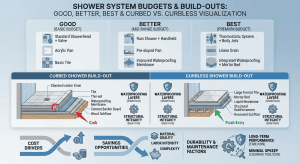
Showers: The Dominant Cost Driver – Curbless vs. Curbed
The shower area consistently emerges as the single most significant expense in most bathroom remodels [9]. This is due to the intricate combination of specialized trades (plumbing, waterproofing, tiling, glass installation) and high-quality, durable materials required. Even a standard custom tiled walk-in shower incurs costs ranging from $1,200–$5,000+ for installation alone [10], and premium custom configurations with multiple showerheads, floor-to-ceiling tile, and frameless glass can add thousands more [11].
A recent trend shows 61% of homeowners enlarging their shower size during renovations, with 54% adding rainfall showerheads and 16% incorporating body sprays, all features that escalate costs [12] [13].
The Curbless Shower Premium
The appeal of a sleek, accessible, zero-entry curbless shower is undeniable, with approximately 24% of remodeled showers now featuring this design [16]. However, this aesthetic and functional upgrade comes with a notable cost premium. Converting to a curbless shower typically adds $1,000–$2,000 in extra labor and subfloor work compared to a standard curbed shower [14] [24]. The additional structural modifications involve recessing the subfloor by 2-3 inches to achieve the necessary slope for drainage [34]. In Phoenix, where most homes are built on slab foundations, this frequently necessitates cutting or recessing concrete, pushing the curbless “premium” to $2,000–$5,000 in challenging scenarios [15] [26]. Seasoned professionals caution that a curbless shower is “not a minor upgrade” and its feasibility hinges on the home’s structure and meticulous waterproofing [17] [14].
The Non-Negotiable: Quality Waterproofing
Regardless of whether a shower is curbed or curbless, proper waterproofing is paramount. It is a critical, unseen investment that prevents costly water damage down the line. Industry standards, such as a 1/4″ per foot floor slope to the drain as mandated by the International Plumbing Code (IPC) and Tile Council of North America (TCNA) guidelines, must be strictly adhered to [18] [37]. The implementation of robust waterproof membranes and correct pan construction are non-negotiable. Experts confirm that most shower failures are a result of “shortcuts… or incomplete waterproofing,” rather than the presence or absence of a curb [19]. While using a proven shower kit or membrane system adds upfront material costs (several hundred dollars) and requires skilled labor, it effectively “insures” against future leaks and expensive repairs [20].
Key Cost Drivers Beyond the Shower
While the shower often takes center stage, several other factors significantly influence the overall bathroom remodel budget:
- Material Choices: The selection of finishes and materials dictates much of the aesthetic and a substantial portion of the cost. For example, opting for natural marble or specialty tile can cost $20–$40 per sq. ft., a stark contrast to quality ceramic tile at $2–$5 per sq. ft. [21] [29]. Custom hardwood vanities can range from $2,500–$10,000+, dwarfing the cost of a stock unit (~$500) [22] [31]. Even fixtures vary widely: a standard toilet is approximately $375 installed, while a wall-mounted smart toilet can cost $1,000–$4,000 [23] [31]. These premium selections collectively can push a project into the $50,000+ range [24]. Tactful use of high-impact, less expensive alternatives, such as quality porcelain mimicking natural stone, can offer significant savings [49].
- Layout Changes and Hidden Costs: Altering the bathroom layout by moving plumbing or walls is arguably the biggest cost escalator. Relocating a shower or toilet can incur around $7,000 for new plumbing rough-in work alone, excluding permits and potential structural engineering fees [25] [32]. Labor costs in Phoenix range from $100–$200/hour for plumbers and $60–$130/hour for electricians [26] [28] (although other sources give a wider range of $50-$150/hour depending on trade and expertise [27]). Demolition and debris disposal typically add $1,000–$2,000 [27] [33]. These “behind-the-walls” tasks can consume 40–60% of the total budget [28] [29], emphasizing that comprehensive overhauls are substantially more expensive than cosmetic updates. Homeowners should also budget a 10–15% contingency fund for unforeseen issues like water damage or code updates.
- Labor vs. Materials: Labor generally accounts for 40% to 65% of the total remodel cost [28] [29]. The remaining 35-60% goes towards materials, including fixtures, tile, cabinetry, and finishes.
Rising Costs and Investment Returns (ROI)
The cost of bathroom renovations has been on an upward trajectory. The median U.S. bathroom remodel spend escalated by 50% from $9,000 in 2021 to $13,500 in 2022. This figure continued to rise, reaching $15,000 by 2023 for all bathrooms and $25,000 for large master baths (100+ sq. ft.) [30] [31]. While there are some indications of stabilization, 2026 budgets are expected to remain elevated due to consistent demand and inflation in labor and material costs [32].
From an ROI perspective, a bathroom remodel primarily serves as a quality-of-life improvement. On resale, a mid-range bathroom remodel typically recoups about 60–70% of its cost in added home value [34]. Simpler “refreshes” often yield the best ROI (around 66–67%), while upscale, luxury remodels might only see a 50% return [35] [36]. Therefore, high-end projects are best justified by personal enjoyment rather than expecting a full financial payback.
Regional Considerations for Phoenix, AZ
Remodeling in Phoenix presents unique challenges and opportunities:
- Hard Water: Phoenix’s notoriously hard water (9.9–16.1 grains/gallon) [37] [67] necessitates specific product choices. Many homeowners invest in water softeners (~$1,500–$2,500), or opt for specialty glass coatings and specific fixture finishes to mitigate mineral buildup and protect surfaces [61].
- Single-Story Layouts and Master Baths: The prevalence of single-story homes, often on slab foundations, means that while curbless showers can be more labor-intensive to install (due to concrete cutting), expanding a bathroom horizontally into adjacent spaces (like closets or bedrooms) is relatively common for 22% of homeowners seeking larger primary baths [38] [39] [62]. This creates a demand for spacious, spa-like master baths that can easily cost $50,000 or more [63].
- Climate and Design: Phoenix’s arid climate favors materials like ceramic and porcelain tile, which handle heat and moisture well. Radiant floor heating is rare, but improved ventilation and cooling are often prioritized. Homeowners also tend to favor low-maintenance, easy-to-clean materials like quartz countertops, and water-efficient fixtures are standard due to local conservation codes [64].
- Market Pricing and Contractor Availability: Phoenix’s dynamic housing market means reputable contractors are in high demand, leading to competitive pricing. Obtaining multiple quotes is advisable, and homeowners should anticipate planning 6–12 months in advance for major projects [66].
Strategies for Cost Savings (Value Engineering)
For homeowners looking to manage their budget without sacrificing quality, several strategies can be employed:
- Maintain Current Layout: Keeping the existing plumbing layout is the most effective way to save significantly, as moving fixtures incurs substantial costs.
- Standard Sizes and Off-the-Shelf Products: Opting for standard-sized fixtures, prefab shower bases, and stock vanity cabinets instead of custom-built items can reduce both material and labor expenses [47] [48].
- Refinish or Retain Elements: Refinishing an existing tub instead of replacing it, or simply repainting and updating hardware on solid wood vanities, can offer a fresh look at a fraction of the cost [50] [51].
- Strategic Splurging: Allocate budget to one or two high-impact features (e.g., custom tile accent, premium countertop) and choose more affordable, yet quality, options for other areas.
In conclusion, a bathroom remodel in Phoenix in 2026 is a nuanced undertaking where cost is a direct reflection of scope, material choices, and the complexity of labor. By understanding these key drivers, regional specificities, and smart saving strategies, homeowners can embark on their renovation journey with realistic expectations and achieve a bathroom that perfectly balances their desires with their financial plan.
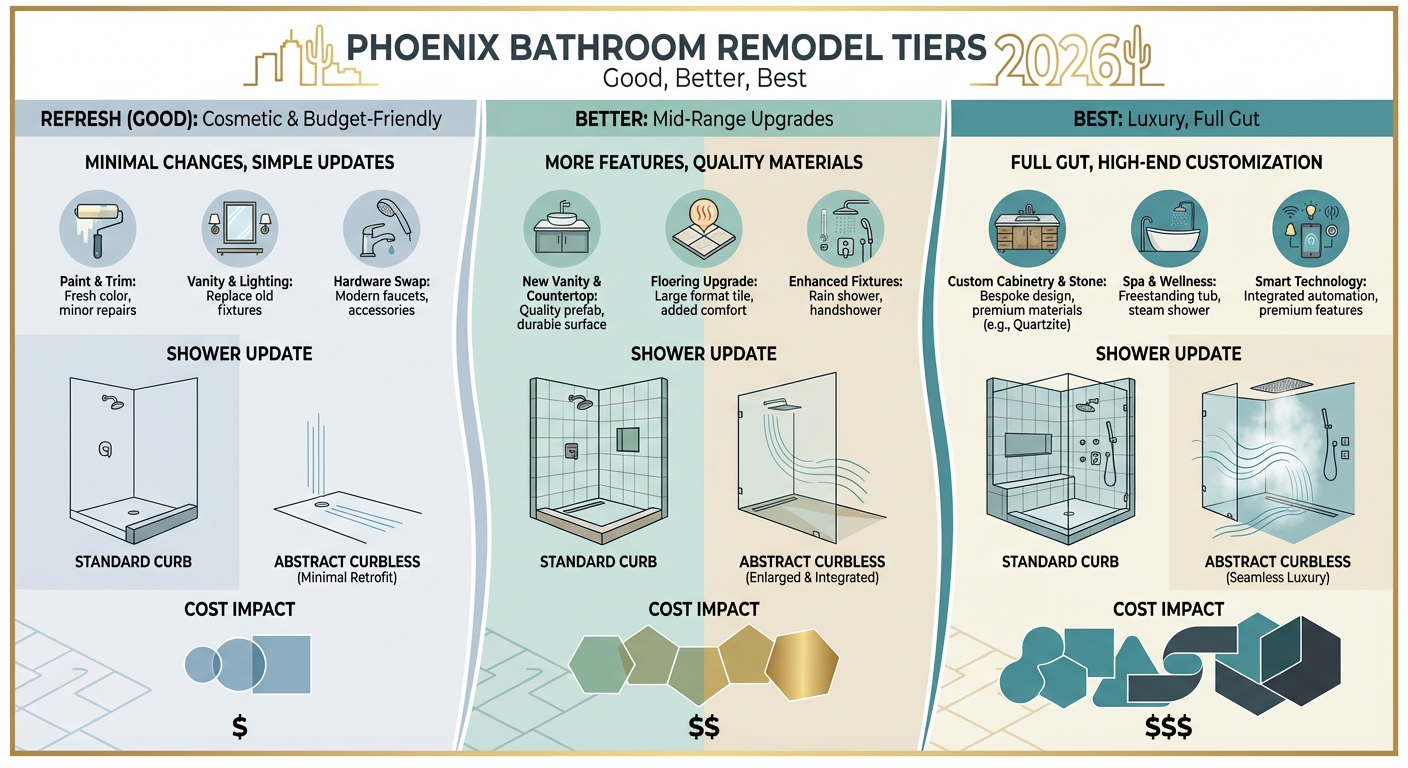
2. Bathroom Remodel Cost Tiers by Scope (Good, Better, Best)
Understanding the financial landscape of a bathroom remodel in Phoenix requires more than a simple average; it demands a nuanced breakdown by scope. From a superficial refresh to a complete overhaul, costs can fluctuate drastically based on the client’s aspirations, the bathroom’s size and current condition, and the quality of materials and labor chosen. This section will meticulously detail the “Good, Better, Best” budget tiers in the Phoenix market for 2026, offering clear expectations for what each investment level entails in terms of features, finishes, and overall project complexity. We will also highlight the significant impact of specific choices, such as moving plumbing or opting for a curbless shower, on the final price tag. The goal is to provide homeowners with a realistic framework for budgeting their bathroom renovation, enabling informed decisions that balance desired aesthetics and functionality with financial constraints.
The spectrum of bathroom renovation costs in Phoenix is remarkably wide. Projects can begin under **$10,000 for a basic cosmetic refresh** and escalate to **$90,000 or more for a luxury, spa-like primary bathroom gut renovation** [1]. Nationally, typical full remodels average around **$12,300** for a mid-range scope, with most projects ranging between **$7,000 and $18,000** [3]. For high-end luxury remodels in upscale homes, it’s not unheard of for costs to exceed six figures in rare instances [4]. This vast difference underscores the critical importance of defining the project’s scope early in the planning process.
2.1. Defining the Remodel Tiers: Good, Better, Best
To provide clarity and aid in budgeting, bathroom remodels can be segmented into three primary tiers: Good (Basic Refresh), Better (Mid-Range Update), and Best (High-End Luxury Renovation). Each tier represents a distinct level of investment, feature set, and complexity.
2.1.1. Good: Basic Refresh ($5,000 – $15,000)
The “Good” tier, or a basic refresh, focuses on cosmetic updates without altering the bathroom’s existing footprint or moving significant plumbing fixtures. This approach is ideal for homeowners looking to modernize a dated space, such as a guest bathroom or powder room, on a conservative budget. In Phoenix, a basic bathroom remodel typically costs between $10,000–$15,000 [46], though minor updates can start as low as $3,000–$8,000 for powder rooms [5].
Key Features and Scope:
- Surface-Level Changes: This tier primarily involves refreshing visible elements. This includes painting walls, updating lighting fixtures, and replacing purely cosmetic items [33].
- Fixture Swaps: Replacing existing fixtures with new, budget-friendly options is common. This might include a new toilet (a standard unit averaging around $375 installed [15]), a new sink, and basic faucets (typically $100–$200 each [23]).
- Vanity Update: A stock vanity and countertop unit (around $500–$1,000) is a common choice, offering a fresh look without the expense of custom cabinetry [15].
- Shower/Tub: The existing bathtub or shower enclosure is often retained and, if in good condition, might be professionally reglazed or resurfaced. For example, reglazing an old tub can cost around $400 [75], a significant saving compared to replacement [76]. If replacement is necessary, a basic acrylic insert might be chosen.
- Flooring: Inexpensive flooring options like vinyl plank or basic ceramic tile ($2–$5/sq.ft. material cost [16]) are common.
- No Layout Changes: Crucially, this tier avoids any relocation of plumbing or structural walls, which is the most significant cost-saving measure [17]. This dramatically reduces complex labor costs for plumbers and electricians [67].
- Duration: Projects at this level are typically completed in 1–2 weeks [47].
Phoenix Specifics: Given the region’s hard water, even at this tier, homeowners might consider a water softener (~$1,500–$2,500), although it’s an additional expense often saved for higher tiers [26]. Finishes are chosen for practicality and ease of maintenance in this climate.
Example: A Phoenix homeowner undertook a basic refresh of a 50 sq. ft. hall bath for approximately $8,500. They painted, replaced a stock vanity, new budget faucets and showerhead, and reglazed their existing tub for about $400. This kept their project under $10,000, illustrating how targeted cosmetic upgrades can yield high visual impact on a modest budget [74].
2.1.2. Better: Mid-Range Update ($15,000 – $30,000)
The “Better” tier signifies a more comprehensive update, often involving replacing most major components within the existing layout. This is the sweet spot for many homeowners seeking a blend of enhanced aesthetics, improved functionality, and good value. In Arizona, a mid-range bathroom remodel generally costs between $15,000–$30,000 [48].
Key Features and Scope:
- Full Component Replacement: This tier usually involves replacing the vanity, countertop, toilet, tub, and shower.
- Upgraded Finishes: Higher quality materials are introduced. Examples include semi-custom vanities, quartz or granite countertops, and higher-grade porcelain or ceramic tiles for flooring and shower walls (material cost of $10–$20/sq.ft. is common here [21]).
- Tiled Shower/Tub: The tub or shower area will likely feature new tile work rather than a basic insert. A standard custom tiled walk-in shower alone (including pan, tile, and basic glass) can range from $1,200–$5,000+ [9].
- New Fixtures: Better quality faucets, shower fixtures (e.g., pressure-balanced systems), and lighting are installed.
- Minor Reconfiguration (Optional): While significant plumbing relocation is avoided, minor adjustments within the existing footprint might occur, such as adding a shower niche or bench.
- Duration: These projects typically take 2–3 weeks to complete [49].
Phoenix Specifics: This tier might see an investment in better ventilation systems to combat humidity, or selecting easy-to-clean materials that resist hard water stains. Many Phoenix homeowners opt for low-flow fixtures for water conservation, aligning with local codes [70].
Curbless Shower Comparison: A curbed, custom-tiled shower will fit well within this budget. A curbless option would push this tier towards its upper limit, adding an estimated $1,000–$2,000 in labor and structural work [13], possibly reaching $2,000–$5,000 if concrete slab cutting is required [14].
Example: A standard 5’x7′ hall bathroom in Phoenix underwent a full gut remodel for approximately $25,000 [78]. This included demolishing everything to the studs, installing a new tiled tub-shower with porcelain subway tiles, a new prefab dual-sink vanity, and upgrading plumbing. Labor and services constituted about 50% of this cost [79].
2.1.3. Best: High-End Luxury Renovation ($30,000 – $60,000+)
The “Best” tier represents a top-tier remodel, often of a primary or master bathroom, transforming it into a luxurious, spa-like retreat. These projects prioritize premium materials, custom features, and often involve significant layout changes or expansion. In Arizona, high-end renovations typically range from $30,000–$60,000+, with luxury master suites frequently exceeding $50,000 [50].
Key Features and Scope:
- Premium Materials: Expect luxury materials such as natural stone (marble, granite, quartzite) for countertops and extensive tile work ($20–$40/sq.ft. material cost [16]), custom solid wood cabinetry, designer lighting, and high-end fixtures.
- Custom Walk-in Shower: A hallmark of this tier is a large, custom-tiled walk-in shower. This often includes features like multiple showerheads (rainfall, body jets – 54% and 16% adoption respectively [12]), benches, shelving niches, and frameless glass enclosures ($1,500–$3,000 installed [24]).
- Curbless Shower: Curbless designs (24% of remodeled showers are curbless [14]) are highly sought after for their aesthetic and accessibility benefits, with an added cost of $1,000–$5,000 for structural modifications and specialized drainage [14].
- Freestanding Tubs: If a tub is included, a designer freestanding soaking tub ($3,000–$7,000+) is a popular choice [23], particularly given the trend of enlarging showers when tubs are removed [19].
- Layout Changes: It is common to alter the layout extensively, moving plumbing fixtures, or even expanding the bathroom’s footprint by incorporating adjacent space (22% of homeowners enlarge their primary bathroom [28]). Moving plumbing alone can add ~$7,000 in new rough-in work [17].
- High-Tech Amenities: Features like heated floors (costing ~$1,800 for system and installation in one example [82]), smart toilets ($1,000–$4,000 [15]), and integrated sound systems are common.
- Duration: These intricate projects can take 4–6 weeks or more [51].
Phoenix Specifics: Hard water protection, such as choosing stain-resistant glass coatings for showers, is a key consideration. The prevalence of single-story homes in Arizona means that enlarging a bathroom often involves expanding horizontally into existing rooms (like adjacent closets or bedrooms) [27]. This adds significant construction cost but enables the spacious, spa-like primary baths many Phoenix homeowners desire [28].
Example: A 120 sq.ft. master bathroom in Scottsdale underwent a lavish remodel for over $75,000 [81]. This included a large curbless walk-in shower with dual rainfall heads (costing around $20k for the shower alone, including slab cutting and marble), electric floor heating, a custom floating walnut vanity, and high-end fixtures like wall-mounted faucets and a smart toilet-bidet combo [82].
| Tier | Description | Typical Cost Range (Phoenix) | Powder Bath (Half-Bath) | Hall Bath (Full, 5’x7′) | Primary Bath (Large, 80-120 sq.ft.) | Key Features & Scope |
|---|---|---|---|---|---|---|
| Good (Basic Refresh) | Cosmetic updates, no layout changes. Focus on fresh look. | $5,000 – $15,000 | $3,000 – $8,000 | $7,000 – $15,000 | $10,000 – $20,000 | Paint, new mirror/lighting, stock vanity/counter, basic faucet/toilet, reglaze existing tub/shower or pre-fab insert. No plumbing relocation. |
| Better (Mid-Range Update) | Full update within existing footprint. Quality materials, improved functionality. | $15,000 – $30,000 | $8,000 – $15,000 | $15,000 – $25,000 | $20,000 – $40,000 | Semi-custom vanity, quartz/solid surface counter, new tile floor/shower walls, better quality fixtures (e.g., pressure-balanced shower), new tub or tiled walk-in shower with standard curb. Minor electrical upgrades (GFCI outlets). |
| Best (High-End Luxury) | Premium materials, custom features, layout changes possible. Spa-like experience. | $30,000 – $60,000+ | $15,000 – $30,000 | $25,000 – $40,000 | $40,000 – $90,000+ | Custom vanity, natural stone counters, extensive high-end tile (marble, large format porcelain), curbless walk-in shower system (multi-head optional), designer freestanding tub, smart toilet, floor heating, layout reconfigurations (plumbing moves). |
2.2. The Shower as the Primary Cost Driver: Curbless vs. Curbed
The shower area consistently emerges as the single largest expense in most bathroom remodels, often consuming between 30-50% of the total budget [37]. This is due to the confluence of multiple trades (plumbing, waterproofing, tiling, glass installation) and the need for durable, water-resistant materials capable of withstanding constant exposure to moisture [81].
2.2.1. Standard Curbed Shower System
A standard curbed shower involves a raised threshold (curb) that separates the shower area from the rest of the bathroom floor. This design is generally simpler and less costly to install because it doesn’t require lowering the subfloor. A standard custom tiled walk-in shower setup, including demolition of the old unit, a new mixing valve, a proper waterproof membrane (e.g., a pre-sloped pan liner and cement backer board), tile, grout, and a basic framed glass door, can easily range from $1,200–$5,000+ for the structure and finishes alone [10].
- Construction: The shower pan typically consists of a pre-slope, a waterproof pan liner (e.g., PVC or CPE), a mortar bed, and tile. The curb is built with concrete or wood and wrapped with waterproofing.
- Waterproofing: Industry standards, such as those from the Tile Council of North America (TCNA), mandate specific waterproofing methods. This includes a 1/4″ per foot floor slope to the drain (as per International Plumbing Code) [18] and continuous waterproof membranes on both the pan and walls (typically 6 inches above the floor to avoid splash damage) [20].
- Glass Enclosure: Framed or semi-frameless glass doors are common and more budget-friendly (often under $800 installed) [24].
2.2.2. Curbless Shower Systems: The Added Complexity and Cost
Curbless, or zero-entry, showers are a growing trend, offering a sleek aesthetic and enhanced accessibility. Approximately 24% of upgraded showers are now curbless [14]. However, this modern appeal comes with a higher price tag due to the increased labor and structural modifications required [13].
- Cost Premium: Converting to a curbless shower generally adds $1,000–$2,000 in extra labor and subfloor work compared to a standard curbed shower [13]. On concrete slab foundations, prevalent in Phoenix, contractors often need to cut or recess the concrete subfloor by ~2-3 inches to achieve the necessary drainage slope [38]. This can push the “curbless premium” to an additional $2,000–$5,000 in complex scenarios [14].
- Structural Modifications: The subfloor must be recessed to allow for the proper 1/4″ per foot slope to the drain [18] while maintaining a flush transition at the bathroom entry. This involves either modifying floor joists (in homes with crawl spaces) or cutting into the concrete slab (common in Phoenix) [38].
- Advanced Waterproofing: Curbless showers often extend the waterproofing membrane further into the main bathroom floor, sometimes creating a “wet room” effect, to prevent water migration. Linear trench drains are frequently used in curbless designs, which are often more expensive than standard center drains [14]. The entire system must meet or exceed ANSI A118 compliant waterproofing standards.
- Glass Enclosures: Curbless showers often pair with frameless glass enclosures, which are more expensive ($1,500–$3,500+ for custom 1/2″ tempered glass with protective coatings) but contribute to the open aesthetic [24].
Critical Waterproofing: Regardless of curb or no curb, proper waterproofing is paramount. Experts note that most shower failures stem from “shortcuts… or incomplete waterproofing,” not the presence or absence of a curb [20]. Investing in proven systems, such as topical sheet membranes (e.g., Schluter®-Kerdi) or liquid-applied membranes (e.g., Laticrete HydroBan), adds upfront cost (a few hundred dollars in materials plus skilled labor) but prevents costly repairs down the line [20]. The International Plumbing Code requires a minimum 1/4″ per foot slope to the drain, and TCNA guidelines emphasize sealing corners and extending waterproofing up walls [71].
| Feature/Component | Standard Curbed Shower (Mid-Range) | Curbless Shower (High-End) | Cost Difference/Premium |
|---|---|---|---|
| Subfloor/Pan Construction | Pre-sloped mortar bed, waterproof liner, standard curb construction. | Recessed subfloor (concrete cutting/joist modification), integrated linear drain, advanced pre-slope. | $1,000 – $5,000+ (for structural work)[14] |
| Waterproofing System | Cement backer board + liquid membrane or basic sheet system. | Full topical sheet membrane (e.g., Schluter) for pan and walls, extended into bathroom floor. | $200 – $800 (for enhanced materials/labor) |
| Tile Work | Porcelain/ceramic (est. 100 sq ft @ $10-20/sq ft installed) | High-end porcelain/natural stone (est. 120+ sq ft @ $25-50/sq ft installed) | $1,500 – $3,000+ (for materials and skilled labor) |
| Drain Type | Standard round point drain (typically $50-150 for hardware). | Linear trench drain (typically $300-900+ for hardware), requires more complex pan. | $250 – $750+ |
| Glass Enclosure | Framed or semi-frameless door (approx. $800-1,500 installed). | Custom frameless 1/2″ tempered glass (approx. $1,500-3,500+ installed, with coatings). | $700 – $2,000+ |
| Fixtures | Pressure-balanced shower head/valve (~$500-800). | Multi-function shower system (rainfall, body jets, handheld) ($1,000-3,000+). | $500 – $2,200+ |
| Estimated Shower Component Total | $5,000 – $10,000 | $10,000 – $20,000+ | Overall difference: $5,000 – $10,000+ |
2.3. Key Drivers of Bathroom Remodeling Costs
Beyond the initial tier selection, several factors exert significant influence on the final cost of a bathroom remodel. These drivers primarily relate to material choices, layout modifications, and labor considerations.
2.3.1. Material Selection
The choice of materials is arguably the most flexible and impactful cost driver. The difference between a budget-conscious selection and a luxury finish can be exponential [34]. For example, basic ceramic tile can cost $2–$5/sq.ft., while high-end natural stone or specialty tile material can be **$20–$40/sq.ft.** or even higher [16]. For a bathroom requiring 100 sq.ft. of tile, this variable alone can shift material costs by thousands of dollars.
- Tile: Consider porcelain tiles that mimic natural stone for a fraction of the cost [69]. Strategic use of accent tiles over entire walls can also save money.
- Countertops: Laminate is the most economical, followed by cultured marble, quartz composites, and then natural stone (granite, marble). Quartz, while more expensive than basic laminate, offers excellent durability and design versatility without the sealing needs of real stone.
- Vanities: Stock vanities from big box stores are far more affordable ($500–$1,000) than custom-built hardwood units ($2,500–$10,000+) [15].
- Fixtures: Basic chrome faucets can start at $100, while designer brass or matte black fixtures can easily exceed $500. Toilets vary from standard ~$375 installed to smart, wall-mounted units at **$1,000–$4,000** [15].
2.3.2. Layout Changes and Plumbing Relocation
Altering the bathroom layout is one of the most significant cost escalators. Each time a fixture (toilet, sink, shower) is moved from its original location, it necessitates extensive and costly plumbing work. A major plumbing rough-in for a bathroom that involves relocating multiple fixtures can cost around $7,000 on average [17]. This involves:
- Rerouting Pipes: New supply lines and drain lines must be installed, often requiring opening up walls and floors.
- Slab Work (Phoenix): For homes on concrete slab foundations (common in Phoenix), moving drains means cutting into the concrete, which is labor-intensive and adds significantly to the cost [65].
- Permits and Inspections: Major layout changes almost always require permits and inspections, adding to the timeline and administrative fees.
Expanding the bathroom’s footprint by moving walls or incorporating adjacent space (e.g., a closet) introduces additional expenses for framing, drywall, flooring extension, and potential architectural or engineering consultations [25]. About 22% of homeowners enlarge their bathroom size during a remodel [28], which places these projects at the higher end of the cost spectrum.
2.3.3. Labor Costs and Skilled Trades
Labor typically accounts for 40% to 65% of the total bathroom remodel cost [21]. A typical bathroom remodel requires a team of skilled tradespeople, including a general contractor, demolition crew, framer, plumber, electrician, tile installer, and drywall/paint finisher. Hourly rates in Phoenix vary:
- General Trades: $50–$150 per hour [22].
- Plumbers: $100–$200 per hour [17].
- Electricians: $60–$130 per hour [17].
Projects involving intricate tile patterns, custom cabinetry, or complex curbless shower installations demand highly skilled labor, commanding premium rates. Demand for skilled trades in Phoenix’s booming construction market means reputable contractors often have lead times and reflect higher labor rates in their bids. Unexpected issues discovered during demolition, such as hidden water damage, outdated wiring, or corroded pipes, can add significant unforeseen labor and material costs.
2.3.4. Hidden Costs and Contingency
It is crucial to budget for unforeseen circumstances. Common hidden costs include:
- Demolition and Debris Removal: Typically $1,000–$2,000 [81].
- Water Damage/Mold Remediation: Discovery of water damage behind walls or under floors can add thousands to the project.
- Code Upgrades: Bringing older plumbing or electrical systems up to current code, even if not directly part of the initial plan, may be required.
- Permits and Inspections: Fees vary by scope but are typically a few hundred dollars.
Industry professionals strongly recommend setting aside a contingency fund of 10–20% of the total project budget to cover these potential surprises [36].
2.4. Regional Considerations in Phoenix, Arizona
Phoenix presents unique environmental and market conditions that influence bathroom remodel costs and choices.
2.4.1. Hard Water Protection
Phoenix has some of the “hardest” water in the U.S., with levels around 10–16 grains per gallon [26]. This mineral-rich water can cause unsightly spots and etching on shower glass, fixtures, and tile. To mitigate this:
- Water Softeners: Installation of a whole-house water softener (~$1,500–$2,500) is a common investment [26].
- Glass Coatings: Selecting shower glass with factory-applied protective coatings or applying aftermarket treatments is recommended.
- Fixture Finishes: Brushed nickel or matte black fixtures are often preferred over polished chrome, as they tend to camouflage water spots more effectively.
2.4.2. One-Story Layouts and Master Bathroom Trends
Phoenix’s housing stock predominantly features single-story homes, many on slab foundations. While this can complicate plumbing moves (requiring concrete cutting for drains) [65], it also offers opportunities for expansion without dealing with upper-floor structural challenges. Many homeowners opt to enlarge their primary bathrooms by absorbing adjacent closet or bedroom space, creating expansive, spa-like retreats [27]. These larger primary bathrooms (often 100+ sq.ft.) frequently include dual vanities, separate showers and tubs (often a large walk-in shower and a freestanding tub), and can easily reach or exceed $50,000 for comprehensive updates [66].
2.4.3. Climate and Material Choices
The hot, arid climate of Phoenix influences material selections. Cool, durable surfaces like ceramic and porcelain tile are standard for flooring and shower surrounds, as they handle heat and moisture well. Radiant floor heating, popular elsewhere, is largely eschewed due to high temperatures. Instead, attention is given to powerful ventilation and cooling, and water-efficient fixtures are mandated by local codes, such as low-flow toilets (1.28 GPF or less) and showerheads (2.0 GPM or less) [70].
2.5. Conclusion
Bathroom remodel costs in Phoenix are highly variable, determined by the chosen scope of work, material selections, and whether the layout is altered. The “Good, Better, Best” framework provides a useful guide for budgeting, ranging from $5,000 for a basic refresh to $60,000+ for a luxury renovation. The shower area is consistently the most expensive component, with curbless designs adding a significant premium due to complex structural and waterproofing requirements. Homeowners must prioritize quality waterproofing, adhere to industry standards like TCNA and IPC guidelines, and budget a contingency for unforeseen issues. Understanding these tiers and cost drivers, alongside Phoenix-specific considerations like hard water and single-story home layouts, empowers homeowners to make informed decisions for a successful and cost-effective bathroom transformation in 2026.
The subsequent section will delve deeper into the specific cost implications of curbless versus curbed shower systems, providing detailed budget breakdowns for each configuration across various bathroom types.
3. Cost Differences by Bathroom Type: Primary, Hall, and Powder Rooms
The financial outlay for a bathroom remodel in Phoenix, Arizona, is not a monolithic figure; rather, it is highly dependent on the type of bathroom being renovated. From the compact powder room to the expansive primary suite, each space presents unique challenges, size considerations, and expectations for features and finishes. This section delves into the specific cost realities for primary bathrooms, hall bathrooms, and powder rooms in the Phoenix metro area for 2026, considering typical Arizona home layouts and how scope of work, including choices like dual vanities or separate tubs and showers, directly impacts the overall project budget.
Bathroom remodels in Phoenix exhibit a wide cost spectrum, ranging from under $10,000 for a superficial refresh to upwards of $90,000 for a luxury, full gut renovation of a large primary bath [1]. Nationally, the median spend for a bathroom remodel in 2023 was approximately $15,000, reaching $25,000 for primary bathrooms larger than 100 square feet [2]. By 2024, the national median spend dipped slightly to around $13,000, while large primary baths maintained a median spend of $25,000 [3]. These figures demonstrate that the scale and ambition of a renovation are paramount in determining its final price tag. Local Phoenix costs generally align with or run slightly higher than national averages due to strong demand and specific market conditions [4].
3.1. Primary Bathrooms: The Pinnacle of Investment
Primary (or master) bathrooms almost invariably represent the most significant investment in a home’s bathroom renovation portfolio. These spaces are typically larger, designed for optimal comfort and often feature higher-end amenities. In Arizona, primary bathrooms frequently span 80–120 sq. ft., which is considerably larger than secondary baths [5]. This larger footprint alone dictates higher material and labor costs compared to smaller counterparts.
3.1.1. Typical Scope and Cost Range for Primary Bathrooms
The scope of work in a primary bathroom remodel often includes:
- Dual vanities [5]
- Separate tub and shower (though many homeowners are opting to remove tubs to enlarge showers) [6]
- Premium finishes, such as natural stone, custom cabinetry, and high-end fixtures [5]
- Advanced shower systems with multiple showerheads, body sprays, and rainfall features [7]
- Enlarging the overall bathroom footprint by incorporating adjacent spaces like closets or unused bedrooms [8]
Due to these factors, primary bathroom remodels in Phoenix routinely cost $25,000–$50,000+ [5]. For very large, spa-like master baths with custom features and layout changes, costs can easily push to $60,000–$90,000 or even more [9]. One Phoenix-area luxury remodel with spa-like features initiated at around $30,000 and easily exceeded $60,000 upon completion [10]. In rare cases, high-end projects in upscale homes can even exceed six figures [4]. This reflects a growing trend of homeowners investing in personalized, high-quality, and often larger primary bathroom spaces.
3.1.2. The Shower as a Primary Cost Driver
Within the primary bathroom, the shower often emerges as the single most expensive component. Renovators are increasingly prioritizing showers over tubs, with over 78% of those removing a bathtub opting to enlarge the shower footprint [6]. This focus on expansive, luxurious showers drives up costs substantially. A standard custom tiled walk-in shower alone can cost $1,200–$5,000+ to install [11]. However, when considering premium configurations with multiple showerheads, floor-to-ceiling tile, benches, niches, and frameless glass enclosures, the cost for the shower area can be $15,000 or more [12]. For example, a Scottsdale master bath renovation detailed below included a curbless shower costing approximately $20,000, illustrating how premium features and structural modifications contribute significantly to the budget.
3.1.3. Tub vs. Shower Trends in Primary Baths
While historically, primary baths often featured large jetted tubs, the trend has shifted dramatically. Houzz data indicates that homeowners are willing to forego tubs, especially if it means a larger, more functional shower. Among those who remove a tub, 40% make the new shower at least 25% bigger [6]. Freestanding soaking tubs remain popular in high-end projects where space permits, with 58% of renovators choosing a tub opting for this style [6]. However, many remodels in Phoenix now forego a tub entirely in the primary bath for a sleeker, all-shower design, especially if other bathrooms in the home retain a tub for bathing children or pets.
3.2. Hall Bathrooms: The Mid-Range Workhorses
Hallway bathrooms, also known as secondary or guest bathrooms, typically serve secondary bedrooms or general guest use. These bathrooms are generally smaller and more functional in design compared to primary baths. In Arizona, a common size for a hall bath is around 5’x7’ or 5’x8’ [13], usually featuring a single vanity, toilet, and a tub/shower combination. They are often refreshed or remodeled with an eye toward functionality, durability, and a blend of aesthetic appeal and cost-effectiveness.
3.2.1. Expected Costs for Hall Bathroom Remodels
A mid-range overhaul of a hallway bathroom in Phoenix typically runs between $10,000–$25,000 [13]. This budget allows for a significant upgrade from a basic refresh, often including:
- New tiled tub/shower surround (replacing outdated surrounds or inserts)
- Upgraded semi-custom vanity with a new countertop
- New flooring (often porcelain or ceramic tile)
- New toilet, faucet, and shower fixtures
- Fresh paint and updated lighting
A standard 5’x7’ full gut remodel in Phoenix in 2025 cost roughly $25,000 [14]. This particular project included removing everything down to the studs, installing a new tiled tub-shower with porcelain subway tiles ($3/sq.ft. material), a porcelain mosaic floor, upgraded plumbing valves, and a shower niche. The labor and services alone constituted about 50% of the total cost, with materials making up the balance [14]. Plumbing and electrical for this small bath amounted to approximately $6,500, covering corroded pipe replacement and exhaust fan wiring upgrades. These costs highlight that even for smaller bathrooms, a comprehensive renovation can quickly add up, especially if behind-the-walls issues are discovered.
3.2.2. Value Swaps in Hall Baths
Given the typical guest- or family-use nature of hall baths, homeowners often seek value-engineered solutions. Swaps that save money without sacrificing too much on quality or aesthetic include:
- Opting for a durable, aesthetically pleasing porcelain tile that mimics natural stone, saving $15-$35 per square foot compared to marble [15].
- Choosing a pre-fabricated shower base or tub/shower unit instead of a fully custom-tiled shower pan, saving on labor and complexity [16].
- Selecting a stock vanity from a home center rather than a custom-built unit. Stock vanities can be $500–$1,000, while custom ones range from $2,500–$10,000+ [17].
- Keeping the existing layout to avoid expensive plumbing relocation fees, which can add thousands of dollars [18].
3.3. Powder Rooms: The Economical Update
Powder rooms, or half-baths, are typically the smallest and most economical bathrooms to remodel. Lacking a shower or tub, their renovation focuses primarily on the vanity, toilet, flooring, and decorative elements. These rooms are often high-traffic areas for guests, making visual impact a key driver for renovation.
3.3.1. Cost Ranges for Powder Rooms
For minor updates, powder rooms are the cheapest to refresh, often costing between $3,000–$8,000 [19]. A “basic” powder room remodel might reach $10,000. This relatively contained cost makes them attractive for homeowners looking for a noticeable upgrade without a significant financial commitment. The scope for a powder room typically involves:
- New vanity and sink
- New toilet (often dual-flush or wall-mounted for space savings)
- Updated flooring
- New light fixture and mirror
- Fresh paint or wallpaper
An example of a cost-conscious hall bath refresh (which is typically larger than a powder room but showcases budget strategies) involved spending about $8,500 in mid-2025 in Phoenix. This included new paint, a stock $600 vanity/sink combo, budget-friendly faucets and showerhead (~$250), and reglazing the existing tub for ~$400 [20]. A powder room, being smaller and without a tub to reglaze, could achieve a significant update for a similar or lower price. The absence of complex tiling, waterproofing, and shower glass keeps powder room remodel costs substantially lower than full bathrooms.
3.4. Impact of Scope on Budget: A Comparative Analysis
The stark differences in cost between bathroom types are directly attributable to their size, the number of fixtures, and the expectations for finish levels. Here’s a comparative breakdown:
| Bathroom Type | Typical Size (Phoenix) | Features & Scope Drivers | Average Cost Range (Phoenix, 2026) | Key Cost Elements |
|---|---|---|---|---|
| Powder Room (Half-Bath) | ~20-40 sq. ft. | Single vanity, toilet, no bathing facilities. Primarily cosmetic updates. Focus on aesthetics. | $3,000 – $10,000 | Vanity, toilet, flooring, paint, lighting. Minimal labor. |
| Hall Bathroom (Full Bath) | ~35-50 sq. ft. (e.g., 5’x7′) | Single vanity, toilet, tub/shower combo. Mid-range finishes, some fixture upgrades. Layout usually remains. | $10,000 – $25,000 | Tub/shower system, tile work, vanity, plumbing fixtures, toilet, flooring, labor. |
| Primary Bathroom (Full Bath) | ~80-120+ sq. ft. | Dual vanities, separate tub/shower (or large walk-in shower), premium finishes, custom elements. Often involves layout changes or expansion. | $25,000 – $90,000+ | Extensive shower system (curbless likely), custom cabinetry, high-end tile, possible layout changes (plumbing/walls), luxury fixtures, advanced waterproofing, glass enclosure, significant labor. |
The “shower system stack” is a prime example of how complexity and material choices escalate costs. In a powder room, this “stack” is absent. In a hall bath, it might involve a standard acrylic tub/shower surround with ceramic tile. In a primary bath, it often translates into a custom tiled, curbless shower with specialty waterproofing, a linear drain, and frameless glass, each step significantly increasing the budget.
3.5. Geographic and Layout Considerations in Arizona
Arizona’s housing landscape, particularly in Phoenix, consists largely of one-story homes often built on concrete slab foundations [21]. This has several implications for remodel costs:
- Slab Foundation Challenges for Curbless Showers: Achieving a curbless shower on a concrete slab requires cutting or recessing the concrete to drop the shower floor. This is a labor-intensive process that can add a $2,000–$5,000 premium to a curbless shower installation compared to homes with wood subfloors where joists can be modified [22].
- Large Primary Suites: Many Arizona homes, especially newer builds, feature spacious primary suites. This allows for grander primary bathrooms, sometimes covering 100+ sq. ft., facilitating separate tubs and large walk-in showers [23]. When remodelling, homeowners often enlarge these spaces further by borrowing from adjacent closets or bedrooms; in fact, 22% of homeowners enlarge their primary bathroom during remodels [8]. While this enables luxurious designs, it also escalates costs due to additional framing, drywall, and flooring work.
- Hard Water Protection: Phoenix’s extremely hard water (9.9–16.1 grains/gallon) is a critical factor [24]. Homeowners in the region frequently invest in water softeners (typically $1,500–$2,500) or specify specialty glass coatings for shower enclosures to protect against mineral buildup and etching. This adds a specific regional cost consideration that might not be as prevalent elsewhere.
3.6. Conclusion on Bathroom Type Cost Dynamics
The cost differences among primary, hall, and powder rooms in Phoenix for 2026 are not merely proportional to their size but are magnified by prevailing design expectations and functional requirements for each space. Primary bathrooms command the highest budgets due to their scale, desire for luxury, and often complex structural modifications (like curbless showers and layout changes). Hall bathrooms represent a mid-range investment, balancing functionality with modern aesthetics, usually within existing footprints. Powder rooms offer the most economical route to an updated look, focusing on visible surface changes. Regardless of bathroom type, understanding the impact of material selection, layout modifications, and labor intensity remains key to accurate budgeting. The trends toward larger showers and curbless designs, coupled with regional specificities like hard water and single-story slab construction, shape the unique cost reality for Phoenix homeowners.
4. Shower System Costs and Curbless vs. Curbed Comparisons
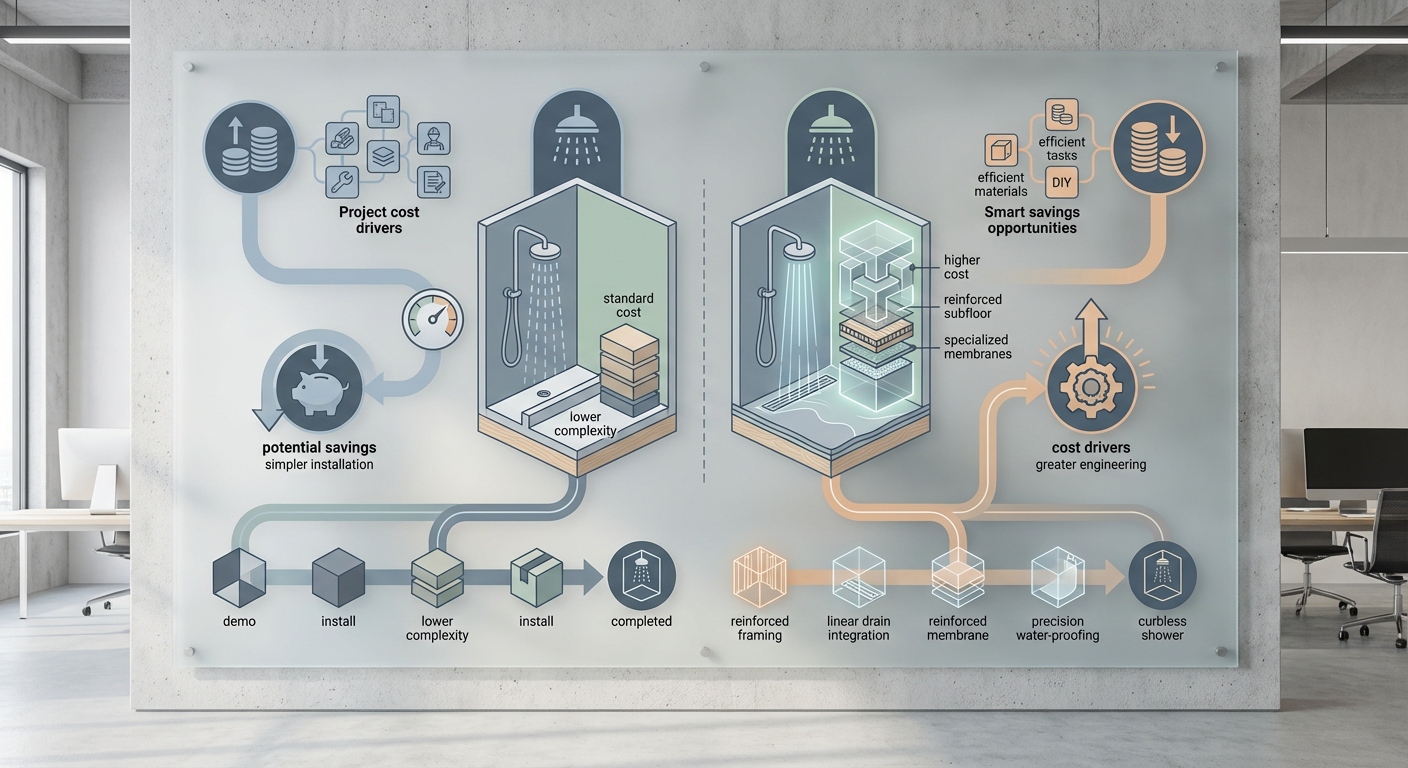
The shower system is undeniably the single biggest expense and the most complex component of a complete bathroom remodel, often consuming 30% to 50% of the overall budget, especially in primary bathrooms that aim for a spa-like experience [3]. Homeowners are increasingly prioritizing larger, more luxurious showers, with 61% electing to increase their shower size during renovations, and two-thirds adding premium features such as rainfall showerheads and body sprays [5]. This intensive focus on the shower area means that decisions regarding its design, from basic acrylic inserts to elaborate custom-tiled, curbless installations, directly impact both the functionality and the financial outlay of the entire project. Understanding the cost drivers, particularly the distinction between curbed and curbless designs, is crucial for effective budgeting in 2026. This section will delve deep into the costs associated with different shower systems, juxtaposing curbless (zero-entry) and curbed designs, highlighting the added complexities and expenditures of curbless installations, especially on the slab foundations prevalent in Phoenix. Furthermore, it will cover the costs of glass enclosures, fixtures, and the non-negotiable importance of proper waterproofing.
The Shower: The Core of Bathroom Remodel Expense
The shower area demands a significant portion of the bathroom remodeling budget due to its intricate plumbing, waterproofing requirements, and the need for skilled labor across multiple trades. Costs for a standard custom tiled walk-in shower can range from $1,200 to over $5,000 for installation alone [4], excluding many of the higher-end material and feature upgrades. When accounting for demolition, new plumbing rough-ins, specialized waterproofing membranes, tile and labor, and glass enclosures, a mid-range shower can easily consume $5,000 to $10,000 [3]. For luxury projects, the cost can escalate to $15,000 or more just for the shower area [37].
Several elements contribute to this high cost:
- Demolition and Prep: Removing an existing shower or tub, especially a cast-iron unit, requires significant labor and disposal costs, typically adding $1,000 to $2,000 to the overall project for demolition and debris removal [6].
- Plumbing: The shower relies on a complex network of water supply lines, drain lines, and mixing valves. If the layout is changed, or old plumbing needs updating, these costs can climb rapidly. New plumbing rough-in work can average around $7,000 if fixtures are relocated [7]. This includes moving drains, installing new mixing valves, and potentially modifying the hot and cold water lines.
- Waterproofing and Substrate: This critical, unseen layer prevents leaks and water damage. It involves building a sloped shower pan, installing waterproof membranes (such as cement backer board, liquid-applied membranes, or sheet membranes), and ensuring proper sealing at all seams and corners. Industry standards, such as the International Plumbing Code (IPC) and Tile Council of North America (TCNA) guidelines, mandate a minimum 1/4 inch per foot slope to the drain [10]. These meticulous steps ensure longevity but require specialized materials and skilled labor.
- Tile and Installation: Tile selection and the complexity of its installation are major cost drivers. Basic ceramic tile might cost $2-$4 per square foot for material and $5-$6 for installation, while premium options like natural stone or high-end porcelain can command $20-$40 per square foot for material alone [3]. For a shower requiring 100 square feet of tile, this could mean a difference of thousands of dollars. Labor for intricate patterns, small mosaics, or large-format tiles also escalates due to the precision required.
- Fixtures: Showerheads, body sprays, hand showers, and mixing valves range widely in price. A basic pressure-balanced shower system might cost a few hundred dollars, while a multi-function shower with thermostatic controls, rainfall heads, and body jets can run into thousands [3].
- Glass Enclosures: Custom frameless glass enclosures, particularly those made of thicker 3/8″ or 1/2″ tempered glass with protective coatings, can cost $1,200 to $2,000 or more [37]. Framed or semi-frameless options are generally more budget-friendly, often under $800 installed.
The Curbless Premium: Zero-Entry Showers and Associated Costs
The desire for sleek aesthetics and enhanced accessibility has driven a significant trend toward curbless (zero-entry) showers. Approximately 24% of remodeled showers are now curbless [5], reflecting their popularity. However, achieving a true curbless design adds notable cost and complexity compared to a standard curbed shower.
The primary reason for the increased cost of a curbless shower lies in the preparation of the subfloor. For water to drain properly without a curb, the shower floor area must be recessed typically by 2 to 3 inches below the surrounding bathroom floor level [9]. This allows for the necessary slope toward the drain while maintaining a flush transition at the entry point.
On a typical slab foundation, common in Phoenix homes, achieving this recess often involves:
- Concrete Cutting/Jackhammering: The existing concrete slab must be cut out and removed to create the depressed area for the shower pan. This is labor-intensive, creates significant dust and debris, and requires specialized equipment.
- New Sub-Slab Plumbing: If the drain location is also being changed, new trenches in the concrete slab must be cut to run the drainpipe, and new drain lines installed, potentially further complicating the process.
- Extended Waterproofing: To prevent water migration beyond the shower area, curbless designs often require extending the waterproofing membrane further into the main bathroom floor, effectively turning a larger section of the bathroom into a “wet zone” under the tile. This ensures that any splashed water that crosses the traditional shower footprint does not seep into the subfloor.
- Linear Drains: While not strictly required, many curbless showers incorporate linear drains for their aesthetic appeal and ability to efficiently manage water flow across a wider area. These drains are typically more expensive than traditional center point drains [3].
These structural modifications and additional labor typically add an extra $1,000 to $2,000 for standard curbless installations [9]. In more complex scenarios, such as extensive concrete cutting or challenging drain relocations, this premium can escalate to $3,000 to $5,000 [3]. As one remodeling expert notes, a curbless shower is “not a minor upgrade” [9], emphasizing the need for skilled professionals and a higher budget allocation.
Table 1: Cost Comparison: Curbed vs. Curbless Shower (Phoenix, 2026 Estimates)
| Feature/Component | Curbed Shower (Standard Custom Tile) | Curbless Shower (Custom Tile) | Delta Cost (Curbless vs. Curbed) |
|---|---|---|---|
| Demolition & Subfloor Prep | $500 – $1,000 (standard pan removal) | $1,500 – $3,000 (slab cutting, recessing) | +$1,000 – $2,000 |
| Plumbing Rough-in (existing location) | $800 – $1,500 | $800 – $1,500 (can increase with drain relocation) | No change (or +$0-1000 for drain move) |
| Waterproofing System | $500 – $1,000 (standard pan + wall membrane) | $800 – $1,500 (extended floor coverage) | +$300 – $500 |
| Shower Pan/Base Materials | $200 – $500 (mortar/pre-slope materials) | $200 – $500 (mortar/pre-slope materials) | No change |
| Drain Fixture | $50 – $150 (standard round) | $300 – $900 (linear drain) | +$250 – $750 |
| Tile & Tile Installation (80-120 sq ft) | $2,000 – $4,000 (mid-range porcelain) | $2,000 – $4,000 (mid-range porcelain) | No change (can increase with complex patterns) |
| Shower Fixtures (head, valve) | $500 – $1,000 (mid-range) | $500 – $1,000 (mid-range) | No change |
| Glass Enclosure (Frameless) | $1,200 – $2,000 | $1,200 – $2,500 (often larger panels) | +$0 – $500 |
| Subtotal Estimated Cost | $5,750 – $11,150 | $7,300 – $14,900 | +$1,550 – $3,750 |
| Note: These are estimates for the shower system alone within a larger remodel. Final costs vary based on contractor, materials, and specific site conditions. Labor for structural modifications in curbless designs is the primary cost differentiator. | |||
For homeowners prioritizing accessibility (aging-in-place) or a particular aesthetic, the “curbless premium” is often a worthwhile investment. However, for those on a tighter budget, a low-curb shower (with a minimal 2-3 inch step) or a pre-fabricated shower pan with a low threshold can provide a similar modern look at a reduced cost [37].
Waterproofing: The Unseen, Unnegotiable Investment
Regardless of whether a shower is curbed or curbless, proper waterproofing is paramount. Experts consistently emphasize that most shower failures, leading to costly leaks and mold, are due to “shortcuts… or incomplete waterproofing,” not the presence or absence of a curb itself [14]. This makes the waterproofing system the most critical component for long-term durability and avoiding expensive future repairs.
Key standards and practices for durable shower waterproofing include:
- Proper Slope: The shower floor must be constructed with a minimum 1/4 inch per foot slope towards the drain, as mandated by the International Plumbing Code (IPC) [10] and echoed by TCNA guidelines. This ensures efficient drainage and prevents water pooling. While some ADA-compliant applications may allow a shallower 1/8 inch per foot slope, it demands extremely precise installation to prevent issues [10].
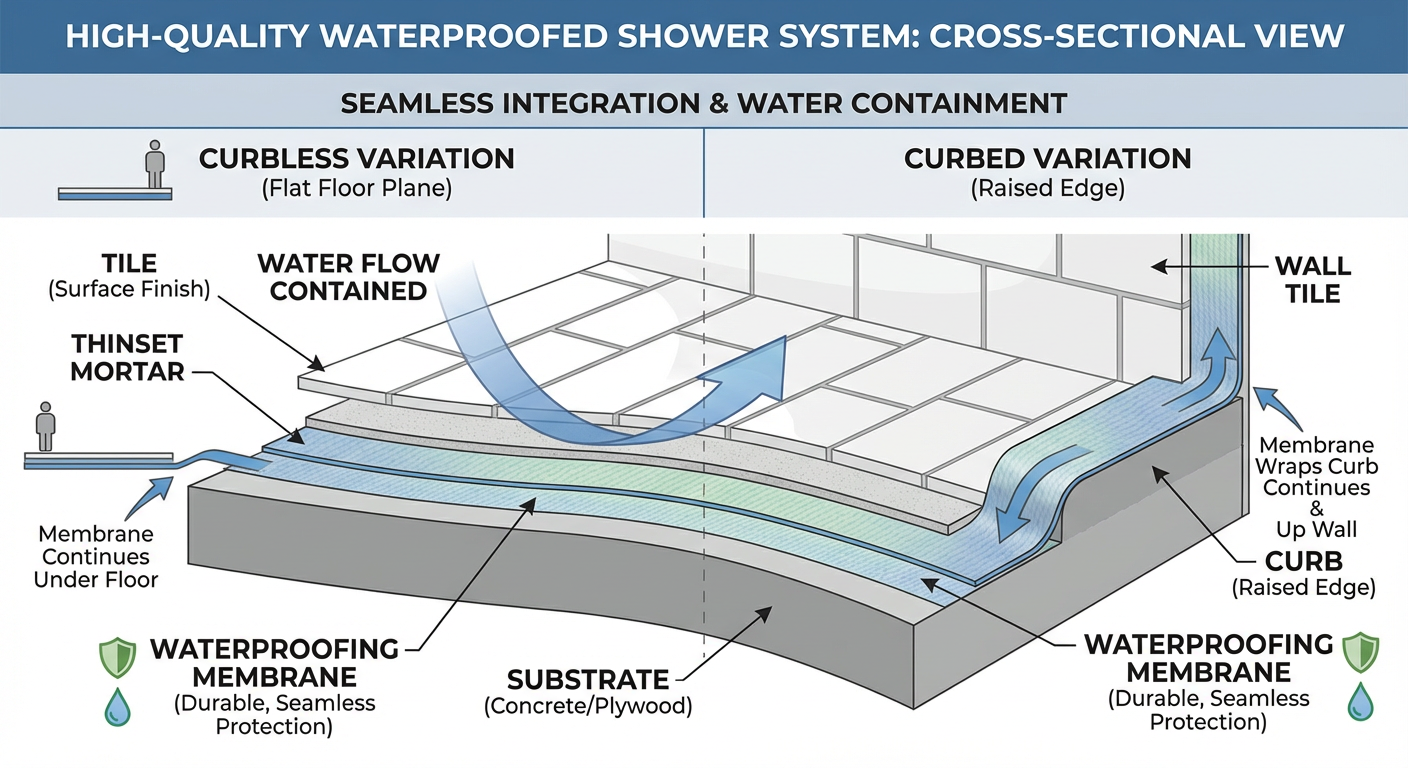
- Continuous Membrane: A reliable waterproof membrane must be installed on the shower pan and extend up the walls, typically at least 6 inches above the finished shower floor or to the height of the showerhead [14]. This continuous barrier prevents water from penetrating the substrate.
- ANSI A118 Compliant Materials: Materials used for waterproofing, such as liquid-applied membranes (e.g., RedGard, HydroBan) or bonded sheet membranes (e.g., Schluter®-Kerdi), must meet ANSI A118 standards for waterproofing.
- Sealed Corners and Penetrations: All corners, changes in plane, and penetrations (such as for the shower valve or niche) must be meticulously sealed with appropriate tapes, sealants, and methods to prevent any water intrusion.
Adhering to these rigorous standards requires skilled labor and quality materials, costing several hundred dollars more upfront for materials and specialized installation [14]. However, this investment is negligible compared to the thousands of dollars and extensive disruption required to address a leaky shower, which might not manifest for years after installation [14]. Homeowners should insist on understanding their contractor’s waterproofing methods and materials, ensuring they align with industry best practices rather than seeking to cut costs in this critical area.
Glass Enclosures and Fixtures: Balancing Aesthetics and Practicality
Once the shell of the shower and its waterproofing are complete, the visible elements – glass enclosures and fixtures – significantly contribute to both the aesthetic appeal and final cost.
Glass Enclosures
The choice of shower glass can drastically affect the budget and the final look:
- Framed Glass Doors: These are the most economical option, with metal frames outlining the glass panels. A standard framed glass door might cost around $800 installed [37].
- Semi-Frameless Doors: These offer a cleaner look with minimal framing, often just around the perimeter. They present a middle-ground in terms of cost and aesthetics.
- Frameless Glass Enclosures: Highly popular for their minimalist, elegant appearance, frameless enclosures use thicker tempered glass (3/8″ or 1/2″) and rely on robust hardware, with minimal metal visible. A custom-cut frameless enclosure, especially for larger or unusually shaped showers, can easily cost $1,200 to $2,500 or more to install [37].
In Phoenix, the region’s extremely hard water (9.9-16.1 grains/gallon) [14] presents a unique challenge for shower glass. Mineral deposits can quickly accumulate, leading to cloudy, etched glass. Many Phoenix homeowners opt for specialized glass coatings (either factory-applied or aftermarket) that repel water and make cleaning easier, adding to the cost. Alternatively, diligent use of a squeegee after each shower is essential to maintain clarity.
Shower Fixtures
The range of available shower fixtures is vast, from basic utilitarian sets to multi-component luxury systems:
- Basic Fixtures: A simple chrome showerhead and valve set can be purchased for $100-$200.
- Mid-Range Options: These often include pressure-balanced valves, larger showerheads, or hand showers, typically ranging from $300-$800.
- Luxury Systems: High-end systems can include thermostatic mixing valves, multiple body sprays, rainfall showerheads, and integrated hand showers. Each component adds cost, and a full luxury system can range from $1,000 to $4,000 or more [3] depending on brand, material, and features. Digital controls and smart shower capabilities push these costs even higher.
Geographic and Structural Considerations: Phoenix’s Impact on Shower Costs
Phoenix’s unique environmental and architectural characteristics significantly influence shower remodel costs, particularly for curbless designs.
Slab Foundations and Concrete Work
A majority of homes in metropolitan Phoenix are built on concrete slab foundations. As discussed, this structural reality adds labor and complexity to curbless shower installations. Creating the necessary recess in a concrete slab requires diamond core drilling and saw cutting, which is far more intensive than modifications to a wood-joisted subfloor [9]. Contractors must factor in the time, specialized equipment, and disposal of concrete debris, driving up the “curbless premium” in the Phoenix market. Relocating a drain involves similar concrete cutting and trenching, further escalating plumbing costs, which can reach around $7,000 for major rough-in shifts [3].
Hard Water Mitigation
Phoenix’s extremely hard water means additional budget items are often recommended for shower systems.
- Water Softeners: Many homeowners invest in a whole-house water softener, costing $1,500 to $2,500 installed, to protect new fixtures and glass from mineral buildup [14].
- Specialty Glass: Choosing shower glass with factory-applied protective coatings (e.g., ShowerGuard or ClearShield) or opting for aftermarket treatments is common. These proactive measures help prevent hard water spots from etching the glass, maintaining clarity and reducing maintenance efforts.
- Fixture Finishes: Selection of brushed nickel, matte black, or oil-rubbed bronze finishes for fixtures can help conceal water spots more effectively than polished chrome or polished nickel.
Tub-to-Shower Conversions and Space Optimization
In older Phoenix homes, particularly those with single-story layouts, master bathrooms often feature large, rarely used built-in garden tubs alongside small, cramped showers. A popular renovation trend is to remove these oversized tubs and convert the space into an enlarged, luxurious walk-in shower. This trend is supported nationally, with 78% of homeowners who remove a bathtub choosing to enlarge their shower footprint, and 40% increasing the shower size by at least 25% [7]. This allows for features like dual showerheads, benches, and greater freedom in curbed or curbless design. Given Arizona’s prevalence of single-story homes and a culture that values spacious primary suites, these conversions are highly sought after and can significantly increase both functionality and resale appeal.
What Raises Cost Most vs. What Saves Money
What Raises Shower System Costs Most:
- Curbless Design on Slab Foundations: The structural work required to recess the subfloor in concrete is the single biggest cost escalator for curbless installations [3].
- Layout Changes: Moving existing plumbing for the shower drain or valve location is very expensive, requiring extensive labor and often concrete cutting [7].
- High-End Tile Choices: Natural stone, imported tiles, or intricate mosaic patterns can escalate tile material costs by 5-10 times ($20-40+ per sq. ft. vs. $2-5 per sq. ft. for ceramic) and demand more skilled, higher-priced labor for installation [3].
- Customization and Specialty Features: Anything custom-built (e.g., oddly shaped glass, built-in benches, multiple niches) or premium fixtures (rainfall showerheads, body sprays, smart controls) adds significantly to the budget [3].
- Thick, Frameless Glass Enclosures: These are more expensive to fabricate and install than framed or semi-frameless options [37].
What Swaps Save Money on Shower System Costs:
- Maintaining Existing Layout: Keeping the shower drain and valve in their original locations avoids costly plumbing relocation and concrete work [3].
- Opting for a Low-Curb or Prefabricated Pan: Instead of a true curbless design, a low-curb or an acrylic pre-fabricated shower pan provides a modern look at significantly reduced labor and material costs (pre-fabricated pans can save $1,000+ in labor alone) [37].
- Strategic Tile Selection: Using high-quality porcelain or ceramic tiles that mimic more expensive materials like marble can save thousands. Limiting expensive accent tiles to small areas can also control costs [3].
- Framed/Semi-Frameless Glass: These options offer a clean look at a fraction of the cost of custom frameless glass [37].
- Mid-Range Fixtures: Many reputable brands offer stylish and highly functional showerheads and valves at mid-range price points, delivering excellent performance without luxury markups.
- Standard Sizes: Choosing items in standard dimensions (e.g., shower niches, glass panels) can reduce fabrication costs.
The Long-Term Value: Why Quality Pays Off in Shower Systems
While the initial investment in a well-built shower system, especially a curbless one, can be substantial, it often translates into long-term value. A properly waterproofed and expertly installed shower prevents costly water damage, mold remediation, and premature replacement. In Phoenix, where hard water is a constant battle, investing in water softeners or protective glass coatings upfront reduces long-term maintenance and preserves the aesthetic of the new shower.
Furthermore, accessible and visually appealing showers, such as curbless designs, add significant resale value. As the population ages, demand for homes that support “aging-in-place” features like zero-entry showers will continue to grow. Studies show that while high-end remodels generally yield a lower percentage ROI than mid-range projects, the functional and aesthetic benefits of a luxury shower are often valued more for homeowner enjoyment and future-proofing than immediate resale profit [12]. A modern, spa-like shower is among the top requests from buyers in the Phoenix market, boosting a home’s appeal [3].
This detailed examination of shower system costs, with a particular focus on the curbless vs. curbed dynamic and Phoenix-specific considerations, underscores the importance of informed decision-making. The next section will delve deeper into the overall budget bands for different bathroom scopes, integrating the insights gained from this analysis of the shower system’s impact.
5. Ensuring Durability: The Importance of Quality Shower Waterproofing
The shower system, often the aesthetic and functional centerpiece of a modern bathroom remodel, is simultaneously its most complex and vulnerable component to failure. While homeowners frequently focus on luxurious tiles, high-end fixtures, and frameless glass enclosures, the unseen elements, specifically, proper waterproofing and structural integrity, are paramount to ensuring the longevity and preventing costly damage in the future. In fact, experts agree that most shower failures, leading to leaks, mold, and rot, are not attributable to material choices or design preferences (such as a curbless vs. curbed shower), but rather to “shortcuts… or incomplete waterproofing” during installation [20]. This section delves into the critical role of quality shower waterproofing, outlining industry standards, essential materials, required construction techniques, and the long-term financial implications of prioritizing durability.
A bathroom remodel in Phoenix, ranging from under $10,000 for a refresh to over $90,000 for a luxury primary bath renovation [0], can be a significant investment. Given that the shower area itself can consume anywhere from 30% to 50% of the total budget [42], protecting this investment through meticulous waterproofing is non-negotiable. Modern shower design, especially the increasingly popular curbless style (which now accounts for roughly 24% of remodeled showers [14]), places even greater demands on a robust waterproofing system. Homeowners and contractors alike must understand the fundamental principles and best practices to preempt the substantial financial and structural consequences of water infiltration.
5.1 The Uncompromising Role of Shower Waterproofing
Water, if allowed to penetrate behind finished surfaces, can cause extensive damage to a home’s structure. In a shower, the constant exposure to moisture makes it a high-risk area for leaks. This is especially true in areas like Phoenix, where the prevalence of slab foundations means that any water infiltration can quickly lead to costly concrete cutting and specialized repair work if drainage needs to be addressed [12]. A properly waterproofed shower acts as a sealed container, directing all water to the drain and preventing it from reaching the subfloor, wall studs, or adjacent spaces. The core philosophy is to create a continuous, impervious barrier that protects the building envelope.
The perceived upfront cost of quality waterproofing materials and skilled labor might seem like an extra expense, but it is ultimately a wise investment that averts far more significant costs down the line. Shower failures, often not apparent until years after installation, can necessitate tearing out not just the shower itself, but damaged portions of the subfloor, wallboard, and even structural framing, leading to reconstruction costs that far exceed the initial savings from subpar waterproofing [20]. For example, replacing a failed shower floor and the resulting subfloor damage could easily add thousands of dollars to a project that initially cost a mere few hundred to waterproof correctly. This principle is reinforced by industry experts who universally caution against cutting corners in this critical phase of construction.
5.2 Industry Standards and Best Practices for Shower Construction
Adhering to established industry standards is not merely a formality but a safeguard. Key organizations provide comprehensive guidelines for proper shower construction, ensuring durability and compliance with building codes.
- Tile Council of North America (TCNA): The TCNA Handbook is considered the authoritative guide for ceramic tile installation, including detailed methods for shower pans and walls. TCNA provides specific recommendations for various shower types, such as method B415 for standard showers with a mortar bed and flexible waterproof membrane, and method B421 for curbless shower installations. These methods emphasize continuous waterproofing and proper substrate preparation.
- American National Standards Institute (ANSI): ANSI A118 standards define the acceptable performance levels for various tile installation materials, including membranes (e.g., ANSI A118.10 for load-bearing, bonded, sheet membrane waterproofing) and grouts. Ensuring that chosen waterproofing products meet these ANSI specifications guarantees their effectiveness and suitability for wet environments.
- International Plumbing Code (IPC): The IPC, adopted by many municipalities including Phoenix, mandates specific requirements for shower drains and surfaces. Critically, it stipulates that shower floors must have a minimum slope of 1/4 inch per foot (2%) towards the drain [18]. This slope is essential to ensure positive drainage and prevent water from pooling, which significantly reduces the risk of water penetration and mold growth.
Meeting these standards involves specific construction techniques. For instance, the traditional method involves a pre-slope layer of mortar beneath the shower pan liner (often PVC or chlorinated polyethylene), followed by a second sloped mortar bed on top of the liner to support the tile. Modern systems, however, frequently employ advanced bonding flange drains, pre-sloped foam trays, and topical sheet or liquid-applied membranes, which streamline the process while enhancing waterproofing integrity. Regardless of the system chosen, the principle remains constant: a continuous, sloped, and sealed barrier is essential.
5.3 Critical Components of a Durable Shower System
Building a durable shower involves several key layers and materials, each playing a vital role in preventing leaks and ensuring long-term performance.
5.3.1 Shower Pan and Floor Slope
The foundation of any waterproof shower is a properly constructed shower pan with adequate slope. The International Plumbing Code (IPC) strictly requires a minimum slope of 1/4 inch per foot (2%) directed towards the drain [18]. This gradient ensures that all water drains efficiently and prevents ponding, which can degrade grout and eventually lead to water penetration. Achieving this slope requires meticulous preparation:
- Pre-slope: In traditional mortar bed systems, a sloped layer of mortar is applied directly to the subfloor before the waterproof pan liner is installed. This ensures that any water that penetrates the tile and mortar bed above the liner still flows towards the weep holes of the drain, rather than sitting on a flat liner.
- Pan Liner/Membrane: A continuous, impervious waterproof membrane (e.g., PVC liner, CPE, or a more modern topical sheet or liquid-applied membrane) is then installed over the pre-sloped base. This membrane typically extends up the shower walls for at least 6 to 12 inches, or to the height of the showerhead, creating a watertight basin. Corners and seams must be meticulously sealed to prevent any breaches.
- Secondary Mortar Bed (for traditional systems): Another sloped mortar bed is applied on top of the liner/membrane to provide a solid, level (but sloped) substrate for tile installation.
- Pre-sloped Trays: Increasingly popular, especially for curbless applications, are factory-manufactured pre-sloped foam trays (e.g., from Schluter-Systems or Laticrete). These lightweight trays integrate directly with topical waterproofing membranes and bonding flange drains, simplifying installation and guaranteeing the correct slope.
5.3.2 Wall Waterproofing
Just as critical as floor waterproofing is sealing the shower walls. Water splashes and steam can penetrate standard drywall or greenboard over time, leading to mold and structural damage. Modern best practices dictate using appropriate substrates and continuous waterproofing:
- Cement Board or Fiber-Reinforced Boards: These materials (e.g., HardieBacker, Durock, Permabase) are moisture-resistant and provide a stable substrate for tile. They are installed over wall studs using corrosion-resistant screws and mesh tape is used to reinforce seams.
- Topical Waterproofing Membrane: A continuous waterproof barrier is applied over the cement board before tiling. This can be either:
- Liquid-Applied Membranes: These roll-on or trowel-applied coatings (e.g., Schluter-Kerdi-DS, Laticrete Hydro Ban) create a seamless, flexible waterproof layer. They are typically applied in two coats, extending from the shower floor up to at least the showerhead height, or preferably to the ceiling.
- Sheet Membranes: Bonded fabric membranes (e.g., Schluter-Kerdi) are adhered to the cement board using thin-set mortar. These membranes are durable and provide consistent waterproofing. Pre-formed corners and banding are used at seams and changes in plane to ensure complete coverage.
- Key Detail – Corners: All inside and outside corners, as well as the junction between the walls and the shower floor, are critical points. These areas experience the most movement and stress, and specialised corner pieces or generous application of liquid membrane with reinforcing fabric are essential.
5.3.3 Drains and Penetrations
The shower drain and any pipe penetrations for fixtures (showerhead, valve) represent potential weak points in the waterproofing system. Proper sealing around these elements is crucial:
- Bonding Flange Drains: Modern drains often feature a bonding flange that directly integrates with the waterproof membrane, creating a continuous seal from the membrane to the drain outlet. These are preferable to older clamp-ring drains, especially with topical membranes.
- Sealants: All penetrations (e.g., for drain, shower valve, and showerhead) must be sealed with a high-quality, mold-resistant silicone or polyurethane sealant compatible with the waterproofing system.
The diagram below illustrates a typical modern shower waterproofing stack for clarity:
| Layer | Description | Materials/Comments |
|---|---|---|
| Shower Wall (Exterior) | Studs, insulation, drywall (standard) | Structural backing and room side of wall |
| Shower Wall Substrate (Interior) | Cement board/fiber-reinforced panel | Moisture-resistant tile backer |
| Wall Waterproofing | Liquid-applied or sheet membrane | Continuous barrier, integrated corners |
| Thin-set Mortar | Adhesive for tile | ANSI A118.4 or above |
| Tile | Finished surface | Ceramic, porcelain, stone |
| Grout | Fills tile joints | Cementitious (sealed) or epoxy |
| Shower Floor (Beneath Tile) | Pre-sloped mortar bed or foam tray | Min. 1/4″ per foot slope to drain [18] |
| Floor Waterproofing | Integrated sheet or liquid membrane | Continuous, fully sealed to drain |
| Shower Drain | Bonding flange drain for integration | Directly connected to plumbing, sealed to membrane |
| Subfloor | Plywood, OSB, or concrete slab | Structural support |
5.4 Curbless Showers: Enhanced Aesthetics, Higher Demands
The allure of the curbless (zero-entry) shower has grown immensely, driven by its sleek, contemporary aesthetic and improved accessibility, especially for aging-in-place designs [14]. With approximately 24% of remodeled showers now featuring a curbless design [14], this trend shows no signs of slowing. However, achieving a truly curbless shower comes with distinct construction challenges and increased costs, primarily related to creating the necessary floor slope without a physical barrier.
The primary hurdle is recessing the shower floor by typically 2.5 to 3 inches below the main bathroom floor level. This drop allows for the proper 1/4 inch per foot slope to be built into the shower pan while maintaining a flush transition at the entry point [16]. The execution of this recess significantly impacts cost and complexity:
- On wooden subfloors: Recessing often involves cutting and lowering floor joists or modifying the existing subfloor framing. While labor-intensive, it’s generally more straightforward than on concrete.
- On concrete slab foundations (common in Phoenix): This is where the complexity and cost escalate. Contractors must cut and remove a section of the concrete slab, dig down to the appropriate depth, and then build the new, sloped shower pan. This process requires specialized tools (e.g., concrete saws, jackhammers), generates significant dust and debris, and is considerably more labor-intensive [12].
Due to these structural modifications and the meticulous waterproofing required, a curbless shower typically adds an estimated $1,000 to $2,000 in extra labor and structural work compared to a standard curbed shower [11]. In challenging scenarios, especially on slab foundations, this “curbless premium” can reach $2,000 to $5,000 [12]. This additional expense covers not only the subfloor modifications but often the use of linear drains (which spread out drainage over a wider area), expanded waterproofing of the surrounding bathroom floor, and the specialized skill required to maintain a continuous slope across the entire wet area.
However, simply achieving the flush entry is not enough. The absence of a curb means that water management becomes even more critical. Proper slope across the entire shower floor is paramount to contain water and prevent it from migrating into the dry areas of the bathroom. This often involves extending the waterproofing membrane further into the bathroom floor, sometimes creating a “wet room” concept, to ensure multiple layers of protection. Given that a significant portion of remodeling budgets is allocated to the shower, it is critical that homeowners understand that while the visible luxury of a curbless shower is appealing, the real value lies in the precision of its underlying construction and waterproofing.
5.5 Long-Term Cost Savings of Doing it Right
The argument for investing in quality shower waterproofing ultimately boils down to long-term cost benefits. While tempting to reduce upfront expenses, cutting corners on waterproofing is a classic example of being penny-wise and pound-foolish.
- Preventing Catastrophic Failures: The most significant saving comes from avoiding major water damage. Leaks can lead to rotten wood, collapsed ceilings in rooms below, extensive mold growth, and compromised structural integrity. Repairing such damage can cost tens of thousands of dollars, far outweighing the initial savings from using cheaper materials or less experienced labor.
- Avoiding Mold Remediation: Mold thrives in damp, dark environments. Inadequate waterproofing creates ideal conditions for mold growth, which not only causes unsightly stains and unpleasant odors but can also pose health risks. Mold remediation is an expensive and disruptive process.
- Maintaining Property Value: A leaking or poorly performing shower system can severely diminish a home’s value and deter potential buyers. A meticulously constructed, fully warranted waterproof shower, on the other hand, is a strong selling point.
- Enhanced Durability and Longevity: Properly installed and waterproofed showers are designed to last for decades without issues. This means homeowners avoid the premature need for another costly remodel or extensive repairs.
- Peace of Mind: Beyond the financial aspects, knowing that a significant investment like a bathroom remodel, particularly its most flood-prone area, is correctly built offers invaluable peace of mind.
Experienced contractors in Phoenix universally advocate for comprehensive waterproofing. They emphasize that using a proven shower kit or membrane system, even if it adds several hundred dollars in material and requires specialized installation, acts as a crucial insurance policy against future problems [20]. For example, a quality integrated waterproofing system like Schluter-Kerdi or Laticrete Hydro Ban Board, including pre-sloped pans and linear drains for curbless designs, might add $500 to $1,500 in material costs for an average shower. However, this is a negligible amount compared to the potential $5,000 to $15,000 (or more) required to repair water damage from a failed system.
5.6 Geo-Specific Considerations: Phoenix, AZ and Waterproofing
In Phoenix, several regional factors amplify the importance of robust shower waterproofing and related considerations:
- Slab Foundations: As previously noted, the predominance of slab-on-grade construction in Phoenix means that any shower leak can lead to immediate and expensive concrete work if the subfloor is breached [12]. This makes the initial waterproofing layer even more critical compared to homes with crawl spaces where water damage might be more easily contained and repaired.
- Hard Water: Phoenix is known for its extremely hard water, with levels typically between 9.9 and 16.1 grains per gallon [13]. While not directly impacting waterproofing integrity, hard water necessitates careful material selection to prevent mineral buildup and etching on shower glass and fixtures. Many Phoenix homeowners opt for water softeners (~$1,500–$2,500 installed) [13] or choose glass with protective coatings. The integrity of grout and sealants can also be challenged by mineral deposits if not properly maintained, indirectly stressing the shower’s waterproof assembly.
- High Temperatures and Humidity (Monsoon Season): While typically arid, Phoenix experiences monsoon seasons with high humidity. Efficient ventilation through high-quality exhaust fans helps reduce moisture buildup, protecting against mold and extending the life of bathroom finishes. While not direct waterproofing, good ventilation complements the waterproof system by minimizing overall moisture levels in the bathroom.
The combination of these factors means that Phoenix homeowners embarking on a bathroom remodel should be particularly vigilant about the shower system. Professional contractors in the region are well-versed in these challenges and will often explicitly recommend superior waterproofing methods and materials to address local conditions, ensuring the functionality and beauty of the remodel endure for years.
5.7 Conclusion and Transition to Material Choices
Ensuring durability through quality shower waterproofing is not an optional add-on but a foundational requirement for any successful bathroom remodel. Adherence to TCNA and ANSI standards, precise execution of the required 1/4 inch per foot floor slope [18], and the use of robust membranes are critical steps that provide long-term protection and ultimately save homeowners from expensive repairs. For design trends like curbless showers, the waterproofing demands are even higher, requiring careful consideration of structural modifications and precision installation. The investment in doing it right far outweighs the potential costs of failure. With the understanding of essential structural elements, we can now turn our attention to the visible and tangible aspects of a bathroom remodel: the material choices that define its aesthetics and significantly influence the overall budget.
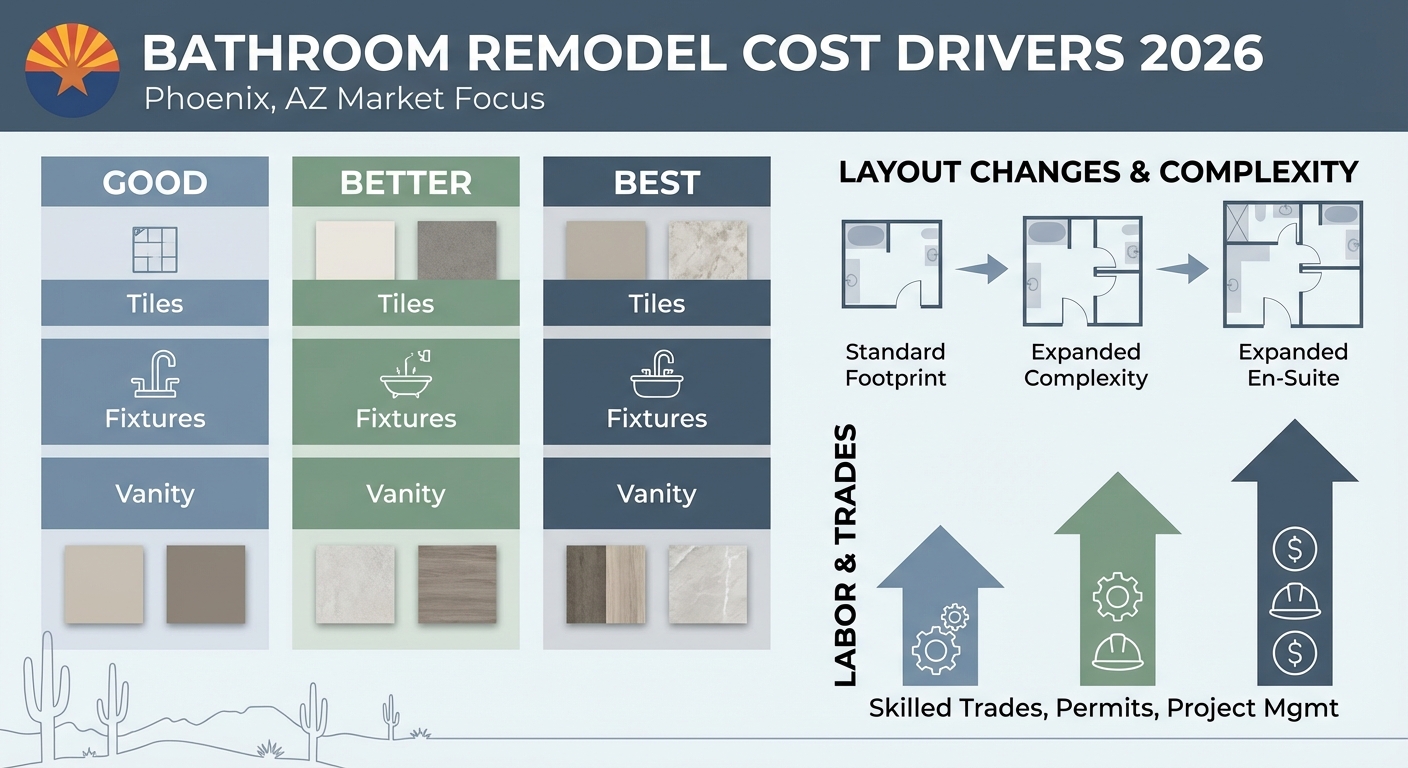
6. Key Cost Drivers: Materials, Layout Changes, and Labor in Phoenix
Embarking on a bathroom remodel in Phoenix in 2026 involves navigating a complex landscape of costs, where decisions regarding materials, layout, and labor can significantly sway the final budget. While a simple refresh might keep expenses under $10,000, a luxury gut renovation of a primary bathroom can easily exceed $90,000[1]. Understanding the primary factors that escalate these costs is crucial for homeowners planning their projects. This section delves into the granular details of material selections, the often-underestimated expense of layout alterations, and the regional impact of Phoenix’s labor market dynamics on overall renovation budgets. By dissecting these key drivers, homeowners can make informed choices to balance their aesthetic aspirations with financial realities, ensuring their bathroom remodel is both beautiful and fiscally responsible.
The Interplay of Material Selections and Budget
The choice of materials stands as one of the most visible and impactful cost drivers in any bathroom remodel. From flooring to fixtures, each selection has a direct bearing on both the aesthetic outcome and the project’s bottom line. The spectrum of material costs is vast, allowing for considerable flexibility or substantial overruns depending on a homeowner’s preferences and budget discipline.
Tile and Flooring: The Foundation of Cost
Tile, often covering shower walls and floors, represents a significant portion of material expenditure. The cost variance is striking: basic ceramic tile can be sourced for as little as $2–$5 per square foot, with installation adding another $5–$6 per square foot[22]. In contrast, opting for natural marble or imported specialty tile can see material costs alone soar to $20–$40 per square foot[22]. For a typical bathroom requiring 60–100 square feet of tiled surfaces within the shower and on the floor, this differential can translate to thousands of dollars. For instance, a 100 sq. ft. shower tiled with basic ceramic might cost around $1,000 in materials, whereas using high-end natural stone could push the material cost to $4,000, not accounting for the more specialized (and expensive) labor required for installation. Upgraded flooring, such as custom mosaics or polished natural stone, also commands a premium compared to standard porcelain or resilient vinyl options. In Phoenix, where tile is a popular choice for its cool properties and durability, these decisions are particularly pertinent.
Fixtures and Features: Enhancing Functionality and Style
Beyond surface materials, the fixtures chosen for a bathroom remodel also present a wide price range. A basic acrylic bathtub might cost between $500–$1,000, while a freestanding designer tub can command between $3,000–$7,000+. Similarly, a standard stock toilet averages around $375 installed, but a wall-mounted smart toilet with bidet functions can range from $1,000 to $4,000[23]. Faucets vary from simple mass-market brands at $100–$200 to luxury models exceeding $500 each. These choices, while seemingly minor individually, quickly accumulate. High-end master bathroom remodels often incorporate multiple showerheads, body sprays, and rainfall fixtures, each adding hundreds to thousands of dollars to the plumbing fixture budget. These premium selections offer enhanced user experience and a bespoke look but are significant contributors to the overall cost. For example, a homeowner could select a mid-range pressure-balanced rain shower system for about $800, but a fully customized, multi-function system with thermostatic controls and multiple body sprays could easily reach $3,000 to $5,000 or more in materials alone.
Cabinetry and Vanity: Storage Meets Aesthetics
The selection of cabinetry and a vanity unit is another area where material choices dictate costs. A ready-made vanity from a home improvement store might be found for $500–$1,000. However, upgrading to a custom-built hardwood vanity, designed to fit specific dimensions or aesthetic requirements, can cost anywhere from $2,500 to $10,000 or more[24]. The choice between custom and stock cabinetry not only affects material expenditure but also labor costs for installation and lead times. Integrated storage solutions, such as custom medicine cabinets or linen towers, further push these figures upwards. For a large primary bathroom in Phoenix, a double vanity made from premium wood with specialized finishes and integrated storage can become a focal point and a substantial investment.
The cumulative effect of these material choices is profound. A strategic approach involves identifying one or two “splurge” items that are highly valued by the homeowner, such as a stunning piece of countertop or a luxurious shower system, and then balancing those choices with more budget-friendly alternatives for other surfaces or fixtures. This “splurge and save” strategy is essential for achieving a desired aesthetic without incurring prohibitive costs. For instance, a homeowner might opt for a porcelain tile that mimics the look of natural marble (saving significant cost on material and installation) while investing heavily in a custom stone countertop. This thoughtful consideration of material tiers is a critical lever in managing a bathroom remodel budget.
Layout Changes: The Ultimate Cost Escalator
While material choices are often the most visible cost drivers, alterations to the bathroom’s layout frequently cause the most significant budget increases, often unexpectedly. Moving plumbing fixtures or walls instigates a chain reaction of work that requires multiple skilled trades and can expose hidden issues, prolonging the project and driving up expenses.
Relocating Plumbing: A Complex Undertaking
Any modification that involves moving the shower, toilet, or sink necessitates extensive plumbing work. Relocating these fixtures demands rerouting water supply lines, drain lines, and potentially vent pipes, which typically reside within walls or floors. In Phoenix, where most homes are built on concrete slab foundations, moving drains becomes particularly challenging. It often requires cutting, trenching, and patching the concrete slab, a labor-intensive process that significantly adds to the cost and complexity compared to homes with crawl spaces or basements. The average cost for a major plumbing rough-in work to relocate multiple fixtures can easily reach ~$7,000 alone[25]. Beyond the direct plumbing costs, there are downstream expenses for patching and refinishing the disturbed areas, including flooring and drywall. This type of work also typically requires obtaining permits and undergoing inspections, adding to the administrative burden and timeline.
Structural and Spatial Modifications
Beyond plumbing, altering the physical footprint of the bathroom by moving or removing walls introduces another layer of significant expense. If a homeowner opts to enlarge the bathroom into an adjacent closet or bedroom, costs accrue for:
- Demolition: Removing existing walls, flooring, and fixtures. Demolition and debris removal for a bathroom typically add between $1,000–$2,000[26].
- Framing: Building new walls, installing headers if load-bearing walls are altered (potentially requiring an architect or structural engineer), and creating new doorways or openings.
- Drywall and Finishing: Installing new drywall, taping, mudding, sanding, and painting the new wall surfaces.
- Flooring Extension: Extending new flooring into the enlarged area to ensure a seamless finish.
- Electrical: Rerouting existing electrical lines or adding new outlets and lighting to accommodate changes.
These structural changes can add $5,000–$10,000+ to the budget, separate from the cost of the finishes[27]. According to a Houzz study, about 22% of homeowners enlarge their primary bathroom during a remodel[28], which inherently places their projects at the higher end of the cost spectrum.
The allure of a new bathroom layout is strong, promising improved flow and functionality. However, homeowners must enter these decisions with a clear understanding that layout changes are not minor upgrades. They are fundamental shifts that reshape the structural and utility backbone of the space, requiring significant investment in labor, specialized skills, and overcoming potential structural hurdles. Projects that prioritize keeping the existing layout, even with updated fixtures, consistently offer a more budget-friendly approach.
Labor Costs in Phoenix: A Premium for Skilled Trades
Labor represents a substantial portion of any bathroom remodel, often accounting for 40% to 65% of the total project cost[29][30]. In Phoenix, the robust construction market and demand for skilled trades mean that labor rates are competitive and can significantly influence the overall budget. The success and longevity of a remodel heavily rely on the expertise of these professionals.
Hourly Rates and Trade Specialization
A typical bathroom remodel requires a diverse team of skilled tradespeople. This often includes plumbers, electricians, tile setters, carpenters, drywall specialists, and painters, often orchestrated by a general contractor. Each trade commands its own hourly rate, which can vary based on experience, licensing, and complexity of the task. In Phoenix, skilled trades roughly charge $50–$150 per hour[31][32]. Specifically, licensed plumbers typically charge between $100–$200 per hour, while electricians fall in the range of $60–$130 per hour[33]. Tile setters, especially those experienced in intricate designs or curbless shower systems, also command higher rates due to the precision and skill required. For example, installing high-end natural stone or complex mosaic patterns demands more time and expertise than laying large-format porcelain, directly impacting labor costs.
The time investment for labor is also considerable. Even a relatively small bathroom can accumulate 100–150 total labor hours across various trades. This means that labor costs can easily contribute $10,000 or more to the budget, even before material costs are factored in. Project management by a general contractor also adds to this, covering coordination, scheduling, quality control, and ensuring compliance with local codes.
Phoenix Market Dynamics and Contractor Availability
Phoenix’s continued growth and strong housing market contribute to high demand for construction and remodeling services. This demand, combined with a persistent shortage of skilled labor, means that reputable contractors often have lead times of several months. These market conditions also enable contractors to price their services reflecting the value of their expertise and reliability. While homeowners might seek lower bids, experts caution that highly competitive (low) pricing can sometimes indicate corners being cut, particularly in critical areas like waterproofing, which can lead to costly failures down the road. The adage “you get what you pay for” is particularly relevant in specialized trades like shower waterproofing and tile installation, where improper techniques can lead to expensive water damage that may not manifest for years[21].
Furthermore, local permit requirements and inspections also factor into labor costs, as contractors must allocate time for documentation, scheduling inspections, and potentially making adjustments based on inspector feedback. General contractor overhead, profit margins (typically 15-25%), and warranty services are also built into labor costs, reflecting the comprehensive service provided.
Curbless Showers: A Deeper Dive into Cost and Complexity
The desire for modern aesthetics and enhanced accessibility has made curbless (zero-entry) showers increasingly popular. Approximately 24% of remodeled showers are now curbless[16], offering a sleek, continuous floor design. However, this feature comes with an inherent increase in cost and complexity compared to traditional curbed showers.
The Curbless Premium
Converting to a curbless shower typically adds $1,000–$2,000 in extra labor and subfloor work compared to a standard curbed shower[14]. This “curbless premium” arises from the necessity to “drop” the shower floor by recessing the subfloor by approximately 2–3 inches[17]. This recess is crucial to allow for the proper 1/4 inch per foot floor slope toward the drain, mandated by the International Plumbing Code and TCNA guidelines[19], ensuring efficient water drainage without a physical curb.
In Phoenix, the prevalence of slab foundations exacerbates this cost. Instead of simply modifying wood joists (as in homes with crawl spaces), contractors must cut or recess the concrete slab. This labor-intensive process often involves jackhammering and meticulous finishing, which can push the curbless “premium” to $2,000–$5,000 in difficult scenarios[15]. This cost includes not only the physical alteration of the slab but also the specialized waterproofing and drainage solutions required for a successful curbless installation.
Critical Role of Waterproofing in Curbless Designs
Proper waterproofing is paramount for both curbed and curbless showers but takes on added significance in a curbless design. With no curb to contain water physically, any failure in the membrane system can lead to widespread water damage across the bathroom floor. Industry standards, such as those from the Tile Council of North America (TCNA), emphasize the need for continuous waterproof membranes extending beneath the tile on the shower pan and up the walls (typically 6+ inches or to showerhead height). Experts consistently note that most shower failures are due to “shortcuts… or incomplete waterproofing,” not the presence or absence of a curb[20]. Investing in a robust, modern waterproofing system (e.g., Schluter®-Kerdi, Laticrete HydroBan Board) adds to the upfront material cost but is a critical insurance policy against future leaks and costly repairs. These systems inherently require skilled labor to install correctly, further contributing to the overall curbless investment.
Glass Enclosures: Complementing the Curbless Aesthetic
Curbless showers are often paired with frameless or minimalist glass enclosures to maintain the open and airy aesthetic. While a framed glass door might cost around $800, a custom-cut frameless glass enclosure, particularly for larger openings or unique configurations, can easily cost $1,500–$3,000 installed[34][35]. Thicker glass (e.g., 1/2-inch tempered) and protective coatings (beneficial in Phoenix’s hard water environment) further increase this expense. Precision measurement and expert installation are vital to ensure proper fit and prevent leaks, contributing to the higher labor component for these specialized installations.
Regional Factors: Tailoring Costs to the Phoenix Experience
Phoenix’s unique environmental and geographical characteristics impose specific considerations on bathroom remodel costs, often requiring homeowners to budget for specialized solutions.
Hard Water Mitigation
Phoenix is known for its extremely hard water, with levels typically ranging from 9.9–16.1 grains per gallon[36]. This high mineral content leads to prominent scaling and spotting on shower glass, fixtures, and tile. To combat these issues, Phoenix homeowners frequently budget for solutions such as:
- Whole-house water softeners: An investment of ~$1,500–$2,500 installed can significantly reduce mineral buildup and extend the life of fixtures.
- Specialty glass coatings: Factory-applied or aftermarket protective coatings for shower glass help repel water spots and make cleaning easier.
- Finish selection: Choosing brushed nickel or matte black fixtures over polished chrome can mask water spots more effectively.
These preventative measures add to the overall project cost but are considered essential for maintaining the long-term appearance and functionality of a newly remodeled bathroom in the Phoenix area.
One-Story Layouts and Master Suite Trends
The prevalence of single-story homes in Phoenix, many built on slab foundations, influences renovation approaches. While slab foundations complicate plumbing relocations for curbless showers, the single-story nature can simplify expansions. Many Phoenix homeowners choose to enlarge their primary bathrooms by absorbing space from adjacent closets or unused bedrooms[37]. This horizontal expansion avoids the structural complexities and costs associated with altering upper-story layouts. Given the generous footprints of many Arizona primary baths (often 80–120 sq. ft. or more), comprehensive remodels in these spaces can easily reach $50,000 or more[38], driven by the sheer scale and the desire for spa-like amenities like dual vanities, separate showers, and freestanding tubs. The trend of removing rarely used jetted tubs to create oversized, multi-feature walk-in showers is particularly strong in these larger primary bathrooms.
Climate-Driven Design Choices
Arizona’s arid, hot climate also guides material and design preferences. Tile, for instance, is a popular choice for flooring due to its cooling properties and moisture resistance, while radiant floor heating (common in colder climates) is rarely installed. Instead, investments might be made in upgraded ventilation systems to combat humidity and improve air quality. Water-efficient fixtures, beyond being a code requirement, are often prioritized by homeowners conscious of local water conservation efforts, influencing selections like low-flow showerheads and dual-flush toilets. Builders in Phoenix also focus on minimizing dust and ensuring easy maintenance, leading to preferences for materials like quartz countertops (which don’t require sealing) and large-format tiles with fewer grout lines.
Case Studies: Illustrating Cost Drivers in Action
Real-world examples from Phoenix and Scottsdale underscore how these cost drivers play out:
- Cost-Conscious Hall Bath Refresh (Phoenix, 2025): A homeowner spent approximately $8,500 to update a 50 sq.ft. hall bath. The low cost stemmed from retaining the existing layout, opting for stock fixtures (a $600 vanity/sink combo, $250 faucet/showerhead), and reglazing the old tub for ~$400 instead of replacing it[39][40]. This example highlights the savings achieved by avoiding layout changes and leveraging cost-effective updates to existing elements.
- Standard 5×7 Full Gut Remodel (Phoenix, 2025): A complete tear-down and rebuild of a 5×7 hall bath cost around $25,000. This included new tiled walls in the tub-shower area, a mid-range fiberglass tub, pressure-balanced rain shower, and a prefab dual-sink vanity. Labor and services accounted for about 50% of the cost, with plumbing and electrical work tallying around $6,500 due to pipe replacements and wiring upgrades[41]. This demonstrates how a full gut, even without layout changes, incurs significant costs in demolition and all-new materials/labor.
- High-End Master Bath Renovation (Scottsdale, 2023): A 120 sq.ft. master bathroom renovation in Scottsdale reached over $75,000. Key cost drivers included a massive curbless walk-in shower ($20,000 for slab cutting, linear drain, Schluter waterproofing, imported marble tile), a custom 1/2-inch frameless glass enclosure ($3,500), electric floor heating ($1,800), custom walnut floating double vanity ($8,000), and high-end fixtures like a smart toilet-bidet ($4,000)[42]. The extensive plumbing and electrical work alone exceeded $10,000 due to relocating fixtures and adding circuits. This example vividly illustrates how premium material choices, complex layout changes (curbless design), and custom elements rapidly escalate the budget into luxury territory.
Conclusion: Navigating the Cost Landscape
The journey of a bathroom remodel in Phoenix in 2026 is punctuated by pivotal decisions that directly influence its ultimate cost. Homeowners face a dynamic interplay between their vision, material selections, and the fundamental structural changes they are willing to undertake. Opting for premium materials, customizing elements, and altering the bathroom’s existing layout are the primary factors that will rapidly escalate costs. The additional complexities and labor associated with features like curbless showers, especially on Phoenix’s prevalent slab foundations, demand additional budget allocation for specialized skills and robust waterproofing. Conversely, strategic choices such as maintaining the existing layout, selecting standard-sized products, and thoughtfully blending high-end accents with more economical alternatives can yield significant savings without compromising quality or overall aesthetic appeal. Understanding these nuances and planning with a realistic contingency for unforeseen issues, particularly given Phoenix’s unique regional considerations like hard water and single-story layouts, will empower homeowners to achieve their dream bathroom within their financial parameters.
The next section will delve further into the specific budget bands for a refresh, mid-range, and luxury remodel, providing detailed breakdowns and showcasing how these cost drivers manifest across different project scopes.
7. Regional Nuances and Trends in the Phoenix Remodeling Market
The Phoenix metropolitan area presents a unique landscape for bathroom remodeling, shaped by its distinctive climate, prevalent housing styles, and a dynamic construction market. Homeowners embarking on renovation projects in 2026 must navigate a set of regional considerations that can significantly influence project scope, material selection, and overall cost. From the challenges posed by the region’s exceptionally hard water to the opportunities presented by its abundant single-story homes, understanding these local nuances is paramount to a successful and cost-effective remodel. This section delves into the specific factors that define bathroom remodeling in Phoenix, offering a detailed analysis of environmental impacts, architectural implications, market trends, and how these elements converge to shape the reality of renovation costs in the Valley of the Sun.
7.1 Environmental Considerations: Hard Water and Climate Impacts
The arid climate of Phoenix is a primary driver of specific challenges and preferences in bathroom design and material selection. Among the most prominent environmental factors is the region’s notoriously hard water, which contains a high concentration of dissolved minerals such as calcium and magnesium.
7.1.1 The Challenge of Phoenix’s Hard Water
Phoenix’s municipal water generally registers between **9.9 and 16.1 grains per gallon of hardness**, placing it firmly in the “very hard” category according to industry standards [14]. This high mineral content has direct and observable impacts on bathroom surfaces and fixtures:
- Mineral Buildup and Etching: Hard water leaves unsightly white residue (limescale) on shower glass, faucets, and tile surfaces. Over time, these mineral deposits can etch into glass, making it permanently cloudy and difficult to clean. Chrome fixtures can also lose their luster and become pitted.
- Reduced Lifespan of Appliances: Continuous exposure to hard water can shorten the lifespan of water-using appliances, including showerheads, faucets, and even water heaters, by causing internal scaling and reduced efficiency.
To counteract these pervasive issues, homeowners in Phoenix frequently allocate budget towards preventive and protective measures:
- Water Softeners: A common and highly recommended investment is a whole-house water softener system. These systems typically cost anywhere from **$1,000 to $2,500 installed** [13] and work by removing hardness minerals from the water supply, thus protecting all plumbing, fixtures, and surfaces throughout the home.
- Specialty Glass Coatings: For new shower enclosures, many Phoenix homeowners opt for glass treated with protective coatings. These factory-applied or aftermarket nanocoatings repel water and minerals, making the glass easier to clean and significantly reducing the frequency and severity of hard water spots. These coatings, while adding to the initial cost of the glass enclosure (which can already range from **$1,500 to $3,000 for frameless oversized units** [10]), are considered a worthwhile investment for long-term maintenance.
- Fixture Finishes: Strategic selection of fixture finishes can also mitigate the appearance of hard water spots. Brushed nickel, matte black, or oil-rubbed bronze finishes tend to camouflage mineral deposits better than polished chrome or highly reflective surfaces.
- Maintenance Habits: Remodelers often advise clients on diligent maintenance practices, such as using a squeegee after each shower and regularly applying cleaning solutions specifically designed for hard water. Installing a handheld showerhead can also aid in rinsing down shower walls and glass after use, simplifying regular cleaning.
The necessity of addressing hard water in Phoenix means that these protective measures are not merely upgrades but often integral parts of a durable and low-maintenance bathroom remodel.
7.1.2 Climate-Responsive Design Choices
Beyond hard water, Phoenix’s intense heat and arid climate also influence material choices and design priorities:
- Cool Surfaces: Unlike colder climates where elements like radiant floor heating are highly desirable, heated floors are a rare indulgence in Phoenix bathrooms (few are willing to pay **~$1,000 for heated floors** that would only be useful for a couple of months a year) [13]. Instead, naturally cool surfaces like ceramic, porcelain, and stone tiles are highly favored for flooring and wall coverings due to their aesthetic appeal and ability to retain a cooler temperature, which is a comfort advantage in the hot summers. Wooden flooring, in contrast, is typically avoided in bathrooms due to moisture concerns and expansion/contraction issues in the fluctuating desert humidity.
- Ventilation and Cooling: While the climate is arid, monsoon seasons bring humidity. Effective ventilation is crucial in Phoenix bathrooms to prevent mold and mildew. Investing in higher-capacity exhaust fans or even adding a second fan for very large master bathrooms can significantly improve air quality and comfort, especially after long, hot showers [13].
- Natural Light Management: To bring natural light into bathrooms without introducing excessive heat, options like skylights or solar tubes are popular. These systems reduce reliance on artificial lighting during the day while minimizing solar heat gain, especially if equipped with modern low-E glass.
- Low-Maintenance Materials: Phoenix homeowners often prioritize low-maintenance materials, partly influenced by a lifestyle that values outdoor activities over extensive indoor cleaning. This trend is evident in the popularity of quartz countertops (stain-proof and requiring no sealing) over granite, and large-format porcelain tiles that minimize grout lines, thereby simplifying cleaning compared to smaller tiles [13].
- Dust Management: The desert environment is inherently dusty. Design elements that facilitate easy cleaning, such as cabinetry with good seals or floating vanities that allow for easy sweeping underneath, are practical considerations often appreciated by Phoenix residents [13].
These climate-driven preferences guide homeowners towards specific upgrades that make their new bathroom more functional, comfortable, and sustainable in the local environment.
7.2 Architectural Implications: Housing Stock and Foundation Types
The predominant housing styles in Phoenix, particularly the prevalence of single-story homes built on slab foundations, significantly impact renovation possibilities and costs.
7.2.1 Single-Story Layouts and Large Primary Baths
A defining characteristic of the Phoenix and wider Arizona housing market is the abundance of **single-story homes**, many of which feature generous master suite footprints [13]. This architectural style has several implications for bathroom remodeling:
- Expansion Potential: With no upper floors to contend with, single-story homes offer more straightforward opportunities for horizontal expansion. Homeowners frequently consider borrowing space from adjacent closets, unused bedrooms, or even sections of the garage to enlarge their bathrooms [13]. Data shows that **22% of homeowners enlarge their primary bathroom** during remodels, often by integrating space from nearby areas like closets [13]. This kind of expansion involves framing, drywall, and flooring extensions, along with potential architectural or engineering consultation if load-bearing walls are involved, adding significantly to the overall cost.
- Larger Primary Bathrooms: Many newer and mid-century Phoenix homes already boast larger primary bathrooms, often exceeding **100 square feet** [8]. These spaces typically include dual vanities, separate showers and tubs, and potentially dedicated dressing areas. Remodeling such expansive spaces inherently costs more due to the sheer volume of materials and labor required. Comprehensive updates to these large primary bathrooms can easily reach **$50,000 or more** [7].
- Tub-to-Shower Conversions: A popular trend in larger primary bathrooms is the removal of rarely used, oversized built-in jetted tubs common in 1990s construction. This space is then often transformed into a luxurious, expansive walk-in shower, sometimes with dual rainfall heads and body jets. This not only modernizes the space but also enhances accessibility and provides a more frequently used amenity. Survey data indicates that **78% of homeowners who remove a bathtub enlarge their shower**, with 40% increasing the shower footprint by at least 25% [7].
7.2.2 Slab Foundations and Plumbing Challenges
The widespread use of concrete slab foundations in Phoenix homes presents particular challenges, especially when altering a bathroom’s layout:
- Curbless Shower Premium: Creating a curbless shower on a slab foundation typically requires cutting into or recessing the concrete slab by approximately **2.5 to 3 inches** to achieve the necessary floor slope for drainage [9]. This structural modification is labor-intensive, often involving jackhammering, and can push the curbless “premium” to **$2,000–$5,000** compared to a standard curbed shower [5]. In homes with wooden subfloors and crawl spaces (less common in Phoenix), this process is significantly easier and less costly. One expert indicates curbless showers generally start **$1,000–$2,000 higher in labor costs** than standard showers due to this specialized subfloor work [9].
- Relocating Plumbing: Moving toilets, sinks, or showers in a slab home necessitates cutting trenches into the concrete to lay new drain lines. This type of major plumbing rough-in work can incur costs upwards of **$7,000** [18], significantly more than in homes where plumbing can be accessed through a crawl space or between floor joists. The need for precise concrete cutting and patching, coupled with adhering to strict plumbing codes, makes layout changes a primary cost escalator in Phoenix remodels.
7.3 Market Trends and Cost Dynamics for 2026
The Phoenix remodeling market is characterized by strong demand and specific cost drivers that influence overall project budgets.
7.3.1 General Cost Landscape and Trajectory
The cost of bathroom remodeling in Phoenix has seen significant shifts in recent years and is projected to remain elevated into 2026:
- Current Averages: As of 2025, the average bathroom remodel in Phoenix hovers around **$12,332**, with a typical range of **$6,973 to $18,186** for standard projects [1]. This is broadly in line with the national average for mid-range renovations (around $12,300) [1]. However, more comprehensive projects, especially primary bath remodels, routinely enter the **$25,000 to $50,000+** range [4], with luxury gut renovations potentially exceeding **$90,000** [3] or even **$100,000** in rare cases for high-end primary suites [4].
- Historical Cost Increases: The median U.S. bathroom remodel spend saw a substantial **50% jump from $9,000 to $13,500** between 2021 and 2022 [5]. This figure further climbed to **$15,000 by 2023** [6]. While there are signs of stabilization or a slight cool-down, with the 2024 median easing to **~$13,000** [7], costs for 2026 are widely expected to remain elevated. This is predominantly due to persistent high demand for skilled labor and increased material costs.
- Phoenix vs. National Averages: Remodeling costs in Phoenix are generally comparable to, or slightly higher than, the national average, but remain lower than more expensive coastal markets. For instance, a mid-range bathroom remodel that might cost **$20,000 in the Midwest could be $25,000–$30,000 in Phoenix** [12]. This is attributed to Phoenix’s thriving housing market, consistent population growth, and high demand for construction services.
7.3.2 Influential Factors: Labor, Materials, and Permits
Several specific elements continue to drive costs in the Phoenix market:
- Labor Costs: Labor typically accounts for **40% to 65% of total bathroom remodel costs** [8]. Skilled tradespeople in Phoenix, such as plumbers and electricians, command hourly rates ranging from **$100–$200/hour** and **$60–$130/hour** respectively [19]. The strong demand for construction and remodeling services in the region contributes to these elevated labor rates.
- Material Costs: After significant inflation in recent years, material costs are stabilizing but remain a major factor. The choice of materials drastically impacts the budget. For example, basic ceramic tile can cost **$2–$5 per square foot**, while specialty tile or natural stone can range from **$20–$40 per square foot** or more [17]. Custom items, such as vanities (**$2,500–$10,000+** vs. ~$500 for stock) [17] and high-end fixtures (e.g., smart toilets **$1,000–$4,000** vs. standard at ~$375) [17], further amplify material expenses.
- Permits and Inspections: All significant remodeling work requires permits and inspections from the City of Phoenix or relevant municipal authorities. Permit fees can range from a few hundred to over a thousand dollars, depending on the scope. These regulatory steps add to the timeline and introduce potential for delays if codes are not strictly adhered to, underscoring the importance of hiring experienced, licensed contractors familiar with local requirements.
7.3.3 Return on Investment (ROI) and Resale Value
Homeowners in Phoenix, like those elsewhere, consider the return on investment when undertaking a bathroom remodel:
- Mid-Range vs. Upscale ROI: A mid-range bathroom remodel typically recoups about **60–70% of its cost** in added home value at resale [12]. For example, a **$25,000 mid-range remodel might add roughly $12,000–$15,000** to the home’s value. More upscale or luxury projects tend to have a lower ROI, around **50–55%** [12]. This suggests that homeowners undertaking highly customized, high-end renovations should do so primarily for personal enjoyment rather than expecting a full financial payback upon sale.
- Buyer Preferences: In the Phoenix market, modern, updated bathrooms are highly sought after. Real estate agents often highlight updated primary bathrooms with large, walk-in showers as key selling points, reflecting buyer demand for spa-like amenities. While a home with multiple bathrooms might see a tub removed for an expanded shower without negatively impacting resale, homes with only one bathroom typically benefit from retaining at least one tub for family buyers. Accessibility features, such as curbless showers, also increase appeal to a growing demographic of buyers considering aging-in-place.
7.4 Building Standards and Best Practices
Ensuring longevity and adherence to safety is paramount in any bathroom remodel, especially concerning shower systems. Phoenix contractors must follow stringent building codes and industry standards.
7.4.1 Shower Waterproofing and Slope Requirements
Proper waterproofing is a non-negotiable aspect of shower construction, regardless of whether it’s curbed or curbless. Skipping proper waterproofing is a leading cause of shower failure:
- Industry Standards: According to the International Plumbing Code (IPC) and reinforced by the Tile Council of North America (TCNA) guidelines, all shower pans must have a minimum **1/4-inch per foot slope** towards the drain [10]. Achieving this precise slope is critical for effective drainage and preventing water pooling, which can lead to leaks and mold.
- Waterproof Membranes: High-quality, continuous waterproof membranes (e.g., ANSI A118 compliant systems like Schluter®-Kerdi or Laticrete HydroBan Board) are essential. These membranes are applied either behind or on top of cement backer board in wet areas, extending over the shower pan and up the walls (typically **at least 6 inches above the floor or to the height of the showerhead**) [14].
- Consequence of Shortcuts: Experts emphasize that the vast majority of shower failures and leaks stem from “shortcuts or incomplete waterproofing,” not from the design choice (e.g., curbless vs. curbed) [9]. While durable shower systems add a few hundred dollars in material cost and require skilled labor, this investment prevents much more expensive repairs and water damage down the line.
7.4.2 Codes and Local Amendments
Phoenix’s codes align with national standards but include specific amendments, particularly concerning water conservation:
- Water-Efficient Fixtures: Due to California’s historic droughts and water scarcity concerns, local codes require the installation of water-efficient fixtures in renovations. This means new toilets must be **1.28 gallons per flush (GPF) or less**, and showerheads must be **2.0 gallons per minute (GPM) or less** [13]. These low-flow fixtures are now standard and generally do not incur additional costs but are a mandatory consideration.
- Permitting Process: The permitting process in Phoenix ensures that all work meets safety and structural standards. Homeowners should engage contractors who are licensed and knowledgeable about local permitting requirements to avoid costly re-work.
7.5 Case Studies from the Phoenix Market
Examining specific projects helps to illustrate the cost realities and trends discussed.
7.5.1 Cost-Conscious Hall Bath Refresh (Phoenix, 2025)
A Phoenix homeowner successfully updated a **50 sq.ft. hall bathroom for approximately $8,500 in mid-2025**. This project focused on cosmetic improvements:
- Scope: Repainting, replacing an old vanity with a **$600 stock vanity/sink combo**, installing new budget-friendly fixtures, and reglazing the existing tub for **~$400** [notable example 1].
- Cost-Saving Strategies: No layout changes or extensive tile work minimized labor. The project demonstrated that working with the existing layout and infrastructure significantly reduces costs.
- Outcome: A modernized bathroom under $10,000, with increased appraisal value, showcasing the effectiveness of targeted cosmetic upgrades.
7.5.2 Standard 5×7 Full Gut Remodel (Phoenix, 2025)
A complete renovation of a **5′ x 7′ hall bathroom** in a 1970s Phoenix home in 2025 cost around **$25,000** [notable example 2]:
- Scope: Full demolition to studs, new tiled tub-shower with porcelain subway tile, upgraded plumbing valves, a new fiberglass soaking tub (**$1,200**), a pressure-balanced rain shower system (**~$800**), a prefab dual-sink vanity (**$1,100**), and a standard toilet (**$300**).
- Cost Breakdown: Labor and services constituted approximately 50% of the cost, with materials and fixtures making up the other half. Plumbing and electrical work amounted to **~$6,500** due to pipe replacement and wiring upgrades [notable example 2].
- ROI: This project yielded an estimated **$12,000 in added home value**, aligning with the 45-50% ROI typically seen in mid-range remodels [12].
7.5.3 High-End Master Bath Renovation (Scottsdale, 2023)
A luxury remodel of a **120 sq.ft. master bathroom in Scottsdale in late 2023 exceeded $75,000** [notable example 3]:
- Scope: Creation of a massive curbless walk-in shower (**~$20,000**) with slab cutting, linear drain (**~$900 fixture**), full Schluter waterproofing, imported Italian marble tile (**$25/sq.ft.**), dual rainfall showerheads, and body jets. A custom frameless glass enclosure cost **$3,500**. Additionally, the project included electric floor heating (**$1,800**), custom walnut floating vanities (**$8,000**), wall-mounted faucets (**$600 each**), and a smart toilet-bidet combo (**~$4,000**) [notable example 3].
- Key Cost Drivers: Extensive layout changes requiring **$10,000 in plumbing and electrical work** [notable example 3], premium materials, and custom fabrication significantly escalated costs.
- Outcome: A luxurious, spa-like master bath reflecting a growing trend in Phoenix’s high-end market where homeowners prioritize lifestyle investments over immediate ROI.
7.5.4 New Bathroom Addition for Large Family (Glendale, 2025)
A family added a **56 sq.ft. three-quarter bathroom in Glendale, AZ for $30,480** in 2025 [notable example 4]:
- Scope: Conversion of a garage storage area into a new bathroom, involving new framing, extensive plumbing lines (**$6,200**), wiring, and finishes including a prefab acrylic shower unit (**$4,735**).
- Cost Drivers: The project’s cost per square foot was around **$544/sq.ft.** [notable example 4] due to the need for entirely new infrastructure (plumbing, electrical, framing), permits, and engineering fees (**$2,500**).
- Lesson: Adding a new bathroom is typically more expensive per square foot than remodeling an existing one but significantly boosts functionality and home value by increasing the bath count.
7.6 Conclusion to Regional Nuances
The Phoenix bathroom remodeling market in 2026 is characterized by a blend of unique regional challenges and homeowner aspirations. The pervasive issue of hard water necessitates proactive measures like water softeners and protective glass coatings. The prevalence of single-story, slab-on-grade homes impacts structural modification costs, particularly for sought-after curbless showers and significant layout changes. Despite these cost drivers, a robust market and a desire for personalized, spa-like escapes indicate continued investment, especially in primary bathrooms. Understanding these specific dynamics, along with the critical importance of adhering to stringent building and waterproofing standards, is crucial for both homeowners and contractors to navigate the complexities and achieve successful outcomes in the Valley’s remodeling landscape.
The following section will expand on the various budget tiers for bathroom remodels, from basic refreshes to luxury gut renovations, providing a detailed breakdown of expected costs and features within each category, with a specific focus on curbless versus curbed shower options.
8. Return on Investment (ROI) and Value-Driven Decisions
For many homeowners, a bathroom remodel serves a dual purpose: enhancing daily living through improved aesthetics and functionality, and strategically boosting the property’s market value. While the personal enjoyment derived from a beautifully renovated bathroom is invaluable, the financial return on investment (ROI) remains a critical consideration. This section dives into the intricate relationship between remodel costs and their recoupment at resale, offering granular insights into how different project scopes, from minor refreshes to full luxury gut renovations, impact a home’s market appeal and financial value, especially within the unique Phoenix real estate landscape in 2026. Understanding these dynamics is paramount for making value-driven decisions that align with both lifestyle aspirations and long-term financial goals.
The Realities of Bathroom Remodel ROI
It’s a common misconception that every dollar spent on home renovation directly translates into an equivalent increase in resale value. While bathroom remodels are consistently ranked among projects that offer a respectable return, they rarely achieve 100% recoupment. The value homeowners place on a new bathroom when living in the home often exceeds what a subsequent buyer is willing to pay for it. According to remodeling industry data, a bathroom remodel is first and foremost a quality-of-life investment, with its financial recovery secondary [12].
Mid-Range Remodels: The Sweet Spot for ROI
For most homeowners looking for a balance between personal enjoyment and investment recovery, a mid-range bathroom remodel often presents the most favorable ROI. Data compiled by Remodeling Magazine’s Cost vs. Value report indicates that a mid-range bathroom remodel, on average, recoups approximately 60-70% of its cost at resale [12]. This means that if a homeowner invests $20,000 into a mid-range renovation, they could expect to see an increase in their home’s value of around $13,000 upon sale. Buyers appreciate updated baths but may not be willing to pay the full premium for highly customized luxurious features [12].
A “mid-range” remodel in Phoenix, typically costing between $15,000 and $30,000, usually includes upgraded semi-custom vanities, better fixtures, new tile work (often tiled tub/shower), and potentially minor reconfiguration without structural layout changes [4]. Such projects strike a desirable balance, incorporating trendy features like quartz counters and new tile accents without venturing into bespoke territory. For instance, a hypothetical $25,000 full gut remodel of a standard 5’x7′ hall bathroom in Phoenix was observed to yield an appraised value increase of roughly $12,000, aligning with a ~48% recoupment rate [75]. This demonstrates that even projects replacing everything down to the studs can still fall within the mid-range ROI expectations if material and labor choices are balanced.
Minor Refreshes: High Impact, Lower Cost
Simpler updates, often referred to as “refreshes” or “facelifts,” typically yield some of the best returns. A modest bathroom facelift can return around 66-67% of its cost [12]. These projects focus on cosmetic upgrades such as repainting, replacing old vanities with stock units, updating lighting and fixtures, and perhaps reglazing an existing tub rather than replacing it [70]. By avoiding significant structural changes or plumbing relocations, these projects keep labor costs relatively low while dramatically improving the bathroom’s visual appeal. For example, a Phoenix homeowner spent approximately $8,500 on a hall bath refresh in mid-2025 by repainting, installing a stock vanity, new budget-friendly fixtures, and reglazing the tub for about $400. This targeted approach resulted in a modernized bathroom for under $10,000, with an appraisal suggesting a significant portion of this investment was recouped in increased home value [71].
Upscale Remodels: Investing in Lifestyle Over Strict ROI
At the opposite end of the spectrum are upscale or luxury bathroom remodels, which involve premium materials, custom designs, and often significant layout changes or expansions. These projects frequently exceed $30,000-$60,000 in Arizona, with luxury master suites easily surpassing $50,000 [5]. While these renovations create a “wow” factor and significantly enhance personal enjoyment, their financial ROI is generally lower, hovering around 50-55% [12]. This means a $60,000 upscale bath remodel might only add $30,000-$33,000 to the home’s resale value [12].
The diminished ROI for luxury remodels stems from several factors:
- Personalization: High-end remodels often feature highly personalized design choices that may not perfectly align with a broad buyer base. A buyer might appreciate the quality but may not be willing to pay full price for features tailored to someone else’s taste.
- Market Saturation: In competitive markets, homes with luxury features are often priced against other luxury properties, where extreme customization may not stand out as much as it would in a mid-range home.
- Diminishing Returns: There’s a ceiling to what even the most elegant bathroom can add to a home’s value relative to its overall price. Once a certain level of finish and functionality is achieved, additional investment yields progressively smaller increases in market value.
Therefore, ultra-luxe projects are best justified by the homeowner’s extended enjoyment and improved daily living experience rather than solely by an expectation of dollar-for-dollar payback at resale. The Scottsdale master bath renovation, costing over $75,000 for a curbless shower with Italian marble, custom vanity, and smart toilet, exemplifies this. While it created a spa-like retreat, its projected ROI of $30,000-$35,000 added value indicates a recoupment of around 40-47%, primarily a lifestyle investment [74].
Value-Driven Decisions: Maximizing ROI and Enjoyment
Making informed decisions about a bathroom remodel involves balancing personal desires with financial prudence. Several strategies can help homeowners maximize their value, whether their priority is high ROI, personal enjoyment, or a blend of both.
Strategic Item Swaps and Value Engineering
One of the most effective ways to control costs and improve ROI is through strategic material choices and value engineering. High-end finishes can inflate costs dramatically. For example, natural marble or specialty tile at $20–$40 per square foot can be 5–10 times the cost of quality ceramic tile at $2–$5 per square foot [20]. Similarly, a custom hardwood vanity might cost $2,500–$10,000+, whereas a stock unit could be around $500 [21].
Homeowners can achieve a high-end look without a high-end price tag by mixing and matching:
- Tile Choices: Opt for high-quality porcelain tile that mimics natural stone or marble. These options often cost a fraction of their natural counterparts while offering superior durability and easier maintenance, especially in Phoenix’s hard water environment [24].
- Vanity vs. Cabinetry: A stock vanity from a big-box store with a high-end quartz or granite countertop can provide a sophisticated look at a lower cost than a fully custom-built vanity [24].
- Fixtures: Splurge on a designer faucet or showerhead, but choose more budget-friendly options for less visible fixtures like the toilet or secondary lighting. A standard toilet can cost around $375 installed, whereas a smart toilet can range from $1,000-$4,000 [22].
- Shower Glass: Opt for a semi-frameless glass enclosure over a custom frameless one if budget is tight. While frameless offers a sleek, modern look, a semi-frameless can provide a similar aesthetic at a lower cost (e.g., ~$800 vs. $1,500-$3,000 for frameless) [42].
An example of this “splurge and save” strategy is a homeowner who swapped a proposed $1,200 custom glass sink for a $200 undermount sink, freeing up budget for a desired rainfall showerhead and body sprays. This allowed them to meet their performance and aesthetic goals by reallocating funds smartly.
The Cost of Changing Layouts: A Major ROI Factor
One of the biggest detractors from ROI is significant layout changes, particularly moving plumbing fixtures. Relocating a shower, toilet, or sink involves extensive plumbing work, often requiring opening walls and floors, which dramatically inflates labor costs. For instance, moving plumbing for a new layout can add approximately $7,000 in new plumbing rough-in work [23]. In Phoenix, where many homes are built on concrete slabs, relocating drains can necessitate cutting into concrete, further adding to labor and complexity [9].
Homeowners aiming for a higher ROI typically adhere to the existing bathroom footprint, making cosmetic and fixture upgrades while keeping the plumbing lines largely in place. This approach drastically reduces labor costs associated with plumbers ($100-$200/hour) and electricians ($60-$130/hour) [23]. Cosmetic changes, such as new tiles, paint, vanity, and fixtures, offer a fresh look without the prohibitive expense of a complete structural overhaul.
Aging-in-Place and Accessibility Features
While often viewed as lifestyle enhancements, features that promote aging-in-place and accessibility can also contribute to long-term home value and broaden market appeal, especially in an aging population. Curbless showers, for example, offer not only a sleek aesthetic but also significant accessibility benefits, making the bathroom safer and more usable for individuals with mobility challenges. About 24% of remodeled showers are now curbless [10]. While curbless showers incur an additional cost of $1,000–$5,000 due to complex subfloor modifications and advanced waterproofing [10], this investment can be highly attractive to specific buyer segments and future-proof the home for the current owners.
Other accessibility features like grab bars (when installed thoughtfully and aesthetically), comfort-height toilets, and lever-handle faucets contribute to universal design principles, making a home appealing to a wider demographic over time. The value here is often realized more in sustained marketability and future-proofing than in immediate, quantifiable resale dollar increases. The 2025 Houzz Bathroom Trends Study noted a continued emphasis on accessibility, with 68% of renovators planning for special needs [79].
Understanding Tub vs. Shower Trends
The decision to include a bathtub or opt for an expanded shower profoundly impacts both the functionality and potential resale value of a bathroom. Current trends strongly favor large, luxurious showers. Over 78% of homeowners who remove a bathtub during a remodel choose to enlarge their shower footprint, with 40% making the new shower at least 25% bigger [13]. Many contemporary designs prioritize expansive, walk-in showers, often foregoing a tub entirely, particularly in master bathrooms where space is a premium [13].
In homes with multiple bathrooms, converting an unused or rarely used tub-shower combo in a primary bath into a large, sophisticated walk-in shower is often a strong selling point. However, in single-bathroom homes, real estate experts often advise retaining at least one bathtub for families with young children, as the absence of a tub can slightly deter a portion of potential buyers. Freestanding soaking tubs remain popular in high-end master baths that have ample space, with 58% of renovators choosing a tub opting for this style [13]. The value proposition here is to align the selection with both current lifestyle needs and the broader market expectations for the home’s size and location.
Regional Nuances: Phoenix ROI Considerations
The Phoenix real estate market introduces specific factors that influence bathroom remodel ROI:
- Hard Water Mitigation: Phoenix’s extremely hard water (9.9–16.1 grains per gallon) presents unique maintenance challenges [14]. Investing in features like water softeners ($1,500-$2,500 installed) or specialty glass coatings for shower enclosures can prevent mineral buildup, preserve the new aesthetic, and subtly add value by reducing future upkeep for buyers [14]. These proactive measures can help maintain the perceived value of a renovated bathroom over time.
- One-Story Layouts and Master Bath Scale: The prevalence of one-story homes and large master suites in Arizona means primary bathroom remodels are often extensive. Homeowners frequently enlarge these spaces by expanding horizontally into adjacent closets or bedrooms (22% of homeowners do so), aiming for spacious, spa-like retreats [15]. While such expansions increase costs (often leading to $50k+ projects), the resulting large, luxurious master baths are a significant draw in the Phoenix market, particularly for affluent buyers who expect such amenities.
- Climate-Appropriate Materials: Design choices influenced by the desert climate, such as the widespread use of tile and stone (for their cooling properties and durability), align well with local preferences and are generally seen as value-adding. Conversely, features less suited to the climate, like radiant floor heating, typically offer a lower ROI in Phoenix compared to colder regions.
- Market Demand and Contractor Availability: Phoenix’s bustling housing and renovation market mean that reputable contractors are in high demand. While competitive pricing exists, quality work comes at a price. Homeowners understand that paying for experienced, licensed professionals helps ensure a durable, compliant remodel, which contributes to long-term value and avoids costly future repairs typically caused by cutting corners on installation.
These local specificities emphasize that a successful value-driven remodel in Phoenix considers not just general ROI figures but also adaptation to the local environment and buyer expectations. An upgraded bathroom that addresses hard water issues, functions well in the heat, and matches the spaciousness of other master suites in the area will likely command a better return.
Table 8.1: Bathroom Remodel ROI by Scope (Phoenix Averages, 2026 Projections)
The following table provides an overview of the estimated costs and corresponding return on investment for various bathroom remodel scopes in the Phoenix market, based on current data and projections for 2026. These figures serve as a guide for homeowners planning their renovations.
| Remodel Scope | Average Cost Range (Phoenix) | Recouped Value at Resale (Estimated) | Estimated ROI Percentage | Key Features & ROI Drivers |
|---|---|---|---|---|
| Minor Cosmetic Refresh (Powder/Hall Bath) | $3,000 – $10,000[2][3] | $2,000 – $6,700 | 66-67%[12] | New paint, budget fixtures, stock vanity, reglazed tub. High ROI due to low cost, high visual impact, and broad appeal. |
| Mid-Range Hall Bath Remodel (Full Gut) | $15,000 – $30,000[4] | $9,000 – $21,000 | 60-70%[12] | New tiled tub/shower, semi-custom vanity, upgraded fixtures, no layout changes. Balances cost, quality, and broad appeal. |
| Mid-Range Primary Bath Remodel (Full Gut) | $25,000 – $50,000[3] | $15,000 – $30,000 | 60% | Large shower (possibly curbless), dual vanity, quality tile & fixtures. Good ROI for larger baths, meets buyer expectations. |
| Upscale Master Bathroom Remodel | $50,000 – $90,000+[3] | $25,000 – $49,500 | 50-55%[12] | Custom curbless shower, freestanding tub, luxury materials (marble), custom cabinets, layout changes. Lower ROI, greater personal enjoyment. |
| New Bathroom Addition (e.g., Garage Conversion) | $30,000 – $60,000+[78] | $30,000 – $60,000+ | Potentially 100%+ | Adds bath count, which is a key valuation metric. Higher cost per sq. ft. but can significantly increase home value if bath count is low. |
Note: These figures are estimates for the Phoenix metropolitan area in 2026. Actual costs and ROI can vary based on material selections, labor rates, specific home characteristics, and market conditions at the time of sale.
Conclusion: Balancing Personal Enjoyment and Financial Prudence
The decision to remodel a bathroom in Phoenix in 2026 involves a nuanced understanding of both personal aspirations and market realities. While most projects will not yield a 100% financial return, a thoughtfully planned renovation can significantly enhance a home’s livability and its appeal to future buyers. Mid-range remodels and minor refreshes generally offer the most attractive ROI, often recouping 60-70% of their cost. Upscale projects, while delivering exceptional personal enjoyment and luxury, typically see lower financial returns (50-55%), making them more of a lifestyle investment.
Key strategies for maximizing value include avoiding costly layout changes, smartly selecting materials (balancing splurges with saves), and incorporating features that address local climate and buyer preferences, such as hard water protection and spacious shower designs. Ultimately, a successful bathroom remodel harmonizes functional improvements, aesthetic upgrades, and a keen awareness of what adds tangible value in the dynamic Phoenix real estate market.
Having explored the financial return aspects, the next section will delve into the practicalities of a durable shower system, focusing on materials and construction that ensure longevity and prevent common issues, representing another critical investment for homeowner satisfaction and sustained home value.
9. Frequently Asked Questions About Bathroom Remodel Costs in Phoenix
Embarking on a bathroom remodel in Phoenix can be an exciting, albeit sometimes daunting, prospect for homeowners. With a wide spectrum of possibilities, from a basic refresh to a luxurious, full-gut renovation, understanding the true financial commitment and what drives costs is paramount. This section aims to demystify common questions surrounding bathroom remodeling expenses in the Valley of the Sun, leveraging specific data for 2026. We will delve into what factors most significantly increase the budget, highlight smart swaps that can lead to savings, and provide detailed insights into the cost of durable shower systems, including the popular curbless trend. Drawing on recent contractor quotes, industry standards, and local Phoenix market nuances, this deep dive will equip homeowners with the knowledge to make informed decisions for their 2026 bathroom renovation projects.
What Raises the Cost Most in a Bathroom Remodel?
Several key factors consistently emerge as the primary drivers of increased costs in bathroom remodels. These elements often involve extensive labor, specialized skills, and premium materials, fundamentally altering both the complexity and the expense of a project.
1. Layout Changes and Plumbing Relocation
Without a doubt, altering the existing layout by moving plumbing fixtures is among the most significant cost escalators. Homeowners often underestimate the ripple effect of such changes. Relocating a toilet, shower, or sink is not merely about moving the fixture itself; it necessitates rerouting supply lines and drainpipes within walls and floors. In Phoenix, where most homes are built on concrete slab foundations, this can involve jackhammering and cutting into the concrete to lay new drain lines, a labor-intensive and messy process. The associated costs for plumbing rough-in work alone can be substantial, with a major plumbing reconfiguration adding anywhere from $5,000 to $10,000, and specifically around $7,000 for rough-in plumbing if multiple fixtures are relocated[81]. This figure does not even account for the subsequent patching, flooring, and finishing work required after the pipes are moved. Beyond plumbing, if walls are moved to enlarge the bathroom or to reconfigure its shape, additional costs for framing, drywall, and potentially structural engineering are incurred. Approximately 22% of homeowners enlarge their primary bathroom during a remodel, a decision that typically pushes the project to the higher end of cost ranges due to these structural additions[82]. Keeping the existing layout, even if updating all fixtures within their current footprint, remains the most effective strategy for cost control.
2. Material Selection: High-End Finishes and Customization
The choice of materials profoundly impacts the overall budget, presenting a classic “champagne taste vs. beer budget” dilemma. While seemingly small differences per square foot, these costs can accumulate rapidly across an entire bathroom. For instance:
- Tile: Basic ceramic tile might cost $2–$5 per square foot for the material, while natural marble or specialty artisan tiles can easily reach $20–$40+ per square foot (material only)[22]. For a shower requiring 100 square feet of tile, this material difference alone could swing the cost by thousands of dollars.
- Countertops: Opting for natural stone (e.g., granite, marble) or high-end quartz over laminate or cultured marble can add hundreds to thousands of dollars.
- Vanities and Cabinetry: A stock vanity unit readily available at a home center might cost $500–$1,000, but a custom-built hardwood vanity can range from $2,500 to $10,000 or more, depending on size, wood type, and features[23].
- Fixtures: Basic toilets typically start around $375 installed, while wall-mounted smart toilets or bidet combos can go from $1,000 up to $4,000[24]. Designer faucets can similarly cost several times more than mass-market brands.
- Shower Glass: A standard framed glass shower door might be around $800, whereas a custom-cut, frameless 3/8″ or 1/2″ tempered glass enclosure can easily run $1,500–$3,000 installed, especially for larger or unusually shaped showers[75].
The combination of multiple high-end material selections can push a project well past the $50,000 mark for a primary bathroom[25]. The desire for a “bespoke” or “spa-like” feel often correlates directly with increased material expenses and the specialized labor required for their installation.
3. Labor Costs and Skilled Trades
Labor constitutes a significant portion, typically 40% to 65%, of the total bathroom remodel cost[17]. In Phoenix, skilled tradespeople like plumbers and electricians command hourly rates ranging from $100–$200/hour and $60–$130/hour, respectively, for remodel work[83]. A typical bathroom remodel requires a general contractor, demolition crew, framers, plumbers, electricians, tile installers, drywallers, and painters. The more complex the design, the more specialized labor is needed, such as for intricate tile patterns or custom cabinetry installation, which invariably costs more. Unexpected issues discovered during demolition, such as hidden water damage or outdated wiring, also add to labor hours and, consequently, the final bill. The demand for qualified trades in Phoenix’s bustling construction market keeps labor costs elevated, making it a critical budget component.
4. Advanced Shower Systems (Especially Curbless)
As detailed in other sections, the shower area itself is often the single most expensive component of a bathroom remodel. Upgrading to a custom tiled walk-in shower can cost $1,200–$5,000+ to install for a standard configuration, with premium features like multiple showerheads and floor-to-ceiling tile adding thousands more[10]. The increasing popularity of curbless (zero-entry) showers further elevates this cost. While desirable for their sleek aesthetic and enhanced accessibility, curbless showers are “not a minor upgrade”[15]. They typically add $1,000–$2,000 in extra labor and subfloor modification compared to a standard curbed shower[13]. On concrete slab foundations common in Phoenix, this premium can rise to $2,000–$5,000 due to the extensive concrete cutting and recessing required to achieve the proper slope for drainage[14]. This specialized work requires highly skilled labor and meticulous waterproofing, making the shower system a major budget item.
What Swaps Save Money in a Bathroom Remodel?
Controlling costs in a bathroom remodel often comes down to making strategic choices and prioritizing spending. Savvy homeowners can achieve a significant upgrade without necessarily opting for the most expensive options at every turn. Here are some effective swaps and strategies to save money:
1. Maintain the Existing Layout
As discussed, moving plumbing fixtures is a major expense. The most significant cost-saving swap is to keep the toilet, shower, and sink in their original locations[84]. This eliminates the need for expensive rough-in plumbing work, which can easily cost $5,000–$10,000. By working within the existing footprint, you can still achieve a dramatically new look through updated finishes and fixtures without the hidden costs associated with structural changes. This “surface-level” approach can turn a typical full remodel into a “minor remodel” budget territory, often costing about $5,000–$8,000 instead of $15,000–$20,000+ for a major layout change[30].
2. Choose Standard Sizes and Off-the-Shelf Products
Customization commands a premium. Opting for readily available, standard-sized products over custom-built items can lead to substantial savings:
- Vanities: Instead of a custom-built vanity that might cost $2,500–$10,000, choose a stock vanity from a home improvement store, which can be found for $500–$1,000[23]. Many stock options today offer stylish designs and good quality.
- Shower Pans: While a fully custom-tiled shower pan is desirable, a high-quality prefabricated shower base (e.g., acrylic or solid surface) can be a cost-effective and durable alternative. These save on both material and specialized labor costs associated with building a custom mortar bed pan, with prefab pans costing only a few hundred dollars versus thousands in labor for a custom one[85].
- Shower Doors: Standard-sized framed or semi-frameless glass shower doors are significantly less expensive, often under $800 installed, compared to custom frameless enclosures, which can cost $1,500–$3,000[75].
- Tile: Swap expensive natural stone or designer tiles ($20–$40/sq.ft.) for high-quality porcelain or ceramic tiles ($2–$5/sq.ft.) that mimic the look of more costly materials. Modern porcelain tiles can convincingly replicate wood, marble, or concrete at a fraction of the price and with superior durability for wet environments[86].
3. Refinish or Retain Existing Elements
Not every element needs to be replaced. If certain components are still functional and structurally sound, consider giving them a facelift:
- Bathtubs: If your existing cast-iron or steel tub is in good condition, professional reglazing (re-enameling) can make it look brand new for a few hundred dollars (e.g., ~$400), a fraction of the cost of purchasing and installing a new tub (which can be $1,500+)[87]. One Phoenix homeowner reportedly saved $4,000 by reglazing their tub and surrounding tile[88].
- Vanity Cabinets: If the vanity cabinet structure is sturdy, consider refacing or painting it. New hardware can dramatically update its appearance for a minimal cost ($200–$500 for paint and hardware versus thousands for a new cabinet).
- Floor Tile: If the existing floor tile is neutral, in good condition, and coordinates with your new design, consider leaving it. Removing and replacing floor tile adds significant demolition, labor, and material costs.
4. Strategic “Splurge and Save” Balancing
Identify one or two “statement” items where you want to splurge for maximum impact, and then be frugal on everything else. For example:
- Invest in a stunning quartz countertop, but pair it with an affordable stock vanity cabinet.
- Choose an elaborate, high-end mosaic tile for a small area, such as a shower niche or an accent strip, and use a more budget-friendly field tile for the rest of the shower walls.
- Prioritize a luxurious shower system with multiple jets, but select a more economical porcelain tile for the main bathroom floor. This approach allows you to achieve a high-end feel in specific areas without inflating the entire budget.
5. DIY for Non-Skilled Labor (Cautiously)
Homeowners can save on labor costs by handling tasks that don’t require specialized skills or licensing, such as demolition, painting, or transporting materials. However, it’s crucial to be realistic about your skills and time. Tasks like electrical, plumbing, structural work, and meticulous tile installation are best left to licensed professionals. Attempting complex tasks yourself without proper expertise can lead to costly mistakes and delays, ultimately negating any initial savings.
How Much for a Durable Shower System?
A durable shower system is central to any successful bathroom remodel. While the aesthetics are important, the longevity and prevention of leaks hinge on proper construction and adherence to industry standards. The cost can vary significantly based on design, materials, and whether it’s curbless or curbed.
Cost Breakdown for a Standard vs. Curbless Shower System
The shower area is consistently cited as the single most expensive component of a bathroom remodel, often consuming 30–50% of the total budget[65].
Table 1: Estimated Shower System Costs (Phoenix, 2026)
| Component | Standard Curbed Shower (Estimated Cost Range) | Curbless Shower (Estimated Cost Range) | Cost Driver / Notes |
|---|---|---|---|
| Demolition & Prep | $500 – $1,000 | $500 – $1,000 | Removal of old shower, subfloor leveling |
| Waterproofing & Substrate | $1,000 – $2,500 | $2,000 – $4,500 | Cement board, liquid/sheet membrane, pre-sloped pan. Curbless requires more extensive floor recessing/concrete cutting. |
| Tile (Material & Install) | $1,500 – $5,000+ | $2,000 – $7,000+ | Price depends heavily on tile choice ($2-$40+/sq.ft.) and complexity of layout. Larger format tiles, intricate patterns increase labor costs. Curbless may involve more area. |
| Fixtures | $500 – $2,000 | $800 – $3,500+ | Showerhead, mixing valve, trim. Upscale options (rainfall, body jets, smart controls) significantly increase cost. Linear drain (curbless) ~$300-$900. |
| Glass Enclosure | $800 – $1,500 (framed/semi-frameless) | $1,500 – $3,500+ (frameless custom) | Frameless custom glass can be very expensive, especially for large or odd-shaped openings. Thicker glass, hard water coatings add cost. |
| Minor Plumbing/Electrical | $500 – $1,000 | $500 – $1,500 | Valve replacement, light fixture, exhaust fan. |
| Labor “Premium” (Curbless Specific) | N/A | $1,000 – $5,000 | Specialized labor for subfloor modifications (concrete cutting in Phoenix), complex waterproofing transitions. |
| TOTAL ESTIMATE | $4,800 – $13,000+ | $8,300 – $26,000+ | *These ranges are for the shower area ONLY and do not include the rest of the bathroom remodel. |
A standard custom tiled walk-in shower in Phoenix can range from $1,200–$5,000+ for installation alone, not including other components like glass or waterproofing[10]. When factoring in all components for a mid-range project, a standard curbed shower system may cost $4,800–$13,000+. For a curbless system, the estimated cost can increase to $8,300–$26,000+ due to the additional labor and materials required for floor modification and extensive waterproofing[14].
The Curbless Shower System and Its Added Costs
The allure of a curbless shower lies in its seamless aesthetic and ease of access. However, achieving this flush entry involves specific construction requirements that add to the cost:
- Subfloor Modification: To eliminate the curb, the shower floor must be recessed by approximately 2–3 inches to allow for the proper slope (minimum 1/4″ per foot) to the drain[71]. In Phoenix, where most homes are on concrete slabs, this means extensive concrete cutting and removal, which is a major labor component. This subfloor work alone can add a $1,000–$2,000 labor premium compared to a curbed shower[72], and potentially $3,000–$5,000 in complex scenarios[14].
- Advanced Waterproofing: Curbless showers require a continuous, expanded waterproof membrane that often extends beyond the shower area, effectively turning a portion of the bathroom into a “wet room” to contain any potential water overflow. Adhering to standards like those from the Tile Council of North America (TCNA) and ANSI is critical here.
- Drainage: Linear drains are often preferred for curbless designs for their sleek look and efficient water collection, but they are generally more expensive than traditional center drains (e.g., ~$300–$900 for the fixture itself).
- Glass Enclosures: While not unique to curbless, the open nature of many curbless designs often leads homeowners to choose large, custom frameless glass panels, further adding to the expense ($1,500–$3,500+)[73].
Despite the added cost, about 24% of remodeled showers are now curbless, driven by design preferences and a desire for accessibility[16]. It’s an investment in both aesthetics and future-proofing the home for aging-in-place.
The Non-Negotiable: Quality Waterproofing
Regardless of curb presence, the longevity of any shower system hinges on its waterproofing. This is one area where cutting corners leads to catastrophic and costly failures down the line. Industry standards, such as those from the International Plumbing Code (IPC) and TCNA, mandate a minimum 1/4″ per foot floor slope to the drain[19]. Proper waterproof membranes (ANSI A118 compliant) are essential, installed beneath or behind all tile surfaces in wet areas. Experts universally agree that most shower failures stem from “shortcuts… or incomplete waterproofing,” not from the presence or absence of a curb[20]. Modern, reliable waterproofing systems (such as topical sheet membranes like Schluter®-Kerdi or liquid-applied membranes) add a few hundred dollars in material cost but act as an “insurance policy” against expensive repairs caused by water damage years later[21]. While this hidden cost adds to the initial investment, it is an absolutely critical component of a durable shower system.
Other Practical Considerations for Phoenix Homeowners
Beyond the core questions of cost drivers and savings, several regional and practical factors influence bathroom remodels in Phoenix.
Phoenix Hard Water and Maintenance Implications
Phoenix has some of the “hardest” water in the country, with levels ranging from 9.9–16.1 grains per gallon[27]. This high mineral content leads to pervasive water spots and scale buildup on shower glass, fixtures, and tiles. Homeowners frequently address this by:
- Water Softeners: Investing in a whole-house water softener (typically $1,500–$2,500 installed) can significantly reduce mineral deposits, protecting new fixtures and minimizing cleaning efforts.
- Protective Glass Coatings: Many choose shower glass with factory-applied protective coatings or apply aftermarket sealants to repel hard water spots.
- Fixture Finishes: Opting for brushed nickel, matte black, or oil-rubbed bronze finishes can help disguise water spots more effectively than polished chrome.
These considerations, while adding to the overall budget, are often seen as essential for preserving the new bathroom’s appearance and reducing long-term maintenance in the Phoenix climate.
Phoenix’s Single-Story Layouts and Master Bath Scale
The prevalence of single-story homes in Arizona means that many master bathrooms are generously sized (often 80–120 sq. ft. or more), allowing for spa-like features such as dual vanities, separate tubs, and large showers[7]. This larger footprint naturally leads to higher costs, with primary bathroom remodels routinely costing $25,000–$50,000+, and luxury versions pushing $60,000–$90,000 or more[8]. For these larger baths, horizontal expansion (borrowing space from closets or adjacent bedrooms) is a common strategy, employed by about 22% of homeowners, further adding to the project’s complexity and cost[29].
Tub vs. Shower Prevalence
There is a distinct trend toward prioritizing showers over bathtubs in remodels. Over 78% of homeowners who remove a bathtub end up enlarging the shower footprint, and 40% make the new shower at least 25% bigger[17]. Many remodels, especially in primary bathrooms, now forego a tub entirely for a larger, more luxurious walk-in shower[17]. While freestanding soaking tubs remain popular in high-end projects with ample space, the general movement is to replace under-utilized tubs with expanded shower areas to create a modern, more functional bathroom.
Return on Investment (ROI)
While a bathroom remodel is primarily a quality-of-life investment, it’s also a financial one. A mid-range bathroom remodel typically recoups about 60–70% of its cost in added home value upon resale, with some reports showing it at around 66–67%[11]. Upscale remodels, though beautiful, often yield a lower ROI, recouping closer to 50% of their cost[12]. This suggests that more modest, well-executed updates often have the best financial returns, while ultra-luxury projects are best justified by personal enjoyment rather than expecting a full financial payback. For Phoenix owners, the long-term value of accessibility features like curbless showers also contributes to ROI, appealing to a broader market and potential for aging-in-place.
Contingency Budget
Regardless of careful planning, hidden issues (like water damage, outdated wiring, or non-code-compliant plumbing) can arise during demolition. Experts consistently advise homeowners to allocate a 10–15% contingency fund within their budget to cover these unforeseen circumstances, ensuring the project stays on track without unexpected financial strain.
Understanding these frequently asked questions and their detailed answers provides a clearer picture of bathroom remodeling costs in Phoenix for 2026. By carefully evaluating project scope, material choices, and the implications of any layout changes, homeowners can make informed decisions to achieve their dream bathroom within a realistic budget. The next section will delve deeper into specific budget bands by scope, providing concrete examples for different types of bathroom remodels.
References
- Bathroom Remodel Cost Reality 2026: From Phoenix Refresh to Full Gut & Curbless Showers
- Bathroom Remodel Cost Reality 2026: From Phoenix Refresh to Full Gut & Curbless Showers
- How Much Does Bathroom Remodel Cost in Phoenix, AZ? | Angi
- What Is the Average Cost of a Bathroom Remodel Phoenix in 2025 – Infinity Builders
- How Much Does Bathroom Remodel Cost in Phoenix, AZ? | Angi
- Bathroom Remodel Cost Reality 2026: From Phoenix Refresh to Full Gut & Curbless Showers
- Bathroom Remodel Cost Reality 2026: From Phoenix Refresh to Full Gut & Curbless Showers
- Bathroom Remodel Cost Reality 2026: From Phoenix Refresh to Full Gut & Curbless Showers
- Bathroom Remodel Cost Reality 2026: From Phoenix Refresh to Full Gut & Curbless Showers
- What Is the Average Cost of a Bathroom Remodel Phoenix in 2025 – Infinity Builders
- Bathroom Remodel Cost Reality 2026: From Phoenix Refresh to Full Gut & Curbless Showers
- Houzz Press: Media Resources and Press Releases
- Houzz Press: Media Resources and Press Releases
- Curbless vs Curbed Showers: What Homeowners Should Know
- Bathroom Remodel Cost Reality 2026: From Phoenix Refresh to Full Gut & Curbless Showers
- Houzz Press: Media Resources and Press Releases
- Curbless vs Curbed Showers: What Homeowners Should Know
- Curbless vs Curbed Showers: What Homeowners Should Know
- Critical planning for curbless shower success – TileLetter
- Curbless vs Curbed Showers: What Homeowners Should Know
- Curbless vs Curbed Showers: What Homeowners Should Know
- Bathroom Remodel Cost Reality 2026: From Phoenix Refresh to Full Gut & Curbless Showers
- Bathroom Remodel Cost Reality 2026: From Phoenix Refresh to Full Gut & Curbless Showers
- Bathroom Remodel Cost Reality 2026: From Phoenix Refresh to Full Gut & Curbless Showers
- Bathroom Remodel Cost Reality 2026: From Phoenix Refresh to Full Gut & Curbless Showers
- Bathroom Remodel Cost Reality 2026: From Phoenix Refresh to Full Gut & Curbless Showers
- How Much Does Bathroom Remodel Cost in Phoenix, AZ? | Angi
- How Much Does Bathroom Remodel Cost in Phoenix, AZ? | Angi
- What Is the Average Cost of a Bathroom Remodel Phoenix in 2025 – Infinity Builders
- What Is the Average Cost of a Bathroom Remodel Phoenix in 2025 – Infinity Builders
- 2023 U.S. Houzz Bathroom Trends Study
- Houzz Press: Media Resources and Press Releases
- 2025 U.S. Houzz Bathroom Trends Study
- 2023 Cost vs. Value Report Reveals ROI Data for Common Remodeling Projects
- 2023 Cost vs. Value Report Reveals ROI Data for Common Remodeling Projects
- 2023 Cost vs. Value Report Reveals ROI Data for Common Remodeling Projects
- What Is the Average Cost of a Bathroom Remodel Phoenix in 2025 – Infinity Builders
- What Are Phoenix Water Hardness Levels? | Rayne Water Conditioning
- Houzz Press: Media Resources and Press Releases
- 2023 U.S. Houzz Bathroom Trends Study
- How Much Does Bathroom Remodel Cost in Phoenix, AZ? | Angi
- The 2022 Houzz Bathroom Trends Study
- The 2022 Houzz Bathroom Trends Study
- 2024 Bathroom Remodeling Trends and Costs in Arizona | Desert Remodel
- 2024 Bathroom Remodeling Trends and Costs in Arizona | Desert Remodel
- 2024 Bathroom Remodeling Trends and Costs in Arizona | Desert Remodel
- 2024 Bathroom Remodeling Trends and Costs in Arizona | Desert Remodel
- 2024 Bathroom Remodeling Trends and Costs in Arizona | Desert Remodel
- Bathroom Remodel Cost Reality 2026: From Phoenix Refresh to Full Gut & Curbless Showers
- Bathroom Remodel Cost Reality 2026: From Phoenix Refresh to Full Gut & Curbless Showers
- Bathroom Remodel Cost Reality 2026: From Phoenix Refresh to Full Gut & Curbless Showers
- Curbless vs Curbed Showers: What Homeowners Should Know
- Bathroom Remodel Cost Reality 2026: From Phoenix Refresh to Full Gut & Curbless Showers
- The 2022 Houzz Bathroom Trends Study
- The 2022 Houzz Bathroom Trends Study
- The 2022 Houzz Bathroom Trends Study
- What Is the Average Cost of a Bathroom Remodel Phoenix in 2025 – Infinity Builders
- What Is the Average Cost of a Bathroom Remodel Phoenix in 2025 – Infinity Builders
- How Much Does Bathroom Remodel Cost in Phoenix, AZ? | Angi
- How Much Does Bathroom Remodel Cost in Phoenix, AZ? | Angi
- How Much Does Bathroom Remodel Cost in Phoenix, AZ? | Angi
- Bathroom Remodel Cost Reality 2026: From Phoenix Refresh to Full Gut & Curbless Showers
- Bathroom Remodel Cost Reality 2026: From Phoenix Refresh to Full Gut & Curbless Showers
- Bathroom Remodel Cost Reality 2026: From Phoenix Refresh to Full Gut & Curbless Showers
- Bathroom Remodel Cost Reality 2026: From Phoenix Refresh to Full Gut & Curbless Showers
- 2023 U.S. Houzz Bathroom Trends Study
- 2023 Cost vs. Value Report Reveals ROI Data for Common Remodeling Projects
- 2023 Cost vs. Value Report Reveals ROI Data for Common Remodeling Projects
- What Are Phoenix Water Hardness Levels? | Rayne Water Conditioning
- Critical planning for curbless shower success – TileLetter
- Curbless vs Curbed Showers: What Homeowners Should Know
- Bathroom Remodel Cost Reality 2026: From Phoenix Refresh to Full Gut & Curbless Showers
- How Much Does Bathroom Remodel Cost in Phoenix, AZ? | Angi
- How Much Does Bathroom Remodel Cost in Phoenix, AZ? | Angi
- 2024 Bathroom Remodeling Trends and Costs in Arizona | Desert Remodel
- 2024 Bathroom Remodeling Trends and Costs in Arizona | Desert Remodel
- Bathroom Remodel Cost Reality 2026: From Phoenix Refresh to Full Gut & Curbless Showers
- How Much Does Bathroom Remodel Cost in Phoenix, AZ? | Angi
- Bathroom Remodel Cost Reality 2026: From Phoenix Refresh to Full Gut & Curbless Showers
- Bathroom Remodel Cost Reality 2026: From Phoenix Refresh to Full Gut & Curbless Showers
- What Is the Average Cost of a Bathroom Remodel Phoenix in 2025 – Infinity Builders
- What Is the Average Cost of a Bathroom Remodel Phoenix in 2025 – Infinity Builders
- What Is the Average Cost of a Bathroom Remodel Phoenix in 2025 – Infinity Builders
- 2023 U.S. Houzz Bathroom Trends Study
- 2024 U.S. Houzz Bathroom Trends Study
- 2025 U.S. Houzz Bathroom Trends Study
- What Is the Average Cost of a Bathroom Remodel Phoenix in 2025 – Infinity Builders
- How much does it cost to install a curbless shower?
- Houzz Press: Media Resources and Press Releases
- Houzz Press: Media Resources and Press Releases
- Houzz Press: Media Resources and Press Releases
- Curbless vs Curbed Showers: What Homeowners Should Know
- Curbless vs Curbed Showers: What Homeowners Should Know
- Bathroom Remodel Cost Reality 2026: From Phoenix Refresh to Full Gut & Curbless Showers
- Bathroom Remodel Cost Reality 2026: From Phoenix Refresh to Full Gut & Curbless Showers
- Critical planning for curbless shower success – TileLetter
- Curbless vs Curbed Showers: What Homeowners Should Know
- Critical planning for curbless shower success – TileLetter
- How much does it cost to install a curbless shower?
- Curbless Showers Are They Worth It | Mustache Approved Remodeling
- Bathroom Remodel Cost Reality 2026: From Phoenix Refresh to Full Gut & Curbless Showers
- Bathroom Remodel Cost Reality 2026: From Phoenix Refresh to Full Gut & Curbless Showers
- Bathroom Remodel Cost Reality 2026: From Phoenix Refresh to Full Gut & Curbless Showers
- Bathroom Remodel Cost Reality 2026: From Phoenix Refresh to Full Gut & Curbless Showers
- Bathroom Remodel Cost Reality 2026: From Phoenix Refresh to Full Gut & Curbless Showers
- 2023 U.S. Houzz Bathroom Trends Study
- How Much Does Bathroom Remodel Cost in Phoenix, AZ? | Angi
- How Much Does Bathroom Remodel Cost in Phoenix, AZ? | Angi
- How Much Does Bathroom Remodel Cost in Phoenix, AZ? | Angi
- How Much Does Bathroom Remodel Cost in Phoenix, AZ? | Angi
- Bathroom Remodel Cost Reality 2026: From Phoenix Refresh to Full Gut & Curbless Showers
- How much does it cost to install a curbless shower?
- Bathroom Remodel Cost Reality 2026: From Phoenix Refresh to Full Gut & Curbless Showers
- Bathroom Remodel Cost Reality 2026: From Phoenix Refresh to Full Gut & Curbless Showers
- Bathroom Remodel Cost Reality 2026: From Phoenix Refresh to Full Gut & Curbless Showers
- Bathroom Remodel Cost Reality 2026: From Phoenix Refresh to Full Gut & Curbless Showers
- What Are Phoenix Water Hardness Levels? | Rayne Water Conditioning
- Curbless vs Curbed Showers: What Homeowners Should Know
- Houzz Press: Media Resources and Press Releases
- Bathroom Remodel Cost Reality 2026: From Phoenix Refresh to Full Gut & Curbless Showers
- New Bathroom + Master Suite Update for Large Family
- What Is the Average Cost of a Bathroom Remodel Phoenix in 2025 – Infinity Builders
- What Is the Average Cost of a Bathroom Remodel Phoenix in 2025 – Infinity Builders
- What Is the Average Cost of a Bathroom Remodel Phoenix in 2025 – Infinity Builders
- 2023 Cost vs. Value Report Reveals ROI Data for Common Remodeling Projects
- 2023 Cost vs. Value Report Reveals ROI Data for Common Remodeling Projects
- Bathroom Remodel Cost Reality 2026: From Phoenix Refresh to Full Gut & Curbless Showers
- New Bathroom + Master Suite Update for Large Family
- New Bathroom + Master Suite Update for Large Family
- New Bathroom + Master Suite Update for Large Family
- New Bathroom + Master Suite Update for Large Family
- New Bathroom + Master Suite Update for Large Family
- How Much Does Bathroom Remodel Cost in Phoenix, AZ? | Angi
- How Much Does Bathroom Remodel Cost in Phoenix, AZ? | Angi
- 2024 Bathroom Remodeling Trends and Costs in Arizona | Desert Remodel
- 2024 Bathroom Remodeling Trends and Costs in Arizona | Desert Remodel
- Bathroom Remodel Cost Reality 2026: From Phoenix Refresh to Full Gut & Curbless Showers
- Bathroom Remodel Cost Reality 2026: From Phoenix Refresh to Full Gut & Curbless Showers
- What Is the Average Cost of a Bathroom Remodel Phoenix in 2025 – Infinity Builders
- What Is the Average Cost of a Bathroom Remodel Phoenix in 2025 – Infinity Builders
- Houzz Press: Media Resources and Press Releases
- Houzz Press: Media Resources and Press Releases
- 2024 U.S. Houzz Bathroom Trends Study
- 2024 U.S. Houzz Bathroom Trends Study
- 2025 U.S. Houzz Bathroom Trends Study
- Houzz Press: Media Resources and Press Releases
- Houzz Press: Media Resources and Press Releases
- Curbless vs Curbed Showers: What Homeowners Should Know
- Curbless vs Curbed Showers: What Homeowners Should Know
- Critical planning for curbless shower success – TileLetter
- Critical planning for curbless shower success – TileLetter
- 2023 U.S. Houzz Bathroom Trends Study
- Houzz Press: Media Resources and Press Releases
- 2023 Cost vs. Value Report Reveals ROI Data for Common Remodeling Projects
- 2023 Cost vs. Value Report Reveals ROI Data for Common Remodeling Projects
- The 2022 Houzz Bathroom Trends Study
- The 2022 Houzz Bathroom Trends Study
- What Are Phoenix Water Hardness Levels? | Rayne Water Conditioning
- Curbless Showers Are They Worth It | Mustache Approved Remodeling