
A Brief History of Home Storage
The debate between cabinets vs. open shelving has resurfaced with renewed intensity in Phoenix homes. Kitchens are no longer purely functional spaces hidden from view. They are now architectural statements, social hubs, and reflections of personal style. Storage decisions influence not just organization, but atmosphere.
Cabinets provide concealment, protection, and a polished architectural finish, while open shelving delivers visual lightness, accessibility, and curated design expression. The best choice in Phoenix depends on lifestyle, maintenance preferences, spatial constraints, and long-term aesthetic goals.
3 Key Takeaways:
- Cabinets provide concealed storage, protect dishes from dust and sunlight, and help create a more structured kitchen appearance.
- Open shelving can make a kitchen feel lighter and more accessible, but it requires consistent organization because everything remains visible.
- Many Phoenix kitchens benefit from a balanced approach, using cabinets for everyday storage and selective open shelving for display, openness, and design flexibility.
As experienced providers of kitchen remodel services, we have seen how this decision impacts daily function and resale perception. In some homes, cabinets anchor the kitchen with structure and refinement. In others, open shelving introduces airiness and character. Many Phoenix homeowners ultimately combine both approaches to achieve balance.
Understanding how these storage systems evolved helps clarify which option suits your home.
The Evolution of Cabinets
Cabinets once represented luxury. Having the ability to hide belongings was considered a mark of refinement and order. Over time, cabinetry evolved from freestanding furniture pieces into integrated architectural elements.
In neighborhoods like Desert Villas and Valencia Acres, modern cabinetry often extends from floor to ceiling, eliminating visual gaps and creating strong vertical lines. This integration reinforces proportion and architectural continuity within open-concept kitchens.
Contemporary cabinets prioritize alignment and seamless integration. Concealed hinges, flush-mounted panels, and minimal hardware emphasize clean design. The evolution has shifted from ornamentation to precision.
Cabinets today do more than store items. They shape the visual rhythm of the kitchen.
The Rise of Open Shelving
Open shelving originated from commercial and industrial kitchens, where accessibility was paramount. The concept later migrated into residential design as homeowners sought lighter, more expressive spaces.
Homes throughout Thunder Mountain and Hermosa Vista Flood frequently incorporate open shelving to soften kitchen walls and introduce display opportunities. Rather than presenting storage as hidden compartments, open shelves invite homeowners to showcase curated items.
Open shelving aligns with contemporary design movements emphasizing transparency and simplicity. It can visually expand compact kitchens by reducing upper cabinet bulk.
However, open shelving requires discipline. Items remain visible at all times, encouraging organization.
Open shelving represents both accessibility and accountability.

Cabinets vs. Open Shelving in Modern Homes
Modern Phoenix homes emphasize minimalism and functionality. The choice between cabinets and open shelving becomes central in achieving those goals.
In communities like Sossaman Estates and Emperor Estates, homeowners often opt for upper cabinetry combined with a few strategically placed open shelves. This hybrid approach preserves storage capacity while preventing visual heaviness.
Full cabinetry walls provide concealed organization and protect dishes from dust. Open shelving introduces openness and design flexibility.
The modern kitchen increasingly favors balance rather than exclusivity.

Kitchen Cabinets Reign Supreme
Cabinets remain the dominant storage solution for most Phoenix kitchens.
Their ability to conceal clutter offers visual calm. Kitchens in Desert Villas frequently feature slab-style cabinets with integrated handles to maintain uninterrupted surfaces. In Valencia Acres, traditional shaker cabinetry remains popular for its timeless appeal.
Advantages of Cabinets
Privacy and clutter management are primary benefits. Everyday items such as mismatched dishware or small appliances remain hidden.
Durability and protection also matter. Cabinets shield contents from dust and direct sunlight. In Phoenix’s dry climate, protecting materials from prolonged exposure helps preserve longevity.
Structural alignment reinforces architectural consistency. Full cabinet walls create visual symmetry.
Homeowners leaning toward enclosed storage can compare stock vs. semi-custom vs. custom cabinets to understand how cabinet type affects sizing, storage flexibility, finish options, and the overall kitchen design.
Drawbacks of Cabinets
Cabinets can visually compress smaller kitchens when upper walls are fully enclosed. Deep shelves may require bending or reaching to access items stored at the back.
Even so, cabinet evolution continues to address these concerns through pull-out trays and integrated lighting.
Homeowners who already have enclosed storage should know when to refinish or replace kitchen cabinets before deciding whether their current cabinets still support the kitchen’s function and appearance.
Cabinets offer predictability and order.

Open Shelving: A Breath of Fresh Air
Open shelving introduces contrast to traditional cabinetry dominance.
In Thunder Mountain, designers frequently incorporate floating wood shelves to soften modern kitchens with warmth. In Hermosa Vista Flood, glass and metal shelving adds contemporary flair.
Benefits of Open Shelving
Aesthetic appeal stands out immediately. Carefully styled shelves transform everyday objects into visual accents.
Accessibility enhances convenience. Without doors or hinges, reaching items becomes effortless.
Open shelving can also visually widen narrow kitchens by reducing upper wall mass.\
The Challenges with Open Shelving
Maintenance becomes essential. Dust accumulation requires regular cleaning.
Visual clutter can overwhelm if items are not thoughtfully arranged.
Homes in Sossaman Estates often address this by limiting open shelving to specific zones rather than replacing all upper cabinets.
Open shelving demands intention.

Functionality Face-off: Practicality in the Limelight
Functionality defines daily satisfaction.
Cabinets excel in storing bulk items, protecting fragile dishware, and reducing visible clutter. Kitchens near Emperor Estates frequently rely on cabinet-heavy layouts to maximize concealed storage.
Open shelving excels in showcasing frequently used items and creating quick access. In Meyer Park, compact kitchens often incorporate selective shelving to reduce upper cabinet weight while preserving lower cabinet storage.
The decision hinges on lifestyle. Frequent entertainers may appreciate open display areas. Large families may prioritize concealed organization.
Practicality remains personal.
Aesthetics and Ambiance: Which One Takes the Cake?
Aesthetic direction influences the atmosphere.
Cabinets create structured elegance. Clean lines and consistent finish tones project refinement. In Rural Geneva, cabinetry often frames focal elements such as statement backsplashes.
Open shelving introduces personality. Displayed ceramics, plants, and cookbooks add texture and character.
Homes in University Heights frequently combine both approaches to create layered design.
Ambiance is shaped by balance between concealment and display.
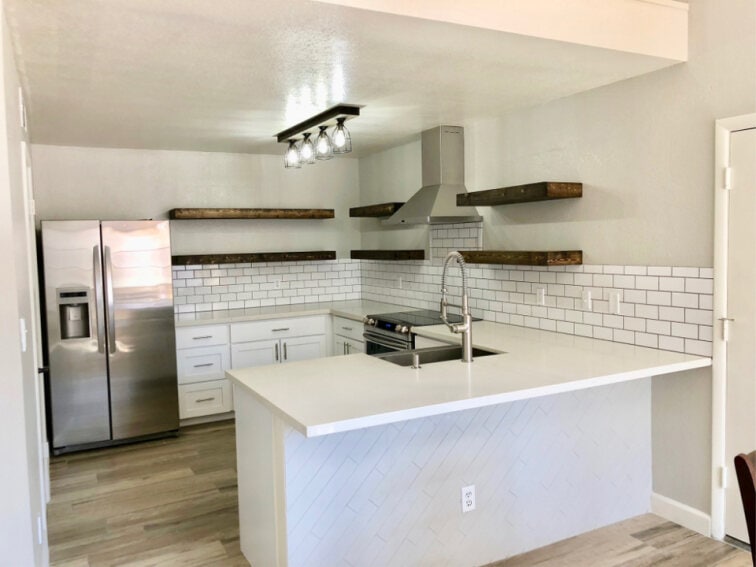
The Flexibility Factor: Mixing and Matching in Modern Designs
Hybrid storage strategies are increasingly common in Phoenix.
In communities like College Park and Hudson Manor, designers often integrate a full cabinet wall with a contrasting open shelving segment near windows.
This approach preserves storage while introducing openness. It also allows homeowners to adapt organization over time.
Flexibility ensures longevity in design relevance.
Material Matters: From Wood to Metal
Material choice influences visual tone and durability.
Warm wood cabinets introduce depth. Painted finishes reflect natural light. Metal shelving adds industrial contrast.
In Sierra Tempe, designers often pair matte cabinetry with thin-profile metal shelving to achieve contemporary balance.
Material contrast enhances spatial interest.
Care and Maintenance: A Balancing Act
Maintenance requirements differ between cabinets and open shelving.
Cabinets require occasional hinge adjustment and interior cleaning. Open shelves require regular dusting and surface upkeep.
If cabinets remain the main storage choice, comparing traditional cabinet hinges or soft-close hinges can help homeowners improve daily use, door control, and long-term cabinet performance.
Climate conditions in Phoenix encourage sealed finishes that resist dryness and cracking.
Maintenance tolerance often determines preference.
The Space Situation: Making the Most of It
Space planning in Phoenix kitchens varies dramatically depending on home age, architectural style, and neighborhood standards. In compact layouts, open shelving can visually widen a narrow footprint by reducing upper cabinet mass. This technique is especially effective in homes near Desert Villas, where streamlined design often enhances smaller floor plans.
In contrast, properties throughout Valencia Acres frequently benefit from full-height cabinetry that maximizes vertical storage without compromising cohesion. Concealed storage allows counters to remain clear, which is critical in high-use kitchens.
Balancing openness and enclosure depends on square footage and daily habits. Smaller kitchens may benefit from selective shelving, while larger kitchens can support full cabinetry walls without feeling heavy.
The Cost Conundrum: Budgeting for Your Dream Kitchen
Cost differences between cabinets and open shelving are not always straightforward.
Open shelving may appear more affordable initially because it eliminates upper cabinet boxes. However, high-quality shelving materials, custom brackets, and installation precision can quickly narrow the price gap. In communities like Thunder Mountain, premium hardwood shelving installations often rival semi-custom cabinetry in cost.
Full cabinetry typically carries higher upfront material and labor costs. Homes in Sossaman Estates often justify this investment because storage needs are greater and resale expectations align with enclosed cabinetry systems.
Budget decisions should account for durability, long-term maintenance, and property value alignment in Phoenix.

Trends and Transformations: The Future of Kitchen Design
Kitchen storage trends in Phoenix are moving toward hybrid integration.
Reviewing modern kitchen cabinet trends can help homeowners compare enclosed storage, selective display areas, door styles, finishes, and hardware before choosing a cabinet strategy.
Combining closed cabinets with limited open shelving remains the most balanced approach. In Emperor Estates, many remodels incorporate glass-front upper cabinets alongside concealed base storage to achieve both refinement and display flexibility.
Minimalist cabinetry profiles paired with floating shelves continue to gain popularity in Desert Villas. The aesthetic remains modern while preserving essential storage capacity.
The future of kitchen design favors adaptability. Storage solutions must support evolving lifestyles without appearing dated.
Global Perspectives: What's Cooking Worldwide?
International design influences continue to shape Phoenix kitchens.
European frameless cabinetry emphasizes clean lines and concealed hardware. Japanese-inspired minimalism prioritizes calm and organization. Industrial aesthetics introduce metal shelving and exposed hardware elements.
Homes near Hermosa Vista Flood frequently reflect European influence through slab cabinetry and integrated handles. In Thunder Mountain, warm wood shelving sometimes introduces a subtle Scandinavian touch.
Global influence expands local design vocabulary.
The Environmental Angle: Sustainability in Design
Sustainability is increasingly prioritized in Phoenix remodeling projects.
Open shelving can reduce material consumption by eliminating upper cabinet boxes. However, material sourcing matters more than quantity. Responsibly harvested wood and low-VOC finishes contribute to environmentally conscious remodeling.
In Sossaman Estates, many homeowners select engineered materials that resist warping in Arizona’s dry climate while reducing waste. Properties in Valencia Acres often incorporate durable finishes that extend lifespan and minimize replacement cycles.
Environmental responsibility and longevity must work together.
Safety and Accessibility: Designing for All
Safety considerations influence storage selection.
Cabinets provide enclosed protection for hazardous items, reducing accessibility risks for children and pets. This remains especially important in family-oriented communities throughout Emperor Estates.
Open shelving requires careful placement. Frequently used items should remain within comfortable reach. In Hermosa Vista Flood, homeowners often reserve open shelving for decorative or lightweight pieces rather than heavy cookware.
Accessibility also matters for aging-in-place design. Lower pull-out drawers often outperform traditional shelving for ease of use.
Safety and accessibility should guide placement decisions.
Why are open shelves gaining popularity in modern homes?
Open shelves offer versatility in design, showcase personality, and provide easy access to frequently used items.

Concluding remarks
Cabinets vs. open shelving is more than a design debate. It reflects how homeowners in Phoenix prioritize organization, aesthetics, maintenance, and lifestyle functionality.
Homes across Desert Villas and Emperor Estates illustrate that thoughtful integration of both approaches often produces the strongest results.
When planning your kitchen remodel, partnering with Phoenix Home Remodeling ensures that layout strategy, storage balance, and finish precision align with your long-term goals.
The heart of the home deserves storage solutions that feel intentional, durable, and tailored to how you live.
FAQs on Cabinets vs. Open Shelving
How do I decide between cabinets and open shelving for my kitchen?
The right choice comes down to how you use your kitchen every day and how much structure versus visibility you want in the space.
Cabinets provide consistency. They hide clutter, protect contents, and create a clean, finished look. Open shelving, on the other hand, introduces accessibility and visual openness, but it requires discipline to maintain.
Many homeowners assume this is purely a style decision, but it is actually a functional one. If you rely heavily on storage and prefer a clean, low-maintenance environment, cabinets are usually the better choice. If you enjoy displaying items and maintaining a curated look, open shelving can add personality.
In many Phoenix homes, especially in areas like Desert Villas or Valencia Acres where open-concept layouts are common, the best solution is often a combination of both.
At Phoenix Home Remodeling, this decision is guided during the Feasibility, Planning, and Design phase.
Storage is designed around your habits first, then the visual balance is layered on top. The goal is not to choose one over the other. It is to create a system that works for how you live.
Are open shelves practical for everyday use, or are they just for design appeal?
Open shelving can be practical, but only when it is used intentionally and in the right areas of the kitchen.
The appeal of open shelves is immediate. They make the kitchen feel lighter and more open, especially in smaller spaces. However, they also require consistent organization because everything remains visible. This can quickly become overwhelming if used for general storage.
Open shelving works best for frequently used items or curated displays. Plates, glassware, and decorative pieces are easier to access and maintain when placed strategically. It becomes less practical when used to replace large amounts of concealed storage.
In some homes across the Phoenix metro area, especially where kitchens are part of larger living spaces, open shelving is used sparingly to reduce visual weight without sacrificing functionality.
At Phoenix Home Remodeling, shelving decisions are made during the design phase with both use and maintenance in mind.
This ensures shelves enhance the kitchen rather than creating additional work. Open shelving is most successful when it is selective, not dominant.
Do cabinets always make a kitchen feel more organized?
Cabinets tend to create a more organized appearance, but that only holds true when the internal storage is designed properly.
Closed cabinetry hides clutter, which can make a kitchen feel calm and controlled. However, if the internal layout is inefficient, the disorganization simply moves out of sight rather than being resolved.
Poorly designed cabinets often lead to overfilled shelves, hard-to-reach items, and wasted space. Over time, this creates frustration even if the kitchen still looks clean from the outside.
In contrast, well-designed cabinets include features like pull-out drawers, internal dividers, and accessible storage zones that make organization easier to maintain.
At Phoenix Home Remodeling, cabinetry is planned as part of the full kitchen system during the Feasibility, Planning, and Design phase.
This ensures that storage supports your routine rather than working against it. Organization should not rely on constant effort. It should be built into the design.
Can I combine cabinets and open shelving without making the kitchen feel mismatched?
Combining cabinets and open shelving is often the most effective approach, but it requires careful balance to avoid a disjointed look.
The key is to define clear roles for each element. Cabinets should handle bulk storage and concealment, while open shelving should be used selectively for accessibility or display. When both are used intentionally, they complement each other rather than compete.
In many homes, including those in communities like Sossaman Estates or Emperor Estates, designers use open shelving in specific zones such as near windows or above countertops while maintaining cabinet walls for primary storage.
At Phoenix Home Remodeling, this balance is created during the design phase by mapping out how each section of the kitchen will be used.
This ensures the transition between cabinets and shelves feels natural. Materials, finishes, and proportions are aligned so the space feels cohesive.
The goal is not to mix styles randomly. It is to create a layered design that feels intentional from every angle.
How does maintenance differ between cabinets and open shelving?
Maintenance is one of the most important differences, and it often determines which option works best long-term.
Cabinets require less frequent cleaning because contents are enclosed. Dust and grease buildup are minimized, which makes them easier to maintain in high-use kitchens.
Open shelving, by contrast, requires regular upkeep. Items are exposed to dust, and surfaces need to be wiped more often. This is especially noticeable in kitchens where cooking is frequent or where airflow carries particles through the space.
Some homeowners enjoy the discipline that comes with open shelving, while others find it adds unnecessary effort to their routine.
At Phoenix Home Remodeling, maintenance expectations are discussed during the planning phase so your storage choices align with your lifestyle.
This ensures you are not choosing a design that looks appealing but becomes difficult to maintain over time. The right solution should feel manageable without constant effort.
Does choosing cabinets or open shelving affect home value?
The impact on home value depends on how well the storage solution aligns with buyer expectations and overall kitchen design.
Cabinets are generally expected because they provide reliable storage and a finished appearance. Kitchens with insufficient enclosed storage may feel incomplete to buyers, especially in family-oriented homes.
Open shelving can enhance value when it is used thoughtfully and as part of a balanced design. It adds character and can make the space feel more open, but it should not replace essential storage.
In some Phoenix markets, particularly in areas like Arcadia Proper or Thunder Mountain, buyers often expect a mix of both. Too much open shelving can feel impractical, while too much cabinetry can feel heavy if not designed carefully.
At Phoenix Home Remodeling, resale positioning is considered during the design phase.
This ensures storage decisions support both your current lifestyle and future market appeal. Value is created through balance, not extremes.
What is the biggest mistake homeowners make when choosing between cabinets and open shelving?
The biggest mistake is making the decision based on appearance alone instead of considering how the kitchen will be used daily.
Open shelving is often chosen because it looks modern and visually appealing, but without considering maintenance and storage needs, it can become impractical. On the other hand, fully enclosed cabinetry can feel overly heavy if not balanced with lighter design elements.
Another common issue is treating storage as an afterthought. When cabinets and shelving are not planned together, the kitchen can feel either cluttered or incomplete.
At Phoenix Home Remodeling, storage decisions are made during the Feasibility, Planning, and Design phase as part of the full kitchen system.
This ensures that both cabinets and shelving are placed with purpose. The result is a kitchen that feels cohesive and functions well without requiring constant adjustment.
What is the best first step before deciding between cabinets and open shelving?
The best first step is to evaluate how your kitchen functions today and what you need it to do moving forward.
Most homeowners begin by focusing on style, but storage decisions should be based on usage. How much storage do you need? What items are used daily? How much maintenance are you willing to manage?
At Phoenix Home Remodeling, this evaluation begins in the Feasibility, Planning, and Design phase.
Your layout, storage requirements, and daily habits are all analyzed before design decisions are made. This creates a clear plan that shows how cabinets and shelving will work together.
Instead of guessing which option is better, you are making a decision based on a complete system. That clarity ensures the final kitchen feels both functional and intentional.
Video of this Info:
PDF version:
Why Homeowners Trust Phoenix Home Remodeling
Phoenix homeowners investing in a kitchen remodel consistently identify two concerns above all others: costs that change mid-project and timelines that slip.
Phoenix Home Remodeling addresses both through a planning-first process that confirms cabinet layout, appliance selections, and fixed pricing before a single cabinet is removed.
Recognized as the Number 1 Kitchen Remodeling Company in Arizona by Contractor List HQ
Rated Best Phoenix Kitchen Remodeler by Trust Analytica
Rated Best Phoenix Home Remodeler by Trust Analytica
Rated 4.9 Stars Across 200+ Verified Public Reviews
Accredited by the Better Business Bureau with an A+ Rating
Member of the National Association of the Remodeling Industry (NARI)
Member of the National Kitchen and Bath Association (NKBA)
Named a Top Contractor in Arizona by Ranking Arizona (2024)
Voted a Nextdoor Neighborhood Favorite (2022, 2023, 2024, 2025)
Founder authored Remodel Without Regret, an Amazon bestselling homeowner remodeling guide
Each kitchen project begins with a comprehensive feasibility review, cabinet layout planning, and finalized material and appliance selections before construction is scheduled. Countertop choices, cabinetry configurations, and any electrical or plumbing modifications are resolved during the design phase so pricing is locked before demolition begins. A dedicated project manager coordinates cabinetry delivery, trade sequencing, and communication checkpoints throughout the build so the project stays on schedule.
Homeowners who resolve layout, appliance selections, and material choices before demolition typically experience fewer scope changes, more predictable timelines, and a finished kitchen that matches what was planned.
Do you live in Phoenix, Scottsdale, Chandler, Gilbert, Mesa, Tempe, Sun Lakes, Ahwatukee, Laveen, or Queen Creek?
Ready to talk about your remodeling needs?
Take the next step...