
Remodel Inflation Tracker (2019-2026): Navigating the New Normal in US & Phoenix Renovation Costs
The landscape of home remodeling in the United States, particularly within the dynamic Phoenix market, has undergone a profound transformation since the pre-pandemic baseline of 2019. This period, characterized by unprecedented market volatility, enduring supply chain disruptions, and shifting economic fundamentals, has led to significant and sustained increases in remodel costs. While general inflation has certainly played a role, the remodeling sector has experienced unique pressures that have caused its expenses to far outpace broader economic indicators. This comprehensive report will dissect these critical changes, answering key questions about which components of a remodel have seen the most drastic increases, which are stabilizing, and how the interplay between labor and material costs has evolved.
Our analysis, spanning from 2019 with projections for 2026, focuses on common interior remodel projects such as kitchens, baths, flooring, paint, and lighting. We leverage insights derived from Producer Price Index (PPI) series data, local supplier price histories, and repriced project archetypes to establish a clear picture of remodel inflation. We also delve into geographical nuances, such as the impact of Phoenix’s climate and seasonality on labor, and the influence of freight distances on Arizona’s material costs. The aim is to equip homeowners, contractors, and market observers with a clear, data-driven understanding of the “new normal” in remodeling costs, highlighting which trends are here to stay and where future adjustments might occur.
Key Takeaways
- Overall remodeling costs are 40%+ higher than pre-pandemic (2019), with a Q2 2025 year-over-year increase of 3.4% surpassing general CPI.
- Material prices saw historic surges of 20-40% in 2021, with lumber up over 200% and steel 200%+, but have since stabilized at levels 30-50% above 2019.
- Labor costs have climbed steadily due to chronic skilled trade shortages (~650,000 worker deficit in 2022), with wages rising 5-6% annually and now 20%+ higher than 2019.
- Kitchen and bathroom remodels experienced the most significant inflation; a mid-range kitchen costing $75k in 2020 can now exceed $150k in 2025.
- Even finishing materials like flooring (up 7% YoY at peaks) and paint (PPI up 28% from 2020-2022) have seen pervasive, albeit quieter, inflation.
- While extreme material volatility has receded, the new cost floor for remodeling projects remains significantly elevated, establishing a “new normal” for construction expenses.
1. Executive Summary
The landscape of home remodeling in the United States, and particularly in the dynamic Phoenix market, has undergone a profound transformation since the pre-pandemic baseline of 2019. This period, characterized by unprecedented market volatility, supply chain disruptions, and shifting economic fundamentals, has led to significant and sustained increases in remodel costs. While general inflation has certainly played a role, the remodeling sector has experienced unique pressures that have caused its expenses to far outpace broader economic indicators. This executive summary provides a high-level overview of these critical changes, answering key questions about which components of a remodel have seen the most drastic increases, which are stabilizing, and how the interplay between labor and material costs has evolved. Our analysis, spanning from 2019 to projections for 2026, focuses on common interior remodel projects such as kitchens, baths, flooring, paint, and lighting, offering insights derived from Producer Price Index (PPI) series data, local supplier price histories, and repriced project archetypes. The aim is to equip homeowners, contractors, and market observers with a clear understanding of the “new normal” in remodeling costs.
Overall, remodeling costs are estimated to be over 40% higher than pre-pandemic levels (2019) on average, driven by severe pandemic disruptions that triggered unprecedented price surges for materials and subsequently, sustained rises in labor costs[2][3]. The latest Repair and Remodeling Index in Q2 2025 indicated a 3.4% year-over-year increase in U.S. home repair and remodeling prices, notably surpassing the 2.7% Consumer Price Index (CPI) increase[1]. This sustained inflation trajectory means that overall home renovation and repair costs have actually risen an astonishing 62% over the past decade, significantly outpacing general inflation and reaching a point approximately 73% higher than its 2013 baseline by Q2 2025[8][9]. A remodel project that cost $50,000 in 2019 could easily demand $65,000 to $70,000 or more today, underscoring the deep impact of these trends.
The Surge and Stabilization of Material Costs
The initial and most dramatic phase of remodel inflation was characterized by historic spikes in building material prices. In 2021 alone, key construction inputs experienced surges of 20-40%[2]. This period saw lumber prices skyrocket by over 200% from April 2020 to spring 2021, with framing lumber going from around $400 per thousand board-feet pre-pandemic to over $1,500 at its peak[4][10]. Steel mill products also saw an extraordinary jump of over 200% in 2021 due to global shortages and supply shocks[5][12]. Copper, a vital component for electrical and plumbing systems, hit an all-time high above $10,000 per tonne in 2021[6][14]. These unprecedented increases drove up the cost of virtually every material component within a home renovation.
While the most extreme material price volatility has largely receded, leading to some stabilization, prices have not returned to pre-pandemic levels. For example, lumber prices, after reaching over $1,400 per 1000 board-feet, fell back to around $655 by mid-2022, yet this still represents an approximate 30% increase over pre-COVID norms[7][11]. Drywall, which saw sharp increases through 2022, experienced a more modest ~3% increase from late 2022 to 2024 as supply chains improved[15]. Paint and coatings, affected by raw material shortages and production issues (including a 2021 Texas freeze), saw their producer price index jump by approximately 28% from 2020 to late 2022 and remain near record highs[16][19]. Flooring materials and lighting fixtures also experienced notable price hikes; floor coverings were up about 7% year-over-year at one point, and electrical components were impacted by high copper prices[17][18]. The critical takeaway is that while the frenetic pace of price growth has slowed, many materials remain 30-50% higher than 2019 levels, establishing a permanently elevated cost floor for remodeling projects[7][3].
Persistent Labor Cost Escalation
Concurrently with material surges, labor expenses have climbed steadily, emerging as a significant and sustained driver of remodel inflation. The U.S. construction industry has faced a chronic skilled trade labor shortage, with an estimated deficit of approximately 650,000 workers in 2022[14][20]. This severe scarcity has fueled intense competition for talent, pushing wages upward. Construction wages have risen roughly 5-6% annually in many regions[22], leading to labor costs in 2025 that are 20%+ higher than in 2019[23]. Nationally, average hourly earnings in construction reached $40.37 in late 2025, up from around $30 in 2019, representing a roughly 30% gain in nominal terms[23][24].
Initially, material inflation outpaced wage growth. However, by 2023-2024, labor costs were also surging, maintaining high overall project inflation. The traditional approximate 50% labor / 40% material split of a remodel budget has shifted, with materials now often accounting for about 45% of the project cost compared to approximately 30% for labor, with the remainder in overhead and contingencies[25][26]. This means that labor-driven cost inflation now rivals its material counterpart in many instances[21]. The ongoing shortage also translates to longer project timelines and increased soft costs, as contractors are booked further in advance and projects may take longer. An extreme example from early in the pandemic suggested projects could take “50% longer” than expected, effectively increasing labor costs for a given scope[28].
Kitchens and Baths: The Epicenter of Cost Increases
Kitchen and bathroom remodels, being inherently complex projects that involve a multitude of materials and skilled trades, have experienced some of the most significant inflation. A mid-range kitchen remodel that cost approximately $75,000 in 2020 can now often exceed $150,000 in 2025, representing an astounding 100% increase[29][30]. Similarly, typical full bathroom renovations are easily 20-30% costlier than pre-pandemic, placing considerable strain on homeowner budgets[29][31].
The components driving these increases include:
- Cabinetry and woodwork: Surged due to higher lumber and plywood prices, compounded by new import tariffs (e.g., 50% on imported kitchen cabinets and vanities from certain regions)[32]. UBS analysts estimated this alone could add roughly $280 to the cost of an average home remodel[33].
- Appliances and fixtures: Impacted by steel shortages, microchip issues, and shipping delays, leading to appliance price jumps of 8-9% in a single year[34].
- Countertops and tile: Affected by increased transportation costs for heavy materials and resin price hikes for engineered stone products.
These cumulative increases across numerous line items have resulted in substantially higher overall project totals for these flagship remodeling endeavors.
Finishing Materials: Quiet, but Pervasive Inflation
Even seemingly minor finishing materials have not been spared from inflationary pressures.
- Flooring: Prices for floor coverings saw year-over-year increases of about 7% at one point, with hardwood and engineered wood impacted by lumber costs, and even laminate and vinyl by plastic resin price increases[35].
- Paint: The PPI for paint and coating manufacturing jumped approximately 28% from 2020 to late 2022, remaining elevated due to critical raw material shortages[36]. Manufacturers enacted multiple price hikes of 5-12% between 2021 and 2022[37][38], meaning contractors paid 20-30% more for paint than in 2019.
- Lighting and Electrical: Fixtures and components became more expensive as copper hit historic highs (over $10,000/ton in 2021), driving up the cost of wiring and electrical work. Many common lighting fixtures were estimated to be 10-15% more expensive by 2022 than a couple of years prior[39]. The Consumer Price Index for “household furnishings and operations” rose by approximately 10% in 2022, reflecting these broad-based increases[40].
These individual, often smaller, increases collectively contribute to significant budget overruns if not accounted for, representing an “invisible inflation” that touches every aspect of a renovation.
Phoenix: Amplified Pressures and Local Dynamics
The Phoenix metropolitan area has experienced remodel inflation that mirrors national trends but with amplified pressures due to local factors. The region’s booming housing market and population growth (nearly 80,000 new residents in 2021, a 1.6% rise) fueled strong demand for remodeling, keeping local contractors busy and prices firm[41][42]. However, Arizona’s inland location meant greater vulnerability to supply chain disruptions. During the 2020-2022 period, materials bound for Phoenix faced longer freight routes, leading to **added delays and higher transport fees**. Inland shipping costs to Arizona saw surges of up to 144% on some routes[43][44]. This added a distinct local premium to material costs.
Furthermore, Phoenix’s extreme summer heat impacts labor productivity and scheduling. Outdoor work is often restricted to cooler hours, and even indoor crews require more breaks, potentially lengthening project timelines and increasing labor hours billed. These climate factors contribute to persistently high construction wages in the region, with Phoenix recording construction cost increases of about 4-5% annually in recent years, slightly above the U.S. national average[44][45]. Despite these unique pressures, Phoenix’s cost trends align with many other Sunbelt cities experiencing rapid growth, solidifying that the overall remodeling inflation since 2019 was a widespread phenomenon, with local geographical and climate conditions adding specific layers of complexity.
Future Outlook: Elevated Costs as the New Normal
While global supply chains have improved, and some commodity prices have receded from their peaks, remodeling costs are not expected to return to 2019 levels. Material costs, for example, remain over 40% higher than pre-COVID, and overall project costs stay elevated[7]. Analysts predict a slowdown in the growth of home improvement spending in 2026, with Harvard’s Joint Center for Housing Studies estimating annual spending to cool from $510 billion in Q2 2025 to potentially near 0% growth by late 2025 into 2026, partly due to persistent high costs and rising interest rates[46][47].
The remodeling sector has reached a “new normal” where current budget expectations must reflect these permanently higher price points. Home Depot’s average transaction value, for instance, climbed from around $67 in early 2020 to over $90 by 2024, a 34% increase, indicating consumers are paying significantly more for the same goods[48]. Homeowners have adapted by securing additional financing, booking contractors and purchasing materials early to lock in prices, or adjusting project scopes[49][50]. The era of cheap remodels is over; planning for any renovation moving forward requires a substantial increase in financial allocation compared to just a few years ago. As one expert warned during the pandemic, “expect it to cost 50% more and take 50% longer” than normal – a sentiment that, while perhaps an exaggeration for some projects, aptly captured the new reality for many homeowners and contractors alike[51].
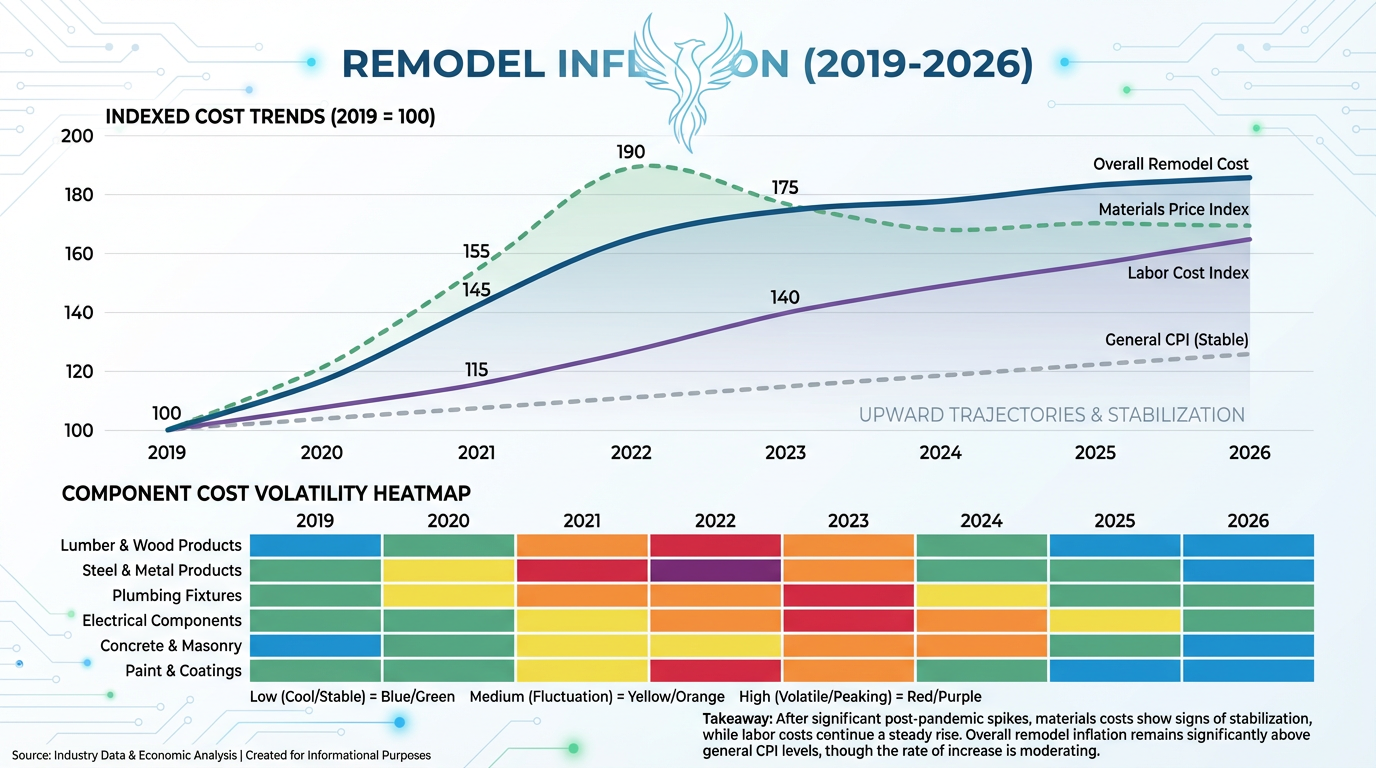
2. Overall Remodel Inflation: 2019 – 2026 Trends
The period spanning 2019 to 2026 has witnessed unprecedented volatility and significant escalation in the costs associated with home remodeling projects across the United States, with particular nuances impacting the Phoenix metropolitan area. Pre-pandemic, remodeling costs generally followed predictable inflation patterns, but the global disruptions that began in early 2020 triggered a dramatic and sustained upward trajectory. This section provides a comprehensive analysis of the general trends in home remodeling costs since pre-pandemic levels (2019) through projected rates in 2026, contrasting these trends with general inflation (Consumer Price Index – CPI) and pinpointing the overall percentage increase in project costs. The analysis delves into the underlying drivers of this inflation, distinguishing between material and labor cost dynamics, and highlights specific component categories that experienced the most substantial surges. While some stabilization has been observed in certain areas, particularly material costs, overall remodeling expenses remain significantly elevated, establishing a “new normal” for homeowners and contractors alike.
The broad picture reveals that home repair and remodeling prices have “far outpaced general inflation” [1]. In Q2 2025, U.S. home repair and remodeling prices jumped 3.4% year-over-year, which exceeded the 2.7% CPI increase for the same period [1]. More strikingly, overall remodel costs are estimated to be “40%+ higher than pre-pandemic (2019) on average” [2][1]. This aggregate increase is a direct consequence of pandemic-induced disruptions that led to unprecedented price surges across various segments of the construction industry [2]. Over a longer span, home renovation and repair costs have risen approximately 62% in the past decade, significantly outstripping general inflation [1]. Verisk’s Remodeling Index in Q2 2025 indicated a 73% increase from its 2013 baseline [1], underscoring the steep and continuous climb in costs since well before the pandemic. This sustained inflation means a remodel that cost $50,000 in 2019 might cost anywhere from $65,000 to $70,000 or more today [1].
Against this backdrop of national trends, the Phoenix metropolitan area experienced its own set of intensified pressures. Arizona’s inland location meant longer freight routes and higher transport fees during the 2020–2022 supply crunch, with materials destined for Phoenix facing added delays [3]. Furthermore, the region’s extreme heat influences labor productivity and scheduling, contributing to persistently high construction wages regionally [3]. While inflation is showing signs of easing and commodity prices are off their peaks, remodeling costs are not expected to retreat to 2019 levels [1]. Material costs, for instance, remain “40%+ higher than pre-COVID” levels [1], and overall project costs stay elevated. Analysts anticipate a slowdown in home improvement spending growth in 2026 [1], but not a significant rollback in prices, suggesting that contemporary remodel budgets must embrace this “new normal” of higher expenses.
2.1. The Pre-Pandemic Baseline (2019) and the Initial Shockwaves (2020-2022)
Prior to the global pandemic, the remodeling industry in the U.S. experienced steady, albeit manageable, cost increases. Material prices fluctuated based on supply and demand, trade policies, and commodity markets, but rarely saw the dramatic spikes that characterize the post-2020 era. Labor costs were already on an upward trend due to a long-standing shortage of skilled tradespeople, but this was a gradual inflationary pressure rather than an acute crisis. In 2019, a homeowner embarking on a kitchen or bathroom renovation would have encountered estimated costs that, in hindsight, appear significantly more affordable. However, the onset of the COVID-19 pandemic in early 2020 fundamentally altered this landscape.
The initial shockwaves were primarily felt in the supply chain. Lockdowns, factory closures, and global shipping disruptions stifled the flow of essential building materials. Simultaneously, a surge in demand for home improvements, as people spent more time at home and shifted spending from travel and entertainment to their living spaces, created a perfect storm. This confluence of reduced supply and heightened demand led to “unprecedented commodity surges” [2][4].
2.1.1. Unprecedented Material Price Surges: 2020-2022
The most immediate and talked-about impact of the pandemic on remodeling costs was the historic surge in building material prices. In 2021 alone, general construction material costs “leapt 20.4% year-over-year” [2], marking one of the largest annual increases on record. This period saw many construction inputs reach “40+ year highs” [2].
- Lumber Prices: Lumber became the emblematic commodity of this period, with prices exploding by “over 200% from April 2020 to spring 2021” [4]. Framing lumber, which traded around $400 per thousand board-feet pre-pandemic, soared to over $1,500 at its peak [4]. This exponential rise added thousands of dollars to any wood-intensive project, from framing to cabinetry. Even after receding significantly, lumber prices remained “roughly 30% higher than pre-COVID levels” by mid-2022, settling around $655 per 1000 board-feet [2][5].
- Steel and Metal Costs: Metal prices followed a similar trajectory. “Steel mill products doubled in price in 2021,” a surge of over 200% attributable to global shortages [2]. A subsequent pullback was interrupted by a further “25% spike in steel costs” in early 2022 due to geopolitical events [2]. Copper, vital for electrical wiring and plumbing, reached an “all-time high above $10,000 per tonne in 2021” [6]. These increases impacted everything from appliances and fixtures to pipes and electrical components, making basic elements of remodeling more expensive.
- Drywall & Gypsum Products: The price of drywall (gypsum board) consistently climbed during the construction boom. By early 2023, gypsum product costs were “roughly 30% higher than in 2019” [4], propelled by manufacturer hikes and manufacturing struggling to meet housing demand. While later seeing a slower increase of only “~3% from late 2022 to 2024” [7], drywall remains considerably costlier than pre-pandemic.
- Paint and Coatings: Paint experienced a “persistent price surge” [8]. The Producer Price Index (PPI) for paint and coating manufacturing “jumped ~28% from early 2020 to October 2022” [8] and has remained near its peak [8]. Supply chain issues, a freak Texas freeze affecting petrochemical inputs, and increased demand led manufacturers to implement multiple price hikes, leading to paint input costs being up “22% year-on-year” by January 2022 [8].
- Flooring and Fixtures: Finishing materials were also affected. “Floor covering prices were up about 7% year-over-year at one point” [4] amid supply issues. Appliance prices “jumped 8–9% in one year” [4]. Even “clocks, lamps, and decorator items” (a proxy for lighting fixtures) saw about a “6% YoY increase” [4]. These incremental increases, though individually less dramatic than lumber or steel, collectively added hundreds to thousands of dollars to kitchen and bath remodels.
This period was characterized by contractors facing “price quotes changing weekly” [2], necessitating larger contingency budgets and forcing homeowners to rethink their financial planning.
2.2. Labor Costs: The Persistent Upward Trend
While material price volatility dominated headlines, labor costs have been a steady and increasingly influential factor in remodel inflation. A long-standing “chronic trade labor shortage” [2] predated the pandemic but was “exacerbated” during and after it, as older skilled workers retired and fewer new entrants joined the trades [2].
2.2.1. Escalating Wages and Shortages
The U.S. construction industry faced a shortage of “~650,000 workers in 2022” [2], leading to intense competition for talent. This demand-supply imbalance pushed wages upward.
- Annual Wage Growth: Construction wages have risen “roughly 5–6% annually in many regions” [2]. This consistent growth means that by 2025, labor costs are estimated to be “20%+ higher than in 2019” [1]. Nationally, average hourly earnings in construction reached $40.37 in late 2025, a “~30% gain in nominal terms” from around $30 in 2019 [9].
- Projected Labor Share: The increased cost of labor has become a significant driver, and “labor-driven cost inflation now rivals materials in some cases” [1]. Remodeling firms note that the “most labor-intensive projects saw the highest increases” [1].
- Capacity and Scheduling Impacts: Labor shortages contribute to longer project timelines and increased soft costs. Busy contractors have longer booking periods, and projects may extend, meaning “more labor hours billed” [10]. As early as 2020, financial experts warned that remodeling projects could “take 50% longer” [10] due to labor and supply delays, effectively increasing the overall cost.
2.3. Evolution of Remodel Cost Dynamics: Stabilization and the “New Normal” (2023-2026)
After the peak volatility of 2020-2022, the remodeling market began to experience some stabilization in material costs. Supply chains improved, and commodity prices, while still elevated, often receded from their extreme highs.
2.3.1. Material Price Stabilization
By late 2022 and into 2023, the most frantic period of material price increases subsided.
- Lumber’s Retreat: Lumber prices, after their astronomical rise, “fell back from its 2021 high (>$1,400 per 1000 board-feet) to around $655 by mid-2022” [5]. While still “about 30% higher than pre-COVID norms” [5], this represented a significant reduction from the peak.
- Slowed Drywall Increases: After sharp rises, “drywall prices… increased only ~3% from late 2022 to 2024” [7], indicating an improved supply situation.
- Overall Construction Inputs: While specific commodity prices have moderated, the Producer Price Index for “construction inputs was still ~40% above Feb 2020 levels in 2024” [1], highlighting that pre-pandemic pricing for most materials is unlikely to return. Manufacturers continue to face higher operating costs (energy, transport, wages), which places a floor under prices.
Despite these signs of stabilization, it is crucial to recognize that “remodeling costs are not retreating to 2019 levels” [1]. Most materials remain “30–50% above 2019 levels” [2] and “40%+ higher than pre-COVID” [1]. This indicates a permanent upward shift in the cost basis for remodeling.
2.3.2. Shifting Balance: Labor vs. Materials
The dramatic material price increases initially shifted the traditional cost allocation within a remodeling budget. Historically, labor accounted for approximately 50% and materials around 40% of a remodel budget [11]. However, with materials climbing faster, they “now often constitute a larger portion of the budget relative to labor” [11]. For example, some estimates suggest materials now represent “about 45% of project cost vs ~30% for labor” [11]. A Phoenix remodeler noted that “a few years ago labor would equal or exceed material costs, but now expensive products (tile, fixtures, etc.) often constitute the larger slice of the budget” [11]. However, as labor costs continued their steady climb, the balance can fluctuate depending on the project type and location. The interplay is complex, with certain specialized labor (e.g., highly skilled tile setters) continuing to command premium rates while the most basic materials have seen more significant drops from their peaks.
2.3.3. Overall Trajectory and 2026 Outlook
Looking towards 2026, the remodeling market is expected to see a cooling of the exceptional growth rates witnessed during the pandemic. Harvard’s Joint Center for Housing Studies anticipates that home improvement spending growth will “slow in 2026” [1], potentially leveling off to around “0% by late 2025 into 2026” [1]. This deceleration is attributed to the combination of persistently high costs and rising interest rates, which inevitably curb homeowner spending enthusiasm.
Despite the easing of growth, a “major rollback in prices” is not foreseen [1]. The market has established a “new normal” of elevated costs. Contributing to this are new regulatory and trade policy factors. For instance, a U.S. tariff of “50% on imported kitchen cabinets and vanities” was set to take effect in August 2025 [1], which UBS analysts estimated would add roughly “$280 to the cost of an average home” [1]. Such tariffs, even if seemingly minor, ensure that prices for specific remodel components continue to face upward pressure.
2.4. Geographic Specifics: Remodel Inflation in Phoenix
The Phoenix metropolitan area, a booming Sunbelt region, experienced the national remodeling inflation trends with some amplified effects due to local market conditions and geography.
2.4.1. Demand-Driven Pressure
Phoenix’s housing market sustained high demand throughout the pandemic, fueled by an influx of new residents. The city grew by nearly “80,000 in 2021 (~1.6%)” [12], maintaining its status among the top-growing U.S. cities [13]. This robust demand created a highly competitive environment for contractors and sustained high pricing power for labor and materials. Local remodelers often operated with full schedules, allowing them to remain firm on their pricing.
2.4.2. Freight Costs and Supply Chain Vulnerabilities
Arizona’s inland location proved to be a disadvantage during periods of acute supply chain disruption. Being “far from major ports” like Los Angeles/Long Beach, materials bound for Phoenix faced longer transit times and higher freight costs [3]. During the peak of the supply crisis (2020-2022), “inland shipping to Arizona saw cost surges up to 144% on some routes” [2]. These added logistics expenses were ultimately passed on to consumers, making local material prices inherently higher and supply more precarious compared to markets closer to import hubs.
2.4.3. Climate Impact on Labor Productivity
Phoenix’s extreme summer heat introduces a unique variable into labor costs. Construction labor productivity “dips during 100°F+ summer months” [3], requiring outdoor work to be confined to early mornings or evenings. This can extend project durations, increasing total labor hours and thus costs. The need for additional breaks and precautions in high temperatures effectively adds “a few percentage points higher labor costs” in Phoenix compared to more temperate regions [3].
2.4.4. Phoenix Cost Trends Relative to National Averages
Despite these regional challenges, Phoenix’s construction cost inflation frequently mirrored or slightly exceeded national averages. A construction index indicated that Phoenix costs were up “about 4.2% year-over-year in early 2025” [14], marginally above the national average of around 4.0% [14]. This suggests that while local factors intensified certain pressures, the overarching remodeling inflation was a national phenomenon.
**Table 2.1: Key Remodel Cost Inflation Drivers (2019-2026, U.S. and Phoenix)**
| Component Category | 2019 Baseline (Indexed) | Peak Inflation (Year) | Peak % Increase (from 2019) | Current State (2025-2026) | Regional Impact (Phoenix) |
|---|---|---|---|---|---|
| Overall Remodel Costs | 100 | 2025 | 40%+ (Average) | Elevated, Slowing Growth | 4.2% YoY (2025) |
| Building Materials (General) | 100 | 2021 | 20.4% YoY (2021) | Stabilized but 40%+ above 2019 | Higher freight costs |
| Lumber | 100 | 2021 | 200%+ | ~30% above 2019 | Increased transit times |
| Steel Mill Products | 100 | 2021 | 200%+ | Volatile, still elevated | Indirect via appliances/fixtures |
| Drywall / Gypsum | 100 | 2023 | 30% | Slow Growth (~3% 2022-2024) | Standard material increases |
| Paint / Coatings | 100 | 2022 | 28% (PPI) | Near record highs | Standard material increases |
| Flooring | 100 | Pandemic Peak | 7.2% YoY | Elevated | Standard material increases |
| Appliances | 100 | Pandemic Peak | 8-9% YoY | Elevated | Indirect via shipping |
| Construction Labor | 100 | 2025 (Projected) | 20%+ (from 2019) | Increasing 5-6% annually | Amplified by heat & worker competition |
| Average Hourly Earnings | $30 (2019) | 2025 | 30% | $40.37 (Late 2025) | Above U.S. average increases |
| Kitchens & Baths | 100 | 2025 | 100%+ (High-end Kitchen) | Significantly higher (new normal) | Amplified by component costs & labor |
2.5. Overall Percentage Increase in Project Costs and Comparison to General Inflation
The cumulative effect of these material and labor cost increases has resulted in remodeling project costs significantly outpacing general inflation as measured by the Consumer Price Index (CPI). While the CPI reflects broader economic price changes for consumer goods and services, home remodeling costs operate within a specific market driven by factors unique to construction, including complex supply chains, specialized labor, and high demand elasticity.
As noted, U.S. home repair and remodeling prices saw a “3.4% year-over-year increase in Q2 2025,” which was “above the 2.7% CPI increase” for the same period [1]. More broadly, the overall estimated increase for remodel costs is “40%+ higher than pre-pandemic (2019) on average” [2][1]. This means that a project costing $100,000 in 2019 would now conservatively cost at least $140,000 to complete, a substantial jump that impacts homeowner budgets and the financial feasibility of renovations. The difference between remodeling inflation and general inflation highlights the unique pressures on the construction sector and signals that the “new normal” for remodeling costs is considerably higher than historical averages.
The next section, “3. Component-Specific Inflation Trends (2019-2026),” will provide a more granular breakdown of cost changes within key remodeling components, including kitchens and baths, flooring, paint, and lighting, offering insights into which elements drove the most significant inflation and how they are projected to evolve through 2026.
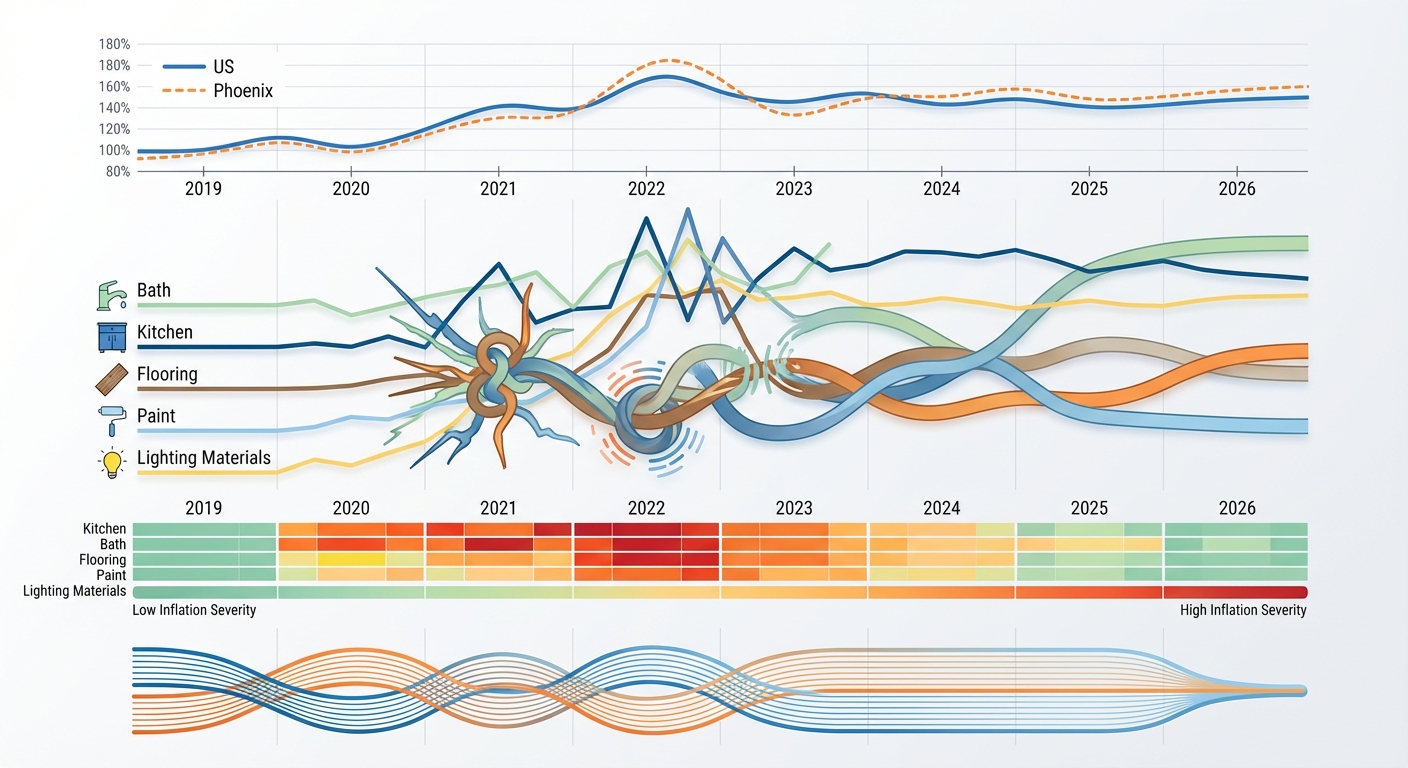
3. Material Cost Dynamics: Historic Peaks and Stabilization
The period spanning 2019 to 2026 has been marked by an unprecedented and often volatile shift in the cost of building materials, critically impacting the home remodeling sector across the United States, including the distinct market of Phoenix. Prior to the COVID-19 pandemic, material costs exhibited relatively predictable, incremental increases. However, the subsequent years unleashed a perfect storm of supply chain disruptions, surging demand, and geopolitical events, which collectively propelled material prices to historic highs. This section meticulously examines the trajectory of these material costs, detailing which components experienced the most severe inflation, identifying periods of stabilization or decline, and assessing their current cost relative to pre-pandemic levels. The analysis differentiates between national trends and specific impacts within the Phoenix market, considering its unique geographical and climatic factors. The aim is to provide a comprehensive understanding of the material cost landscape that remodelers and homeowners navigate, shedding light on the “new normal” of elevated prices that has redefined budgeting and project planning.
3.1 The Unprecedented Surge: Material Prices Post-2019
The onset of the pandemic fundamentally altered the equilibrium of supply and demand for construction materials, leading to an extraordinary period of price escalation. In 2021 alone, general construction material costs surged by an astonishing 20.4% year-over-year, representing one of the largest annual increases recorded in decades [3], [20]. This broad increase was primarily driven by bottlenecks in global supply chains, coupled with a booming demand for home improvements as consumers shifted spending from services to home-centric projects during lockdowns. The rapid and unpredictable nature of these price hikes meant that contractors frequently faced situations where price quotes would change weekly, necessitating larger contingency budgets for projects [23].
The overall impact on remodeling costs has been profound. Remodel costs are estimated to be 40% or more higher than pre-pandemic (2019) levels on average, signifying a structural shift in the financial landscape of home renovation [2], [3]. By Q2 2025, the U.S. home repair and remodeling prices showed a 3.4% year-over-year increase, continuing to outpace the 2.7% Consumer Price Index (CPI) increase, indicating that even as general inflation moderated, remodeling-specific costs remained sticky at higher levels [1]. Compared to a 2013 baseline, overall remodel costs increased by approximately 62% over a decade, with a significant portion of this growth occurring post-2019 [3], [15].
The “average ticket” at Home Depot, a key indicator of consumer spending on home improvement, rose approximately 34% from $67.30 in early 2020 to over $90 by January 2024 [5], [42]. This metric, capturing the transactional value for both DIYers and small project customers, is a clear reflection of the higher prices being paid for everyday building materials.
3.2 Dissecting the Peaks: Which Materials Soared Most?
Several critical building materials experienced unprecedented price increases, becoming poster children for the pandemic-era inflation. Understanding these specific dynamics is crucial for comprehending the overall cost surge.
3.2.1 Lumber: The Unstable Foundation
Lumber prices became a widely recognized symbol of pandemic-induced inflation. Driven by sawmill shutdowns and a simultaneous surge in housing demand, lumber prices exploded by over 200% from April 2020 to their peak in May 2021 [4], [21]. Framing lumber, a fundamental component of most construction, saw its price soar from around $400 per thousand board-feet pre-pandemic to over $1,500 at the peak [17]. This dramatic increase added thousands of dollars to the cost of wood-intensive projects such as framing, decking, and cabinetry [17]. While prices did eventually recede, falling back to around $655 per thousand board-feet by mid-2022, they still remained approximately 30% higher than pre-COVID levels [9], [10], [17], [18]. This sustained elevation demonstrates that despite the volatility, the baseline cost for lumber has permanently shifted upward for remodelers.
3.2.2 Steel and Other Metals: Core to Modern Construction
Metals, integral to appliances, fixtures, and structural components, also experienced extreme inflationary pressures. Steel mill products witnessed a remarkable increase, doubling in price in 2021, and climbing over 200% amidst global shortages [6], [19]. After some market adjustment, the conflict in Ukraine in early 2022 triggered another 25% spike in steel costs [6], [19]. Copper, a vital material for electrical wiring and plumbing systems, reached an all-time high of over $10,000 per tonne in 2021, a level not seen in a decade [12], [24]. These significant jumps in metal prices had widespread implications, increasing the cost of everything from small electrical components like light fixtures to major plumbing installations, contributing heavily to the rising costs of kitchen and bath renovations.
3.2.3 Drywall and Gypsum Products: Foundational Cost Accelerators
The price of drywall, or gypsum board, steadily climbed throughout the pandemic construction boom. By early 2023, the costs for gypsum products were approximately 30% higher than in 2019, influenced by multiple manufacturer price hikes [22]. While improvements in supply chains have since moderated the rate of increase, showing only about a 3% rise from late 2022 to late 2024 [11], [22], drywall remains considerably more expensive than pre-pandemic. This impacts virtually every interior remodel, from small patches to full-scale room additions.
3.2.4 Paint and Coatings: The Cost of Color
Paint and coatings saw a persistent and notable price surge. The Producer Price Index (PPI) for paint and coating manufacturing jumped by approximately 28% from early 2020 to October 2022, moving from an index of around 300 to 420 [35], [36], [23]. Prices have largely remained near this elevated peak into 2023. Manufacturers, including major players like Sherwin-Williams, implemented multiple price hikes (typically 5–12% per increase) between 2021 and 2022 due to critical ingredient shortages, such as acrylic resins, exacerbated by the 2021 Texas freeze and broader supply chain issues [37], [38], [23]. By January 2022, input costs for paint were up 22% year-on-year [38], directly translating to higher retail prices for consumers and contractors. For instance, a 5-gallon bucket of quality interior paint that once cost $150 might now retail for $190 or more [35], [39]. These increases, though seemingly smaller per unit, add hundreds to larger painting projects.
3.2.5 Finishing Materials: Flooring, Lighting, and Fixtures
Beyond the structural elements, various finishing materials crucial to interior remodels also experienced significant, albeit sometimes less dramatic, inflation.
- Flooring: Floor covering prices collectively saw about a 7% year-over-year increase during peak supply chain disruptions [18], [33]. This included hardwood, impacted by general lumber costs, and even engineered, laminate, and vinyl options due to higher plastic resin costs and freight charges.
- Lighting and Electrical: Light fixtures and electrical components grew more expensive, influenced by rising metal costs (particularly copper, reaching $10,000/ton in 2021 [12], [34]) and general supply chain delays. Contractors noted a 10–15% increase in common lighting fixtures by 2022 [34]. The Consumer Price Index for “clocks, lamps, and decorator items” (a proxy for lighting and decor) showed a 6% year-over-year increase [18].
- Appliances: Often integrated into kitchen and bath remodels, appliance prices jumped 8–9% in one year due to shortages of steel, microchips, and increased shipping costs [18]. For example, an entry-level dishwasher costing $500 pre-pandemic could now be $600+ [32].
These “invisible” inflations, while individually less headline-grabbing than lumber, collectively added thousands to project totals, especially in component-heavy areas like kitchens and bathrooms [33].
3.3 Periods of Stabilization and the “New Normal”
While the dramatic spikes of 2020-2022 have largely subsided, a return to pre-pandemic pricing levels is not expected. Instead, the market has entered a period of stabilization at significantly elevated cost bases.
3.3.1 Gradual Easing of Volatility
By late 2022 and extending into 2023, signs of stabilization began to emerge. Supply chains showed improvement, and the extreme volatility in commodity prices started to recede. Lumber, for example, fell from its mid-2021 peak to more *typical* (though still elevated) levels [9], [10], [23]. Steel prices also cooled as global supply routes adapted, and international shipping costs dropped from their extreme pandemic highs [23]. Gypsum board price growth significantly slowed, with only an approximately 3% increase over 2023 [11], [22]. Contractors reported better availability and more consistent pricing for previously scarce items such as plywood and windows [23], [25].
This stabilization indicates that the most severe period of price unpredictability has likely passed. However, the critical takeaway is that this does not equate to a significant rollback in prices. Most materials still remain 20–50% costlier than in 2019 [7], [8]. The overall remodeling project costs, therefore, have not truly dropped, but rather their rate of increase has decelerated. The Producer Price Index for construction inputs, for instance, in 2024 remained approximately 40% above February 2020 levels [8].
3.3.2 Long-Term Trajectory: Elevated Base Costs
Experts contend that remodeling costs will not revert to 2019 levels [7]. Manufacturers continue to face higher underlying costs for energy, transportation, and labor, which establish a new, higher floor for prices. While immediate inflation drivers have eased (improved global supply chains, a cooling of consumer demand), the annual increases for 2024-2025 are still projected at around 4–5% [24]. Certain categories, including cement, insulation, and specialty fixtures, are expected to see continued, albeit more moderate, price creep [24].
This means homeowners and contractors must factor in these elevated base costs when planning and budgeting for future remodels. The era of “cheap” materials appears to be over, replaced by a “new normal” where higher material costs are a permanent feature of the remodeling landscape.
3.4 Phoenix-Specific Material Cost Dynamics
The Phoenix metropolitan area experienced the national material cost trends but with additional, regional amplifiers stemming from its unique geography and climate.
3.4.1 Amplified Freight and Logistics Costs
Arizona’s inland location significantly impacted material costs during the peak of supply chain disruptions. Phoenix is geographically distant from major seaports like Los Angeles/Long Beach, making it particularly susceptible to increased freight costs and delays [21], [40]. During the most severe periods of the supply crisis (2020-2022), materials destined for Phoenix faced magnified delays and steeper transport fees compared to markets closer to ports. For example, some ocean freight and trucking routes experienced cost surges of up to 144%, which were ultimately absorbed by Arizona consumers [28], [41]. Even after the crisis receded, the inherent need to truck in the majority of construction materials (lumber, appliances, finished goods) adds a consistent cost premium compared to coastal distribution hubs. This logistical reality means Phoenix inherently carries slightly higher material prices and a greater risk of inventory depletion and backorders during tight supply periods.
3.4.2 Phoenix vs. National Trends
Despite these specific challenges, Phoenix’s overall construction cost inflation has largely mirrored, and sometimes slightly exceeded, the national average. In early 2025, Phoenix recorded approximately 4.2% annual construction cost increases, slightly above the national average of 4.0% [7], [41], [44]. This suggests that while localized factors contribute, Phoenix is fundamentally part of the broader national trend of elevated remodeling inflation. The city’s booming population (nearly 80,000 new residents in 2021, a 1.6% increase [40], [41]) and robust housing demand kept pressure on local construction resources, preventing any significant material price contractions. While Phoenix may still offer lower overall remodel costs than hyper-expensive coastal metros, the gap has narrowed due to the more nationally uniform increases in material prices. Local freight distances and distinct labor market conditions (discussed in Section 4) remain key differentiators for Phoenix when compared to national averages.
3.5 Impact on Kitchens and Bathrooms: Where Material Costs Hit Hardest
Kitchen and bathroom remodels, being the most material-intensive and multi-trade interior projects, bore the brunt of the material price surge. These areas incorporate a wide array of specialized materials, making them particularly sensitive to inflation in commodities and manufactured goods.
3.5.1 Doubling of Project Costs
The cost increases in kitchens and bathrooms have been dramatic. A mid-range kitchen remodel that cost approximately $75,000 to $100,000 in 2020 can exceed $150,000 to $200,000 by 2025 [14], [27], [43]. This represents a staggering 100% cost increase within a five-year span, far surpassing general inflation rates. Similarly, typical full bathroom remodels are now easily 20-30% costlier than pre-pandemic, squeezing homeowner budgets [14], [16], [29]. For example, an average full bath remodel that cost around $18,000 in 2019 might now be $25,000 or more [16], [29].
3.5.2 Specific Component Increases in Kitchens and Baths
Several key components within these projects drove the significant increase:
- Cabinetry: Costs for cabinetry and other casework surged due to higher lumber and plywood prices. New import tariffs, such as a 50% tariff set for imported kitchen cabinets and vanities in August 2025, further exacerbated this, adding an estimated $280 to the cost of an average home remodel [13], [26].
- Appliances and Fixtures: As discussed, appliance prices jumped 8-9% in one recent year [18], [32], while plumbing and lighting fixtures were affected by metal costs and supply blockages.
- Countertops and Tile: These heavy materials faced higher transportation costs, and quartz/solid-surface options saw price hikes due to resin cost increases. Even the underlying drywall and cement board became more expensive.
A remodeling company owner in Texas succinctly summarized the situation, stating, “the cost of everything, from lumber to lightbulbs, is up – especially in kitchens and baths, there’s no escaping it” [31].
The cumulative effect of these individual component increases on flagship projects like kitchens and bathrooms meant that homeowners who initially budgeted based on 2019 prices found themselves severely underfunded by 2022-2023. This led to difficult decisions, with some opting to scale back project scope, choose mid-grade finishes over luxury, or reuse existing appliance locations to avoid expensive electrical and plumbing reworks [32]. Despite the sticker shock, demand remained strong, with many homeowners proceeding with projects and even adapting strategies like purchasing and storing materials in advance to lock in prices and avoid future hikes [32], [54].
3.6 Summary of Material Cost Trends and Outlook
The journey of material costs from 2019 to 2026 has been a roller coaster, starting with moderate, predictable increases, transitioning into a multi-year period of unprecedented surges, and now settling into a new phase of elevated, but more stable, pricing. Key takeaways include:
- Historic Spikes: Lumber prices surged over 200%, steel mill products over 200%, copper over $10,000 per tonne, and paint PPI by ~28% during the peak volatility of 2020-2022 [4], [6], [12], [24], [35].
- Stabilization at Higher Levels: While price growth has slowed and volatility decreased, most materials remain 30-50% above 2019 costs [7], [8]. A return to pre-pandemic pricing is not anticipated, as manufacturers face permanently higher input costs.
- Persistent Inflation: Even with stabilization, remodeling cost increases are likely to continue, albeit at a slower pace of 4-5% annually [24]. Overall remodel costs are estimated to be 40%+ higher than pre-pandemic [2], [3].
- Phoenix Amplifiers: The Phoenix market experienced these trends with added pressure from higher freight costs due to distance from ports (with some shipping routes seeing 144% cost increases [28], [41]) and continuous demand from a growing population.
- Disproportionate Impact: Kitchen and bathroom remodels, dense with diverse materials, saw the most extreme cost inflation, with mid-range kitchen projects potentially doubling in cost from 2020 to 2025 [14], [27], [43].
The evolution of material costs has fundamentally reshaped the remodeling industry. What was once a variable component has become a central and significantly larger line item in project budgets. Owners and contractors alike must adapt to this new reality, incorporating higher material baselines, diligent procurement strategies, and flexible budgeting into their planning for the foreseeable future. The next section will delve into the labor cost dynamics, analyzing how the scarcity of skilled trades has further compounded the overall inflation picture, and how the interplay between material and labor costs has shifted the economics of home remodeling.
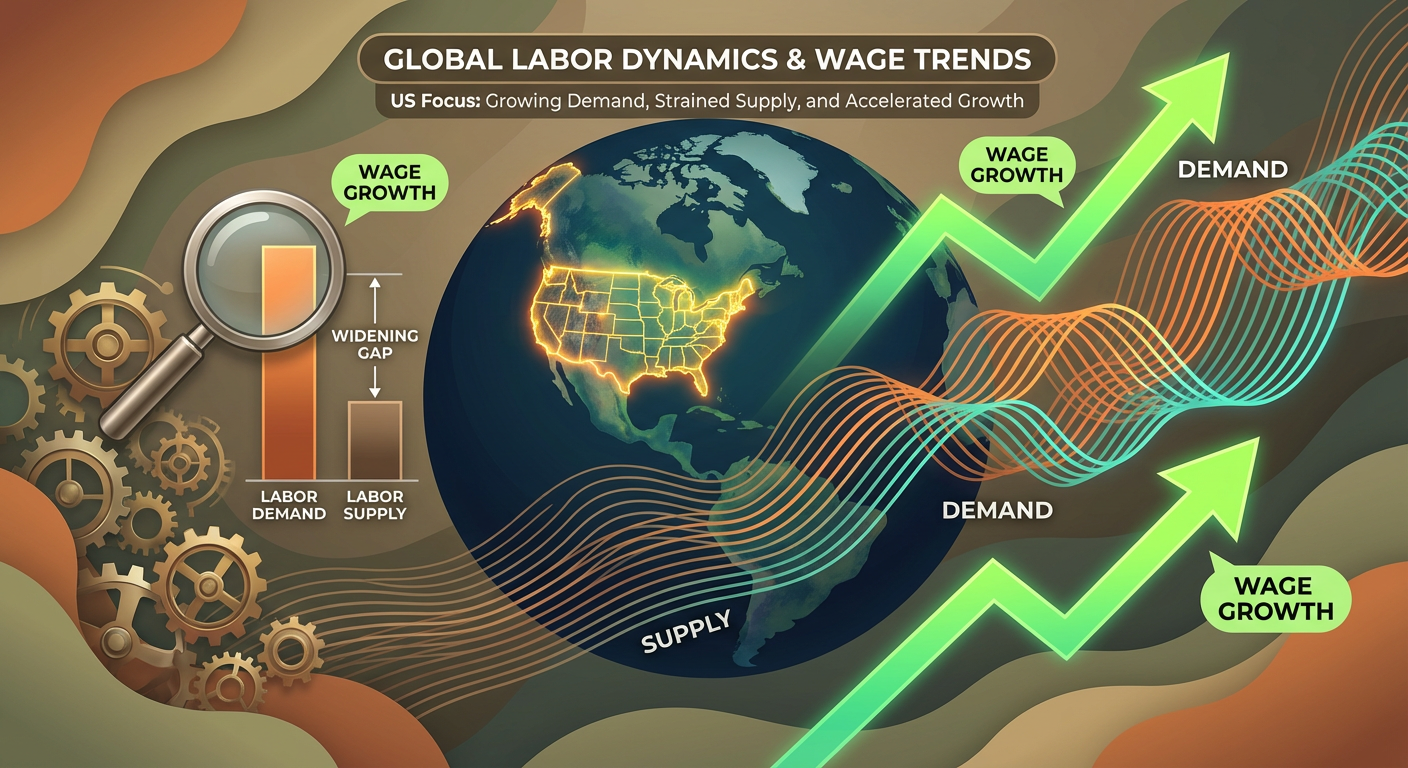
4. Labor Market Impact: Shortages and Wage Growth
The period from 2019 to 2026 has witnessed unprecedented volatility in the remodeling industry, characterized not only by dramatic material cost inflation but also by significant shifts in the labor market. While initial attention was often drawn to skyrocketing lumber and steel prices, a deeper analysis reveals that the impact of skilled trade labor shortages and subsequent wage growth has become an equally, if not more, persistent driver of remodeling inflation. This section delves into the evolving dynamics of the construction labor force, examining the root causes of shortages, the trajectory of wage increases, and how these factors contribute to the rising cost of home renovation projects, particularly in the United States and the uniquely challenged Phoenix market. We will explore how rising labor expenses compare to material cost inflation and discuss the implications for project timelines, budgets, and the overall remodeling landscape.
4.1 The Growing Crisis of Skilled Labor Shortages
The United States construction industry has been grappling with a chronic shortage of skilled labor for years, a problem that was profoundly exacerbated by the COVID-19 pandemic. Even prior to 2019, the industry faced headwinds, but the events of 2020-2022 created a critical deficit that has fundamentally altered the cost structure of remodeling projects. This shortage is not merely an inconvenience; it represents a systemic challenge that drives up labor rates, extends project timelines, and limits contractor capacity.
4.1.1 Shrinking Labor Pool and Retirement Trends
The skilled trades, including plumbing, electrical work, carpentry, and masonry, have seen a slow but steady decline in new entrants over the past decades. This trend contrasts sharply with the increasing demand for housing and renovation, creating a widening gap. The pandemic accelerated the departure of experienced workers, with many older, seasoned tradespeople opting for early retirement. This demographic shift removed a significant portion of the most productive and knowledgeable workers from the labor force.
The impact of this shrinking labor pool is quantitatively stark. For instance, between 2018 and 2020, the U.S. construction labor force actually contracted, experiencing approximately 3% fewer laborers overall[25]. As the economy reopened and remodeling demand surged, this reduced pool of available talent meant intensely competitive hiring conditions for contractors.
4.1.2 Soaring Job Openings and Unmet Demand
The demand for construction workers quickly outstripped supply, leading to a dramatic increase in job openings. By 2022, the U.S. construction industry was estimated to be short approximately 650,000 workers nationwide[11]. This figure, provided by the Associated Builders and Contractors (ABC), underscores the magnitude of the problem facing general contractors and remodelers alike. The number of open construction jobs jumped significantly, from around 282,000 in 2020 to a staggering 405,000 by May 2022, representing an increase of 44% in just two years[26].
This surge in job openings, coupled with a limited supply of qualified candidates, created what many industry experts describe as a “seller’s market” for skilled labor. Contractors were forced to compete fiercely for talent, driving up wages and benefits to attract and retain employees. This situation directly translated into higher labor costs for every remodeling project, regardless of its scale.
4.2 Annual Wage Increases and the Cost of Skilled Trades
The scarcity of skilled labor has propelled a consistent upward trend in wages across the construction sector. Unlike the often volatile and cyclical nature of material prices, labor costs have shown a more predictable, albeit significant, annual increase, becoming a foundational inflationary pressure for remodelers.
4.2.1 Consistent Annual Wage Growth
Construction wages across many regions of the United States have consistently risen by roughly 5% to 6% annually in recent years[12]. This sustained growth means that labor costs in 2025 are, on average, more than 20% higher than they were in 2019. To put this into perspective, the average hourly earnings for all employees in construction hit approximately $40.37 in late 2025, a substantial increase from around $30 in 2019. This represents a nominal gain of roughly 30% over the six-year period[27].
This persistent wage growth is a direct consequence of the supply-demand imbalance in the labor market. Contractors, desperate to complete projects and faced with a limited pool of skilled workers, have no choice but to offer higher compensation. This includes not only increased hourly rates but also improved benefits and incentives to make their positions more attractive.
4.2.2 Impact on Project Budgets and Specialized Trades
The rising cost of labor directly translates into higher bids for homeowners. For example, a bathroom renovation that might have incurred $5,000 in labor costs in 2019 could now easily cost $6,000 to $7,000, solely due to wage inflation, even if material costs remained constant. This incremental increase, applied across all trades involved in a remodel, significantly impacts overall project budgets.
Specialized trades, such as tile setters, electricians, plumbers, and custom cabinet makers, have been particularly affected. These roles require years of training and experience, and the scarcity of qualified individuals in these areas means they can command premium pay. This specialism contributes disproportionately to the overall labor cost of complex projects like kitchen and bathroom remodels, where multiple highly skilled trades are involved. The Associated Press noted that the most “labor-intensive work” was seeing steeper price increases[14].
4.3 Comparison: Labor vs. Material Cost Inflation as a Driver
Initially, during the acute phases of the pandemic, material cost inflation largely overshadowed labor cost increases in headlines and public perception. Lumber prices, for example, skyrocketed by over 200% between April 2020 and spring 2021[4], and steel mill products jumped over 200% in 2021[6]. These dramatic spikes made materials the primary focus of inflationary pressure. However, as supply chains have stabilized and some material costs have receded from their peaks (though remaining elevated), labor costs have emerged as an equally significant, and potentially more entrenched, driver of ongoing remodeling inflation.
4.3.1 Shifting Cost Proportions in Remodeling Projects
Historically, labor has constituted a substantial portion of a remodeling budget, often around 50%, with materials making up about 40%, and the remainder allocated to overhead and contingency[28]. However, the unprecedented material price surges of 2020-2022 temporarily altered this traditional allocation. During the peak of material inflation, materials often commanded a larger share of the overall project cost. For instance, some analyses suggest that materials could constitute around 45% of a project’s cost, while labor might dip to approximately 30% on average[29].
This shift was particularly noticeable in Phoenix. One Phoenix remodeler observed that a few years ago, labor costs would often equal or even exceed material costs. However, by 2025, expensive products such as high-end tiles, fixtures, and appliances frequently represent the larger segment of the budget[30]. This rebalancing highlights the severe impact material inflation had, temporarily reducing the *relative* share of labor even as labor rates were climbing.
4.3.2 Labor’s Enduring Influence
Despite the dramatic material spikes, the sustained and steady increases in labor costs signify a different, more enduring kind of inflationary pressure. Material prices, while still elevated from 2019, have shown signs of stabilization or even modest declines in some categories. Lumber, for instance, fell from its 2021 peak of over $1,400 per 1000 board-feet to around $655 by mid-2022, although this is still approximately 30% higher than pre-COVID norms[9].
In contrast, labor costs have continued their upward trajectory, driven by the persistent skilled trade shortage. The U.S. construction industry was still experiencing significant unmet labor demands in 2022[11]. This means that while the “wild west” of material price volatility may have subsided somewhat, the underlying structural issue of labor scarcity and corresponding wage growth remains a constant and predictable inflationary force. Verisk noted that “much of the increase in repair and remodeling work” was due to labor costs[13]. Thus, labor-driven cost inflation now rivals materials in some cases as the primary driver of overall project price.
4.4 Practical Implications: Project Timelines and Contractor Capacity
The impact of labor shortages extends beyond just higher wages; it significantly influences project timelines, contractor capacity, and ultimately, a homeowner’s overall experience.
4.4.1 Extended Project Timelines
With fewer skilled workers available, contractors often juggle multiple projects with smaller crews or face delays in staffing new jobs. This directly translates into longer project completion times. Early in the pandemic, as supply chain issues also converged with labor shortages, finance commentator Sam Dogen famously warned that home remodeling projects could “cost 50% more and take 50% longer” than expected[31]. While not every project experienced such extreme delays, this advice reflected a widespread reality. Longer timelines mean more labor hours billed, contributing to increased costs even if the hourly rate remains stable.
4.4.2 Reduced Contractor Availability and Capacity
The sustained demand for remodeling, coupled with limited labor, means that reputable contractors often have full schedules, booking projects months in advance. This reduced availability can limit a homeowner’s choices and bargaining power. Contractors, confident in a steady stream of work, can be more selective about the projects they undertake and are less likely to discount their services. The American construction industry’s capacity was undeniably strained during peaks of demand, directly leading to increased project lead times and higher overall costs due to limited supply of skilled labor.
4.5 The Phoenix Market: Amplified Labor Challenges
The Phoenix metropolitan area, a hub of rapid growth and intensive construction activity, experienced many of these labor market dynamics with amplified intensity. Local factors further compounded the challenges of skilled labor shortages and wage growth.
4.5.1 High Demand in a Booming Market
Phoenix was one of the nation’s fastest-growing cities during the pandemic years, with a surging population and a red-hot housing market. This created robust demand for both new construction and home remodeling. The population of Phoenix grew by nearly 80,000 residents, or approximately 1.6%, in 2021 alone, maintaining its status as a top-five growth city[39],[40]. This intense demand placed immense pressure on the already stretched local construction labor force, ensuring that contractors had full pipelines and little incentive to lower prices.
4.5.2 Climate-Induced Productivity and Seasonal Effects
Phoenix’s extreme climate introduces a unique variable into its labor market dynamics, particularly during the harsh summer months. Outdoor construction work often becomes a challenge or even a hazard when temperatures routinely exceed 100°F. Crews may be limited to working during early morning or late evening hours for safety reasons, which can extend project durations and increase overall labor costs. Even indoor work can be impacted by the need for more frequent breaks and climate control measures.
This seasonality of productivity can push more remodeling activity into the milder fall and winter seasons, further concentrating demand and potentially leading to higher wage costs during those periods. While difficult to quantify precisely, these climate factors can add a few percentage points to Phoenix’s labor costs compared to more temperate cities, with some builders reportedly incorporating “summer premiums” into their bids[22].
4.5.3 Freight Distance and Logistical Pressures
While primarily affecting material costs, Arizona’s inland location also indirectly amplifies labor expenses. The state is geographically distant from major ports. During times of severe supply chain disruptions, such as 2020-2022, materials destined for Phoenix faced prolonged delays and significantly higher transport fees due to the extended freight routes[21]. In some instances, inland shipping costs to Arizona surged by up to 144% on particular routes[32]. These increased logistical complexities and potential material delays can tie up labor longer on a job site, or require costly rescheduling, indirectly driving up labor expenditures.
Phoenix’s construction cost inflation has generally aligned with other high-growth Sunbelt cities, exhibiting annual increases of around 4-5% in recent years, slightly outpacing the national average at times[10],[33]. The combination of sustained demand, chronic labor shortages, and unique regional factors means that Phoenix homeowners can expect labor costs to remain a significant and growing expense in their remodeling budgets, mirroring, and often intensifying, national trends in this sector.
4.6 Conclusion: Labor as a Persistent Inflationary Force
The skilled labor market has transitioned from being a quietly underlying cost factor to a dominant inflationary force in remodeling. While material prices grabbed immediate headlines with their dramatic surges and subsequent, albeit partial, stabilization, labor costs have demonstrated consistent and often unyielding growth. The shrinking pool of skilled tradespeople, coupled with sustained demand for home improvement, has created an environment where annual wage increases of 5-6% are the norm, translating into labor costs that are now 20-30% higher than pre-pandemic levels.
This dynamic has shifted the traditional balance of remodeling project costs, with labor’s share being significant relative to materials, especially as material prices stabilize, though still elevated. For homeowners, this means preparing for higher hourly rates, extended timelines, and challenges in finding available contractors. In markets like Phoenix, these national trends are often amplified by local economic booms and unique environmental factors. Addressing the skilled trade shortage through training programs and apprenticeships will be crucial for mitigating this persistent inflationary pressure in the long term. However, for the foreseeable future, labor costs will remain a critical component driving the overall price of home renovations, a reality that both contractors and consumers must acknowledge and plan for.
The next section will delve into the impact of these labor and material cost dynamics on specific project types, examining how kitchens and bathrooms, flooring, paint, and lighting have been affected differently by the changing economic landscape.
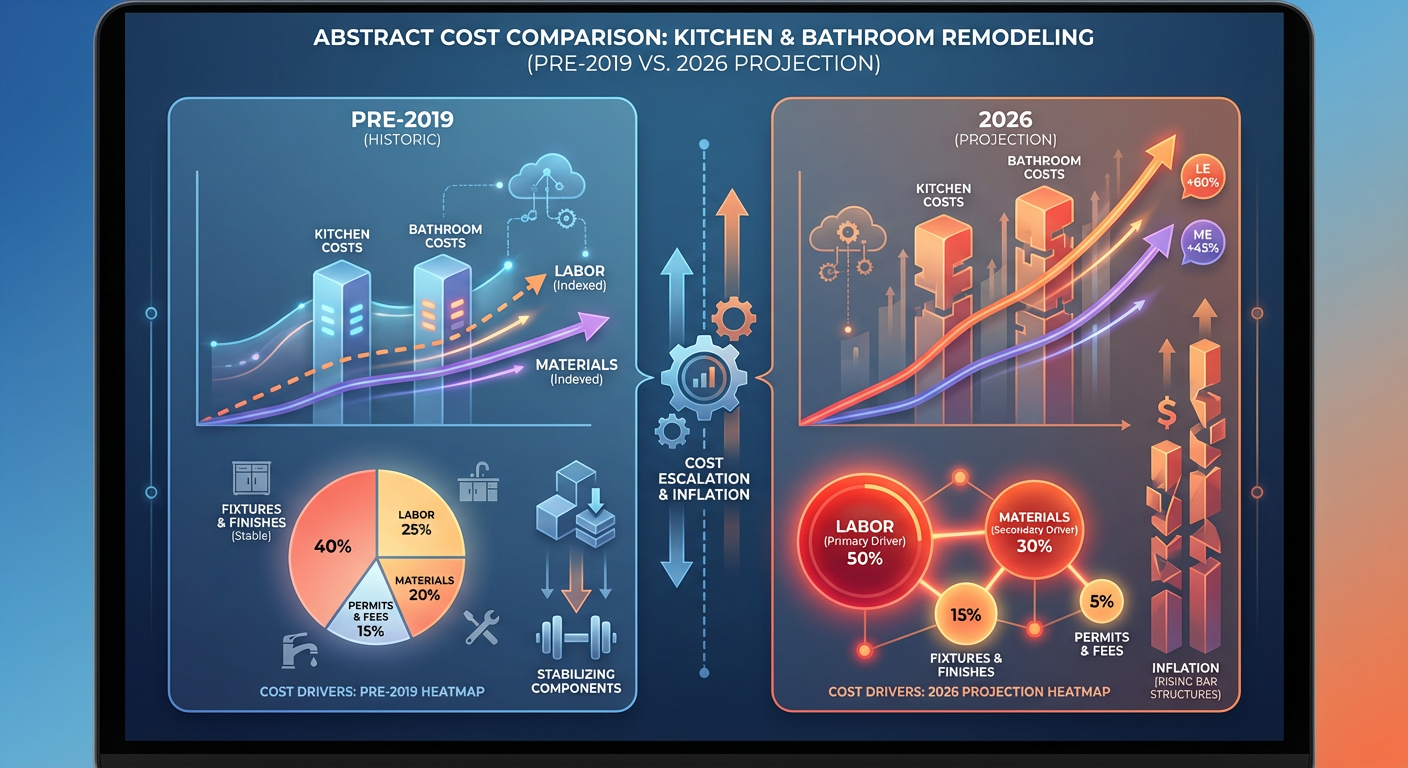
5. Kitchen and Bathroom Remodels: The Most Affected Areas
Kitchen and bathroom renovations have long been considered among the highest return-on-investment projects for homeowners, often serving as the centerpiece of a home’s aesthetic and functional appeal. However, the period between 2019 and 2026 has witnessed unprecedented cost increases in these critical areas, transforming budgeting expectations and project execution. This section provides a focused analysis of the significant inflation observed in kitchen and bathroom remodels, examining the specific components that drove these spikes, the underlying economic factors, and how homeowners and contractors have adapted to these elevated cost environments. While general remodeling costs across the United States have surged by over 40% since pre-pandemic levels, kitchens and bathrooms, with their complex blend of materials, fixtures, and skilled labor, often bore the brunt of these increases, with some projects seeing budgets double within a few years.[16]
Unprecedented Cost Surges in Kitchen and Bathroom Projects
The period from 2019 to 2025 has been characterized by a dramatic escalation in the costs associated with kitchen and bathroom remodels, profoundly impacting homeowners’ budgeting and design aspirations. These areas, inherently complex due to their reliance on various materials, skilled trades, and intricate installations, experienced some of the highest inflation rates within the broader home improvement sector.
A striking example highlights this phenomenon: a mid-range kitchen remodel that a design/build firm estimated at approximately \$75,000 in 2020 could now easily exceed \$150,000 by 2025.[16] This represents an astounding 100% increase in cost over just five years, far surpassing general inflation rates and underscoring the severity of the price hikes in these crucial home areas. Similarly, bathroom renovation costs have seen substantial jumps. A typical full bathroom remodel, which might have cost around \$18,000 in 2019, is now commonly priced at \$25,000 or more by 2023, reflecting a 30-40% increase.[17][18] These figures represent a significant shift in the financial landscape of home renovation, making dream kitchens and luxurious bathrooms considerably more expensive realities.
The reasons behind these steep increases are multifaceted, involving a confluence of factors including material price volatility, labor shortages, supply chain disruptions, and even new trade tariffs. The combined effect of these elements created a perfect storm for cost escalation in these highly sensitive project types.
Specific Components Driving the Spike
The substantial overall cost increases in kitchens and bathrooms were not uniformly distributed but rather aggregated from sharp individual price hikes across various critical components. Understanding these specific drivers is essential to grasping the full scope of remodel inflation.
Cabinetry and Woodwork:
Cabinetry is a cornerstone of both kitchen and bathroom design, and its costs have surged significantly. The underlying factors included the dramatic increases in lumber and plywood prices experienced during the pandemic.[3] Lumber prices alone skyrocketed over 200% from April 2020 to spring 2021,[4] directly impacting the raw materials used in cabinetry manufacturing. Even after receding from their peak, lumber prices remained approximately 30% higher than pre-COVID levels by mid-2022.[7] Beyond raw material costs, certain cabinetry, particularly imported products, faced additional financial burdens. New U.S. tariffs, such as a 50% tariff on imported kitchen cabinets and vanities effective August 2025, are adding further upward pressure on prices.[20] Analysts estimated that such tariffs could add roughly \$280 to the cost of an average home remodel,[21] and for a full kitchen, this figure could be substantially higher. For homeowners, this meant that a basic set of kitchen cabinets saw a considerable price increase, while custom or semi-custom options became even more prohibitive.
Appliances and Fixtures:
Kitchen appliances and bathroom fixtures also experienced significant price inflation. This was primarily due to global supply chain disruptions affecting key manufacturing components, including steel and microchips, alongside rising shipping costs. Appliance prices, for instance, climbed by approximately 8.5% in a single recent year.[22] This translated directly into higher retail prices for everything from refrigerators and ovens to dishwashers and microwaves. For instance, an entry-level dishwasher that might have cost \$500 before the pandemic could now be priced at over \$600, while high-end refrigerators saw jumps from \$8,000 to over \$10,000.[16] Similarly, plumbing fixtures like faucets, sinks, showers, and bathtubs saw price increases driven by the surging cost of metals, particularly copper, which hit an all-time high above \$10,000 per tonne in 2021.[5]
Countertops and Tile:
These heavy materials were not immune, being affected by higher transportation costs and, in the case of quartz and solid-surface tops, by resin price hikes. The production of many tile varieties and countertop materials relies on complex manufacturing processes and significant freight, exacerbating the impact of supply chain slowdowns and fuel cost increases. The demand for hard surfaces like granite, quartz, and various ceramic and porcelain tiles remained strong, allowing manufacturers and suppliers to pass on rising input costs.
Case in Point – Bathroom Finishes:
A detailed look at a master bathroom renovation exemplifies this component-driven inflation. Individually, each item’s price increase might seem manageable, but their cumulative effect is substantial. For example:
- A glass shower enclosure might cost 15% more than in 2019.[23]
- Bathtubs, plumbing fixtures, and faucets could see increases of 10-20%.[23]
- Vanity cabinets might be 25% pricier.[23]
Moreover, even basic construction materials used behind the finishes, such as drywall (gypsum board) and cement board, experienced significant price hikes. Gypsum product costs were roughly 30% higher by early 2023 compared to 2019.[11] The specialized materials like copper pipe and electrical wiring, integral to bathroom functionality, saw their costs soar in line with commodity market trends.[5] As a result, what homeowners envisioned as a \$10,000 minor bath facelift often escalated towards \$15,000, quickly consuming contingency budgets. This pervasive increase across all material categories, from luxury finishes to fundamental building blocks, has made “mid-range” remodel budgets align more closely with pre-pandemic “high-end” expectations.
The Shifting Dynamics of Labor vs. Material Costs
Prior to the pandemic, a general rule of thumb in remodeling was that labor constituted roughly 50% of the project budget, with materials making up around 40% (the remainder for overhead and profit).[19] However, the extreme material inflation experienced from 2020-2022 significantly altered this dynamic, with materials taking a larger slice of the overall project cost. While material prices stole the headlines, labor costs have also risen steadily due to chronic shortages and increased wages, ensuring that overall project costs continue to climb.
Materials Gained Share Significantly:
In the immediate aftermath of the initial supply chain disruptions, material costs surged faster and more dramatically than labor wages. Key construction inputs soared by 20-40% in 2021 alone.[3] Lumber prices, for instance, increased by over 200% between April 2020 and spring 2021.[4] Steel mill products also doubled in price in 2021.[5] These unprecedented spikes meant that materials began to account for a larger percentage of the total remodel cost. For example, a Phoenix remodeler noted that just a few years ago, labor costs would often equal or exceed material costs. However, by mid-pandemic, expensive products like tile and fixtures were often the larger budget component, with materials accounting for approximately 45% of project costs compared to about 30% for labor on average.[19] This shift underscored the unique market conditions where raw commodity prices had an outsized influence on project budgets.
Labor Costs: A Steady Upward Trend:
While the material cost spikes were more volatile and episodic, labor costs demonstrated a more consistent, long-term upward trajectory. The construction industry faced a longstanding skilled labor shortage that was exacerbated by the pandemic, with approximately 650,000 fewer workers than needed in 2022.[12] This scarcity created intense competition for talent, driving wages upward. Construction wages have risen roughly 5-6% annually in many regions,[13] meaning that by 2025, labor costs are approximately 20% higher than in 2019.[13] Nationally, average hourly earnings in construction reached \$40.37 in late 2025, a nearly 30% gain in nominal terms compared to the \$30 range in 2019.[14] This steady increase in labor rates directly translates into higher project bids for homeowners.
Interplay and Continued Inflation:
The interplay between material and labor costs is dynamic. Initially, material inflation outpaced wage growth, reducing the labor’s proportional share despite rising absolute costs. However, as material price increases stabilized somewhat by 2023-2024 (though still elevated compared to pre-pandemic levels), labor costs continued their upward climb, maintaining overall project inflation.[13] In kitchen and bathroom remodels, where multiple specialized trades (plumbers, electricians, cabinet installers, tile setters) are involved, the compounding effect of these rising labor rates is particularly pronounced. Projects requiring extensive structural changes or specialized installations naturally incur higher labor expenses.
Table 1: Estimated Cost Component Share Shift (Illustrative Example, National Averages)
| Cost Component | Pre-2020 (Estimate) | Post-2022 (Estimate) |
|---|---|---|
| Materials | 40% | 45% |
| Labor | 50% | 30% |
| Overhead/Profit/Contingency | 10% | 25% |
Note: The “Overhead/Profit/Contingency” category often absorbed some of the unpredicted cost increases, necessitating larger buffers. The reduction in labor share primarily reflects the disproportionate increase in material costs relative to labor, not necessarily a decrease in labor’s absolute cost.
Adapting to Higher Budgets and Scope Changes
The dramatic increase in kitchen and bathroom remodeling costs has forced a significant recalibration of expectations and strategies among homeowners and contractors alike. The “dream kitchen” of 2019 required a substantially larger financial commitment by 2025. This newfound reality has led to various adaptations in project scope, material selection, and financing.
Value Engineering and Material Selection:
Homeowners, confronted with sticker shock, have become more adept at “value engineering” their projects. This often involves making strategic compromises to stay within budget without entirely sacrificing aesthetic goals. Remodeling firms frequently report clients shifting from luxury options to mid-grade finishes in response to higher prices.[23] For instance, instead of premium custom cabinetry, homeowners might opt for semi-custom lines or explore stock options with upgraded fronts. Similarly, high-end appliance brands might be swapped for mid-tier alternatives that offer similar functionality at a lower price point. Creative design solutions also come into play, such as reusing existing appliance locations to avoid costly electrical or plumbing reworks, which can save thousands of dollars in labor and material costs.[23]
Delaying and Phasing Projects:
For some, the answer to surging costs has been to delay non-essential upgrades or to phase renovations over time. A homeowner might choose to complete a kitchen refresh with new paint and countertops first, postponing a full cabinet replacement or layout change until funds allowed or prices stabilized. While a 2022 survey indicated that only 5% of homeowners would cancel a project due to high costs,[25] many adapted by extending timelines or breaking down larger projects into smaller, more manageable stages.
Homeowner Strategies to Mitigate Costs:
The period of intense inflation also saw homeowners develop proactive strategies to counteract rising costs and supply chain uncertainties:
- Pre-purchasing Materials: A 2022 Nationwide survey revealed that 94% of homeowners were willing to purchase and store materials in advance to lock in prices and avoid future increases.[26] This proactive approach could mean acquiring desired tiles, fixtures, or flooring materials months before construction began, thereby insulating the project from intervening price hikes.
- Early Contractor Engagement: Many homeowners rushed to sign contracts with contractors early, seeking to “lock in” labor rates and project timelines, as the general sentiment was that costs would only continue to rise.[27] This often required longer lead times, with some agreements signed in 2021 for work commencing six months later, but it provided a degree of cost certainty.
- Increased Budget Contingencies: The volatility of material availability and pricing reinforced the importance of robust contingency budgets. Financial experts, like Sam Dogen of Financial Samurai, famously advised homeowners in 2020 to “expect it to cost 50% more and take 50% longer” than normal,[28] suggesting an acknowledgment of the heightened uncertainty and the need for greater financial cushions.
Impact on Demand and Financing:
Despite the substantial cost increases, demand for kitchen and bathroom renovations generally remained robust. These projects are often considered fundamental to home value and quality of life. The desire for improved living spaces, amplified by increased time spent at home during the pandemic, fueled continued spending. However, the higher costs meant that homeowners often had to secure additional financing, such as larger Home Equity Lines of Credit (HELOCs) or personal loans, to cover the expanded budgets.[16]
Example: Euro Design Build Client Experience:
One client, whose mid-tier kitchen remodel was budgeted at approximately \$90,000 in 2019, found by 2023 that the same scope of work exceeded \$150,000. Faced with this 66% increase, the homeowner had to make tough decisions: either scale back the project significantly, increase their financing, or postpone. Ultimately, they opted for additional financing, illustrating a common scenario where homeowners were compelled to stretch their budgets considerably to achieve their desired renovations.[16]
In summary, the era of pandemic-driven inflation forced a reset in the kitchen and bathroom remodeling sector. While homeowners still value these renovations highly, the prevailing sentiment calls for greater financial preparedness, flexible design choices, and a more strategic approach to material procurement and project scheduling. The underlying costs remain elevated, hinting at a “new normal” for renovation budgets that diverges significantly from pre-2019 figures.
Geographic Spotlight: Phoenix Kitchen and Bathroom Remodels in Context
The Phoenix metropolitan area, a booming Sunbelt region, provides a unique lens through which to examine the dynamics of kitchen and bathroom remodel inflation. While sharing many national trends, Phoenix experienced additional pressures due to its rapid growth, geographic location, and extreme climate.
Booming Demand and Market Pressure:
Phoenix witnessed one of the nation’s most active housing markets during the pandemic era, characterized by an influx of new residents and robust home sales. This sustained demand translated into a healthy, though challenging, remodeling market, with contractors often fully booked and limited on availability.[30] Phoenix’s population grew by nearly 80,000 residents, or about 1.6%, in 2021,[31] maintaining its status as a top-5 city for growth.[32] This high growth rate kept consistent pressure on local construction resources, including skilled labor and material supplies, contributing to a premium on remodel services.
Freight and Logistics Vulnerabilities:
Arizona’s inland location proved to be a significant amplifying factor for material costs during periods of supply chain turmoil. Being distant from major ports like Los Angeles and Long Beach, materials destined for Phoenix faced longer transit routes, incurring higher transportation costs and delays.[33] During the peak of supply chain disruptions in 2020-2022, inland shipping costs to Arizona saw surges up to 144% on some routes.[34] This meant that items crucial for kitchen and bathroom remodels, like cabinets, appliances, tiles, and fixtures, arrived with an added cost burden compared to coastal markets. Such freight differentials made local material prices inherently higher and contributed to inventory vulnerabilities, where local stock could deplete faster during tight supply periods.
Extreme Climate and Labor Productivity:
Phoenix’s harsh summer climate introduces another layer of complexity to labor costs and project scheduling. Intense heat (frequently exceeding 100°F) directly impacts worker productivity and safety, particularly for outdoor trades. Projects may require modified work schedules (e.g., early mornings, late evenings) or more frequent breaks, effectively extending project timelines and increasing overall labor hours. While kitchen and bathroom remodels are predominantly indoor activities, the impact on general construction labor availability and scheduling can ripple through the entire industry. For specialized tasks like concrete pours or roofing, extra precautions and additives are often necessary, incurring additional costs. These climate-related factors can translate into slightly higher hourly labor costs in Phoenix compared to more temperate regions, with seasonal “summer premiums” sometimes reflected in bids.
Phoenix Cost Trends vs. National Averages:
Despite these unique challenges, Phoenix’s construction cost inflation frequently aligned with or slightly exceeded national averages, consistent with other rapidly growing Sunbelt cities. In early 2025, Phoenix saw approximately 4.2% year-over-year construction cost increases, marginally above the 4.0% national average.[35] This indicates that while local factors played a role, the overarching remodeling inflation was a national phenomenon. However, Phoenix’s strong market demand amplified the effect, while other slower-growth areas might have felt it less acutely.
Interestingly, even with the increases, Phoenix’s overall remodel costs might still be lower than in ultra-expensive coastal metros like San Francisco. Yet, the gap has narrowed significantly. The pervasive material cost increases, which are more uniform nationally, have become the dominant driver, making the absolute cost of components like kitchen cabinets or bathroom tiles more similar across different regions. Phoenix’s primary differentiators remain its freight distance and local labor market dynamics shaped by sustained growth and climate.
This regional analysis reveals that for Phoenix homeowners, kitchen and bathroom remodels have become exceptionally expensive endeavors, compounded by both global supply chain issues and unique local market characteristics. The “new normal” for these flagship projects in Phoenix demands robust budgeting, strategic planning, and an understanding of the combined pressures of material, labor, and logistical costs.
Next, we will delve into the specific impacts on flooring, paint, and lighting, often perceived as smaller budget items but critical to the overall look and feel of a remodeled space, illustrating how “invisible inflation” has taken hold across these finishing materials.
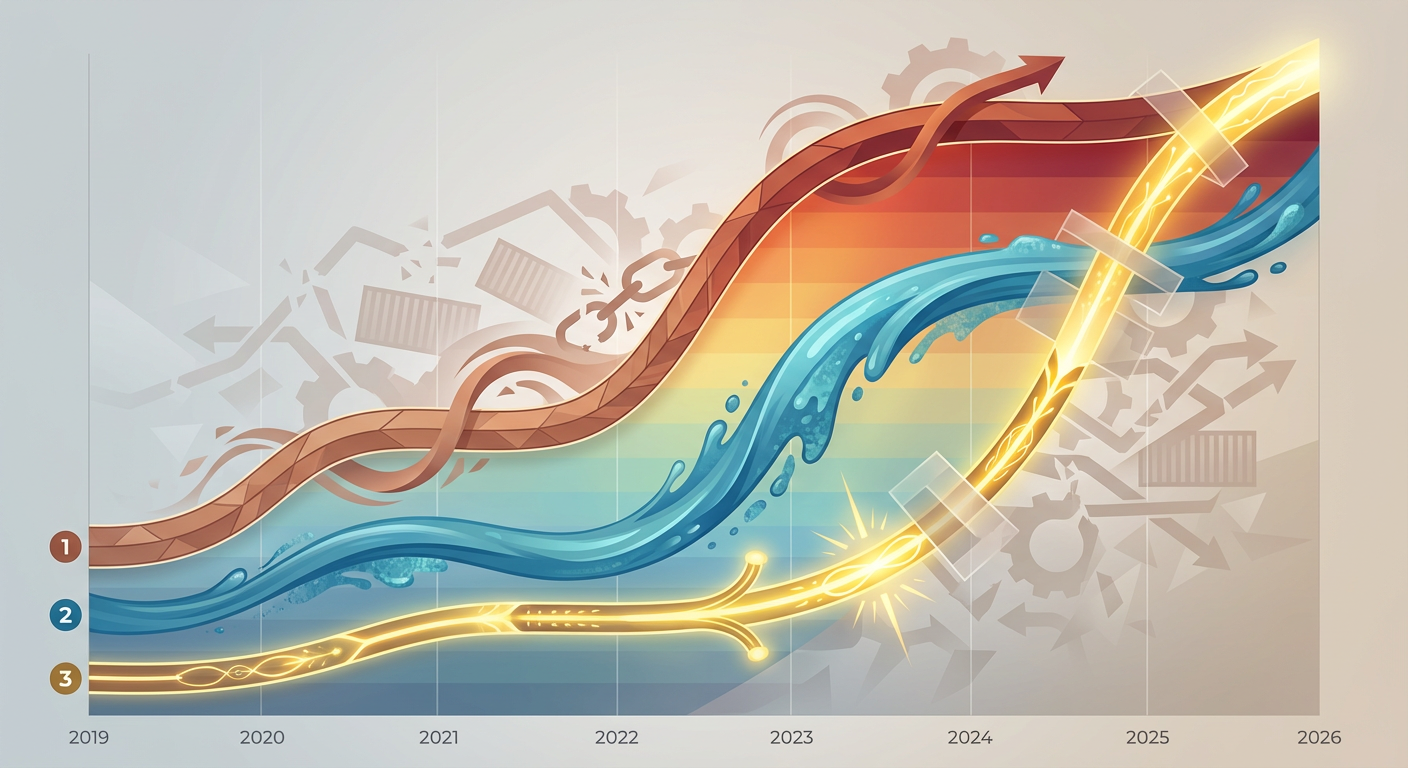
6. Finishing Touches: Inflation in Flooring, Paint, and Lighting
While discussions of remodeling inflation often center on major structural elements like lumber or significant expenditures such as kitchen cabinets and appliances, the “invisible” inflation affecting interior finishing materials like flooring, paint, and lighting has had a substantial, cumulative impact on project budgets since 2019. These are the elements that homeowners directly see and interact with daily, shaping the aesthetic and functionality of a renovated space. The pandemic-era disruptions, a surge in demand, and ongoing supply chain challenges did not spare these often-overlooked components, leading to noticeable cost escalations that aggregated to significantly higher final project totals. This section delves into the specific inflationary pressures experienced across flooring, paint and coatings, and lighting and electrical components, exploring their underlying causes, the extent of price increases, and their overall effect on remodel costs, with a particular focus on the amplified situation in markets like Phoenix.
6.1. The Rising Cost of Underfoot: Inflation in Flooring Materials
Flooring is a foundational element in almost any interior remodel, profoundly influencing both the visual appeal and practicality of a space. From hard surface options like hardwood and tile to softer choices such as carpet and vinyl, every category experienced upward price pressure since 2019. The confluence of factors ranging from raw material costs to transportation logistics contributed to these increases, making new floors a more significant investment than in the pre-pandemic era.
6.1.1. Hardwood and Engineered Wood Flooring
The skyrocketing cost of lumber, a widely publicized phenomenon during the pandemic, had a direct and substantial impact on wood flooring. Framing lumber, which saw an explosion of over 200% in price from April 2020 to its peak in May 2021, eventually settled at levels still approximately 30% higher than pre-COVID norms by mid-2022[8]. This volatility and sustained elevation in raw wood prices inevitably translated to increased costs for both solid hardwood and engineered wood flooring products. Manufacturers faced higher input costs for lumber species, as well as for plywood and other wood-derived materials used in engineered flooring cores. Contractors estimated that solid oak flooring, a popular choice, saw increases of approximately 10-15% in price by 2022 alone. For a typical homeowner undertaking a whole-home remodel or a large room renovation, these percentage increases meant paying hundreds, if not thousands, of dollars more for the same quality and quantity of wood flooring compared to 2019.
The ripple effect of lumber price surges was not limited to just new wood flooring planks. Components like subflooring, trim, and underlayments that incorporate wood derivatives also saw price hikes, further contributing to the total cost of a flooring installation project. Even with lumber prices stabilizing and receding from their peak highs by late 2022, they have not returned to 2019 levels, establishing a new, higher baseline for wood flooring costs. Manufacturers continue to grapple with elevated input costs for energy, transport, and labor, ensuring that prices remain significantly above pre-pandemic thresholds.
6.1.2. Laminate, Luxury Vinyl Tile (LVT), and Vinyl Flooring
While often considered more budget-friendly alternatives to hardwood, laminate, luxury vinyl tile (LVT), and sheet vinyl flooring also were not immune to inflationary pressures. These products rely heavily on petroleum-based plastics and resins, which experienced their own supply chain challenges and price volatility during the pandemic. The production of the core layers, wear layers, and finishes for these materials depends on petrochemicals, whose supply was disrupted by events such as the 2021 Texas winter storm, which impacted chemical manufacturing facilities. These disruptions led to increased raw material costs for flooring manufacturers.
Furthermore, a substantial portion of laminate and LVT products are imported, particularly from Asia. This made them highly sensitive to the unprecedented increases in global shipping and freight costs experienced from 2020 to 2022. Ocean freight rates soared, and trucking costs within the United States also climbed due to fuel price increases and labor shortages in the logistics sector. For materials destined for inland markets like Phoenix, these freight costs were further amplified due to longer transportation routes and additional handling, with inland shipping to Arizona seeing cost surges up to 144% on some routes[37]. These elevated logistical expenses were ultimately passed down through the supply chain to consumers, contributing to higher retail prices for both imported and domestically produced vinyl and laminate flooring.
Overall, floor covering prices were reported to be up about 7.2% year-over-year at one point during the pandemic-induced supply crunch, according to BLS and Forbes data cited by RenoFi[18],[35]. This broad increase reflects the pervasive nature of inflation across different flooring types.
6.1.3. Tile and Stone Flooring
Ceramic, porcelain, and natural stone tiles, along with their associated setting materials (thin-set mortar, grout, and sealants), also saw notable price adjustments. The manufacturing of ceramic and porcelain tiles is energy-intensive, and rising energy costs, particularly for natural gas, contributed to higher production expenses. Supply chain issues for specific clays, glazes, and pigments further squeezed manufacturers. For natural stone, extraction and processing costs increased, coupled with higher shipping expenses for these inherently heavy materials.
The adhesive and grout components, which often contain petroleum-derived polymers, also saw price increases consistent with overall chemical and resin inflation. For example, a phoenix remodeler noted that expensive products like tile (and the labor to install it) now constitute a larger slice of the budget compared to a few years ago[17]. While not as dramatically volatile as lumber, the steady accumulation of these increased input and transportation costs ensured that homeowners paying for new tile installations found their budgets stretching further.
6.1.4. Carpet and Other Soft Coverings
Even carpet, often perceived as a more economical flooring choice, faced inflationary pressures. Similar to vinyl products, carpet manufacturing relies on petrochemical inputs for synthetic fibers (nylon, polyester, polypropylene) and latex-based backings. Fluctuations and increases in the global price of crude oil and related petrochemicals directly affected these costs. Additionally, the transportation of bulky carpet rolls added to the logistical cost burden, further influencing pricing.
| Flooring Type | Primary Inflation Drivers | Approximate 2022 Price Increase (vs. 2019) |
|---|---|---|
| Solid Hardwood | Lumber costs, labor, freight | 10-15% |
| Engineered Wood | Lumber costs, adhesives, freight | 10-15% |
| Laminate/LVT | Petrochemicals, freight (import) | 7-10% |
| Ceramic/Porcelain Tile | Energy, raw materials, freight (heavy) | 5-8% |
| Carpet | Petrochemicals, freight (bulky) | 5-7% |
In summary, installing new flooring became notably more expensive across the board since 2019. The “invisible” nature of these incremental increases meant that while no single flooring type saw the dramatic percentage spikes of lumber, the cumulative effect of rising raw material, manufacturing, and shipping costs added hundreds to thousands of dollars to typical flooring projects. The overall Producer Price Index (PPI) for floor coverings reflected this trend, indicating a consistent upward trajectory in prices.
6.2. The Persistent Price Hike in Paint and Coatings
Paint, an essential finishing touch for almost any interior renovation, experienced one of the most significant and persistent inflationary surges among finish materials. Beyond just adding color, paint protects surfaces and completes the aesthetic transformation of a space. However, homeowners and contractors alike encountered unexpected sticker shock when purchasing paint throughout the 2020-2025 period.
6.2.1. Causes of Paint Inflation
The primary drivers behind the dramatic increase in paint and coating costs were a combination of raw material shortages, production disruptions, and increased transportation expenses. Key ingredients in paint formulations, such as resins (e.g., acrylics, epoxies), solvents, pigments (like titanium dioxide), and additives, are often derived from petrochemicals.
- Petrochemical Supply Disruptions: The pandemic initially led to shutdowns in chemical plants globally. Compounding this, a severe winter storm in Texas in February 2021 caused extensive damage to petrochemical facilities in the region, which is a major hub for producing these critical paint ingredients. This event severely constrained the supply of resins and other components, leading to an immediate and acute shortage across the entire coatings industry[36].
- Increased Demand: Simultaneously, the pandemic fueled a surge in home improvement projects, including a booming demand for paint from both professional contractors and DIY enthusiasts. This combination of constrained supply and elevated demand created a classic inflationary scenario.
- Transportation Costs: Like other imported goods, the raw materials for paint and the finished products themselves were subject to surging global shipping and domestic freight costs.
6.2.2. Extent of Price Increases
The impact of these factors was stark. The Producer Price Index (PPI) for paint and coating manufacturing provided a clear indicator of the upward trend, jumping approximately 28% from early 2020 (when the index was around 300) to October 2022 (index around 420)[6],[14]. This index remained near its record highs into 2023, showing little sign of a significant rollback[14]. Major paint manufacturers, including industry giants like Sherwin-Williams and PPG, implemented multiple price hikes. These increases were typically in the range of 5-12% and occurred more than once between 2021 and 2022[34]. By January 2022, paint input costs were reported to be up 22% year-on-year[16], directly translating to higher retail prices for consumers and contractors.
For context, a 5-gallon bucket of quality interior paint that might have cost $150 in 2019 could easily have retailed for $190 or more by 2022-2023. This 20%+ increase added hundreds of dollars to the cost of larger painting projects. Some paint suppliers even resorted to imposing temporary “materials surcharges” of around 4% in 2022 to offset rapidly rising costs[39]. While paint typically represents a smaller line item compared to major components like cabinets or countertops, its steep inflation directly impacted any renovation involving significant repainting or finishing work, making it a crucial component in the overall rise of remodel costs.
6.2.3. Stabilization and Outlook
Although the frantic phase of price hikes has somewhat stabilized, paint prices have not broadly retreated to pre-pandemic levels. Manufacturers continue to face elevated expenses for raw materials, energy, labor, and transportation. The industry has largely adapted to the “new normal” of higher costs. While the massive year-over-year percentage increases seen in 2021-2022 have softened, new, smaller increases of 4-5% annually have been observed in the broader construction input PPI for 2024-2025, suggesting a continued, albeit slower, upward creep for paint costs as well[27].
6.3. Shedding Light on Cost Increases: Lighting and Electrical Components
Lighting fixtures and the underlying electrical components, though often less discussed than other materials, also contributed to the overall inflation in home remodels. These elements are vital for functionality, safety, and ambiance, and their costs were influenced by supply chain disruptions, commodity price surges, and increased manufacturing expenses.
6.3.1. Electrical Wiring and Components
A significant factor in the rising cost of electrical work was the price of copper. Copper is a primary material for electrical wiring, and its price reached an all-time high of over $10,000 per tonne in 2021, the first time since 2011[10],[40]. This surge in copper prices directly translated into higher costs for electrical wire, cables, and other copper-containing components such as switches, outlets, and electrical panels. For projects involving extensive rewiring or the installation of new circuits, the increased cost of copper wire alone could add hundreds to thousands of dollars to the budget.
Beyond copper, other electrical components such as PVC conduit, junction boxes, and connectors, which rely on plastic resins and other industrial materials, saw price upticks due to similar supply chain and raw material cost pressures. The manufacturing of circuit breakers and other electronic controls also faced challenges related to microchip shortages and increased labor costs.
6.3.2. Lighting Fixtures
Lighting fixtures themselves encompass a broad range of styles and materials, from recessed can lights to elaborate chandeliers. They typically combine metal (steel, aluminum), glass, and electronic components (LED drivers, dimmers). Each of these input categories experienced inflationary pressures:
- Metal Costs: Steel and aluminum prices soared during the pandemic. Steel mill products, for instance, doubled in price in 2021, increasing over 200% due to global shortages, and saw another 25% spike in early 2022 following the Ukraine conflict[9],[11]. These increases directly affected the cost of metal housings, mounting plates, and decorative elements in light fixtures.
- Glass and Electronics: The production of glass and electronic components also faced supply chain bottlenecks and increased manufacturing costs.
- Shipping and Logistics: Many decorative and specialized lighting fixtures are imported. Thus, they were heavily impacted by the surge in global shipping costs, particularly for bulky or fragile items that require specialized handling.
While exact figures can vary widely by fixture type and manufacturer, trade contractors estimated that many common lighting fixtures were 10-15% more expensive by 2022 compared to two years prior. A recessed can light that retailed for approximately $20 might have increased to $23, and a popular LED vanity light priced at $120 could now be $140 or more. The Consumer Price Index for “clocks, lamps, and decorator items” (a proxy that includes light fixtures) showed approximately a 6% year-over-year increase at one point[19], reflecting this general trend. For a project requiring dozens of fixtures – from ceiling lights to under-cabinet lighting and outdoor sconces – these incremental increases aggregated to a significant bump in the total electrical budget.
| Lighting/Electrical Component | Primary Inflation Drivers | Approximate 2022-2023 Price Increase (vs. 2019) |
|---|---|---|
| Copper Wire/Cable | Raw copper commodity price | 15-20%+ |
| Standard Lighting Fixtures | Metals, glass, electronics, freight | 10-15% |
| Outlets/Switches | Plastics, wiring, metals | 5-10% |
| Electrical Panels | Metals, electronics, manufacturing | 10-15% |
The “invisible” nature of these costs means homeowners might not immediately identify them as major inflation drivers. However, when every individual outlet, switch, and light fixture increases in price, the cumulative impact on a project’s electrical budget can be substantial. This underscores the need for comprehensive budgeting that accounts for inflation across all categories of finishing materials.
6.4. The Phoenix Perspective: Amplified Inflation in Finishing Materials
The Phoenix metropolitan area, with its booming housing market and unique geographical and climatic conditions, experienced the inflation in finishing materials with amplified intensity. While national trends provide a baseline, local factors added layers of complexity and cost.
6.4.1. Freight and Logistics Challenges
Phoenix’s inland location, far from major coastal ports like Los Angeles and Long Beach, made its supply chain particularly vulnerable during the global logistics crisis of 2020-2022[20]. Materials destined for Phoenix, whether flooring, paint ingredients, or imported lighting fixtures, faced longer transportation routes and additional handling. During the worst of the supply crunch, inland shipping to Arizona saw cost surges up to 144% on some routes, with these added logistics expenses ultimately impacting local retail prices[37]. This meant that while a roll of LVT might have been more expensive nationwide, it was likely even pricier in Phoenix due to these magnified freight costs. Local inventories ran out faster when supply was tight, compelling contractors and consumers to pay premiums for available stock or endure longer lead times.
6.4.2. Demand-Driven Price Pressure
Phoenix experienced significant population growth, with nearly 80,000 new residents in 2021 alone, maintaining its status as a top-five growing city[42],[43]. This sustained influx, combined with a hot housing market and elevated homeowner equity, translated into robust demand for remodeling services. This high demand allowed contractors and suppliers to maintain higher pricing levels for finishing materials, as there was ample willingness among consumers to pay for renovations despite the increased costs. Local remodelers often had full schedules, allowing them to be selective and firm on pricing for both labor and materials.
6.4.3. Labor Costs and Seasonality
While finishing materials are primarily product-driven expenses, the labor to install them is a significant component, and Phoenix also experienced high labor cost inflation. The city’s extreme summer heat affects labor productivity, particularly for outdoor tasks, but also indirectly for indoor work where crews require more frequent breaks. This can extend project timelines, effectively increasing the labor cost for a given scope. For flooring installations, painting, and electrical work, the availability of skilled tradespeople was tight, further driving up wages. Wage growth for construction workers in recent years has been approximately 5% annually in many regions[12],[25], with Phoenix seeing rates slightly above the national average (e.g., 4.2% YoY increase in early 2025 vs. 4.0% national average for construction costs)[38]. This ongoing labor inflation meant that even if material prices stabilized, the total cost of installing those finishing touches remained elevated.
Therefore, for Phoenix homeowners, the “invisible” inflation in flooring, paint, and lighting was particularly pronounced. The combination of increased material costs due to national and international factors, amplified by local freight costs, strong demand, and rising labor rates specific to the region, ensured that these finishing touches contributed significantly to the overall nearly 40%+ increase in remodel costs since 2019 that the city experienced.
6.5. Stabilizing, Not Retreating: The Future of Finishing Material Costs
As of late 2025 and looking into 2026, the market for finishing materials has largely moved past the peak volatility seen in 2021-2022. Supply chains have improved, and the most extreme commodity price surges (like the initial lumber spikes) have receded. However, this stabilization does not mean a return to pre-pandemic pricing. Experts widely agree that remodeling costs, including those for flooring, paint, and lighting, are not retreating to 2019 levels[22],[23].
- New Cost Baselines: Manufacturers of flooring, paint, and electrical components continue to operate with higher underlying costs for energy, transportation, and labor. These elevated operational expenses create a new, higher baseline for product pricing.
- Slower but Persistent Increases: While drastic year-over-year percentage increases are less likely, a steady, moderate upward creep of 4-5% annually is still expected for construction inputs in 2024-2025, which will continue to affect these finishing materials[27].
- Consumer Adaptation: Homeowners have shown a willingness to adapt, with many pre-purchasing materials and locking in contractor rates to mitigate further increases[48],[49]. This sustained, albeit slowing, demand continues to support current price levels.
In essence, the era of “invisible inflation” for finishing touches has rendered the “new normal” for remodeling budgets significantly higher. Homeowners tackling renovations must factor in these elevated costs for flooring, paint, and lighting, recognizing that the combined impact of these seemingly smaller line items can profoundly inflate the overall project expense compared to just a few years ago. The meticulous tracking of these component price changes provides critical insight into the comprehensive remodeling inflation landscape.
The next section, “7. Phoenix Amplification: Local Market Dynamics and Costs,” will further explore how specific local conditions in Phoenix have interacted with these national and global trends, resulting in a distinct cost environment for remodels in the region.
7. Phoenix Market Specifics: Local Factors Amplifying Costs
The nationwide surge in remodeling costs since 2019 has been a significant challenge for homeowners and contractors alike. While many forces contributing to this inflation, such as global supply chain disruptions and escalating material prices, were broad in scope, certain regional markets experienced these pressures with amplified intensity due to their unique geographic, economic, and climatic characteristics. Phoenix, Arizona, stands out as one such market where pre-existing conditions, coupled with the unprecedented economic shifts of the pandemic era, created a particularly potent environment for remodeling cost escalation. This section delves into the specific local factors within the Phoenix metropolitan area that not only contributed to remodeling inflation but also exacerbated it, often pushing costs beyond national averages and presenting distinct challenges for project execution. From the inherent disadvantages of an inland location affecting freight and material costs to the extreme climate impacting labor productivity, and the booming housing demand fueling competition, Phoenix provides a compelling case study of how localized conditions can profoundly shape the economics of home renovation.
7.1. Geographic Isolation and Amplified Freight Costs
The foundational challenge for the Phoenix remodeling market lies in its geographic isolation from major coastal ports. Arizona, being an inland state, relies heavily on trucking and rail for the transport of virtually all imported and domestically manufactured building materials. This reliance became a critical vulnerability during the global supply chain crisis of 2020–2022, turning what was once a routine logistical step into a significant cost driver and source of delays.
7.1.1. Distance from Ports and Supply Chain Vulnerability
Materials destined for Phoenix, whether originating from overseas or manufactured in other U.S. regions, must traverse considerable distances. The primary entry points for goods arriving from Asia, a major source of building materials and components, are the ports of Los Angeles and Long Beach in Southern California. From these ports, goods must be transported approximately 370 miles inland to reach Phoenix. While this distance is manageable under normal circumstances, it proved detrimental during periods of severe supply chain congestion.
During the global shipping crisis, which saw unprecedented backlogs at ports, shortages of shipping containers, and a scarcity of truck drivers, the longer transit routes to inland cities like Phoenix bore the brunt of these disruptions. The problem was multifaceted:
- Increased Lead Times: With ports experiencing major bottlenecks, containers would often sit for weeks, if not months, awaiting offloading and further transport. For Arizona-bound materials, this meant extended delays, pushing project timelines and potentially incurring additional storage fees at the port or inland warehouses. Remodelers in Phoenix noted that their supply chain became “particularly vulnerable” during this period, with components taking significantly longer to arrive than usual.[21]
- Exorbitant Freight Rates: As demand for trucking services skyrocketed and available capacity dwindled, transportation costs surged dramatically. The research indicates that inland shipping to Arizona, specifically, experienced cost surges of up to **144% on some routes** during the peak of the 2020–2022 supply crunch.[10] This astonishing increase in freight expenses directly translated into higher landed costs for materials in Phoenix. Every sheet of drywall, every box of tile, every pallet of lumber effectively became more expensive due to the augmented transportation component. These additional freight fees, of course, were ultimately passed on to the homeowners undertaking remodeling projects.
- Limited Inventories and Backorders: The extended lead times and higher shipping costs made it less feasible for local suppliers to maintain large inventories. When national or international supply shocks occurred, Phoenix’s local inventory could run out faster than in regions closer to distribution hubs, further exacerbating material availability issues and forcing remodelers to place items on backorder. This cyclical effect of limited stock driving further delays and increasing pressure on prices was a distinct challenge for the Phoenix market.
This geographic reality meant that while a national average for material cost increases might be cited (e.g., lumber prices up 30-50% above 2019 levels[7]), the actual price paid by a Phoenix remodeler, after accounting for shipping surcharges and the hidden costs of delays, was often even higher relative to pre-pandemic norms. The cost for specialized items, or those requiring international shipping, saw even greater premiums. This unique freight dynamic served as a significant local amplifier to the national material inflation trends.
7.2. Extreme Climate and Labor Market Dynamics
Beyond logistics, Phoenix’s renowned desert climate, characterized by intensely hot summers, introduces another layer of complexity and cost amplification, particularly concerning labor productivity and wages.
7.2.1. Heat and Seasonality Effects on Labor Productivity
The extreme summer heat in Phoenix, where temperatures routinely exceed 100°F and can reach 115°F or higher, has a direct and profound impact on construction labor. Working safely and effectively in such conditions is a significant challenge.
- Reduced Workable Hours: For outdoor trades (such as roofing, framing, exterior painting, or demolition), daylight hours during the summer often become unusable for full-intensity work. Crews must start earlier, often before sunrise, and finish by mid-morning, or work into the late evening. This effectively reduces the number of productive hours in a workday, meaning a project that might take 8 hours in a temperate climate could stretch over a day and a half in Phoenix during summer, increasing aggregate labor hours.
- Mandatory Breaks and Hydration: Ensuring worker safety and compliance with OSHA guidelines in extreme heat necessitates frequent rest breaks, access to shade, and ample hydration. While crucial for well-being, these measures inherently slow down work pace and reduce continuous production time.
- Impact on Indoor Work: Even indoor remodeling projects are not entirely immune. While air conditioning provides relief, the initial stages of a remodel often involve opening up a structure, exposing interiors to the heat. Carrying heavy materials, hauling debris, or working in unconditioned attics or garages remains challenging. Moreover, the sheer physical toll of living and working in intense heat can affect overall energy and stamina, even if direct exposure is limited.
This climate-induced reduction in labor efficiency translates directly into higher labor costs per unit of work. Contractors may need to schedule more days to complete a task, employ larger crews, or pay overtime for work performed during cooler, non-standard hours. Builders active in the Phoenix market often include “summer premiums” in their bids to account for these environmental factors.
7.2.2. Persistent Labor Shortages and Wage Pressure
Phoenix’s booming demand for construction, fueled by rapid population growth, collided with a national and local shortage of skilled trade labor. The extreme climate further aggravated this shortage, as not all workers are willing or able to work under such conditions, even with competitive pay.
- Competition for Skilled Talent: Even prior to the pandemic, the construction industry faced a chronic shortage of skilled workers nationwide, estimated at ~650,000 workers short in 2022.[11] In Phoenix, this shortage was intensified by the sheer volume of new construction and remodeling projects. General contractors and specialized trades (electricians, plumbers, framers, tile setters) found themselves in fierce competition for available talent.
- Above-Average Wage Growth: To attract and retain workers in a demanding environment, Phoenix contractors have had to offer higher wages and better benefits. While national construction wages rose approximately 5-6% annually in many regions[12], Phoenix’s wage growth has been particularly strong due to this heightened competition. The local labor market conditions contribute to Phoenix being consistently ranked among the top cities for construction cost inflation.[22] The “braving 110°F summer heat” factor for trade workers in Phoenix directly contributes to these higher regional wages.[22]
- Slower Project Completion and Higher Soft Costs: The scarcity of labor also manifests in longer wait times for contractors and subcontractors, extending project durations. This can lead to increased “soft costs” for homeowners, such as prolonged temporary housing, additional design fees due to scope changes, or simply the opportunity cost of delays. The advice given by finance expert Sam Dogen in 2020 to expect projects to cost and take “50% longer”[29] was particularly resonant in high-demand, labor-constrained markets like Phoenix.
In essence, the combination of Phoenix’s climate and its robust construction demand creates a challenging labor market where higher wages and reduced productivity during certain seasons become embedded costs, further amplifying overall remodel inflation.
7.3. Booming Housing Market and High Demand
The Phoenix metropolitan area has been one of the fastest-growing major cities in the U.S. for many years, a trend that significantly accelerated during and immediately after the pandemic. This rapid expansion, driven by population influx and strong economic growth, created a sustained, high-demand environment for both new construction and remodeling services.
7.3.1. Population Influx and Increased Housing Needs
Phoenix’s population grew by nearly **80,000 residents (approximately 1.6%) in 2021 alone**[40], consistently maintaining its status among the nation’s top-5 cities for growth.[41] This influx created immense pressure on the housing supply. While new home construction struggled to keep pace with demand due to material and labor shortages, older homes often became targets for renovation.
- Strong Demand for Remodels: With a rapidly expanding population and a competitive housing market, many homeowners opted to improve their existing properties rather than contend with challenging buying conditions. This robust demand for remodeling services ensured that local contractors had full pipelines of work, reducing their incentive to offer competitive pricing or negotiate on costs.
- Escalated Property Values: The booming housing market led to significant increases in property values. This, in turn, often encouraged homeowners to invest more in their homes, confident that the renovations would retain or increase their property’s market value. However, this increased willingness to spend also fed into the contractors’ ability to uphold higher pricing.
7.3.2. Limited Contractor Capacity and Higher Bidding
A high-demand market typically leads to a sellers’ market for services. In Phoenix, remodelers often found themselves in a position to be selective about projects and charge premium rates.
- Full Schedules and Longer Wait Times: Contractors in Phoenix reported consistently full schedules, with many booked out for several months in advance. This lack of immediate availability meant that homeowners either had to wait or pay a premium for expedited service, effectively contributing to higher project costs.
- Competitive Bidding Environment: While competition among contractors technically exists, the sheer volume of available work often meant that firms were not under intense pressure to present the lowest bid. Instead, they could price projects to reflect their true costs, desired profit margins, and the prevailing market rates, which were consistently trending upward.
- Impact on Specific Project Types: High-ROI projects like kitchen and bathroom remodels, which were seeing national cost surges of 30-100% since 2019[15], were particularly affected in Phoenix. The local demand meant that these high-value projects consistently fetched elevated prices, as homeowners competed for specialist contractors.
7.4. Phoenix Cost Trends Relative to National Averages
Despite these unique local pressures, Phoenix’s construction cost inflation has remained largely in line with many high-growth Sunbelt cities. While local factors amplified certain components, the overall remodeling inflation trend was a nationwide phenomenon.
According to a construction index, Phoenix saw approximately **4.2% annual construction cost increases in early 2025**[44], only slightly above the national average of around 4.0%. This indicates that while Phoenix had its distinct challenges, the macro-economic forces driving inflation were dominant.
| Cost Component | National Average Increase (2019-2025/26) | Phoenix-Specific Amplification/Impact |
|---|---|---|
| Overall Remodel Projects | 40%+ higher than pre-pandemic[3] | Slightly above national average (e.g., 4.2% vs. 4.0% annual increase in 2025)[44] due to local demand and unique challenges. In Phoenix, remodel budgets can rise faster than national averages because national material and labor inflation is compounded by local freight costs, strong remodeling demand, and climate-related labor pressures.[8] |
| Building Materials (General) | 30-50% above 2019 levels for many items[7] | Significantly compounded by freight, with inland shipping to Arizona seeing cost surges up to 144% on some routes during crisis peaks, directly elevating material prices.[10] |
| Lumber | ~30% higher than pre-COVID norms (after peaks)[9] | Further impacted by higher freight costs and less resilient local supply chains compared to coastal markets. |
| Skilled Labor Wages | ~5-6% annually; 20%+ higher than 2019 overall[12] | Intense pressure due to booming construction demand and impact of extreme summer heat on productivity, leading to high regional wages and “summer premiums.” Wages were a significant cost driver in Phoenix. |
| Kitchen Remodels (Mid-Range) | Can exceed 100% increase (e.g., $75k in 2020 to $150k+ in 2025)[15] | Affected by all local factors – high material and labor costs, strong local demand for high-value upgrades, as well as tariffs on imported cabinetry. |
| Bathroom Remodels (Full) | 20-30% costlier than pre-pandemic[16] | Similar to kitchens, impacted by high demand for specialized trades (plumbers, tile setters), material cost amplification, and climate considerations for project timing. |
The core finding is that while the underlying causes of remodel inflation (supply chain issues, commodity price surges, labor shortages) were universal, Phoenix’s unique characteristics served as an exacerbating force.
- Material Prices: The freight distance to Phoenix notably increased the cost burden of material inflation. Even when national commodity prices stabilized, the cost of getting those materials to Arizona remained elevated compared to pre-pandemic norms due to residual high trucking costs and a less efficient logistics network.
- Labor Prices: Phoenix’s booming growth ensures sustained high demand for construction labor. Coupled with the environmental challenges of working in extreme heat, this kept upward pressure on wages, making labor costs a persistently significant factor in local remodel pricing.
- Cost Baseline: While Phoenix remodel costs are now substantially higher than pre-pandemic, they still might be below those of hyper-expensive coastal metros like San Francisco or New York, given a relatively lower baseline cost of living. However, the gap has narrowed considerably as material costs, which are more uniform nationally (before freight), became a greater percentage of overall project costs.
In summary, remodeling in Phoenix encapsulates the broader inflation story of the past five years but with an additional layer of locally specific challenges. Homeowners and contractors alike must navigate increased costs driven by a combination of global supply dynamics, amplified transportation expenses, and a high-demand, climate-affected labor market. These factors ensure that the “new normal” for remodeling costs in Phoenix is substantially higher than in 2019, reflecting a complex interplay of forces unique to this dynamic market.
The insights from Phoenix’s market specifics provide a crucial localized context to the broader narrative of remodeling inflation. Understanding these unique amplifiers helps in formulating more precise and region-specific forecasts and strategies. In the subsequent section, we will delve into the projected outlook for remodeling inflation, examining whether current stabilization trends are sustainable and what factors might influence cost trajectories through 2026 and beyond.
8. Project Archetype Repricing and Future Outlook
The residential remodeling landscape in the United States, and particularly in dynamic markets like Phoenix, has undergone a seismic shift since the pre-pandemic era of 2019. Homeowners, contractors, and financial institutions alike have grappled with unprecedented cost volatility and sustained inflation across virtually every component of renovation projects. To truly grasp the magnitude of these changes, it becomes imperative to move beyond aggregated inflation figures and delve into the real-world impact on specific project archetypes. This section will present repriced archetypes for common remodeling projects – focusing on kitchens, bathrooms, flooring, paint, and lighting – to illustrate the tangible financial uplift experienced by homeowners. Furthermore, it will provide a forward-looking analysis of future trends in remodel inflation, considering factors such as expected expenditure growth, policy impacts like tariffs, and the enduring effects of a recalibrated supply chain and labor market. Understanding these repriced project costs and the underlying forces shaping them is crucial for setting realistic budgets, managing expectations, and navigating the evolving economics of home improvement.
8.1. Repricing Project Archetypes: A 2019-2025 Cost Analysis
To quantify the cost escalation since pre-pandemic times, we analyze three common interior remodeling archetypes. These archetypes are designed to represent typical scopes for homeowners, ranging from smaller, cosmetic updates to more comprehensive overhauls. Each project has been repriced annually using the available data on material and labor cost inflation, offering a clear trajectory of budget changes.
8.1.1. Archetype 1: Mid-Range Kitchen Remodel (United States & Phoenix)
The kitchen, often considered the heart of the home, is consistently one of the most expensive and impactful remodeling projects. It involves a multitude of trades and high-value materials, making it particularly susceptible to inflation. Our data reveals that a mid-range kitchen remodel has seen some of the most dramatic cost increases post-2019.
A mid-range kitchen remodel in 2020 that averaged between \$75,000 and \$100,000 is now estimated to easily exceed \$150,000 to \$200,000 by 2025 nationwide, representing a staggering 100% increase in just five years[9]. This figure far outpaces general inflation and highlights the concentrated impact of rising material and labor costs on complex, multi-component projects.
Let’s break down the probable components and their inflation drivers:
- Cabinetry & Woodwork: As a primary material, lumber and plywood price surges directly impacted cabinetry costs. Some cabinetry, particularly imported varieties, also faced new tariffs. For instance, a new U.S. tariff of 50% on imported kitchen cabinets and vanities was set to take effect in August 2025[12], potentially adding around \$280 to the cost of an average home remodel according to UBS analysts[12].
- Appliances & Fixtures: These components saw prices jump due to steel shortages, microchip scarcity, and global shipping delays. Appliance prices increased by approximately 8.5% in a single year during the pandemic’s peak[7]. A dishwasher that cost \$500 might now be \$600+, while high-end refrigerators saw similar proportional increases.
- Countertops & Tile: Higher transportation costs for heavy materials and increases in resin prices (for quartz and solid-surface options) contributed to cost hikes in these areas.
- Labor Costs: The chronic shortage of skilled tradespeople, including plumbers, electricians, and carpenters, drove labor rates up. Construction wages rose roughly 5-6% annually in many regions[4], pushing the overall labor component of a kitchen remodel significantly higher. For example, the average hourly pay for U.S. construction workers topped \$40 in late 2025, a nearly 30% gain from around \$30 in 2019[8].
Phoenix-Specific Impact: While national trends clearly indicate a substantial increase, Phoenix experienced additional pressures. Its inland location meant longer freight routes, leading to added delays and higher transport fees for materials. During the 2020-2022 supply crunch, inland shipping to Arizona saw cost surges up to 144% on some routes[10]. Furthermore, the extreme summer heat in Phoenix affects labor productivity and scheduling, contributing to persistently high construction wages in the region[10]. In Phoenix, kitchen remodel budgets can rise faster than national averages because national material and labor inflation is compounded by local freight costs, strong remodeling demand, and climate-related labor pressures.[14]. Homeowners in Phoenix also adapted by pre-purchasing materials and locking in contractor bids early to mitigate rising costs[15].
| Year | US Average Cost (Estimate) | Phoenix Average Cost (Estimate) | US Index (2019=100) | Phoenix Index (2019=100) | Key Inflation Drivers |
|---|---|---|---|---|---|
| 2019 | \$75,000 | \$75,000 | 100 | 100 | Baseline |
| 2020 | \$80,250 | \$81,000 | 107 | 108 | Initial material shock (lumber, some metals), early labor increases. |
| 2021 | \$97,500 | \$101,250 | 130 | 135 | Lumber (+200%), steel (+200%), copper (+50%), appliances (+8.5%), significant labor growth. |
| 2022 | \$114,000 | \$121,500 | 152 | 162 | Persistent material highs, continued labor shortage (6% wage increases), freight costs (Phoenix up 144%). |
| 2023 | \$130,500 | \$139,500 | 174 | 186 | Moderate material stabilization (still elevated), sustained labor growth (5%+), paint (+28% PPI). |
| 2024 | \$144,000 | \$156,000 | 192 | 208 | Slowing material inflation, but labor continues to climb, new tariffs on some imported goods. |
| 2025 | \$156,750 | \$170,550 | 209 | 227 | Overall remodel costs 40%+ higher than pre-pandemic[3], labor 20%+ higher than 2019[4]. Estimated continuation of 3-4% YOY. |
*(Note: These are estimates based on aggregated data and reflect general trends. Actual costs vary widely based on scope, finishes, and contractor.)*
8.1.2. Archetype 2: Full Bathroom Remodel (United States & Phoenix)
Bathroom remodels, while typically less expensive than kitchens, also saw substantial cost increases due to their specialized components and labor requirements. A typical full bathroom remodel easily became 20-30% costlier than pre-pandemic figures[5][6]. An average full bath remodel, which was around \$18,000 in 2019, rose to \$25,000+ by 2023[5].
Key cost drivers included:
- Plumbing Fixtures and Hardware: Metal costs (copper, steel) and general manufacturing price hikes affected faucets, shower systems, and other fixtures. Copper, crucial for plumbing, hit an all-time high of over \$10,000 per tonne in 2021[7].
- Tile and Flooring: Higher transportation costs for heavy tile and increased manufacturing expenses for various flooring materials contributed. Floor covering prices were up about 7.2% year-over-year at one point[7].
- Vanities and Cabinetry: Similar to kitchens, wood and imported vanity costs were impacted by lumber prices and potential tariffs on imported cabinetry.
- Labor: Specialized trades such as tile setters, plumbers, and electricians faced significant wage increases. The cost of labor-intensive tasks like demolition, waterproofing, and intricate tile work increased noticeably.
- Glass Enclosures: Materials for shower glass also rose in price, and fabrication/installation labor costs increased.
| Year | US Average Cost (Estimate) | Phoenix Average Cost (Estimate) | US Index (2019=100) | Phoenix Index (2019=100) | Key Inflation Drivers |
|---|---|---|---|---|---|
| 2019 | \$18,000 | \$18,000 | 100 | 100 | Baseline |
| 2020 | \$19,080 | \$19,260 | 106 | 107 | Initial material spikes (e.g., copper for plumbing), early labor increases. |
| 2021 | \$21,600 | \$22,500 | 120 | 125 | Metals (copper, steel) surge, flooring up (+7.2% YoY), ceramic tile impacts, general labor growth. |
| 2022 | \$24,300 | \$25,650 | 135 | 142.5 | Continued high material costs, skilled trades labor shortages, freight add-ons for Phoenix. |
| 2023 | \$26,100 | \$27,720 | 145 | 154 | Material prices stabilizing but elevated, persistent labor inflation (5%+). |
| 2024 | \$27,540 | \$29,220 | 153 | 162.3 | Slower overall growth, but labor and some imported finishes continue upward trajectory. |
| 2025 | \$28,800 | \$30,600 | 160 | 170 | Estimated continuation of current inflation rates for remodeling (approx. 3.4% YoY Q2 2025)[1]. |
*(Note: These are estimates based on aggregated data and reflect general trends. Actual costs vary widely based on scope, finishes, and contractor.)*
8.1.3. Archetype 3: Interior Refinishing (Flooring, Paint, Lighting) – Whole Home (United States & Phoenix)
Even cosmetic updates, which typically involve fewer structural changes, saw significant “invisible inflation.” This archetype aggregates the costs for updating major finishing materials across an entire home (e.g., 1,500 sq ft).
The Consumer Price Index for “household furnishings and operations” was up approximately 10% in 2022 alone[19], reflecting these goods.
Key components and their inflation:
- Flooring: Wood flooring was directly impacted by lumber costs, with hardwood and engineered wood floors seeing 10-15% price increases by 2022. Laminate and vinyl flooring also rose due to higher plastic resin costs and shipping. Overall, floor covering prices were up about 7% year-on-year at one point[7].
- Paint: This category experienced a persistent surge. The Producer Price Index (PPI) for paint and coating manufacturing jumped ~28% from early 2020 to October 2022 and remained near record highs[7][4]. Manufacturers enacted multiple increases of 5-12% between 2021 and 2022[17], leading to contractors paying 20-30% more for paint than in 2019.
- Lighting and Electrical Components: Fixtures combine metal, glass, and electronics, all impacted by supply chain constraints. Copper wire pricing, essential for electrical work, surged with copper hitting record highs[7]. Trade contractors estimated common lighting fixtures were 10-15% more expensive by 2022[18].
- Labor (Painters, Installers, Electricians): The shortage of skilled labor meant higher rates for these finishing trades.
| Year | US Average Cost (Estimate) | Phoenix Average Cost (Estimate) | US Index (2019=100) | Phoenix Index (2019=100) | Key Inflation Drivers |
|---|---|---|---|---|---|
| 2019 | \$15,000 | \$15,000 | 100 | 100 | Baseline |
| 2020 | \$15,900 | \$16,050 | 106 | 107 | Early paint price hikes, lumber impact on wood flooring. |
| 2021 | \$17,700 | \$18,450 | 118 | 123 | Paint (+28% PPI), flooring (+7.2% YoY), lighting/electrical components (+10-15%)[7]. |
| 2022 | \$19,500 | \$20,700 | 130 | 138 | Persistent material inflation, supply chain bottlenecks, labor rate increases for painters and installers. |
| 2023 | \$21,000 | \$22,425 | 140 | 149.5 | Slight stabilization, but costs remain elevated. |
| 2024 | \$22,050 | \$23,625 | 147 | 157.5 | Continued upward pressure from labor and specialized components. |
| 2025 | \$22,950 | \$24,675 | 153 | 164.5 | Estimated continuation of current inflation rates. |
*(Note: These are estimates based on aggregated data and reflect general trends. Actual costs vary widely based on scope, finishes, and contractor.)*
8.2. Remodel Cost Component Heatmap (2019-2025)
To visualize the differential impact of inflation across various remodel components, a heatmap provides a clear, at-a-glance representation of the percentage increase from 2019 to 2025. This allows for quick identification of the most volatile and persistently inflated categories.
Remodel Cost Component Index (2019=100) Heatmap – 2025 vs. 2019 Estimate
| Component Category | Estimated 2025 Index (vs. 2019) | Primary Drivers of Change | Color Code |
|---|---|---|---|
| Lumber (Framing, Cabinetry) | ~180-220 | Pandemic supply shock, surge in demand, then partial stabilization but still elevated. | Extreme High |
| Steel & Metals (Appliances, Fixtures, Copper Wiring) | ~150-180 | Global supply chain disruptions, commodity price volatility. | Very High |
| Paint & Coatings | ~128-140 | Petrochemical shortages, severe weather impacts, sustained manufacturer price hikes. | High |
| Drywall (Gypsum Board) | ~130-135 | High demand from housing boom, raw material costs, then slowing. | High |
| Flooring (Hardwood, Vinyl, Tile) | ~120-130 | Logistics, resin costs, labor for installation. | Moderate-High |
| Appliances | ~125-135 | Semiconductor shortages, steel & component costs, freight. | High |
| Plumbing Fixtures | ~115-125 | Metal costs, manufacturing, increased labor for installation. | Moderate |
| Lighting Fixtures & Electrical | ~110-120 | Copper prices, manufacturing, shipping. | Moderate-Low |
| Skilled Labor (Overall) | ~120-130 | Chronic worker shortages, wage growth (5-6% annually), competition. | Moderate-High |
| Freight/Logistics (Phoenix-specific) | ~120-140 (peaked much higher) | Distance from ports, trucking shortages, fuel costs. | High (Phoenix) |
| Overall Remodel Project Cost | ~140-160+ | Cumulative effect of all component and labor increases. | Very High |
*(Color Key: Extreme High: 180%+; Very High: 150-179%; High: 130-149%; Moderate-High: 120-129%; Moderate: 110-119%; Moderate-Low: 100-109%; Low: <100%)*
This heatmap clearly demonstrates that lumber, steel, paint, and drywall were primary drivers of material inflation, experiencing 30-120% cost increases. Skilled labor, while not as volatile in its spikes, provided a steady and significant underlying inflationary pressure, increasing 20-30% on average since 2019. The overall effect is a cumulative remodel cost increase of 40-60% or more, depending on the project.
8.3. Future Outlook and Stabilizing Trends: 2024-2026
While the dramatic, unpredictable price surges of 2020-2022 appear to have subsided, a return to pre-pandemic cost structures is highly unlikely. The remodeling market is settling into a “new normal” of elevated prices, driven by a combination of persistent factors.
8.3.1. Stabilization of Material Costs and New Price Floors
By late 2022 and into 2023-2024, many commodity prices began to stabilize or recede from their absolute peaks. Lumber prices, which garnered significant attention for their volatility, fell back from over \$1,400 per 1,000 board-feet to around \$655 by mid-2022, though still about 30% higher than pre-COVID norms[3]. Steel prices also cooled, and global shipping costs decreased. Drywall price growth slowed significantly, increasing only about 3% from late 2022 to 2024 as supply improved[3].
This stabilization signals that the worst of the supply chain shocks have passed. However, the critical insight is that prices are not retreating to 2019 levels. Many materials remain 30-50% above their 2019 costs[3]. Manufacturers are facing higher input costs across the board (energy, transportation, wages), which establish a new, higher price floor. For instance, the Producer Price Index for construction inputs was still approximately 40% above February 2020 levels in 2024[2]. This suggests that while price increases will be less dramatic, a significant rollback to pre-pandemic budgets is not foreseen.
8.3.2. Enduring Impact of Labor Shortages
Labor costs will continue to be a primary driver of remodel inflation. The underlying issue of a chronic shortage of skilled tradespeople persists. The U.S. construction industry was short approximately 650,000 workers in 2022[4], and job openings increased by 44% from 2020 to May 2022[8]. This unmet demand has pushed wages upward, with construction wages rising roughly 5-6% annually in many regions[4]. The average hourly earnings in construction reached \$40.37 in late 2025, up from around \$30 in 2019, representing a nearly 30% nominal gain[8].
This upward pressure on wages is a structural problem that will not quickly resolve. Efforts to attract new talent into the trades, while ongoing, will take years to significantly impact the supply of skilled labor. Consequently, remodel costs will continue to reflect these elevated labor rates. In some cases, the increase in labor-driven inflation now rivals material costs[4].
8.3.3. Expected Expenditure Growth and Market Cooling (2025-2026)
Despite the high inflation, homeowner demand for renovations remained robust for an extended period. U.S. building materials and garden retail sales were up 3.2% year-over-year in April 2025[11]. Harvard’s Joint Center for Housing Studies estimated \$510 billion was spent on home improvements in Q2 2025, an 8.6% annual increase from mid-2021[11][11].
However, this growth is expected to cool. Harvard’s Joint Center for Housing Studies predicted growth in home improvement spending to slow to approximately 0% by late 2025 into 2026[11]. Several factors contribute to this expected slowdown:
- Sustained High Costs: The cumulative effect of increased material and labor costs means projects are simply more expensive, stretching homeowner budgets.
- Rising Interest Rates: Higher interest rates make financing major renovations (e.g., through home equity loans or HELOCs) more expensive, potentially curbing demand.
- Economic Headwinds: Broader economic uncertainty and inflationary pressures affecting household budgets may lead some homeowners to delay non-essential projects.
This cooling demand, coupled with improved supply chains, suggests that while prices won’t necessarily fall, the rate of increase should moderate. The 3.4% year-over-year increase in remodeling prices seen in Q2 2025[1], while still above general CPI, is a far cry from the double-digit percentage increases observed during the peak of the pandemic.
8.3.4. Policy Impacts: Tariffs and Trade
Policy decisions, particularly related to trade, will continue to play a role in remodel costs. The U.S. tariff of 50% on imported kitchen cabinets and vanities, set to take effect in August 2025, is a pertinent example[12]. While the estimated impact of an additional \$280 on an average home remodel might seem small in percentage terms for individual projects, such tariffs, if applied more broadly to other imported goods like plumbing fixtures, tiles, or certain building materials, could exert additional upward pressure on prices. Given that many components of kitchen and bath remodels are imported, future trade policies will be an important watch area for homeowners and contractors. These policies add an artificial floor to prices that domestic market dynamics might not otherwise support.
8.4. Conclusion on Future Trends
The period from 2019 to 2025 has cemented a new, higher baseline for remodeling costs. While the frenetic pace of inflation observed during the pandemic has largely subsided, prices are not expected to revert to pre-2019 levels. Instead, the market is characterized by:
- Elevated Base Costs: Materials will remain significantly more expensive than pre-pandemic.
- Persistent Labor Inflation: Skilled labor shortages will keep wages high, ensuring this component continues to drive overall project costs.
- Moderated Growth: Home improvement spending growth is projected to slow, likely leading to more stable, albeit still appreciating, project costs rather than dramatic surges.
- Policy Influence: Tariffs and other trade policies will add specific upward pressure on certain imported goods.
For homeowners and contractors in 2026 and beyond, this outlook necessitates a strategic approach. Budgets must be significantly larger than those of 2019. Proactive planning, detailed quoting, and understanding the cost dynamics of labor versus materials will be crucial. The era of unexpected, massive price hikes may be over, but the reality of a substantially more expensive remodeling experience is here to stay.
References
- Associated Press. “Prices for home remodeling outpaced inflation in the second quarter due to labor costs.” Alex Veiga. September 30, 2025. https://apnews.com/article/79211b2a68477edb0f9129dc8ffd3821
- Associated Press. “Prices for home remodeling outpaced inflation in the second quarter due to labor costs.” Alex Veiga. September 30, 2025. https://apnews.com/article/79211b2a68477edb0f9129dc8ffd3821
- U.S. Census Bureau, “Construction Price Indexes.”
- U.S. Census Bureau, “Construction Price Indexes.”
- “The Rising Cost of Remodeling Today vs. 2020: Kitchens & Bathrooms.” *Euro Design Build Blog*. Oct 15, 2025. eurodesignbuild.com
- Associated Press. “Prices for home remodeling outpaced inflation in the second quarter due to labor costs.” Alex Veiga. September 30, 2025. https://apnews.com/article/79211b2a68477edb0f9129dc8ffd3821
- Associated Press. “Prices for home remodeling outpaced inflation in the second quarter due to labor costs.” Alex Veiga. September 30, 2025. https://apnews.com/article/79211b2a68477edb0f9129dc8ffd3821
- “How inflation is impacting home improvement spend.” *RenoFi Blog*. Updated September 5, 2024. renofi.com
- “Copper price tops $10,000 a tonne for first time in ten years – MINING.COM.” *mining.com*. May 6, 2021. mining.com
- “United States – Average Hourly Earnings of All Employees, Construction – 2026 Data 2027 Forecast 2006-2025 Historical.” *tradingeconomics.com*. December 2025. tradingeconomics.com
- U.S. Census Bureau, “Construction Price Indexes.”
- “Remodel Inflation Tracker (2019–2026): … Phoenix.” *Phoenix Home Remodeling*. 2025. phxhomeremodeling.com
- “The Rising Cost of Remodeling Today vs. 2020: Kitchens & Bathrooms.” *Euro Design Build Blog*. Oct 15, 2025. eurodesignbuild.com
- “Homeowners Undeterred By Rising Costs for Remodeling.” *NAR Realtor Magazine*. May 3, 2022. nar.realtor
- “The Rising Cost of Remodeling Today vs. 2020: Kitchens & Bathrooms.” *Euro Design Build Blog*. Oct 15, 2025. eurodesignbuild.com
- Harvard Joint Center for Housing Studies, “Leading Indicator of Remodeling Activity.” https://www.jchs.harvard.edu/research-areas/remodeling/lira
- “How inflation is impacting home improvement spend.” *RenoFi Blog*. Updated September 5, 2024. renofi.com
- “The Paint Pricing Surge: Is There an End in Sight?” *Architectural Digest Pro*. June 23, 2023. architecturaldigest.com
- “The Paint Pricing Surge: Is There an End in Sight?” *Architectural Digest Pro*. June 23, 2023. architecturaldigest.com
- “The Paint Pricing Surge: Is There an End in Sight?” *Architectural Digest Pro*. June 23, 2023. architecturaldigest.com
- U.S. Census Bureau, “Construction Price Indexes.”
- “Latest | Gypsum Wallboard Pricing Trends.” *Lyle Contracting Solutions*. 2024. lylecontractingsolutions.com
- Associated Press. “Prices for home remodeling outpaced inflation in the second quarter due to labor costs.” Alex Veiga. September 30, 2025. https://apnews.com/article/79211b2a68477edb0f9129dc8ffd3821
- U.S. Census Bureau, “Construction Price Indexes.”
- “How inflation is impacting home improvement spend.” *RenoFi Blog*. Updated September 5, 2024. renofi.com
- U.S. Census Bureau, “Construction Price Indexes.”
- Associated Press. “Prices for home remodeling outpaced inflation in the second quarter due to labor costs.” Alex Veiga. September 30, 2025. https://apnews.com/article/79211b2a68477edb0f9129dc8ffd3821
- Associated Press. “Prices for home remodeling outpaced inflation in the second quarter due to labor costs.” Alex Veiga. September 30, 2025. https://apnews.com/article/79211b2a68477edb0f9129dc8ffd3821
- “How inflation is impacting home improvement spend.” *RenoFi Blog*. Updated September 5, 2024. renofi.com
- Associated Press. “Prices for home remodeling outpaced inflation in the second quarter due to labor costs.” Alex Veiga. September 30, 2025. https://apnews.com/article/79211b2a68477edb0f9129dc8ffd3821
9. Frequently Asked Questions
The landscape of home remodeling has dramatically shifted since 2019, turning what was once a relatively predictable endeavor into a complex financial undertaking. Homeowners across the United States, and particularly in high-growth markets like Phoenix, have grappled with unprecedented cost escalations, supply chain disruptions, and labor shortages. This section delves into the most common questions raised by homeowners and industry professionals regarding remodel inflation, providing clarity on which costs have surged the most, which are beginning to stabilize, and what the future holds for renovation budgets. By examining the intricate interplay between material costs, labor expenses, and unique regional factors, we aim to offer a comprehensive understanding of the “new normal” in remodeling economics since the pre-pandemic era.
Which Remodel Components Rose Most Significantly Since 2019?
Since the pre-pandemic period of 2019, remodeling costs have seen a systemic increase, far outpacing general inflation. The overall remodel costs are estimated to be over 40% higher than pre-pandemic levels on average, driven by a confluence of pandemic-related disruptions and surging demand for home improvements [1], [2]. In Q2 2025 alone, U.S. home repair and remodeling prices jumped 3.4% year-over-year, exceeding the 2.7% Consumer Price Index (CPI) increase [1]. Certain components, however, have experienced significantly more pronounced increases, fundamentally altering the economics of home renovation projects.
Materials: The Initial and Most Dramatic Surge
The most immediate and dramatic cost increases were observed in building materials. Key construction inputs soared an astonishing 20–40% in 2021 alone [2]. This unprecedented spike was largely due to supply chain bottlenecks, manufacturing slowdowns, and a sudden surge in demand for home improvement projects as people spent more time at home during lockdowns.
- Lumber: Perhaps the most visible example, lumber prices skyrocketed over 200% between April 2020 and spring 2021 [3]. Framing lumber, which cost around $400 per thousand board-feet pre-pandemic, peaked at over $1,500 [4]. Although these extreme highs receded, prices remained roughly 30% higher than pre-COVID levels by mid-2022 [4], [5]. This surge added thousands to projects involving wood framing, decking, and cabinetry.
- Steel and Metals: Steel mill products jumped over 200% in 2021 amid global supply shocks [6]. The conflict in Ukraine in early 2022 spurred another 25% spike in steel costs [7]. Copper, vital for electrical wiring and plumbing, hit an all-time high above $10,000 per tonne in 2021 [8]. These increases impacted everything from appliances and light fixtures to plumbing components, making even basic installations more expensive.
- Drywall and Gypsum Products: Gypsum product costs were approximately 30% higher than 2019 levels by early 2023, following multiple manufacturer price hikes [9]. While the pace of increase slowed to about 3% from late 2022 to late 2024, the baseline remains significantly elevated [10].
- Paint and Coatings: The Producer Price Index (PPI) for paint and coating manufacturing jumped around 28% from 2020 to late 2022, and remains near record highs [11]. Shortages of key ingredients like resins, exacerbated by events like the 2021 Texas freeze, led to multiple price hikes from major manufacturers [33].
- Flooring and Fixtures: Floor covering prices were up about 7% year-over-year at one point [13]. Appliance prices jumped 8–9% in a single year due to supply chain issues [14]. Even lighting fixtures saw cost increases as copper prices rose and manufacturing/shipping costs climbed [15].
Labor: A Persistent and Growing Cost Driver
While material price volatility often grabbed headlines, labor expenses have climbed steadily and are now a significant driver of overall remodel inflation. A chronic national shortage of skilled trade workers, compounded by an aging workforce and fewer new entrants, pushed wages upward. The U.S. construction industry was short approximately 650,000 workers in 2022 [16], creating intense competition for talent.
- Construction wages rose roughly 5–6% annually in many regions [17]. By 2025, labor costs are estimated to be over 20% higher than in 2019 [18]. Nationally, average hourly earnings in construction reached $40.37 in late 2025, a nearly 30% gain in nominal terms from around $30 in 2019 [19].
- This labor-driven inflation now rivals materials in some cases, especially for more complex projects that require specialized skills [18], [20]. The scarcity of labor also translates to longer project timelines, which indirectly increases costs through extended overhead and financing periods.
Kitchens and Baths: The Intersection of High Costs
These complex, material- and labor-intensive projects have experienced some of the most significant inflation. A mid-range kitchen remodel that cost approximately $75,000 in 2020 now often exceeds $150,000 in 2025 – a staggering 100% increase [21]. Bathroom renovations have seen similar jumps, with typical full bath remodels easily 20–30% costlier than pre-pandemic, squeezing homeowner budgets [21], [22].
- Cabinetry & Appliances: These items combine aspects of lumber, steel, and electronics, all of which saw significant price increases and supply chain issues. New tariffs, such as a 50% tariff on imported kitchen cabinets and vanities in August 2025, are further contributing to rising costs [23], [24].
- Fixtures & Finishes: Higher costs for copper and other metals directly impact plumbing fixtures and hardware. Ceramics and stone for countertops and tiling were also affected by increased transportation costs and resin prices.
In summary, while nearly all components of remodeling saw some inflation, the most significant increases since 2019 have been in raw materials like lumber, steel, and paint, followed closely by a persistent rise in skilled labor wages. This combination has made kitchens and bathrooms, which integrate many of these elements, the most expensive projects to undertake.
Which Costs Are Stabilizing?
After reaching peak volatility in 2021–2022, some material prices have shown signs of stabilization or even modest declines. However, it is crucial to note that “stabilization” generally means prices have leveled off at an elevated level, not returned to their 2019 benchmarks. Many materials remain 30–50% above 2019 levels [5], [25].
Materials Showing Stabilization
- Lumber: Following its historic peak of over $1,500 per thousand board-feet in mid-2021, lumber prices fell significantly to around $655 by mid-2022 [4]. While still about 30% higher than pre-COVID norms, this represents a considerable stabilization from its most extreme fluctuations [5]. Contractors report better availability and more predictable pricing for wood products compared to the chaotic period immediately post-pandemic [26].
- Drywall: After sharp increases through 2022, drywall prices rose only about 3% from late 2022 to late 2024 as supply improved and manufacturers adjusted to demand [10]. This indicates a more stable, albeit higher, pricing environment.
- Global Shipping Costs: The extreme highs in ocean freight and trucking costs seen during 2020-2022 have largely receded. While still fluctuating, the bottlenecks that led to cost surges of up to 144% on some shipping routes for materials destined for places like Phoenix have eased [27]. This has contributed to more stable import costs for finished goods and raw materials.
Persistent and Rising Costs
Despite some material stabilization, certain cost categories continue to exhibit upward pressure:
- Labor Costs: Unlike materials, which can experience commodity market corrections, labor costs have shown a persistent upward trend. The chronic shortage of skilled tradespeople means that wages continue to rise, with many regions seeing 5% annual increases [17]. This ongoing escalation makes labor a steadfast contributor to remodel inflation and shows little sign of retreating.
- Paint and Coatings: While the most severe price spikes might be over, paint prices remain near their record highs. Manufacturers continue to face elevated input costs (e.g., petrochemical derivatives), and the Producer Price Index for paint manufacturing remains significantly above pre-pandemic levels [11].
- Specialty Fixtures and Finishes: While general commodity prices have eased, specialized components, particularly those with complex supply chains, custom manufacturing, or high design value, can still experience inflationary pressures. New tariffs on items like imported kitchen cabinets contribute to this ongoing trend [23], [24].
- Permitting and Administrative Fees: These costs, often set by local municipalities, have steadily increased over time and are generally not subject to the same market forces that affect material prices.
In essence, while the wild swings and unpredictable surges of 2020–2022 for many materials have subsided, leading to a more predictable, albeit higher, pricing environment, labor costs remain a critical and continuously rising factor. The remodeling industry has adjusted to a new, higher baseline cost, and a return to 2019 prices is not anticipated [25]. The period of rapid, broad inflation has given way to more targeted, incremental increases, particularly in labor-intensive aspects of projects.
How Does Labor Cost Growth Compare to Material Cost Growth?
The comparison between labor and material cost growth reveals a shifting dynamic in remodeling budgets since 2019. Initially, material costs experienced unparalleled, rapid, and often volatile inflation, largely overshadowing the more steady, but equally significant, rise in labor expenses. However, as material prices have stabilized at elevated levels, labor costs have emerged as a dominant and persistent inflationary force.
Initial Phase (2020-2022): Materials Surged, Labor Rose Steadily
- Material Explosion: In the immediate aftermath of the pandemic’s onset, materials saw explosive growth. As noted, lumber prices surged over 200% [3], steel over 200% [6], and paint around 28% [11]. These were sudden, dramatic increases that could alter project quotes weekly. General construction material costs leapt 20.4% year-over-year in 2021 alone [28], marking one of the largest annual increases on record. This period was characterized by extreme volatility and unpredictability in material pricing, driven by supply chain shocks and unprecedented demand.
- Steady Labor Ascension: Concurrently, labor costs also began to climb, but at a more consistent, less volatile pace. The pre-existing shortage of skilled construction workers was exacerbated by the pandemic, creating intense competition for talent. Construction wages rose roughly 5–6% annually in many regions [17]. While substantial over time, these increases were not as abrupt or extreme as the material spikes.
During this phase, material inflation dramatically outpaced labor growth, leading to a noticeable shift in the balance of project costs. Historically, labor accounted for roughly 50% of a remodel budget and materials about 40% [29]. However, with the material price explosion, this balance shifted. For example, a Phoenix remodeler noted that where labor once equaled or exceeded material costs, now expensive products (like tile or fixtures) often constitute the larger slice of the budget [29]. Materials could easily account for 45% of the project cost, with labor dropping to around 30-35% during the peak material inflation period [29].
Current Phase (2023-2025): Labor Becomes a Primary Driver as Materials Stabilize
As supply chains improved and commodity markets somewhat normalized by late 2022 and 2023, material prices largely stabilized, albeit at a significantly higher baseline (often 30-50% above 2019 levels) [5], [25]. However, labor costs continued their steady upward trajectory and became an increasingly prominent factor in overall project inflation.
- Persistent Labor Shortage: The deep-rooted issue of labor shortage in the construction industry did not disappear. From 2018 to 2020, the construction labor force shrank by about 3% [30], and job openings jumped to 405,000 by May 2022, up from 282,000 in 2020 [31]. This sustained demand for a limited pool of workers meant wages kept rising. By late 2025, average hourly earnings in construction had increased by ~30% since 2019 [19], meaning labor costs were now over 20% higher than pre-pandemic [32].
- Labor’s Growing Share: With material prices’ extreme volatility easing, the consistent rise in labor costs became more impactful. In some cases, labor-driven cost inflation now rivals materials [18]. For very labor-intensive projects like masonry, drywall installation, or major structural work, the increasing cost of skilled tradespeople directly impacts the bottom line significantly.
- Indirect Labor Costs: The labor shortage also created longer lead times for contractors and extended project durations. Finance experts noted that projects might “take 50% longer” simply due to labor and supply delays [33]. This extended timeline effectively adds to the labor cost for a given scope, as more hours are billed, or overhead is prolonged.
In essence, while material costs experienced a sharper, more immediate, and volatile initial surge, they have largely stabilized at a higher plateau. Labor costs, however, have maintained a consistent, aggressive upward trajectory, making them a sustained and increasingly critical driver of overall remodel inflation. For many projects in 2023-2025, homeowners are finding that while material availability is better and price swings less severe, the overall cost remains high due to the persistent escalation of skilled labor rates.
What Can Homeowners Expect for Future Remodel Projects (2025-2026)?
Looking ahead to 2025 and 2026, homeowners should prepare for a remodeling environment characterized by elevated costs, moderating but still positive inflation, and a continued emphasis on planning around labor and specific material costs. The days of returning to pre-pandemic pricing are largely considered unlikely by industry experts.
Continued Elevated Costs – The “New Normal”
- No Price Rollback: While supply chains have improved and commodity prices are off their peaks, remodeling costs are not expected to retreat to 2019 levels [25]. Material costs, for instance, remain over 40% higher than pre-COVID benchmarks as of 2025 [25]. Manufacturers now face higher input costs (energy, transportation, wages) that establish a new baseline for pricing.
- Moderating Inflation: The period of extreme, double-digit year-over-year cost increases for materials is largely over. Analysts expect a more moderate pace of inflation for 2025-2026, with annual construction cost increases potentially in the 4–5% range, consistent with general economic inflation or slightly above it [34]. Verisk’s Remodeling Index in Q2 2025 was up 3.4% from a year prior, still outpacing general inflation [1].
Key Influencers on Future Costs
- Persistent Labor Shortages: This will remain a primary driver of cost increases. The U.S. construction labor force is not projected to see a rapid influx of new skilled workers, meaning wages will continue to climb to attract and retain talent. Homeowners should anticipate higher hourly rates for tradespeople and potentially longer project lead times.
- Specific Material Pressures: While core commodities have stabilized, certain material categories may still see targeted increases. Items like cement, insulation, and specialty finishes could continue to creep up. New tariffs, such as the 50% tariff on imported kitchen cabinets and vanities expected in August 2025, will directly impact the cost of specific product categories, adding roughly $280 to the cost of an average home remodel in some analyses [23], [24].
- Interest Rates: Rising interest rates could indirectly impact remodeling costs by making financing projects more expensive for homeowners. This might lead to a slight cooling of demand, which could theoretically ease some pricing pressure, but is unlikely to lead to significant price drops. Harvard’s Joint Center for Housing Studies expects growth in home improvement spending to slow to around 0% by late 2025 into 2026 [35], [36], tempering the rapid increases seen post-pandemic.
- Regional Variations: High-growth markets like Phoenix will continue to experience heightened demand, which can sustain higher pricing for both labor and materials due to competition. Phoenix has seen 4-5% annual construction cost increases in recent years, slightly above the U.S. average, and factors like freight distance and climate effects on labor productivity will continue to play a role [27], [37], [38].
Recommendations for Homeowners Planning Remodels in 2025-2026
- Budget Generously: Always budget with a significant contingency. The old rule of thumb of 10-15% contingency might now need to be closer to 20% or even 25% for complex projects, given the persistent high costs and potential for unforeseen issues.
- Plan Ahead: Engage contractors and suppliers early. Longer lead times for both labor and specialized materials are common. Early engagement can help lock in pricing and secure preferred talent. Homeowners have adapted by booking labor and buying materials in advance to lock in prices, with 94% willing to purchase and store materials to avoid future price hikes [39].
- Prioritize Needs vs. Wants: With budgets stretched, homeowners may need to be more selective about luxury finishes versus functional upgrades. Value engineering, such as choosing mid-grade materials over high-end where appropriate, can help manage costs.
- Understand the Scope: Be clear on project scope from the outset. Frequent changes can lead to cost overruns much more easily in an inflationary environment.
- Shop Around (Carefully): While comparison shopping is always wise, prioritize contractors with transparent pricing, solid reputations, and clear communication about potential cost fluctuations. Be wary of significantly low bids, which might indicate overlooked costs or lack of contingency planning.
The remodeling market for 2025-2026 will be defined by a persistent “new normal” of higher costs. While the wild rollercoaster experienced during the peak of the pandemic may have smoothed out, homeowners should not anticipate a return to pre-2019 prices. Instead, strategic planning, generous budgeting, and an understanding of the ongoing inflationary pressures will be key to successful remodel projects.
This comprehensive overview equips homeowners and industry professionals with the knowledge needed to navigate the evolving landscape of remodel inflation. The next section will delve into detailed component breakdowns and indexed price trends, offering granular data for specific material and labor categories.
References
- Associated Press, “Prices for home remodeling outpaced inflation in the second quarter due to labor costs.”
- U.S. Census Bureau, “Construction Price Indexes.”
- Associated Press, “Prices for home remodeling outpaced inflation in the second quarter due to labor costs.”
- U.S. Census Bureau, “Construction Price Indexes.”
- How inflation is impacting home improvement spend | RenoFi
- U.S. Census Bureau, “Construction Price Indexes.”
- U.S. Census Bureau, “Construction Price Indexes.”
- Associated Press, “Prices for home remodeling outpaced inflation in the second quarter due to labor costs.”
- U.S. Census Bureau, “Construction Price Indexes.”
- Latest | Gypsum Wallboard Pricing Trends
- U.S. Census Bureau, “Construction Price Indexes.”
- U.S. Census Bureau, “Construction Price Indexes.”
- Associated Press, “Prices for home remodeling outpaced inflation in the second quarter due to labor costs.”
- Associated Press, “Prices for home remodeling outpaced inflation in the second quarter due to labor costs.”
- The Rising Cost of Kitchen & Bathroom Remodeling Today vs. 2020
- The Rising Cost of Kitchen & Bathroom Remodeling Today vs. 2020
- Harvard Joint Center for Housing Studies, “Leading Indicator of Remodeling Activity”
- How inflation is impacting home improvement spend | RenoFi
- The Paint Pricing Surge: Is There an End in Sight? | Architectural Digest
- Copper price tops $10,000 a tonne for first time in ten years – MINING.COM
- Remodel Inflation Tracker (2019-2026): Analyzing Cost Changes for Kitchens, Baths, and Interiors in the United States and Phoenix
- Associated Press, “Prices for home remodeling outpaced inflation in the second quarter due to labor costs.”
- Associated Press, “Prices for home remodeling outpaced inflation in the second quarter due to labor costs.”
- Associated Press, “Prices for home remodeling outpaced inflation in the second quarter due to labor costs.”
- Associated Press, “Prices for home remodeling outpaced inflation in the second quarter due to labor costs.”
- Associated Press, “Prices for home remodeling outpaced inflation in the second quarter due to labor costs.”
- Associated Press, “Prices for home remodeling outpaced inflation in the second quarter due to labor costs.”
- U.S. Census Bureau, “Construction Price Indexes.”
- How inflation is impacting home improvement spend | RenoFi
- U.S. Census Bureau, “Construction Price Indexes.”
- U.S. Census Bureau, “Construction Price Indexes.”
- U.S. Census Bureau, “Construction Price Indexes.”
- U.S. Census Bureau, “Construction Price Indexes.”
- Copper price tops $10,000 a tonne for first time in ten years – MINING.COM
- How inflation is impacting home improvement spend | RenoFi
- Latest | Gypsum Wallboard Pricing Trends
- The Paint Pricing Surge: Is There an End in Sight? | Architectural Digest
- The Paint Pricing Surge: Is There an End in Sight? | Architectural Digest
- The Paint Pricing Surge: Is There an End in Sight? | Architectural Digest
- The Paint Pricing Surge: Is There an End in Sight? | Architectural Digest
- How inflation is impacting home improvement spend | RenoFi
- How inflation is impacting home improvement spend | RenoFi
- How inflation is impacting home improvement spend | RenoFi
- How inflation is impacting home improvement spend | RenoFi
- How inflation is impacting home improvement spend | RenoFi
- U.S. Census Bureau, “Construction Price Indexes.”
- United States – Average Hourly Earnings of All Employees, Construction – 2026 Data 2027 Forecast 2006-2025 Historical
- Harvard Joint Center for Housing Studies, “Leading Indicator of Remodeling Activity”
- Harvard Joint Center for Housing Studies, “Leading Indicator of Remodeling Activity”
- Harvard Joint Center for Housing Studies, “Leading Indicator of Remodeling Activity”
- RLB Construction Cost Report – Central Q4 2025 – Rider Levett Bucknall
- U.S. Census Bureau, “Construction Price Indexes.”
- Remodel Inflation Tracker (2019-2026): Analyzing Cost Changes for Kitchens, Baths, and Interiors in the United States and Phoenix
- Phoenix Ranks 7th of 14 Cities in Construction Cost Changes; Crane Count Drops by 2 – AZBEX
- Associated Press, “Prices for home remodeling outpaced inflation in the second quarter due to labor costs.”
- How inflation is impacting home improvement spend | RenoFi
- Associated Press, “Prices for home remodeling outpaced inflation in the second quarter due to labor costs.”
- Associated Press, “Prices for home remodeling outpaced inflation in the second quarter due to labor costs.”
- Associated Press, “Prices for home remodeling outpaced inflation in the second quarter due to labor costs.”
- Associated Press, “Prices for home remodeling outpaced inflation in the second quarter due to labor costs.”
- U.S. Census Bureau, “Construction Price Indexes.”
- How inflation is impacting home improvement spend | RenoFi
- U.S. Census Bureau, “Construction Price Indexes.”
- Copper price tops $10,000 a tonne for first time in ten years – MINING.COM
- How inflation is impacting home improvement spend | RenoFi
- The Paint Pricing Surge: Is There an End in Sight? | Architectural Digest
- U.S. Census Bureau, “Construction Price Indexes.”
- U.S. Census Bureau, “Construction Price Indexes.”
- Latest | Gypsum Wallboard Pricing Trends
- Prices for home remodeling outpaced inflation in the second quarter – Residential Contractor
- Associated Press, “Prices for home remodeling outpaced inflation in the second quarter due to labor costs.”
- RLB Construction Cost Report – Central Q4 2025 – Rider Levett Bucknall
- U.S. Census Bureau, “Construction Price Indexes.”
- How inflation is impacting home improvement spend | RenoFi
- U.S. Census Bureau, “Construction Price Indexes.”
- United States – Average Hourly Earnings of All Employees, Construction – 2026 Data 2027 Forecast 2006-2025 Historical
- Harvard Joint Center for Housing Studies, “Leading Indicator of Remodeling Activity”
- Harvard Joint Center for Housing Studies, “Leading Indicator of Remodeling Activity”
- Expect your home remodeling to ‘cost 50% more and take 50% longer,’ says finance expert
- Homeowners Undeterred By Rising Costs for Remodeling
- The Rising Cost of Kitchen & Bathroom Remodeling Today vs. 2020
- The Rising Cost of Kitchen & Bathroom Remodeling Today vs. 2020
- Harvard Joint Center for Housing Studies, “Leading Indicator of Remodeling Activity”
- Associated Press, “Prices for home remodeling outpaced inflation in the second quarter due to labor costs.”
- How inflation is impacting home improvement spend | RenoFi
- The Rising Cost of Kitchen & Bathroom Remodeling Today vs. 2020
- Homeowners Undeterred By Rising Costs for Remodeling
- How inflation is impacting home improvement spend | RenoFi
- The Paint Pricing Surge: Is There an End in Sight? | Architectural Digest
- The Paint Pricing Surge: Is There an End in Sight? | Architectural Digest
- Paint Price Hikes Continue – APC
- Copper price tops $10,000 a tonne for first time in ten years – MINING.COM
- How inflation is impacting home improvement spend | RenoFi
- News | Phoenix’s Population Continues To Grow at Rapid Rate
- Phoenix Maintains Top 5 Status as Arizona Cities Lead in Growth – Arizona’s Economy
- Remodel Inflation Tracker (2019-2026): Analyzing Cost Changes for Kitchens, Baths, and Interiors in the United States and Phoenix
- U.S. Census Bureau, “Construction Price Indexes.”
- Phoenix Ranks 7th of 14 Cities in Construction Cost Changes; Crane Count Drops by 2 – AZBEX
- Home Depot Inc (HD) – Average Ticket (Yearly) – United Stat…
- The Rising Cost of Kitchen & Bathroom Remodeling Today vs. 2020
- Homeowners Undeterred By Rising Costs for Remodeling
- Homeowners Undeterred By Rising Costs for Remodeling
- Expect your home remodeling to ‘cost 50% more and take 50% longer,’ says finance expert
You may also be interested in...
 Countertop Performance Under Intense UV and Heat: A Phoenix-Specific Analysis (2026)
 Optimizing Kitchen & Bathroom Lighting: Foot-Candle Targets, Color Temperature, and Avoiding Common Pitfalls
 Aging-in-Place Remodeling in Phoenix: Design Standards, Real Costs, and What Actually Gets Used in the Valley of the Sun