
A laundry room can either make daily routines feel smoother or make every load of laundry feel more frustrating than it needs to be. When detergent bottles crowd the counter, hampers sit in walkways, cleaning supplies land wherever there is an empty surface, and folded clothes have no proper place to go, the room stops working for you. A well-planned laundry room does more than look tidy. It gives every item a defined home, creates a better flow between washing, drying, folding, hanging, and storing, and helps you move through chores without constantly clearing clutter first. This guide follows the original laundry organization structure you provided.
The best laundry room organization systems combine storage, workflow, accessibility, and long-term durability so you can keep laundry supplies, hampers, hanging clothes, folded linens, cleaning products, and overflow household items organized without fighting the layout every day. In Phoenix homes, this usually means planning cabinets, shelves, rods, folding surfaces, baskets, drawers, and wall-mounted storage around how you actually use the room, not just adding random containers after the space becomes cluttered.
3 Key Takeaways:
- A strong laundry room organization system starts with zones for sorting, washing, drying, folding, hanging, storage, cleaning supplies, and household overflow.
- Cabinets, drawers, shelves, rods, hampers, counters, hooks, and bins work best when each feature solves a specific workflow problem instead of simply adding more storage.
- The best organization plan considers appliance clearance, moisture resistance, durability, visibility, maintenance, storage capacity, and how the room will be used every day.
If your laundry room feels cramped, the problem is usually not just square footage. The deeper issue is often that the room has no real system. Many laundry rooms are treated as leftover utility spaces, so they collect items that do not belong anywhere else. A smart system changes that. It separates daily-use items from occasional-use items, keeps bulky products from taking over countertops, gives clean clothes a landing zone, and prevents cleaning tools from leaning against walls or blocking doors.
Working with a laundry room contractor near the beginning of the process can help you avoid piecing together storage that looks good online but does not fit your laundry habits. In communities like Stratland Estates and Val Vista Meadows, homeowners often want laundry rooms that feel finished and intentional, especially when the laundry space connects to a hallway, garage entry, mudroom, or primary suite. Planning the system before construction gives you a better chance of creating a room that feels built for your daily routine instead of forcing your routine into a weak layout.
Laundry room organization systems can be simple or highly customized. Some homes only need stronger shelving, labeled bins, and a better folding counter. Others benefit from custom cabinetry, pull-out hampers, hanging rods, utility sinks, concealed storage, tall broom cabinets, and built-in drying zones. The right answer depends on what you wash, how often you do laundry, how many people use the space, what else you store there, and how much visual clutter you are willing to see.
How Do You Organize A Laundry Room?
You organize a laundry room by first identifying what the room must handle, then assigning a specific zone for each task. The major zones usually include sorting, washing, drying, folding, hanging, storing, cleaning, and overflow household storage. Once those zones are clear, you can choose cabinets, drawers, shelves, hooks, hampers, and counters that support the way you move through laundry from start to finish.
Start by removing everything that does not need to live in the laundry room. This step sounds obvious, but it is where many homeowners go wrong. A laundry room often becomes a catchall for paper towels, pet supplies, light bulbs, tools, extra tile, batteries, sports gear, seasonal items, cleaning chemicals, and random household overflow. Some of those items may belong in the room, but many do not. Before you design laundry room organization systems, you need to know which items actually deserve space there.
Once the room is cleared, group everything by function. Laundry detergent, stain removers, dryer sheets, wool dryer balls, mesh wash bags, lint rollers, bleach, fabric softener, and scent boosters should be stored together. Cleaning supplies should have their own zone, especially if you use the laundry room as a cleaning hub. Linens, towels, pet items, pool towels, or household extras should not be mixed into daily laundry supplies unless the room has enough cabinet space to keep everything separated.
Homes in Ocotillo Lakes and Vasaro may have laundry rooms that function as transition spaces from the garage or backyard, which changes how the room should be organized. When a laundry room also acts as a drop zone, storage must handle more than clothing. You may need hooks for bags, a closed cabinet for shoes or cleaning supplies, a bench area, or a tall storage section for brooms and mops. Without planning, these extra functions quickly compete with the actual laundry work.
The next step is to think about the order of movement. Dirty clothes should have an easy place to land. Supplies should be close to the washer. A folding surface should be near the dryer. Hanging space should be close enough that delicate items do not need to be carried across the room. If you air-dry clothing, the drying area should not block the washer, dryer, sink, or door swing. Organization is not just about storage volume. It is about reducing unnecessary steps.
Visibility also matters. Some homeowners prefer open shelves because they can see supplies quickly. Others dislike visual clutter and need cabinet doors to keep the room calm. Neither choice is automatically better. The right option depends on how disciplined you want to be with containers and labels. Open shelving looks good only when items are curated, consistent, and not overloaded. Closed cabinetry is more forgiving, but it still needs internal organization so products do not get buried in the back.
Labels can make a major difference, especially in shared households. When everyone knows where stain remover, lint brushes, cleaning towels, laundry bags, and extra detergent belong, the room is easier to maintain. Organization should not depend on one person remembering the system. It should be obvious enough that any family member can put things back without guessing.

Types Of Laundry Rooms Organization Systems
Laundry room organization systems usually fall into several major categories: shelves, hanging rods, cabinets, drawers, countertops, folding stations, baskets, hampers, wall-mounted racks, utility hooks, and built-in specialty storage. Most effective laundry rooms use a combination of these options rather than relying on only one type of storage. Shelves alone may not hide clutter. Cabinets alone may not provide quick access. A folding counter without hampers still leaves dirty clothes on the floor. The system works best when each feature solves a specific problem.
In Montelena and Nauvoo Station, homeowners often look for laundry rooms that feel less like utility spaces and more like extensions of the home. That usually means combining function with a clean design. Cabinet doors may match nearby rooms, countertops may coordinate with bathroom or kitchen finishes, and hardware may be selected to make the laundry room feel finished rather than forgotten. Organization becomes part of the design, not an afterthought.
A strong system should support both daily convenience and long-term flexibility. Your laundry habits may change as kids grow, older relatives move in, pets join the household, or your work routine shifts. A laundry room that only works for your current routine may become frustrating later. Adjustable shelves, flexible hampers, removable bins, and multi-use counters can help the room adapt.
Another important factor is whether the system is freestanding, semi-custom, or built-in. Freestanding storage can be budget-friendly and easy to change, but it may not use space efficiently. Semi-custom solutions can give you a more tailored fit without fully custom construction. Built-in systems generally provide the cleanest look and best use of space, especially in narrow laundry rooms, pass-through laundry rooms, or spaces with unusual wall dimensions.
A well-designed laundry room should also account for safety. Heavy detergent jugs should not be stored where they can fall. Chemicals should be kept away from children and pets. Ventilation should not be blocked. Washer and dryer access should remain open for maintenance. Organization fails when it makes the room look good but interferes with proper appliance use or safe access.
Shelving Units
Shelving units are one of the most common laundry room organization systems because they are simple, versatile, and useful in small spaces. Shelves can hold detergent, baskets, folded towels, cleaning cloths, jars, bins, paper products, and extra household supplies. They can be installed above the washer and dryer, beside a utility sink, over a folding counter, or along an empty wall.
The best shelving design depends on what you plan to store. Deep shelves may hold bulky supplies, but they can also make smaller items disappear in the back. Shallow shelves keep items more visible, but they may not handle large containers. Adjustable shelves give you more control because you can change the height as your storage needs change. For many Phoenix laundry rooms, adjustable shelving is a practical choice because it allows the room to evolve without a full remodel.
In Desert Highlands and Encanterra, homes with larger laundry rooms may benefit from a combination of open and closed shelving. Open shelves can display attractive baskets, folded linens, or frequently used supplies, while closed cabinets can hide less attractive items like bulk detergent, bleach, cleaning chemicals, and appliance manuals. This balance keeps the room useful without making it feel cluttered.
Shelving should also be placed at comfortable heights. If shelves are too high, daily-use items become annoying to reach. If they are too low, they may interfere with appliance lids, countertop space, or folding tasks. The most frequently used products should be easy to grab without stretching. Less frequently used items can be stored higher, especially if they are lightweight.
Baskets and bins make shelving more effective. Instead of lining up every bottle and supply individually, you can create categories. One bin can hold stain treatment products. Another can hold dryer supplies. Another can hold cleaning cloths. This prevents shelves from turning into messy rows of unrelated products. Matching bins can also make open shelving look more intentional.
Shelving materials should be chosen carefully. Laundry rooms deal with moisture, heat, vibration, and cleaning products. Thin shelves may sag under heavy detergent containers. Poorly finished wood may show wear quickly. Metal shelves can be strong, but they may not deliver the finished look you want in a remodeled laundry room. The right material should match both the weight of your supplies and the style of the space.
Hanging Rods
Hanging rods are useful when you wash delicate clothing, work clothes, uniforms, dresses, button-down shirts, athletic gear, or anything that should not go straight into the dryer. A hanging rod gives wet or freshly dried clothing a temporary place to hang without taking over door frames, shower rods, or furniture in nearby rooms. It also helps prevent wrinkles because clothes can be moved directly from the dryer to a hanger.
In Silverleaf and DC Ranch, laundry rooms are often expected to support a more polished lifestyle, which means hanging space matters. If you regularly care for delicate fabrics, business clothing, or specialty garments, a rod is not a luxury. It is a functional part of the room. The key is placing it where it helps rather than where it blocks movement.
A rod above a countertop can work well if the counter is used for folding and sorting. You can pull shirts from the dryer, hang them immediately, and continue folding other items below. A rod between two cabinets can also look clean and built-in. In a narrow laundry room, a retractable or fold-down rod may be better because it can be tucked away when not in use.
Height matters with hanging rods. If the rod is too low, longer garments may drag on the counter or block workspace. If it is too high, it becomes inconvenient for daily use. A good design considers who will use the room most often and how garments will hang. It also considers airflow. Damp clothing needs space to dry properly, so the rod should not be crammed into a tight cabinet cavity without ventilation.
Hanging rods can also support temporary organization during laundry day. You can separate items that need ironing, items that need to be returned to closets, and items that need air drying. This keeps clean laundry from piling up in baskets where it wrinkles and gets mixed together. When every category has a short-term landing place, the entire process feels less chaotic.
For a cleaner look, consider rods that coordinate with cabinet hardware, faucets, or other finishes in the room. A rod may seem like a small detail, but mismatched finishes can make the space feel pieced together. In a remodeled laundry room, these details matter because they help the room feel designed rather than improvised.

Cabinets and Drawers
Cabinets and drawers are ideal when you want the laundry room to look calm, finished, and uncluttered. They hide supplies, protect items from dust, and create a cleaner visual line than open shelving. For homeowners who dislike seeing detergent bottles, cleaning sprays, and random containers, cabinetry is often the foundation of a good laundry room organization system.
Upper cabinets are useful for storing detergent, stain removers, dryer products, extra sponges, cleaning cloths, light bulbs, batteries, and household overflow. Base cabinets can hold larger items, pull-out hampers, pet supplies, paper goods, or bulk products. Tall cabinets can store brooms, mops, vacuums, ironing boards, step stools, and other awkward items that do not fit well on shelves.
Choosing the best cabinets for a laundry room helps homeowners decide which storage features can hide supplies, organize larger items, and keep the room feeling clean and intentional.
In Arcadia and Biltmore, laundry rooms may be more visible to guests or connected to high-traffic areas of the home, so cabinet design becomes especially important. A laundry room with finished cabinetry can feel like part of the home instead of a purely utilitarian corner. This is especially valuable when the laundry area sits near a kitchen, powder room, hallway, or garage entry.
Drawers are often underestimated in laundry rooms. Deep cabinets can become messy if everything is stacked loosely inside. Drawers allow you to separate smaller items and see them from above. A shallow drawer can hold lint rollers, sewing kits, mesh bags, clothespins, dryer balls, small tools, and labels. A deeper drawer can hold cleaning towels, microfiber cloths, or folded laundry bags.
Pull-out features can make cabinets even more useful. Pull-out hampers keep dirty clothes off the floor. Pull-out trays can hold detergents and make bottles easier to reach. Pull-out vertical storage can fit narrow spaces beside appliances. These details matter because laundry rooms often have limited square footage, and every inch needs to work.
Cabinet planning should also account for appliances. Front-loading machines may allow for counters above them, while top-loading machines need clear lid access. Pedestals change appliance height and may affect cabinet placement. Washer and dryer depth can also affect walkways. A cabinet plan that ignores appliance dimensions can create a beautiful but frustrating room.
Countertops and Folding Surfaces
Countertops and folding surfaces turn a laundry room from a storage area into a true work zone. Without a proper folding surface, clean laundry often migrates to beds, sofas, dining tables, or random counters throughout the home. A dedicated folding area helps keep the task contained and reduces the chance that clean clothes become clutter in other rooms.
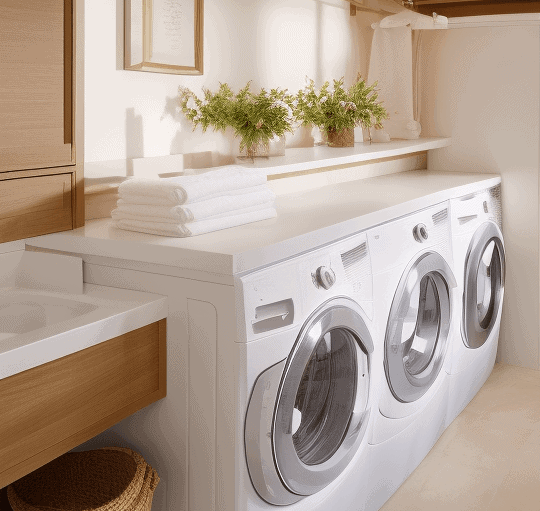
The best folding surface is close to the dryer. Ideally, you should be able to remove clothes and place them directly on the counter. This simple detail saves time and reduces piles. A counter above front-loading machines is a common solution, but it must be planned correctly. The counter should allow appliance access, ventilation, and service clearance. It should also be durable enough to handle baskets, detergent spills, damp clothing, and daily use.
Homeowners planning a dedicated folding zone should compare the best laundry room countertop options so the surface can handle baskets, damp clothing, detergent spills, and daily use.
In Desert Villas and Lehi, a laundry room that includes a folding counter can also serve as a household reset zone. You can sort school clothes, organize towels, prepare guest linens, or separate items by family member. When the surface is large enough, laundry becomes less of a scattered task and more of a controlled process.
Countertop material should be practical. Laundry rooms do not always need the same material as a kitchen, but the surface should resist moisture, stains, and wear. Laminate may be budget-friendly. Quartz can offer durability and a cleaner finished look. Wood can add warmth, but it needs the right finish and maintenance expectations. The choice should match how hard the surface will be used.
A folding counter should not become a dumping zone. This is where organization systems matter. If there is no nearby storage for supplies, the counter will collect bottles and baskets. If there is no hamper system, the counter may become a pile zone. If there are no labels or shelves, random items will land there permanently. The counter works best when it is supported by cabinets, shelves, bins, and defined categories.
For small laundry rooms, a fold-down counter may be a better option. This gives you a work surface when you need it and frees space when you do not. Another option is a pull-out folding shelf hidden inside cabinetry. These solutions are especially useful when a full counter would block circulation.

Factors To Consider When Choosing Laundry Room Organization Systems
Choosing laundry room organization systems should start with how you use the space, not with what looks attractive in a photo. A system that works beautifully for one homeowner may fail in your home if your laundry habits, storage needs, appliance layout, or family routine are different. Before selecting cabinets, shelves, counters, rods, or hampers, you need to understand what the room is expected to do every day.
Before selecting shelves, cabinets, counters, or hampers, homeowners should understand what comes first when remodeling a laundry room so storage decisions follow the right layout and workflow plan.
In Rancho Apache and Scottsdale Mountain, homeowners may have laundry spaces that need to handle larger household routines, guest linens, outdoor towels, pet supplies, or specialty clothing care. That kind of use requires more than a few shelves. It requires a system that separates clean from dirty, daily from occasional, visible from hidden, and lightweight from heavy.
Start with capacity. How many people use the laundry room? How often do you wash clothes? Do you wash bulky bedding? Do you air-dry clothing? Do you store cleaning supplies there? Do you need a utility sink? Do you want hidden hampers? Do you need space for ironing or steaming? These questions shape the storage plan.
Next, consider the room’s limitations. Door swings, appliance depth, plumbing locations, electrical outlets, dryer vents, windows, and walkways all influence what can be installed. A cabinet may look perfect on paper but fail if it blocks access to valves or makes the walkway too tight. Planning protects you from expensive corrections later.
Maintenance is another factor. Open shelves require more visual discipline. White cabinets may show scuffs. Dark surfaces may show lint and dust. Wire shelving may allow small items to fall through. Solid shelves may collect spills. A good system should be easy to clean and realistic to maintain.
You should also consider whether your laundry room should match the rest of your home. Some homeowners want the room to feel purely practical. Others want it to coordinate with kitchens, bathrooms, mudrooms, or hallway cabinetry. Neither approach is wrong, but the decision should be intentional.
Cost
Cost is one of the most important factors when choosing laundry room organization systems because the range can vary widely. A basic system with wall shelves, bins, hooks, and a simple rod can be relatively modest. A more advanced system with custom cabinetry, stone counters, built-in hampers, a utility sink, tall storage, specialty drawers, and upgraded finishes will require a larger investment.
The mistake many homeowners make is focusing only on the upfront cost. Cheap storage can become expensive if it fails, sags, wastes space, or needs to be replaced quickly. A flimsy shelf that cannot hold detergent, a cabinet layout that blocks access, or a counter that stains easily can create long-term frustration. The better question is not simply what costs less. The better question is what solves the problem properly.
Homes in Cactus Corridor and Cantabria may have different laundry room expectations depending on layout, finishes, and how integrated the space is with the rest of the home. A laundry room tucked behind a closed utility door may not need the same finish level as one connected to a visible hallway or mudroom. Cost should match both function and exposure.
Labor also affects cost. Installing a few shelves is different from building custom cabinets, relocating plumbing, adding lighting, changing flooring, or adjusting electrical. If your laundry room remodel includes new appliances, countertops, a sink, backsplash, or improved ventilation, organization becomes part of a larger remodeling scope. That is why planning matters before construction begins.
Understanding laundry room remodel cost helps homeowners prioritize built-in storage, countertops, cabinetry, lighting, and layout improvements before finalizing the organization system.
Budget should also include accessories. Baskets, bins, drawer dividers, labels, hanging systems, hamper inserts, and organizers are not afterthoughts. They are part of the system. A beautiful cabinet without internal organization can still become messy. A shelf without the right containers can still look cluttered.
A practical approach is to decide where custom work matters most. You may not need custom everything. You might invest in built-in cabinets and a durable counter, then use simple baskets and adjustable shelves inside. Or you might keep existing cabinets and upgrade the interior organization. The best cost strategy is focused, not random.
Style
Style matters because a laundry room is still part of your home. Even when the room is primarily functional, it should feel intentional. A well-designed laundry space can make routine chores feel less unpleasant because the room is easier to use and more pleasant to enter. The goal is not to make the laundry room overly decorative. The goal is to make it clean, cohesive, and aligned with the rest of the home.
In Allen Ranch and Los Tesoros, homeowners may prefer laundry rooms that feel refined but not fussy. This can be achieved through cabinet color, hardware, counter material, backsplash, lighting, flooring, and storage containers. Even simple choices, like matching baskets or choosing consistent metal finishes, can make the room feel more organized.
Your style choice should also support maintenance. A bright white laundry room can look fresh, but it may show scuffs, dust, and detergent marks more quickly. Dark cabinetry can feel dramatic, but it may show lint. Open shelving can look warm and airy, but it requires consistent organization. Closed cabinets create a cleaner appearance, but they need good internal storage.
The style should also match the level of use. A laundry room used by a busy family needs durable finishes more than delicate details. A room that handles pet items, sports uniforms, cleaning supplies, and muddy clothes should not rely on fragile materials. A beautiful room that cannot handle real life is not a successful room.
Color can influence how organized the space feels. Lighter colors often make small laundry rooms feel more open. Warm wood tones can soften a utility space. Neutral cabinets can create a timeless look. A patterned floor or backsplash can add personality, but too many competing elements may make the room feel busier than it is.
Hardware and fixtures should be easy to use. Small knobs may look nice but can be annoying when your hands are full. Pulls are often easier for drawers and tall cabinets. If you use the room daily, function should guide style decisions.

Durability
Durability is critical in a laundry room because the space deals with moisture, heat, vibration, chemicals, heavy containers, and repeated use. Laundry room organization systems need to hold up to detergent spills, damp clothing, cleaning products, appliance movement, and constant opening and closing. A system that looks good for a few months but wears down quickly is not a good investment.
Durable shelving should be strong enough to hold bulk detergent, cleaning supplies, baskets, and folded linens without sagging. Cabinets should be properly installed and made from materials suited for a utility environment. Countertops should resist moisture and staining. Hardware should feel solid. Rods should support wet clothing without bending.
Moisture resistance is especially important. Even when a laundry room does not feel wet, humidity and occasional spills are part of the space. Materials that are not properly sealed or suited for utility use may warp, swell, stain, or peel. This is one reason planning your laundry room organization systems during a remodel is better than adding random storage later.
Durability also includes layout. If a cabinet door constantly hits the washer, if a drawer cannot open fully, or if a hamper blocks the walkway, the system will wear poorly because it is fighting the room. A durable design is not only about materials. It is about clearances, access, and daily usability.
Ease Of Installation
Ease of installation matters because a laundry room organization system should improve the room without creating unnecessary complications. Some storage updates are simple, such as adding labeled bins, open shelves, wall hooks, or a hanging rod. Other updates require more planning, especially if you want built-in cabinetry, a utility sink, lighting upgrades, appliance relocation, or custom pull-out storage. The more permanent the system, the more carefully it should be measured, designed, and installed.
For Phoenix homeowners, installation should begin with accurate measurements of the full room, not just the open wall space. You need to account for washer and dryer depth, door swings, appliance hookups, dryer vent locations, plumbing valves, electrical outlets, baseboards, flooring transitions, and the space needed to move comfortably while carrying baskets. A shelf that looks like it fits may still create problems if it blocks access to shutoff valves or makes the walkway feel tight.
Homes in Stratland Estates and Val Vista Meadows may have laundry rooms that serve more than one purpose, such as a utility room, hallway transition, pet care area, or storage zone for cleaning products. In those situations, installation should not focus only on adding shelves. You need a system that respects the room’s traffic pattern. A cabinet door that opens into the walkway or a hamper that blocks the garage entry will become frustrating quickly, even if the storage itself looks attractive.
Wall-mounted systems also need proper support. Laundry supplies can be heavier than they appear, especially large detergent containers, bulk cleaning products, folded towels, and baskets filled with linens. Installing shelves into drywall without proper anchoring can lead to sagging or failure. If the wall has plumbing or electrical behind it, placement becomes even more important. Good installation protects the room, your belongings, and the long-term stability of the system.
The easiest systems to install are usually modular shelves, freestanding cabinets, over-the-appliance organizers, hooks, rods, and baskets. These can work well when your laundry room already has a functional layout and only needs better order. The tradeoff is that freestanding products may not maximize every inch, and they can make the room feel less finished if the pieces do not match.
Built-in laundry room organization systems take more effort, but they can deliver a better result when the room needs a permanent upgrade. Custom or semi-custom cabinets can fit around appliances, hide supplies, create dedicated hamper storage, support a folding counter, and make the room feel intentional. The installation may be more involved, but the finished space is often easier to maintain because every feature has a purpose.
Homeowners planning built-in cabinets, counters, hampers, or specialty storage should also understand how long a laundry room remodel takes so the organization system is coordinated with the full project timeline.
Flexibility
Flexibility is one of the most valuable qualities in a laundry room organization system because household routines change over time. A room that works today may need to support different needs in a few years. Kids get older, clothing types change, guests visit, pets create extra laundry, hobbies require storage, and household supplies shift. A rigid system can become outdated quickly if it was designed around only one narrow routine.
Flexible storage starts with adjustable shelving. Fixed shelves can work, but adjustable shelves allow you to change the height when detergent bottles, baskets, bins, or folded linens no longer fit the way they used to. This is especially helpful in Phoenix homes where the laundry room may also store seasonal items, pool towels, cleaning supplies, or household overflow. Adjustable shelves give you the ability to refine the system without starting over.
Laundry rooms in Ocotillo Lakes and Vasaro may benefit from flexible zones that can shift between daily laundry, guest linens, and cleaning supply storage. A pull-out hamper may hold everyday clothing most of the year, then temporarily support towels or bedding when guests are staying over. A folding counter may function as a laundry surface during the week and a staging area for household organization on weekends. When the room has flexible surfaces and movable containers, it can handle these changes without becoming cluttered.
Modular storage is another practical option. Modular systems let you add, remove, or rearrange components as needs change. This can include stackable bins, removable baskets, adjustable rods, rolling carts, and cabinet inserts. The advantage is control. You can start with the essentials, then add more organization only when you know what the room actually needs.
Flexibility also applies to visibility. Some items should be hidden because they create visual clutter, such as bleach, stain removers, cleaning sprays, extra rags, and appliance manuals. Other items should stay visible because you use them constantly. A flexible system gives you both closed and open storage. This prevents the room from feeling too exposed while still keeping daily essentials easy to reach.
A strong laundry room should not depend on perfection. If the system only works when every bottle is lined up and every towel is folded a certain way, it will fail during busy weeks. Flexible organization gives you room to live. It creates structure without making the space feel fragile.

Tips For Implementing Laundry Room Organization Systems
Implementing laundry room organization systems works best when you start with habits, not products. Buying bins, baskets, shelves, or cabinets too early can lead to a room full of storage that does not solve the real problem. The better approach is to study how laundry actually moves through space. Dirty clothes come in, supplies are used, clothing moves from washer to dryer, some items are hung, some are folded, some are returned to closets, and some are stored for later. The system should support each of those steps.
A practical implementation process begins with decluttering. Remove expired products, duplicate cleaning supplies, empty containers, damaged baskets, unused tools, and items that belong elsewhere. This step creates a clearer picture of what the room truly needs to hold. It also prevents you from designing storage around clutter that should not remain in the room.
Homes in Montelena and Nauvoo Station may have laundry rooms with enough space for multiple functions, but extra space can still become messy if every item is treated the same. Separate the room into categories. Daily laundry supplies should be near the washer. Folding supplies, lint rollers, and mesh bags should be near the counter or dryer. Cleaning tools should have a separate wall or cabinet. Bulk items should be stored higher or farther away from the main work zone.
After categories are clear, choose storage based on access. The most frequently used items should be at the easiest height. Heavy items should not be stored too high. Products used only occasionally can go in upper cabinets or less accessible shelves. If children or pets are in the home, chemicals should be stored in a safer closed area.
Implementation also requires consistency. Labels, matching bins, drawer dividers, and dedicated baskets help everyone understand where things belong. A system that only one person understands is not a true system. The goal is to make the right action obvious, so laundry supplies return to their place without constant reminders.
Maximizing Vertical Space
Maximizing vertical space is one of the best ways to improve a laundry room without expanding the footprint. Many laundry rooms have unused wall space above appliances, beside doors, over counters, or near utility sinks. When that vertical space is planned well, the room can hold more while feeling less crowded.
Vertical storage can include upper cabinets, floating shelves, wall-mounted baskets, peg rails, tall cabinets, hooks, rods, drying racks, and narrow pull-out towers. The right choice depends on what you need to store and how often you need it. Cabinets create a cleaner look and hide clutter. Open shelves make daily items easy to grab. Hooks and racks keep tools and garments off the floor. Tall cabinets are helpful for awkward items such as mops, brooms, ironing boards, vacuums, and step stools.
Laundry rooms in Desert Highlands and Encanterra can benefit from vertical storage when floor space is needed for movement, appliances, or hampers. A room may feel small not because it lacks storage, but because too much storage is sitting on the floor. Moving supplies upward clears the walkway and makes the room easier to use.
The area above the washer and dryer is often the first place to consider. For front-loading machines, a counter can create a folding surface, while cabinets or shelves above can hold supplies. For top-loading machines, the design must leave enough clearance for the lid to open comfortably. This is a detail that should never be guessed. Measure the lid height, the appliance depth, and your reach before placing anything above the machines.
A thoughtful laundry room floor plan helps homeowners decide where vertical storage, appliance clearance, folding surfaces, hampers, and walking space should work together.
Vertical space should also be organized by weight. Store lighter items higher, such as paper products, extra towels, dryer sheets, or seasonal supplies. Keep heavy detergent and liquid cleaners at a lower, safer height. This reduces strain and lowers the risk of spills or falling containers.
A tall cabinet can be one of the most useful vertical features in the room. It can hide brooms, mops, a vacuum, cleaning supplies, and even a foldable drying rack. Without a tall cabinet, these items often lean in corners and make the room feel unfinished. With one, the space feels cleaner and more controlled.
Vertical organization should still leave breathing room. Filling every inch of wall space can make a laundry room feel heavy and cramped. The best designs balance storage with open areas so the room feels useful without feeling packed.
Grouping Similar Items Together
Grouping similar items together makes a laundry room easier to use because it removes guesswork. When detergent, stain treatments, dryer supplies, cleaning cloths, hampers, hangers, and utility products each have a clear home, the room becomes easier to maintain. The system does not depend on constant tidying because the categories guide the cleanup.
Start by creating a laundry supply zone. This area should hold detergent, fabric softener, stain remover, bleach, oxygen cleaner, scent boosters, dryer sheets, wool dryer balls, mesh wash bags, and garment care items. Keeping these products together prevents the common problem of having detergent in one cabinet, stain spray on the counter, and dryer sheets in a random basket.
Homes in Silverleaf and DC Ranch may have laundry rooms that support clothing care beyond basic washing and drying. If you handle delicate fabrics, athletic wear, business clothing, or linens, grouping becomes even more important. You may need one basket for delicate wash items, one drawer for mesh bags and specialty cleaners, and one hanging section for air-dry garments. This prevents specialty items from being mixed into general supplies.
Cleaning products should have their own category. If the laundry room stores all-purpose spray, disinfectant, microfiber cloths, gloves, sponges, dusters, and refill products, keep them separate from laundry supplies. Mixing categories makes shelves harder to maintain and increases the chance of grabbing the wrong product in a hurry.
Linens and household textiles should also be grouped carefully. If your laundry room stores towels, guest sheets, pet towels, or cleaning rags, separate them clearly. Clean towels should not share a bin with utility rags. Pet supplies should not be mixed into guest linens. Simple separation keeps the room more sanitary and easier to navigate.
Grouping works best when containers match the category size. Small bins work for dryer balls, lint rollers, and clothespins. Larger baskets work for towels and linens. Narrow trays work for bottles. Drawer dividers work for small tools and laundry accessories. The goal is to match the container to the category, not force every item into identical bins that may not fit the contents well.

Making Use Of Empty Wall Space
Empty wall space can become some of the most valuable storage in a laundry room. Walls often go unused because homeowners focus on cabinets and counters first. The right wall-mounted features can reduce floor clutter, improve access, and create dedicated storage for items that are hard to place elsewhere.
Wall space near the washer can hold a narrow shelf for detergent, stain remover, and daily-use supplies. Wall space near the dryer can hold lint brushes, dryer balls, hangers, or a small rack for items that need attention after drying. A wall near the door can hold hooks for bags, cleaning tools, or frequently used items. Even a narrow wall can support a slim organizer if the placement is planned carefully.
Laundry rooms serving Arcadia and Biltmore homes may be visible from hallways, kitchens, or garage entries, so wall storage should be both useful and attractive. A random assortment of hooks can make the room look busy. A planned row of hooks, a matching shelf, or a cabinet-backed hanging area can give the same function with a cleaner appearance.
Wall-mounted drying racks are especially useful when the room does not have space for a freestanding rack. Fold-down racks can open when needed and sit flat against the wall when not in use. Retractable clotheslines can work in certain layouts, but they should be placed where damp clothes will not block cabinets, doors, or appliance access.
Pegboards can also work well, but they should be used with restraint. A pegboard filled with too many items can look cluttered. It is better for tools, brushes, small baskets, or utility accessories than for every laundry supply in the room. If you prefer a refined look, a rail system with hooks may feel cleaner than a full pegboard.
Wall space should never interfere with safety or maintenance. Do not block electrical panels, appliance connections, vents, shutoff valves, or access points. Organization should make the room better, not make service harder.
Installing Hooks And Hangers
Hooks and hangers are simple features, but they can dramatically improve a laundry room when they are installed in the right places. They keep items off the floor, create temporary holding spots, and support the natural flow of laundry. Without hooks, items like hangers, cleaning tools, bags, and damp garments often land on counters, doorknobs, or appliance tops.
Hooks work well for mops, brooms, dusters, reusable bags, ironing accessories, pet leashes, cleaning cloths, and laundry bags. They can also support a quick drop zone for items that need to be carried to bedrooms or closets. Hangers are useful for shirts, dresses, uniforms, delicate items, and anything that should not wrinkle in a basket.
Homes in Desert Villas and Lehi may benefit from a combination of sturdy hooks and a dedicated hanging rod. Hooks are best for small or irregular items. A rod is better for multiple garments. If you often hang clothes straight from the dryer, a rod near the folding counter can save time and reduce wrinkles. If you air-dry clothing, the rod should have enough clearance and ventilation.
Installation height is important. Hooks placed too high become inconvenient. Hooks placed too low can interfere with counters or appliances. A good placement keeps items easy to reach while preventing them from dragging on the floor or blocking movement. For cleaning tools, hooks should be high enough to hold the handle securely and keep the tool head off the floor.
Hardware strength matters as well. A decorative hook may not hold a heavy laundry bag or wet garment. Choose hooks based on what they will carry, not just how they look. Anchoring is also important. Hooks installed into studs or with proper anchors will perform better over time.
Hangers should also have a designated place when not in use. Loose hangers quickly become messy. A small hanging bar, wall hook, drawer, or basket can keep empty hangers contained until they are needed. This small detail makes the whole room feel more controlled.
Storage Details That Keep The Room Easy To Maintain
Maintenance should be considered before the laundry room organization system is installed. A room can look organized on the first day, but the real test is whether it stays that way during normal use. Easy maintenance comes from clear categories, accessible storage, durable surfaces, and realistic expectations.
Laundry rooms in Cactus Corridor and Cantabria can stay easier to manage when storage is designed around repetition. Most laundry tasks happen again and again, so the room should support the same movements every time. Detergent should return to the same place. Empty hangers should have a home. Dirty clothes should go into the correct hamper. Clean folded items should have a landing zone before they leave the room.
One useful detail is a built-in trash area. Laundry rooms generate lint, dryer sheets, tags, pocket debris, empty containers, and small packaging waste. Without a trash pull-out or small bin, these items often collect on counters. A hidden trash area keeps the room cleaner with almost no effort.
Another helpful detail is a lost-and-found container. Coins, receipts, buttons, small toys, hair ties, and other pocket items need a temporary place to land. Without a small tray or drawer, these pieces scatter. A small container keeps them from taking over the counter.
Maintenance also depends on limiting overflow. If every shelf and cabinet is full from the start, the room has no room to breathe. Leave some open space for future supplies, seasonal changes, or temporary laundry loads. A system packed to capacity will become messy faster than one with a little extra room.
Common Laundry Room Organization Mistakes To Avoid
Common laundry room organization mistakes usually come from choosing storage before understanding the room. Adding shelves, baskets, or cabinets may feel productive, but storage that does not match your habits only hides the problem temporarily. A better system starts with workflow, then adds storage to support it.
A frequent mistake is storing too many bulk products in the laundry room. Buying in bulk can be practical, but not every extra container needs to occupy prime space. Daily-use supplies should be easy to reach. Overstock can go higher, farther back, or in a secondary storage area if the laundry room is tight.
Homes in Allen Ranch and Los Tesoros can avoid clutter by separating display storage from utility storage. Open shelves are best for attractive baskets, folded towels, or supplies that look consistent. Closed cabinets are better for chemicals, mismatched containers, refills, and tools. When everything is displayed, the room can feel busy even if it is technically organized.
Another mistake is ignoring the folding zone. Many laundry rooms have storage but no real work surface. Without a folding counter, clean clothes often leave the room and create clutter elsewhere. Even a small counter, pull-out shelf, or fold-down surface can improve the process.
Poor hamper planning is another issue. One general hamper may not be enough for a busy household. Separate hampers for lights, darks, towels, delicates, or family members can make laundry easier to process. Built-in hampers can keep the room cleaner, but they must be easy to remove and carry.
A final mistake is blocking access. Never let organization interfere with appliance service, shutoff valves, vents, or electrical outlets. A laundry room should be beautiful and orderly, but it still needs to function as a utility space.

Conclusion
Proper laundry room organization systems help you create a room that is cleaner, easier to use, and better suited to your daily routine. The right system does more than store supplies. It improves movement through the room, reduces clutter, protects surfaces, creates useful zones, and helps laundry feel less scattered. When shelves, cabinets, drawers, rods, hooks, hampers, and counters all work together, the room becomes easier to maintain.
Phoenix homeowners should think about laundry organization as part of the full remodeling plan, not as a last-minute accessory. The best results come from understanding how you wash, dry, fold, hang, sort, and store items before choosing the system. A well-planned room can support daily laundry, guest linens, cleaning supplies, pet items, delicate clothing, and household overflow without becoming chaotic.
Homes in Rancho Apache and Scottsdale Mountain may need organization systems that feel polished while still handling real daily use. That balance matters. A laundry room should look finished, but it should also hold up to moisture, heavy products, frequent movement, and changing household needs. Durable materials, smart placement, flexible storage, and clear categories make that possible.
A design-build team such as Phoenix Home Remodeling can help turn a frustrating laundry space into a more organized, practical, and comfortable part of your home. With the right plan, your laundry room can stop feeling like a cluttered utility area and start working as a dependable space that supports the way you actually live.
Proper laundry room organization systems help you create a room that is cleaner, easier to use, and better suited to your daily routine. The right system does more than store supplies. It improves movement through the room, reduces clutter, protects surfaces, creates useful zones, and helps laundry feel less scattered. When shelves, cabinets, drawers, rods, hooks, hampers, and counters all work together, the room becomes easier to maintain.
FAQs About Laundry Room Organization Systems In Phoenix
What is the best laundry room organization system for a Phoenix home?
The best laundry room organization system is the one that matches your laundry routine, appliance layout, storage needs, and available space instead of relying on generic shelves or baskets that only hide clutter temporarily. A strong system usually includes a mix of cabinets, drawers, open shelves, pull-out hampers, a folding surface, hanging space, wall hooks, and labeled containers. The goal is to create a room where dirty clothes, clean clothes, detergents, cleaning supplies, linens, and hang-dry items all have a clear place to go.
For many Phoenix homes, the best system starts with zoning. You need one area for washing supplies, one area for folding, one area for hanging, one area for hampers, and one area for utility storage. Without these zones, even a large laundry room can feel messy because every item competes for the same counter or shelf. A well-planned room reduces extra steps, keeps counters clear, and makes laundry easier to maintain during busy weeks.
Homeowners in communities like Stratland Estates and Val Vista Meadows often benefit from built-in storage because it creates a more finished look while still supporting daily use. Upper cabinets can hide detergent and cleaning products, lower drawers can hold laundry accessories, and a dedicated rod can support delicate garments or freshly dried clothing. The best system is not always the most expensive one. It is the one that solves the specific problems in your space, whether that means better vertical storage, closed cabinetry, a stronger folding zone, or hidden hampers that keep clothing off the floor.
How do you keep a laundry room organized long term?
You keep a laundry room organized long term by making the system easy to follow, easy to reset, and realistic for the way your household actually uses the space. A laundry room that only looks good right after cleaning will not stay organized if the storage is hard to reach, poorly labeled, too small, or placed in the wrong location. Long-term organization depends on clear categories and simple routines.
Start by limiting what belongs in the laundry room. Detergent, dryer supplies, stain removers, hampers, cleaning cloths, hangers, and laundry bags make sense. Random household overflow should only stay there if the room has proper cabinet or shelf space for it. When the laundry room becomes a dumping ground for unrelated items, the organization system breaks down quickly.
Homes around Ocotillo Lakes and Vasaro may use laundry rooms as transition spaces from a garage, hallway, or outdoor area, so long-term organization may require more than laundry storage. Hooks for bags, cabinets for shoes or cleaning products, and tall storage for brooms or mops can help prevent the room from becoming cluttered. The key is to give every recurring item a permanent place. If something enters the room every week, it needs a home. If it does not have one, it will end up on the counter, the washer, the dryer, or the floor.
Long-term maintenance also improves when you leave empty space. A laundry room packed to the edge will fail because there is no room for temporary piles, new supplies, or seasonal changes. A little breathing room inside cabinets and baskets makes the system easier to keep clean.
Are cabinets or open shelves better for laundry room organization systems?
Cabinets are better when you want a cleaner, more finished look, while open shelves are better when you want quick access to frequently used items, so the strongest laundry room organization systems often use both. Open shelves can make a small room feel lighter and more accessible, but they also expose every bottle, basket, and container. Cabinets hide clutter, but they can become messy inside if there are no dividers, bins, or pull-out features.
For a Phoenix laundry room, the right choice depends on visibility and discipline. If the laundry room connects to a hallway, kitchen, mudroom, or guest-facing area, closed cabinets often make more sense because they create a cleaner appearance. If the room is tucked away and used mostly for utility tasks, open shelves may be practical, especially above a washer and dryer or near a folding counter.
Homeowners in Montelena and Nauvoo Station may prefer a balanced approach. You can use closed cabinets for bleach, refills, cleaning sprays, and mismatched containers, then use open shelves for attractive baskets, folded towels, or everyday supplies stored in matching bins. This keeps the room from feeling sterile while still controlling visual clutter.
Cabinets also work better for safety when children or pets are in the home because chemicals can be stored out of sight and out of reach. Open shelves work better for items you grab constantly, such as detergent pods, dryer balls, lint rollers, or stain spray. The mistake is choosing based only on style. You need to decide which items should be visible, which should be hidden, and which should be easiest to reach.
How can a small laundry room have enough storage?
A small laundry room can have enough storage when you use vertical space, narrow wall areas, over-appliance surfaces, hooks, adjustable shelves, and compact built-in features instead of relying only on floor space. Small laundry rooms often feel cramped because the available wall space is underused. When everything sits on the floor or appliance tops, the room feels smaller than it really is.
The first move is to look above the washer and dryer. Front-loading machines may allow a countertop to create a folding surface, with cabinets or shelves above for supplies. Top-loading machines need open clearance, but they can still support wall-mounted cabinets or side shelving if the lid can open comfortably. A narrow shelf beside the appliances can hold detergent, stain remover, or dryer products without taking over the counter.
Laundry rooms serving Desert Highlands and Encanterra homes may also benefit from tall cabinets. A tall cabinet can hide brooms, mops, vacuums, ironing boards, and cleaning supplies in one vertical zone. This keeps awkward items from leaning against walls or blocking the doorway. Wall hooks can hold reusable bags, hangers, dusters, or laundry bags, while a fold-down drying rack can provide air-drying space without permanently occupying the room.
Small spaces also need stricter editing. You cannot store every bulk item in a compact laundry room and expect it to feel organized. Daily-use supplies should stay within easy reach, while overflow products can go in upper cabinets or another storage area. Small laundry room organization systems work best when they are selective. Every inch should have a purpose, and every item should justify the space it takes.
What should be stored in a laundry room?
A laundry room should store items that directly support washing, drying, folding, hanging, cleaning, and nearby household routines, while unrelated overflow should be removed unless the room has dedicated storage for it. The essentials usually include laundry detergent, stain removers, fabric care products, dryer sheets or dryer balls, mesh wash bags, hampers, hangers, lint rollers, cleaning cloths, and a small trash area for lint and pocket debris.
A laundry room can also store towels, linens, pet towels, paper products, cleaning sprays, gloves, sponges, and extra household supplies if the room has enough cabinets or shelves to keep those categories separate. Problems happen when everything is mixed together. Clean towels should not share space with utility rags. Laundry detergent should not be buried behind unrelated supplies. Cleaning chemicals should not sit loosely on a folding counter.
Homes in Silverleaf and DC Ranch may have laundry rooms that support more detailed garment care, such as air drying, steaming, stain treatment, or specialty fabric care. In those rooms, storage should include a place for delicate wash bags, hangers, garment brushes, and a rod for items that should not go into the dryer. This helps protect clothing and keeps the process organized.
It is also smart to include a small lost-and-found tray or drawer. Coins, receipts, buttons, hair ties, and small pocket items need a landing spot. Without one, these items collect on counters and make the room feel messy. The best storage plan separates daily-use items from occasional-use items, then gives each category a home that matches how often it is needed.
How important is a folding counter in a laundry room?
A folding counter is one of the most useful features in a laundry room because it gives clean clothes a dedicated landing area before they leave the room. Without a folding surface, clean laundry often moves to beds, sofas, kitchen islands, dining tables, or random counters. That spreads the task throughout the home and makes it easier for clean clothes to become clutter.
A good folding counter should be close to the dryer, durable enough for daily use, and large enough to handle at least one load of laundry comfortably. If the room has front-loading appliances, a counter over the washer and dryer can be very efficient. If the room has top-loading machines, a side counter, pull-out shelf, or fold-down surface may work better. The key is to place the surface where it supports the natural laundry flow.
Homes around Arcadia and Biltmore may also use the laundry counter as a sorting station for towels, guest linens, school clothes, or delicate garments. In that case, the counter should not be the only storage feature in the room. If detergent, baskets, and supplies have nowhere else to go, the folding surface will become a cluttered storage shelf instead of a work zone.
The counter material matters too. Laundry rooms deal with damp clothing, detergent spills, lint, baskets, and frequent movement. A surface that stains easily or cannot handle moisture may look worn too quickly. The folding counter should be practical first, attractive second. When designed correctly, it keeps laundry contained, reduces piles in other rooms, and makes the entire process feel more controlled.
How do pull-out hampers improve laundry room organization?
Pull-out hampers improve laundry room organization by keeping dirty clothes off the floor, separating laundry categories, and hiding visual clutter inside cabinetry. A hamper system is especially helpful when the laundry room handles more than one person’s clothing or more than one type of laundry. Instead of one overflowing basket, you can separate lights, darks, towels, delicates, uniforms, or household linens.
Built-in pull-out hampers can make the room look cleaner because laundry is concealed when the cabinet is closed. This is useful in Phoenix homes where the laundry room is visible from a hallway, mudroom, or garage entry. A cleaner visual line makes the room feel more finished and less chaotic, even when laundry is waiting to be washed.
Homes in Desert Villas and Lehi may benefit from removable hamper inserts. A pull-out hamper should not just look good. It should be easy to lift, carry, empty, and clean. If the hamper is difficult to remove, people may stop using it correctly. Ventilation also matters, especially for damp towels or athletic clothing. A hamper that traps moisture can create odor problems, so the design should match the type of laundry being stored.
Pull-out hampers are most effective when placed near the laundry entry point. If people naturally drop clothes near the door, the hamper should be convenient to that path. If the hamper is hidden in an awkward corner, clothing will still end up on the floor. The best hamper system works with human behavior, not against it.
How can laundry room organization systems help with cleaning supplies?
Laundry room organization systems can make cleaning supplies easier and safer to store by separating them from laundry products, placing them at the right height, and keeping chemicals in closed or clearly labeled areas. Many homeowners use the laundry room as a cleaning supply hub, but without a plan, sprays, cloths, refills, gloves, and sponges quickly crowd the shelves and counters.
The best approach is to create a dedicated cleaning zone. This might be a tall cabinet for brooms and mops, a drawer for microfiber cloths, a shelf for sprays and refills, and hooks for dusters or reusable bags. Laundry products should stay near the washer, while cleaning products should have their own area. Mixing the two categories makes the room harder to use and can create safety issues.
Homes near Rancho Apache and Scottsdale Mountain may have laundry rooms with enough space for larger utility storage. In those rooms, a tall cabinet can be especially useful because it hides long-handled tools and keeps the floor clear. Adjustable shelves inside the same cabinet can hold gloves, sponges, extra cleaning bottles, and paper products. This creates one organized cleaning station instead of scattering supplies throughout the room.
Safety should guide placement. Heavy liquid containers should not be stored too high. Harsh chemicals should not sit where children or pets can easily access them. Frequently used products should be visible enough that you do not buy duplicates because you forgot what you already have. A well-organized cleaning supply area saves space, reduces waste, and keeps the laundry room from feeling like a crowded utility closet.
What are the most common laundry room organization mistakes?
The most common laundry room organization mistakes are buying storage before planning the layout, ignoring the laundry workflow, using the counter as permanent storage, failing to separate categories, and blocking access to appliances or utility connections. These mistakes can make a room look organized briefly, but they usually create frustration later.
One of the biggest mistakes is assuming that more storage automatically solves the problem. More shelves can still become messy if there are no categories. More cabinets can still become cluttered if the inside is poorly planned. More baskets can still crowd the floor if there is no dedicated place for them. A good system starts with how laundry moves through the room, then storage is added to support that flow.
Homes in Cactus Corridor and Cantabria can avoid these issues by planning around clear zones. Detergent should be near the washer. Dryer products should be near the dryer. Folding space should stay open. Hampers should be easy to access. Cleaning products should be separate from laundry products. When the room is organized around tasks, the system becomes easier to maintain.
Another mistake is choosing open shelving without accepting the visual discipline it requires. Open shelves can look attractive, but only when containers are consistent and items are not overcrowded. Closed cabinets are more forgiving, but they still need bins, drawers, or dividers inside. Homeowners also sometimes forget service access. Organization should never block dryer vents, plumbing valves, electrical outlets, or appliance maintenance areas. A laundry room has to stay functional as a utility space.
Is a custom laundry room organization system worth it?
A custom laundry room organization system can be worth it when your current layout wastes space, creates clutter, lacks folding or hanging areas, or needs storage that standard products cannot provide. Custom storage is not necessary for every home, but it can be valuable when the room has awkward dimensions, visible clutter, limited floor space, or multiple functions.
Standard shelves and baskets may work well for simple laundry rooms. However, if you need pull-out hampers, tall broom storage, built-in cabinets, a durable folding counter, closed chemical storage, a utility sink, or a coordinated design, custom or semi-custom planning can produce a better result. The advantage is that the system is designed around your room rather than forcing your room to fit a store-bought product.
Homeowners in Allen Ranch and Los Tesoros may also value the finished look of custom cabinetry, especially when the laundry room connects to another living area. A custom system can match nearby finishes, improve storage efficiency, and make the space feel like part of the home rather than an afterthought. It can also help hide the less attractive parts of laundry, such as bulk detergent, cleaning chemicals, hampers, and utility tools.
The value depends on how much the laundry room affects your daily life. If the room constantly frustrates you, wastes time, or spreads clutter into other areas, a better organization system can make a noticeable difference. The smartest custom designs focus on function first. Style matters, but the real return comes from a room that is easier to use, easier to clean, and easier to keep organized.
Video of this post:
Audio Version of this post:
PDF version:
Why Homeowners Trust Phoenix Home Remodeling
Laundry room remodeling involves more complexity than most homeowners expect, particularly around plumbing routing, electrical requirements, and storage configurations. Getting those decisions resolved before construction starts is what separates a smooth project from a disruptive one. Phoenix Home Remodeling works through every detail during a structured planning phase before scheduling any work.
Rated Best Phoenix Home Remodeler by Trust Analytica
Positioned Among the Top Renovation Contractors in Phoenix by The Phoenix Review
Awarded Best of Houzz Service 2020, 2021, 2022, 2023, 2024, 2025, 2026
Rated 4.9 Stars Across 200+ Verified Public Reviews
Accredited by the Better Business Bureau with an A+ Rating
Member of the National Association of the Remodeling Industry (NARI)
Named a Top Contractor in Arizona by Ranking Arizona (2024)
Voted a Nextdoor Neighborhood Favorite (2022, 2023, 2024, 2025)
Founder authored Remodel Without Regret, an Amazon bestselling homeowner remodeling guide
Each laundry room project begins with a space planning review, fixture and storage selections, and finalized plumbing and electrical layout decisions before construction is scheduled. Utility routing, cabinetry configurations, and material choices are resolved during the planning phase so pricing can be confirmed before demolition begins. A dedicated project manager coordinates trade scheduling and daily oversight to keep the project moving efficiently from start to finish.
Homeowners who finalize layout, plumbing routing, and storage selections before the project begins typically experience cleaner installation sequencing and a finished space that functions exactly as planned.
Do you live in Phoenix, Scottsdale, Chandler, Gilbert, Mesa, Tempe, Sun Lakes, Ahwatukee, Laveen, or Queen Creek?
Ready to talk about your remodeling needs?
Take the next step...